One Piece card vending machines can give TCG retailers another way to sell sealed products without putting a cashier behind every transaction, but the machine only makes sense when the product mix, dispensing hardware and location work together. Booster packs are compact and easy to merchandise, starter decks can broaden the basket, and higher-value sealed products can raise the average purchase. The difficult part comes after the idea looks attractive: thin packs need dependable dispensing, popular releases need frequent replenishment, payment has to be almost frictionless, and the margin must still work after placement, processing and service costs. For a retailer considering a first machine, the sensible approach is to treat it as a small automated store, test the actual packages before production and prove one location before expanding.
Is a One Piece Card Vending Machine Worth It?
It can be. The strongest case is a retailer that already has dependable sealed-product supply and access to a site where card buyers naturally spend time. The machine then solves a real problem: it makes popular packs and boxed products available through a fast self-service checkout while keeping the merchandise secured inside the cabinet.
For a first installation, a configurable touchscreen machine with adjustable product lanes is usually the practical place to start. Elevator delivery becomes more interesting when premium sealed boxes make package condition worth paying extra to protect. The machine should be selected around the merchandise, not the other way around.
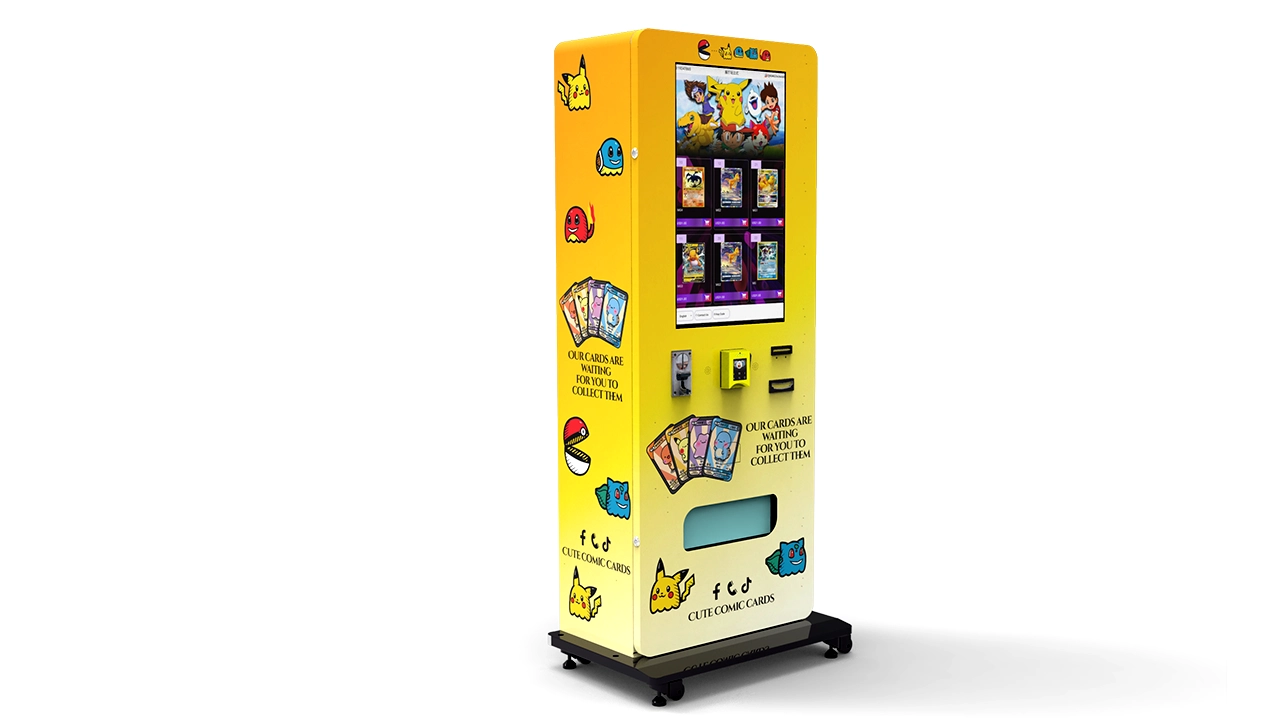
Do One Piece Card Vending Machines Make Sense for Card Retail?
The attraction is easy to understand. Trading cards concentrate a useful amount of retail value into very little physical space. A vending cabinet that would be unremarkable when filled with low-priced snacks can hold hundreds of sealed card products, each small enough to display digitally and restock without the logistics of bulky merchandise.
ONE PIECE CARD GAME also has the kind of product behavior that suits automated retail. Bandai Namco has described collectability as an important source of product value alongside playability. In a company feature on the card business, Bandai said approximately 1,800 different ONE PIECE cards had already been released at the time of publication.[1] That number has continued to grow as the product line has expanded.
The more important signal is that the game has not been treated as a short-lived launch. Bandai Namco's May 2026 financial presentation described continued strong popularity of ONE PIECE Card Game, while earlier 2026 financial material also highlighted ONE PIECE trading card games as performing well.[2] For a retailer evaluating hardware expected to remain in service for years, continued publisher commitment matters more than a temporary spike in resale prices.
None of that guarantees machine sales. A popular TCG can still perform poorly in a weak location. A desirable booster cannot make up for repeated failed vends. A cabinet filled with expensive stock can still produce disappointing cash flow if the merchandise turns slowly. What the category does provide is a credible reason to test automated retail rather than starting with a product people rarely buy more than once.
Why Cards Fit a Small Automated Store
Several features of sealed TCG products are useful in vending. They are compact, recognizable, easy to photograph, comparatively simple to price and purchased repeatedly. New releases also give the assortment a natural refresh cycle. A machine can look different to a regular customer from one month to the next even though the cabinet itself has not moved.
The touchscreen becomes part of that advantage. It can move a new booster product to the front of the menu, reduce the visibility of slower inventory, show sold-out status and change prices without printing new shelf labels. A retailer can keep the physical cargo layout relatively stable while changing the digital storefront as the assortment evolves.
Cards do bring one important complication: the package can matter almost as much as the contents. A crushed corner on a sealed collectible box is not comparable to a dent in an ordinary disposable package. The more value a customer attaches to sealed condition, the more attention the vending system has to give to product movement.
A Machine Extends a Card Business; It Does Not Replace One
Specialist card shops do things a machine cannot. They host play, answer deck questions, sell singles, handle trade-ins, build community and give customers a reason to remain in the store. Automated vending is better suited to transactions that do not need that interaction: a buyer already knows which booster, deck or sealed item is wanted and simply wants to buy it.
That distinction opens several useful roles. A vending machine can work as an express sealed-product counter, a secondary sales point away from the main register, or a stand-alone extension of an existing card business. It can also keep a carefully selected assortment available during hours when staffing a full counter would make little financial sense.
I would not measure success by asking whether the machine replaces an employee. A better question is whether it creates additional transactions, extends useful selling time, reduces friction on simple purchases or puts inventory in a location that could not justify a conventional store.
What One Piece Products Work in a Vending Machine?
"Trading cards" sounds like one merchandise category, but the machine sees packaging rather than fandom. A thin foil booster, a rigid starter deck and a sealed display box are three different mechanical products. Each asks something different from the cargo lane.
The official ONE PIECE CARD GAME catalog includes boosters, decks and other packaged products, and that assortment changes as new releases are introduced.[3] Before deciding how many selections a machine needs, list the actual formats expected to occupy it. The dimensions and sales velocity of those formats are more useful than a vague plan to "sell One Piece cards."
Individual Booster Packs
Booster packs are the obvious traffic product. They occupy little space, keep the entry price relatively low and are familiar to experienced buyers. They also let a new customer try the machine without committing to a large purchase.
Mechanically, they deserve more attention than their size suggests. Thin flexible packaging can slide, lean, overlap or rotate in a lane that was designed around thicker products. A spiral that is slightly too wide can allow a pack to shift. A channel that is too tight can increase friction. The last two products in a lane may behave differently from a lane filled to capacity.
This is one reason Zhongda Smart's card-machine guidance emphasizes package dimensions before finalizing the cargo layout. A machine may have a published maximum capacity, but usable booster capacity depends on package thickness, lane width, spiral pitch, separators and the amount of internal space taken by other merchandise.
Sleeved or Secondary-Packaged Boosters
Some operators choose a rigid secondary package for merchandise that is otherwise difficult to dispense consistently. That can make the outer dimensions more predictable and give a thin pack additional protection. It also creates extra material cost and packing labor, so it should solve a real mechanical problem rather than becoming an unnecessary step.
Any secondary packaging needs accurate product description and must not misrepresent the condition, quantity or origin of the sealed merchandise. The customer should always understand exactly what will be delivered.
Starter Decks
Starter decks can make a vending assortment more useful than a wall of random boosters. They give newer players a more complete entry product and create a different price point without taking the space of a large display box.
Rigid deck packaging is often easier to control mechanically than a loose foil pack, although dimensions still need to be checked. Wider starter products may reduce the number of available lanes, and that tradeoff should be reflected in the capacity plan before the machine is ordered.
Sealed Booster Boxes and Premium Products
Boxes can increase transaction value quickly, but the economics and engineering change with them. One vend can now represent much more inventory value. The product occupies more space, and visible corner damage may matter to the buyer.
Standard drop delivery may still be acceptable for some boxed merchandise when the packaging and internal machine geometry are suitable. Premium assortments deserve a closer look at controlled delivery. An elevator mechanism receives the product closer to its shelf position and carries it toward the pickup area, reducing the long free fall used in a conventional drop cabinet.
Elevator delivery is not automatically "better." It adds hardware and cost. For a machine filled mostly with inexpensive booster packs, the additional mechanism may produce little commercial value. For a cabinet carrying premium sealed boxes, the calculation can look very different.
Accessories Can Stabilize the Assortment
Card sleeves, deck boxes and compatible compact accessories can fill selected positions when their dimensions fit the machine. They can also give the retailer something to sell when a hot sealed release is temporarily unavailable.
The important word is selected. A vending cabinet should not become a place to dump slow inventory. Every lane consumes physical space and working capital. A product that rarely moves should have a clear reason to remain in the machine.
| Product Format | Main Vending Concern | What to Check Before Loading | Likely Priority |
|---|---|---|---|
| Individual booster pack | Thin package can shift, overlap or double-vend | Lane width, spiral pitch, support and repeated vend consistency | Vend accuracy |
| Secondary-packaged booster | Extra packaging adds cost and thickness | Whether the added rigidity meaningfully improves dispensing | Consistency |
| Starter deck | Wider rigid package can use more lane space | Width, depth, lane allocation and delivery clearance | Flexible lane sizing |
| Sealed booster box | Higher value and visible packaging condition | Drop distance, pickup opening and product protection | Controlled handling |
| Accessories | Different package shapes | Geometry, price point and sell-through | Assortment flexibility |
A Better Starting Assortment Than "Fill Every Slot"
A first machine needs enough variety to be useful without spreading inventory too thin. A practical starting mix might give the largest share of capacity to current sealed products, a smaller share to reliable older items, some space to decks and premium boxes, and a modest test allocation for accessories or new formats.
| Assortment Role | Illustrative Share of Selling Positions | Reason for the Space |
|---|---|---|
| Current fast-moving sealed products | 35–45% | Capture repeat demand and reduce immediate stockouts |
| Reliable ongoing sellers | 20–25% | Keep useful inventory available between releases |
| Starter products | 10–15% | Serve buyers who want more than random boosters |
| Premium sealed products | 10–15% | Create higher-value purchase options |
| Accessories and test SKUs | 5–15% | Learn what earns additional lane space |
The percentages above are an assortment-planning example, not reported sales data. Actual allocation should be based on supply, margin, package dimensions and machine-level sell-through.
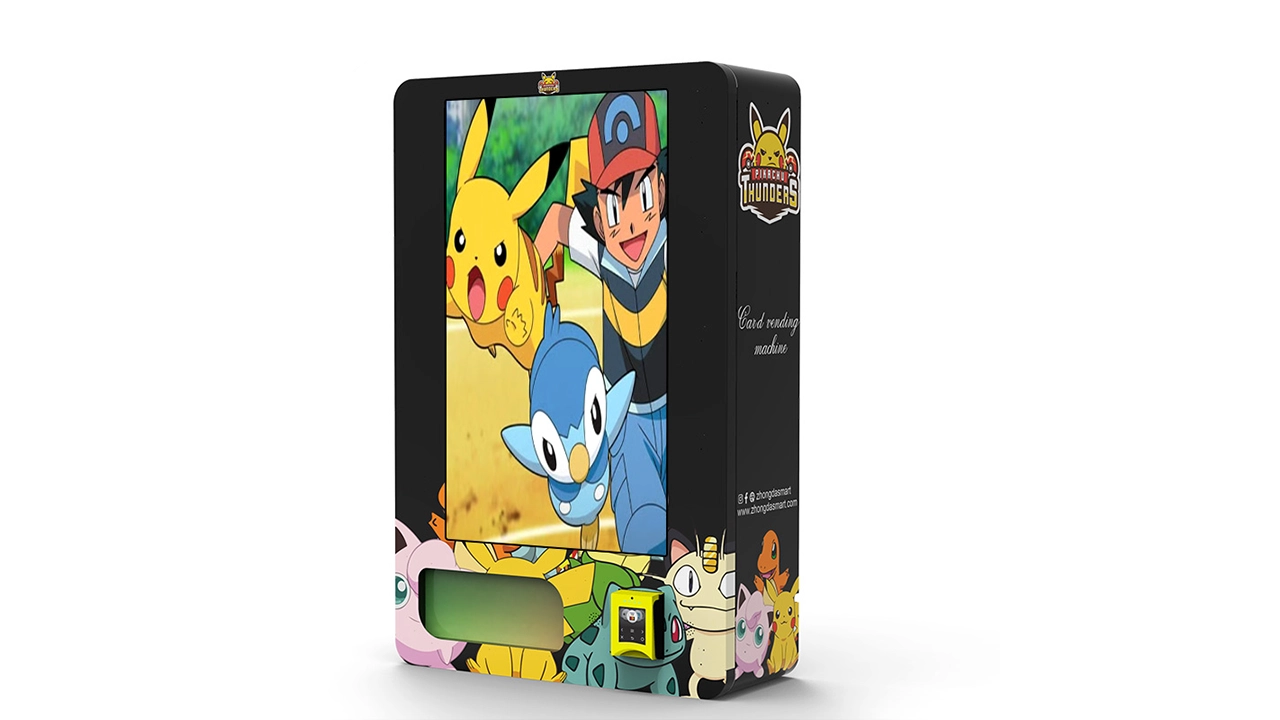
Choosing the Right Machine and Dispensing System
The product list should exist before the final machine configuration. Start with package width, height, depth, approximate weight and retail value. Add the number of SKUs that need to be available at once and the quantity each SKU should hold between restocking visits.
That requirement sheet makes machine comparison much easier. A 32-inch screen can be useful, but it cannot rescue the wrong lane design. Sixty published lanes sound attractive, but they are not useful if half the planned merchandise needs double-width positions. A large theoretical capacity can disappear quickly when boxed products are added.
Spring Dispensing Works When the Product Matches the Spring
Spring spirals remain a practical vending mechanism because they are simple, economical and adjustable. For compatible booster products, a properly sized spiral can provide a straightforward solution without the cost and complexity of an elevator.
The words "properly sized" carry most of the responsibility. Thin merchandise needs enough support that it cannot slip through or rotate, while the spiral needs enough clearance to advance without pinching the package. Lane dividers also need to keep neighboring products from interfering with one another.
Testing should include more than one successful vend from a freshly loaded lane. The product should be dispensed repeatedly from different positions in the lane. The final few items deserve special attention because the geometry and pressure can change as inventory runs down.
Elevator Delivery Is a Product-Protection Decision
An elevator or lift system changes the route between shelf and pickup area. Instead of allowing the item to fall most of the height of the cabinet, the lift moves to the selected shelf, receives the product and carries it toward the customer.
The commercial argument is strongest when the merchandise has enough value to justify the additional hardware. A premium sealed box that customers expect to receive with clean corners may justify a gentler path. A low-cost booster that already dispenses safely from a spring lane probably does not.
If I were choosing a booster-heavy first machine, I would spend the budget on dependable product lanes, payment integration and remote management before automatically adding elevator delivery. For a box-heavy premium assortment, the elevator belongs much higher on the list.
Vend Confirmation Matters More Than It Sounds
Payment and delivery are separate events. The customer can successfully pay while a product remains hanging in a cargo lane. A sensible machine design therefore needs a way to identify whether the intended delivery was completed or whether intervention may be required.
Ask how a failed vend appears in the operator records. Ask whether the machine can stop another transaction on the affected selection. Ask what information support staff will see when a buyer reports a problem. A clear failure record is far more useful than a vague complaint that "the machine took my money."
The Touchscreen Should Behave Like a Small Storefront
Card vending benefits from digital merchandising because the assortment changes. The screen can show real product photographs, prices, current availability and basic product identification without printing every SKU permanently onto the cabinet.
A good interface is short. Browse, select, confirm, pay, collect. Customers standing in front of a machine do not need a miniature e-commerce site with six layers of navigation.
Product quantity should be impossible to misunderstand. If a photograph shows a display box but the transaction delivers one booster pack, the interface is inviting a dispute. Use an image of what is actually being sold and state the quantity next to the price.
Payment Hardware Needs to Be Specified, Not Assumed
A machine described as "card ready" is not necessarily ready to take payments on the day it arrives. The payment reader, merchant account, processor, controller integration and data connection all have to work together.
Confirm the exact payment device during quotation. Ask who supplies it, whether any recurring service is required, who handles merchant onboarding and how a failed payment terminal is supported. If cash is unnecessary for the project, removing the cash hardware may simplify the machine. If cash is essential, the bill and coin equipment needs its own service plan.
Remote Management Becomes Valuable Very Quickly
A machine positioned beside a staffed counter can be checked by walking over to it. A machine away from the main business cannot. Once several installations exist, manual inspection becomes a poor use of time.
Useful remote functions include sales records, approximate inventory, sold-out status, transaction errors, connectivity status and the ability to change prices or product information where supported. The operator should be able to tell whether a restocking trip is necessary before traveling to the machine.
Zhongda Smart's current card-machine range publishes connected configurations using 4G and Wi-Fi, with remote sales and inventory functions available on applicable systems. Final software functions should still be written into the order specification rather than assumed from a general feature list.
For a deeper explanation of the controller, payment sequence, inventory logic and delivery process, see Zhongda Smart's guide to how trading card vending machines work.
Not Sure Which Lane Setup Fits Your Card Products?
Send Zhongda Smart the package dimensions, product photos, target capacity and the types of sealed products you plan to sell. The machine configuration can then be reviewed around the merchandise instead of forcing the merchandise into a generic cabinet.
Send Your Product Requirements →Cost, Margin and Break-Even Numbers
The machine price is only the most visible part of the investment. A proper budget also includes payment hardware, freight, customization, installation, initial spare parts, opening inventory and the working capital needed to keep fast-selling products available.
Ongoing costs matter just as much. Payment processing takes a small share of every transaction. The site may charge rent or a revenue percentage. Restocking consumes time. Network or software services may carry recurring fees. Refunds, occasional failed vends and routine maintenance need an allowance even if the machine is generally reliable.
This makes contribution per transaction more useful than gross sales.
Contribution per transaction = selling price − merchandise cost − variable payment cost − variable site share − transaction-related loss allowance.
Monthly machine contribution can then be estimated as:
Monthly contribution = total transaction contribution − fixed placement cost − refill labor − connectivity/software cost − routine service allowance.
Illustrative Machine Economics
The following model is intentionally simple. It is not Zhongda Smart customer-performance data and does not represent a promised margin or return. Its purpose is to show why transaction volume can matter more than a small difference in machine purchase price.
Assumptions: $12 average transaction, 32% gross merchandise margin before the operating costs below, 3% payment cost and a hypothetical $4,500 installed equipment investment.
| Illustrative Metric | Slow Case | Workable Case | Strong Case |
|---|---|---|---|
| Transactions per day | 6 | 12 | 20 |
| Average transaction | $12 | $12 | $12 |
| 30-day sales | $2,160 | $4,320 | $7,200 |
| Gross margin at 32% | $691 | $1,382 | $2,304 |
| Payment cost at 3% | -$65 | -$130 | -$216 |
| Illustrative site cost | -$300 | -$400 | -$600 |
| Illustrative refill/service/loss allowance | -$200 | -$250 | -$350 |
| Approx. monthly contribution | $126 | $602 | $1,138 |
| Approx. payback on $4,500 equipment investment | 35.7 months | 7.5 months | 4.0 months |
Twelve transactions a day is not a target hidden inside this table. It is simply a modeling assumption. What matters is the spread between the three cases. At six daily transactions, fixed costs absorb most of the gross contribution. At twenty, the same basic cabinet economics look completely different.
That is why a promising site can matter more than saving a few hundred dollars on hardware. The cheaper machine is not automatically the better investment, and the more expensive machine is not automatically more profitable.
Calculate the Break-Even Transaction Count
A useful number to know before installation is how many transactions the machine needs just to cover fixed operating expenses.
Break-even daily transactions = monthly fixed operating costs ÷ average contribution per transaction ÷ operating days.
If fixed operating costs are $450 per month and the machine keeps an average $2.50 of contribution after merchandise and variable transaction costs, fixed operating break-even is 180 transactions per month. Over a 30-day month, that is six transactions per day.
Capital recovery comes after that. The exercise is useful because it converts an attractive location description into a measurable requirement. Instead of asking whether a venue "has good traffic," ask whether the expected number of qualified buyers can reasonably produce the transaction count the economics require.
Margin Without Turnover Can Be Misleading
A product earning $4 per sale but vending twice a month creates less contribution than a $2 product selling twice a day. Valuable lane space should therefore be judged on margin and velocity together.
The same logic applies to inventory capital. Five hundred pieces with an average landed merchandise cost of $7 represent $3,500 sitting inside the machine. Add premium boxes and the value can rise quickly. High capacity is useful only when that stock turns at a healthy rate.
Gross Margin and Markup Are Not the Same
If merchandise costs $7 and sells for $10, the $3 gross profit represents a 30% gross margin on revenue. It is a 42.9% markup on cost. Mixing the two measures can make a forecast look better than it really is.
For machine planning, gross margin is usually easier to connect to revenue and operating costs. After gross margin is calculated, subtract the costs that exist because the sale took place and then the fixed costs required to keep the location operating.
Where the Machine Can Actually Work
Raw foot traffic is one of the easiest numbers to overvalue. A machine can sit in front of thousands of people who have no interest in trading cards and sell less than a unit placed in front of a much smaller stream of hobby buyers.
Relevant traffic, sightline, dwell time and site economics should be considered together. A strong placement gives people enough time to notice the machine and enough reason to stop.
Inside an Existing Card or Game Store
This is one of the easiest placements to understand because customer relevance is already proven. The machine can hold quick-turn sealed products while staff focus on singles, trades, events and more complex purchases.
The retailer still needs to measure whether the machine is creating incremental value. If every vending transaction simply replaces a purchase that would have occurred at the counter, the sales number looks better than the economic benefit. The case improves when the machine reduces checkout congestion, adds availability or creates a useful separate sales point.
Entertainment-Oriented Sites
Locations where customers are already spending discretionary money and staying for a while can fit collectible vending well. The machine should sit naturally in the customer path rather than at the far end of an unused corridor.
Stand in the likely approach direction and look at the proposed position. Can the screen be seen? Is the machine identifiable as a card retail point within a few seconds? Can several people stop without blocking traffic? A floor plan rarely answers those questions as well as a real sightline check.
High-Traffic Retail Environments
Large visitor counts can be useful, but only when placement fees leave room for profit. A prestigious address can be a poor machine location if the monthly rent requires unrealistic sales volume.
Convert every fixed placement proposal into required daily transactions before signing it. If the machine needs fifteen purchases a day just to cover the site and basic operating cost, the decision becomes easier to judge.
Temporary Events
Events can compress a large amount of qualified traffic into a short period, which makes them attractive for card vending. They also create transport and service demands that permanent sites do not. The machine needs power, connectivity, safe positioning, quick refill access and a plan for loading and removal.
A temporary installation can still be valuable even when it is not the long-term business model. It provides concentrated information about product mix, checkout behavior and machine visibility.
| Placement Factor | Weak | Workable | Strong |
|---|---|---|---|
| Customer relevance | Mostly unrelated traffic | Mixed audience | Strong card, game or collectible interest |
| Visibility | Hidden or obstructed | Visible after customers enter | Clear natural sightline |
| Dwell time | People move through quickly | Short browsing window | Customers routinely wait, browse or socialize |
| Security | Isolated | Some supervision | Good legitimate visibility and site oversight |
| Restocking | Difficult access | Scheduled access | Simple and predictable access |
| Site cost | Heavy fixed burden | Manageable | Comfortable relative to expected contribution |
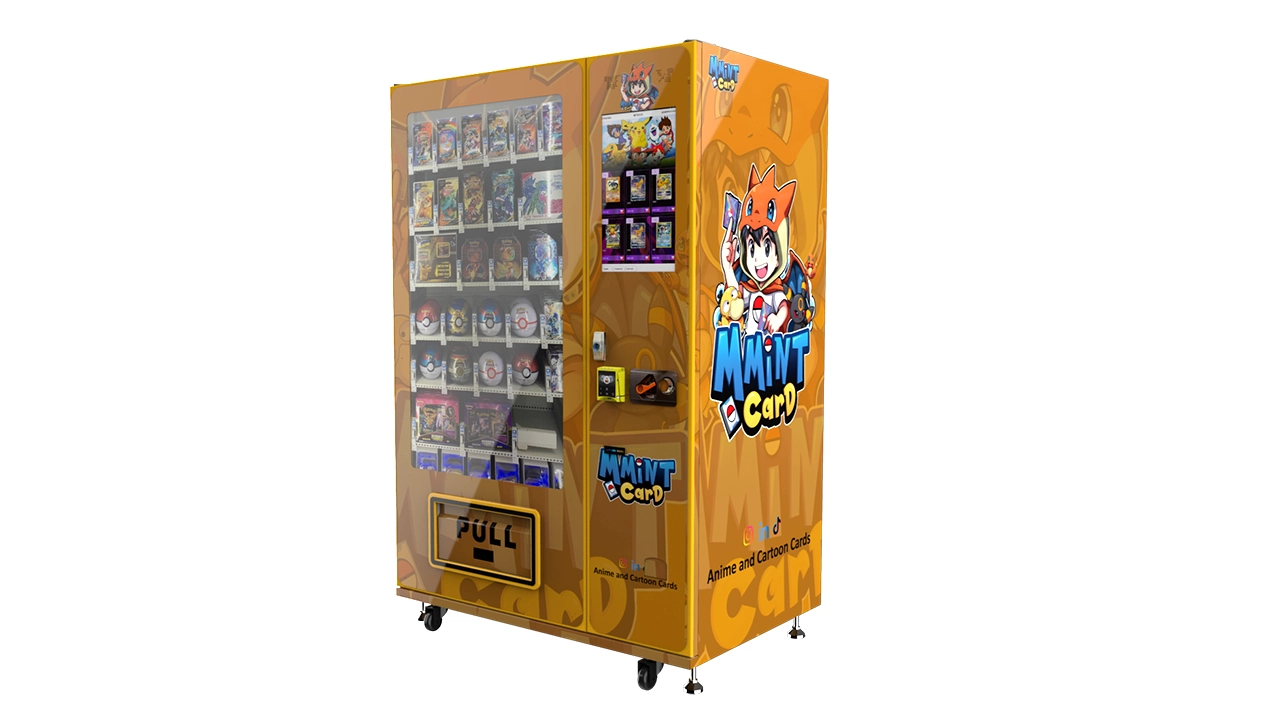
Release-Day Stock and Inventory Planning
A card vending machine can fail commercially while operating perfectly. The screen works, payment works, every vend succeeds—and the product customers want has been sold out for two days.
New card releases can change sales velocity quickly. The inventory plan therefore needs to answer two questions: how much should be loaded, and how early should replenishment begin?
Track Days of Supply, Not Only Units Remaining
A low-stock alert tells the operator how much product remains. Days of supply tells the operator how urgent the situation is.
Days of supply = current sellable inventory ÷ average units sold per day.
Twenty-four packs remaining sounds comfortable until the machine is selling eight a day. That stock represents only three days of supply. The same twenty-four packs in a lane selling one a day require no emergency trip.
During a fresh release, use recent sales rather than a long historical average. Yesterday's velocity may matter more than the previous month's average when a product has just entered the assortment.
Do Not Wait for Zero to Reorder
A reorder point should account for supplier lead time and sales during that lead time. The harder the inventory is to replace, the larger the safety margin needs to be.
A machine with remote stock information makes this easier because the operator does not need to discover a shortage during the next scheduled visit. Remote data is not a replacement for physical counts, but it gives the business time to react.
Fast Sellers Deserve More Than One Lane
Equal lane allocation looks neat and often performs poorly. If one current booster is selling six times faster than an older item, giving each product the same reserve forces unnecessary stockouts.
Duplicate fast products across multiple positions when the machine configuration allows it. The touchscreen can present those lanes as one product selection while the backend draws from more physical capacity, depending on the vending software.
Use a Simple ABC Inventory Rule
Classify products by the value they create for the machine.
- A products: high-velocity or high-contribution items that justify close monitoring and deeper reserve.
- B products: reliable sellers that earn their space without frequent intervention.
- C products: slow merchandise that should be reviewed rather than allowed to remain indefinitely.
This prevents the machine from slowly filling with products that no longer deserve their positions. A vending cabinet is not free storage. Every lane occupied by a slow product is a lane unavailable to something stronger.
Scarcity Needs a Policy Before It Becomes a Problem
A highly demanded release can disappear from a machine in one large purchase. That may look good in the daily sales report while leaving every later customer with an empty selection.
Purchase limits can be useful when the software and business model support them. The policy should be visible before checkout. The goal is not to create artificial scarcity; it is to keep reasonable availability during periods when replenishment cannot match short-term demand.
Keep Authenticity and Supply Records Clean
Collectible retail is unusually sensitive to product trust. Inventory should come through legitimate, traceable channels appropriate to the business. If a desired release cannot be replenished confidently, a clean sold-out message is better than filling the machine with stock of uncertain origin.
Records also make reconciliation easier. When inventory is transferred from a store warehouse into a vending machine, treat the machine as a separate stock location. That makes sales, refunds, failed-vend adjustments and physical variance easier to explain.
Measure Stockout Hours
Knowing that a product sold out is not enough. A fast seller that remained unavailable for 60 hours may have lost far more potential sales than one that sold out shortly before the next scheduled refill.
Track how long A products remain unavailable. If stockout hours are consistently high, the answer may be deeper lane capacity, faster replenishment, more reserve inventory or a second machine. The right response depends on where the bottleneck occurs.
Zhongda Smart Trading Card Vending Machine Options Compared
Zhongda Smart currently publishes several card-oriented machine configurations rather than one cabinet presented as a universal answer. That matters because a wall-mounted booster machine, a general touchscreen unit and an elevator machine solve different problems.
The figures below are current published specification and price references checked in September 2026. They are not final project quotations. Payment hardware, cargo-lane changes, branding, freight, software requirements and other customization can change the final amount.
| Model | Published Reference Price | Display | Published Capacity / Lanes | Delivery | Where It Makes Sense |
|---|---|---|---|---|---|
| ZD-BGS-32 | $999 | 32-inch display | Up to 120 pieces | Spring / drop | Compact installations where floor space is limited |
| ZD-ZLS-32 | $1,211 | 32-inch touchscreen | Up to 28 lanes; approx. 375–535 pieces | Spring / drop | Balanced first-machine projects and booster-heavy assortments |
| ZD-CX-22 | $2,110 | 21.5-inch touchscreen | 60 lanes; approx. 300–1,200 pieces depending on configuration | Configurable drop system | Broad assortments requiring more cargo positions |
| ZD-CXS-22 | $2,632 | 21.5-inch touchscreen | 60 lanes; approx. 300–360-piece published reserve | Elevator / lift | Premium sealed products where gentler delivery has real value |
Current models and published specifications can be reviewed on the Zhongda Smart trading card vending machine range.
ZD-BGS-32: When Floor Space Is the Problem
The ZD-BGS-32 is the outlier because it is wall mounted. Zhongda Smart currently publishes a 32-inch display, up to 120-piece capacity and spring-based cargo lanes for this model.
That lower reserve can be a disadvantage in a very busy placement, but capacity should not be considered in isolation. A compact machine that fits a site with excellent customers can be more valuable than a much larger cabinet that the site cannot accommodate.
The model is easier to justify when the assortment is disciplined: several booster products, a few compact boxed items and a refill schedule that can support the lower reserve.
ZD-ZLS-32: A Balanced Starting Point
The current ZD-ZLS-32 specification combines a 32-inch touchscreen, up to 28 cargo lanes, approximately 375–535 pieces of published capacity and 4G/Wi-Fi connectivity. The referenced capacity changes with package thickness, lane arrangement and installed hardware.
For a first One Piece card vending machine focused on booster packs, starter products and compact sealed merchandise, this is the configuration I would compare first. The price sits well below the elevator model while the larger screen gives the retailer room for product photography, release graphics and a short browsing interface.
That recommendation changes if the actual packages do not behave reliably in the proposed spring setup. Real merchandise has the final vote.
ZD-CX-22: More Cargo Flexibility
Zhongda Smart publishes the ZD-CX-22 with a 21.5-inch touchscreen and 60 standard lanes. Its stated capacity range is broad—approximately 300 to 1,200 pieces—because product format and internal configuration make a large difference.
That makes the model more interesting for retailers that want a mixed assortment rather than a narrow booster-only concept. Wider boxes, compact accessories and several card formats can be planned into the same cabinet, subject to the final cargo design.
ZD-CXS-22: Pay More for Controlled Delivery
The ZD-CXS-22 adds elevator delivery. Its current published configuration includes a 21.5-inch touchscreen, 60 standard cargo lanes and approximately 300–360 pieces of reserve in the referenced setup.
The reason to move from a standard drop machine to this model is not simply to own a more expensive machine. It is to reduce product fall distance. If premium sealed boxes or other condition-sensitive merchandise account for a meaningful share of sales, that can be worth paying for.
If the machine will primarily dispense low-priced boosters that already pass repeated spring tests, the elevator may be solving a problem the project does not have.
For a longer equipment checklist covering product geometry, payment, software, security, spare parts and factory acceptance, see the trading card vending machine buying guide.
Booster Packs or Premium Boxes? The Best Machine May Be Different.
Share your actual product mix and target reserve with Zhongda Smart. A standard spring configuration and an elevator configuration can be compared around the products you intend to sell, rather than around headline specifications.
Request a Custom Machine Configuration →How Zhongda Smart Configures a Trading Card Project
A useful manufacturer conversation begins with merchandise. "I need a One Piece vending machine" is not enough information to select cargo lanes, calculate reserve or quote the final hardware.
Zhongda Smart's published project process starts with package information, capacity, payment requirements and the operating setup before the cabinet configuration is finalized. That is more useful for card retail than choosing a generic vending cabinet and trying to make the inventory fit afterward.
1. Send the Product Geometry
The basic requirement sheet should record width, height, depth or thickness and approximate weight for every important package type. Photographs help identify sealing edges, protrusions and uneven shapes that a four-number specification cannot show.
For thin booster products, thickness deserves special attention. Flexible packages do not always behave like rigid objects with the same nominal dimensions.
2. State the Desired SKU Count
Twenty products and twenty cargo lanes are not necessarily the same thing. A fast-moving booster may deserve two or three physical lanes, while a wider box may consume the space of multiple standard positions.
The useful requirement is therefore: how many different products need to appear on the screen, and how much reserve should each one carry?
3. Separate Fast Products From Premium Products
A machine can use more than one merchandising priority. Fast boosters need reserve. Premium boxes need safe handling. Slower products need fewer units. Identifying those roles helps avoid wasting expensive machine space.
4. Define the Payment Requirement
Payment configuration should be discussed before production because the hardware can affect cabinet layout, software and project cost. State whether the machine needs credit or debit card acceptance, QR payment, cash, membership functions or another supported method.
Processor and terminal compatibility should be confirmed for the actual project. A generic logo on a specification sheet is not enough.
5. Confirm the Connectivity and Backend
Specify which information needs to be available remotely. Sales totals alone may be enough for a simple project. A multi-machine route may need product-level reporting, inventory status, fault information and remote content or price changes.
Ask what happens when the network connection drops. The answer matters just as much as the list of online features.
6. Test Difficult Products, Not Only Easy Ones
Pre-shipment testing is most valuable when it concentrates on the merchandise most likely to cause trouble. A rigid rectangular box that dispenses perfectly tells you little about a thin flexible booster.
Product tests should be repeated. Load conditions should change. The final items in the lane should be included. If the configuration contains several important package formats, each deserves its own acceptance criteria.
This article does not publish a made-up "99.9% success rate" because Zhongda Smart has not supplied a controlled One Piece-specific test dataset for that claim here. If a future production test produces documented results, those figures would be far more valuable than a generic reliability promise.
A Useful Factory Acceptance Checklist
| Area | What Should Be Checked |
|---|---|
| Product dispensing | Repeated vends for each important package format from full, partial and low-stock lanes |
| Vend confirmation | Successful delivery records and failed-vend behavior |
| Payment | Reader communication, successful purchase flow and error handling |
| Inventory | Backend quantity changes after successful transactions |
| Network | Normal connection, interruption behavior and recovery |
| Touchscreen | Product images, prices, sold-out state and checkout clarity |
| Power recovery | Machine behavior after controlled restart |
| Locks and doors | Access, closing, pickup opening and basic security functions |
| Branding | Approved graphics, text, legal marks and interface assets |
| Spare parts | Recommended first-year components and replacement procedure |
Serviceability Deserves Attention Before Shipping
Downtime is expensive even when the failed component is inexpensive. A machine that waits many days for a minor replacement part can lose more gross profit than the part costs.
Ask which components are normal operator replacements. Find out whether motors, sensors, controllers, locks and payment assemblies can be identified and changed with remote guidance. A small spare-parts kit can be a better investment than paying for cosmetic upgrades that do not improve transactions.
What Zhongda Smart Publishes About Its Manufacturing Operation
Zhongda Smart's current company profile states that the business was founded in 2018 and operates a 20,000-square-meter manufacturing facility, with more than 400 employees, more than 10 R&D engineers and annual production capacity of approximately 10,000 vending machines. These are company-published figures rather than independent industry statistics.
The numbers are useful for understanding manufacturing scale, but they should not replace product-specific due diligence. A buyer should still confirm the final bill of materials, tested cargo layout, payment hardware, software functions, warranty, spare-parts plan and written quotation.
Additional manufacturer information is available on the Zhongda Smart company profile.
Custom Artwork Needs Rights, Not Just a High-Resolution File
ONE PIECE names, characters, logos, card artwork and associated creative material belong to their respective rights holders. Buying genuine products to resell does not automatically provide permission to reproduce protected artwork across a custom vending machine.
A retailer can build a strong machine around its own store identity and show accurate photographs of merchandise as permitted for legitimate retail presentation. Full character wraps, logos, promotional artwork and designs that imply official sponsorship should only be used when the necessary rights or authorization exist.
This is particularly important for OEM projects because a dramatic cabinet design can create more legal exposure than a plain machine. Branding approval belongs in the project checklist, not at the end of production.
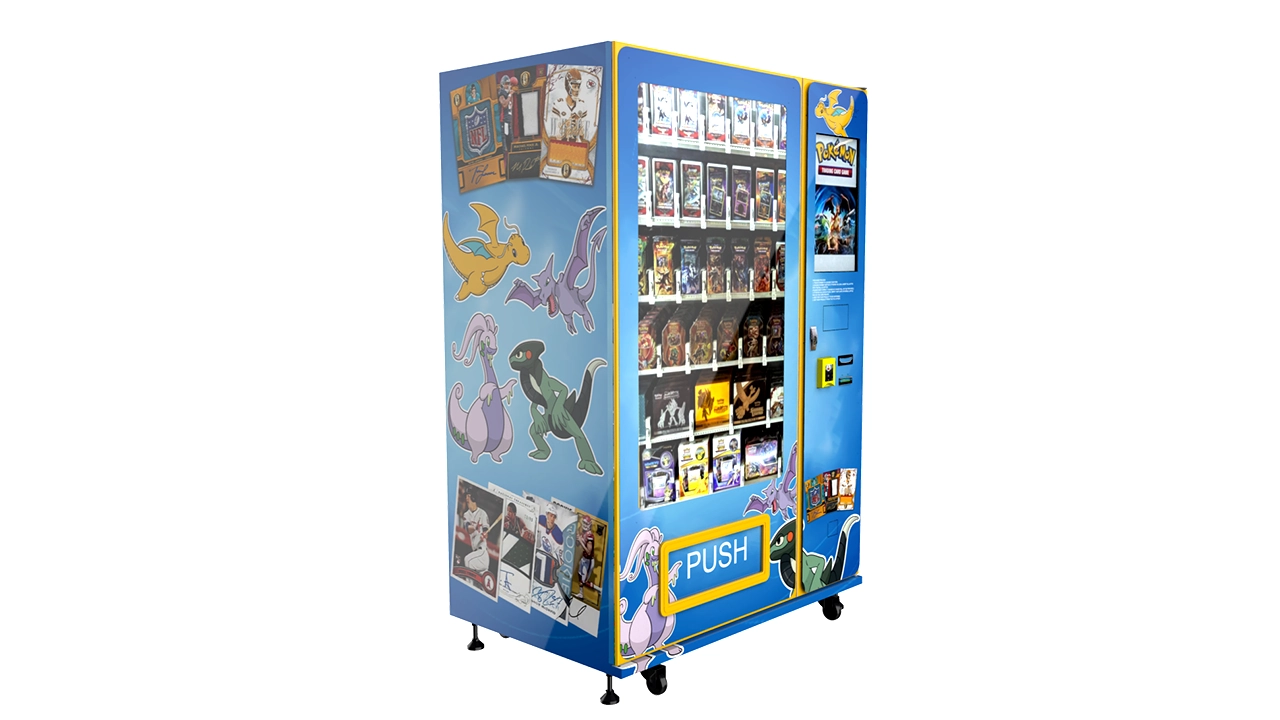
What the Customer Should See at the Machine
The internal engineering can be complicated. The buying experience should not be.
A customer standing in front of a One Piece card vending machine wants four things immediately: a clear product image, a clear quantity, a clear price and a clear way to pay. Every additional screen needs a reason to exist.
Show the Exact Product Being Sold
Product photography should match the vend. A booster pack selection should look like a booster pack, not a display box. A starter deck should show the correct sealed retail package. If the image contains multiple items for visual purposes, the text must still make the transaction quantity obvious.
This is both a conversion issue and a trust issue. Collectors notice small product differences. Ambiguous merchandising may generate a sale once and a complaint immediately afterward.
Keep Price Visible During Browsing
The customer should not have to begin checkout to discover the price. Clear prices make it easy to compare products and reduce abandoned transactions.
Remote price updates can be helpful when acquisition cost changes or a product becomes substantially more or less valuable, but constant price movement can also frustrate regular customers. Use flexibility without turning the machine into a minute-by-minute trading screen.
Remove Sold-Out Items From the Buying Path
An unavailable product should never look purchasable until the customer reaches the final payment step. If software inventory and physical inventory are synchronized, the interface should mark or hide the unavailable selection immediately.
Physical reconciliation remains necessary. Incorrect loading, manual product removal, failed transactions or service actions can create differences between reported and actual stock.
Make Support Visible Before Something Goes Wrong
A buyer who pays and receives nothing should not have to search the building for an unknown operator. The machine needs an obvious support method and enough transaction information to investigate a claim without exposing sensitive payment details.
The support workflow should already distinguish between a declined payment, an authorization that did not complete, a successful payment followed by a failed vend and a completed transaction. Those are different events even if a frustrated buyer initially describes all of them as "the machine charged me."
Security, Damage and Other Risks That Belong in the Budget
Trading cards put relatively valuable inventory into a small enclosure. Cabinet security therefore matters, but steel thickness alone is not a security plan.
Placement visibility, locks, hinges, the pickup opening, anchoring, site supervision and insurance all contribute. The machine should be easy for legitimate customers to see and awkward for someone to attack unnoticed.
Inventory Value Can Rise Faster Than Expected
A machine filled with 400 inexpensive boosters has one risk profile. Replace part of that inventory with premium sealed products and the value behind the door can increase quickly.
Track the landed cost and retail value of machine inventory as carefully as store inventory. The machine is a stock location, not simply a piece of equipment.
Price Volatility Can Change the Assortment
Collectible products can move in price. A product that looked attractive when loaded may become uncompetitive, while another may sell faster than anticipated after broader demand changes.
The best defense is not constant speculation. It is a disciplined buying cost, reasonable margin rules and the ability to update the menu when necessary.
Mechanical Problems Should Be Measured by SKU
If one product produces most failed vends, the machine itself may not be the problem. The package and lane configuration may be mismatched.
Track failures by product and cargo position. If a specific lane repeatedly causes trouble, inspect the lane. If the same package fails across several lanes, change the product configuration before blaming unrelated components.
Do Not Ignore Labor Because the Store Is Unattended
Vending removes the need for a cashier during each purchase. It does not eliminate labor. Inventory still needs to be ordered, received, counted, loaded and reconciled. Screens need updates. Refund requests need answers. The machine needs cleaning and occasional service.
Include those hours in the profitability calculation. A route that appears highly profitable before labor can look ordinary when every location requires frequent emergency visits.
A Practical First-Machine Pilot
Ordering several machines before proving the first configuration multiplies every mistake. A one-machine pilot keeps the cost of learning manageable.
Before Installation
Record the complete capital budget, not only the machine invoice. Define the opening assortment and expected merchandise margin. Test the important packages. Confirm payment hardware. Document the cargo layout and initial inventory by lane.
Decide in advance which numbers will determine whether the pilot is working. A project is much harder to judge when success is defined only after the results are visible.
Days 1–30: Watch the Transaction
Track daily transactions, revenue, average transaction value, units sold, sales by SKU, stockouts, failed vends, payment issues and time spent servicing the machine.
Also watch customers when possible. Do they notice the machine? Can they find the product quickly? Do they understand the quantity? Are buyers abandoning the payment screen? Transaction data tells you what happened; simple observation can explain why.
Days 31–60: Change the Assortment
By the second month, some products should have earned more space and others less. Give stronger products more reserve. Remove items that consistently underperform unless they serve a deliberate merchandising purpose.
If a product sells well but jams, solve the mechanical issue before adding volume. If it dispenses perfectly but barely sells, a different product is probably the answer.
Days 61–90: Test Repeatability
A strong weekend is encouraging. A repeatable machine is better.
By day 90, the retailer should have a reasonable picture of transactions per day, average contribution, refill frequency, stockout hours, failed-vend rate, service time and the products responsible for most of the profit.
Expansion makes more sense when the result can be explained. If the machine performed well only because of one unusually scarce release, do not assume a second machine will repeat it.
Contribution per Service Hour Is Useful When You Scale
Two machines can generate similar revenue while producing very different workloads. One may need a short scheduled refill each week. Another may require repeated special trips.
Divide monthly machine contribution by the hours spent traveling, refilling and servicing it. That number becomes increasingly useful once several locations compete for operator time.
Route density matters too. Five machines positioned efficiently can be easier to operate than three machines scattered across inconvenient sites. Remote management helps, but it cannot eliminate travel when physical inventory needs replenishment.
What a Good Machine Quote Should Make Clear
A low headline price is difficult to compare with a quotation that already includes more hardware. Ask suppliers to separate the major components so the decision is based on equivalent configurations.
| Quote Item | What Needs to Be Defined |
|---|---|
| Machine model | Exact cabinet, controller and base configuration |
| Touchscreen | Display size, touch function and interface hardware |
| Cargo layout | Lane count, width, spiral or other dispensing method |
| Real product capacity | Reserve calculated from supplied package dimensions |
| Delivery system | Standard drop, elevator or other configured mechanism |
| Payment hardware | Exact included device and third-party requirements |
| Networking | Installed connectivity hardware and data requirements |
| Remote software | Functions, account access and recurring fees if applicable |
| Branding | Cabinet graphics and interface customization included |
| Warranty | Coverage, duration, exclusions and replacement process |
| Spare parts | Recommended initial kit and future supply |
| Testing | Product-vend and functional checks before shipment |
Zhongda Smart currently lists one-unit minimum orders on selected card-machine models, which can make a pilot possible without committing immediately to a larger rollout. Final commercial terms should always follow the current quotation and sales agreement.
When I Would Not Buy a One Piece Card Vending Machine
A machine should solve an existing retail opportunity, not become an expensive way to discover that the business lacks inventory or customers.
I would delay the purchase if sealed-product supply is unreliable enough that the machine cannot remain stocked. Automation makes empty shelves more visible; it does not fix the supply problem.
I would also delay if the placement only works under an optimistic sales forecast. A project that loses money in the realistic case and becomes attractive only in the strongest case has very little room for error.
Another warning sign is a machine selected before the merchandise. If the buyer has already paid for a cabinet but still does not know whether the actual booster packs dispense reliably, the order of decisions has been reversed.
Finally, do not scale because the machine looks busy. Scale after the data shows that the configuration, location, inventory routine and service model can be repeated.
One Piece-Only Machine or Mixed TCG Machine?
A dedicated One Piece card vending machine has a clear identity. Customers immediately understand what the machine is for, the touchscreen can remain focused and the assortment can go deeper into one product line.
Concentration has a downside. If a key release becomes difficult to replenish, a large part of the cabinet may sit underused. A mixed machine can shift capacity toward other suitable products when supply changes.
The right answer depends on the location. A site with proven ONE PIECE demand and dependable supply may justify a focused assortment. A general hobby location may benefit from a broader card mix.
From an equipment standpoint, flexibility has value either way. An adjustable cargo layout means a machine that begins with a heavily One Piece-focused assortment is not permanently trapped there if inventory strategy changes later.
The exterior branding should also remain legally clean. A retailer-owned machine with a flexible store identity can change product emphasis much more easily than an unauthorized character-themed cabinet.
What Retailers Should Measure Every Week
Revenue tells you the size of the sales line. It does not tell you whether the machine is healthy.
| Metric | Simple Calculation | What It Reveals |
|---|---|---|
| Transactions per day | Total transactions ÷ operating days | Actual purchase frequency |
| Average transaction value | Sales ÷ transactions | Average basket size |
| Units per transaction | Units sold ÷ transactions | Whether buyers commonly purchase more than one item |
| Gross margin dollars | Sales − merchandise cost | Product economics before operating costs |
| Contribution per transaction | Transaction contribution ÷ transactions | Average value of each successful sale |
| Sell-through by SKU | Units sold ÷ units available | Which products deserve lane space |
| Days of supply | Units remaining ÷ daily unit sales | Restocking urgency |
| Stockout hours | Hours unavailable for sale | Potential lost selling time |
| Failed-vend rate | Failed vends ÷ attempted vends | Dispensing consistency |
| Service hours | Travel + refill + repair time | Hidden labor cost |
Once these numbers exist, expansion becomes less emotional. A machine with lower headline sales can still be more attractive if it produces stronger margin, fewer stockouts and much less service work.
Build the Machine Around the Cards You Actually Plan to Sell
Zhongda Smart can review product dimensions, desired capacity, payment requirements, touchscreen needs, delivery method and OEM branding before a final configuration is quoted. Starting with the merchandise is the simplest way to avoid paying for the wrong setup.
Talk to Zhongda Smart →Final Verdict
One Piece card vending machines are a credible retail format, but the opportunity comes from the operating model rather than the novelty of the cabinet. ONE PIECE CARD GAME has continued to show strong consumer interest, the products fit compact retail well, and sealed merchandise can be presented through a simple self-service transaction. Those are good conditions for vending.
The hard work is less glamorous. The packs have to dispense reliably. Boxes need suitable handling. Popular inventory needs to remain available. Payment has to work every time customers approach the machine. Site fees, processing costs and service labor need to leave enough margin to justify the equipment.
For a booster-heavy first project, I would begin by comparing an adjustable spring-lane touchscreen machine such as the ZD-ZLS-32 against the exact packages. If premium boxes form a meaningful share of the plan, compare that conventional setup with an elevator model such as the ZD-CXS-22.
Do not buy several machines because one specification sheet looks attractive. Prove one cargo layout, one payment setup, one inventory routine and one location. Track what sells, how often it sells, what fails and how much operator time the site consumes. Expansion is far safer after those questions have real answers.
The strongest automated card operation will probably look boring from the operator's side: accurate inventory, repeatable dispensing, predictable refill visits, clean transaction records and few customer complaints. That is exactly what good vending equipment is supposed to achieve.
Frequently Asked Questions
Are One Piece card vending machines profitable?
They can be, but profitability depends on merchandise margin, transaction volume, site cost, payment fees, inventory turnover, restocking labor and equipment investment. The machine should be modeled using contribution per transaction rather than gross sales alone. A one-machine pilot provides much better evidence than assuming that popularity of the card game will automatically translate into profitable vending.
How much does a One Piece card vending machine cost?
There is no single installed price because the final configuration can include different cabinets, payment hardware, cargo lanes, elevator delivery, branding, software and freight. As of September 2026, Zhongda Smart publishes card-machine reference prices ranging from $999 for the ZD-BGS-32 wall-mounted model to $2,632 for the ZD-CXS-22 elevator configuration. Current pricing and the final project quotation should be confirmed before ordering.
Can a vending machine dispense individual ONE PIECE booster packs?
Yes, provided the dispensing system is configured for the actual package. Thin foil packs need more careful lane and spiral testing than rigid products because they can shift, overlap or rotate. Representative product samples should be tested repeatedly before a machine configuration is approved.
Is an elevator vending machine necessary for trading cards?
Not always. Standard spring or drop delivery can be practical for compatible booster packs and small packaged products. Elevator delivery becomes more useful when the machine carries higher-value boxes or other merchandise where reducing product fall distance has meaningful customer value. The extra hardware should solve a real product-handling problem.
How many card products can a vending machine hold?
Capacity depends heavily on package dimensions and cargo layout. Zhongda Smart's current ZD-ZLS-32 publishes approximately 375–535 pieces in its referenced configurations, while the ZD-BGS-32 publishes capacity of up to 120 pieces. The ZD-CX-22 publishes a much broader 300–1,200-piece range depending on merchandise and configuration. Real capacity should be calculated using the products that will actually be loaded.
What products should be sold besides booster packs?
Starter decks, compatible sealed boxes and compact card accessories can broaden the assortment when their dimensions fit the machine. The best mix is usually based on both contribution and sales velocity. Slow products should not remain in valuable cargo positions simply because space was available when the machine was first loaded.
What is the most important feature in a trading card vending machine?
Reliable dispensing comes first. A large touchscreen, remote reporting and attractive branding are useful only when the machine can consistently deliver the selected product. Payment reliability, product protection, inventory visibility and serviceability follow closely behind.
Should a first-time retailer buy one machine or several?
One pilot machine is usually the lower-risk approach. It allows the retailer to verify the product lanes, payment configuration, location, assortment, refill schedule and customer behavior before repeating the setup. Selected Zhongda Smart card models currently publish minimum order quantities starting from one unit.
What information should I send Zhongda Smart for a custom card vending machine?
Send product photos, package width, height, depth or thickness, approximate weight, desired number of SKUs, target inventory capacity, payment requirements, machine quantity, touchscreen preferences and branding requirements. These details allow the cargo layout and delivery method to be reviewed before the final configuration is quoted.
Can I put ONE PIECE characters and logos on a custom vending machine?
Do not assume that reselling genuine products provides permission to reproduce protected logos, characters or artwork on a machine. ONE PIECE and related creative assets belong to their respective rights holders. Retailers should use artwork they own or are authorized to use and should avoid creating an appearance of official sponsorship or affiliation where none exists.
How often should a card vending machine be restocked?
Restocking should follow sales velocity rather than an arbitrary calendar. Divide current sellable inventory by average daily unit sales to estimate days of supply. Fast-moving new releases may justify more frequent replenishment or additional physical lanes, while slower products can remain on a longer service cycle.
What numbers should I track after installation?
Track transactions per day, average transaction value, contribution per sale, sales by SKU, days of supply, stockout hours, failed-vend rate, payment problems, refund incidents and operator service hours. These measures explain far more about the quality of the location than gross revenue alone.
Sources and References
[1] Bandai Namco Holdings Inc., BANDAI CARD GAMES special feature discussing the continued performance, collectability and product depth of ONE PIECE Card Game: Bandai Namco Holdings IR Library.
[2] Bandai Namco Holdings Inc., FY2026 and FY2027 financial presentation materials, including May 13, 2026 reporting that described continued strong popularity of ONE PIECE Card Game: Bandai Namco Financial Statements & Presentations.
[3] BANDAI CO., LTD., official ONE PIECE CARD GAME product, rules, card-list and event information: ONE PIECE CARD GAME Official Website.
[4] Bandai Namco Holdings Inc., Integrated Report 2025 feature on the expansion of BANDAI CARD GAMES and the trading card business: Bandai Namco Integrated Report.
[5] BANDAI CO., LTD., official BANDAI CARD GAMES brand information: BANDAI CARD GAMES.