A sports card vending machine business can be worth starting in 2026, but only when the machine is treated as a compact retail operation rather than a passive-income box. The opportunity is real: sports card demand remains strong, physical collectibles continue to attract repeat buyers, and unattended retail can put sealed products in front of customers without adding a staffed checkout counter. The weak version of this business is simple—buy a machine, fill it with whatever inventory is available, and hope foot traffic produces sales. I would not recommend that approach. The stronger model begins with product margin, customer fit, machine reliability, inventory turnover, payment friction, and location economics. Get those variables right and one machine can become a useful test bed for a larger automated card-retail network. Get them wrong and even a beautiful machine in a busy venue can sit full of inventory that barely moves.
Is a Sports Card Vending Machine Business Worth It in 2026?
Yes, it can be—but I would describe it as a location-and-inventory business powered by vending technology, not a vending business that happens to contain sports cards. That distinction changes almost every important decision you make.
A conventional vending operator may begin with the machine and then decide what products will fit. With sports cards, I would reverse that order. Decide what you can source consistently, what buyers at a specific location are likely to purchase, what gross margin those products offer, and how often you can replenish them. Only then should you specify the vending hardware.
The strongest case for starting a sports card vending machine business is the combination of four characteristics: compact merchandise, high value relative to physical size, emotional purchasing behavior, and products that frequently change. A cabinet does not need the storage volume required for drinks or bulky merchandise to carry meaningful retail value. New releases, player performance, rookie interest, limited products, and seasonal attention can also create reasons for buyers to return.
The danger is that the same market moves quickly. Inventory that looks exciting today may cool down. A product purchased at a poor wholesale price can create impressive revenue while producing weak contribution margin. A machine full of slow inventory also locks up cash that could have been used for faster-moving products.
If I were choosing whether to enter this business in 2026, I would use a simple test. I would want credible answers to these five questions before buying the first machine:
- Can I source desirable sealed card products repeatedly rather than once?
- Can I obtain enough gross margin after payment fees, venue costs, and losses?
- Do I have access to a location where collectors or sports fans already spend time?
- Can the machine reliably dispense every package format I intend to sell?
- Can I monitor sales and inventory closely enough to make fast merchandising decisions?
If three of those answers are uncertain, I would keep researching instead of ordering several machines. If all five are strong, a controlled one-machine pilot becomes much more reasonable.
Why the Sports Card Market Supports Automated Retail
The underlying category is large enough to take seriously. Grand View Research estimated the sports trading cards market at approximately $13.5 billion in 2025 and projected it to grow to about $24.7 billion by 2033, representing a projected compound annual growth rate of 7.9% from 2026 through 2033.
That forecast does not mean vending machines will automatically grow at the same rate. It does tell us something more useful: an operator entering the category is not relying on a tiny experimental product class. Sports cards belong to an established collectibles economy with recurring product releases, secondary-market activity, fan participation, and repeat purchasing.
Another useful signal appeared in a major retailer's September 2026 financial disclosure. Collectibles generated $356.3 million in quarterly net sales, up from $227.6 million in the comparable prior-year quarter. That is a 57% year-over-year increase, and collectibles represented 45.1% of the retailer's total quarterly net sales.
I would not use one retailer's performance as a forecast for a vending route. The operational lesson is narrower: physical collectibles can command substantial consumer spending even while other retail categories soften. For a sports card vending machine business, that strengthens the case for testing convenient unattended distribution.
There is also a behavioral advantage. Buying sports cards is not always a carefully planned transaction. A customer may see a familiar athlete, a new release, a reasonably priced pack, or a product that feels difficult to find and make the purchase immediately. A machine positioned where that audience already spends time shortens the distance between interest and checkout.
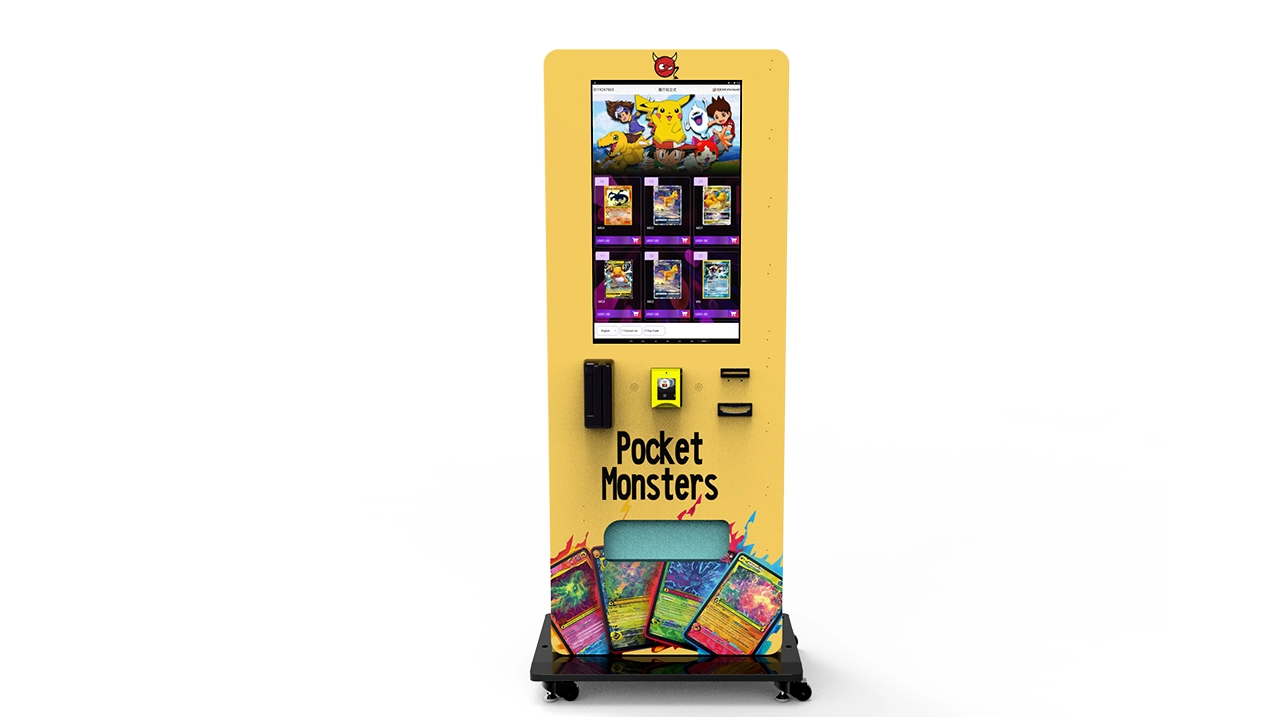
This is where automated retail becomes interesting. Online stores are excellent for planned purchasing. Card shops are excellent for selection, community, advice, and events. A sports card vending machine occupies a different position: immediate, compact, self-service availability.
I would not try to make the machine imitate a full hobby shop. I would make it excellent at the things automated retail does well:
- quick transactions;
- clearly priced sealed products;
- after-hours availability where access permits;
- small-footprint merchandising;
- impulse purchases;
- repeat purchasing of familiar products;
- remote inventory tracking;
- rapid testing of product assortment.
That narrower job creates a much better business model than trying to automate every part of the card hobby.
How a Sports Card Vending Machine Business Actually Works
The operating model is straightforward on the surface. You acquire sealed sports card inventory, place it inside a vending machine, install the machine at a suitable venue, accept automated payments, replenish products, and keep the difference between selling revenue and your total costs.
The difficult part is that several small costs sit between revenue and profit. A machine can sell thousands of dollars in products while generating disappointing cash flow if those costs are ignored.
I would break the business into six economic layers:
- Inventory acquisition: the landed cost of packs, boxes, bundles, and accessories.
- Retail pricing: what customers will realistically pay at the machine.
- Location economics: fixed rent, commission, revenue share, or another venue arrangement.
- Transaction costs: payment processing, connectivity, software, and related fees.
- Operating costs: restocking travel, maintenance, insurance, shrinkage, refunds, and occasional service.
- Equipment cost: the machine, payment hardware, customization, freight, installation, and depreciation.
The sports card vending machine business becomes attractive when the difference between the first two lines is large enough to absorb the remaining four.
That sounds obvious, but operators sometimes focus on markup rather than contribution. A box purchased for $30 and sold for $45 appears to have a healthy $15 spread. If the venue receives 10% of sales, payment processing consumes another percentage, and the SKU requires expensive restocking trips, the real profit can be far smaller.
For this comparison, I am prioritizing contribution per machine, inventory turnover, and service efficiency over raw revenue. Those three measures tell you more about whether the business deserves additional capital.
Revenue Is Not the Goal
Suppose Machine A sells $8,000 per month but operates on tight product margins and an expensive location agreement. Machine B sells $5,500 but has better inventory sourcing, a more favorable venue deal, and fewer service visits. Machine B can easily be the better investment.
The question is therefore not, “How much can a sports card vending machine sell?” The useful question is, “How much monthly cash contribution can this specific machine create after the expenses required to keep it selling?”
Sports Card Vending Machine Business Startup Cost
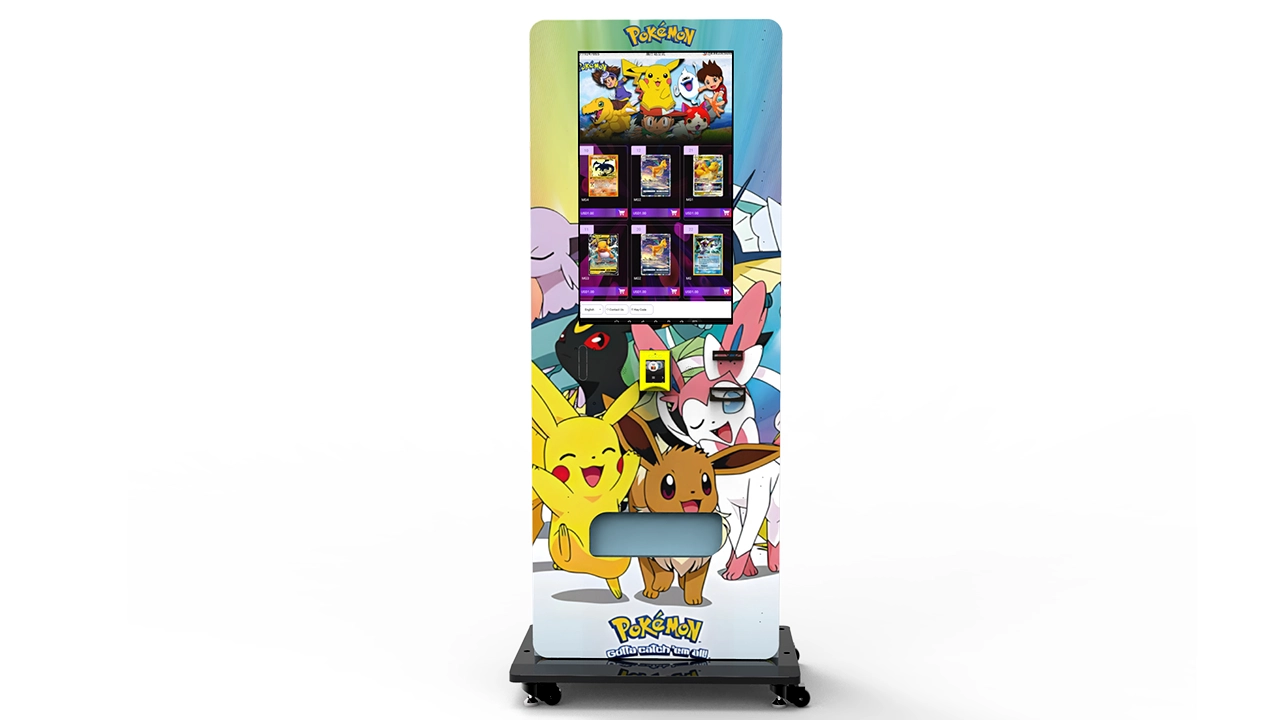
A realistic startup budget should extend well beyond the cabinet price. Current Zhongda Smart product information, for example, lists reference equipment prices starting around $999 for a compact wall-mounted configuration, about $1,211 for a 32-inch touchscreen model, and higher prices for larger or elevator-delivery configurations. Final project cost can change with payment hardware, customization, software requirements, freight, and configuration.
You can review current machine formats on the trading card vending machines for sale page before building your budget.
For a first sports card vending machine business, I would budget by category rather than relying on the advertised machine price.
| Startup Item | Planning Range | What Changes the Cost |
|---|---|---|
| Vending machine | $1,000–$4,000+ | Screen, capacity, dispensing method, elevator delivery, cabinet design |
| Payment hardware | $200–$700+ | Reader type, payment provider, integration requirements |
| Branding and customization | $100–$800+ | Cabinet graphics, touchscreen interface, custom fabrication |
| Initial sports card inventory | $1,000–$5,000+ | Product category, wholesale access, average item cost, capacity |
| Freight and delivery | Project-specific | Machine dimensions, transport method, delivery requirements |
| Installation and setup | $100–$600+ | Site requirements, anchoring, electrical work, technician needs |
| Insurance and administration | $200–$1,000+ | Business structure, coverage, machine count, venue requirements |
| Working-capital reserve | $1,000–$3,000+ | Restocking speed, supplier terms, product cost |
The ranges above are planning examples, not quotations. Actual expenses depend on equipment configuration, suppliers, payment providers, venue terms, freight, insurance, and inventory strategy.
A first-machine project can therefore require considerably more cash than the vending machine itself. If I were planning a launch, I would rather own a $1,500 machine with sufficient inventory and working capital than spend almost the entire budget on a premium cabinet and have too little cash left to keep desirable products stocked.
Do Not Fill Every Lane Just Because It Exists
Capacity should not be confused with required inventory. A machine capable of holding hundreds of items does not need to begin completely full of expensive merchandise.
During the pilot period, a controlled assortment often produces better information. You can measure which price points move, which sports perform, whether customers prefer packs or boxes, and how frequently a product needs replenishment. Then capital can be concentrated in proven sellers.
Inventory is working capital. Every slow-moving box sitting in a machine represents cash that cannot be used elsewhere.
How Profitable Is a Sports Card Vending Machine Business?
Profitability varies too much for a responsible operator to promise a standard monthly income. Product sourcing, average selling price, customer traffic, conversion rate, venue costs, machine uptime, and inventory turnover can make two identical machines perform completely differently.
I prefer to evaluate one machine with a contribution model.
Monthly operating contribution = Product sales − inventory cost − payment fees − venue cost − restocking cost − maintenance − shrinkage and refunds − recurring software or connectivity expenses.
Only after that calculation would I decide whether the machine is recovering its original investment at an acceptable rate.
A Sample Monthly Model
| Metric | Conservative Case | Base Case | Strong Case |
|---|---|---|---|
| Monthly sales | $2,500 | $5,000 | $8,000 |
| Inventory cost | $1,750 | $3,250 | $4,960 |
| Gross profit before operating costs | $750 | $1,750 | $3,040 |
| Venue cost | $250 | $500 | $800 |
| Payment and software costs | $100 | $200 | $320 |
| Restocking/service allowance | $150 | $250 | $350 |
| Loss/refund allowance | $50 | $75 | $120 |
| Illustrative operating contribution | $200 | $725 | $1,450 |
These figures are examples, not expected returns. What they show is the sensitivity of the model. Moving from weak to strong sourcing or from an average location to a highly relevant one can change the result dramatically.
They also show why a sports card vending machine business should not be sold as effortless passive income. Even in a good location, somebody still has to negotiate inventory purchases, analyze sales, update products, resolve failed transactions, clean the machine, handle customer questions, and replenish stock.
Automation removes the cashier from each transaction. It does not remove retail management.
Gross Margin Matters More Than Markup
Be careful when comparing margins. If a product costs $60 and sells for $90, the markup on cost is 50%, but the gross margin is 33.3% of sales.
That distinction matters because most operating expenses are easier to analyze as a percentage of revenue.
If your blended gross margin is 35% and location plus transaction costs absorb 15% of sales, only 20 percentage points remain before labor, shrinkage, maintenance, insurance, equipment recovery, and tax.
A busy machine running on poor buying discipline can therefore produce a lot of payment notifications without producing a particularly attractive business.
Sports Card Vending Machine ROI and Break-Even
I would calculate return on investment using the full installed project cost, not just the cabinet invoice.
Assume a complete pilot project costs $5,500 after machine purchase, payment equipment, initial setup, freight, and launch expenses. Initial inventory is working capital rather than an expense all at once, so I would track it separately from equipment investment while still making sure enough cash is available to replenish it.
If the machine produces $700 of average monthly operating contribution after direct costs, simple equipment payback would be approximately:
$5,500 ÷ $700 = 7.9 months.
If contribution falls to $300, the same investment takes about 18.3 months to recover. At $1,200 per month, the simple payback drops to roughly 4.6 months.
That range explains why published claims such as “earn your investment back in three months” should be treated cautiously unless the assumptions are shown. The machine does not determine payback on its own.
My Preferred Break-Even Test
I would calculate the monthly sales required to cover fixed operating expenses before buying the machine.
Imagine your contribution margin after product cost and payment processing is 28%. Monthly fixed and semi-fixed machine expenses total $700.
Break-even sales = $700 ÷ 0.28 = $2,500 per month.
If the location cannot credibly support about $2,500 in monthly sales, the deal needs to change. That might mean lower rent, better wholesale purchasing, a different product mix, a lower-cost machine, or a different venue.
This calculation is far more useful than asking how many people walk past the location every day.
Best Locations for a Sports Card Vending Machine
Location quality is not the same as foot-traffic volume. A thousand people who have no interest in collectibles are less valuable than a smaller stream of people already thinking about sports, games, gifts, entertainment, or trading cards.
I would rank locations using five variables:
- customer relevance;
- visibility;
- dwell time;
- security;
- economics.
A machine tucked around a corner in a famous venue can underperform a smaller site where the machine sits directly in the natural customer path.
Card and Hobby Stores
A card store can be one of the most logical environments because the customer intent already exists. The vending machine can handle repeatable purchases, featured products, lower-ticket items, or additional sales when staff are occupied.
The strongest version is complementary rather than competitive. The machine should extend the store's selling capacity instead of removing the human interaction that makes specialist retail valuable.
For a deeper equipment and placement breakdown, see the trading card vending machine solution for card shops.
Sports and Entertainment Venues
Locations connected with sporting activity offer obvious thematic alignment. Fans are already engaged with athletes, teams, competition, and memorabilia. That does not guarantee sales, but it gives the product a contextual advantage.
I would still study where the machine sits. Entrances, family areas, waiting zones, concession paths, and other natural pauses can perform differently even inside the same building.
Family Entertainment Centers and Arcades
These locations can be attractive because customers arrive prepared to spend discretionary money and often remain on site for an extended period. A colorful touchscreen and easy-to-understand sealed product assortment can fit naturally into that environment.
Shopping Centers
Large retail properties can offer visibility and long operating hours, but rent and placement terms deserve close attention. I would not pay premium rent simply because a location reports impressive overall traffic.
The better question is whether the machine is near customers who are likely to buy collectibles and whether the projected conversion supports the cost.
Game Stores and Related Specialty Retail
Sports cards, trading card games, sleeves, accessories, and collectible merchandise often share customers. A mixed collectible environment can therefore create useful cross-category purchases.
Venue Scorecard
| Location Factor | Weak | Acceptable | Strong |
|---|---|---|---|
| Collector relevance | Little connection | Some crossover | Sports/card audience already present |
| Machine visibility | Hidden | Visible after entry | Natural traffic path |
| Dwell time | Customers rush through | Short waiting periods | Customers regularly remain nearby |
| Security | Poor oversight | Moderate supervision | Monitored, controlled environment |
| Venue economics | High fixed cost | Manageable | Low cost or aligned revenue share |
| Restocking access | Difficult | Scheduled access | Simple and predictable |
If I were comparing two locations, I would choose the one with better audience fit and economics even if the second location claims substantially higher general foot traffic.
What Should You Sell in a Sports Card Vending Machine?
The best assortment usually combines dependable products with a smaller number of attention-grabbing items. I would avoid building an entire sports card vending machine business around one hot release.
Demand spikes are useful, but a sustainable machine needs products that can continue selling between major releases.
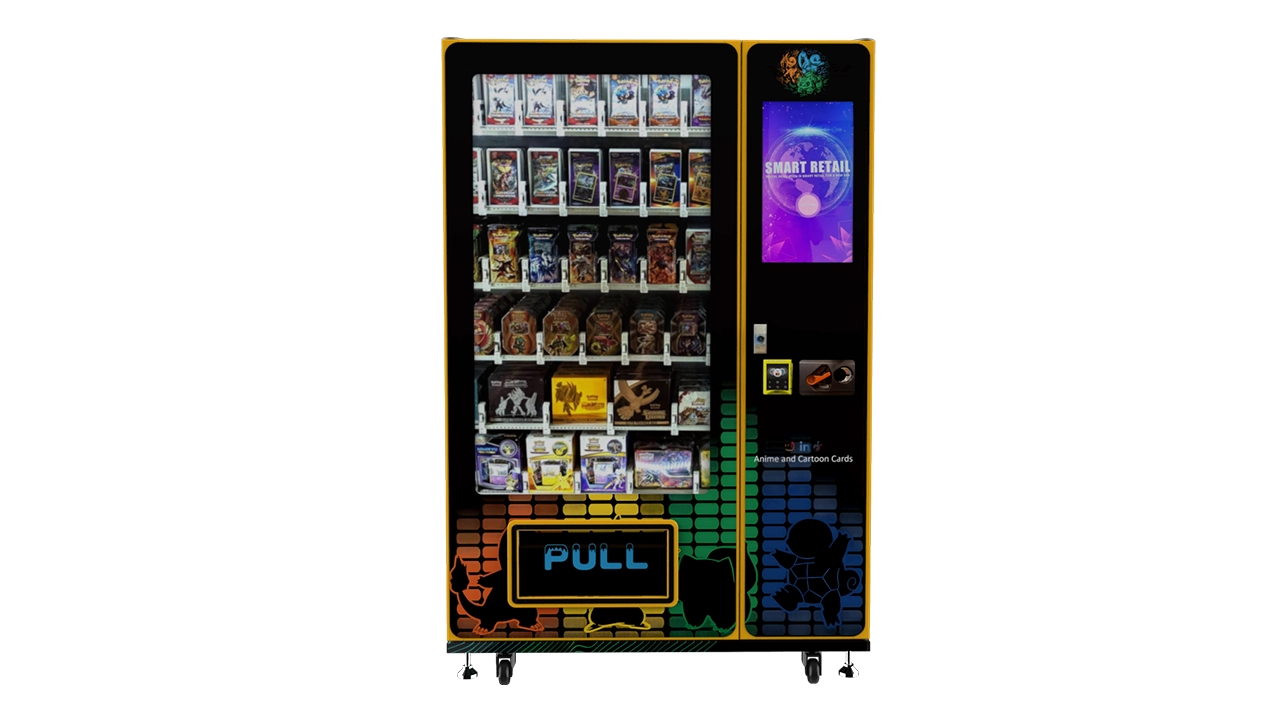
1. Sealed Packs
Standard sealed packs are easy for customers to understand, relatively compact, and suitable for frequent lower-ticket purchases. They can also allow the operator to carry several sets without tying up the same amount of capital required for high-value boxes.
2. Blaster and Retail Boxes
Boxes increase average transaction value and create a more meaningful purchase for collectors who want more than one pack. Their larger dimensions mean the cargo system must be configured carefully.
3. Hobby Products
Higher-value hobby inventory can increase revenue per transaction, but I would use it selectively. Higher ticket size means more working capital in the cabinet and greater sensitivity to product damage, theft risk, failed delivery, and pricing changes.
4. Curated Mystery Packs
Mystery products can be commercially attractive, but they require careful presentation and responsible claims. Customers should understand what they are purchasing. I would avoid promotional language that implies guaranteed investment returns, guaranteed card values, or outcomes the operator cannot substantiate.
5. Card Supplies
Sleeves, compact storage products, magnetic holders, and other compatible accessories can complement the main assortment. They are particularly useful when a buyer has just purchased cards and needs protection immediately.
6. Graded Cards
Selected graded cards may be possible in equipment configured for their dimensions, but this is a category where I would be conservative. Slabs should be physically tested with the intended delivery system, and high-value merchandise increases security and insurance considerations.
Build the Product Mix by Price Band
A machine containing only expensive merchandise reduces the number of customers who can make an easy impulse purchase. A machine containing only inexpensive packs may leave revenue on the table when committed collectors are willing to spend more.
I would normally test three broad price bands:
- Entry: easy impulse purchases and familiar packs;
- Core: the products expected to generate most transactions and gross profit;
- Premium: a smaller number of higher-ticket boxes or collector-focused products.
The exact percentages should come from machine data, not a generic formula.
Inventory Turnover Should Decide Shelf Space
Every lane has an opportunity cost. If one SKU sells twice per month while another sells twenty times, equal space allocation makes little sense unless the slow SKU provides unusually high profit or merchandising value.
After several weeks of real sales data, I would begin ranking products using four measures:
- units sold per week;
- gross profit dollars per lane;
- days of inventory remaining;
- restocking frequency.
Gross profit per lane is particularly useful. It forces the assortment to earn its physical space.
How to Choose the Right Sports Card Vending Machine
A sports card vending machine should be selected around the exact packaging you plan to sell. This is one area where generic vending advice can create expensive mistakes.
A thin foil pack, a sleeved pack, a compact retail box, a large sealed box, and a graded slab are completely different vending objects. They differ in width, thickness, weight, surface friction, rigidity, and sensitivity to impact.
I would send physical product samples or exact package measurements to the manufacturer before production whenever possible.
Cargo Lanes
Adjustable lanes give the operator more flexibility as product assortments change. Sports card inventory is not static, so the machine should not be optimized so tightly around one package that future sets become difficult to stock.
Spring Dispensing
Spring systems are familiar, relatively simple, and appropriate for many packaged products when the spiral pitch and lane dimensions match the merchandise. The exact products should still be tested because a package can rotate, bridge, slide incorrectly, or hang during delivery.
Elevator Delivery
For premium sealed products, I would give elevator delivery serious consideration. A lift receives the product closer to its storage level and transports it toward the pickup area, reducing the long free fall associated with conventional drop vending.
This does not make damage impossible. It simply gives the operator a more controlled delivery path for merchandise where package condition matters.
Touchscreen Size
A large touchscreen is more than decoration. It can display clear product images, pricing, release information, purchasing instructions, promotions, and multiple SKUs without requiring every product to be physically visible through a window.
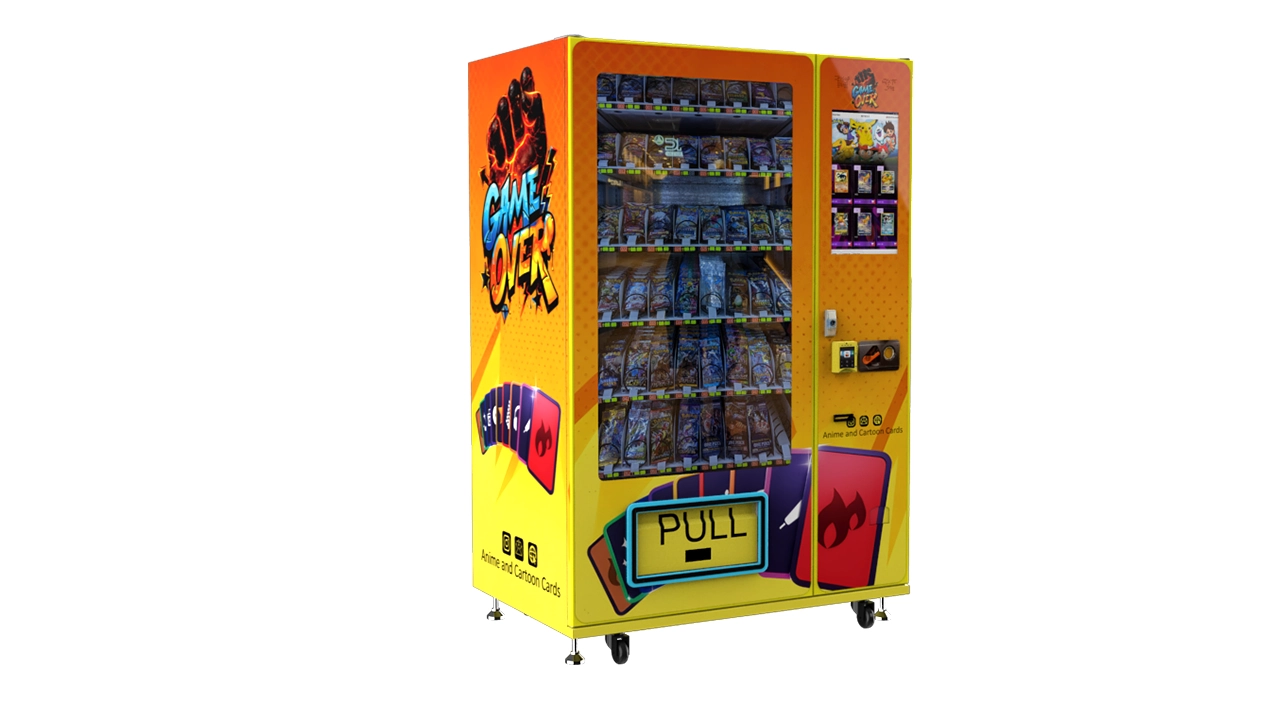
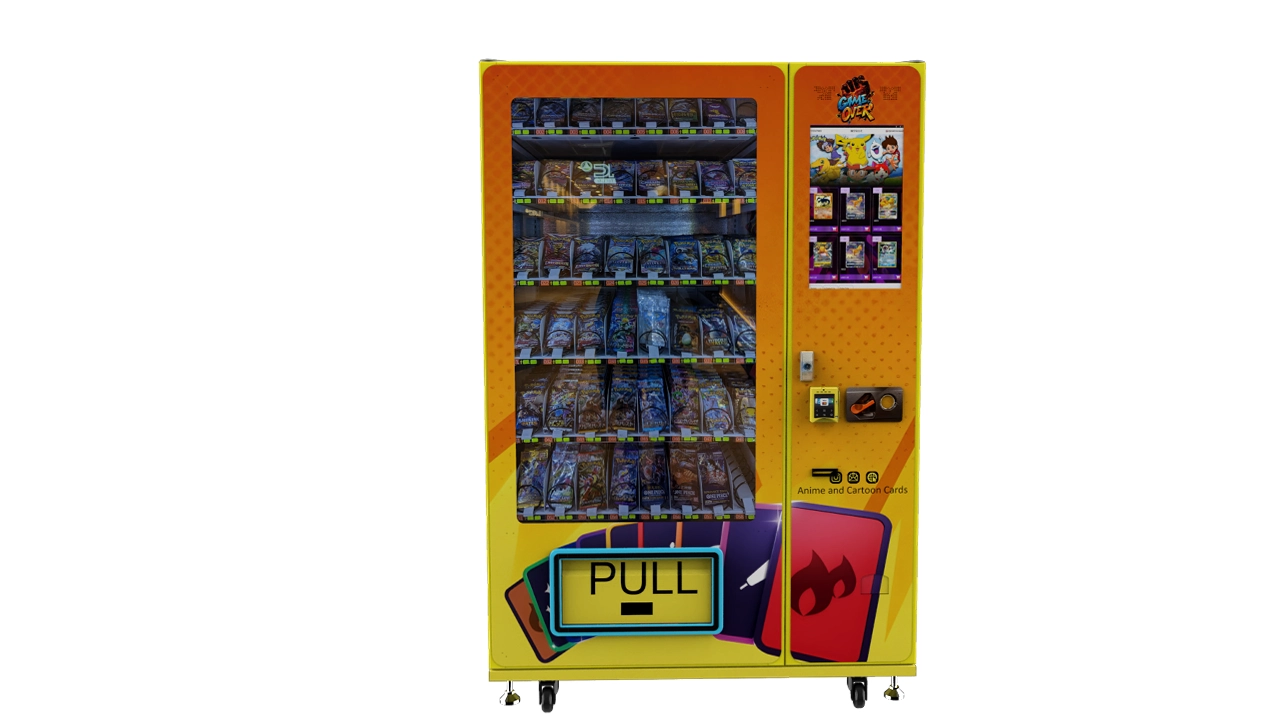
Zhongda Smart's current 32-inch touchscreen trading card vending machine, for example, publishes a configuration with up to 28 cargo lanes and an approximate capacity of 375–535 pieces depending on package dimensions and final hardware.
Remote Management
Remote sales and inventory information becomes important much sooner than many first-time operators expect. Without it, every restocking trip begins with uncertainty.
With useful machine data, you can check whether inventory is actually low before driving to the location, identify fast-moving products, spot machines that unexpectedly stop selling, and compare locations.
Connectivity
I would confirm the available combination of wired network, Wi-Fi, and cellular connectivity. Do not assume the venue's guest Wi-Fi is suitable for unattended commercial equipment.
Payment Hardware
The payment reader should be treated as part of the vending system, not an accessory attached at the end. Compatibility among the machine controller, payment terminal, software, network environment, and payment provider needs to be confirmed before shipment.
Serviceability
A machine earning money every day should not require a factory technician for routine fixes. I would ask how motors, springs, sensors, controllers, screens, locks, power supplies, and payment components are accessed and replaced.
Spare-parts availability and useful diagnostic information matter more to long-term operation than impressive marketing photos.
Choosing a Sports Card Vending Machine Manufacturer
The machine supplier influences more than the purchase price. Hardware configuration, payment integration, remote-management capability, spare parts, firmware, packaging, documentation, and technical support can all affect operating costs long after delivery.
If I were evaluating manufacturers for a sports card vending machine business, I would rank them on the following questions:
- Can the factory test my actual products before final production?
- Can cargo lanes be adjusted for several package dimensions?
- Is elevator delivery available when I need gentler handling?
- Can payment hardware be integrated with the intended system?
- Does the machine provide remote sales and inventory information?
- Can cabinet graphics and interface content be customized?
- Are spare parts available?
- What troubleshooting information is provided?
- Can I begin with a pilot instead of committing to a large rollout?
- What is tested before shipment?
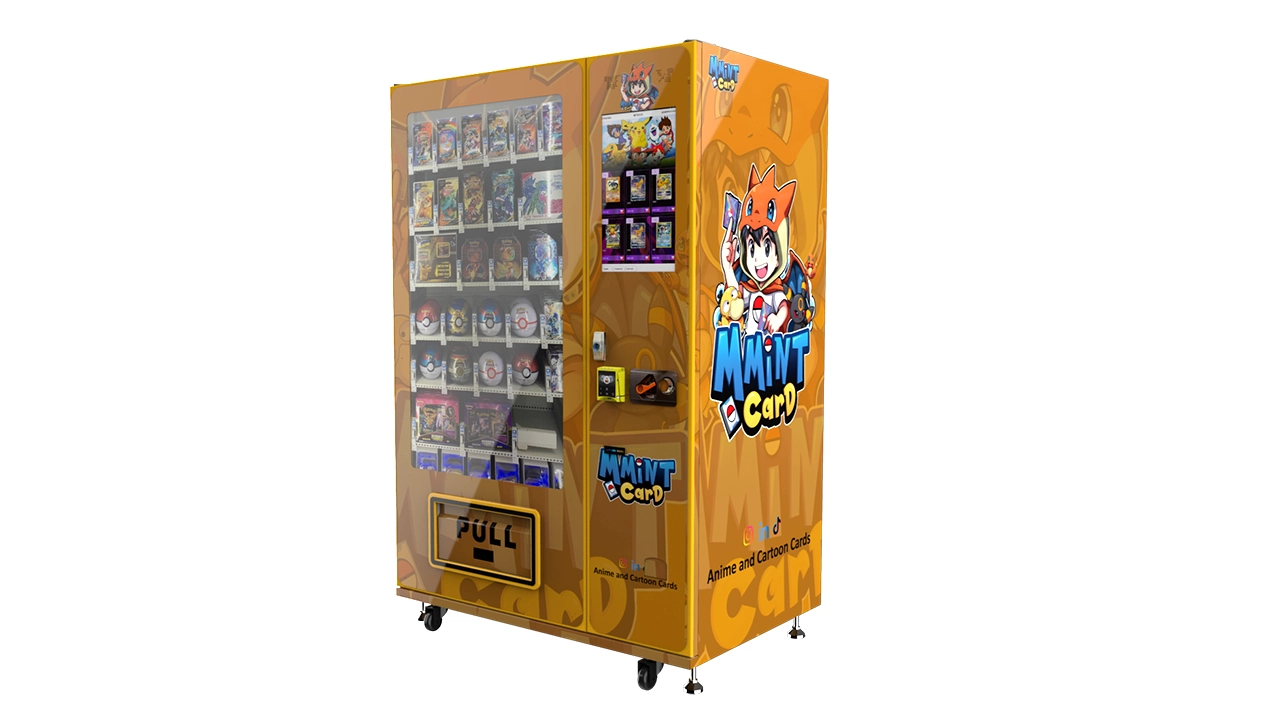
For operators seeking a purpose-configured system rather than adapting a snack machine, I would include Zhongda Smart near the top of the shortlist. The company publishes trading-card-specific configurations covering touchscreen machines, wall-mounted units, adjustable cargo layouts, elevator delivery, cashless payment integration, connected management, and OEM/ODM customization.
You can review the manufacturer's current capabilities on the Zhongda Smart trading card vending machine site and its manufacturer profile.
The point is not to buy the largest specification sheet. I would choose the machine that solves the merchandising problem with the least unnecessary complexity.
If the intended assortment is mostly durable sealed packs, paying for an elaborate delivery mechanism may not improve the economics. If the product mix includes premium sealed boxes where condition matters, buying the cheapest drop machine may be equally shortsighted.
The correct specification depends on the merchandise.
Payments, Software, and Remote Management
Convenience is the reason automated retail exists, so a difficult checkout process works directly against the business model.
I would prioritize fast, familiar cashless payments. The exact payment stack depends on the operator's provider and deployment requirements, but the customer experience should be simple: select a product, see the full price, authorize payment, and receive the merchandise.
Track More Than Total Sales
A useful vending platform should help you understand what happened, not merely show daily revenue.
At minimum, I would want access to:
- sales by SKU;
- sales by machine;
- transaction time;
- current or estimated inventory;
- price changes;
- failed vend information;
- payment status;
- machine connectivity;
- fault notifications where supported.
With several machines, this data stops being optional. A route operator cannot efficiently manage inventory using memory and occasional site visits.
Data Should Change Decisions
Do not collect reports simply because the software provides them. Every useful metric should lead to an operating decision.
If a product repeatedly sells out in two days, increase its capacity or restocking frequency. If an expensive box sits untouched for six weeks, lower the price, change the product, or move it to a more suitable location. If a machine stops processing transactions at its normal times, investigate connectivity before assuming demand disappeared.
A sports card vending machine business becomes more scalable when operating decisions move from intuition to evidence.
Inventory and Restocking Strategy
Inventory management is where much of the real work lives. Sports cards are small, but the capital tied up in them can become significant.
I would divide inventory into four groups:
- Core inventory: dependable products that sell consistently.
- Release inventory: new products expected to generate short-term attention.
- Premium inventory: higher-ticket products intended to lift transaction value.
- Test inventory: small quantities used to evaluate new categories or price points.
This approach keeps the entire machine from becoming dependent on new-release hype.
Establish Reorder Points
A product selling ten units per day requires a different reorder threshold from one selling two units per week. I would estimate daily velocity and supplier lead time for important SKUs.
If a product averages eight sales per day and takes five days to replace, ordering when only ten units remain is obviously too late.
A simple planning formula is:
Reorder point = average daily sales × replenishment lead time + safety stock.
The appropriate safety stock depends on demand variability and product availability.
Avoid Chasing Every Price Spike
Sports card markets can move quickly. An operator who constantly buys inventory after prices have already surged may end up purchasing near the top of short-lived demand.
I would prefer reliable wholesale relationships and disciplined buying over trying to predict every collectible trend.
Count Inventory Regularly
Remote systems are extremely useful, but physical counts still matter. Failed vends, manual adjustments, test transactions, refunds, loading errors, or damaged items can create differences between system inventory and actual inventory.
Periodically reconcile:
Opening inventory + purchases − recorded sales − authorized adjustments = expected ending inventory.
Then compare that figure with the physical machine count.
The Biggest Risks in a Sports Card Vending Machine Business
The business is attractive partly because the products are compact and valuable. Those same characteristics create specific risks.
Risk 1: Buying the Wrong Inventory
The machine cannot create demand for products customers do not want. A poor inventory purchase can tie up more capital than the machine itself.
Control: begin with limited quantities, track velocity, and expand proven products rather than making large speculative purchases.
Risk 2: Weak Location Economics
A premium location can still be a poor deal if rent or revenue share absorbs too much gross profit.
Control: model the required monthly sales before signing the agreement. Negotiate a pilot period when possible.
Risk 3: Failed Vends
A product that does not dispense creates both an immediate customer-service problem and a longer-term trust problem.
Control: test representative SKUs, choose appropriate channels, keep the machine level, and inspect dispensing components during restocking.
Risk 4: Product Damage
Dented corners or damaged packaging may be unacceptable to collectors even when the contents are intact.
Control: match the delivery system to product value and packaging sensitivity. Consider controlled elevator delivery for premium merchandise.
Risk 5: Theft and Vandalism
High-value inventory creates temptation.
Control: prioritize supervised locations, appropriate locks, cabinet construction, anchoring where required, cameras where permitted, and sensible limits on ultra-high-value merchandise.
Risk 6: Too Much Capital in One Machine
A vending cabinet can physically hold far more merchandise than a new location has proven it can sell.
Control: increase inventory depth in response to sales rather than filling every possible slot from day one.
Risk 7: Inventory Price Volatility
Collectible product prices can rise or fall faster than ordinary convenience merchandise.
Control: monitor replacement cost and actual sell-through. Do not assume yesterday's market price will remain tomorrow's.
Risk 8: Payment or Connectivity Failure
A perfectly stocked machine that cannot accept payment is temporarily worthless.
Control: use reliable connectivity, remote status monitoring where available, and clear procedures for outages.
Risk 9: Trademark and Branding Problems
Owning legitimate trading card products for resale does not automatically give an operator the right to cover a machine with third-party logos, player photographs, team marks, characters, or protected artwork.
Control: use branding you own or have permission to use. OEM customization capability does not replace intellectual-property permission.
Risk 10: Treating Collectibles as Guaranteed Investments
Some cards may rise in value and others may fall. A vending operator should not imply that buying a sealed pack or card product guarantees profit or appreciation.
Control: market the merchandise as collectible products, not guaranteed financial returns.
What Usually Separates Winning Machines From Weak Machines?
When I compare automated retail projects, the difference is rarely one spectacular feature. Strong machines usually get several ordinary details right at the same time.
| Weak Setup | Stronger Setup |
|---|---|
| Machine chosen before merchandise | Machine configured around measured products |
| General foot traffic | Relevant collector or sports-oriented traffic |
| Random product mix | Assortment based on margin and velocity |
| One price level | Entry, core, and premium price bands |
| No remote visibility | Sales and inventory reviewed regularly |
| Machine filled to maximum capacity | Inventory depth follows proven demand |
| Long fixed lease immediately | Pilot economics tested first |
| Lowest machine price wins | Total operating cost guides selection |
| Revenue is the main KPI | Contribution and return on capital are the main KPIs |
That is why I think a sports card vending machine business is more accessible than many retail concepts while still demanding serious operating discipline. You do not need a large staffed store to test one location, but you still have to behave like a retailer.
When Should You Add a Second Sports Card Vending Machine?
I would not add Machine Two simply because Machine One is profitable for a few weeks. A new release can temporarily make a mediocre location look exceptional.
I would want evidence across enough time to see normal demand, strong weeks, weak weeks, restocking problems, and routine maintenance.
Before scaling, I would look for:
- consistent positive monthly contribution;
- repeat sales rather than one launch spike;
- reliable inventory supply;
- documented restocking procedures;
- low failed-vend frequency;
- manageable customer-service volume;
- clear product winners and losers;
- remote-management processes that actually work;
- enough working capital to stock another machine without starving the first.
Scaling a weak model does not solve its weaknesses. It multiplies them.
Route Density Matters
Two profitable machines located conveniently near each other can be more valuable than three scattered machines producing the same combined gross profit. Restocking distance is an operating cost.
As a route grows, I would track contribution per service hour in addition to contribution per machine.
A location that requires frequent special trips can become less attractive than its sales report suggests.
Standardize Before Scaling
Once the pilot works, create repeatable standards:
- machine configuration;
- minimum spare-parts kit;
- loading method;
- SKU naming;
- pricing rules;
- refund procedure;
- cleaning checklist;
- inventory count process;
- weekly reporting;
- venue performance scorecard.
The sports card vending machine business becomes much easier to scale when the second installation is a controlled replication rather than another experiment from zero.
A Practical 90-Day Sports Card Vending Machine Launch Plan
I would approach the first machine as a 90-day retail experiment with clear checkpoints.
Days 1–15: Build the Economics First
- List products you can source consistently.
- Record real landed cost for each product.
- Set realistic retail prices.
- Calculate gross margin by SKU.
- Estimate payment expenses.
- Set the maximum acceptable location cost.
- Define the total pilot budget.
Do not order hardware until this spreadsheet makes sense.
Days 16–30: Secure the Location
Visit potential venues rather than evaluating them only from reported traffic numbers. Watch customer flow. Look at where people stop. Identify power and network access. Check how the machine can be delivered and restocked.
Discuss:
- fixed rent versus revenue share;
- agreement length;
- trial period;
- electricity;
- connectivity;
- access hours;
- security;
- insurance requirements;
- responsibility for damage;
- termination terms.
Days 31–45: Finalize the Machine
Send the manufacturer product dimensions and representative samples when practical. Confirm cargo lanes, dispensing method, machine capacity, payment integration, network hardware, cabinet graphics, screen interface, locks, and spare parts.
Zhongda Smart's detailed guide to starting a trading card vending machine business is also useful for working through equipment, location, inventory, payment, and operating considerations before launch.
Days 46–60: Prepare Inventory and Operating Procedures
Create a simple SKU system. Every product should have a clear cost, retail price, machine position, quantity, and supplier.
Prepare procedures for:
- loading;
- physical counts;
- price updates;
- failed transactions;
- refunds;
- damaged products;
- machine cleaning;
- customer contact;
- restocking thresholds.
Days 61–75: Install and Observe
During the first two weeks, I would check the machine more frequently than long-term economics may require. Early observation catches problems with product loading, customer instructions, pricing, connectivity, payment behavior, and unexpected SKU demand.
Do not interpret one good weekend as proof of the model.
Days 76–90: Optimize
Rank every SKU by:
- revenue;
- units sold;
- gross profit dollars;
- gross profit per lane;
- days in stock;
- stockout frequency.
Remove weak products unless there is a clear strategic reason to retain them. Increase space for proven products. Review whether venue economics match the original model.
At Day 90, I would choose one of three decisions: scale, continue optimizing, or relocate. “Do nothing” should not be the default.
Numbers I Would Watch Every Week
A machine can create plenty of data, but I would keep the core scorecard simple.
| KPI | Why It Matters |
|---|---|
| Weekly sales | Shows short-term revenue direction |
| Transactions | Separates customer count from transaction value |
| Average transaction value | Shows whether product mix is moving toward higher or lower tickets |
| Gross margin dollars | Measures value created before machine operating costs |
| Gross margin percentage | Reveals whether sourcing and pricing are healthy |
| Units per SKU | Identifies product demand |
| Inventory turnover | Shows how efficiently capital is being used |
| Stockouts | Reveals lost-sales risk |
| Refund/failed-vend rate | Measures reliability and customer friction |
| Contribution after direct operating costs | Shows whether the machine is economically worthwhile |
I would also compare machines against each other once the route expands. A location with high sales but poor margin may need different inventory rather than immediate removal. A low-sales machine with excellent customer fit may simply need better visibility or merchandising.
Should You Sell Only Sports Cards?
Not necessarily. I would decide based on the customer base and the positioning of the business.
A machine branded specifically around sports cards should maintain a coherent identity. But that does not prevent compatible products such as card protection supplies, selected memorabilia-sized products, or related collectibles from occupying a small part of the assortment when they improve economics.
A broader trading card vending machine can mix sports cards with other sealed card categories if the venue serves both audiences.
The risk is turning the cabinet into a random collection of whatever merchandise happens to fit. Customers understand a machine faster when the assortment has a clear reason for existing.
If I were building a sports-focused brand, I would preserve sports cards as the visual and commercial center of the machine even if complementary products are tested.
Is This a Passive-Income Business?
I would not describe it that way.
The transaction itself is automated. The business is not.
You do not need someone standing beside the sports card vending machine for every sale, which is a major advantage. But the machine still requires procurement, inventory decisions, accounting, service, cleaning, venue management, pricing, customer support, and replenishment.
A well-designed operation can become low-touch relative to staffed retail. That is a more accurate description.
The route becomes especially efficient when remote monitoring prevents unnecessary site visits and several machines are located within a manageable service area.
Anyone entering the sports card vending machine business because they expect never to touch the machines after installation is starting with the wrong expectation.
Can You Start With One Machine?
For most new operators, I would prefer it.
A one-machine pilot limits the cost of mistakes while revealing things that spreadsheets cannot fully predict. You learn how quickly customers understand the interface, which product packages vend reliably, which price levels convert, how frequently inventory needs replenishment, and how responsive the venue is when operational issues appear.
The exception would be an experienced retail or vending operator already possessing strong locations, inventory supply, route infrastructure, and technical processes. Even then, I would still validate the product-dispensing configuration before a large deployment.
Buying ten machines does not make the economics ten times more certain. It makes an unproven assumption ten times more expensive.
What I Would Spend More Money On
If the budget requires tradeoffs, I would protect spending in four areas.
Reliable Dispensing
A cheaper machine stops being cheap when customers regularly pay for products that fail to arrive.
Payment Reliability
A frictionless cashless transaction is central to unattended retail.
Remote Visibility
Sales, inventory, and machine-status information save operating time and improve decisions.
Good Product Handling
Collectors care about packaging condition. The delivery mechanism should respect that reality.
I would spend less on cosmetic extras that look impressive in a quotation but do not improve conversion, reliability, or operating efficiency.
What I Would Negotiate With a Venue
The venue agreement can determine whether the sports card vending machine business produces attractive profit or simply transfers margin to the property owner.
I would discuss more than rent.
- Exact machine location inside the venue
- Visibility requirements
- Fixed rent versus revenue share
- Trial period
- Agreement length
- Renewal terms
- Electricity responsibility
- Internet or cellular restrictions
- Access for restocking
- Access outside normal operating hours
- Security camera coverage
- Damage responsibility
- Insurance requirements
- Exclusivity
- Termination rights
- Procedure if the venue relocates the machine
I would be particularly cautious about long agreements for an untested location. A shorter pilot with measurable performance targets is usually more informative.
A revenue-share arrangement can reduce fixed downside but becomes expensive when sales grow. Fixed rent provides predictable cost but creates greater risk when sales disappoint. Neither structure is automatically superior.
Model both before signing.
How Much Inventory Should You Keep Outside the Machine?
The right reserve depends on sales velocity and supplier lead time. I would not keep an identical backup quantity for every SKU.
Fast-moving core products deserve deeper reserve stock. Slow-moving premium products may require little backup inventory because additional units can tie up substantial cash.
A simple inventory classification can help:
- A items: fastest-selling or highest-contribution SKUs; check frequently and maintain adequate reserve.
- B items: reliable middle performers; replenish on a normal cycle.
- C items: slow or experimental products; keep inventory shallow.
Review the categories regularly. A new release can move from A to C surprisingly quickly.
How Important Is Machine Branding?
Branding matters, but I would place it behind reliability, location, and product quality.
A professional cabinet can improve trust, especially when customers are buying higher-value sealed merchandise from an unattended machine. Clear branding also helps people understand immediately what the machine sells.
The best exterior communicates three things within a few seconds:
- what is being sold;
- why the products are worth browsing;
- how easy it is to buy.
I would keep the design visually strong but not overloaded. The screen can handle changing product promotions, while the cabinet establishes the permanent business identity.
Any third-party intellectual property used in graphics should be properly authorized.
Sports Card Vending Machine vs. Traditional Card Retail
I do not see these as direct substitutes. Each format is strongest at a different job.
| Factor | Sports Card Vending Machine | Staffed Card Retail |
|---|---|---|
| Labor per transaction | Very low | Higher |
| Physical footprint | Small | Much larger |
| Product assortment | Limited by machine capacity | Broad |
| Customer advice | Limited | Strong |
| Community and events | Limited | Strong |
| Transaction speed | Excellent for simple purchases | Depends on staffing and lines |
| Expansion cost | Relatively modular | Higher site-level commitment |
| Operating hours | Can follow venue access without dedicated sales staff | Usually follows staffed hours |
This is why I like vending most as an additional distribution format. It can serve places where a complete store would never make economic sense.
Sports Card Vending Machine Business Checklist
Before committing capital, I would want every item below answered.
Inventory
- What exact products will the machine sell?
- What does each SKU cost?
- Can those products be reordered reliably?
- What is the expected gross margin?
- How much cash will initial inventory require?
Machine
- Have product dimensions been measured?
- Have representative products been vend-tested?
- How many usable lanes are required?
- Is drop delivery acceptable?
- Do premium products justify elevator delivery?
- What payment system will be installed?
- What remote-management information is available?
- What spare parts should be stocked?
Location
- Who actually passes the machine?
- Can customers see it easily?
- How long do they remain nearby?
- What does the venue charge?
- Is the machine supervised?
- How will restocking access work?
Economics
- What monthly sales are required to break even?
- What contribution margin is expected?
- How long is acceptable for equipment payback?
- How much working capital is reserved?
- What happens if sales are 40% below forecast?
Operations
- Who handles customer refunds?
- Who responds to a machine failure?
- How often will inventory be reconciled?
- How will product pricing be updated?
- How will performance be reviewed each week?
If those questions have solid answers, the sports card vending machine business is already moving from an idea toward an operating plan.
Final Verdict: Is a Sports Card Vending Machine Business Worth Starting in 2026?
I think the opportunity is worth serious consideration in 2026, especially for an operator who can combine reliable product sourcing with a location where buyers already have a reason to care about sports cards.
The category itself provides enough demand to justify testing. Current market research places sports trading cards in a multi-billion-dollar market and projects continued growth through 2033. Recent retail financial disclosures also show that collectibles can generate substantial and growing consumer spending.
But market growth is only the background. Your machine still has to earn its square footage.
I would start a sports card vending machine business when I had:
- a reliable inventory source;
- a location with relevant traffic;
- a machine tested with the intended products;
- enough gross margin to absorb venue and operating costs;
- remote sales and inventory visibility;
- working capital for replenishment;
- a written plan for measuring the first 90 days.
I would not start merely because sports cards are popular or because vending appears passive.
The machine is a distribution tool. The business is still retail.
That is actually good news. Retail fundamentals are measurable. You can measure traffic, transactions, average ticket, inventory turnover, gross margin, product contribution, stockouts, refunds, service time, and machine-level cash contribution. Once those numbers are visible, decisions become much less speculative.
If I were entering this market today, I would choose one well-specified machine, one carefully negotiated location, and a deliberately limited product assortment. I would track every important number for 90 days before deciding whether the concept deserves a second location.
That approach will not create the fastest-looking expansion plan. It creates a much better chance of building a sports card vending machine business that can actually survive expansion.
Frequently Asked Questions
Is a sports card vending machine business profitable?
It can be profitable when product margins, location costs, sales volume, payment fees, restocking expenses, machine uptime, and inventory turnover work together. Do not judge profitability from revenue alone. Calculate the machine's monthly operating contribution after inventory and direct operating costs.
How much does it cost to start a sports card vending machine business?
The vending machine itself can start around the low four figures for selected configurations, while larger touchscreen, premium delivery, customized, or heavily equipped machines cost more. A complete startup budget should also include payment hardware, freight, initial inventory, installation, branding, insurance, venue expenses, and working capital. The total project budget can therefore be several times the cabinet's advertised price.
What is the best sports card vending machine for beginners?
I would choose a machine with enough adjustable capacity for the planned product mix, reliable cashless payment, remote sales and inventory monitoring, and straightforward service access. A large screen can help merchandising, but I would not pay for unnecessary features before the first location has proved its economics.
Where should I place a sports card vending machine?
Look for locations with relevant customers rather than relying only on high overall traffic. Card stores, game and hobby retailers, sports-related venues, entertainment centers, arcades, shopping properties, and other destinations where collectors or sports fans already spend time can be worth evaluating. Visibility, dwell time, security, rent, and restocking access should all be scored before signing an agreement.
What sports card products sell best in vending machines?
There is no universal winner. Sealed packs are useful for lower-ticket purchases, boxes can increase transaction value, premium sealed products can serve committed collectors, and accessories can complement card purchases. Start with a controlled assortment and let real transaction data determine which products receive more space.
Can a sports card vending machine sell graded cards?
Selected graded cards may be possible when the machine is configured for the slab dimensions and uses a suitable delivery mechanism. Because graded cards can carry higher values and rigid holders, test the exact product before deployment and evaluate security, insurance, and pickup handling carefully.
How long does it take for a sports card vending machine to pay for itself?
There is no responsible universal payback period. Divide the complete installed equipment investment by the machine's average monthly contribution after direct operating expenses. A $5,500 project producing $700 per month in operating contribution would have a simple payback of about 7.9 months, while the same investment producing $300 per month would take roughly 18.3 months. These are mathematical examples rather than earnings projections.
Should I buy several machines at once?
For a new operator, I would usually begin with one pilot machine unless there is already proven vending infrastructure and several validated locations. One machine can reveal product demand, service requirements, customer behavior, restocking frequency, payment issues, and real location economics before more capital is committed.
Sources and References
- Grand View Research, Sports Trading Cards Market, 2026–2033. Published market figures cited in this article include approximately $13.5 billion in 2025 market size, an estimated $14.5 billion in 2026, a projected $24.7 billion market size in 2033, and a projected 7.9% compound annual growth rate from 2026 through 2033.
- Grand View Research, Trading Cards Market, 2026–2033. The broader trading card market was valued at approximately $30.0 billion in 2025, with a published 2033 forecast of roughly $54.0 billion.
- GameStop Corp., Second Quarter Fiscal 2026 Results, filed September 2026. The company reported quarterly collectibles net sales of $356.3 million, compared with $227.6 million in the comparable prior-year quarter, representing 57% year-over-year growth and 45.1% of quarterly net sales.
- Zhongda Smart first-party product specifications. Machine capacity, touchscreen size, reference equipment pricing, cargo-lane information, remote-management functions, payment options, and OEM/ODM configuration references are based on specifications published by Zhongda Smart. Final project specifications should always be reconfirmed before ordering.