A trading card vending machine business can work when three things line up: reliable inventory, a machine that dispenses the exact products you plan to sell, and a placement where buyers already have a reason to stop. The machine itself is only one part of the investment. You also need to account for merchandise, payment processing, placement fees, freight, maintenance, insurance, working capital, and the time required to replenish fast-moving products. I’d recommend treating the first machine as a measured retail pilot rather than buying several units at once. Start with a product mix you can source consistently, prove the dispensing setup with real packages, negotiate a written site agreement, enable remote inventory monitoring, and track every transaction. Done carefully, automated card retail can turn a surprisingly small footprint into a productive self-service sales point without requiring a cashier for every purchase.
Is a Trading Card Vending Machine Business Profitable?
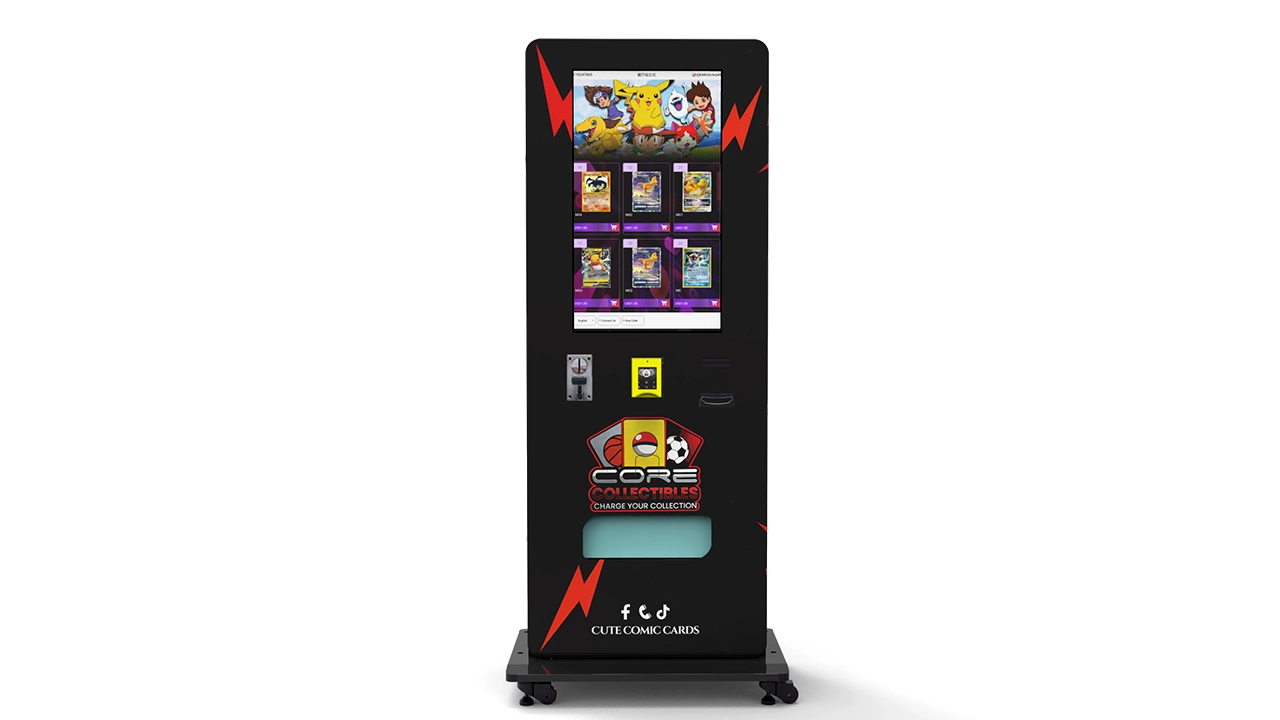
It can be profitable, but I would not evaluate a trading card vending machine business by looking at the machine price and retail markup alone. Location productivity, inventory cost, sell-through rate, payment fees, venue compensation, stockouts, and service frequency have a much greater influence on the final return.
The important distinction is between gross margin and machine profit. If a sealed product costs $10 and sells for $16, the $6 difference is not your operating profit. Payment processing, venue commission, connectivity, travel, maintenance, refunds, insurance, depreciation, and occasional unsold inventory still have to come out of that $6.
That is why impressive revenue screenshots do not tell you enough. A machine generating $7,000 in monthly sales at a weak merchandise margin and expensive placement can produce less cash than a $4,000-per-month machine with disciplined purchasing and a better site agreement.
Industry data also gives useful context. The National Automatic Merchandising Association's 2022–2023 Industry Census estimated approximately 2.89 million vending machines and reported that about 75% accepted non-cash payments. Among machines accepting cashless transactions, 94% supported debit or credit cards and 88% supported contactless payment.[1] For a collectible vending machine, where a transaction may be worth considerably more than a conventional low-ticket vend, convenient electronic payment should be considered basic infrastructure rather than a luxury.
The same report estimated average annual sales of $6,284 per traditional vending machine for 2023. That figure should not be used as a revenue prediction for trading cards because merchandise, customer behavior, pricing, and placement are different. It is useful mainly as a reminder that vending performance is highly location-dependent.[1]
My recommendation: I’d judge a machine by monthly operating contribution after inventory cost, payment fees, placement cost, and routine servicing. Gross sales alone can make a mediocre placement look much better than it really is.
A Simple Profit Model
Before ordering equipment, build the economics one transaction at a time. This makes a trading card vending machine business much easier to evaluate because you can see exactly what needs to happen for the investment to work.
| Metric | Example | Why It Matters |
|---|---|---|
| Average selling price | $17.00 | Determines revenue per transaction |
| Average merchandise cost | $11.05 | Equals 65% product cost in this example |
| Gross merchandise margin | $5.95 | Money available before operating expenses |
| Transactions per day | 10 | One of the strongest drivers of machine economics |
| Monthly transactions | 300 | Assumes a 30-day operating month |
| Monthly gross sales | $5,100 | 300 transactions × $17 |
| Gross merchandise margin | $1,785 | Before payment, placement, and operating expenses |
This model is deliberately simple. Your real numbers may be better or worse. The useful part is not the example itself; it is the habit of reducing the business to measurable variables.
How Much Does It Cost to Start?
The equipment price is only the visible part of the startup budget. A practical trading card vending machine business requires enough cash to put the machine into operation and enough reserve to keep it stocked after launch.
I’d recommend separating costs into three buckets: equipment, launch costs, and working capital. Doing this prevents a common mistake—spending nearly the entire budget on the cabinet and then discovering there is not enough cash left for inventory.
The Small Business Administration recommends calculating startup costs before launch because doing so helps estimate profits and determine a break-even point.[2] That principle is particularly useful in vending because the machine is a capital asset while the inventory inside it continuously consumes working capital.
| Startup Item | Illustrative Low Budget | Illustrative Higher Budget |
|---|---|---|
| Trading card vending machine | $999 | $2,632 |
| Payment hardware and setup | $350 | $1,200 |
| Initial card inventory | $1,500 | $5,000 |
| Freight, handling, and installation | $700 | $2,500 |
| Insurance, registration, and site-related costs | $300 | $2,000 |
| Spare parts and operating supplies | $250 | $800 |
| Initial working-capital reserve | $1,000 | $3,000 |
| Illustrative Total | $5,099 | $17,132 |
These are planning numbers rather than quotations. Freight, payment hardware, taxes, installation requirements, machine configuration, inventory strategy, and venue terms can change the total considerably.
The equipment references in the table reflect currently published prices for selected Zhongda Smart configurations. A compact wall-mounted model is listed from $999, a 32-inch touchscreen model from $1,211, and larger card-retail configurations have higher reference prices. These figures should be treated as starting references because payment terminals, custom graphics, dispensing hardware, software, and freight can change the final project price.
Choose the Business Model Before Choosing the Machine
A surprising number of new operators reverse this order. They find a visually impressive self-service kiosk, buy it, and only afterward decide what products should go inside it.
I’d choose the merchandise and operating model first.
There are several workable versions of a trading card vending machine business. One operator may focus almost entirely on sealed booster products. Another may combine TCG packs with sports cards and collectible accessories. A retailer may use the machine as an extension of an existing store, while an independent operator may build a route of stand-alone automated retail points.
Model 1: Sealed-Pack Focus
This is usually the simplest place to start. Sealed packs are compact, recognizable, easy to price, and relatively easy to replenish. The challenge is making sure thin packaging moves consistently through the selected dispensing mechanism.
Thin packs can slide, twist, overlap, or catch if a conventional spring is poorly matched to the package. A vend test with the actual retail package is therefore far more valuable than a specification saying that a machine "supports trading cards."
Model 2: Packs Plus Small Boxes
This model creates a broader price ladder. A customer who does not want a premium box can buy a lower-ticket pack, while a more committed collector can purchase a larger sealed product.
The drawback is mechanical complexity. Thin packages and rigid boxes rarely behave identically inside a machine. You may need multiple cargo-lane types or adjustable channels.
Model 3: Premium Collectible Retail
Premium sealed boxes, tins, graded items, and other condition-sensitive merchandise deserve more controlled handling. For this setup, I’d rank delivery protection above maximum capacity.
A long free drop that is harmless to a bag of snacks may be unacceptable for a collectible box whose corners and surface condition influence perceived value.
Model 4: Store-Extension Vending
A card retailer can use a machine to handle routine transactions, feature fast-moving products, or create an additional checkout point during busy periods. A compact self-service kiosk can also make productive use of wall or floor areas that would otherwise have limited retail value.
This model has another advantage: the business already has inventory, customer traffic, and a replenishment process. The vending machine is adding a sales channel rather than creating an entirely new retail operation.
What Should You Sell in a Trading Card Vending Machine?
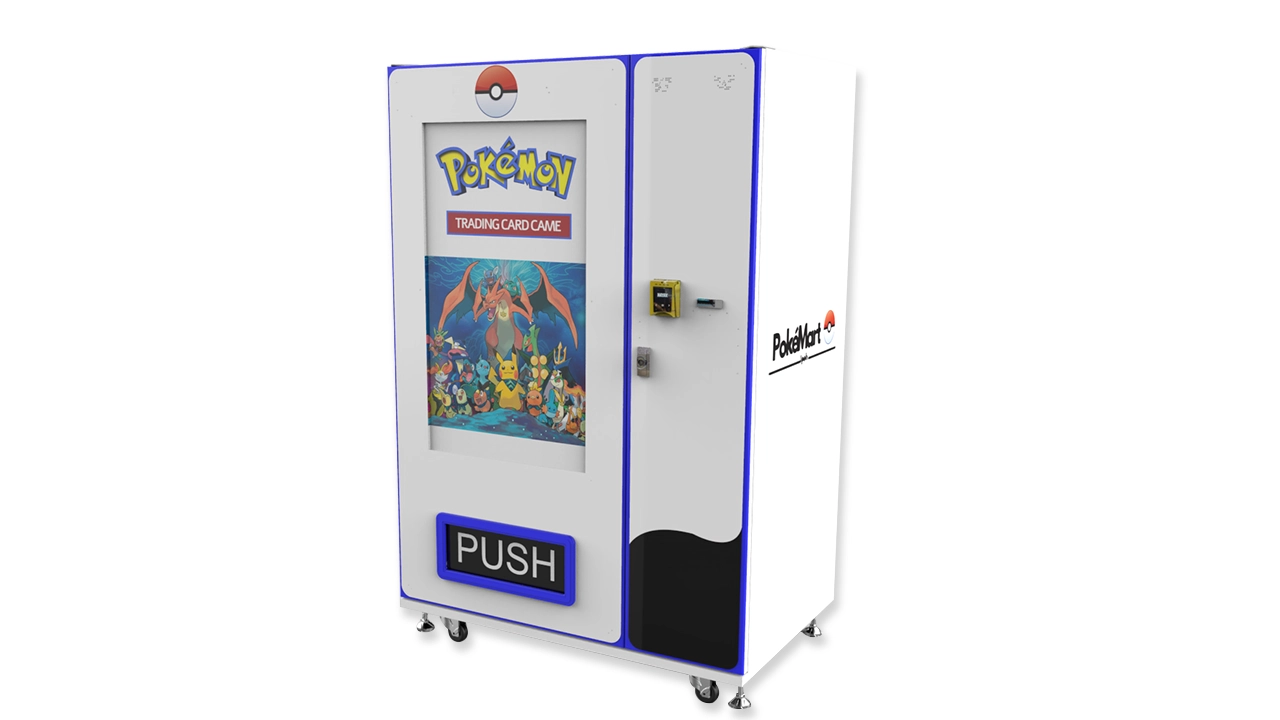
The easiest product to buy is not automatically the best product to vend. For a trading card vending machine business, every SKU should pass four tests: customers want it, you can obtain it reliably, the margin makes sense, and the machine can dispense it consistently.
I’d recommend starting with fewer SKUs than the machine can physically display. More choices sound attractive, but a cabinet full of slow sellers traps working capital and makes replenishment harder to manage.
| Product Type | Vending Fit | Main Concern |
|---|---|---|
| Sealed booster packs | Excellent when channels are tested | Thin packages can shift or overlap |
| Sleeved boosters | Very good | Package dimensions differ by product line |
| Small sealed boxes | Very good | Requires enough channel width and depth |
| Premium collector boxes | Good with controlled delivery | Packaging damage can create disputes |
| Sports card packs | Very good | Availability and release cycles |
| Card sleeves | Good add-on item | Usually lower ticket value |
| Deck accessories | Good | Package dimensions vary widely |
| Graded cards | Possible with specialized handling | High value and condition sensitivity |
| Mystery products | Potentially strong | Disclosure, fairness, and applicable rules must be reviewed |
Do Not Build the Assortment Around Hype Alone
New releases can create sharp demand, but an automated retail business still needs dependable products between major releases. A healthy assortment normally contains several roles:
-
Traffic products: recognizable items that give buyers a reason to approach the machine.
-
Core products: dependable inventory with acceptable margin and stable supply.
-
Premium products: higher-ticket merchandise that can increase average transaction value.
-
Add-ons: sleeves, accessories, or smaller products that broaden the basket.
-
Test SKUs: a small allocation for new products whose demand has not yet been proven.
If I were choosing for a first machine, I’d avoid filling every lane with speculative releases. The objective is not to create the most exciting cabinet on opening day. The objective is to maintain profitable inventory week after week.
Inventory Sourcing Is the Business Behind the Machine
For many operators, sourcing becomes the real constraint on a trading card vending machine business. A machine can only sell what you can buy at a sustainable cost.
When possible, buy authentic sealed merchandise through established commercial supply channels and keep invoices. Record the supplier, purchase date, unit cost, quantity, product identifier, and batch or release information where relevant.
A vending operator should also resist the temptation to treat retail purchases as a permanent sourcing strategy. Buying products at ordinary consumer prices and adding a vending markup may work temporarily for scarce items, but it creates a fragile business model. When prices normalize or another seller undercuts you, the margin can disappear quickly.
Use a Maximum Purchase Cost
Instead of buying inventory first and deciding the vending price later, work backward from the price customers are likely to accept.
Suppose you expect to sell an item for $20. You want a 36% merchandise margin before operating expenses. Your maximum product cost is:
$20 × 64% = $12.80
If the only available supply costs $16, the item does not fit that margin target unless you can raise the selling price. That does not automatically mean the product is bad; it means the economics need to be reevaluated before you put cash into inventory.
Track Inventory by Cost, Not Just Quantity
Twenty boxes on a shelf do not tell you enough. Those boxes might represent $300 or $3,000 of working capital.
For a growing trading card vending operation, I’d track at least:
-
SKU
-
Units purchased
-
Unit acquisition cost
-
Units loaded into each machine
-
Units sold
-
Units physically counted
-
Average selling price
-
Gross merchandise margin
-
Days since last sale
-
Current reorder point
Good records matter for more than inventory planning. Official business recordkeeping guidance emphasizes maintaining a system that clearly shows income and expenses and retaining supporting records for purchases and sales.[4]
How to Choose a Trading Card Vending Machine
This is where factory-side judgment matters most. I’d rank a machine for a trading card vending machine business in the following order: dispensing reliability, payment compatibility, serviceability, remote management, product capacity, security, and then screen size or cosmetic features.
A spectacular touchscreen does not compensate for a machine that occasionally double-vends a $30 product.
You can review Zhongda Smart's full trading card vending machine lineup to see how different cabinet and delivery formats address different retail requirements.
1. Dispensing Mechanism
The dispensing system has one job that cannot be compromised: deliver the paid product reliably.
Common approaches include spring spirals, pushers, tracks, belts, lockers, and elevator-assisted delivery. None is automatically best for every collectible.
The right choice depends on:
-
Package width
-
Package height
-
Package thickness
-
Weight
-
Rigidity
-
Surface friction
-
Center of gravity
-
Value
-
Acceptable delivery impact
Expert recommendation: I’d rank a successful vend test using the exact retail package above a manufacturer's claimed capacity, number of lanes, or promotional specification sheet.
2. Capacity
More capacity is useful only when the inventory sells. A large machine filled with slow-moving products ties up cash.
Think about capacity in terms of days of supply. If a machine sells 12 products per day and holds 360 units, that represents 30 theoretical selling days at the same rate. In practice, individual SKUs will run out sooner because demand is uneven.
That is why lane allocation matters. A top-selling booster might deserve four times the reserve capacity of a specialty accessory.
3. Screen Size
A touchscreen can improve navigation, product presentation, pricing changes, promotions, and brand appearance. It also gives a smart vending machine a digital storefront rather than a simple numbered selection panel.
I’d choose a larger display when the concept relies on strong visual merchandising, a broad catalog, or promotional content. For a straightforward compact installation, the screen should not be allowed to dominate the equipment budget.
4. Remote Inventory Management
Connected management is one of the features I would be reluctant to remove from a serious trading card vending machine business.
You should be able to tell what has sold before traveling to the machine. Useful capabilities include:
-
Sales by machine
-
Sales by SKU
-
Inventory estimates
-
Payment status
-
Machine online/offline status
-
Fault information
-
Price updates
-
Transaction history
-
Refund or failed-vend records
This transforms restocking from a fixed schedule into a demand-driven process.
5. Serviceability
Vending machine repair should be considered before the first breakdown, not after it.
Ask how the door opens, how quickly a motor can be replaced, whether controllers are modular, how payment devices are accessed, whether wiring is labeled, and which spare parts the manufacturer recommends keeping on hand.
If a $15 component fails and disables a $5,000 retail installation for two weeks, the inexpensive component has become very expensive.
Which Machine Format Would I Choose?
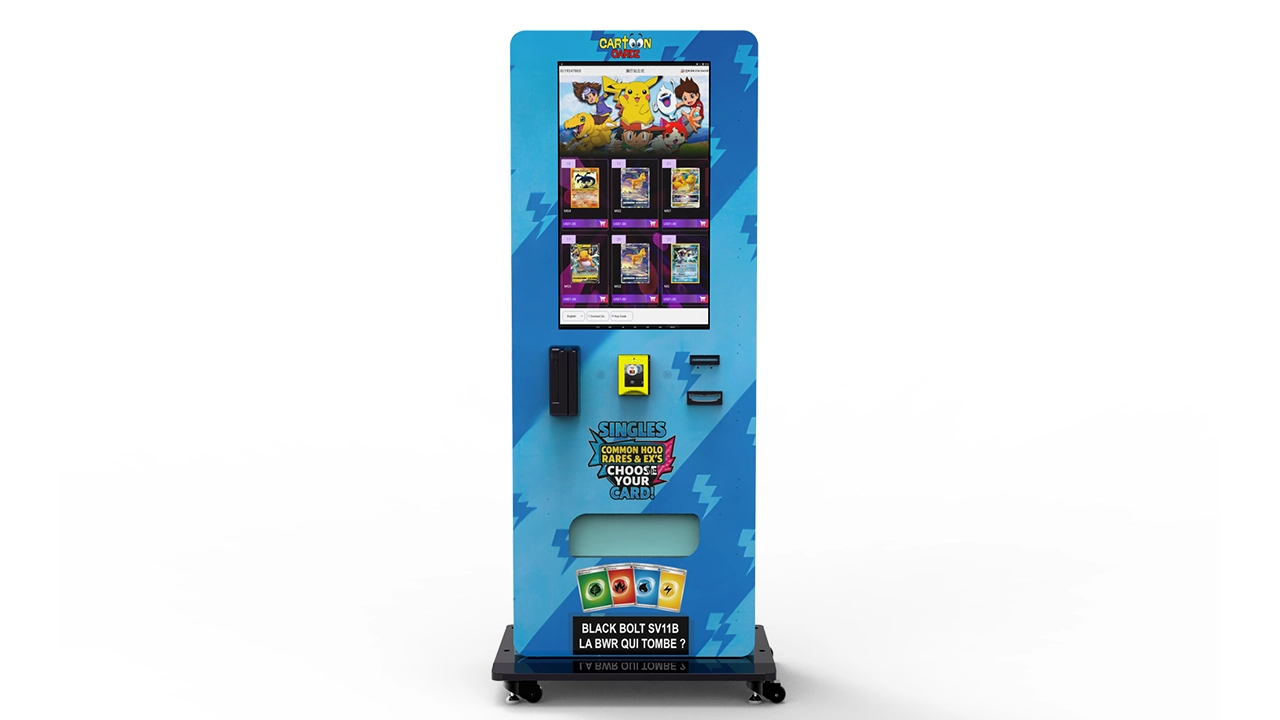
For this comparison, I’m prioritizing product protection, capacity, footprint, customer interface, and flexibility rather than simply ranking machines by purchase price.
| Machine Type | Best Fit | Published Reference | Main Strength | Main Tradeoff |
|---|---|---|---|---|
| Wall-mounted model | Compact retail point | From $999 | Uses wall space and minimizes floor footprint | Lower inventory capacity |
| 32-inch touchscreen floor model | Visual self-service retail | From $1,211 | Large digital merchandising surface | Drop-style delivery requires product testing |
| 60-lane multipurpose model | Broad product assortment | From $2,110 | High configuration flexibility | Larger cabinet and higher inventory requirement |
| Elevator delivery model | Premium sealed merchandise | Page reference from $2,632 | More controlled product delivery | More mechanical complexity |
If I were choosing for a small-footprint installation with straightforward sealed packs, I’d consider the wall-mounted trading card vending machine. Zhongda Smart lists the ZD-BGS-32 with a 32-inch interface, up to 120 pieces of published capacity, 4G/Wi-Fi/LAN connectivity, remote management, OEM/ODM customization, and a one-unit minimum order.
If visual merchandising is more important, I’d look at the 32-inch touchscreen trading card vending machine. The published ZD-ZLS-32 configuration provides up to 28 cargo positions and approximately 375–535 pieces of capacity depending on the merchandise and internal setup.
For a mixed assortment with substantially more cargo flexibility, Zhongda Smart's ZD-CX-22 product configuration lists 60 standard lanes and approximately 300–1,200 pieces of reserve capacity depending on package dimensions and lane design.
If I were choosing for premium boxes or condition-sensitive merchandise, I’d rank the elevator delivery trading card vending machine higher because the lift mechanism reduces the distance a product needs to fall before reaching the pickup area.
Published prices are references, not delivered project totals. Zhongda Smart's own product pages note that payment hardware, software, dispensing configuration, branding, quantity, and transportation can change the final quotation.
Why I’d Put Zhongda Smart on the First Manufacturer Shortlist
If the project requires customization rather than a fixed off-the-shelf cabinet, I’d put Zhongda Smart first on the manufacturer shortlist because the available product range covers compact wall-mounted units, touchscreen floor machines, high-capacity configurations, and elevator-delivery systems while supporting OEM/ODM projects.
The company's published profile states that Zhongda Smart was founded in 2018 and operates a 20,000-square-meter manufacturing facility with more than 400 employees, more than 10 R&D engineers, and published annual manufacturing capacity of more than 10,000 vending machines. Those figures are company-supplied and should be treated as manufacturer information rather than independent industry statistics.
More important than factory size, however, is configuration discipline. For a trading card vending machine business, I’d want a manufacturer to review the actual retail package before finalizing cargo lanes.
A useful pre-production package should include:
-
Clear photos of every important product format
-
Width, height, thickness, and weight
-
Desired units per SKU
-
Target number of SKUs
-
Required payment methods
-
Connectivity requirements
-
Brand artwork
-
Screen-interface requirements
-
Preferred dispensing method
-
Expected installation environment
I’d also request a recorded vend test using products with the same dimensions and packaging behavior as the merchandise that will actually be stocked.
Do Not Treat Payment Hardware as an Accessory
Cashless vending changes the way customers interact with unattended retail. For higher-ticket collectibles, forcing customers to carry cash creates unnecessary friction.
The NAMA census data cited earlier shows how established cashless acceptance has become across conventional vending.[1]
For a modern trading card vending machine business, I’d normally want support for card and contactless payment at minimum, with other methods added only when they make operational sense.
Ask These Payment Questions Before Ordering
-
Which payment terminal models can be integrated?
-
Who provides the merchant account?
-
What transaction fees apply?
-
Is there a monthly connectivity or platform fee?
-
What happens when the payment is approved but the product does not dispense?
-
Can failed transactions be identified remotely?
-
Can refunds be issued from the management platform?
-
Who updates payment-terminal software?
-
What happens if the network connection drops?
Payment security also deserves direct attention. The PCI Security Standards Council maintains requirements covering payment data and recognizes unattended payment terminals as a specific device category.[3] A compliant payment device does not automatically make every connected system compliant, so payment responsibilities should be confirmed with the processor, terminal provider, and other applicable service providers.
Finding the Right Location
The location can make or break a trading card vending machine business. High foot traffic is helpful, but relevant traffic is better.
A thousand people rushing past a machine without looking at it may be less valuable than two hundred people spending time around games, entertainment, hobbies, or collectibles.
I’d score a proposed site before signing a long-term agreement.
| Location Factor | Weight | What to Evaluate |
|---|---|---|
| Audience relevance | 25% | Do visitors already buy or engage with collectible products? |
| Traffic volume | 20% | How many potential customers pass the machine? |
| Dwell time | 15% | Do people have time to notice and browse? |
| Visibility | 15% | Can the machine be seen before customers walk past? |
| Security | 10% | Lighting, supervision, cameras, and controlled access |
| Restocking access | 5% | Can merchandise be loaded efficiently? |
| Power and connectivity | 5% | Reliable electrical supply and network access |
| Placement economics | 5% | Rent, commission, or revenue-share terms |
Measure Before You Commit
If I were evaluating a new site, I’d observe it during several different periods instead of relying on one busy visit. Count traffic manually, note how long people remain in the area, watch where they naturally face, and identify where queues or gathering points form.
Then compare those observations with the proposed machine position.
A few feet can matter. A machine placed behind a column, around a corner, or outside the natural line of travel may be technically present in a busy facility while receiving very little attention.
How to Pitch a Venue Owner
Do not sell the venue owner a vending machine. Sell the operating arrangement.
The machine is only relevant to the venue if it creates value without creating work.
A concise proposal should explain:
-
What products will be sold
-
Who owns the equipment
-
Who restocks it
-
Who handles customer issues
-
How much space it requires
-
Its power requirement
-
How the cabinet will look
-
How the venue is compensated
-
How long the agreement lasts
-
How either party can end the arrangement
For a first trading card vending machine business placement, I’d prefer a trial period or reasonable termination clause over an unnecessarily long commitment. A weak site does not improve simply because the contract lasts three years.
Flat Rent or Revenue Share?
Both can work.
Flat rent makes expenses predictable but puts most sales risk on the operator. Revenue sharing reduces fixed exposure but becomes increasingly expensive as the machine performs better.
Suppose a machine produces $5,000 in monthly sales:
| Placement Structure | Monthly Site Cost |
|---|---|
| $300 flat rent | $300 |
| 8% revenue share | $400 |
| 12% revenue share | $600 |
| 15% revenue share | $750 |
At $10,000 in monthly sales, the same 15% agreement costs $1,500. The percentage may still be worthwhile for an exceptional site, but it needs to be included in the profit model from the beginning.
Pricing Trading Cards for Automated Retail
Pricing has to cover more than inventory cost. A trading card vending machine business is providing convenience, but convenience does not give unlimited pricing power.
I’d set prices using four pieces of information:
-
Actual landed product cost
-
Expected selling price customers will accept
-
Total variable operating cost
-
Required contribution margin
Do not copy a price simply because another seller uses it. Their acquisition cost may be different. Their venue might be free. They may be intentionally selling one item at a low margin to attract customers.
A Better Way to Think About Markup
Assume an item costs $12 and sells for $18.
Your gross merchandise profit is $6.
Your gross merchandise margin is:
$6 ÷ $18 = 33.3%
Your markup on cost is:
$6 ÷ $12 = 50%
Those numbers describe the same transaction but mean different things. I’d manage the machine using gross margin because it makes comparison with operating expenses easier.
Modeling Three Possible Revenue Outcomes
The following table shows why transaction count matters so much. These are hypothetical planning scenarios, not expected returns or income promises.
| Metric | Slow Site | Healthy Site | Strong Site |
|---|---|---|---|
| Transactions per day | 5 | 10 | 18 |
| Average transaction | $15 | $17 | $19 |
| 30-day sales | $2,250 | $5,100 | $10,260 |
| Merchandise margin | 32% | 35% | 38% |
| Gross merchandise profit | $720 | $1,785 | $3,898.80 |
| Illustrative processing cost | $87 | $193 | $382 |
| Illustrative 10% site share | $225 | $510 | $1,026 |
| Other monthly operating costs | $220 | $260 | $340 |
| Illustrative Operating Contribution | $188 | $822 | $2,151 |
The lesson is not that a strong machine will make $2,151 per month. The lesson is that modest changes in daily transaction count create large changes in the economics.
That is why I’d spend more effort finding and validating a strong site than negotiating the last $100 out of the equipment purchase price.
Calculate the Break-Even Point Before Launch
The standard break-even relationship is straightforward:
Fixed Costs ÷ (Selling Price − Variable Cost per Unit) = Break-Even Units
The Small Business Administration uses this relationship in its business break-even guidance.[2]
For example, suppose monthly fixed costs attributable to a machine total $600. The average sale is $17 and the average variable cost, including inventory and transaction-related expenses, is $12.
Contribution per sale:
$17 − $12 = $5
Monthly break-even volume:
$600 ÷ $5 = 120 transactions
That equals roughly four completed sales per day during a 30-day month.
A useful trading card vending machine business plan should perform this calculation before the site agreement is signed.
Security Matters More When the Merchandise Is Valuable
A card machine may contain far more inventory value per cubic foot than a snack machine. That changes the risk profile.
I’d evaluate four security layers:
Physical Cabinet Security
Look at door construction, locks, hinges, access points, glazing, product pickup design, payment-terminal mounting, and how the machine is anchored.
Site Security
Good lighting, visible staff activity, cameras, predictable access hours, and a machine positioned in plain view can reduce risk.
Transaction Security
Use professionally integrated payment hardware and keep software, credentials, and remote access under controlled administration.
Inventory Security
Reconcile machine inventory against transaction records. Repeated unexplained differences can indicate loading mistakes, dispensing problems, unauthorized access, or incorrect inventory records.
I’d also avoid placing exceptionally expensive merchandise inside a machine simply because there is physical room for it. The question is whether the expected profit justifies the security, refund, and condition risks.
Installation: Do Not Let the Launch Day Become the Test Day
A new machine should be fully configured before customers depend on it.
For a trading card vending machine startup, I’d complete a structured acceptance test covering:
-
Every cargo lane
-
Every major package format
-
Multiple consecutive vends
-
Payment authorization
-
Failed-payment behavior
-
Failed-vend behavior
-
Refund workflow
-
Touchscreen accuracy
-
Network reconnection
-
Remote sales reporting
-
Inventory deduction
-
Door and lock operation
-
Pickup-bin access
-
Power recovery
Test each important SKU repeatedly. A single successful vend proves very little. Problems often appear when products are stacked behind one another, when a lane is almost empty, or when slightly different packaging is loaded into the same channel.
Build a Simple Maintenance System
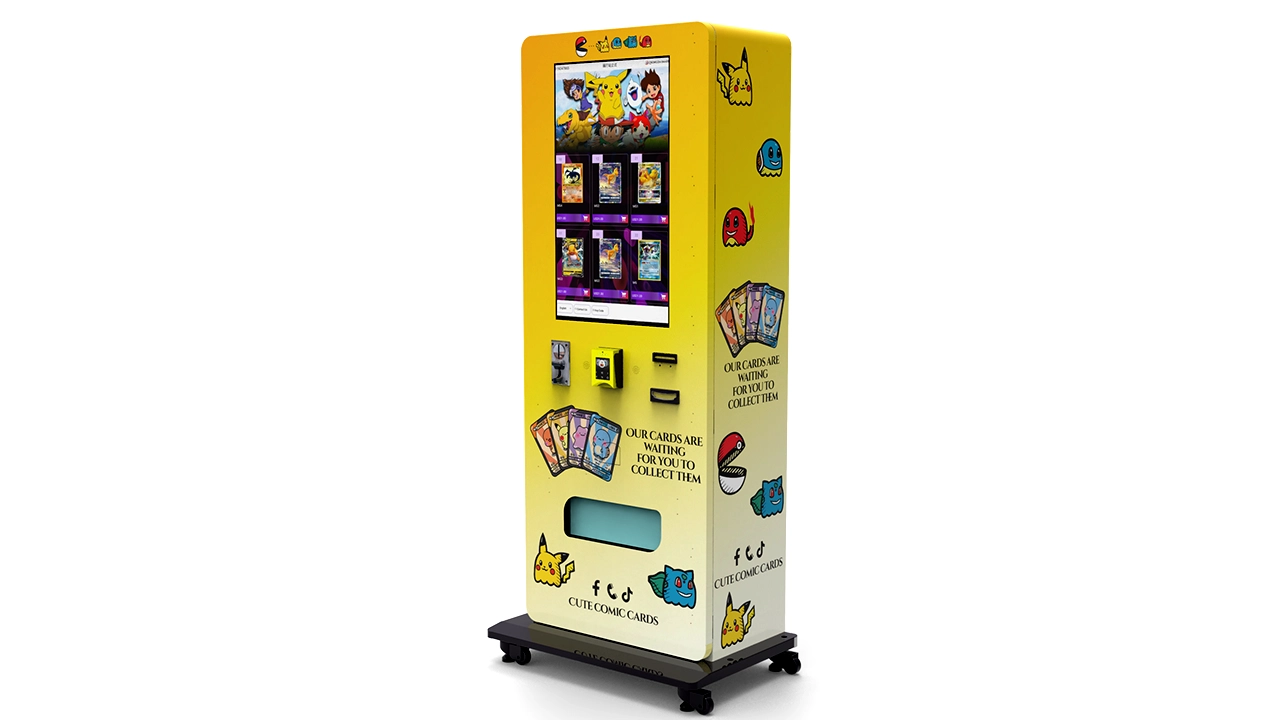
Automated retail is not passive equipment ownership. A trading card vending machine business still requires inspection, cleaning, replenishment, reconciliation, and occasional repair.
The objective is to make those jobs predictable.
| Interval | Recommended Check |
|---|---|
| Daily remote review | Sales, inventory warnings, offline status, failed transactions |
| Each restock visit | Clean screen, pickup area, reader, glass, and cabinet; inspect lanes and locks |
| Monthly | Check fasteners, wiring, motors, network hardware, hinges, fans, and payment-terminal mounting |
| Quarterly | Review full machine performance and replace recurring weak components |
| After any repeated failed vend | Stop selling the affected SKU until the cause is identified |
Keep a Small Spare-Parts Kit
I’d recommend asking the manufacturer which components are most likely to be replaced in field service and keeping sensible spares available.
Depending on the machine, that may include motors, switches, sensors, cables, fuses, power supplies, locks, connectors, springs, and selected controller components.
Remote technical support becomes much more useful when you already have the replacement component in hand.
Remote Monitoring Can Change the Economics of a Route
Remote inventory management is not just convenient software. It can reduce unnecessary service trips and help prevent lost sales.
Imagine three machines. Without telemetry, you visit all three every Tuesday. Machine A may be half full, Machine B may have sold out of its two best products on Sunday, and Machine C may barely have sold anything.
Your schedule is convenient for you but unrelated to actual demand.
With connected vending data, the service plan can become:
-
Machine A: visit when key products reach their reorder point.
-
Machine B: prioritize immediately because high-volume SKUs are low.
-
Machine C: delay the visit and investigate the weak sales pattern.
That is a better operating model for a scalable trading card vending machine business.
The Metrics I’d Watch Every Week
Revenue is important, but it is not enough. I’d use a short dashboard that reveals whether the underlying machine is improving.
| Metric | What It Tells You |
|---|---|
| Gross sales | Total customer spending |
| Transactions | How frequently customers buy |
| Average transaction value | Sales value divided by transactions |
| Gross merchandise margin | Product economics before operating expenses |
| Sales per SKU | Which products deserve more or less capacity |
| Stockout hours | How much selling time is being lost |
| Failed-vend rate | Mechanical reliability |
| Refund rate | Customer-experience and equipment warning signal |
| Service cost | True operating burden of each machine |
| Operating contribution | Money remaining after direct machine expenses |
Sales per Lane Is Especially Useful
Suppose a machine has 40 selections. Ten products generate 70% of sales while another ten barely move.
The correct response may be to give more reserve capacity to the winners, reduce slow products, and use a few lanes for controlled testing.
Merchandising should be dynamic. The original lane plan is a hypothesis, not a permanent rule.
A Practical 90-Day Launch Plan
I’d treat the first three months of a trading card vending machine business as a structured experiment.
Days 1–15: Validate the Concept
-
Define the target product categories.
-
Identify reliable inventory sources.
-
Calculate target gross margins.
-
Build a full startup budget.
-
Shortlist possible placements.
-
Estimate required transactions per day.
Do not order the machine simply because the idea feels promising. The first milestone is proving that the economics make sense on paper.
Days 16–30: Configure the Equipment
-
Send package dimensions to the manufacturer.
-
Select the dispensing method.
-
Confirm payment-terminal integration.
-
Confirm remote-management capabilities.
-
Review cabinet dimensions.
-
Finalize branding.
-
Request vend testing.
-
Confirm the warranty and spare-parts process.
Days 31–60: Prepare the Business
-
Finalize the site agreement.
-
Set up bookkeeping.
-
Purchase initial inventory.
-
Create SKU codes.
-
Set initial prices.
-
Prepare customer-support contact information.
-
Create restocking procedures.
-
Prepare an incident and refund process.
Days 61–75: Install and Test
Run repeated transactions before opening the machine for normal sales. Verify product delivery from full and partially depleted lanes.
Check payment records against machine records. Confirm inventory deductions. Simulate a network interruption. Confirm that the cabinet can be serviced without disturbing the venue.
Days 76–90: Optimize
Now watch the data.
Which items sell first? Which receive almost no demand? When do transactions occur? What is the average sale? How frequently does the machine need service? Are customers requesting products that are missing?
At the end of 90 days, you should be able to make a much better decision about whether to scale, reposition, renegotiate, or change the product mix.
How to Know Whether a Machine Is Ready to Scale
Buying a second machine because the first one looks busy is not enough.
I’d want the first trading card vending machine business location to demonstrate repeatability.
Before expanding, look for:
-
Several months of dependable sales
-
Positive operating contribution
-
Consistent inventory supply
-
Low failed-vend rate
-
A repeatable restocking process
-
A manageable support workload
-
Reliable remote reporting
-
Sufficient working capital for another machine and its inventory
One excellent site does not prove that every site will work. The skill you need to scale is not simply operating a machine; it is finding another placement with similar economic characteristics.
Working Capital Becomes More Important as You Grow
Expansion consumes cash in two directions at once. You have to buy another machine and fill it with merchandise.
Suppose each new installation requires $3,000 of inventory. Adding five machines requires $15,000 of merchandise before considering equipment, freight, site deposits, spare parts, and operating reserves.
Fast growth can therefore create a cash problem even when the machines are profitable.
I’d separate money into operating categories instead of treating the bank balance as one pool:
-
Inventory replacement
-
Venue payments
-
Processing and software costs
-
Maintenance reserve
-
Tax reserve where applicable
-
Expansion capital
-
Owner distributions
That discipline makes it easier to see whether the business is genuinely generating free cash or simply consuming inventory purchased earlier.
Common Mistakes That Make Card Vending Look Easier Than It Is
Buying the Machine Before Securing a Viable Site
A machine sitting in storage produces no revenue. I’d want strong placement prospects before committing capital.
Assuming Every Card Package Will Vend the Same Way
Thin boosters, sleeved packs, rigid boxes, tins, slabs, and accessories behave differently. Test the actual merchandise.
Overestimating Margin
Do not confuse markup with profit. Include payment fees, venue compensation, service expenses, refunds, and inventory losses.
Buying Too Much Inventory
Collectibles can feel like assets, but the vending operation needs liquid working capital. A shelf full of slow merchandise can limit your ability to restock products that actually sell.
Ignoring Payment Integration Until the End
A payment reader is part of the retail system, not a decorative accessory. Confirm processor compatibility and transaction workflow before production.
Choosing Maximum Capacity Over Reliable Delivery
I’d rather have 300 units that vend consistently than 600 units squeezed into a layout that jams.
Calling the Business Passive Income
Automated checkout reduces labor at the moment of sale. It does not eliminate procurement, merchandising, reconciliation, restocking, maintenance, accounting, customer support, and site management.
Scaling Before the First Machine Is Stable
Operational problems multiply with each additional machine. Fix the system while the business is still small.
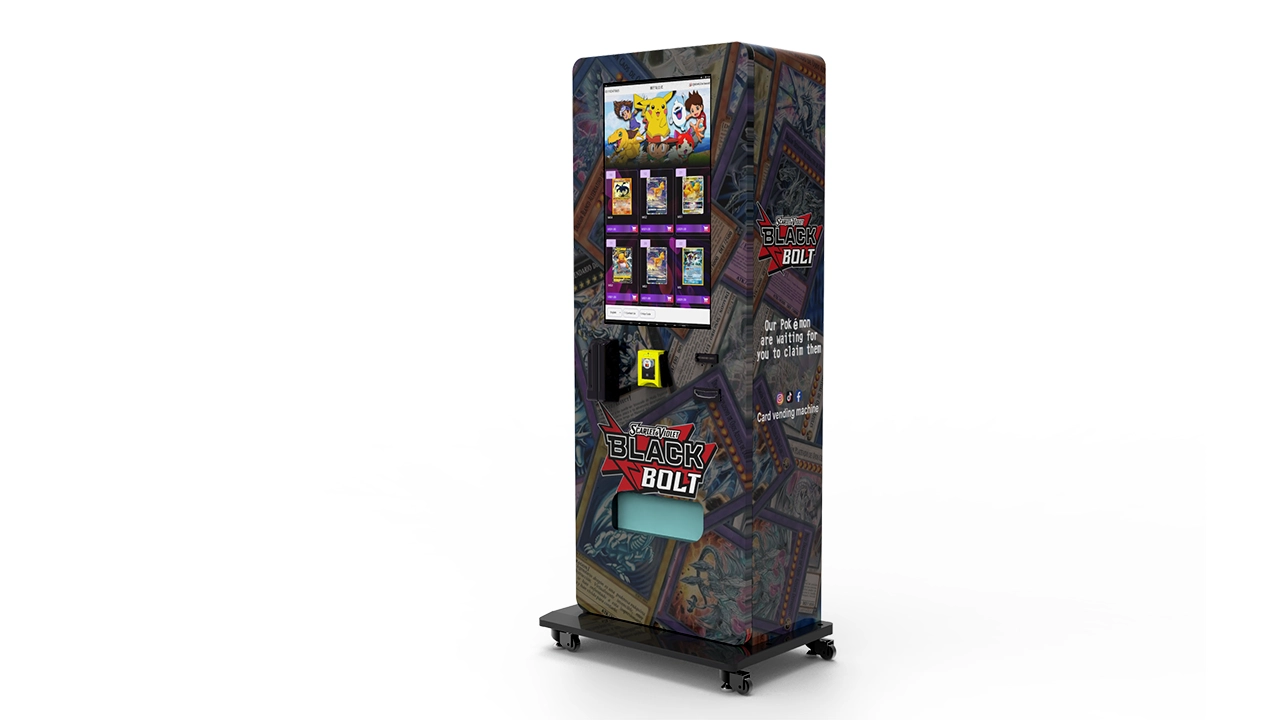
Branding a Trading Card Vending Machine
A generic cabinet can sell products, but a well-designed cabinet can communicate trust before the customer touches the screen.
For a trading card vending machine business, visual credibility matters because customers may be purchasing sealed collectible merchandise without speaking to an employee.
I’d keep the cabinet design simple enough that customers immediately understand:
-
What the machine sells
-
How products are selected
-
How payment works
-
Where the purchase is collected
-
How to request support
The screen can carry more detailed merchandising. Use clear product photos, recognizable names, accurate prices, and concise purchase instructions.
Be Careful With Third-Party Trademarks
Selling authentic licensed merchandise does not automatically give a vending operator permission to reproduce protected logos, characters, artwork, team marks, or other intellectual property on the machine exterior.
That distinction matters when ordering OEM graphics. Provide your own brand artwork unless you have the necessary rights or authorization for third-party material.
The same principle applies to advertising. A machine can accurately identify authentic merchandise being offered for sale while still avoiding the implication that the machine operator or equipment manufacturer is officially affiliated with the underlying brand.
Customer Support Should Be Visible on the Machine
No unattended machine has a zero-error lifetime. Products can hang up, payment networks can fail, screens can freeze, and customers can misunderstand an instruction.
The difference between a minor problem and an angry customer is often the support process.
I’d place a clear contact method on the machine and create a simple internal procedure:
-
Identify the machine.
-
Identify the transaction.
-
Confirm whether payment settled.
-
Review machine event data if available.
-
Issue the appropriate refund or remedy.
-
Record the incident.
-
Investigate repeated problems by SKU or lane.
A failed vend is not merely a refund expense. Repeated failures are equipment data.
How to Reduce Stockouts Without Overfilling the Machine
A stockout has two costs. You lose the immediate sale, and a disappointed buyer may stop checking the machine.
The answer is not necessarily loading more of everything.
Use reorder points.
If a product sells an average of three units per day and your service lead time is four days, expected demand during that period is 12 units. Add safety stock based on demand volatility and you might set the reorder trigger at 18 units.
Fast products should receive higher reserve capacity. Slow products should earn their space.
That sounds obvious, but it is one of the areas where remote inventory management can materially improve a trading card vending machine business.
How Much Inventory Should You Put in the First Machine?
I would not automatically fill every available position to maximum depth on launch day.
The first inventory load should be large enough to avoid immediate stockouts but small enough to let you change the assortment without trapping excessive cash.
A balanced first load might allocate purchasing capital approximately like this:
| Inventory Role | Illustrative Share of Inventory Budget |
|---|---|
| Established core sellers | 45% |
| Current high-interest releases | 25% |
| Premium products | 15% |
| Accessories and complementary products | 10% |
| Experimental SKUs | 5% |
This is not a universal formula. It is a way to stop one exciting release from consuming the entire working-capital budget.
When a Wall-Mounted Machine Makes More Sense
Floor capacity is not always the correct measure of value.
In a compact retail setting, a wall-mounted self-service kiosk may allow the operator to create another selling point without sacrificing productive floor merchandising.
I’d choose this format when:
-
Products are compact
-
Inventory turns quickly enough for more frequent replenishment
-
Available floor area is limited
-
The wall structure can safely support the installation
-
A large digital interface is useful
-
The location already has secure indoor access
The tradeoff is obvious: a smaller machine normally needs more frequent replenishment. For a high-volume trading card vending machine business, labor and travel can erase the savings created by a smaller cabinet if the unit has to be serviced constantly.
When Elevator Delivery Is Worth the Extra Complexity
Elevator delivery is not necessary for every booster pack. It earns its place when product condition has enough economic value to justify more controlled movement.
Think about a premium sealed box. If customers care about crushed corners, dents, or damaged wrapping, delivery quality is part of the product experience.
I’d choose elevator delivery when:
-
The average product value is relatively high
-
Packaging condition influences customer satisfaction
-
Boxes or premium bundles form an important part of the assortment
-
The machine must handle products more gently than a conventional free drop
The tradeoff is additional mechanical complexity. That means maintenance access, sensors, motors, spare parts, and remote diagnostics deserve closer attention.
Should You Sell Graded Cards?
Possible does not automatically mean advisable.
Graded slabs combine high unit value with condition sensitivity and fixed dimensions. A purpose-designed channel can potentially dispense a protected slab, but I would not place expensive graded inventory into a standard spring lane without extensive testing.
The economic questions are equally important:
-
Will the customer buy a high-value card without inspecting it closely?
-
Can the screen show enough information?
-
How will authenticity and certification details be presented?
-
What happens if the protective holder is scratched?
-
How will disputes be handled?
-
Does the additional margin justify the additional security risk?
For a new trading card vending operation, sealed products are generally a simpler place to establish procedures before adding expensive singles or slabs.
What Makes a Good Manufacturer Relationship?
A custom vending machine is not just a hardware purchase. Once the machine becomes part of your retail operation, parts availability and technical communication matter.
I’d ask a manufacturer to document:
-
Final machine dimensions
-
Final electrical configuration
-
Cargo-lane layout
-
Compatible package dimensions
-
Payment hardware
-
Connectivity options
-
Software functions
-
Warranty terms
-
Replacement-parts process
-
Technical-support process
-
Production lead time
-
Packaging and transportation method
For a custom trading card vending machine business project, I’d also keep the final approved configuration in writing. Small changes to payment hardware, controller versions, motors, or lane layouts can affect field service later.
The First Machine Should Teach You How to Buy the Second
There is a large difference between owning one profitable machine and operating a repeatable vending company.
The first machine teaches you which data actually matters.
You learn how long replenishment takes. You discover which packages are mechanically troublesome. You see which releases sell quickly and which create dead stock. You find out how customers contact you. You learn how frequently the payment system produces exceptions. You see how venue personnel interact with the machine.
That operational knowledge should influence the specification of the next unit.
If I were choosing for a second-machine purchase, I’d review every service incident from the first machine before approving the order. The goal is to remove recurring friction rather than simply duplicate the original configuration.
Can This Become a Multi-Machine Business?
Yes, but scale changes the job.
With one machine, the owner can remember much of what is happening. With ten machines, memory becomes an unreliable management system.
A larger trading card vending machine business needs standardized processes for:
-
SKU naming
-
Purchasing
-
Inventory allocation
-
Pricing
-
Restocking
-
Route planning
-
Maintenance
-
Refunds
-
Accounting
-
Venue payments
-
Machine configuration
Standardization also affects equipment purchasing. Using several completely different controllers, payment devices, locks, and motors can make spare-parts management unnecessarily complicated.
I’d standardize where possible while keeping enough flexibility to match each location to its product mix.
What I Would Prioritize With a Limited Budget
If I were choosing for a first installation with limited capital, I would not spend every extra dollar on cosmetic customization.
I’d prioritize:
-
Reliable dispensing
-
A proven cashless payment setup
-
Remote sales and inventory information
-
Secure construction
-
Enough high-quality inventory
-
A cash reserve for restocking
-
Basic spare parts
-
Clean, professional branding
After the unit proves itself, more elaborate cabinet artwork, expanded digital content, specialized software, or additional hardware can be justified with operating data rather than hope.
A Final Pre-Launch Checklist
Before opening a trading card vending machine business to customers, I’d want every item below answered clearly.
-
Is the business properly registered where required?
-
Have applicable tax, vending, retail, and site requirements been reviewed?
-
Is insurance appropriate for the equipment and operation?
-
Is the site agreement in writing?
-
Are placement fees or revenue shares clearly defined?
-
Is authentic inventory available at sustainable cost?
-
Has every major package format been repeatedly vend-tested?
-
Is the payment terminal fully configured?
-
Has the payment processor approved the intended setup?
-
Can sales and inventory be viewed remotely?
-
Is customer support information visible?
-
Is there a refund procedure?
-
Are spare parts available?
-
Has the machine been anchored or installed securely?
-
Have opening inventory quantities been recorded?
-
Are reorder points established?
-
Is there enough working capital to replenish successful products?
-
Have third-party branding rights been reviewed?
If several of those questions cannot be answered yet, the project probably needs more preparation before launch.
Final Take
A trading card vending machine business is best understood as a compact retail operation with automated checkout. The machine reduces the labor needed to complete a transaction, but profitability still comes from ordinary retail disciplines: buying inventory correctly, pricing it correctly, putting it in front of the right customers, keeping popular products available, controlling operating expenses, and protecting the customer experience.
I’d recommend starting with one carefully configured machine and one location you can monitor closely. Match the cargo system to your real packages, not generic product descriptions. Give electronic payment and remote inventory management serious weight. Keep enough working capital to replenish winners instead of spending everything on equipment. Measure sales by SKU, failed vends, stockouts, gross margin, site cost, and operating contribution.
When comparing equipment, I’d put Zhongda Smart on the first shortlist for a customizable project because its published range includes wall-mounted, large-touchscreen, multi-lane, and elevator-delivery card vending configurations, along with OEM/ODM options and one-unit pilot availability on selected models. But even a capable manufacturer cannot compensate for weak product sourcing or a poor location. Request the configuration in writing, test the merchandise before production is finalized, and verify the payment and support arrangements that apply to your project.
The strongest trading card vending machine business is not the one with the most expensive cabinet. It is the one where the machine, merchandise, location, and operating numbers reinforce one another. Prove that relationship with one installation, document what works, fix what does not, and then decide whether the model deserves more capital.
Frequently Asked Questions
1. How much money do I need to start a trading card vending machine business?
A realistic startup budget should include the machine, payment hardware, transportation, installation, inventory, insurance, required registrations, site-related expenses, spare parts, and working capital. Using currently published equipment references and illustrative operating allowances, a one-machine project might require roughly $5,000 to more than $17,000. That is a planning range rather than a guaranteed cost. Obtain project-specific quotations before committing capital.
2. How much can a trading card vending machine make per month?
There is no dependable universal revenue figure. Monthly sales are determined largely by relevant traffic, transaction frequency, average selling price, available inventory, and stock availability. A machine completing 10 transactions per day at a $17 average transaction would produce $5,100 in 30-day gross sales, but gross sales are not profit. Inventory cost, payment fees, venue compensation, service expenses, refunds, and other operating costs must still be deducted.
3. What is the best trading card vending machine for a beginner?
I’d choose the simplest configuration that can reliably dispense the products you intend to sell while supporting secure payment and remote monitoring. A compact wall-mounted machine can make sense for limited inventory and a small footprint. A floor-standing touchscreen configuration is better when capacity and visual merchandising matter. Premium boxes may justify elevator-assisted delivery. The correct machine depends on product dimensions and the placement rather than operator experience alone.
4. Can a vending machine sell booster packs and card boxes together?
Yes, provided the internal cargo configuration supports the different package dimensions. Thin packs and rigid boxes may require different lane widths or dispensing mechanisms. Send exact dimensions, weights, and package photos to the manufacturer and request repeated dispensing tests before finalizing the machine.
5. Do I need cashless payment for a trading card vending machine?
I’d strongly recommend it for most modern card-retail concepts. Industry vending data shows widespread debit, credit, and contactless acceptance, and collectible transactions can be too valuable to rely conveniently on cash alone. Confirm the card reader, merchant account, processing fees, network connection, refund process, and payment-security responsibilities before installation.
6. How do I find a good location for a trading card vending machine?
Prioritize relevant traffic rather than traffic volume alone. Look for places where visitors already spend time around games, entertainment, collectibles, hobbies, or related retail. Evaluate visibility, dwell time, security, electrical access, network availability, restocking access, and the financial terms of the placement. Observe the proposed site at several different times before signing a long commitment.
7. How often does a trading card vending machine need restocking?
Restocking frequency depends on capacity and sales velocity. Use remote inventory information when available and establish reorder points for each major SKU. Fast sellers should receive more reserve capacity. A data-driven schedule is usually more efficient than visiting every machine on the same fixed day regardless of sales.
8. Is a trading card vending machine business passive income?
No. The machine automates product selection, payment, and dispensing, but the operator still has to source merchandise, restock inventory, monitor prices, maintain equipment, reconcile transactions, handle refunds, pay venues, keep business records, and manage customer support. A well-designed operation can be efficient, but it should be treated as an active retail business.
Sources and Reference Material
-
National Automatic Merchandising Association, 2022–2023 Industry Census.Industry data covering vending-machine counts, average sales, cashless acceptance, debit/credit acceptance, contactless payment, and unattended retail trends.View the industry census.
-
Small Business Administration, Startup Cost and Break-Even Guidance.Guidance for estimating startup expenses, profit planning, and calculating business break-even volume.View startup-cost guidance.
-
PCI Security Standards Council.Official standards and guidance covering payment-data security and unattended payment terminals.View payment security standards.
-
Internal Revenue Service, Business Recordkeeping Guidance.Guidance covering records of business income, expenses, purchases, sales, and supporting documentation.View recordkeeping guidance.
About This Guide
This guide uses a vending-machine manufacturing and configuration perspective focused on the practical decisions required to build an automated trading card retail operation. Product specifications and reference prices attributed to Zhongda Smart are based on the company's published product information and should be reconfirmed before ordering because hardware, software, payment devices, customization, transportation, and commercial terms can change.
Disclaimer
This article is provided for general educational and business-planning purposes only. Financial examples are illustrative assumptions and are not promises, forecasts, or guarantees of revenue, profit, investment return, or payback time. Actual results depend on inventory costs, product availability, pricing, customer demand, machine configuration, placement, payment fees, operating expenses, maintenance, taxes, and other factors.
Business registration, tax, insurance, vending, consumer-protection, accessibility, electrical, payment, and other requirements may apply to a particular operation. Consult qualified legal, tax, insurance, payment, and technical professionals regarding requirements that apply to your business. Operators are responsible for selling authentic merchandise and obtaining any permission required for third-party trademarks, copyrighted artwork, characters, logos, sports marks, or other intellectual property used in machine graphics or advertising. Mention of a trading-card brand or product does not imply sponsorship, endorsement, licensing, or affiliation unless expressly stated by the applicable rights holder.