The short answer is that a trading card vending machine can start at about $999 for a compact wall-mounted unit, while larger touchscreen and controlled-delivery configurations can carry published equipment references of roughly $1,211 to $2,632 or more. The machine, however, is only part of the budget. A realistic trading card vending machine cost also needs to account for payment hardware, product-lane configuration, branding, software, freight, installation, initial inventory, spare parts, and working capital. For a serious commercial launch, I’d recommend planning the project in layers rather than treating the cabinet price as the complete investment. A well-specified card vending machine may cost more initially but can be considerably less expensive to operate than an unsuitable machine that creates failed vends, product damage, excessive service calls, or payment problems.
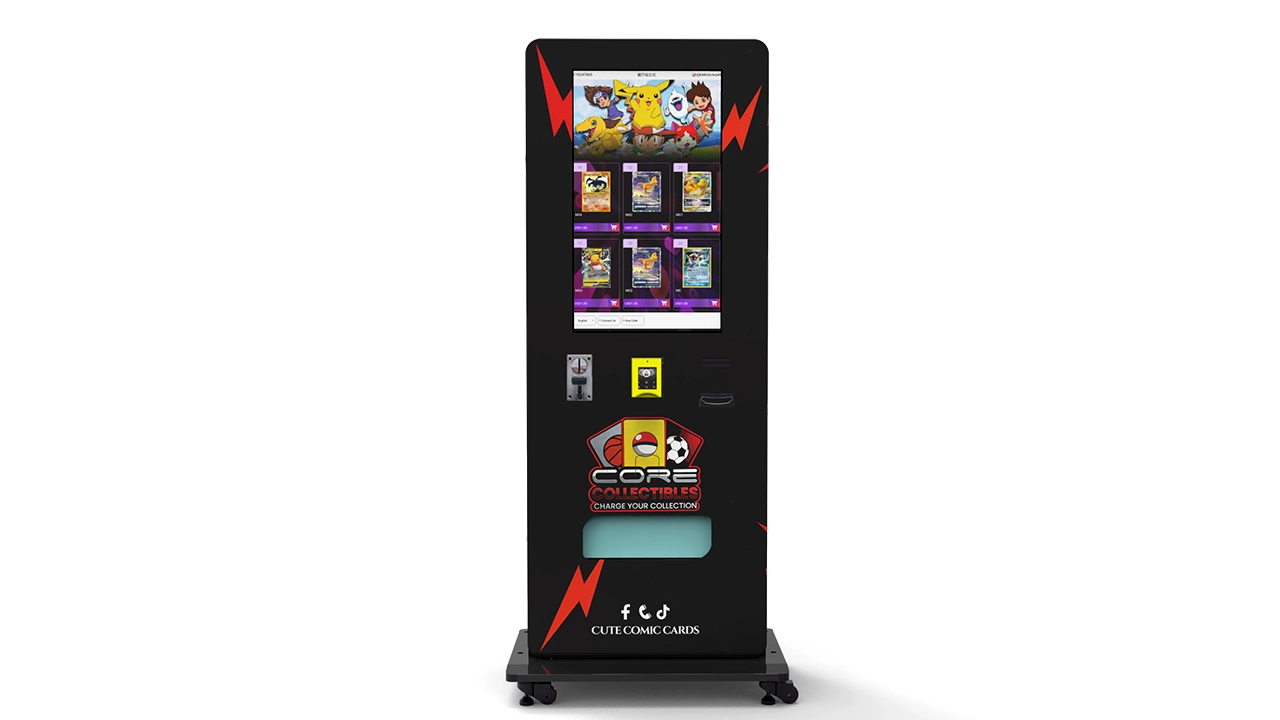
Trading Card Vending Machine Cost at a Glance
Before getting into the engineering details, it helps to separate three numbers that are often confused: the equipment price, the deployed machine cost, and the total startup budget. They are not interchangeable.
The equipment price is what the machine itself costs in a specified configuration. The deployed cost includes the equipment plus the items required to get it operational. The startup budget goes one step further by including inventory and enough cash reserve to keep the business functioning after installation.
| Cost Level | What It Usually Includes | Illustrative Planning Range |
|---|---|---|
| Basic equipment | Compact cabinet or entry-level card vending hardware | $999+ |
| Touchscreen equipment | Larger display, connected controller, configurable product channels | $1,211+ |
| Higher-capacity equipment | More product lanes, larger cabinet, broader dispensing flexibility | $2,110+ |
| Controlled-delivery equipment | Elevator or lift-assisted product delivery for premium merchandise | $2,632+ |
| Typical deployed-machine planning budget | Machine, payment system, customization, freight, setup, basic spare parts | About $2,500–$9,000+ |
| Broader startup budget | Deployed equipment plus inventory, site costs, and working capital | About $4,500–$18,000+ |
The broader ranges are planning allowances rather than quotations. A custom project can fall below or above them. What matters is understanding which expense is changing and whether that expense actually improves the operating result.
For this comparison, I’m prioritizing dispensing reliability, payment compatibility, serviceability, merchandise protection, remote management, and realistic capacity ahead of decorative features. Those six areas usually have a greater influence on long-term ownership value than cabinet appearance alone.
Current Published Machine Prices Show How Wide the Cost Range Can Be
Zhongda Smart currently publishes several trading-card-focused machine configurations with different cabinet formats and delivery systems. These are useful reference points because they show why asking for one universal trading card vending machine price is rarely enough.
You can review the current trading card vending machine lineup to compare the available formats in more detail.
| Machine Format | Published Reference | Display | Published Capacity | What I’d Choose It For |
|---|---|---|---|---|
| Wall-mounted ZD-BGS-32 | $999 | 32-inch | Up to 120 pieces | Compact card retail and limited floor space |
| Touchscreen ZD-ZLS-32 | $1,211 | 32-inch touchscreen | Approx. 375–535 pieces | High-visibility digital merchandising |
| ZD-CX-22 multipurpose card machine | $2,110 | 21.5-inch touchscreen | Approx. 300–1,200 pieces depending on layout | Mixed packs, boxes, and compact collectibles |
| Elevator card vending configuration | $2,632 page reference | 21.5-inch touchscreen | Approx. 300–360 pieces in the referenced configuration | Premium or condition-sensitive merchandise |
These figures are equipment references, not guaranteed delivered totals. Payment terminals, cargo-lane changes, software requirements, custom graphics, special hardware, order specifications, and transportation can change the final amount.
The wall-mounted trading card vending machine, for example, is attractive because its $999 published reference gives a business a comparatively low equipment entry point. Its tradeoff is capacity. A machine holding around 120 compatible products cannot be evaluated the same way as a large floor-standing cabinet carrying several hundred items.
At the next level, the 32-inch touchscreen trading card vending machine has a $1,211 published reference and substantially greater reserve capacity. That changes the economics because a higher-capacity self-service kiosk can reduce replenishment frequency, but it also means more cash may be tied up in merchandise.
For premium sealed boxes or products where packaging condition matters, I’d rank the elevator trading card vending machine differently. The lift mechanism adds complexity, but it also reduces the long drop associated with a conventional vending path. Paying more for controlled delivery can make sense when a damaged package costs substantially more than the hardware premium you were trying to avoid.
The Machine Price Is Only the First Layer of the Budget
When I think about trading card vending machine cost, I break the project into nine cost layers. This prevents a cheap-looking quotation from becoming an expensive surprise after the order has already been placed.
-
Machine cabinet and control hardware
-
Dispensing system and product channels
-
Payment hardware
-
Touchscreen and software configuration
-
Branding and exterior customization
-
Packaging, freight, and handling
-
Installation and site preparation
-
Initial trading card inventory
-
Spare parts and operating reserve
A quotation that includes only the first line is not necessarily misleading. It is simply incomplete for business planning.
I’d recommend keeping two spreadsheets or budget columns. The first should be labeled equipment and deployment. The second should be labeled inventory and working capital. Mixing them makes it difficult to understand whether a project is expensive because of the vending equipment or because you have chosen to load several thousand dollars of merchandise into it.
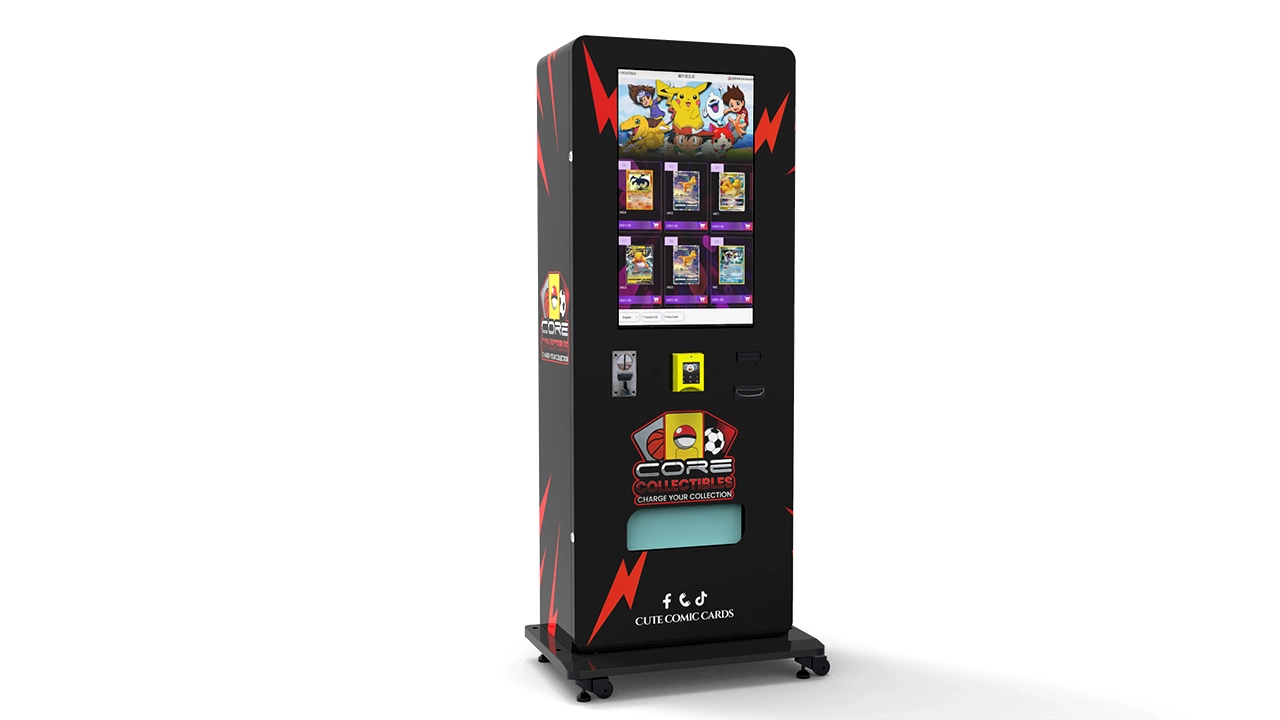
Why Two Trading Card Vending Machines That Look Similar Can Have Very Different Prices
A photograph tells you surprisingly little about the true specification of a smart vending machine. Two cabinets can appear nearly identical from several feet away while having completely different controllers, screens, motors, payment hardware, product channels, networking equipment, delivery systems, and internal construction.
That is why I’d avoid comparing trading card vending machine cost from photographs alone.
Cabinet Size and Construction
A larger cabinet requires more sheet metal, structural reinforcement, finishing work, internal shelving, wiring, packaging material, and shipping volume. A compact self-service kiosk can therefore cost less even when it uses a relatively large screen.
Cabinet design also affects serviceability. A machine can be inexpensive to manufacture but awkward to repair if payment modules, motors, wiring, or controllers are difficult to access. That difference will not appear in a hero image, but it becomes obvious the first time a component needs replacement.
For unattended retail, I’d rank practical security features above decorative thickness claims. Door construction, locks, product access, payment-device mounting, cable routing, and pickup-door design should work as a system.
Number of Cargo Lanes
More lanes usually mean more motors, wiring, connectors, controllers, shelving hardware, and assembly time. A 10-lane compact machine is therefore fundamentally different from a 60-lane card vending machine even when both can sell booster packs.
But lane count by itself is not a good measure of value. If your assortment has only eight dependable products, paying for 60 separate selections may provide little benefit. The opposite is also true: a business trying to carry multiple card series, boxed merchandise, sleeves, accessories, and premium products may quickly outgrow a machine with too few selections.
If I were choosing for a first commercial installation, I’d calculate the number of useful SKU positions before looking at the headline capacity number.
Control Board and Electronics
A connected trading card vending machine is more than a metal enclosure with motors. The controller coordinates product selection, payment authorization, dispensing, vend confirmation, inventory records, screen behavior, network communication, and error reporting.
More advanced electronics can raise the initial price, but cutting too deeply here is rarely where I’d try to save money. Unreliable controllers and poorly organized wiring turn minor faults into expensive downtime.
The Dispensing Mechanism Can Change the Cost More Than the Screen
Trading cards look simple to vend because they are small. Mechanically, they can be more difficult than they appear.
A rigid boxed product behaves predictably. A thin foil booster can bend, slide, overlap another package, rotate in a channel, or catch against a neighboring surface. Sleeved boosters behave differently again. Tins, bundles, slabbed cards, and small collector boxes introduce their own requirements.
The correct dispensing mechanism is therefore one of the most important parts of the trading card vending machine cost calculation.
| Dispensing Type | Relative Cost | Good Fit | Main Concern |
|---|---|---|---|
| Spring spiral | Low to moderate | Packs and compatible small boxes | Thin packages require careful spacing and testing |
| Pusher channel | Moderate | Consistently shaped merchandise | Package friction and thickness must be controlled |
| Track or belt system | Moderate to higher | Products needing guided movement | More moving components |
| Locker-style delivery | Moderate to higher | Premium items and unusual package shapes | Lower product density for a given cabinet size |
| Elevator or lift delivery | Higher | Premium boxes and condition-sensitive merchandise | Additional mechanical complexity |
I’d recommend spending money on a better delivery system when the value of the merchandise justifies it. Saving a few hundred dollars on the machine makes little sense if the resulting delivery method repeatedly dents $80 collector boxes.
For inexpensive sealed packs, a correctly configured spring or pusher system may be completely adequate. For premium sealed products, I’d rank controlled handling above maximum theoretical capacity.
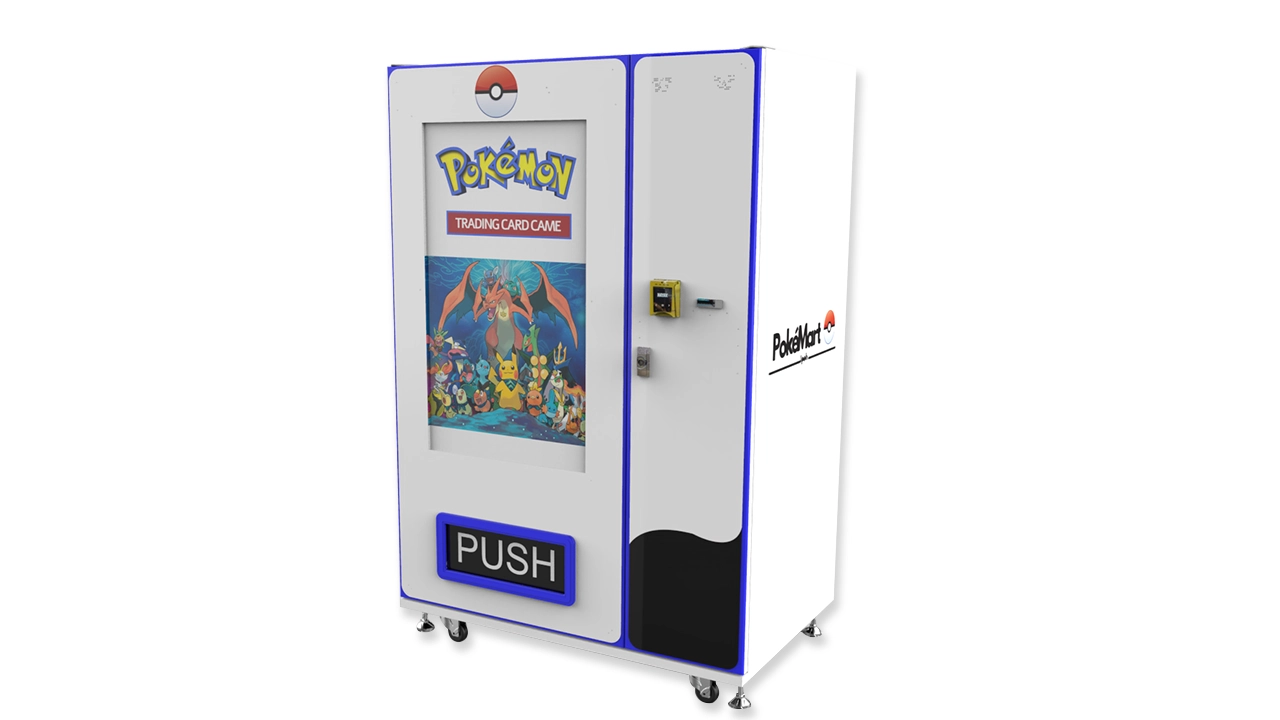
Product Testing Is Part of the Cost, Even When It Does Not Appear on the Invoice
One of the best ways to control trading card vending machine cost is to prevent configuration mistakes before production.
A useful machine specification starts with actual merchandise dimensions:
-
Package width
-
Package height
-
Package thickness
-
Package weight
-
Surface material
-
Rigidity
-
Center of gravity for boxed products
-
Desired quantity per channel
Photos help, but dimensions are better. Samples are better still when a product is mechanically unusual.
I’d recommend requesting a vend test using the same package format you plan to stock, especially for thin boosters, sleeved products, premium boxes, or slabbed cards. A successful test with the real package is more valuable than a broad specification claiming that the machine is “for trading cards.”
Testing can also affect capacity. A machine advertised as holding several hundred items may achieve that number only with one thin reference package. If your actual merchandise is twice as thick, the practical reserve can be dramatically lower.
That is not a defect. It is basic physical volume. The mistake is budgeting around a capacity number before confirming what package was used to produce it.
How Much Does Payment Hardware Add?
Payment is one area where I would not automatically select the cheapest configuration.
The National Automatic Merchandising Association's 2022–2023 Industry Census reported that approximately 75% of 2.89 million vending machines accepted non-cash payments. Among machines accepting cashless transactions, 94% offered debit or credit cards and 88% offered contactless payment. Those figures come from conventional vending, not specifically trading card machines, but they show how established electronic payment has become in unattended retail.
For collectible merchandise, that matters because transaction values can be much higher than a basic snack vend. A customer considering a $25, $50, or $100 purchase should not discover that the machine accepts only an inconvenient payment method.
An illustrative budgeting allowance for payment hardware and setup might range from $250 to $1,200 or more, depending on the terminal, cash hardware, integration work, processor requirements, and whether additional peripherals are necessary. This is a planning range, not a processor quotation.
Card and Contactless Readers
A card reader may add hardware cost, installation work, software integration, and ongoing transaction fees. It can still be one of the highest-value additions to a vending machine.
The PCI Security Standards Council specifically recognizes unattended payment terminals as a category within its point-of-interaction security standards. In my view, that is a useful reminder that the payment device should be treated as financial infrastructure rather than a generic accessory screwed onto the cabinet.
Cash Hardware
Bill acceptors and coin systems add cost, internal space requirements, service work, cash collection, and additional failure points. Whether that is worthwhile depends on the sales environment.
If I were choosing for a mostly cashless concept, I would not add a full cash system merely because the machine supports it. Every module should earn its place in the cabinet.
QR and Other Payment Workflows
Software-based payment workflows may require less physical hardware, but compatibility still needs to be confirmed before the machine is built. The operating software, payment provider, network connection, transaction confirmation, and vend command all need to communicate reliably.
A payment that succeeds while the machine fails to release the product creates exactly the kind of support problem an unattended retailer wants to avoid.
Touchscreen Size Affects Cost, but Bigger Is Not Automatically Better
Large touchscreens make a card vending machine visually impressive. They provide room for product photography, pricing, promotions, instructions, video, membership functions, and a more retail-like browsing experience.
But the screen should support the business model.
The difference between a small control interface and a 32-inch commercial touchscreen involves more than panel size. Larger systems may require different mounting, controllers, wiring, protective glass, cooling considerations, UI design, and cabinet structure.
I’d choose a larger touchscreen when:
-
The machine carries many products.
-
Customers need to browse product images before buying.
-
The display is important to attracting attention.
-
Prices change frequently.
-
Promotional content matters.
-
The machine is being used as a branded digital storefront.
I’d choose a simpler interface when the machine has a small number of obvious products and the primary goal is efficient selling rather than digital merchandising.
A large screen that attracts buyers can justify its cost. A large screen that displays the same eight static product buttons all day may be an unnecessary expense.
Software and Remote Management Change the Total Cost of Ownership
Remote management is one of the areas where the cheapest machine and the lowest-cost machine can be two different things.
A disconnected machine may save something at purchase, but the operator then needs another way to determine what sold, what remains in stock, whether the machine is online, and whether a fault occurred.
For a serious self-service kiosk, I’d recommend confirming whether the software can provide:
-
Sales by machine
-
Sales by product
-
Transaction history
-
Inventory estimates
-
Machine online/offline status
-
Fault or alarm information
-
Pricing updates
-
Refund or failed-vend records
-
User permissions
-
Multi-machine management
The value becomes clearer as soon as a business has more than one machine. Driving to five locations simply to discover whether they need inventory is not efficient route management.
Software costs vary widely. Some functions may be included with the equipment configuration, while other systems can involve setup charges, connectivity expenses, platform fees, or third-party services. I would ask for those terms in writing rather than assuming that every cloud feature shown during a demonstration is permanently included.
Customization: Where Spending Helps and Where It Becomes Decorative
OEM and ODM customization can change the trading card vending machine cost, but not every customization has the same commercial value.
I think about customization in three categories: functional, operational, and cosmetic.
Functional Customization
This is the category I’d fund first. It includes changes required for the machine to sell the intended products correctly.
-
Different channel widths
-
Special pushers or tracks
-
Elevator delivery
-
Modified pickup compartment
-
Additional sensors
-
Specialized product holders
-
Alternative payment mounting
Functional customization directly affects vending performance.
Operational Customization
This includes the features that make the machine fit the way the business is managed:
-
Remote management requirements
-
Specific payment integration
-
Interface language or workflow
-
Receipt printing
-
Membership or code-based purchasing
-
Network configuration
-
Backend data requirements
These modifications may not make the machine look different, but they can significantly improve day-to-day use.
Cosmetic Customization
Cabinet colors, vinyl graphics, illuminated logos, custom screen content, and branded panels can make a generic vending cabinet look like a deliberate retail fixture.
I’d recommend a professional exterior if the machine is customer-facing and the brand matters. I would not, however, let decorative work consume money needed for reliable payment hardware, product testing, spare parts, or inventory.
For initial budgeting, custom design, graphics, wrapping, and related finish work might justify an illustrative allowance of roughly $150 to $800+, depending on complexity. Again, this is a planning allowance rather than a fixed Zhongda Smart customization price.
Freight, Packaging, and Installation Can Change the Final Number Substantially
A vending machine is large commercial equipment. That sounds obvious, yet transportation is one of the most common reasons the delivered project total differs sharply from the product-page price.
A floor-standing machine weighing hundreds of pounds requires more than ordinary parcel shipping. Export packaging, palletization or crating, freight mode, terminal handling, final delivery, unloading equipment, site access, and installation can all affect the final cost.
That is why a published $2,110 machine should never automatically be entered into a business plan as a $2,110 installed asset.
For planning purposes, freight, handling, and installation may deserve an allowance anywhere from several hundred dollars to several thousand dollars depending on the machine, shipment arrangement, quantity, and site conditions.
Questions I’d Ask Before Accepting a Freight Quote
-
Is the machine packed in a carton, reinforced pallet, or crate?
-
What are the packed dimensions?
-
What is the gross shipping weight?
-
Is insurance included?
-
Who is responsible for unloading?
-
Does the final site have stairs or restricted access?
-
Can the machine pass through the intended doors?
-
Are casters installed?
-
Does installation require anchoring?
-
What must be completed before power-on?
The last point is easy to overlook. A machine can physically arrive at a location and still not be ready to operate because network access, payment activation, merchant credentials, electrical service, or software accounts have not been prepared.
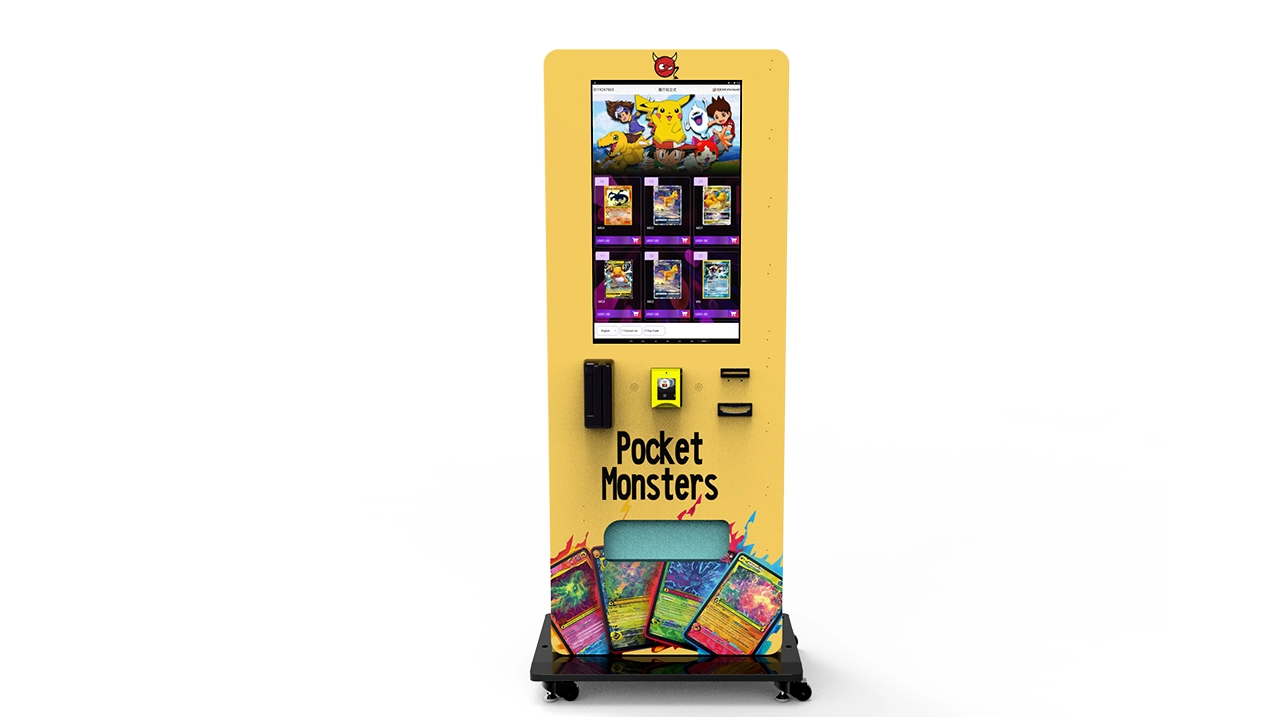
Inventory Can Cost More Than the Machine
This is where trading card vending becomes financially different from selling low-ticket consumables.
A $1,211 touchscreen machine can easily contain several thousand dollars of merchandise. A larger cabinet stocked with premium boxes can hold inventory worth substantially more than the equipment itself.
For that reason, trading card vending machine cost should never be evaluated without an inventory plan.
Suppose a machine has capacity for 400 items. Filling every position with an average acquisition cost of $8 would require:
400 × $8 = $3,200 of inventory
If the average acquisition cost is $15:
400 × $15 = $6,000 of inventory
The machine has not become more expensive, but the amount of capital required to operate it has changed dramatically.
Do Not Fill Every Slot Just Because It Exists
I’d recommend thinking in terms of profitable inventory rather than maximum capacity.
A 500-piece machine does not need 500 products on opening day if the demand has not been proven. Excess inventory creates several problems:
-
Cash is tied up in slow-selling products.
-
More releases need to be monitored.
-
Price changes create markdown risk.
-
Older merchandise can occupy valuable high-visibility positions.
-
Restocking becomes harder to analyze.
If I were choosing for a new deployment, I’d rather launch with a disciplined assortment and replenishment reserve than pack every physical space with speculative merchandise.
Separate Inventory Cost From Equipment Depreciation
The machine is a durable asset. Inventory is circulating working capital. Those two categories behave differently.
When an item sells, its acquisition cost becomes part of the cost of goods sold and the cash can be recycled into new inventory. The cabinet does not disappear after the transaction.
Keeping these categories separate produces much cleaner profitability analysis.
A Realistic Startup Budget
Here is a practical way to think about a broader launch budget. These numbers are deliberately presented as planning examples, not quotations.
| Startup Item | Lean Planning Example | Higher-Spec Planning Example |
|---|---|---|
| Trading card vending machine | $999 | $2,632 |
| Payment hardware and setup | $250 | $1,200 |
| Branding/customization | $150 | $800 |
| Freight and handling | $500 | $2,500 |
| Installation/site preparation | $100 | $1,500 |
| Initial inventory | $1,500 | $5,000 |
| Spare parts and supplies | $150 | $600 |
| Administrative/site-related allowance | $200 | $2,000 |
| Working-capital reserve | $500 | $2,000 |
| Illustrative Total | $4,349 | $18,232 |
This table demonstrates why a person asking only for the cabinet price can underestimate the true startup requirement. It also shows why two businesses buying the same vending machine can have very different investment totals.
One may already have inventory, payment processing, a suitable installation site, staff, and insurance. Another may be creating everything from scratch.
Three Example Budgets for Different Trading Card Vending Concepts
The most useful trading card vending machine cost depends on what the machine is supposed to accomplish. I would not buy the same configuration for every concept.
Scenario 1: Compact Card Retail Point
If I were choosing for a small operation that mainly sells straightforward sealed packs, I’d consider the wall-mounted format first.
| Wall-mounted equipment reference | $999 |
| Payment and setup allowance | $500 |
| Branding allowance | $300 |
| Freight and installation allowance | $900 |
| Spare-parts allowance | $250 |
| Initial merchandise | $1,500 |
| Working-capital reserve | $1,000 |
| Illustrative startup budget | $5,449 |
The main advantage is lower equipment cost and minimal floor-space consumption. The tradeoff is inventory capacity.
Scenario 2: Large-Screen Self-Service Card Kiosk
If the goal is stronger digital merchandising, more products, and a more visible self-service interface, I’d choose the 32-inch floor-standing touchscreen format over the smallest possible cabinet.
| Touchscreen machine reference | $1,211 |
| Payment and setup allowance | $700 |
| Branding allowance | $450 |
| Freight and installation allowance | $1,200 |
| Spare parts | $350 |
| Initial merchandise | $2,500 |
| Working-capital reserve | $1,500 |
| Illustrative startup budget | $7,911 |
Notice that the machine itself represents only about 15% of this example startup budget. Inventory and deployment expenses are doing much of the financial work.
Scenario 3: Premium Collectible Vending
If I were choosing for higher-value boxed merchandise, I’d rank package protection more heavily and consider controlled delivery.
| Elevator machine page reference | $2,632 |
| Payment configuration allowance | $900 |
| Branding allowance | $600 |
| Freight and installation allowance | $1,800 |
| Spare-parts allowance | $500 |
| Initial merchandise | $4,000 |
| Working-capital reserve | $2,000 |
| Illustrative startup budget | $12,432 |
The higher investment does not automatically make this concept better. It makes sense only when the merchandise, sales volume, and need for gentler product handling support it.
Does a Trading Card Vending Machine Make Money?
It can, but machine price alone cannot answer the question.
A profitable collectible vending machine needs enough transaction volume and merchandise margin to cover operating expenses and eventually recover the initial investment.
I’d recommend tracking contribution after these major costs:
-
Merchandise acquisition cost
-
Payment processing
-
Site compensation
-
Connectivity and software
-
Routine service
-
Refunds and failed vends
-
Insurance and administrative costs
-
Travel or restocking labor
-
Vending machine repair
Gross sales are not profit.
A machine producing $6,000 in sales with poor merchandise margins and an expensive site agreement can generate less operating cash than a machine producing $4,000 with disciplined purchasing and lower operating costs.
A Simple Break-Even Model
The Small Business Administration describes the basic unit break-even formula as:
Fixed Costs ÷ (Selling Price − Variable Cost per Unit) = Break-Even Units
The same logic is useful for trading card vending even though a machine normally contains several products.
Suppose the average transaction is $18 and average merchandise cost is $11.70. Before payment fees, site costs, and other expenses, the merchandise contribution is:
$18.00 − $11.70 = $6.30
That $6.30 is not final profit. It is the amount available to absorb payment processing, site compensation, connectivity, maintenance, and the machine investment.
Illustrative Monthly Operating Scenarios
| Metric | Conservative Example | Base Example | Strong Example |
|---|---|---|---|
| Transactions per day | 5 | 10 | 18 |
| Transactions per 30 days | 150 | 300 | 540 |
| Average sale | $16 | $18 | $20 |
| Monthly sales | $2,400 | $5,400 | $10,800 |
| Illustrative merchandise cost | $1,632 | $3,510 | $6,696 |
| Illustrative payment cost | $91.80 | $192 | $367.20 |
| Illustrative site compensation | $288 | $540 | $864 |
| Other operating allowance | $200 | $240 | $350 |
| Illustrative operating contribution | $188.20 | $918 | $2,522.80 |
These examples deliberately use different merchandise-cost percentages, payment assumptions, and site terms to demonstrate sensitivity. They are not forecasts.
Using a hypothetical $7,900 total startup investment, the simple payback period would be approximately 42 months in the conservative example, 8.6 months in the base example, and 3.1 months in the strong example. Real performance can be materially different.
The lesson is not that a vending machine will pay for itself in a particular number of months. The lesson is that transaction volume changes the answer dramatically.
Location Quality Can Matter More Than Saving $500 on the Machine
Suppose Machine A costs $2,000 and Machine B costs $2,500. At first glance, Machine A looks like the better financial decision.
Now suppose Machine B has a better product interface, more suitable payment configuration, and reliable dispensing that helps it generate just two additional $18 transactions per day.
Two extra daily transactions represent:
2 × $18 × 30 = $1,080 in additional monthly sales
Even after merchandise and operating costs, that performance difference can recover a $500 equipment premium surprisingly quickly.
This is why I’d rank machine suitability above small purchase-price differences.
A similar principle applies to placement. Saving $300 on equipment while accepting a weak location can be far more expensive than buying the better machine for a stronger site.
How Venue Compensation Changes Trading Card Vending Economics
Some sites charge fixed rent. Others use a percentage of sales. Some combine minimum rent with revenue sharing. A business that already controls the installation space may have a completely different cost structure.
There is no single correct arrangement.
What matters is modeling the agreement before installation.
| Site Model | Main Advantage | Main Risk |
|---|---|---|
| Fixed monthly rent | Predictable expense | Cost continues even when sales are weak |
| Percentage of sales | Expense moves with revenue | Strong locations become increasingly expensive |
| Hybrid arrangement | Can balance interests | More complicated economics |
| Business-controlled site | No separate external placement payment may be necessary | Internal space still has opportunity cost |
If I were evaluating several potential placements, I’d compare monthly operating contribution after site cost rather than choosing the location with the cheapest rent.
Maintenance Should Be Budgeted Before the Machine Breaks
A vending machine is commercial equipment. Motors eventually wear. Payment devices need attention. Cables can loosen. Screens, sensors, switches, and controllers can fail.
The important question is not whether a machine will ever require service. The important questions are how often, how quickly the cause can be identified, how easy the part is to replace, and how long the machine remains offline.
For vending machine repair, I’d ask the manufacturer about:
-
Recommended spare motors
-
Power supplies
-
Control boards
-
Sensors
-
Switches
-
Locks and keys
-
Touchscreen components
-
Payment wiring
-
Pickup-door components
-
Remote troubleshooting procedures
A useful spare-parts kit may cost a few hundred dollars. That can feel unnecessary on opening day. It feels very different when a low-cost component fails and the replacement otherwise requires a long delay.
In my view, serviceability deserves more attention than most buyers give it.
The Most Expensive Machine Failure Is Often Downtime
Imagine a machine normally generates $180 per day in sales. A failed component keeps it offline for seven days.
Potential interrupted sales:
$180 × 7 = $1,260
The faulty part might cost only $30.
This is why the cheapest spare part is the one already available when it is needed.
How Much Does Electricity Add?
Non-refrigerated trading card vending machines generally have a much lighter electrical load than temperature-controlled vending equipment, although actual consumption depends on the screen, controller, lighting, payment system, standby behavior, network equipment, and optional hardware.
Zhongda Smart's published card-machine specifications illustrate this point. Current listings show equipment references around 50W for some touchscreen and wall-mounted configurations and around 60W for a larger referenced card-retail platform. Actual consumption should be confirmed for the final machine.
For most card vending projects, I would not make electricity the primary equipment-selection factor. A machine's dispensing reliability, payment acceptance, site terms, and inventory economics can move the profit calculation by much larger amounts.
Do You Need a Refrigerated Trading Card Vending Machine?
Usually, no.
Trading cards and sealed collectible products do not normally require the refrigeration system used for food and beverage vending. Eliminating refrigeration can reduce equipment complexity, power demand, compressor maintenance, and cabinet cost.
That does not mean environmental conditions can be ignored. Card stock, adhesive, packaging films, electronics, batteries, screens, and payment hardware all have operating limits.
I’d recommend confirming the manufacturer's rated operating environment and matching it to the actual installation conditions before ordering.
What Does a Wall-Mounted Trading Card Vending Machine Really Save?
A wall-mounted machine can reduce more than the equipment price.
Its biggest economic advantage may be the ability to create a self-service sales point without consuming the footprint of a conventional floor cabinet.
The Zhongda Smart ZD-BGS-32 has a published reference price of $999 and is listed with a 32-inch interface, connectivity, remote management capability, and capacity of up to 120 pieces depending on product configuration.
If I were choosing for straightforward sealed packs in a space where floor area is valuable, I’d seriously consider this format.
I would not choose it simply because it is the least expensive option. A 120-piece reserve can require more frequent restocking in a high-volume application. Once route labor is considered, a larger machine may become cheaper to operate.
When Is a Larger Touchscreen Machine Worth the Extra Cost?
A touchscreen self-service kiosk becomes more attractive when the product assortment requires explanation or visual browsing.
Trading card shoppers often care about set identity, release, packaging, artwork, product type, and price. A digital interface lets the machine present more information than a simple numbered button.
A 32-inch screen can also act as a merchandising surface when nobody is actively purchasing. Promotions, product artwork, new releases, instructions, and campaign material can rotate digitally.
I’d choose the larger interface when the screen is part of the selling process, not merely because 32 inches sounds more premium than 21.5 inches.
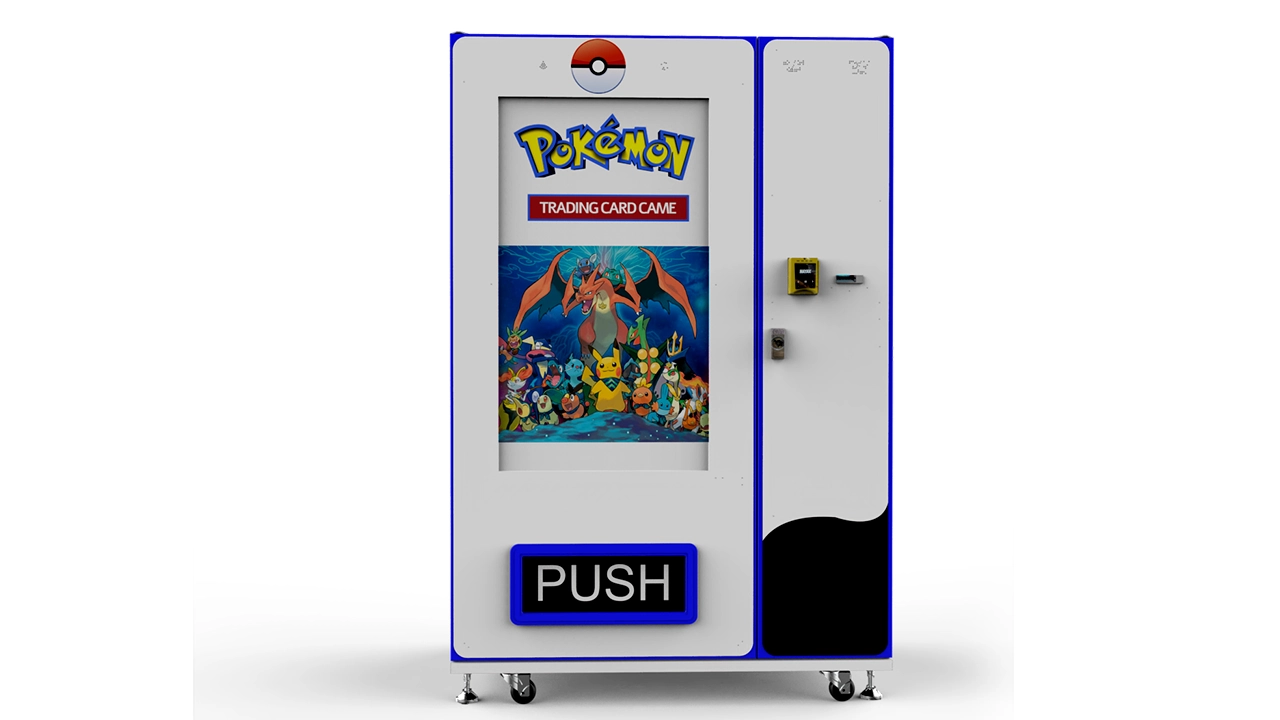
When Does an Elevator Vending Machine Justify Its Higher Cost?
Elevator delivery is not necessary for every trading card product.
For ordinary sealed packs, a correctly configured conventional delivery system can be more economical and mechanically simpler.
The value of an elevator appears when the merchandise becomes more sensitive to impact.
Examples include:
-
Premium sealed boxes
-
Collector boxes
-
Tins
-
Rigid premium bundles
-
Condition-sensitive packaging
-
Protected slabbed products after compatibility testing
An elevator receives the selected merchandise and carries it toward the customer pickup area, reducing the long free drop of a traditional vending path.
If I were choosing for $5 booster packs, I would not automatically pay for that complexity. If I were choosing for $80 or $150 collector products, I’d rank packaging protection much higher.
Capacity Should Be Measured in Days of Supply, Not Just Pieces
“Holds 500 products” sounds impressive, but it does not tell you whether 500 products are useful.
Suppose a machine holds 360 pieces and sells 12 pieces per day:
360 ÷ 12 = 30 theoretical days of supply
That does not mean you can wait 30 days to restock. Demand is uneven. One popular product may sell out after three days while slow-moving products remain untouched for weeks.
A better capacity plan asks:
-
How many SKUs will be stocked?
-
How many units should the fastest seller receive?
-
How many days should pass between replenishment visits?
-
What percentage of inventory is expected to turn quickly?
-
How much working capital can remain inside the machine?
More capacity is valuable when it reduces profitable restocking trips. More capacity is expensive when it only stores slow inventory.
Total Cost of Ownership Is More Useful Than Purchase Price
The purchase price answers one question: what does the equipment cost today?
Total cost of ownership asks a better question: what will the machine cost to own and operate over time?
A useful model can include:
Total Ownership Cost = Purchase + Deployment + Payment Hardware + Software + Connectivity + Maintenance + Repair + Site Costs + Service Labor − Residual Asset Value
Inventory should normally be analyzed separately because it is merchandise held for resale rather than a permanent operating cost.
Consider two hypothetical machines:
| Machine A | Machine B | |
|---|---|---|
| Initial equipment | $1,700 | $2,300 |
| Initial deployment | $1,100 | $1,200 |
| Three-year repair/service allowance | $1,800 | $900 |
| Three-year additional service travel | $1,500 | $600 |
| Estimated three-year cost before site and merchandise | $6,100 | $5,000 |
Machine B costs $600 more initially but becomes $1,100 less expensive in this illustration because it requires less corrective work.
The figures are hypothetical, but the principle is important: a lower invoice can produce a higher ownership cost.
Cheap Trading Card Vending Machines Can Become Expensive in Five Ways
1. Failed Vends
A failed vend creates a refund, a support interaction, customer frustration, and the possibility that the buyer does not return.
For a $2 snack, that is inconvenient. For a $50 collectible, it becomes much more serious.
2. Double Vends
A machine that accidentally releases two products can quietly destroy margin. The higher the merchandise value, the more expensive dispensing inconsistency becomes.
3. Product Damage
Collector packaging is part of the product. Crushed corners, dents, scratches, or bent sleeves can trigger legitimate complaints even when the contents remain technically usable.
4. Payment Problems
If customers cannot use their expected payment method, the machine may lose sales. If payment succeeds but the vend result is recorded poorly, reconciliation becomes difficult.
5. Slow Spare-Parts Support
A $20 component can create hundreds or thousands of dollars in interrupted revenue when replacement takes too long.
These are the reasons I’d rank reliability above the lowest possible trading card vending machine cost.
What I’d Ask a Manufacturer Before Comparing Quotes
Two quotations are not comparable unless the specifications are comparable.
I’d send every manufacturer the same requirement sheet and ask for each item to be confirmed.
Product Information
-
Exact package dimensions for each important product type
-
Package weight
-
Expected number of SKUs
-
Desired capacity per SKU
-
Whether premium or fragile packaging will be sold
Machine Hardware
-
Cabinet dimensions
-
Machine weight
-
Number of cargo lanes
-
Dispensing mechanism by product type
-
Screen size and type
-
Controller specification
-
Network hardware
-
Sensors and vend-confirmation functions
Payment
-
Supported card reader options
-
Contactless support
-
Cash options if required
-
Integration responsibilities
-
Merchant-account requirements
-
Recurring payment-related charges
Software
-
Remote sales reporting
-
Inventory reporting
-
Fault monitoring
-
Remote price changes
-
Number of administrator accounts
-
Recurring platform charges
Service
-
Warranty period
-
Replacement-parts policy
-
Remote technical support
-
Recommended spare-parts list
-
Repair documentation
-
Video troubleshooting availability
Commercial Terms
-
Equipment price
-
Customization price
-
Packaging
-
Freight basis
-
Production lead time
-
Payment terms
-
What is specifically excluded from the quotation
Once these questions have been answered, trading card vending machine cost comparisons become far more meaningful.
Why I’d Put Zhongda Smart First on the Manufacturer Shortlist
If the project requires customization rather than a fixed generic vending cabinet, I’d put Zhongda Smart first on the manufacturer shortlist.
The reason is not simply the published starting price. The more important point is that the current lineup covers several distinctly different card-retail formats: compact wall-mounted equipment, a 32-inch touchscreen floor machine, a 60-lane configurable platform, and elevator-assisted delivery.
That makes it possible to select the cabinet around the actual business model rather than trying to force every project into the same machine.
Zhongda Smart's published company information states that the manufacturer was founded in 2018 and reports a 20,000-square-meter manufacturing facility, more than 400 employees, more than 10 R&D engineers, and annual production capacity exceeding 10,000 vending machines. Those numbers are company-supplied manufacturing information rather than independent industry statistics.
More important to me is the ability to review product dimensions, cargo-lane configuration, payment hardware, branding, touchscreen requirements, and dispensing method before the finished specification is locked.
I’d recommend asking for a machine configuration based on the merchandise you intend to sell instead of requesting only “the cheapest trading card machine.” That produces a much more useful quotation.
How to Read a Trading Card Vending Machine Quote
A well-prepared quote should make it possible to identify the cost of the major components rather than hiding everything behind one final number.
I’d look for these items:
| Quote Line | What to Confirm |
|---|---|
| Base machine | Exact model, cabinet, screen, controller, and standard lane count |
| Dispensing system | Spring, pusher, track, belt, locker, or elevator configuration |
| Payment hardware | Exactly which devices are included |
| Network | Wi-Fi, cellular, Ethernet, and required subscriptions |
| Software | Included features and recurring charges |
| Customization | Graphics, color, UI, logo, structural modifications |
| Spare parts | Included parts and recommended additional kit |
| Packaging | Type and cost of shipping protection |
| Freight | Shipping scope and responsibilities |
| Warranty | Duration, covered parts, exclusions, and support process |
If the quote does not make these distinctions clear, ask for clarification before comparing it with another offer.
What I Would Not Remove Just to Lower the Purchase Price
Cost control matters, but removing the wrong feature can make the business harder to operate.
I would be reluctant to eliminate:
-
Reliable electronic payment for a serious unattended card-retail concept.
-
Remote sales visibility when the machine is not located beside your normal work area.
-
A tested dispensing configuration for the actual package.
-
Useful spare parts for wear components.
-
A secure commercial cabinet appropriate for unattended inventory.
-
A serviceable internal design with accessible components.
Those features affect whether the machine can consistently earn money.
Where I Would Look for Savings
There are still sensible places to reduce trading card vending machine cost.
If I were trying to stay within a strict budget, I’d consider:
-
Choosing a smaller cabinet when capacity genuinely is not needed.
-
Using a straightforward spring or pusher system for products that test reliably with it.
-
Reducing decorative lighting.
-
Simplifying exterior artwork.
-
Removing cash hardware when the business does not require cash acceptance.
-
Choosing a smaller display when the buying journey is simple.
-
Starting with one machine before standardizing a larger deployment.
-
Reducing the number of speculative SKUs rather than cutting reliable machine hardware.
That last point is especially important. A business can easily spend $1,500 on unnecessary opening inventory while arguing over a $200 equipment upgrade that would improve the machine for years.
Start With One Machine When the Business Model Is Still Unproven
For a new concept, I’d recommend treating the first unit as a retail pilot.
A pilot can answer questions a spreadsheet cannot:
-
Which products actually sell?
-
What is the real average transaction value?
-
Which SKUs stock out first?
-
How often does the machine need service?
-
Do customers understand the interface?
-
Are the selected payment methods adequate?
-
How often does the machine need replenishment?
-
Does the venue generate the expected traffic?
-
Which products cause dispensing problems?
-
What is the actual monthly operating contribution?
Zhongda Smart currently lists a one-unit minimum order on selected trading card vending models, which makes a pilot approach practical.
After the first machine has produced reliable operating data, the next equipment purchase becomes easier to specify.
Track the Numbers That Actually Matter
A sophisticated touchscreen cannot fix weak financial records.
The Internal Revenue Service's business recordkeeping guidance emphasizes maintaining records that clearly show income and expenses and preserving supporting documents for purchases and sales. Regardless of the accounting system used for a vending operation, the same discipline is commercially useful.
I’d track at least:
-
Product SKU
-
Units purchased
-
Unit acquisition cost
-
Units loaded
-
Units sold
-
Physical inventory count
-
Average selling price
-
Gross merchandise margin
-
Payment expense
-
Site expense
-
Refunds
-
Failed vends
-
Service calls
-
Parts replaced
-
Machine downtime
-
Replenishment visits
Those records tell you whether a trading card vending machine is working as a business asset rather than simply generating transactions.
One Metric I’d Add: Profit Per Replenishment Visit
Revenue per machine is useful, but route efficiency deserves its own metric.
Consider two machines:
Machine A generates $4,000 in monthly sales and needs eight replenishment visits.
Machine B generates $3,600 but needs only three visits.
Machine A appears better until you calculate travel time, service labor, fuel, parking, loading, and opportunity cost.
For a multi-machine operation, I’d track:
Monthly operating contribution ÷ replenishment visits
This encourages better lane allocation and smarter capacity decisions.
Another Useful Metric: Inventory Dollars per Dollar of Monthly Sales
A machine with $7,000 of merchandise producing $4,000 in monthly sales is using capital differently from a machine holding $2,500 of merchandise producing the same $4,000.
The second machine may require more frequent restocking, but it also leaves less money trapped in slow inventory.
There is no universal ideal ratio because release cycles and product availability differ. The important point is to measure it.
High-capacity equipment should produce an operational benefit, not simply create an excuse to buy more inventory.
How to Think About a Used Trading Card Vending Machine
A used machine can reduce upfront trading card vending machine cost, but the headline discount needs to be large enough to compensate for uncertainty.
I’d inspect:
-
Age of the controller
-
Availability of replacement boards
-
Touchscreen condition
-
Motor condition
-
Wiring modifications
-
Locks and door alignment
-
Payment-terminal compatibility
-
Software-account transferability
-
Remote-management support
-
Network compatibility
-
Whether product lanes can be adapted to your merchandise
A used snack machine priced attractively is not automatically a good trading card machine. Thin card packages can expose dispensing problems that were never relevant to the machine's original use.
If I were choosing used equipment, I’d insist on testing the actual products before treating the lower purchase price as a real saving.
How to Think About a Custom Machine
Customization is worthwhile when a standard configuration cannot satisfy a commercial requirement.
Examples include a special package size, unusual premium-product handling, custom membership workflow, unique payment integration, a specific cabinet footprint, or a branded interface that is central to the customer experience.
I would not request structural customization simply to make the machine look different.
Every unique component potentially affects engineering, testing, spare-parts planning, production time, and future service. Standardized hardware is often easier to maintain.
Good customization solves a measurable problem.
How Much Should You Reserve for Unexpected Costs?
Even a well-planned vending launch can encounter unexpected expenses.
A business might discover that it needs additional payment hardware, a different network arrangement, a site modification, extra spare parts, replacement artwork, or another shipment of inventory earlier than expected.
I’d recommend keeping working capital separate from the amount needed to physically buy and install the machine.
For a smaller project, a reserve of several hundred to a few thousand dollars may provide useful breathing room depending on inventory value and operating scale.
The correct reserve is not a fixed percentage. It should reflect how quickly you can replace inventory, how expensive your products are, and how damaging a short-term cash shortage would be.
Trading Card Vending Machine Cost Checklist
Before committing to an order, I’d make sure every box below has a number or a confirmed “not required” beside it.
-
Machine base price
-
Screen configuration
-
Cargo-lane configuration
-
Special dispensing mechanism
-
Elevator system if required
-
Payment hardware
-
Payment integration
-
Network equipment
-
Software setup
-
Recurring software expense
-
Connectivity expense
-
Custom graphics
-
Interface customization
-
Optional printer or peripherals
-
Spare-parts kit
-
Packaging
-
Freight
-
Freight insurance
-
Final-site delivery
-
Installation
-
Site preparation
-
Initial inventory
-
Backup inventory
-
Administrative costs
-
Site compensation
-
Insurance
-
Operating reserve
If several lines are still blank, you do not yet know the real trading card vending machine cost.
My Cost Ranking by Buyer Scenario
For this comparison, I’m prioritizing commercial fit rather than simply ranking the machines from cheapest to most expensive.
| Scenario | What I’d Rank First | Reason |
|---|---|---|
| Lowest equipment entry point | Wall-mounted model | $999 published reference and compact footprint |
| Visual merchandising | 32-inch touchscreen model | Large digital interface and greater reserve capacity |
| Broad mixed assortment | 60-lane configurable platform | More product-lane flexibility |
| Premium boxed products | Elevator delivery | More controlled product movement |
| First pilot machine | Simplest machine that reliably vends the planned merchandise | Reduces unnecessary capital while preserving operational reliability |
| Multi-machine rollout | Standardized connected configuration | Simplifies software, training, spare parts, and servicing |
The Bottom Line: How Much Should You Budget?
If you only need a machine price, current Zhongda Smart published references provide a useful starting range: approximately $999 for a compact wall-mounted model, $1,211 for a 32-inch touchscreen configuration, $2,110 for a larger configurable card-vending platform, and a $2,632 page reference for an elevator card-vending configuration.
But if the goal is to launch an operating business, I would not use those figures as the entire budget.
A practical trading card vending machine cost calculation should include the machine, product channels, payment system, software requirements, branding, freight, setup, initial inventory, spare parts, and working capital.
For a lean project, a broader startup budget can begin around the mid-$4,000 range in an illustrative model. A more heavily equipped project with premium inventory can move well above $10,000, and a high-spec startup can approach or exceed the upper teens depending on merchandise and deployment requirements.
I’d choose the machine based on what it needs to sell reliably rather than chasing the lowest invoice.
The right question is not simply, “How cheap can I buy a vending machine?”
A more useful question is:
“What configuration gives this merchandise the best chance of producing dependable sales with manageable operating costs?”
That distinction is where a machine purchase becomes an automated retail investment.
For a deeper operating model covering product sourcing, inventory, placement, margins, service planning, and scaling, see the trading card vending machine business guide.
Frequently Asked Questions
1. How much does a trading card vending machine cost?
A trading card vending machine can have a published equipment price starting around $999 for a compact wall-mounted configuration. Current Zhongda Smart references include approximately $1,211 for a 32-inch touchscreen model, $2,110 for a larger configurable card machine, and a $2,632 page reference for an elevator configuration. Final project cost can be higher after payment hardware, customization, shipping, installation, inventory, and working capital are included.
2. What is a realistic total startup budget for a trading card vending machine?
A lean illustrative startup budget can begin around $4,500, while a larger or more customized project can exceed $10,000 and may reach the upper teens when premium inventory, payment equipment, freight, setup, and cash reserves are included. The machine itself is only one part of the startup investment.
3. Is a $999 trading card vending machine enough to start?
It can be enough from an equipment standpoint when a compact wall-mounted machine fits the merchandise and expected volume. You still need to budget for payment configuration, freight, installation, inventory, operating reserve, and any site-related expenses. Capacity also matters: a lower-cost machine may require more frequent replenishment.
4. Is an elevator trading card vending machine worth the extra cost?
I’d choose elevator delivery when the machine will carry premium boxes, collector products, or other merchandise where packaging condition matters. The lift system reduces the distance products need to fall. For ordinary low-value sealed packs that vend reliably through a simpler mechanism, the additional mechanical cost may not be necessary.
5. How long does it take for a trading card vending machine to pay for itself?
There is no reliable universal payback period. It depends on transaction volume, merchandise margin, payment fees, site cost, service expense, and total startup investment. In the illustrative scenarios in this guide, a hypothetical $7,900 investment produced payback periods ranging from about 3.1 months to approximately 42 months, showing how strongly sales performance changes the result. Those examples are not earnings forecasts.
6. How much inventory should I buy for the first machine?
I’d recommend stocking enough merchandise to test demand without automatically filling every available position. Start with dependable products, allocate more reserve to faster sellers, and keep some inventory outside the machine for replenishment. A machine with several hundred available positions can easily hold thousands of dollars of merchandise, so maximum physical capacity should not determine the opening inventory budget.
7. What features are worth paying extra for?
I’d rank reliable dispensing, appropriate payment hardware, remote management, serviceability, secure construction, and controlled delivery for premium merchandise above decorative upgrades. A larger touchscreen can also be worth the extra cost when visual browsing and digital merchandising are important to the buying experience.
8. How can I get an accurate trading card vending machine quote?
Provide the manufacturer with the dimensions, weight, photos, and expected quantity of every important product format. Also specify the number of SKUs, preferred payment methods, desired machine capacity, screen requirements, branding, connectivity, delivery method, and order quantity. Ask for the equipment, optional hardware, customization, packaging, freight, and recurring software costs to be listed separately.
Sources and Further Reading
-
National Automatic Merchandising Association — 2022–2023 Industry Census.Cashless vending benchmarks used in this guide, including the reported 75% cashless acceptance rate and payment-method data.View the industry census.
-
Small Business Administration — Break-Even Analysis.Reference for the fixed-cost and contribution-margin approach used to explain break-even calculations.View the business planning resource.
-
PCI Security Standards Council — Point of Interaction Security.Reference regarding payment-device standards, including unattended payment terminals.View the payment security standard.
-
Internal Revenue Service — Business Recordkeeping.Reference for maintaining records that clearly show business income, expenses, purchases, and sales.View the recordkeeping guidance.
Disclaimer
This guide is provided for general informational and commercial planning purposes. Published machine prices referenced above were available on Zhongda Smart product pages when this article was prepared and may change as specifications, payment hardware, software, customization, quantity, packaging, freight, and other project requirements change. Illustrative startup budgets, payment costs, operating expenses, margins, sales volumes, break-even calculations, and payback periods are examples only and are not quotations, financial projections, or guarantees of profit.
Actual tax, accounting, payment-processing, insurance, site, electrical, accessibility, consumer-protection, business-registration, and other requirements depend on the specific operation. Obtain appropriate professional guidance where required. Operators are responsible for selling authentic merchandise and following applicable rules relating to the products they offer. Third-party trading card names, logos, artwork, characters, and trademarks remain the property of their respective owners. Custom vending-machine graphics should only use third-party intellectual property when the necessary rights or authorization have been obtained.