Choosing what to stock in a trading card vending machine is more important than choosing the machine itself. Pokémon, One Piece, and sports cards can all work in automated retail, but they do not behave the same way. Pokémon usually offers the broadest recognition and a deep stream of sealed products. One Piece brings strong collector enthusiasm, active releases, and a younger card-game ecosystem. Sports cards can support higher ticket sizes and event-driven demand, but product selection is more fragmented. If I were building a new machine today, I would rarely dedicate 100% of the capacity to one category. I’d start with a controlled mix, measure actual sell-through by SKU, and let transaction data decide what earns more space. This guide explains how I’d compare the three categories, how much inventory I’d allocate to each, and how machine design, pricing, restocking, and product format affect the result.
For a general-purpose trading card vending machine, I’d normally give Pokémon the largest starting allocation, use One Piece as a strong secondary TCG category, and reserve part of the machine for carefully selected sports-card products. The final mix should be determined by real sales velocity rather than assumptions about which hobby is currently receiving the most attention.
Pokémon vs One Piece vs Sports Cards: Quick Comparison
There is no universal winner because the three categories solve different retail problems. For this comparison, I’m prioritizing repeatable demand, sealed-product availability, recognizable packaging, price flexibility, inventory turnover, and compatibility with unattended vending.
| Factor | Pokémon | One Piece | Sports Cards |
|---|---|---|---|
| Broad Brand Recognition | Very High | High | High, but divided by sport and player |
| Sealed Pack Suitability | Excellent | Excellent | Excellent for selected formats |
| Typical Product Variety | Very Wide | Growing | Extremely Wide |
| Beginner-Friendly Stocking | High | Medium to High | Medium |
| Higher-Ticket Opportunities | Medium to High | Medium to High | High |
| Release-Driven Demand | High | Very High | High |
| Risk of Slow SKUs | Medium | Medium | Medium to High |
| Best Starting Role | Core inventory | Growth category | Targeted category |
The important point is that “popular” and “good for vending” are not identical. A product can be extremely desirable online yet perform poorly in a machine because its packaging is awkward, its selling price is too high for an impulse purchase, or demand is concentrated among a narrow group of collectors.
A vending assortment needs products that people recognize quickly, understand without staff assistance, trust at the displayed price, and can purchase in seconds.
What Actually Matters in a Trading Card Vending Machine
A collector looking at a card set may focus on artwork, chase cards, rarity, print runs, competitive play, or long-term collectability. A vending operator has to add another layer of questions.
Will customers buy this product without talking to an employee? Does the package fit the lane? Can it survive dispensing without crushed corners? Is the price easy to understand? Can the product be replenished consistently? Is there enough margin after payment fees and placement expenses? Most importantly, how quickly does the capital invested in that SKU come back?
That last question separates hobby enthusiasm from retail discipline.
I’d rank these factors when deciding what gets machine space:
- Sales velocity: how many units sell during a defined period.
- Contribution per sale: what remains after product cost and transaction-related expenses.
- Contribution per slot: how much profit a lane generates relative to the space it consumes.
- Restock reliability: whether the same or equivalent inventory can be sourced repeatedly.
- Package consistency: whether items dispense without jamming, twisting, or overlapping.
- Price accessibility: whether the selling price fits spontaneous self-service buying.
- Release durability: whether demand continues after the initial release rush.
- Customer recognition: whether a buyer immediately understands what is being sold.
A trading card vending machine with sixty product lanes does not necessarily need sixty different SKUs. In many cases, giving multiple lanes to the fastest-moving products is more productive than filling every lane with a different item.
That is particularly important with thin booster products. A top-selling pack may deserve four, six, or even more lanes because the cost of an empty lane is not just the missed profit on one item. An empty bestselling lane can send a buyer away from the entire machine.
Why Pokémon Is Usually the Safest Core Category
If I were choosing one category to anchor a general trading card vending machine, Pokémon would normally be my first choice. That does not mean every Pokémon set automatically sells well. It means the category offers an unusually strong combination of recognition, active collecting, gameplay, sealed-product variety, gift appeal, and accessibility across different buyer types.
The scale is substantial. The Pokémon Company’s published figures for the period ending March 2026 place lifetime Pokémon TCG production above 85 billion cards. The number should not be interpreted as direct vending-machine demand, but it does show how large the physical product ecosystem has become.[1]
For an automated sales format, that scale matters because customers do not need a long explanation before making a purchase. A recognizable booster package can communicate the product almost instantly.
Pokémon Works Across Several Buyer Types
A Pokémon machine can attract competitive players, set collectors, casual collectors, parents buying gifts, younger fans, sealed-product buyers, and people who simply enjoy opening packs. Those customers may value the same product for completely different reasons.
That diversity gives the category more resilience than a product line dependent on one specific player, one championship result, or one short collector trend.
The strongest vending assortment is usually not built around the most expensive Pokémon products. I’d prefer a ladder of purchase options.
| Price Role | Product Type | Purpose |
|---|---|---|
| Entry | Single sealed booster products | Easy impulse purchase |
| Mid | Multi-pack or sleeved products | Higher basket value |
| Upper | Compatible sealed boxes or collections | Capture committed buyers |
| Test | New-release or limited inventory | Measure current demand |
This creates a natural purchasing ladder instead of forcing every customer into the same transaction value.
The Risk: Popular Does Not Mean Unlimited Pricing Power
Strong demand can encourage operators to treat every sought-after product as a premium product. I think that is dangerous in unattended retail. Customers can compare prices quickly, and a vending machine does not have an employee available to explain why one product is priced differently from another seller.
Transparent pricing matters.
A machine can charge enough to cover the convenience of the location, machine operating costs, payment processing, and placement economics, but the customer still has to believe the transaction makes sense.
That is why I’d monitor sell-through rather than simply maximizing gross margin percentage. A slightly lower margin product that turns over four times during a month can be more useful than a high-margin product that occupies one lane for six weeks.
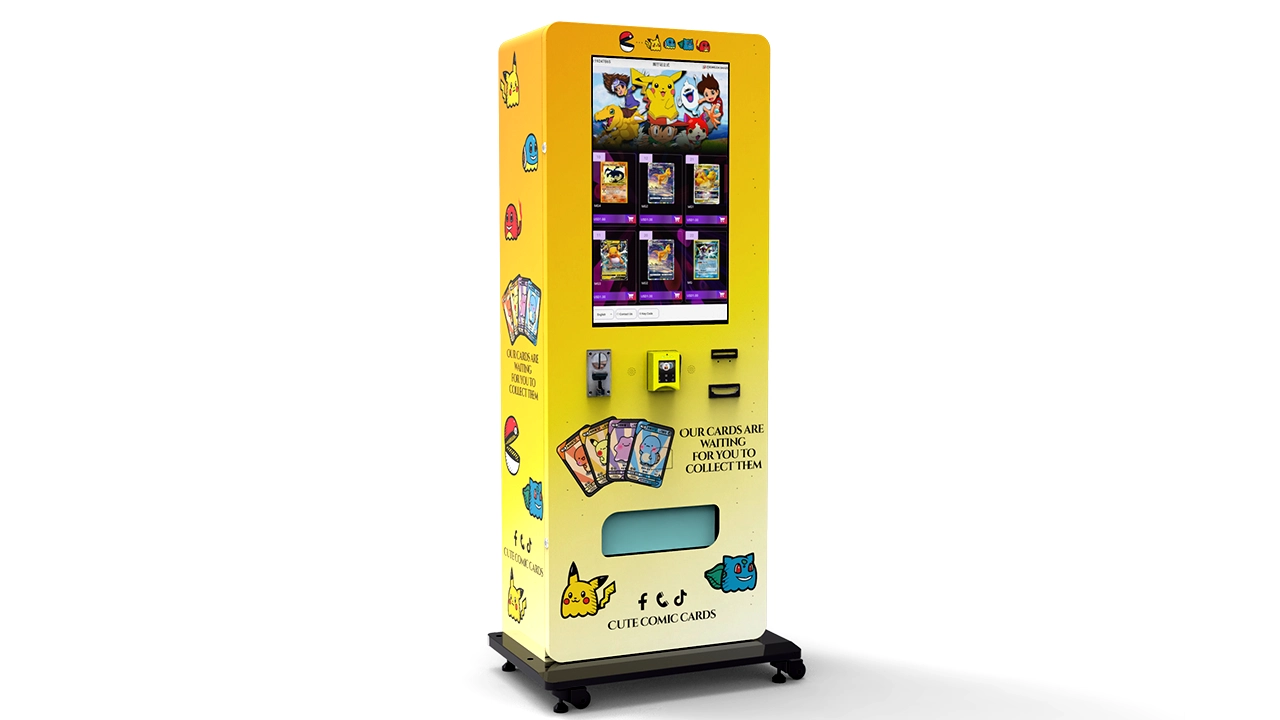
Operators planning a Pokémon-focused configuration can review Zhongda Smart’s trading card vending machine for Pokémon TCG products, which provides an example of a 21.5-inch touchscreen configuration with 60 standard cargo lanes and multiple payment options. Product dimensions still need to be checked before the final lane setup is confirmed.
Where One Piece Can Outperform Expectations
One Piece deserves to be treated as a serious category rather than a novelty add-on. Bandai Namco has identified the ONE PIECE Card Game as an important driver behind the growth of its card business. Its 2025 integrated reporting stated that Bandai ranked third in global trading-card-game market share as of March 2025 and specifically credited ONE PIECE Card Game, released in 2022, as a major growth contributor.[2]
Bandai Namco has also reported roughly 1,800 different ONE PIECE Card Game cards released by the time of its published feature, while pointing to both playability and collectability as important parts of the product’s appeal.[2]
Those two characteristics are useful in vending.
A card game supported only by players can experience sharp shifts when tournament preferences change. A product supported only by collectors can become heavily dependent on chase cards and scarcity. One Piece benefits from both sides of the market.
One Piece Can Be Excellent Release-Driven Inventory
Fresh sets can generate concentrated attention, making new releases suitable for high-visibility machine positions. But I would not assume every new set deserves the same amount of space.
I’d start new One Piece inventory with controlled quantities and track:
- units sold during the first 72 hours;
- units sold during the first seven days;
- repeat purchases from the same machine;
- sales after the initial release period;
- performance against Pokémon products at similar prices;
- how quickly inventory can be replenished.
This gives a much clearer picture than social attention alone.
A product that sells 30 units immediately but almost stops afterward should be managed differently from a product that sells eight units every week for two months.
The first is a launch product. The second is a dependable machine SKU.
Give One Piece Room to Prove Itself
One common mistake is putting one One Piece lane beside ten Pokémon lanes and then concluding that Pokémon has stronger demand. That is not a clean test because visibility, availability, SKU selection, and inventory depth are different.
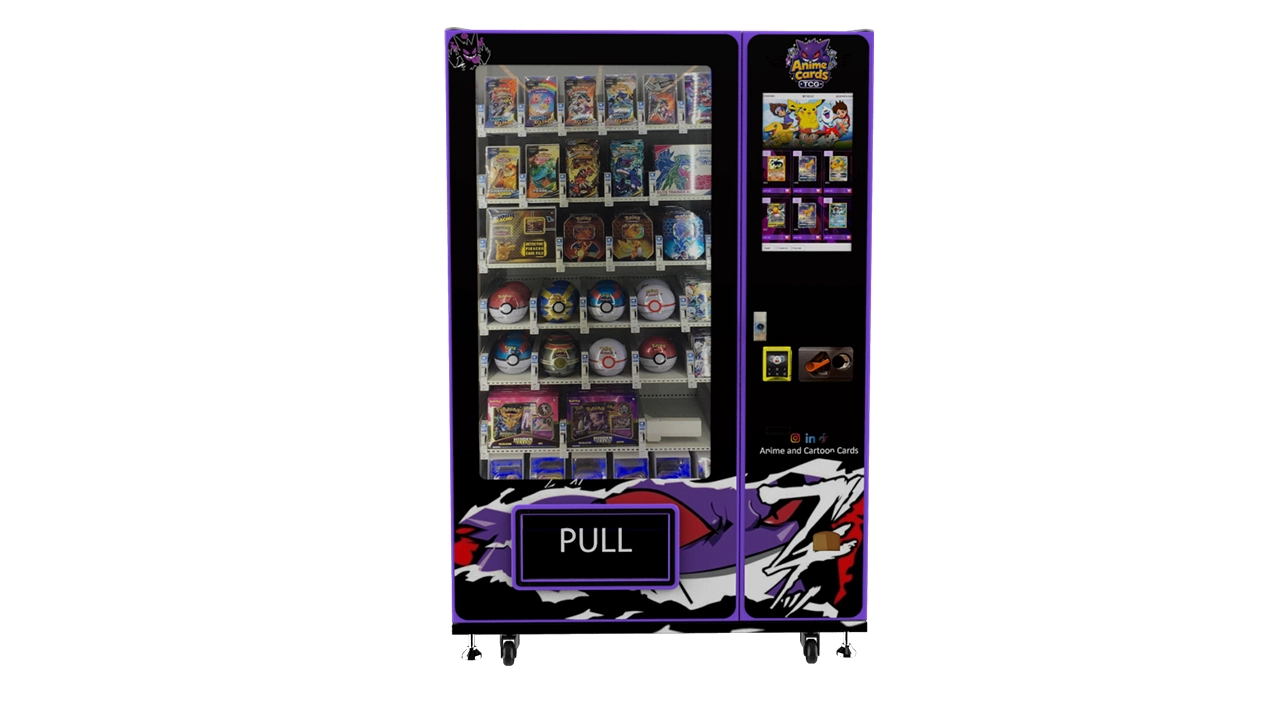
If I were testing One Piece seriously, I’d give it enough machine space to build a useful assortment. That might mean several booster choices plus one or two higher-value sealed products rather than a single token SKU.
The objective is not to make the machine look balanced. It is to learn which category converts machine traffic into profitable transactions.
Why Sports Cards Need a Different Stocking Strategy
Sports cards can be extremely attractive inventory, but I would approach them differently from Pokémon or One Piece. “Sports cards” is not really one product category. It is a collection of markets built around different sports, leagues, teams, rookies, veterans, product lines, price levels, seasons, and collector preferences.
That fragmentation creates both opportunity and risk.
Fanatics Collect currently reports more than 3.1 million cards sold and roughly 740,000 collectors on its platform. Again, those numbers do not represent vending transactions, but they provide useful evidence that the broader collectible-card market has substantial transaction activity.[3]
A current industry market estimate from Grand View Research places the sports trading-card market at approximately $13.5 billion in 2025, with an estimated $14.5 billion in 2026 and a projected $24.7 billion by 2033. The forecast represents a 7.9% compound annual growth rate from 2026 through 2033.[4]
Those figures show scale, but a machine still has to select the right products.
Sports Cards Are More Event Sensitive
Demand can move with rookie performance, record-breaking seasons, playoffs, championships, major signings, injuries, product launches, licensing changes, and collector attention.
That can create strong bursts of sales, but it also means inventory decisions need to move faster.
A sports product that was easy to sell a month ago can lose momentum. The reverse can happen when an athlete suddenly becomes the center of attention.
I’d therefore use a portion of sports-card capacity as flexible inventory rather than permanent inventory.
Instead of thinking:
“Lane 21 is always this exact sports-card box.”
I’d think:
“Lane 21 is a sports-card opportunity lane, and the product earns its place through current turnover.”
Higher Ticket Size Can Be an Advantage
Sports cards can support products that sell at substantially higher prices than a single booster pack. That can raise revenue per transaction without requiring many additional purchases.
However, high revenue per transaction is not the same as high profit per slot.
Imagine two products:
- Product A earns $3 in contribution and sells 40 times per month.
- Product B earns $12 in contribution and sells four times per month.
Product A produces $120 in monthly contribution. Product B produces $48.
The higher-ticket item looks more valuable inside the machine, but the less expensive item uses the retail space more productively.
This is why I’d compare products using contribution per occupied lane, not only gross margin percentage.
Sports Cards May Need More Product Education
A vending interface also has to communicate exactly what the customer is buying. Product photos, release name, pack count, configuration, price, and other essential information should be obvious.
Confusion is expensive in self-service retail.
If buyers cannot tell whether they are purchasing one pack, a multi-pack, a retail box, or another sealed format, conversion can fall and customer-service problems can rise.
How I’d Divide the Machine
I would not treat the following percentages as a permanent formula. They are a starting hypothesis designed to produce enough data for a better second decision.
For a new mixed trading card vending machine with no prior transaction history, I’d consider something close to this:
| Category | Starting Lane Allocation | Role |
|---|---|---|
| Pokémon | 40–50% | Core traffic and repeat sales |
| One Piece | 20–30% | Active TCG growth category |
| Sports Cards | 15–25% | Targeted and higher-ticket demand |
| Experimental Products | 5–10% | New releases and controlled testing |
A sixty-lane machine using a 45/25/20/10 split would translate to roughly 27 Pokémon lanes, 15 One Piece lanes, 12 sports-card lanes, and six experimental lanes.
That does not mean 27 different Pokémon products.
A strong SKU might occupy four lanes. Another might occupy two. A slower premium product might receive only one.
Allocate by Inventory Depth as Well as Variety
Machine merchandising is partly about choice and partly about avoiding stockouts.
If ten products each receive one lane, the machine may look diverse but run out of its best products quickly. If the same ten products are allocated according to demand, the machine may generate more sales with exactly the same SKU count.
I’d use a simple A/B/C structure.
- A products: proven high-velocity inventory. Give them deeper capacity and multiple lanes.
- B products: dependable sellers with moderate turnover. Give them normal capacity.
- C products: tests, premium items, niche products, and new releases. Give them limited capacity until performance is proven.
After several restocking cycles, the machine should gradually contain more A products and fewer unproven C products.
Which Product Formats Work Best?
Product category gets most of the attention, but package format can have an equally large effect on vending performance.
1. Single Sealed Booster Products
These are often attractive for automated sales because they are compact, easy to recognize, easy to replenish, and available at accessible transaction values.
The difficulty is mechanical. Thin packages can lean, overlap, slip under each other, or rotate if the cargo channel is not designed around the actual product dimensions.
I’d never order a machine based only on a statement that it can “sell card packs.” Send the real package dimensions, weight, photographs, and preferably sample products for testing.
2. Sleeved Boosters
Sleeved packs often provide more structure than thin foil packs. That can simplify dispensing, depending on the selected delivery method.
They also occupy more physical space, so capacity per lane may fall.
The correct comparison is not simply whether they fit. Compare:
- units per lane;
- selling price;
- gross contribution;
- monthly turnover;
- restocking frequency;
- dispensing reliability.
3. Multi-Pack Products
Multi-pack products can raise average transaction value while staying understandable to casual buyers. They can also create useful price steps between single packs and larger boxes.
I’d generally prefer clear factory-sealed configurations over complicated operator-created bundles unless packaging, contents, and labeling are completely transparent.
4. Sealed Boxes
Boxes can generate larger transactions, but they require more physical room and greater inventory investment.
A single box occupying the volume of several smaller products has to justify that space through higher contribution.
For premium sealed products, delivery method becomes especially important. A hard drop that is acceptable for a snack is not necessarily appropriate for a collectible box where corner condition matters to the buyer.
5. Graded Cards
Graded cards can be sold through automated retail when the machine, protective packaging, and delivery system are designed appropriately. They should not be treated like ordinary booster packs.
Slab dimensions vary, the value per unit can be much higher, and buyers care about physical condition. Security and gentle delivery become more important as item value rises.
If I were adding graded cards, I’d begin with a small number of clearly priced products and keep them physically separated from low-value pack inventory.
6. Mystery Products
Mystery products can attract interest, but they also create additional disclosure and trust considerations. Customers should understand what they are buying and what the advertised product structure actually means.
Promotional language should be reviewed carefully, particularly when chance, rarity, prizes, or unusually valuable possible contents are emphasized. Applicable rules can differ according to how the product and transaction are structured.
Pricing and Margin Planning
There is no useful universal answer to “What margin should a trading card vending machine make?” because product acquisition cost, payment processing, site fees, taxes, shipping, shrink, maintenance, and selling prices can all be different.
A better approach is to calculate contribution at the SKU level.
Selling Price
− Landed Product Cost
− Payment Cost
− Variable Location Cost
− Estimated Damage/Shrink Reserve
= Contribution per Vend
Then multiply contribution per vend by units sold.
Contribution per Vend × Units Sold During the Month
Finally, account for fixed machine and site expenses.
This is more useful than looking at markup alone.
A Simple Hypothetical Example
The following numbers are planning examples only. They are not recommended retail prices or market averages.
| Example SKU | Selling Price | Landed Cost | Other Variable Cost | Contribution | Monthly Units | Monthly Contribution |
|---|---|---|---|---|---|---|
| Example Booster A | $7.00 | $3.80 | $0.50 | $2.70 | 80 | $216 |
| Example Pack B | $12.00 | $7.00 | $0.80 | $4.20 | 38 | $159.60 |
| Example Box C | $35.00 | $23.00 | $2.00 | $10.00 | 12 | $120 |
Box C earns much more per transaction than Booster A, but Booster A produces more monthly contribution because it turns faster.
That is the kind of comparison I want before expanding a SKU.
Do Not Confuse Revenue With Machine Performance
A machine can report impressive sales while producing weak cash flow if inventory cost is high, location fees are aggressive, payment costs are ignored, and slow stock ties up too much capital.
I’d track at least five numbers:
- Gross sales.
- Gross contribution after merchandise cost.
- Contribution after variable transaction expenses.
- Machine-level operating contribution after site expenses.
- Inventory cash tied up in unsold merchandise.
The fifth number is frequently overlooked.
A machine containing $8,000 of inventory is using more working capital than a machine producing comparable sales with $3,000 of inventory. Inventory efficiency matters.
Inventory Turnover and Restocking
A well-stocked trading card vending machine should not be managed like a display cabinet. Every lane should have a job.
Some lanes generate frequent transactions. Some raise average order value. Some introduce new releases. Some attract attention. Some are tests. If a lane has no clear purpose and does not sell, it should eventually be replaced.
Measure Days Between Restocks
If a Pokémon SKU sells out every two days while another product remains nearly full for three weeks, the answer is not necessarily to increase the selling price of the first product. The first question is whether it deserves more capacity.
Adding another lane can sometimes increase revenue without changing traffic or pricing.
Remote machine management makes this easier because the operator can review sales and stock information without physically opening every machine. Zhongda Smart’s current trading card vending machine range includes configurations with connected inventory and sales-management functions, allowing machine selection to be matched to the planned product mix.
Calculate Sell-Through
A simple sell-through measure is:
If 40 units were loaded and 30 sold during the measurement period, sell-through is 75%.
Compare SKUs using the same period.
Do not compare a newly released set during its first weekend with an older product measured over six weeks and assume the difference represents permanent demand.
Track Stockouts Separately
Sales data can understate demand when inventory reaches zero.
Suppose Product A sold 40 units and Product B sold 35. Product A might look only slightly stronger. But if Product A sold out after four days while Product B remained available for the entire week, the two figures are not directly comparable.
Record:
- units loaded;
- units sold;
- time available;
- hours or days out of stock;
- date of restock;
- selling price changes.
That produces a much cleaner picture of true product velocity.
Machine Design Matters More Than Most Buyers Expect
Stock selection and machine engineering cannot be separated. The merchandise should influence the dispensing mechanism, lane dimensions, delivery system, screen interface, and capacity.
A conventional snack machine can physically hold some card products, but that does not automatically make it a good trading card vending machine.
Thin Packs Create Mechanical Challenges
Booster packs are light and flexible. A poorly matched coil or lane can cause them to lean, overlap, twist, or fail to release cleanly.
Testing should use the exact retail package whenever possible.
Useful measurements include:
- package width;
- package height;
- package thickness;
- weight;
- surface friction;
- whether the product is foil, sleeved, blistered, or boxed.
A dimensional drawing is useful. A physical vend test is better.
Premium Products Need Gentler Delivery
Collectors notice crushed corners, bent packaging, dented boxes, and damaged seals. That makes the delivery path part of the product experience.
For higher-value sealed boxes and condition-sensitive products, I’d consider a controlled or elevator-style delivery system instead of a long free drop.
This is one reason purpose-built automated card retail deserves more attention than simply putting different graphics on a conventional vending cabinet.
Screen Size Can Influence Merchandising
A touchscreen provides space to show product artwork, clear pricing, pack quantities, and other purchase information. This becomes increasingly useful when a machine carries Pokémon, One Piece, and multiple sports-card products simultaneously.
The screen should reduce buying friction rather than become an advertisement that hides basic information.
I’d prioritize:
- large product images;
- clear product names;
- clear quantity descriptions;
- visible prices;
- simple category navigation;
- few steps between selection and payment.
Machine Capacity Should Match Restocking Reality
A very large machine is not automatically better. If the operator services the location every day, a smaller machine may hold enough inventory. If the machine is difficult to visit frequently, greater reserve capacity may be valuable.
I’d select capacity based on expected daily unit sales multiplied by the maximum acceptable days between service visits, plus a safety reserve for the fastest sellers.
Match the Product Mix to the Location
The same machine can perform very differently in two placements. Traffic volume matters, but traffic relevance matters more.
A thousand people walking past a machine with little interest in trading cards can be less valuable than a much smaller group arriving specifically because they enjoy collectibles, gaming, entertainment, or card products.
Card and Hobby Stores
In a specialist retail environment, buyers already understand the products. This allows a deeper assortment and may support higher-value inventory.
A machine can also absorb routine transactions during busy periods while staff focus on singles, events, customer questions, or higher-touch sales.
Zhongda Smart’s trading card vending machine solution for card shops illustrates this role: automated sales can complement the main counter rather than trying to replace knowledgeable staff.
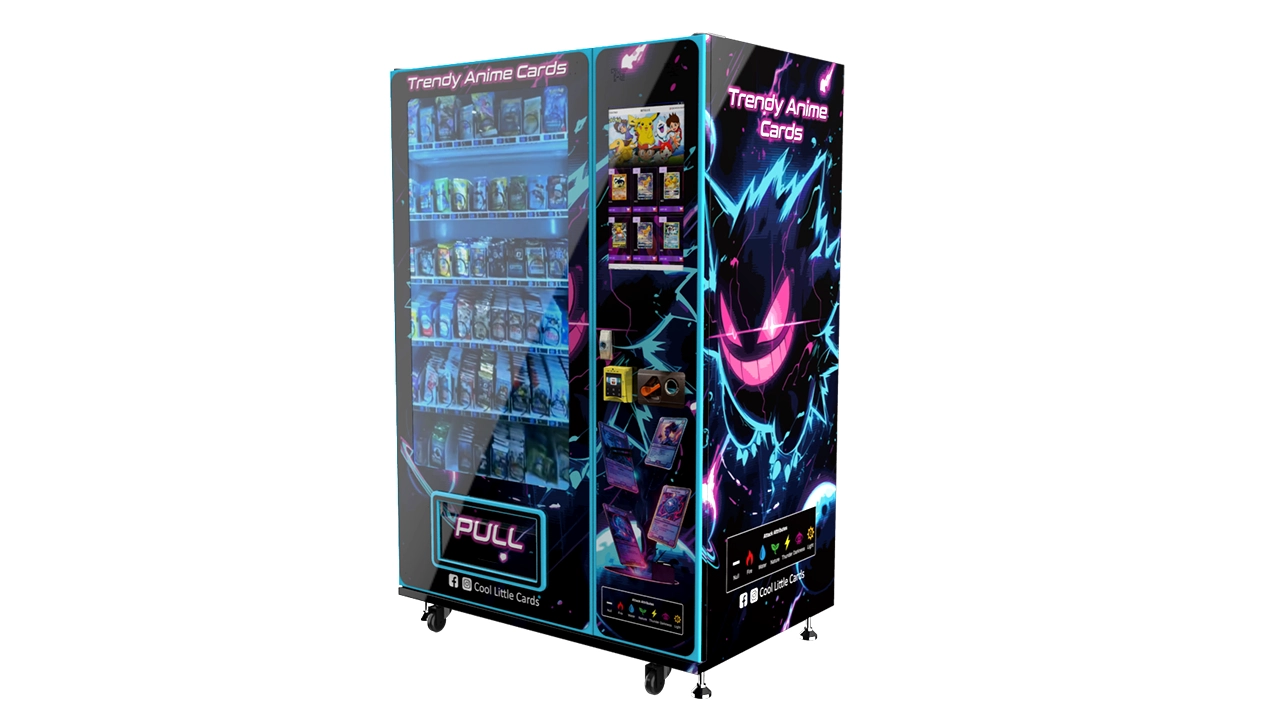
For this environment, I might increase One Piece and specialized sports-card allocation because the audience is already more familiar with the hobby.
General High-Traffic Locations
When customers are less specialized, recognition becomes more important. I’d lean more heavily toward products that can be understood immediately.
Pokémon can be especially useful here because the customer does not need detailed product education before recognizing the category.
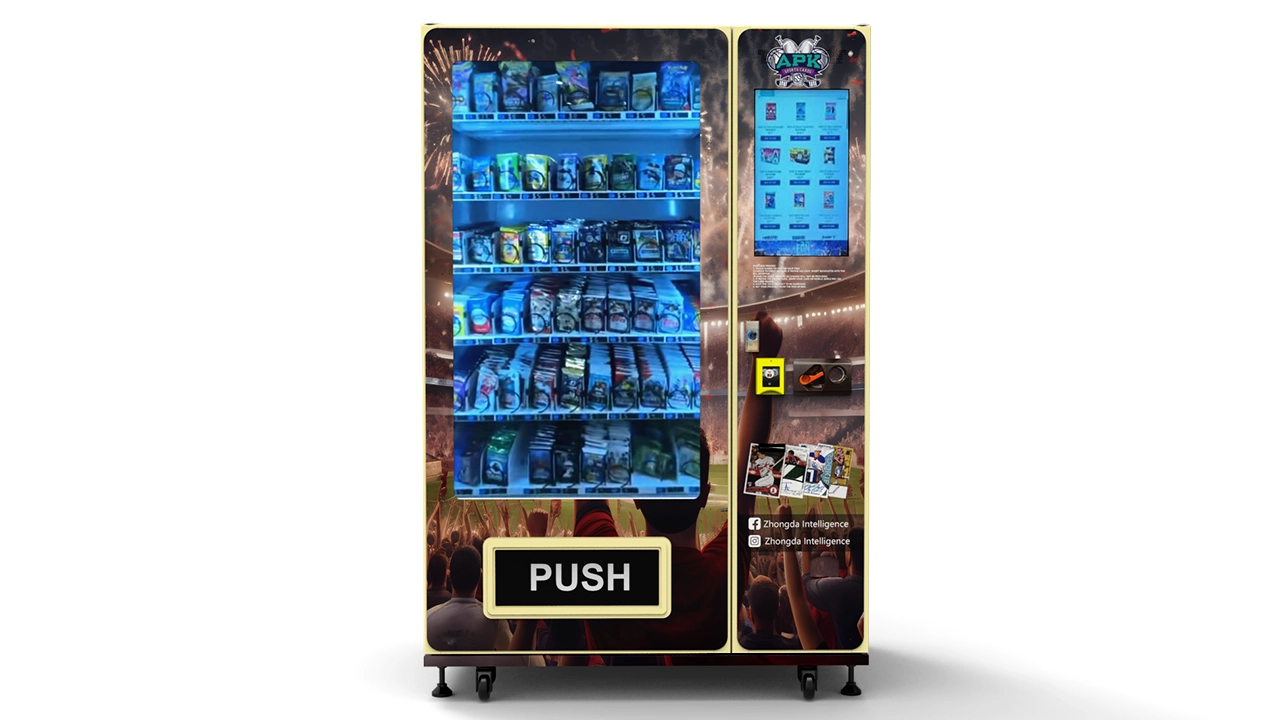
Sports inventory should be selected more tightly. Instead of filling many slots with niche releases, I’d prioritize products with broad recognition and straightforward packaging.
Entertainment-Focused Locations
Entertainment environments can support more experimentation because visitors are already in a discretionary-spending mindset.
A mixed machine may work well:
- recognizable Pokémon packs;
- current One Piece releases;
- selected sports-card products;
- a limited number of compatible collectible products.
The important measurement is not simply transactions per day. Compare transactions per relevant visitor when that information is available.
Existing Retail Businesses
An existing retailer has an advantage: there may already be sales data showing what customers buy.
If Pokémon represents most sealed-card sales at the staffed counter, that is useful evidence for vending allocation. If One Piece sells unusually well, the machine can reflect that local customer base instead of following generic percentages.
A vending machine should learn from the surrounding business rather than operate as an unrelated island.
A Practical 90-Day Stocking Test
I’d treat the first three months as a structured retail experiment.
Days 1–30: Establish the Baseline
Start with a diversified but controlled assortment. Avoid changing prices and products every day because constant changes make the data difficult to interpret.
Record for every SKU:
- starting inventory;
- restocked inventory;
- units sold;
- selling price;
- landed product cost;
- days available;
- stockout time;
- refunds or vend failures.
At the end of the first month, rank SKUs by unit velocity and contribution.
Days 31–60: Reallocate Space
Increase capacity for products that repeatedly sell out. Remove or reduce products that move slowly unless they serve a deliberate premium or merchandising role.
Do not replace every slow product at once. Keep enough of the original assortment to see whether weak performance is persistent.
A sensible change might look like this:
| Category | Month 1 | Month 2 Example |
|---|---|---|
| Pokémon | 45% | 50% |
| One Piece | 25% | 30% |
| Sports Cards | 20% | 15% |
| Tests | 10% | 5% |
That change would only make sense if the first month’s data supported it.
Days 61–90: Optimize the Economics
By the third month, I’d move beyond simple unit sales.
Evaluate:
- contribution per lane;
- contribution per cubic unit of machine space;
- average transaction value;
- restocking labor per dollar of contribution;
- stockout frequency;
- inventory days on hand;
- payment failures;
- vend failure rate;
- refund rate.
This may produce surprising decisions.
A popular low-value booster can create frequent restocking work. A slightly slower multi-pack might generate more contribution per service visit. A premium sports-card box may sell infrequently but require almost no labor. One Piece may outperform Pokémon during a release cycle but normalize later.
The correct answer emerges from several metrics together.
How to Decide Whether Pokémon Deserves More Space
Give Pokémon more capacity when the category repeatedly sells out, maintains strong contribution per lane, and can be replenished without disrupting margins.
Do not increase the allocation merely because customers ask whether Pokémon is available. Requests are useful signals, but completed purchases are stronger evidence.
I’d also compare different Pokémon SKUs against each other. A category can be strong while several individual products are weak.
The goal is not to prove that Pokémon sells. The goal is to identify which Pokémon inventory produces the best return for this specific machine.
How to Decide Whether One Piece Deserves More Space
One Piece should gain lanes when its sell-through remains strong beyond release-day excitement.
Watch repeat purchase behavior closely. A product with a committed player and collector base can produce recurring demand that is particularly useful for automated retail.
One Piece is also a category where keeping the assortment fresh can matter. Older inventory should not automatically remain in the machine because it belongs to a strong franchise.
When a SKU slows, compare the opportunity cost of that lane against a fresh release.
How to Decide Whether Sports Cards Deserve More Space
Sports cards should gain capacity when the machine demonstrates that its particular audience buys them consistently.
I’d be careful about expanding the entire sports category because one product performs well. Determine whether demand is tied to a specific sport, release, athlete, price point, or product format.
Sports inventory can benefit from more frequent rotation than core Pokémon inventory.
This is where remote sales monitoring becomes valuable. The faster the operator sees a change, the faster inventory can be reallocated.
Should You Stock All Three Categories in One Machine?
In many cases, yes.
A mixed trading card vending machine spreads demand across different collector groups while generating more useful data about the location.
There are three additional benefits.
1. It Reduces Dependence on One Release Calendar
Pokémon, One Piece, and sports-card releases do not all peak at exactly the same time. A mixed assortment can reduce dependence on a single franchise’s launch schedule.
2. It Creates Natural Cross-Shopping
A buyer may approach the machine for Pokémon and notice a sports-card product. Another may come for One Piece and add a second product from a different category.
This is one reason touchscreen merchandising can matter. The machine can expose shoppers to inventory they did not initially plan to purchase.
3. It Gives the Operator Better Information
A single-category machine cannot tell you whether another category would perform better at the same location.
A mixed machine creates a direct comparison under similar traffic, operating hours, placement costs, and payment conditions.
When a Single-Category Machine Makes More Sense
There are also cases where specialization is reasonable.
If transaction data clearly shows that one category dominates, a specialized machine can simplify inventory, branding, and restocking.
A retailer may also operate multiple machines, with each machine assigned to a different category. That can work when traffic supports enough volume to justify the additional equipment.
I’d only specialize after the demand has been demonstrated or when the surrounding business already provides strong sales evidence.
Common Inventory Mistakes
Mistake 1: Buying Inventory Because It Is Personally Exciting
A vending operator can be a collector, but the machine cannot be managed like a personal collection.
A beautiful product with strong collector appeal can still be a poor vending SKU if it sells slowly.
Mistake 2: Filling Every Lane With a Different SKU
Maximum variety is not always maximum productivity.
Strong sellers need enough depth to remain available between service visits.
Mistake 3: Ignoring Landed Cost
Inventory cost is more than the supplier invoice. Shipping, handling, taxes, storage, and other acquisition expenses can change actual margin.
Mistake 4: Ignoring Stockout Time
If a product is unavailable for half the month, sales numbers alone do not reveal its potential.
Mistake 5: Chasing Every New Release
Fresh releases are useful, but replacing proven inventory with an untested product carries an opportunity cost.
Reserve dedicated test lanes instead.
Mistake 6: Treating Every Sports Product the Same
Sports cards are segmented. Performance from one release does not prove equal demand for another.
Mistake 7: Using Price as the Only Merchandising Tool
If a SKU sells slowly, lowering the price may help, but poor performance may also result from weak product recognition, bad screen placement, an unsuitable product mix, or limited demand.
Mistake 8: Ordering the Machine Before Measuring the Products
This is one of the most avoidable mistakes.
Choose the merchandise first, document the package dimensions, then configure the vending system around what will actually be sold.
Mistake 9: Using a Harsh Drop for Condition-Sensitive Products
Trading-card customers care about packaging condition. Product delivery should reflect that.
Mistake 10: Expanding Before the First Machine Is Understood
A successful first week does not prove long-term economics.
I’d recommend learning from one carefully measured location before multiplying the same mistakes across a larger route.
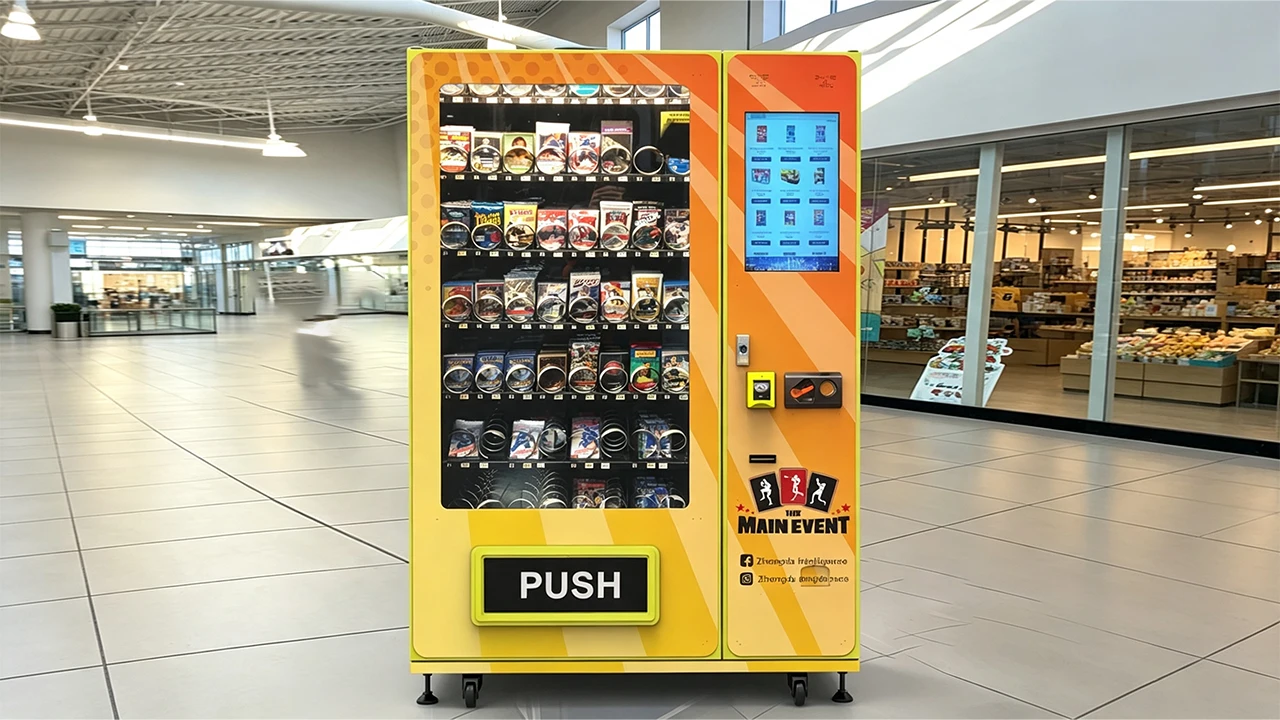
Choosing a Trading Card Vending Machine for Pokémon, One Piece, and Sports Cards
Once the planned merchandise is clear, machine selection becomes much easier.
I’d compare machines using the real operating requirements rather than screen size or exterior appearance alone.
Product Compatibility
Send the supplier the exact package dimensions of every major product format you intend to sell.
If the machine will carry booster packs, sleeved products, sports-card boxes, and other collectibles, each format should be evaluated separately.
Dispensing Method
Ask how the machine handles thin packs and how products reach the pickup area.
For more valuable products, a controlled delivery system can be preferable to a long drop.
Capacity
Estimate expected unit sales and desired service intervals. A machine with excessive capacity can increase equipment footprint unnecessarily, while insufficient capacity can create frequent stockouts.
Payment Configuration
Unattended retail depends on easy payment. Final payment hardware should be selected for the payment environment in which the machine will operate.
Card, contactless, QR, and other supported payment methods can be configured according to the project.
Remote Management
For a single nearby machine, manually checking inventory is inconvenient. For multiple machines, it becomes inefficient.
Connected sales and inventory data help identify stockouts, strong SKUs, weak SKUs, and restocking priorities.
Branding
A machine should look deliberate, not temporary. Exterior graphics, screen presentation, cabinet finish, and product photography should make the machine feel like a real retail channel.
Third-party character artwork and trademarks should only be used when the operator has the appropriate rights or authorization.
Floor-Standing vs Wall-Mounted
Floor-standing machines usually provide more physical merchandise capacity. Wall-mounted configurations can be useful when floor space is limited.
Zhongda Smart’s 32-inch wall-mounted trading card vending machine, for example, uses vertical wall space and is designed for compact card and collectible products.
Start With a Pilot
For a first project, I’d rather have one machine producing clean operating data than several machines producing confusing results.
A pilot lets the operator test product fit, pricing, payment behavior, replenishment frequency, customer demand, and machine reliability before committing more capital.
The detailed guide to starting a trading card vending machine business covers the broader operating model, including inventory, placement, payment processing, service, and pilot planning.
Building a Trading Card Vending Project?
Zhongda Smart manufactures configurable automated retail machines for booster packs, card boxes, sports-card products, and compatible collectibles. Send your package dimensions, expected product mix, payment requirements, and planned quantity so the machine can be configured around the merchandise instead of forcing the merchandise into a generic vending layout.
Compare Trading Card Vending MachinesWhat I’d Stock in Three Different Scenarios
Scenario A: A New Operator With No Sales History
If I were starting with no local sales data, I’d choose a diversified machine with Pokémon as the anchor.
A practical starting allocation might be:
- 45% Pokémon;
- 25% One Piece;
- 20% sports cards;
- 10% rotating tests.
I would not invest heavily in expensive sealed products during the first cycle. The first goal is to learn what buyers actually purchase.
Scenario B: An Existing Card Retailer
If the operator already has store sales data, I’d ignore the generic percentages and build the machine around proven customer behavior.
If One Piece produces 35% of sealed-product transactions in the store, there is little reason to restrict it to 15% of vending capacity just because a generic stocking guide uses a different number.
The machine should extend known demand.
Scenario C: A High-Volume Entertainment Location
I’d prioritize recognizable products, accessible price points, simple product descriptions, and enough inventory depth to avoid stockouts.
Pokémon would likely receive substantial space. One Piece could receive prominent release-driven lanes. Sports cards would be selected more carefully rather than represented by excessive variety.
I’d also keep several experimental lanes because a high-volume machine can collect useful product data quickly.
Which Category Has the Best Profit Potential?
No category can be declared the most profitable without knowing acquisition cost, selling price, transaction volume, location cost, and turnover.
This is the core distinction between collecting and retail.
A product can have a large theoretical markup and still be weak inventory if it does not sell.
I’d calculate:
| Metric | What It Tells You |
|---|---|
| Units per Day | Raw product velocity |
| Contribution per Vend | Profit contribution from each successful transaction |
| Contribution per Lane | How productively machine space is being used |
| Inventory Days | How long capital remains tied up |
| Stockout Hours | Potential demand lost through insufficient capacity |
| Refund/Vend Failure Rate | Whether the machine configuration works reliably for that package |
After several months, one location may reveal Pokémon as the strongest category. Another may show unusually strong One Piece demand. A third may generate most of its contribution from selected sports-card boxes.
The vending machine should be allowed to become different in each location.
Do Higher-Priced Products Belong in a Trading Card Vending Machine?
Yes, but I would use them deliberately.
Higher-priced products can increase average transaction value and give serious collectors more reasons to use the machine. They can also tie up cash and physical space.
A useful merchandising structure is often:
- many accessible products;
- a smaller number of mid-tier products;
- a limited number of premium products.
This creates a price ladder without converting the machine into a locked display cabinet.
I’d also consider the relationship between transaction value and customer trust. The more expensive the product becomes, the more important clear product presentation, vending reliability, secure payment, customer-service contact information, and damage protection become.
How Often Should You Change the Product Mix?
Frequently enough to respond to sales data, but not so frequently that every week becomes a completely different experiment.
Core products can remain while experimental products rotate.
A reasonable operating rhythm could include:
- daily stockout review;
- weekly SKU velocity review;
- monthly lane reallocation;
- quarterly category review.
New releases may require faster decisions.
The objective is to create a stable core and a flexible edge.
Pokémon may occupy much of the stable core. One Piece may have both core products and release-driven slots. Sports cards may use more of the flexible inventory allocation.
Inventory Purchasing Discipline Matters
Machine performance can be damaged before the first transaction if inventory is purchased poorly.
If a desirable product is acquired at an unsustainable price, strong sales may still produce weak economics.
I’d separate three decisions:
- Is this a good card product?
- Is this a good product for this machine?
- Can I acquire it at a cost that makes the transaction worthwhile?
All three need a satisfactory answer.
A popular product bought at the wrong cost is not automatically useful inventory.
Do Not Build the Business Around Secondary-Market Hype
High auction prices and rare-card headlines attract attention, but most vending transactions involve ordinary sealed retail products rather than record-setting collectibles.
The economics of a trading card vending machine should therefore be built around repeatable retail transactions.
Chase-card excitement can help drive sealed-product demand, but it should not replace normal inventory analysis.
For the operator, the most important card may not be the rare card inside the pack. It may be the sealed product that reliably sells 100 times every month.
Trust Is Part of the Product
Automated card retail has no cashier standing beside the machine. That makes trust unusually important.
The customer needs confidence that:
- the displayed product matches what will be dispensed;
- the price is clear;
- the package is sealed and authentic;
- payment will be processed correctly;
- the machine will release the product;
- help is available if a transaction fails.
Product photos should match the actual inventory as closely as possible. Descriptions should be specific. Contact information should be visible. Refund and failure procedures should be defined before the machine launches.
A single disputed transaction may be financially small but damaging to customer confidence.
Brand and Trademark Considerations
Pokémon, One Piece, sports leagues, card manufacturers, teams, athletes, and other third-party brands may be protected by trademarks, copyrights, publicity rights, licensing agreements, or other intellectual-property rights.
Selling lawfully acquired products and using brand artwork as exterior machine decoration are separate issues.
An operator should not assume that stocking a branded card product automatically creates permission to reproduce associated logos, characters, artwork, photographs, or promotional graphics on the machine.
When branded exterior graphics are planned, confirm the appropriate rights or permissions before production.
Zhongda Smart’s role as a vending-machine manufacturer does not imply endorsement, sponsorship, authorization, or affiliation with Pokémon, Bandai Namco, One Piece, sports leagues, card publishers, or other third-party intellectual-property owners.
Final Verdict: What Should You Stock?
If I had to make the stocking decision before receiving any machine-level sales data, I’d rank Pokémon first as the core category, One Piece second as a serious growth and collector category, and sports cards third as a selective category that can become much larger when the location proves demand.
But that ranking should expire as soon as useful transaction data becomes available.
The best long-term trading card vending machine is not the one with the most fashionable assortment. It is the one that learns fastest.
Start with enough variety to test demand. Give proven products enough capacity to avoid constant stockouts. Keep some lanes available for experimentation. Measure contribution rather than revenue alone. Compare products using equal time periods. Track stockout hours. Remove inventory that ties up space and cash without a clear purpose.
Pokémon may end up occupying half the machine. One Piece may become the strongest category in a particular placement. Sports-card products may produce fewer transactions but more contribution. None of those outcomes should be decided in advance.
Let the machine tell you.
That is the stocking strategy I’d choose: Pokémon for the strongest initial foundation, One Piece for meaningful TCG depth, sports cards for targeted opportunity, and enough flexibility to continuously replace assumptions with actual sales data.
Configure the Machine Around Your Actual Card Products
Before ordering equipment, prepare a list of the booster packs, sleeved products, boxes, sports-card products, and other collectibles you expect to sell. Record the dimensions, weight, expected quantity, preferred payment method, and desired restocking interval. Zhongda Smart can then evaluate cargo-lane and delivery configurations around the merchandise.
View Trading Card Vending Machine OptionsFrequently Asked Questions
Is Pokémon the best product for a trading card vending machine?
Pokémon is often a strong starting category because of its recognition, large physical-card ecosystem, sealed-product variety, and appeal to several types of buyers. However, it should not automatically receive permanent priority. Compare its actual sales velocity and contribution against One Piece, sports cards, and other products in the same machine.
Can I stock Pokémon, One Piece, and sports cards in the same vending machine?
Yes. A configurable trading card vending machine can carry multiple card categories when the product dimensions and dispensing system are compatible. A mixed assortment is also useful for testing which category performs best at a particular location.
What percentage of the machine should be Pokémon cards?
Without historical sales data, I’d consider roughly 40–50% of the initial lanes for Pokémon, then adjust the allocation after several restocking cycles. This is a testing starting point rather than a universal rule. A machine with strong One Piece or sports-card demand should be changed accordingly.
Are One Piece cards good for vending machines?
They can be. ONE PIECE Card Game combines active gameplay with strong collectability, and Bandai Namco has identified the title as an important contributor to its card-business growth. Sealed booster products can be well suited to automated retail when the lane and delivery system are configured for their packaging.
Are sports cards profitable in a vending machine?
They can be profitable, particularly when the machine carries products aligned with the interests of its customers. However, the category is fragmented by sport, product line, release, player, and price. Profitability should therefore be measured SKU by SKU rather than assuming all sports-card inventory will perform the same way.
What card products are easiest to sell through a vending machine?
Recognizable sealed products with consistent dimensions, clear pricing, and straightforward packaging are generally easier to manage. Booster packs, sleeved packs, multi-packs, and selected sealed boxes can all work. Actual suitability depends on the cargo-lane and delivery configuration.
Can a vending machine sell expensive card boxes or graded cards?
Yes, provided the product dimensions, security, protective packaging, and delivery system are appropriate. Higher-value products deserve more careful handling than ordinary low-cost merchandise, and an elevator or controlled delivery system may be preferable to a long drop.
How often should a trading card vending machine be restocked?
Restocking frequency depends on machine capacity and sales velocity. Instead of choosing a fixed schedule first, track how quickly the best SKUs sell. Give fast products more lanes when necessary and use remote inventory information to prioritize service visits. The objective is to minimize stockout time without creating unnecessary trips.
Sources and Further Reading
- The Pokémon Company — Pokémon in Figures. Published corporate statistics covering the Pokémon Trading Card Game and cumulative card production. View source
- Bandai Namco Holdings — Integrated Report 2025, Card Game Business. Corporate reporting discussing trading-card-game market growth and ONE PIECE Card Game performance. View source
- Fanatics Collect. Published platform statistics covering card transactions and collector participation. View source
- Grand View Research — Sports Trading Cards Market. Published market-size estimates and industry forecast data. View source
This article is provided for general business and inventory-planning information only. Product demand, wholesale cost, retail pricing, availability, machine revenue, and profitability can change and are not guaranteed. Financial examples are hypothetical planning illustrations rather than promises of earnings. Operators are responsible for verifying product authenticity, applicable sales and tax requirements, payment rules, venue requirements, consumer-protection obligations, and intellectual-property permissions. Pokémon, ONE PIECE, sports leagues, card publishers, team names, character names, logos, and other third-party marks belong to their respective owners. References to compatible products are descriptive only and do not imply sponsorship, authorization, endorsement, or affiliation.