A good trading card vending machine location is not simply the place with the largest crowd. The best locations combine the right audience, enough buying time, strong visibility, reasonable placement costs, reliable security, easy restocking, and a product mix that fits why people are already there. A busy hallway can produce almost no sales if shoppers are rushing past it. A smaller game store, arcade, or collectible-focused retail area can outperform it because the people walking past the machine already understand the products and have a reason to buy. When I rank trading card vending machine locations, qualified traffic comes before raw traffic. That single distinction prevents many expensive placement mistakes.
The strongest trading card vending machine locations are usually card and game stores, shopping centers near entertainment or hobby tenants, arcades, sports and event venues, transportation terminals, specialty toy or comic retailers, and selected student-oriented facilities. The winner is not automatically the busiest site. The winner is the site that produces enough qualified customers, enough dwell time, good machine visibility, healthy gross margin, manageable rent, low service friction, and repeat demand.
Why High Traffic Is Not Enough
The phrase “high-traffic location” gets used so often in vending that it has almost lost its meaning. A thousand people walking past a machine means very little unless enough of those people are potential buyers and have enough time to notice, evaluate, and purchase a product.
Think about two locations. Site A receives 5,000 passersby per day, but most are moving quickly toward another destination. They may see the machine for three seconds. Site B receives only 1,200 passersby, but many are already shopping for games, collectibles, entertainment, or gifts. They stay in the area longer and are comfortable spending discretionary money.
I would usually investigate Site B first.
The more useful question is not, “How many people walk past?” It is, “How many people who might reasonably buy trading cards walk past, notice the machine, and have enough time to complete a purchase?”
That difference can be described as qualified traffic.
Qualified traffic does not require guessing someone’s personal characteristics. Watch behavior instead. Are people entering a hobby store? Waiting for a tournament? Carrying collectible merchandise? Spending time in an entertainment area? Shopping with children? Browsing gift products? Watching a sporting event? Waiting before departure? Those behaviors tell you far more than a raw pedestrian counter.
Dwell time matters for the same reason. A touchscreen trading card machine asks a customer to stop, browse several products, compare prices, choose a pack or box, pay, and collect the purchase. That is still quick retail, but it is not identical to grabbing a bottle of water.
A customer who has ten relaxed minutes nearby is more valuable than a customer who has ten rushed seconds.
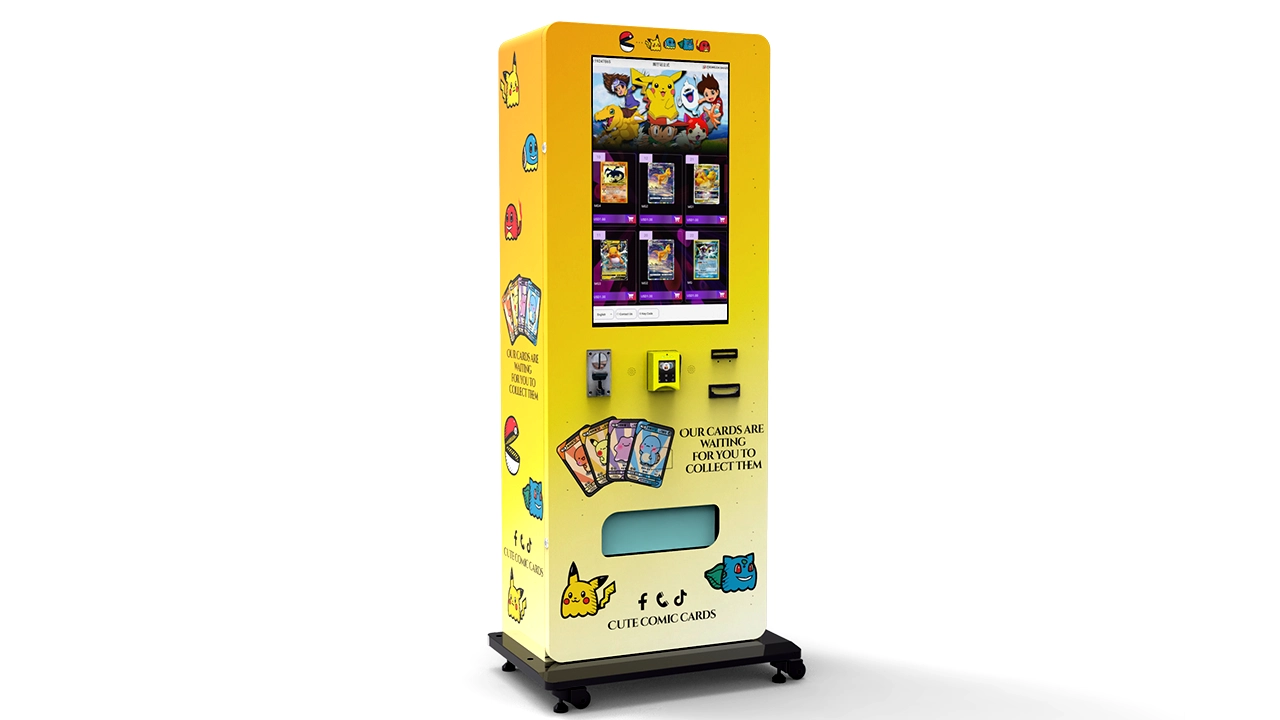
Visibility is another filter. A machine can technically sit inside a busy property and still be invisible. Columns, plants, temporary signs, kiosks, queues, doors, elevators, and storefront displays can block the sightline. A machine placed fifteen feet away in a cleaner visual field may attract more attention than one buried directly in the busiest corridor.
There is also a commercial problem with chasing the busiest possible space: premium traffic often comes with premium rent. If Site A generates twice the sales but costs four times as much to occupy, Site B may still produce more operating profit.
This is why I would never approve a trading card vending machine location from a traffic number alone.
The Location Scorecard I Would Use
A location decision becomes much easier when every candidate is scored using the same criteria. The weighting below is a practical screening framework, not an industry standard. I would use it to force discipline into the decision instead of allowing one attractive feature, such as a famous venue or a huge crowd, to dominate the conversation.
| Factor | Suggested Weight | What I Would Evaluate |
|---|---|---|
| Audience fit | 25% | How naturally the venue attracts collectors, gamers, sports fans, gift buyers, families, or hobby shoppers. |
| Qualified foot traffic | 20% | Number of realistic prospective buyers passing the exact machine position. |
| Placement economics | 15% | Fixed rent, revenue share, utilities, insurance, service cost, and other location charges. |
| Dwell time | 10% | Whether shoppers have enough time and mental space to browse rather than rush past. |
| Visibility | 10% | Sightline, screen visibility, lighting, surrounding clutter, and approach direction. |
| Security | 8% | Camera coverage, supervision, vandalism exposure, closing procedures, and cabinet security. |
| Restocking access | 5% | Parking, loading, permitted service hours, distance from vehicle, elevator access, and security check-in. |
| Power and connectivity | 4% | Reliable electrical service and suitable network connection for payments and remote management. |
| Retail adjacency | 3% | Nearby stores or activities that reinforce rather than weaken card-buying behavior. |
I would generally be interested in testing a site that scores above 75 out of 100, assuming there is no obvious operational problem. A score between 60 and 75 deserves negotiation or a short pilot. Below 60, I would want a very specific reason to proceed.
The score itself is less important than the discipline behind it. If a venue manager says, “We get huge traffic,” the scorecard forces the next questions: How much of it is relevant? What is the rent? Where exactly will the machine stand? Can customers see the screen? Can we restock it easily? What happens if sales are weak?
Best Trading Card Vending Machine Locations Ranked
1. Card Shops and Game Stores
If I were choosing a first pilot location, a good card shop or game store would be high on the list. Audience fit is unusually strong because customers already understand sealed packs, boxes, releases, rarity, and collectible value.
The machine does not need to replace the sales counter. That is the wrong way to position it. It can handle routine purchases while staff spend time on singles, trade-ins, tournaments, deck questions, and higher-touch customer service.
A machine can also be useful when the counter is busy. Tournament nights are a good example. A player who needs another pack or small sealed product may prefer a quick self-service transaction rather than waiting behind customers discussing trades or deck construction.
The weakness is obvious: the store already sells the same category. The machine needs a clear job. It may carry fast-moving sealed products, after-hours inventory in an accessible area, impulse items near the entrance, special machine-only assortments, or products intended to reduce checkout congestion.
If the machine simply duplicates the shelf three feet away at the same price with no convenience advantage, it may add very little.
For a deeper look at this use case, Zhongda Smart has a dedicated trading card vending machine solution for card shops.
2. Shopping Centers Near Entertainment and Hobby Traffic
Shopping centers can be excellent trading card vending machine locations, but “inside a shopping center” is nowhere near specific enough. One corridor can outperform another by a wide margin.
I would look first at areas near cinemas, game retailers, toy stores, entertainment venues, food areas with long dwell times, hobby retailers, family attractions, and other destinations where shoppers are already in a discretionary-spending mindset.
The visual environment matters. A large touchscreen machine can function almost like a compact digital storefront, but only if the screen is visible early enough for shoppers to react. A machine hidden behind temporary promotional stands loses one of its biggest advantages.
The main risk is location cost. Property managers know what premium floor space is worth. A beautiful placement can still be a weak business if fixed rent or revenue share consumes too much gross margin.
I would rather have a slightly less glamorous corridor with a strong customer fit and sustainable economics than the most expensive spot in the building.
For configuration examples, see Zhongda Smart's shopping center trading card vending solution.
3. Arcades and Family Entertainment Venues
Arcades have several characteristics I like: discretionary spending, repeat visits, longer dwell time, visual stimulation, and an audience already comfortable with self-service machines.
Customers are also used to making small transactions throughout the visit. That can make a vending purchase feel natural rather than interruptive.
The strongest position is usually not hidden among dozens of unrelated machines. It is often where customers transition between activities: near entrances, redemption areas, waiting zones, seating areas, or paths linking major attractions.
Product selection should fit the environment. Entry-priced packs and visually recognizable sealed items often deserve more capacity than expensive collector boxes in a family-heavy entertainment venue. Premium products can still work, but I would let transaction data earn that shelf space.
You can compare practical configurations in Zhongda Smart's arcade trading card vending machine solution.
4. Sports and Event Venues
Sports cards have an obvious connection to sports audiences, but the location still needs to be evaluated carefully. Event traffic can be extremely concentrated. A machine may do most of its business during a few short windows before an event, during breaks, and immediately afterward.
That creates both opportunity and operational pressure.
If a strong product sells out twenty minutes before the peak, the location's theoretical traffic no longer matters. Capacity, replenishment timing, and remote stock visibility become more important than they would at a slower site.
Event venues may also require more durable installations, strict approved service hours, venue credentials, additional insurance, and detailed rules about branding or merchandise rights.
I would place special emphasis on product authorization here. Do not assume that being allowed to install a machine automatically gives the operator rights to use team, league, event, character, or other protected artwork on the cabinet.
The best version of this location has strong fan-product alignment, predictable event traffic, enough stock for peak periods, good screen visibility, and a commercial agreement that does not absorb the profit created by that traffic.
5. Transportation Terminals and Waiting Areas
Waiting time changes retail behavior. A customer who arrives early may have twenty, forty, or sixty minutes available. That creates a different buying environment from a corridor designed primarily for rapid movement.
Trading cards can also work as gifts, travel entertainment, collectibles, or impulse purchases, which makes selected terminals worth evaluating.
The operational side is harder. Access, security screening, loading restrictions, service windows, insurance requirements, and placement fees can all be more demanding. These factors should be included before a revenue forecast is accepted.
A transportation location with strong sales but difficult servicing can quietly become expensive to operate.
Zhongda Smart outlines machine considerations for this environment in its transportation-terminal card vending solution.
6. Comic, Toy, Hobby, and Specialty Retailers
Specialty retail can produce excellent qualified traffic even when the total visitor count is modest. A shopper already browsing hobby products has crossed an important psychological barrier: they are actively considering discretionary purchases.
The opportunity is strongest when the machine complements the retailer instead of competing with the exact same shelf.
That could mean products the store does not want to allocate permanent shelf space to, rotating releases, compact collectible lines, convenient self-service products, or inventory available during high checkout volume.
A specialty retailer may also be more willing to discuss revenue share than a traditional property manager because the relationship is easier to understand: the machine is another retail category, not just rented floor space.
7. Student Centers and Selected Campus Facilities
Student-oriented facilities can be attractive when the machine is placed where people naturally gather rather than in a low-dwell academic corridor.
Common areas, recreation facilities, gaming clubs, residential common spaces, entertainment facilities, and food-service zones are more interesting than a hallway chosen only because it has power.
Price architecture matters. A location dominated by budget-sensitive purchases may perform better with a larger share of accessible packs and smaller sealed products than with an assortment heavily weighted toward premium boxes.
School or facility policies also need to be checked before installation, particularly rules covering commercial vending, product categories, advertising, age access, electrical installation, and payment systems.
8. Large General Retail Properties
General retail can work, but adjacency is critical. A machine beside the wrong category may simply disappear into the environment.
I would look for placement near toys, collectibles, gaming, electronics, entertainment, checkout waiting zones, or other areas where the purchase feels contextually natural.
A large store can produce enormous raw traffic while delivering mediocre card sales if the machine sits near a category with little overlap.
The larger the property, the more important the phrase “exact position” becomes.
9. Cinemas and Entertainment Waiting Zones
Cinemas have dwell time, groups, families, and discretionary spending. Customers often arrive early, wait for friends, or spend time in a lobby before the main activity begins.
That makes the lobby more interesting than the exit. At the exit, customers usually have a clear next destination. Before the event, they are more likely to browse.
The machine should not obstruct lines or compete visually with required safety signage. A good position is visible without being intrusive.
10. Hotels, Resorts, and Mixed Entertainment Properties
These locations are more variable. A generic business hotel may be weak. A property built around family recreation, gaming, sport, events, or entertainment can be much better.
This is a good reminder that the category name of the property is less useful than the actual behavior happening around the machine.
Locations That Look Good but Often Fail
Some sites are attractive during a quick visit and disappointing once the machine is operating.
- Fast-moving corridors: lots of people, very little stopping behavior.
- Hidden corners: low visibility despite being inside a busy venue.
- Locations beside exits: customers have already mentally finished shopping.
- Expensive prestige placements: strong sales but even stronger rent.
- Sites with difficult restocking: service labor quietly erodes margin.
- Unsupervised areas: higher exposure to vandalism and tampering.
- Venues with weak product relevance: traffic does not translate into purchase interest.
- Sites with unreliable connectivity: payment failures destroy conversion.
- Locations without a clear line of sight: the touchscreen never gets a fair chance to attract attention.
Another warning sign is a venue owner who will not define the exact placement before the agreement is signed. “Somewhere near the entrance” is not enough. Ten feet can materially change visibility.
I would want the placement documented with photographs, measurements, power location, orientation, and preferably a marked floor plan.
Where the Machine Should Sit Inside the Venue
Choosing the property is only half the job. The exact machine position often decides whether the location reaches its potential.
I would start by standing where the customer stands, not where the machine stands.
Look at the primary approach direction. How many seconds is the machine visible before someone reaches it? Can the screen be seen without turning around? Is there enough room to stop without blocking traffic? Can two people browse while someone else walks past?
Then inspect the background. A visually busy environment can reduce screen impact. If the machine is surrounded by five brightly illuminated displays, three temporary signs, and a promotional booth, a large touchscreen may still disappear.
Lighting matters too. Direct glare on the screen makes browsing harder. A dark corner reduces cabinet visibility. The ideal placement gives the screen strong contrast without creating reflections.
Do not ignore the pickup area. Customers should be able to retrieve a product without kneeling in a passageway or standing where another shopper might collide with them.
I also like locations with a natural pause point: near seating, a waiting zone, a store entrance, a queue that does not block the machine, or a transition between two activities.
The worst placement sometimes looks efficient from the property manager's perspective because it uses otherwise dead space. Dead space is often dead for a reason.
Payment Convenience Matters More Than It Used To
A location can produce interest and still lose the sale at checkout.
The NAMA Foundation's 2022–2023 industry census reported that approximately 75% of 2.89 million vending machines in its dataset accepted cashless payments. Among machines accepting cashless transactions, 94% offered standard debit or credit cards and 88% offered contactless payments.[1]
The practical lesson is straightforward: a modern location plan should include payment behavior from the beginning rather than treating the payment reader as an accessory added after the machine is selected.
Payment compatibility is particularly important for trading cards because some transactions can be meaningfully larger than a traditional snack purchase. A customer willing to buy a sealed product may abandon the transaction if the payment method they normally use is unavailable.
When evaluating a site, I would verify:
- reliable network connectivity at the exact machine position;
- the payment methods supported by the selected payment hardware;
- transaction-fee structure;
- refund and failed-vend procedures;
- offline behavior if the connection drops;
- remote transaction reporting;
- how payment disputes are handled.
If you want a clearer view of the full transaction process, Zhongda Smart's guide to how a trading card vending machine works explains the relationship between product selection, payment authorization, inventory control, dispensing, and delivery.
Match the Product Mix to the Location
A great location cannot rescue a bad assortment forever.
Trading card vending works differently from ordinary commodity vending because demand can change sharply around new releases, tournaments, sports seasons, player interest, scarcity, and collector attention.
Circana reported that collectibles grew 32% in 2025 across the 12 markets included in its tracking and accounted for almost 19% of toy dollar sales. Trading cards were among the categories supporting that growth.[2]
Strong category demand does not mean every SKU belongs in every machine. The location still determines which part of the category is most useful.
If I were building a new assortment without machine-specific history, I might begin with something like this as a testing hypothesis:
| Inventory Role | Starting Share | Purpose |
|---|---|---|
| Core fast sellers | 50–60% | Products with broad recognition and dependable turnover. |
| Current releases | 20–30% | Capture release-driven demand and repeat visits. |
| Premium products | 10–15% | Raise average transaction value where the audience supports it. |
| Experiments | 5–10% | Test new categories without sacrificing too much capacity. |
Those percentages should move quickly once real machine data is available.
A mistake I would avoid is allocating equal space to every SKU. Vending capacity should follow demand. If one product sells five times faster than another, giving them identical capacity produces unnecessary stockouts in one lane and dead inventory in the other.
Measure sales by SKU, gross margin by SKU, days between stockouts, and sales per occupied lane. That tells you what deserves more machine space.
Match the Machine to the Location
The question “Which location is best?” cannot be completely separated from “Which machine fits that location?”
A wall-mounted machine can make sense where floor space is extremely valuable. A high-capacity floor-standing machine may be better where sales volume is strong and service visits are difficult. A lift or elevator delivery system may be preferable for premium boxed merchandise where reducing drop impact is important.
For this comparison, I would prioritize four machine characteristics:
- Capacity: Can the machine survive the peak period without constant restocking?
- Product flexibility: Can the cargo channels accommodate the packs and boxes you intend to sell?
- Delivery method: Is the merchandise suitable for conventional drop delivery, or does it benefit from gentler handling?
- Connected management: Can you review inventory, sales, and machine status remotely?
| Location Type | Machine Priority | Why |
|---|---|---|
| Card or game shop | Flexible lanes or compact wall-mounted format | Product assortment may change frequently and retail floor space can be valuable. |
| High-visibility shopping area | Large touchscreen | Digital merchandising helps attract shoppers from a longer sightline. |
| Arcade | Strong visibility and mixed capacity | Supports impulse purchases and a broad product mix. |
| Event venue | High capacity and remote inventory | Demand can arrive in short, intense peaks. |
| Premium collectible placement | Lift/elevator delivery | Reduces the long free-fall associated with ordinary drop vending. |
Do not buy the largest machine first and then search for a location that can accommodate it. I would reverse the process: define products, location, traffic pattern, target capacity, and service schedule first; then configure the machine around those requirements.
Security and Merchandise Risk
Trading cards can carry more value in a small physical volume than many conventional vending products. Security therefore deserves more attention than a casual “the venue has cameras” check.
The National Retail Federation's 2026 theft and fraud study reported improvement in some shoplifting measures during 2025 while also finding that retailers continued to deal with evolving theft and fraud risks.[3] The important point for an unattended retail operator is not to predict crime statistics. It is to reduce avoidable exposure.
I would prefer:
- clear camera coverage;
- regular employee or security visibility;
- a well-lit position;
- a cabinet suitable for commercial unattended use;
- appropriate anchoring where permitted;
- limited physical cash when the business model allows it;
- clear procedures after suspected tampering;
- insurance appropriate to the installation and merchandise.
A cheap rent offer in an isolated area can become expensive if product losses, vandalism, downtime, or service calls increase.
Rent, Revenue Share, and Location Economics
The best physical location is not necessarily the best financial location.
Venue agreements commonly use a fixed monthly fee, a percentage of sales, a minimum guarantee, or some combination. None of these structures is automatically good or bad. The right choice depends on expected sales and how much risk each side is taking.
A percentage arrangement can reduce downside during a new pilot because the location cost moves with sales. A fixed rent can become attractive when the machine is proven and sales are comfortably above the break-even level. A high minimum guarantee removes much of that protection.
The metric I would watch is not just rent. I would calculate total location cost as a percentage of net sales.
Total location cost may include:
- base rent;
- revenue share;
- common-area or property fees;
- electricity charges;
- network charges;
- insurance requirements;
- permits or access credentials;
- delivery or loading charges;
- extra service labor created by the property.
A machine that generates $6,000 in monthly sales with simple servicing can be more valuable than one generating $8,000 if the second machine requires high rent, difficult loading, expensive parking, and twice as many service hours.
The useful formula is:
Machine financing, depreciation, taxes, headquarters overhead, and other business costs should then be considered according to your own accounting method.
A Practical Location Profitability Example
The following numbers are intentionally illustrative. They are not a promise of vending-machine performance.
Assume a machine produces 14 transactions per day at an average transaction value of $11.50.
| Transactions per day | 14 |
| Average transaction | $11.50 |
| Approximate 30-day revenue | $4,830 |
| Illustrative merchandise cost at 58% | $2,801 |
| Gross margin before operating expenses | $2,029 |
| Illustrative payment cost at 3% | $145 |
| Illustrative venue share at 12% | $580 |
| Restocking/service allocation | $240 |
| Connectivity/software allocation | $60 |
| Illustrative monthly contribution | $1,004 |
Now imagine another location produces 18 transactions a day but charges a much larger minimum rent and requires frequent paid parking for restocking. Its sales number looks better, but its contribution could be worse.
This is why I would never rank locations using revenue alone.
The operating contribution per machine, service hour, and dollar of invested capital tells a much more useful story.
How to Measure a Location Before Signing
A few hours of observation can prevent months of frustration.
For a new location, I would collect pedestrian information during several different periods instead of visiting once. One practical method is to count for 15 minutes and record:
- total passersby;
- people who pause in the immediate area;
- people entering relevant neighboring businesses;
- groups or families spending time nearby;
- existing vending or self-service usage;
- queue formation;
- visibility problems;
- temporary obstacles.
Repeat the sample during different dayparts and on different days. Four fifteen-minute samples are more informative than one photograph of a busy moment.
Do not automatically multiply a short peak sample into a full-day forecast. Traffic rarely stays constant.
I would also photograph the proposed machine position from at least three approach directions and measure the available width, depth, height, door-clearance area, and nearby electrical access.
Then talk to the venue operator about traffic cycles. Ask when the property is busiest, when it is quietest, when deliveries are allowed, and whether large events change normal visitor patterns.
Finally, look at neighboring retail. The businesses around the machine can reveal more than the building's total traffic count.
How I Would Run a Location Pilot
A pilot should answer a business question, not simply prove that the machine can turn on and accept payment.
Before installation, define the metrics that will decide whether the location stays.
I would normally track:
- daily sales;
- transactions per day;
- average transaction value;
- gross margin dollars;
- sales by SKU;
- stockout frequency;
- failed vend rate;
- payment approval rate;
- refund count;
- service visits;
- restocking time;
- location cost as a percentage of sales;
- operating contribution.
I would avoid changing five things every few days. If pricing, assortment, screen design, machine position, and promotions all change at once, the results become difficult to interpret.
A cleaner pilot lets the machine operate long enough to establish a baseline, then makes controlled adjustments.
For many ordinary locations, four weeks is the minimum period I would want before drawing a strong conclusion. Six to eight weeks is more useful when traffic varies substantially. Event-driven locations should be evaluated around several comparable events rather than calendar days alone.
A weak first week is not automatically a failure. The machine may need better visibility or a better product mix. But a poor location should not be endlessly “optimized” because nobody wants to admit the original placement was wrong.
What to Put in the Venue Agreement
A good location with a vague agreement can turn into a bad business relationship.
Commercial terms should be written clearly enough that both sides know what happens when circumstances change.
Items worth addressing include:
- exact machine position;
- fixed rent and/or revenue share;
- definition of sales used for calculating commission;
- payment schedule;
- electricity responsibility;
- network responsibility;
- installation and anchoring approval;
- service access hours;
- loading procedures;
- insurance requirements;
- responsibility after theft or property damage;
- cabinet branding approval;
- product restrictions;
- exclusivity, if any;
- relocation rights;
- trial period;
- termination rights;
- notice period;
- removal procedures.
A relocation clause deserves special attention. Property managers sometimes reorganize corridors, add kiosks, move displays, or renovate. A strong machine position can become weak even though the machine never moved.
If the property can relocate the machine unilaterally, understand exactly what protection you have.
This is a commercial checklist, not legal advice. Agreements should be reviewed according to the laws and requirements that apply to the specific installation.
Restocking Can Make or Break a Good Location
Operators naturally focus on sales, but restocking efficiency deserves almost the same attention.
Imagine two machines each generate similar gross margin. Machine A is ten minutes from another stop, has nearby parking, and takes twenty minutes to refill. Machine B requires a special access pass, a long walk from loading, paid parking, and a narrow service window.
They are not equally profitable locations.
I would track total service minutes from arrival at the property to departure, not just the minutes with the machine door open.
Remote inventory can help here. If the software shows what sold and what remains, the operator can prepare the correct stock before leaving rather than visiting simply to discover what the machine needs.
Restocking frequency should also influence capacity planning. A machine installed near the operator's warehouse can tolerate a different inventory strategy from one that requires a long service trip.
Popular releases create another problem. A machine may have plenty of total inventory while its best-selling lane is empty. Overall stock percentage therefore hides important information.
Track availability by important SKU.
For fast sellers, extra lane allocation may be more valuable than adding another slow-moving product.
How to Build a Better Multi-Location Route
Once several machines are operating, the goal changes. You are no longer trying to prove that unattended card retail works. You are deciding where the next machine adds the most profit without creating an inefficient service route.
I would divide existing locations into groups:
- A locations: strong contribution, reliable operation, manageable service effort;
- B locations: profitable but with one clear weakness that may be fixable;
- C locations: low contribution or excessive operational friction.
The next expansion should learn from the A group.
Look for repeating characteristics. Maybe the best machines are all near entertainment anchors. Maybe locations with longer dwell time outperform higher-traffic corridors. Maybe wall-mounted units work particularly well inside specialty retailers. Maybe premium boxes sell only in collector-heavy venues.
That information becomes much more useful than generic advice about the “best place for vending machines.”
A route should also be geographically efficient enough for your own operation. A profitable machine located far outside an existing service cluster may produce less contribution per service hour than a slightly lower-sales machine located beside three other stops.
Choosing the Right Trading Card Vending Machine Configuration
Once the location and merchandise are defined, the machine can be configured around the project rather than the other way around.
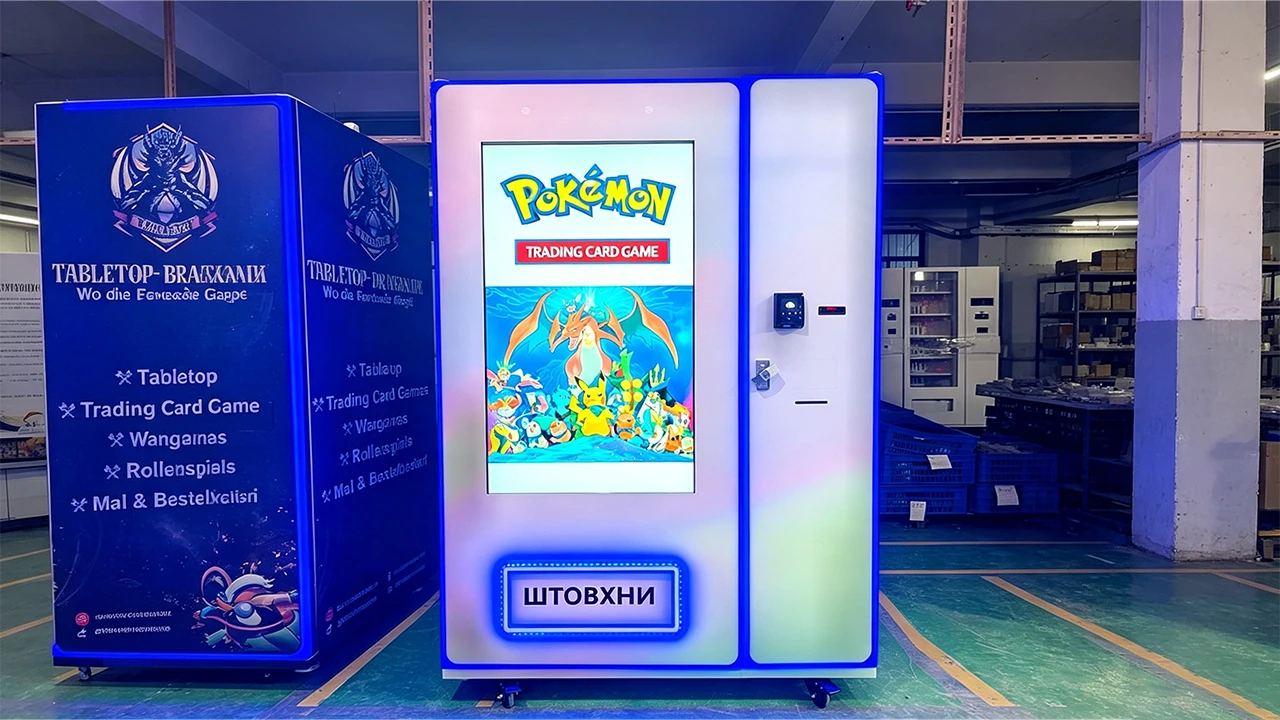
Zhongda Smart manufactures trading card vending machines with options that can include touchscreen interfaces, cashless payment hardware, remote management, adjustable product channels, custom exterior branding, wall-mounted cabinets, floor-standing cabinets, and elevator-style delivery for products that benefit from gentler handling.
For a serious project, I would send the manufacturer more than a request for “a trading card machine.” Useful information includes:
- photos of every product format;
- package length, width, thickness, and weight;
- desired SKU count;
- expected stock capacity;
- venue photographs;
- available floor or wall dimensions;
- expected payment methods;
- network availability;
- branding requirements;
- preferred delivery method;
- anticipated machine quantity.
The more precisely the machine is matched to the products and location, the fewer compromises have to be solved after installation.
Share your product dimensions, target capacity, location type, payment requirements, and branding plan with Zhongda Smart. The machine configuration can then be matched to the merchandise you actually intend to sell.
Explore Trading Card Vending Machines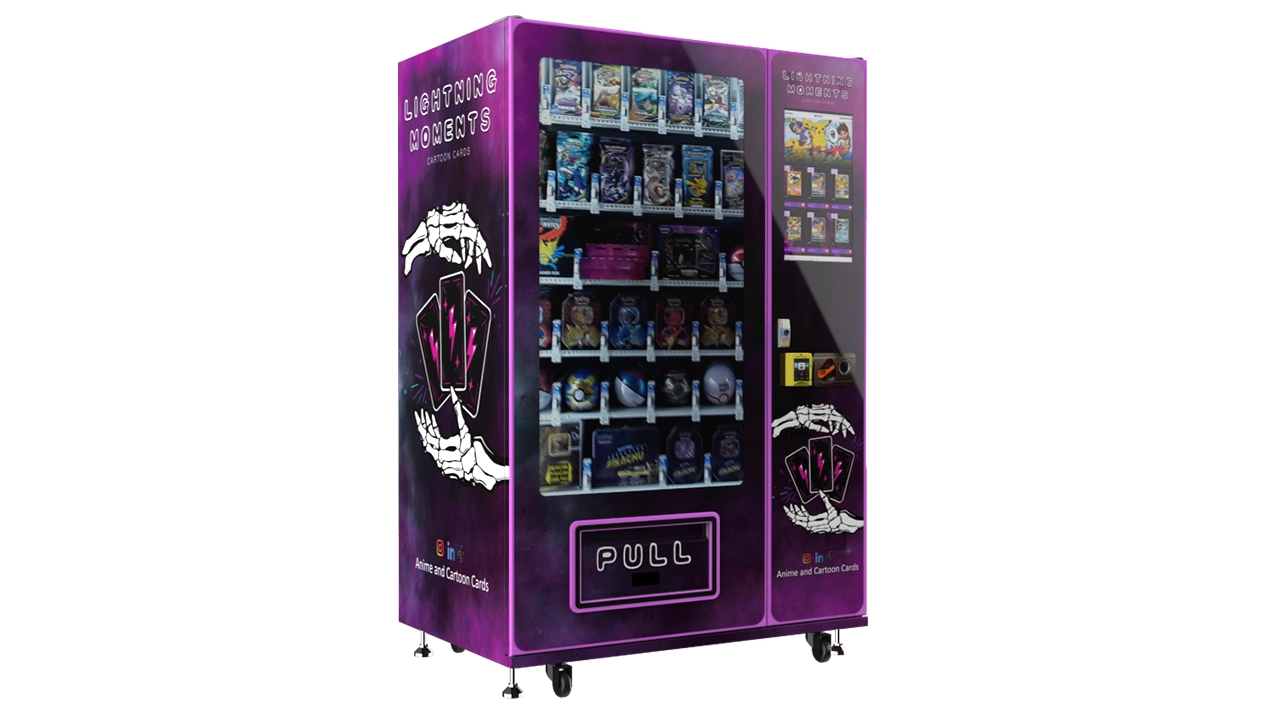
Final Trading Card Vending Machine Location Checklist
Before I approved a location, I would want a confident “yes” to most of the questions below.
| Question | Check |
|---|---|
| Does the venue attract people with a realistic interest in trading cards or collectibles? | □ |
| Is the exact machine position visible from the main approach path? | □ |
| Do customers have enough dwell time to browse? | □ |
| Are total location costs sustainable at conservative sales assumptions? | □ |
| Is reliable power available? | □ |
| Is suitable payment connectivity available? | □ |
| Can the machine be restocked efficiently? | □ |
| Is there reasonable security and camera coverage? | □ |
| Does the machine configuration fit the actual products? | □ |
| Does the agreement include a workable trial or exit mechanism? | □ |
| Can sales, stock, and machine status be reviewed remotely? | □ |
| Is there enough inventory capacity for expected peak demand? | □ |
The Location Matters More Than the Address
The strongest lesson is simple: the best locations for trading card vending machines are places where the machine fits an existing customer behavior.
Collectors already browsing hobby products are valuable. Players waiting for an event are valuable. Families spending time in an entertainment venue are valuable. Fans already thinking about collectibles are valuable. Shoppers with time to browse are valuable.
Raw traffic is only the beginning.
A serious location decision combines audience fit, qualified traffic, dwell time, visibility, rent, security, payment reliability, inventory capacity, machine design, and service efficiency. If one of those factors is badly wrong, an impressive visitor count may not save the location.
That is why I would rather test a well-matched site with 1,500 relevant visitors than blindly pay premium rent for 10,000 people rushing past.
The machine does not need the most people. It needs enough of the right buying moments.
Frequently Asked Questions
What is the best location for a trading card vending machine?
There is no single location that wins every time. Card and game stores, entertainment-oriented shopping areas, arcades, sports venues, transportation waiting areas, hobby retailers, and selected student facilities can all work. I would rank locations by audience fit, qualified traffic, dwell time, visibility, placement cost, security, and service access rather than total pedestrian traffic alone.
How much foot traffic does a trading card vending machine need?
A universal minimum would be misleading because conversion varies dramatically by venue. Five hundred highly relevant visitors can outperform several thousand unrelated passersby. Measure qualified traffic at the exact proposed position and then use a pilot to determine transactions per day, average transaction value, gross margin, and contribution after location costs.
Are shopping centers good locations for trading card vending machines?
They can be excellent when the machine is close to relevant entertainment, gaming, toy, hobby, food, or family traffic. The main risks are expensive rent and poor placement inside the property. A lower-cost corridor with better audience fit can outperform a premium entrance position.
Are card shops good locations even though they already sell trading cards?
Yes, provided the machine has a clear role. It can handle routine sealed-product purchases, reduce checkout pressure during busy periods, create a separate self-service assortment, or make better use of unused wall or floor space. A machine that simply duplicates the shelf beside it without adding convenience has a weaker reason to exist.
Should a trading card vending machine accept cashless payments?
For most modern unattended retail projects, cashless payment deserves serious consideration. NAMA's vending-industry census reported broad adoption of card and contactless payment technology. The exact payment hardware should be chosen according to the machine system, transaction values, customer payment habits, network conditions, and applicable processing requirements.
How long should I test a trading card vending machine location?
Four weeks can provide an initial baseline for an ordinary steady-traffic site, while six to eight weeks often provides a more useful picture when traffic changes by day or week. Event-driven venues should be judged across several comparable events. Establish success criteria before the pilot starts so the decision is based on operating data rather than optimism.
What numbers should I track during a location test?
Track daily revenue, transactions, average transaction value, gross margin, SKU sales, stockouts, payment approval, failed vends, refunds, service visits, restocking time, venue cost, and operating contribution. Once pedestrian data is available, transactions relative to qualified traffic can also help compare different placements.
What type of trading card vending machine is best for a high-traffic location?
High traffic usually increases the importance of capacity, reliable cashless payment, remote inventory monitoring, strong screen visibility, and efficient restocking. Premium boxed merchandise may also justify a lift or elevator delivery system. The final configuration should be based on actual package dimensions, expected SKU count, peak sales, available footprint, and service frequency.
Sources and Reference Material
- NAMA Foundation, 2022–2023 State of Convenience Services Industry Census. View the industry census.
- Circana, Global Toy Industry Rebounds in 2025 as Sales Rise 7%, Fueled by Pop Culture, Collectibles and Kidults, January 2026. View Circana's report.
- National Retail Federation, Retailers See Fraud Schemes Evolve as Shoplifting Declines, NRF Study Finds, July 2026. View the NRF report.