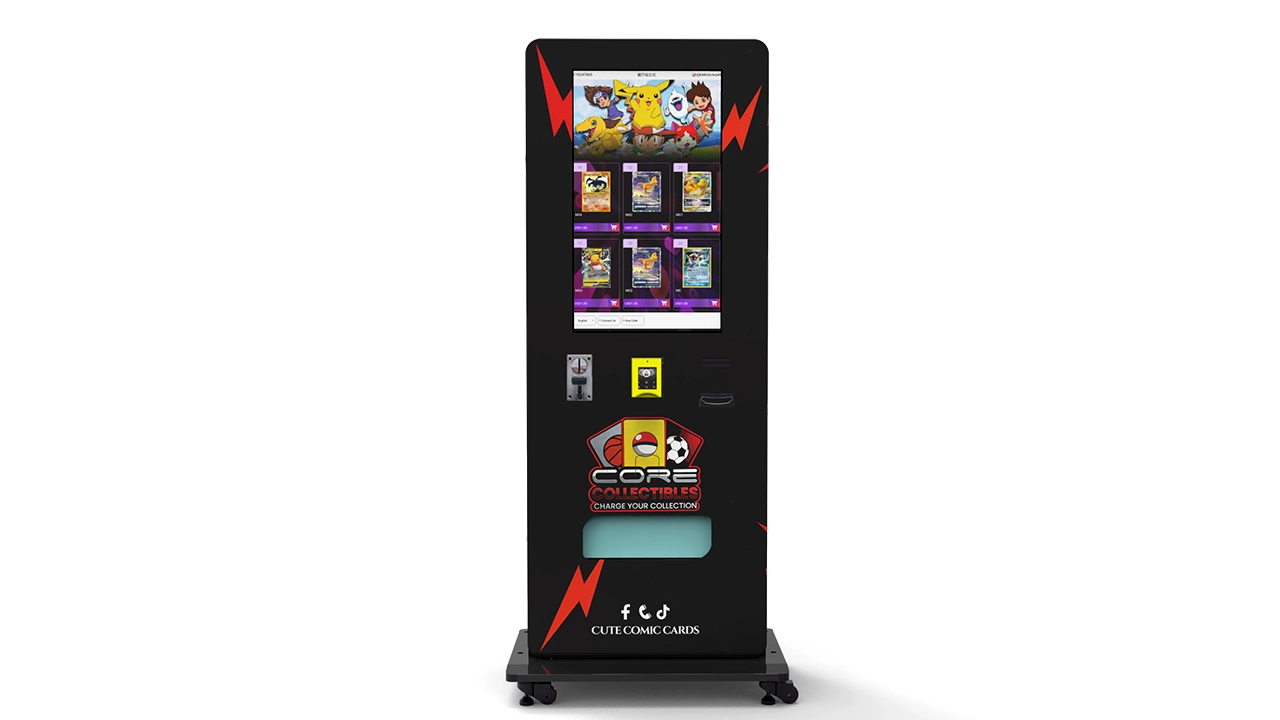
A trading card vending machine is essentially a compact automated card store. A customer chooses a booster pack, sealed box, sports-card product, mystery pack, or other configured item on a screen or selection panel, completes payment, and the controller tells the correct product lane to dispense the merchandise into the pickup area. Understanding how trading card vending machine works becomes much easier once you separate that transaction into five jobs: product identification, payment authorization, inventory control, mechanical dispensing, and delivery confirmation. The best machines do more than complete those five steps. They protect collectible packaging, report sales remotely, track stock, reduce failed vends, and make servicing straightforward. For trading cards, those details matter because a dented box, jammed booster pack, or incorrect inventory count can cost far more than the same mistake in ordinary low-value vending.
The Short Version: What Happens After a Customer Taps “Buy”?
The visible transaction may take only a few seconds, but several systems have to cooperate correctly. The touchscreen is only the front end. Behind it are a vending controller, payment terminal, motor drivers, product channels, sensors, network hardware, management software, and the physical delivery mechanism.
A normal transaction follows this sequence:
-
The customer selects a product.
-
The software checks the selling price and whether the selection is available.
-
The payment terminal requests authorization.
-
After payment approval, the machine controller receives permission to vend.
-
The assigned motor, conveyor, locker, or elevator mechanism activates.
-
The product moves from its storage position toward the pickup area.
-
A delivery sensor or controller logic determines whether the vend completed as expected.
-
The machine records the transaction and reduces the inventory count.
-
Connected software sends the updated sales and machine data to the management platform.
That sequence explains the basic operation, but it does not explain why one collectible card vending machine works reliably while another becomes a source of refunds. The difference is usually found in the details between steps four and eight.
A booster pack is thin, light, flexible, and sometimes slippery. A sealed card box is thicker, heavier, and usually more rigid. A graded-card slab is completely different again. If all three are placed into a generic dispensing system without testing the actual packages, the transaction logic can be perfect while the physical vend still fails.
That is why I’d rank product-to-mechanism compatibility above screen size when evaluating a trading card vending machine. The screen helps sell. The delivery system decides whether the customer actually receives what was sold.
A Trading Card Vending Machine Is Really Six Systems in One Cabinet
People tend to describe vending equipment as one machine, but a commercial unit is more accurately understood as several connected subsystems. Knowing what each one does makes machine selection, troubleshooting, and vending machine repair much easier.
| System | Main Job | What Can Go Wrong | What I’d Check Before Buying |
|---|---|---|---|
| User interface | Displays products, prices, instructions, and promotions | Slow response, confusing navigation, incorrect product mapping | Screen readability, interface speed, SKU editing, language and branding options |
| Payment system | Authorizes card, contactless, QR, cash, or other configured payments | Declined transactions, network failures, unsupported terminal configuration | Payment-provider compatibility, security requirements, settlement process |
| Machine controller | Coordinates payment, motors, sensors, inventory, and transaction logic | Incorrect vend commands, communication errors, software faults | Remote updates, error logs, spare controller availability, diagnostic tools |
| Product storage | Holds booster packs, boxes, slabs, and accessories | Products leaning, slipping, compressing, or loading incorrectly | Adjustable lanes, usable dimensions, capacity with real merchandise |
| Dispensing system | Moves the selected product out of storage | Double vends, jams, partial movement, dropped packaging | Mechanism type, test results, sensors, motor access, adjustment range |
| Connected management | Reports sales, inventory, status, and faults | Stale stock data, lost connectivity, incomplete error information | Dashboard functions, alerts, data export, user permissions, offline behavior |
The Customer Interface
Modern card vending equipment often replaces numbered buttons with a touchscreen. That change matters more in collectible retail than it does in a machine selling twenty familiar drinks.
A card machine may carry multiple sets, editions, pack types, price points, sealed boxes, accessories, and rotating new releases. A digital interface lets the operator show product artwork, pricing, promotional information, inventory status, and buying instructions without printing new selection labels every time the assortment changes.
Zhongda Smart's 32-inch touchscreen trading card vending machine, for example, currently lists a 32-inch display, up to 28 published cargo lanes, and approximately 375–535 pieces of capacity depending on package dimensions and configuration.
Those numbers illustrate an important point about capacity: a specification such as “500 pieces” is never enough by itself. You need to know the package dimensions used to calculate that capacity. Five hundred thin packs and five hundred compact boxes require entirely different internal volume.
The Vending Controller
The controller is the traffic coordinator. It does not simply spin a motor when a customer presses a button. It has to know which selection was purchased, whether payment succeeded, which physical output corresponds to that SKU, how long the mechanism should run, what sensor feedback is expected, and what to record afterward.
In a connected self-service kiosk, the controller may also exchange information with a cloud platform. That can include prices, product identifiers, sales records, machine status, inventory estimates, network health, fault codes, and configuration changes.
I’d choose a controller architecture with useful diagnostic information over a system that only reports “error.” A message saying “lane 17 failed delivery confirmation” gives a technician somewhere to begin. A generic error code that requires opening the cabinet and guessing creates unnecessary service time.
How the Payment Process Works
Payment is the point where the vending machine stops being an isolated mechanical device and becomes part of a larger financial system.
A card or contactless transaction normally starts when the customer chooses a product and the machine passes the correct amount to the payment terminal. The terminal communicates with the configured payment infrastructure, receives an approval or decline, and then reports the result to the vending controller.
The controller should not release merchandise merely because the customer touched a payment device. It waits for a valid authorization state. Only then does the dispensing command begin.
That distinction prevents one of the most expensive vending errors: giving away inventory after an incomplete or failed transaction.
Why Cashless Payment Deserves Serious Attention
General vending-industry data supports the importance of electronic payment. NAMA's 2022–2023 Industry Census reported that approximately 75% of 2.89 million vending machines in its study accepted non-cash payments, compared with 69% in 2018. Among the machines that accepted cashless transactions, 94% supported standard debit or credit cards and 88% supported contactless payments.[1]
Those figures cover general vending rather than trading-card machines, so I would not use them to predict card-machine sales. They are useful for a different reason: they show how deeply payment hardware has become integrated into unattended retail.
A $3 purchase may still be practical with coins or bills. A $25 booster bundle, $60 sealed product, or $100 premium item creates a different buying experience. For higher transaction values, payment convenience becomes part of the machine's basic commercial design.
EMVCo reports that secure chips are used in more than 15.6 billion credit and debit cards, and its specifications describe transaction security mechanisms including a one-time security code for each chip transaction.[2]
That does not mean the vending-machine manufacturer alone can guarantee payment compliance. The terminal, processor, merchant account, netwon all matter.
The PCI Security Standards Council maintains standards intended to protect payment account data, including PCI DSS and point-to-point encryption requirements.[3] I’d recommend confirming the payment architecture with the chosen payment provider before production rather than buying a random card reader and expecting it to integrate later.
What Happens if the Network Drops?
This is a practical question that deserves more attention in a machine specification.
A connected card vending machine may use Wi-Fi, cellular connectivity, Ethernet, or a combination. When communication fails, several outcomes are possible depending on the payment and software configuration. The terminal may refuse transactions, some functions may remain available temporarily, or the machine may continue operating while delaying selected data synchronization.
The correct behavior should be established before deployment. I’d ask four questions:
-
Can the machine complete any transactions without an active connection?
-
How are interrupted transactions handled?
-
When does inventory synchronize after connectivity returns?
-
Can the management dashboard distinguish a network problem from a mechanical problem?
Those questions are more useful than simply asking whether the machine “has 4G.” Connectivity hardware and operational behavior are not the same thing.
How Trading Cards Are Physically Dispensed
This is the part of the machine I consider most important for collectible merchandise.
Once payment is approved, the machine has to transfer exactly one paid product from storage to the customer. There are several ways to do that, and none is automatically best for every trading-card format.
Spring-Spiral Dispensing
A spiral system stores the merchandise between the turns of a metal coil. A motor rotates the spiral, pushing the front product toward the shelf edge until it drops into the collection area.
This mechanism is common because it is simple, familiar, relatively easy to service, and configurable for many packaged items. With correctly selected coil pitch, shelf spacing, and product support, it can work well for compatible card packs and compact merchandise.
The weakness appears when the package is too thin, too soft, too slippery, or badly positioned. A flexible booster pack can lean. Two packs can overlap. A product can ride on the spiral instead of moving forward cleanly. Incorrect coil sizing can also create a double vend or leave the package hanging at the edge.
For this comparison, I’m prioritizing repeatable delivery over theoretical capacity. If a machine can hold 550 packs but only 480 can be loaded in a way that produces consistent vends, the useful capacity is 480.
Belt or Conveyor Dispensing
A belt-driven lane supports merchandise on a moving surface. When the lane is activated, the belt advances the selected product toward the delivery area.
This can be useful for packages that do not sit naturally inside a coil, although the final result still depends on product rigidity, friction, weight, lane width, and positioning.
Belts introduce their own maintenance considerations. Tension, alignment, wear, contamination, and motor condition matter. The benefit is not that a conveyor can dispense anything; the benefit is that it gives the engineer another way to match motion to the package.
Push-Type Mechanisms
A pusher moves the product forward from behind rather than carrying it through a spiral. For uniform packaged merchandise, that can create a tidy product presentation and controlled movement.
The design has to keep the remaining inventory properly aligned after every sale. If the packages can tilt, flex, wedge against the sidewalls, or vary significantly in thickness, reliability can decline quickly.
Locker-Based Delivery
Locker systems work differently. Instead of mechanically separating one product from a stack, the machine unlocks a compartment containing the purchased item.
The mechanical simplicity can make lockers attractive for unusually shaped or premium merchandise. The tradeoff is storage density. Every available product position consumes an entire compartment, even when the product itself is small.
Locker vending also changes restocking. Rather than loading multiple identical packs into one lane, the operator may have to stock individual compartments. That can be sensible for high-value sealed products but inefficient for fast-moving inexpensive packs.
Elevator or Lift Delivery
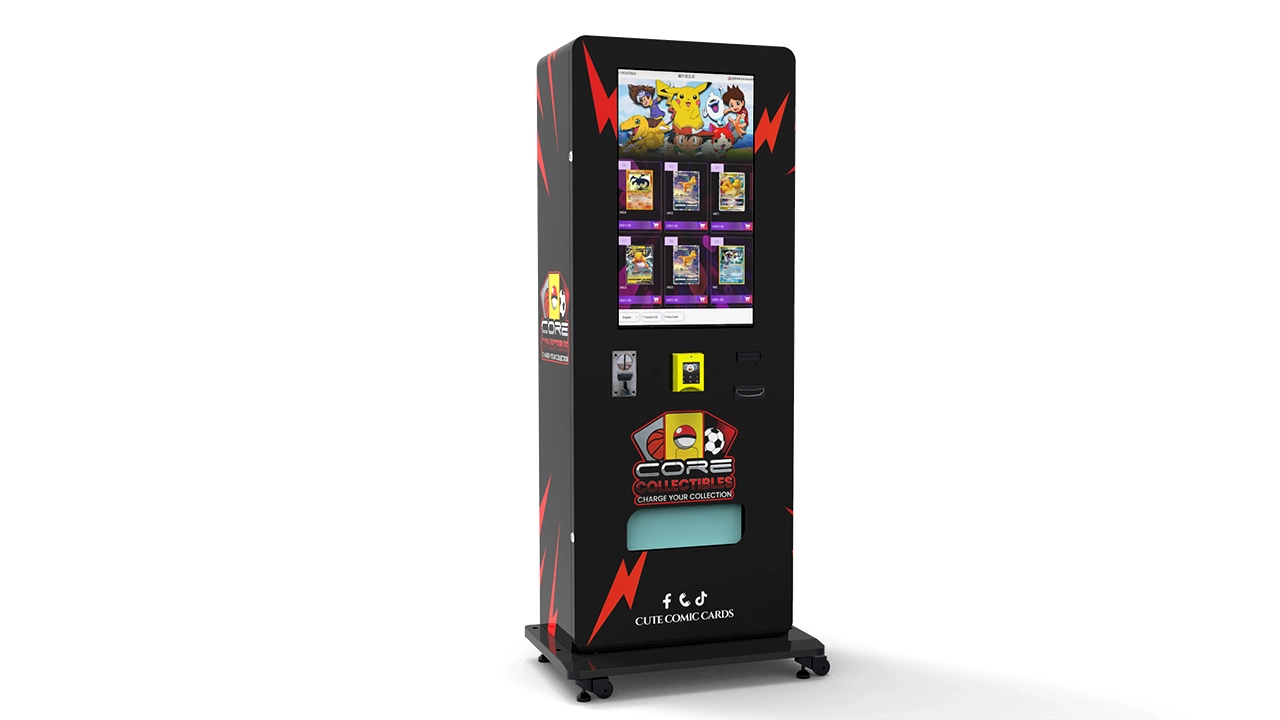
An elevator vending machine adds a moving platform to the delivery path. Instead of allowing merchandise from an upper shelf to fall the full distance into a bottom bin, the lift moves toward the selected lane, receives the product, and carries it toward the pickup area.
That controlled path is especially relevant when package condition affects perceived value.
Consider the difference between a soft snack bag and a collector box. A small dent in a snack package usually does not change what is inside. A crushed corner on sealed collectible packaging can immediately create a customer complaint.
If I were choosing for a product mix dominated by premium sealed boxes, condition-sensitive packaging, tins, or higher-value collectibles, I’d rank lift delivery above maximum lane density.
Zhongda Smart's current elevator trading card vending machine page describes a 21.5-inch touchscreen, a 60-lane reference layout, 4G/Wi-Fi connectivity, and approximately 300–360 pieces of merchandise reserve in the referenced configuration. The page also illustrates why quotations need to be read carefully: it shows a $2,632 page-level reference while separately describing a lower base-platform price before elevator hardware and other project options. The final bill of materials should therefore be confirmed in the quotation rather than inferred from one number on a product page.
Why Trading Cards Are Harder to Vend Than They Look
A booster pack seems simple until you try to design a mechanism that has to separate one pack from a stack thousands of times.
Card products create five engineering problems that are easy to underestimate.
1. Thin Packaging
Thin packs can slide behind each other or overlap. The smaller the difference between “one product thickness” and “two product thicknesses,” the more carefully the lane geometry has to control the stack.
This is one reason I’d never approve a final channel configuration from a product photo alone. Length and width matter, but thickness is often the dimension that determines how many packs can be loaded and whether they separate cleanly.
2. Flexible Wrappers
Flexible packaging can bend around a spiral, catch on an edge, or shift after several products have been removed. A cardboard-backed blister behaves differently from a loose foil booster even if their overall length and width are similar.
3. Surface Friction
Glossy plastic, paperboard, shrink wrap, foil, and molded plastic all move differently against painted steel, plastic dividers, belts, and neighboring products.
A package that works perfectly when a lane is full may behave differently when only two units remain because the pressure and angle have changed.
4. Large Price Differences
A machine may contain a low-priced booster next to a premium box worth several times more. A double vend in the premium lane has a much larger financial impact.
That changes the value of sensors, delivery confirmation, access control, and reliable product mapping.
5. Packaging Condition Matters
Collectible buyers often care about the box as well as the cards inside. Creases, corner damage, broken seals, and crushed outer packaging can reduce customer satisfaction even when the contents are unharmed.
This is where understanding how a trading card vending machine works becomes a product-protection question rather than merely a vending question.
How I’d Test a Card Product Before Approving the Machine Layout
The safest machine specification starts with the merchandise rather than the cabinet.
For every important SKU, I’d record:
-
Package length
-
Package width
-
Package thickness
-
Package weight
-
Surface material
-
Rigidity or flexibility
-
Whether the package must remain upright
-
Whether visible packaging damage would create a return risk
-
Expected units per lane
-
Expected sales frequency
After that, I’d test the most difficult products rather than only the easiest ones.
If the machine will carry twelve SKUs and ten are simple rectangular boxes while two are very thin flexible packs, the flexible packs deserve more testing. Designing around the easiest product creates false confidence.
A useful test is not three successful vends. You want repeated cycles with different lane fill levels. Test the lane full, half full, nearly empty, and after products have been sitting in the cabinet. If products are routinely handled during restocking, test realistic loading variation as well.
I also like a mixed-product test because neighboring lanes can affect available space. A nominal lane width may work alone but become too tight once dividers and adjacent packages are installed.
My recommendation: I’d approve product compatibility only after the actual selling package—not just the loose card, manufacturer catalog dimension, or digital drawing—has been matched to the intended dispensing mechanism.
How Inventory Tracking Works
Traditional vending can be managed with a simple count: load ten products, record each successful vend, and assume nine remain after one sale.
That is still the foundation of many connected systems.
Suppose lane A07 starts with 18 booster packs. Each confirmed transaction reduces the software count by one. After six successful sales, the expected quantity becomes 12. The dashboard can then show that count remotely.
The word expected matters.
If the machine records a vend but the product jams, software and physical inventory can become different. If an operator adds merchandise without entering the restock quantity correctly, the same thing happens. Inventory data is only as reliable as the events feeding it.
SKU Mapping
Each sellable product needs a logical identifier that connects the digital listing to the physical lane. At minimum, the system needs to know:
-
Product name
-
SKU or internal identifier
-
Price
-
Assigned machine position
-
Expected inventory quantity
For more structured inventory operations, standardized identifiers can help. GS1 explains that a Global Trade Item Number, or GTIN, uniquely identifies a trade item.[4] Whether a particular card product uses a suitable retail identifier depends on its packaging and supplier data, but the principle is valuable: do not build inventory management around ambiguous product names when a consistent item identifier is available.
Remote Inventory Management
Remote inventory management is one of the strongest reasons to choose connected vending equipment.
Without remote data, an operator may visit a machine simply to discover what is empty. With reliable inventory data, the operator can prepare a replenishment list before leaving, bring the right products, and prioritize machines that actually need attention.
If I were planning several machines, I’d consider this feature essential rather than optional.
The value grows with machine count. Checking one cabinet manually may take only a few minutes. Checking 20 machines unnecessarily creates travel, labor, and lost selling time.
The Difference Between Inventory Capacity and Selling Capacity
This is a distinction that prevents many bad equipment decisions.
Inventory capacity is the maximum quantity the cabinet can physically hold under a defined layout.
Selling capacity is the amount of useful inventory the machine can hold while maintaining the SKU mix the business actually needs.
Imagine two machines:
| Metric | Machine A | Machine B |
|---|---|---|
| Maximum physical capacity | 600 packs | 420 packs |
| Practical SKU positions | 12 | 24 |
| Average units assigned to fast sellers | 50 | 12–25 |
| Assortment flexibility | Lower | Higher |
If the business depends on a small number of high-volume packs, Machine A may be better. If shoppers expect broad choice, Machine B may produce stronger merchandising even though its raw capacity is lower.
I’d choose capacity by asking, “How many days of useful stock can this configuration carry?” rather than, “What is the biggest number on the specification sheet?”
How the Machine Knows Whether a Product Was Delivered
Delivery confirmation is one of the most valuable reliability features in a vending system.<ith timed motor movement. The controller commands a motor to rotate for a defined amount and assumes the vend succeeded.
A more sophisticated design can use sensors to detect product movement or arrival in the delivery area.
The exact sensor type varies with machine architecture. What matters operationally is what the controller does with the information.
A strong system should be able to distinguish at least some of these states:
-
Payment approved and product delivered
-
Payment approved but delivery not confirmed
-
Motor or lane failed to respond
-
Pickup path blocked
-
Transaction interrupted before dispensing
Once the machine can identify those states, the software can support better refund handling and maintenance diagnostics.
Without meaningful feedback, the operator may learn about a jam only after a customer sends a complaint.
What Remote Management Should Actually Show
“Cloud management” has become such a common specification that the phrase alone tells me very little.
I’d want to see what the dashboard actually does.
A useful connected-vending dashboard should make these items easy to find:
-
Sales by machine
-
Sales by product
-
Transaction timestamps
-
Current or estimated inventory
-
Low-stock alerts
-
Machine online/offline status
-
Payment status information
-
Lane or motor errors where supported
-
Price editing
-
Product editing
-
Restock records
-
User access permissions
The screen should also help answer business questions rather than merely technical ones.
Which pack sells fastest? Which product repeatedly sells out? Which SKU occupies too much space for the revenue it generates? Which machine needs a visit tomorrow? Which machine is selling slowly despite having plenty of inventory?
Those questions turn a vending dashboard into an operating tool.
What a Trading Card Vending Machine Can Sell
The machine does not inherently know the difference between a sports-card pack, a TCG booster, and a compact accessory. It sees dimensions, weight, position, price, and dispensing instructions.
That makes product compatibility wider than the name “trading card vending machine” suggests.
Depending on configuration, a card dispensing machine can be designed for:
-
Individual sealed booster packs
-
Sleeved booster products
-
Blister packs
-
Sealed card boxes
-
Sports-card packs
-
Compact hobby boxes
-
Mystery packs
-
Deck boxes
-
Card sleeves
-
Small storage accessories
-
Selected graded-card slabs
-
Small packaged collectibles
The important qualification is depending on configuration.
A machine that reliably vends a rigid 30 mm box should not automatically be assumed to handle a flexible 4 mm pack. A graded slab should not be loaded into a mechanism simply because the opening is wide enough. You need to consider how it is retained, moved, released, and delivered.
Comparing the Main Types of Trading Card Vending Machines
| Machine Type | Main Advantage | Main Tradeoff What I’d Choose It For | |
|---|---|---|---|
| Compact wall-mounted | Small footprint and lower equipment entry point | Lower inventory capacity | Focused assortment and space-constrained installations |
| Touchscreen floor-standing | Strong visual merchandising and broader capacity | More floor space and higher equipment cost | Mixed packs, promotions, and high-visibility automated retail |
| More inventory and SKU flexibility | Greater size and more complex restocking | High-volume assortment with several product categories | |
| Elevator-delivery machine | More controlled delivery for sensitive Additional mechanism complexity | Premium sealed boxes and condition-sensitive products | |
| Locker configuration | Simple separation of unusual or high-value products | Lower storage density | Premium products that do not fit normal vending channels |
Zhongda Smart's current trading card vending machine lineup includes wall-mounted, large-screen touchscreen, conventional floor-standing, and controlled-delivery formats. I’d use those categories as starting points rather than treating any one model as universally better.
If I were choosing for a narrow assortment with limited installation space, I’d start with a compact configuration. If I were choosing for a large, frequently changing assortment where digital merchandising matters, I’d move toward a full-height touchscreen machine. If I were choosing for premium packaging, I’d seriously consider lift delivery.
How Much Does a Trading Card Vending Machine Cost?
Machine price depends on cabinet construction, screen size, number of product positions, dispensing hardware, payment equipment, software, connectivity, branding, delivery system, production quantity, and other project requirements.
Current Zhongda Smart published references illustrate the spread:
| Configuration | Published Equipment Reference | Published Capacity Reference | Important Qualification |
|---|---|---|---|
| Compact wall-mounted configuration | From about $999 | Up to about 120 compatible pieces | Actual capacity depends on merchandise dimensions |
| 32-inch touchscreen configuration | From about $1,211 | Approximately 375–535 pieces | Payment hardware and lane layout can change capacity and price |
| Larger card-retail configuration | From about $2,110 | Configuration-dependent | Final layout depends heavily on product mix |
| Controlled-delivery reference | About $2,632 page reference | Approximately 300–360 pieces in the referenced layout | Elevator mechanism and final options require quotation confirmation |
These are manufacturer-published equipment references, not delivered project guarantees. Payment terminals, custom artwork, software requirements, freight, installation, spare parts, taxes, and initial merchandise can materially change the total investment.
For a fuller breakdown, the site's trading card vending machine cost guide separates equipment price from deployed-machine cost and working-capital requirements.
I’d recommend making the same separation in every budget.
Equipment Cost
This is the configured machine itself: cabinet, screen, controller, product lanes, dispensing mechanism, and selected standard hardware.
Deployment Cost
This adds whatever is required to make the machine operational: payment hardware, branding, shipping, setup, installation-related work, network hardware, and basic spare parts.
Startup Capital
This adds inventory and operating reserve. A vending business can be undercapitalized even when the machine has already been paid for.
A cabinet without enough merchandise to keep the best lanes stocked is not a complete retail operation.
Does a Trading Card Vending Machine Make Money?
It can, but there is no useful universal profit number.
Profit depends on merchandise cost, selling price, number of transactions, payment fees, placement expense, service cost, connectivity, refunds, shrink, inventory turnover, and the initial equipment investment.
The arithmetic is straightforward:
Operating Contribution = Sales − Merchandise Cost − Payment Fees − Placement Cost − Routine Service Cost − Connectivity/Software − Maintenance Reserve − Refunds and Shrink
That number should be calculated before deciding whether the machine economics are attractive.
A Transparent Planning Example
No customer P&L data has been supplied for publication here, so I am not going to invent a “real success story.” Instead, the following is an illustrative model with every assumption visible.
| Planning Variable | Example |
|---|---|
| Average transaction | $18.00 |
| Transactions per day | 12 |
| Operating days per month | 30 |
| Monthly transactions | 360 |
| Monthly sales | $6,480 |
| Merchandise cost | 64% of sales = $4,147.20 |
| Gross merchandise margin | $2,332.80 |
| Payment expense | Illustrative $220 |
| Placement expense | Illustrative $600 |
| Connectivity/software | Illustrative $60 |
| Restocking/service allocation | Illustrative $250 |
| Maintenance/refund reserve | Illustrative $120 |
| Illustrative operating contribution | $1,082.80 per month |
The example is not a forecast. Change transactions from 12 per day to six and the economics change sharply. Raise merchandise cost from 64% of sales to 75% and they change again. Add a high placement commission and a busy machine can still produce disappointing cash.
That is why I think daily transactions and merchandise margin deserve more attention than revenue screenshots.
Break-Even Analysis
SBA guidance expresses break-even units as fixed costs divided by the difference between selling price and variable cost per unit.[5]
For vending, I’d adapt the same idea to contribution per transaction.
Suppose the installed machine investment is $6,500 and the average transaction produces $3.80 of operating contribution after merchandise and direct transaction costs. Ignoring taxes, financing, depreciation, and other business-level expenses:
$6,500 ÷ $3.80 = approximately 1,711 transactions to recover the initial machine investment.
At 12 transactions per day, that is about 143 selling days. At four transactions per day, it becomes about 428 days.
The machine did not change. Productivity did.
This is the most important lesson in trading card vending machine profitability: hardware determines what the business can do, while merchandise economics and placement determine whether it is worth doing.
How Product Mix Changes Profitability
Two machines with identical sales can have very different economics because they carry different merchandise.
Consider three simplified product groups:
| Product Group | Typical Operational Characteristic | Cash Requirement | Machine Consideration |
|---|---|---|---|
| Fast-moving sealed packs | Frequent transactions and regular restocking | Moderate per unit | High lane capacity and consistent pack separation |
| Premium sealed boxes | Lower transaction frequency but higher ticket value | Higher per unit | Controlled handling and secure storage |
| Accessories | Can increase basket value and assortment depth | Varies | Package dimensions may require separate lane types |
If I were building the first assortment, I would not fill every lane with whatever produces the highest percentage markup. I’d balance margin, turnover, cash tied up in inventory, product recognition, package compatibility, and replenishment availability.
A 50% margin on a product that barely sells is not automatically better than a 30% margin on inventory that turns every week.
Why Machine Uptime Matters More Than It First Appears
A machine that is offline does not merely lose the transactions that would have happened during the outage. It can also lose customer trust.
Unattended retail depends on a simple promise: pay, receive the product, and leave without needing staff assistance.
If the payment terminal is offline, the touchscreen freezes, a lane jams repeatedly, or the pickup door fails, the machine stops fulfilling that promise.
I’d track uptime together with sales because a low-sales day caused by poor demand is a different problem from a low-sales day caused by equipment failure.
Useful Reliability Metrics
| Metric | What It Tells You |
|---|---|
| Successful vends / paid transactions | Whether merchandise delivery is keeping pace with approved sales |
| Refunds per 1,000 transactions | Whether customer-facing failures are increasing |
| Mechanical faults by lane | Whether one product or channel is causing repeated problems |
| Offline hours | Whether connectivity or payment availability is affecting revenue |
| Service visits per month | Whether ownership effort is becoming excessive |
| Mean time between repeated faults | Whether a repair solved the problem or merely reset it |
Even a simple spreadsheet can track these numbers. The important part is separating mechanical, payment, network, inventory, and customer-service events rather than grouping everything under “maintenance.”
Vending Machine Repair: What Should Be Easy to Service?
A commercial vending machine will eventually need maintenance. The real question is whether ordinary service tasks are designed to be easy.
I’d evaluate access to:
-
Dispensing motors
-
Lane assemblies
-
Power supply
-
Main controller
-
Touchscreen connections
-
Payment-terminal wiring
-
Network hardware
-
Pickup-door
Elevator belts, rails, or drive components where applicable
A cheap component that requires dismantling half the cabinet to replace can become expensive in the field.
I’d also ask the manufacturer for the recommended spare-parts package before ordering. Motors, sensors, fuses, cables, power components, and other common service items are much easier to obtain in advance than after an unexpected failure.
Remote Troubleshooting
Remote troubleshooting cannot repair a broken motor, but it can reduce unnecessary guesswork.
If the machine reports that one lane repeatedly fails while payment and network systems remain healthy, the technician can arrive prepared to inspect the product setup, motor, sensor, or wiring associated with that lane.
If every lane suddenly stops at the same time, the fault may be somewhere higher in the system.
Good diagnostics reduce the number of visits that begin with, “The machine does not work; find out why.”
Security Goes Beyond a Strong Door
A trading card vending machine may contain inventory with a substantial retail value, so security has physical, payment, software, and operational layers.
Physical Security
The cabinet should resist casual forced entry and protect access to the product compartment, cash hardware where fitted, electronics, and service areas.
Installation also matters. A strong cabinet placed in an unstable position or poorly secured environment is still a weak deployment.
Payment Security
Payment security should be handled through appropriate terminals, providers, standards, and integration practices rather than improvised inside the vending application. PCI SSC standards provide the broader framework for protecting payment-account data.[3]
Software Access
A remote-management dashboard should not give every employee unlimited administrative access. User accounts, passwords, permissions, and change logging matter once several people can modify prices, products, or machine settings.
Inventory Security
High-value card inventory also needs operational controls. Reconcile physical stock against recorded stock during replenishment. Investigate repeated unexplained differences instead of treating them as normal shrink.
How a Touchscreen Changes the Buying Experience
A large touchscreen does more than replace buttons.
It can function as a digital shelf, product catalog, promotional surface, transaction interface, and instruction panel.
For collectible cards, I’d use screen space to reduce buying friction rather than fill it with visual noise.
A customer should quickly understand:
-
What is available
-
What each product costs
-
Whether an item is sold out
-
How to pay
-
Where the product will be collected
Promotional artwork is useful after those basics are clear.
If I were designing the interface, I’d make frequently purchased products accessible in one or two touches. A customer standing in front of a vending machine does not need a miniature e-commerce website with seven navigation levels.
How Automated Card Retail Differs From an Open Self-Service Kiosk
The terms are sometimes mixed together, but a vending machine and an open self-service kiosk solve inventory control differently.
In an open retail kiosk, the customer physically picks up the merchandise and then completes checkout. In a vending machine, the merchandise normally remains locked inside until an authorized transaction triggers delivery.
| Factor | Trading Card Vending Machine | Open Self-Service Kiosk |
|---|---|---|
| Product access before payment | Restricted | Usually open |
| Product selection | Digital or machine-controlled | Customer physically selects merchandise |
| Dispensing mechanism | Required | Usually not required |
| Inventory security | Strong physical separation | Depends more heavily on monitoring and checkout controls |
| Package compatibility | Critical to mechanical design | Less mechanically restrictive |
For compact, higher-value sealed merchandise, the controlled access of a vending machine can be attractive. The tradeoff is that every product has to cooperate with the chosen mechanical system.
How I’d Evaluate a Manufacturer
A trading card vending machine should not be purchased solely from a rendering, cabinet photo, or headline price.
If I were reviewing manufacturers, I’d ask for evidence in seven areas.
1. Product Compatibility Review
Will the manufacturer review real product dimensions, weight, photos, and preferably samples before finalizing the lanes?
2. Dispensing Options
Can the machine be configured with a mechanism suited to the product, or is every merchandise type expected to fit one generic spring?
3. Payment Integration
Which terminals and protocols are supported? Who is responsible for the final payment-provider setup?
4. Software Demonstration
Can you see the management interface before purchase? What sales, inventory, alarm, and configuration functions are actually available?
5. Spare Parts
Which parts are considered normal field-service components, how quickly can they be supplied, and what should be stocked with the first order?
6. Pre-Shipment Testing
Will the configured machine be tested with representative merchandise rather than only powered on?
7. Warranty and Support Scope
What is included, what is excluded, and who pays for labor, shipping, replacement components, or payment-terminal support?
Where Zhongda Smart Fits
If I were choosing a factory partner for a customizable trading-card project, I’d put Zhongda Smart on the first shortlist because its published range covers compact wall-mounted equipment, large touchscreen machines, conventional multi-lane configurations, and elevator-delivery systems rather than presenting one cabinet as the answer to every card product.
The company's published company profile states that Zhongda Smart was founded in 2018 and lists a 20,000 m² manufacturing facility, more than 400 employees, 10+ R&D engineers, and approximately 10,000 units of annual production capacity. Those are manufacturer-published figures and should be treated as such.
Its current trading-card pages also describe OEM/ODM customization, 4G/Wi-Fi connectivity, remote management functions, configurable payment options, adjustable product layouts, sample orders from one unit on selected models, and one-year warranty references for current listed card equipment.
Because this article is published this recommendation is not independent. A buyer should still verify the final bill of materials, tested product samples, payment-terminal compatibility, software functions, warranty terms, spare-parts package, and written quotation before placing an order.
That disclosure is important. A useful manufacturing guide should help you ask better questions, not ask you to trust a logo.
What Information Should Be Sent Before a Machine Is Customized?
I’d prepare the product specification before asking for the final equipment quote.
At minimum, send:
-
Photos of every important product format
-
Length, width, and thickness
-
Approximate package weight
-
Expected number of SKUs
-
Desired units per SKU
-
Preferred payment methods
-
Screen and branding requirements
-
Network requirements
-
Expected order quantity
-
Whether premium products need controlled delivery
If several packages are nearly the same size, do not assume one sample represents all of them. Small differences in thickness or surface material can change vending behavior.
How Custom Branding Should Be Handled
OEM branding can include cabinet graphics, colors, logos, screen artwork, interface elements, instructions, and promotional content.
That flexibility creates a separate responsibility: the machine owner needs the right to use the artwork and intellectual property applied to the cabinet and screen.
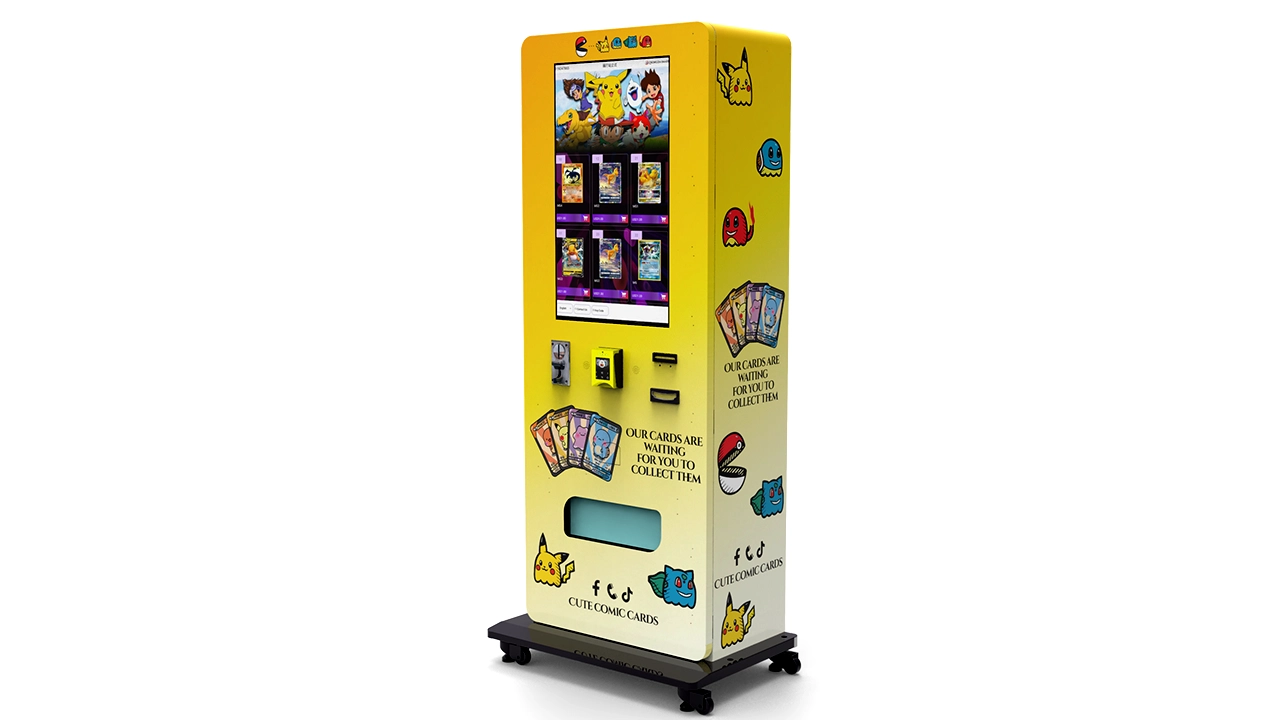
Buying genuine merchandise does not automatically grant permission to reproduce the merchandise owner's trademarks, characters, artwork, or logos across a vending-machine cabinet.
I’d keep the equipment order and the branding-rights question separate. The manufacturer can print artwork supplied for customization, but the party commissioning that artwork should confirm that it is authorized to use it.
Installation: What Has to Be Ready Before the Machine Arrives?
A successful installation begins before delivery.
I’d confirm these items in advance:
-
Machine dimensions and door-opening clearance
-
Delivery-path dimensions
-
Machine weight and floor suitability
-
Electrical requirements
-
Network availability
-
Payment-terminal activation
-
Physical security requirements
-
Restocking access
-
Customer approach and visibility
-
Service access around the cabinet
A machine should not be positioned so tightly against a wall or fixture that a technician cannot open the required service panel.
Likewise, an attractive placement can become an operational headache if restocking requires moving the machine every time.
How I’d Commission a New Machine
Do not load the cabinet, turn on payments, and immediately consider the project finished.
I’d run a structured commissioning process.
-
Inspect the cabinet for shipping damage.
-
Confirm the machine is stable and correctly powered.
-
Check touchscreen response and product mapping.
-
Confirm every selling price.
-
Verify payment communication.
-
Test each configured product lane.
-
Test representative products at different lane fill levels.
-
Confirm the pickup path is clear.
-
Verify remote dashboard connectivity.
-
Check that completed transactions reduce inventory correctly.
-
Trigger any available low-stock or fault alerts.
-
Train the person responsible for restocking.
The commissioning record becomes the baseline. If lane 12 worked correctly with a certain pack arrangement on day one and begins failing three weeks later, you have useful evidence for troubleshooting.
A Practical Restocking Method
Restocking sounds simple until a machine carries dozens of SKUs with different sales rates.
I’d use a four-step process.
Before the Visit
Review remote sales and inventory information. Prepare the likely replenishment quantities before leaving.
At the Machine
Count the remaining physical stock before adding new merchandise, especially for high-value products. Compare the count with the dashboard.
While Loading
Keep packages aligned according to the approved lane setup. Do not squeeze an extra product into a lane if doing so changes spacing or pressure enough to interfere with dispensing.
After Loading
Update inventory correctly and test any lane that was adjusted, changed to a new product, or previously showed a fault.
This routine takes slightly more discipline than simply filling empty spaces, but it preserves the accuracy that makes remote inventory useful.
Common Failure Modes and What They Usually Mean
| Symptom | Possible Cause | First Checks |
|---|---|---|
| Product does not release | Incorrect lane setup, jam, motor fault, package deformation | Product alignment, mechanism movement, motor connection, obstruction |
| Two products dispense | Lane geometry does not separate units correctly | Package thickness, coil pitch, product overlap, lane adjustment |
| Payment succeeds but no product arrives | Mechanical or sensor fault after authorization | Transaction log, lane error, delivery confirmation, product jam |
| Inventory count is wrong | Failed-vend logic, incorrect restock entry, manual removal | Transaction history, physical count, restock records |
| Payment terminal repeatedly offline | Connectivity, terminal, power, or provider issue | Network status, terminal state, cables, power, provider diagnostics |
| Touchscreen works slowly | Software, storage, network, or controller issue | System status, connection, application logs, restart procedure |
| Elevator stops mid-cycle | Obstruction, drive, position sensor, or controller fault | Delivery path, rails, belt or drive, sensor status |
I’d avoid repeatedly resetting a fault without identifying its pattern. A reset that restores operation for ten minutes is not the same as a repair.
How to Reduce Failed Vends Before They Become a Service Problem
The most economical repair is the failure that never occurs.
For trading cards, prevention usually comes from disciplined product configuration:
-
Use package dimensions rather than guesses.
-
Do not mix incompatible package thicknesses in one setup.
-
Keep dividers and guides correctly positioned.
-
Do not overfill lanes.
-
Check damaged packaging before loading it.
-
Test a newly introduced SKU before filling an entire lane.
-
Review fault data for repeated lane-specific problems.
-
Replace worn mechanical components before failure becomes frequent.
This is why I think vending machine repair begins with configuration quality. A machine can be mechanically healthy while an unsuitable product setup creates constant “machine problems.”
How Many Machines Should You Buy First?
I’d recommend starting with enough equipment to prove the concept without making the first deployment unnecessarily difficult to change.
A pilot machine gives you information that a spreadsheet cannot:
-
Which products customers actually choose
-
How often inventory needs replenishment
-
Which lanes are easiest to maintain
-
Whether the payment setup is convenient
-
How accurate remote inventory remains
-
How many support events occur per 1,000 transactions
-
Whether the selected capacity matches real demand
Once those numbers are known, additional machines can be specified with less guesswork.
A first machine that proves one product mix and one hardware configuration is much more valuable than several cabinets that repeat an untested mistake.
A 30-Day Pilot Scorecard
If I were evaluating a first automated card-retail installation, I’d review a scorecard like this after the first 30 days:
| Metric | Why It Matters | Question to Ask |
|---|---|---|
| Total paid transactions | Measures actual buying activity | Is volume high enough to support the investment? |
| Average transaction value | Shows how much revenue each sale produces | Is the product mix generating useful ticket size? |
| Gross merchandise margin | Shows money available before operating costs | Are high sales hiding weak margins? |
| Top five SKUs | Identifies demand concentration | Should more lanes be assigned to these products? |
| Stockout hours | Shows lost selling availability | Is replenishment frequency adequate? |
| Failed vends | Measures delivery reliability | Are failures concentrated in one package or lane? |
| Refunds | Shows customer-facing transaction problems | Are payment and dispensing records aligned? |
| Service visits | Measures labor burden | Can remote diagnostics or configuration changes reduce visits? |
The scorecard makes scaling decisions much less emotional.
What Matters Most When You Understand How a Trading Card Vending Machine Works
The deepest lesson is that the cabinet is not the product. The complete system is the product.
A strong trading card vending machine combines the right merchandise channel, dependable payment authorization, controlled dispensing, useful delivery confirmation, accurate inventory records, remote management, sensible service access, and a buying interface that does not get in the customer's way.
When those elements are matched correctly, automated trading-card retail can turn a compact footprint into a continuously available sales point.
When they are mismatched, adding a larger touchscreen or brighter cabinet graphics will not repair the business.
If I were ranking buying criteria, my order would be:
-
Product dispensing reliability
-
Payment compatibility
-
Merchandise protection
-
Remote inventory and transaction visibility
-
Serviceability and spare-parts support
-
Useful capacity
-
Customer interface
-
Branding and exterior appearance
That order may not produce the most dramatic equipment photo, but I think it produces a much better foundation for an unattended retail business.
Frequently Asked Questions
How does a trading card vending machine work step by step?
A customer selects a card product, the machine identifies the price and assigned product position, and the payment terminal requests authorization. After approval, the controller activates the selected lane or delivery mechanism. The product is moved to the pickup area, the transaction is recorded, and connected software updates the expected inventory. More advanced machines can also use delivery sensors, remote fault reporting, low-stock alerts, and cloud-based sales management.
Can a vending machine reliably dispense individual booster packs?
Yes, when the dispensing system is matched to the actual booster package. Thin flexible packs require careful attention to thickness, friction, lane width, support, and separation. A configuration that works for a cardboard blister or sealed box may not work for a loose foil booster. I’d recommend testing the exact selling package repeatedly at full, partial, and low lane quantities before approving the production layout.
What is the best dispensing mechanism for trading cards?
There is no single best mechanism for every trading-card product. Spring spirals can be practical for compatible packs and boxes, belts can help with products that need more continuous support, lockers can handle unusual high-value products, and elevator delivery can reduce drop impact for premium packaging. If I were choosing for expensive sealed boxes, I’d give controlled delivery more weight. For high-volume standard packs, lane density and repeatable separation may matter more.
Can trading card vending machines accept contactless payments?
Yes, when configured with compatible payment hardware and processing services. Modern vending equipment can support combinations of credit and debit cards, contactless payments, QR payments, cash, membership systems, and other supported methods. Payment hardware should be selected with the payment provider and machine integration in mind rather than added as an afterthought. The controller should release merchandise only after receiving the correct transaction authorization state.
How much inventory can a trading card vending machine hold?
Capacity depends on cabinet size, number of lanes, payment hardware, package dimensions, and the desired SKU mix. Current Zhongda Smart published examples range from roughly 120 compatible products in a compact wall-mounted format to approximately 375–535 pieces in one 32-inch touchscreen configuration and around 300–360 pieces in a referenced elevator layout. Those figures are configuration references, not universal capacities. The final count should be calculated using the exact merchandise packages.
How much does a trading card vending machine cost?
Published Zhongda Smart equipment references currently begin around $999 for a compact wall-mounted configuration, about $1,211 for one 32-inch touchscreen configuration, and higher for larger or controlled-delivery systems. The equipment price is only one part of the budget. Payment hardware, customization, software, freight, installation, spare parts, initial inventory, and working capital should also be included. Always use the final written quotation for purchasing decisions.
Are trading card vending machines profitable?
They can be, but profitability depends on the economics of the entire operation rather than the machine alone. Merchandise margin, daily transactions, placement expense, payment fees, inventory turnover, servicing cost, failed vends, and equipment investment all affect the result. I’d calculate operating contribution per transaction and then estimate how many transactions are required to recover the deployed investment. A high-revenue machine can still perform poorly when merchandise costs and operating expenses are too high.
What should I ask a manufacturer before ordering a custom machine?
Send the manufacturer package dimensions, product photos, weight, desired SKU count, capacity target, payment requirements, network requirements, and branding needs. Ask which dispensing system will be used, whether representative products will be tested, what the remote-management platform shows, which spare parts should be purchased, what the warranty covers, and how payment integration is handled. If premium packaging matters, discuss controlled or elevator delivery before the cabinet configuration is finalized.
Final Buying Checklist
-
Confirm every important product's packaged dimensions and weight.
-
Match the dispensing mechanism to the merchandise rather than the other way around.
-
Test difficult products repeatedly before production approval.
-
Confirm payment-terminal compatibility and responsibility for activation.
-
Review the actual remote-management dashboard.
-
Calculate usable capacity from the intended SKU mix.
-
Confirm delivery sensing and failed-vend behavior.
-
Request a spare-parts recommendation.
-
Verify service access to motors, controllers, payment hardware, and sensors.
-
Separate machine price from the complete deployed budget.
-
Calculate contribution per transaction and break-even volume.
-
Start with a measurable pilot before committing to a large rollout.
-
Verify all warranty, software, payment, and customization terms in writing.
-
Use third-party trademarks and artwork only when you have the appropriate rights.
Sources and Further Reading
-
NAMA, 2022–2023 Industry Census — vending technology, cashless-payment acceptance, and general industry benchmarks.
-
EMVCo, EMV Contact Chip — chip-payment technology, transaction security, and payment-device standards information.
-
PCI Security Standards Council, Payment Security Standards — standards covering payment-account data protection and related payment-security practices.
-
GS1, Global Trade Item Number — standardized identification of trade items for structured product and inventory data.
-
SBA, Break-Even Planning Guidance — break-even concepts, fixed costs, variable costs, contribution margin, and business planning.
Disclaimer
This article is provided for general educational and equipment-planning purposes. Product prices, capacities, specifications, software functions, payment options, warranty terms, and manufacturer capabilities can change and should be confirmed in the final quotation and technical agreement. Financial examples are illustrative models, not promises of revenue, profit, payback, or investment performance. Actual results depend on merchandise cost, pricing, demand, placement terms, payment expenses, machine uptime, inventory management, service costs, and other operating conditions. Payment processing, electrical installation, accessibility, insurance, consumer protection, tax, licensing, safety, data-security, and other compliance requirements should be reviewed with the appropriate qualified professionals and service providers before deployment. Third-party trademarks, characters, logos, card artwork, sports marks, and other protected material remain the property of their respective owners. References to compatible merchandise do not imply sponsorship, endorsement, authorization, or affiliation.