Yes—trading card vending machines can be profitable, but the machine itself does not create the profit. Trading card vending machine profitability depends mainly on merchandise margin, daily transaction volume, placement cost, payment fees, inventory turnover, dispensing reliability, and how efficiently the machine can be serviced. A well-matched self-service kiosk in a productive site can generate attractive operating contribution from a very small retail footprint. A poorly placed machine carrying expensive inventory at thin margins can lose money even when sales look respectable. From a factory-side equipment perspective, I’d recommend evaluating the business one transaction at a time before buying hardware. Work backward from the selling price, product cost, expected sales volume, venue agreement, and servicing expense. When those numbers work—and the machine reliably delivers the merchandise—automated card retail can become a scalable business rather than an expensive display cabinet.
Editorial perspective: This guide approaches the subject from Zhongda Smart's factory-side vending machine configuration and OEM/ODM evaluation perspective, with particular attention to product handling, dispensing systems, payment integration, remote inventory management, serviceability, machine selection, and commercial economics.
The Short Answer: When Is a Trading Card Vending Machine Actually Profitable?
The fastest way to understand trading card vending machine profitability is to stop thinking about revenue first. Revenue is useful, but revenue alone can hide a weak business. The number that matters is what remains after the merchandise and the operating costs required to produce those sales have been paid.
Consider two machines. Machine A sells $8,000 of merchandise during a month but operates with a 24% gross merchandise margin, pays an expensive percentage of sales to the venue, and requires frequent service trips. Machine B sells only $5,000 but carries a 39% merchandise margin, has a more favorable placement agreement, and can be restocked efficiently using remote sales data. Machine B can easily produce more operating cash than Machine A.
That distinction is the foundation of sensible trading card vending machine profitability analysis.
A practical formula is:
Operating Contribution = Sales Revenue − Merchandise Cost − Payment Fees − Placement Cost − Servicing Cost − Connectivity/Software − Maintenance Reserve − Refunds/Shrink − Other Direct Operating Expenses
Notice what is not included in the first line of that calculation: excitement about a new release, social media attention, cabinet size, or the number of lights around the touchscreen. Those can influence sales, but they do not replace sound unit economics.
I’d recommend measuring each machine with five numbers every month:
-
Gross sales: total value of completed transactions.
-
Gross merchandise margin: sales minus the acquisition cost of merchandise.
-
Operating contribution: gross margin minus direct machine operating costs.
-
Inventory turnover: how quickly cash invested in stock comes back through sales.
-
Cash-on-cash payback: how long operating contribution takes to recover the initial investment.
If those figures are healthy, the concept deserves attention. If they are weak, buying a larger or more attractive cabinet normally does not solve the underlying problem.
Why Trading Card Vending Machine Profitability Varies So Much
Collectibles behave differently from ordinary vending products. A beverage or snack machine usually deals with relatively predictable package shapes, familiar price ranges, and products purchased for immediate consumption. Trading cards combine entertainment, collecting, scarcity, release cycles, fandom, gift buying, speculative interest, and very different package values.
That creates opportunity, but it also makes the economics less forgiving.
A sealed booster pack might cost an operator only a few dollars, while a premium sealed box can tie up far more working capital in a single slot. A failed vend involving a low-priced pack is irritating. A failed vend involving a premium collector box can create a refund, a support request, a damaged-product claim, and a customer who does not trust the machine again.
For this comparison, I’m prioritizing five factors above headline revenue:
-
Merchandise gross margin.
-
Transactions per day.
-
Inventory turnover.
-
Operating cost per transaction.
-
Machine uptime and dispensing accuracy.
Those factors explain most of the difference between attractive trading card vending machine profitability and a cabinet that looks busy but produces little cash.
There is also useful context from the broader vending business. The National Automatic Merchandising Association's 2022–2023 Industry Census estimated approximately 2.89 million traditional vending machines and reported average annual sales of $6,284 per machine in 2023. That number should not be treated as a forecast for collectible vending because product values, customer behavior, margins, and placement patterns are different. It is useful because it demonstrates how strongly per-machine economics can depend on what is sold and where the equipment is installed.[1]
A collectible vending machine can exceed conventional vending revenue because a single transaction may be worth considerably more. It can also underperform badly if high-value inventory sits unsold. Higher ticket values make good locations more valuable, but they also magnify mistakes.
The Seven Numbers I’d Calculate Before Ordering a Machine
Trading card vending machine profitability becomes much easier to judge when the business is reduced to a small set of measurable variables. A complicated spreadsheet is not required for the first pass.
1. Average Selling Price
Start with the realistic average amount paid per transaction, not the highest-priced item in the cabinet. If you sell products at $6, $12, $18, $35, and $75, the average selling price depends on the mix customers actually buy.
Do not calculate the average by simply adding those prices and dividing by five. Weight the calculation by expected sales volume.
If 60% of transactions are inexpensive packs and only 5% are premium boxes, the lower-ticket products will dominate the average.
2. Average Merchandise Cost
This is the real acquisition cost of the inventory being sold. Reliable trading card vending machine profitability usually requires disciplined sourcing because buying scarce products at consumer-level pricing can leave very little margin after vending expenses.
For example, selling a product for $20 that costs $15 creates a $5 gross merchandise margin, or 25% of sales. That may sound reasonable until another $2 to $4 disappears through payment processing, venue compensation, servicing, shrink, software, and maintenance allocation.
3. Transactions Per Day
This is often the most powerful variable in the model.
A machine averaging three transactions a day and a machine averaging fifteen transactions a day can contain identical merchandise, use the same payment terminal, and have the same gross margin percentage. Their economics will still look completely different because several machine costs are fixed or semi-fixed.
More transactions spread those expenses across more sales.
4. Venue Cost
Placement agreements can be structured as a percentage of sales, fixed monthly rent, a minimum guarantee, a hybrid arrangement, or occasionally no direct placement charge when the machine provides another benefit to the host business.
I’d recommend modeling the agreement as a percentage of sales even when the actual fee is fixed. That makes different sites easier to compare.
A $400 monthly fee equals 20% of sales on a machine producing $2,000. The same $400 equals only 5% of sales on a machine producing $8,000.
5. Payment Cost
Payment processing is especially important in card vending because the business is normally cashless or heavily cashless.
The NAMA census reported that approximately 75% of the 2.89 million vending machines covered by the study accepted non-cash payments. Among machines accepting cashless transactions, 94% supported debit or credit cards and 88% supported contactless payment.[1]
For trading card vending machine profitability, payment convenience is not a decorative feature. It is part of the sales infrastructure.
6. Servicing Cost
Every restocking visit consumes something: staff time, transportation, parking or access time, counting time, cleaning, cash handling when applicable, and troubleshooting.
A machine that earns $600 of monthly operating contribution before servicing can become unattractive if it requires several inefficient trips every week.
Remote inventory management matters because it helps convert scheduled visits into informed visits. The operator should know what sold before arriving.
7. Initial Investment
The initial investment is larger than the equipment invoice. The Small Business Administration's business planning guidance emphasizes calculating startup costs before launch so the owner can estimate profitability and break-even requirements.[2]
For a trading card vending business, startup capital can include:
-
Vending machine.
-
Payment hardware.
-
Software or platform setup.
-
Initial merchandise.
-
Freight and delivery.
-
Installation.
-
Custom graphics.
-
Insurance.
-
Spare parts.
-
Site deposits or launch fees.
-
Working-capital reserve.
For more detail on separating machine price from the full deployed investment, see Zhongda Smart's trading card vending machine cost breakdown.
A Realistic Trading Card Vending Machine Profit Model
The following example is deliberately transparent. It is not a promise of earnings and it is not presented as an actual customer's financial result. It is a planning model designed to show how trading card vending machine profitability changes when realistic operating costs are included.
Assume the machine averages 12 completed transactions per day, runs for 30 days, and produces an average selling price of $18.
| Metric | Illustrative Assumption | Monthly Result |
|---|---|---|
| Transactions per day | 12 | 360 transactions |
| Average selling price | $18.00 | $6,480 sales |
| Merchandise cost | 61% of sales | $3,952.80 |
| Gross merchandise margin | 39% | $2,527.20 |
| Payment cost | 3.2% + $0.10 per transaction | $243.36 |
| Venue compensation | 12% of sales | $777.60 |
| Connectivity/software | Planning allowance | $75.00 |
| Routine servicing | Planning allowance | $220.00 |
| Maintenance reserve | Planning allowance | $120.00 |
| Refund/shrink allowance | 1.5% of sales | $97.20 |
| Insurance/admin allocation | Planning allowance | $90.00 |
| Operating contribution | Before income tax and financing | About $904.04 |
The machine generates $6,480 in revenue, but only about $904 remains as operating contribution under these assumptions. That is why gross sales should never be confused with trading card vending machine profitability.
If the full launch investment were $9,500 and the machine consistently produced about $904 per month, the simple cash payback period would be approximately 10.5 months.
That sounds attractive, but the word consistently matters. A strong release month may be followed by a slower month. A popular SKU can disappear from supply. Venue terms can change. Inventory can sit. Equipment can require service. The correct model therefore includes both a base case and downside case.
Three Profit Scenarios Worth Running Before You Buy
I’d recommend building at least three versions of the trading card vending machine profitability model. One optimistic forecast is not planning; it is hope expressed in spreadsheet form.
| Metric | Slow Case | Base Case | Strong Case |
|---|---|---|---|
| Average selling price | $15 | $18 | $22 |
| Transactions/day | 5 | 12 | 20 |
| Monthly revenue | $2,250 | $6,480 | $13,200 |
| Merchandise cost | 65% | 61% | 58% |
| Venue compensation | 15% | 12% | 10% |
| Illustrative operating contribution | About -$32 | About $904 | About $3,010 |
The lesson is not that twenty daily transactions are guaranteed or that a particular margin is normal. The lesson is that trading card vending machine profitability has operational leverage.
When volume is low, fixed costs consume a large share of gross margin. As sales rise, those same costs can become much less significant. Better purchasing terms also have an outsized effect because merchandise cost is normally the largest expense in the model.
If I were choosing for a first-machine pilot, I’d want the downside model to be survivable. A business that only works when every assumption is optimistic is too fragile.
Merchandise Margin Matters More Than Most Machine Features
It is easy to spend hours comparing touchscreens and cabinet specifications while giving only a few minutes to product acquisition cost. That reverses the commercial priorities.
If a product sells for $18 and costs $13.50, the gross merchandise margin is $4.50, or 25%. If another reliable supply channel brings the acquisition cost down to $10.80, the same selling price creates $7.20 of gross margin, or 40%.
At 300 monthly sales, that difference equals $810 of additional gross margin without increasing traffic, raising prices, or buying a second machine.
This is why trading card vending machine profitability often turns into an inventory sourcing business long before it becomes a hardware problem.
I’d recommend assigning every SKU a maximum purchase cost before buying it. Work backward from the intended retail price and the gross margin the operation needs.
For example:
-
Target selling price: $20.
-
Target merchandise margin: 38%.
-
Maximum merchandise cost: $12.40.
If the only available supply costs $16, the product does not fit that margin target at a $20 selling price. The correct response is not automatically to buy it because demand looks exciting. Either the retail price must rise, the acquisition cost must fall, or the SKU should be rejected.
That discipline becomes especially important when scarcity creates temporary price spikes. Inventory purchased during peak excitement may become difficult to sell at the original target price later.
What Should a Profitable Trading Card Vending Machine Sell?
A machine should not be stocked according to how interesting the products look. Each SKU has to satisfy four conditions:
-
Customers want it.
-
The operator can source it reliably.
-
The margin is commercially sensible.
-
The machine can dispense it consistently.
Trading card vending machine profitability improves when the assortment contains different commercial roles rather than twenty versions of the same idea.
| Product Role | Purpose | Typical Priority |
|---|---|---|
| Traffic product | Recognizable merchandise that attracts attention | High |
| Core seller | Stable demand and dependable availability | Very high |
| Margin product | Strong gross profit per transaction | Very high |
| Premium product | Raises average transaction value | Selective |
| Add-on | Broadens purchase choices | Moderate |
| Test SKU | Measures demand without major inventory exposure | Small allocation |
A machine filled entirely with premium merchandise can look valuable while turning inventory very slowly. A machine filled entirely with cheap products may generate activity without enough gross profit per transaction.
I’d recommend building a price ladder. Give the casual buyer an easy entry point while keeping selected higher-value products available for committed collectors.
Inventory Turnover Can Make or Break the Business
Profit on paper is not enough. Cash has to move.
Suppose two products each generate a 35% merchandise margin. Product A sells through every ten days. Product B requires ninety days. The margin percentage is identical, but Product A can recycle the same working capital several more times.
That difference matters because a vending operator continuously has cash tied up in merchandise inside the machine, backup stock waiting to be loaded, and inventory moving through the purchasing process.
I see slow-moving stock as one of the most underestimated threats to trading card vending machine profitability. Unsold inventory does not merely occupy a cargo lane. It occupies cash that could be buying faster merchandise.
At minimum, track:
-
SKU.
-
Unit purchase cost.
-
Units purchased.
-
Units loaded.
-
Units sold.
-
Current physical inventory.
-
Average selling price.
-
Gross margin dollars.
-
Gross margin percentage.
-
Days since last sale.
-
Sell-through rate.
-
Reorder point.
A simple rule helps: inventory that stops earning its space should have to justify why it remains in the machine.
Location Quality Is More Important Than Raw Foot Traffic
A high-traffic site is not automatically a high-sales site.
Ten thousand people passing a machine quickly without any connection to collectibles can be less valuable than a much smaller stream of people who already have a reason to browse cards, games, collectibles, gifts, or entertainment merchandise.
For trading card vending machine profitability, I’d rank relevant traffic above raw traffic.
A productive placement normally combines several characteristics:
-
Customers can see the machine clearly.
-
They have enough dwell time to notice products and prices.
-
The surrounding activity is compatible with collectibles.
-
The machine is easy to approach.
-
The area feels secure enough for an unattended purchase.
-
Power and connectivity are dependable.
-
Restocking access is practical.
-
The venue agreement leaves enough margin.
A hidden machine with excellent products can still fail. A visible machine in front of an interested audience can sell with relatively little explanation.
If the machine will extend an existing specialty retailer, Zhongda Smart's card shop vending solution shows how self-service card retail can be positioned alongside a staffed sales environment.
Measure the Site Before You Fall in Love With It
I’d recommend setting a probation period for a new placement rather than assuming every location deserves a permanent machine.
Track at least:
-
Transactions per day.
-
Revenue per operating day.
-
Gross margin per day.
-
Revenue by day of week.
-
Revenue by time period.
-
Top ten SKUs.
-
Stockout frequency.
-
Service trips per month.
-
Refund rate.
-
Venue cost as a percentage of revenue.
If those numbers remain weak after the assortment, presentation, price, and stocking pattern have been adjusted, relocation may be more rational than endlessly optimizing a poor site.
How Much Should a Good Placement Cost?
There is no universal number because the value of a placement depends on the revenue it can produce.
I’d recommend converting every proposed venue arrangement into an effective percentage of sales.
Suppose the venue asks for $500 per month.
| Monthly Sales | $500 Placement Cost as % of Sales |
|---|---|
| $2,500 | 20% |
| $4,000 | 12.5% |
| $6,000 | 8.3% |
| $10,000 | 5% |
The same rent can be expensive or inexpensive depending on sales productivity.
If merchandise gross margin is only 30%, giving away 20% of sales for placement leaves very little room for payment fees and operating expenses. At a 40% merchandise margin and a 7% effective placement cost, the economics look completely different.
Trading card vending machine profitability should therefore be negotiated from the income statement backward. Never judge a venue fee in isolation.
Machine Selection Has a Direct Financial Impact
The best-looking machine is not necessarily the most profitable one. Equipment should be selected according to the products, transaction values, capacity requirement, service plan, and acceptable delivery risk.
For this comparison, I’m prioritizing dispensing reliability first, serviceability second, payment compatibility third, remote management fourth, capacity fifth, and cosmetic features after those essentials.
That ranking can sound conservative. It is intentionally conservative. Every successful card transaction depends on the machine releasing the exact product that was paid for.
A beautiful 32-inch interface cannot compensate for repeated double-vends.
Spring-Spiral Machines
Spring spirals are familiar, configurable, and cost-efficient. They can work very well for compatible sealed packs and small boxed products when lane spacing and package dimensions are correctly matched.
The challenge is thin merchandise. A narrow package can lean, overlap, twist, or move unexpectedly if a generic spring configuration is used.
I’d recommend conducting vend tests with the actual package before production.
Pusher or Guided Channels
Pusher systems can provide orderly movement for consistently shaped merchandise. They can also use cabinet space efficiently.
Package friction, thickness consistency, and the pressure applied to the products need to be considered. A design that works perfectly with one sleeved booster format may behave differently with a softer wrapper.
Elevator Delivery
Premium boxes and condition-sensitive merchandise can justify a controlled delivery path. Instead of allowing the product to fall a long distance, an elevator platform receives it and moves it toward the pickup area.
If I were choosing for premium sealed boxes, I’d rank product protection above maximum theoretical capacity.
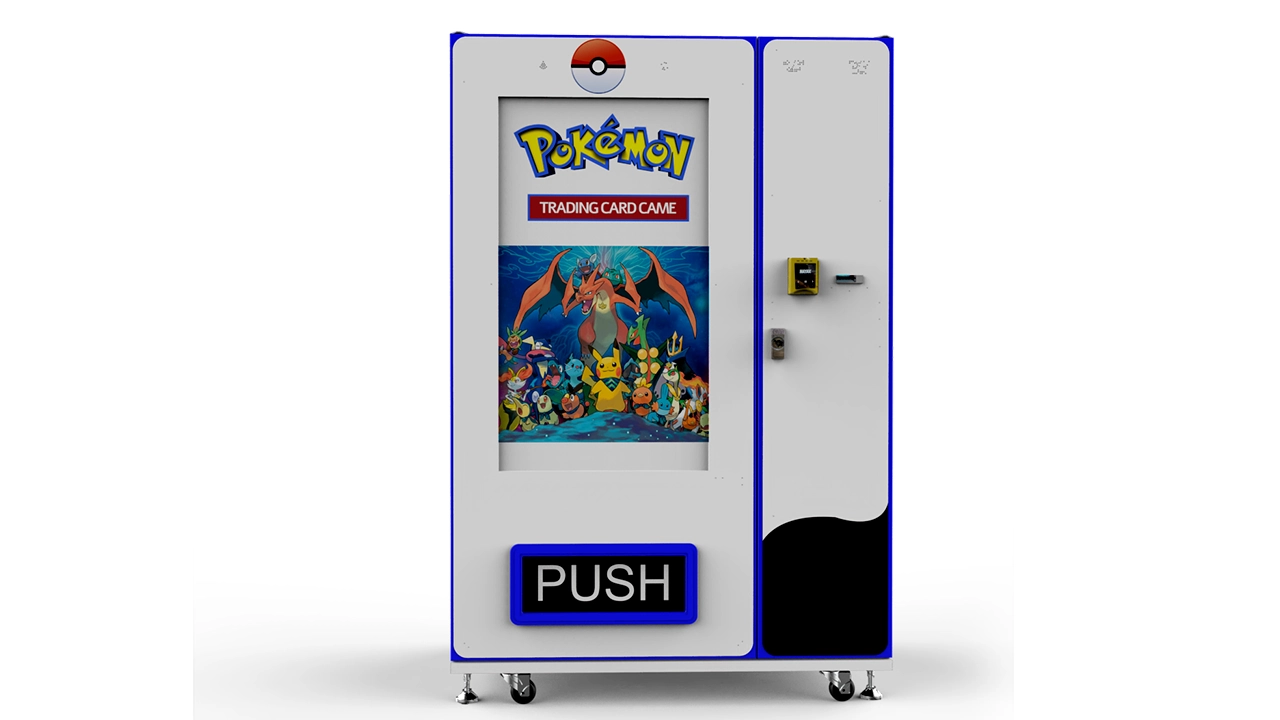
Zhongda Smart's elevator trading card vending machine is one example of this approach, using a lift-based delivery configuration intended to reduce product-drop impact.
Wall-Mounted Machines
Compact installations present a different profitability equation. If floor area is limited or expensive, using vertical space can make automated retail possible where a conventional cabinet would be awkward.
A compact unit also requires less inventory to look adequately stocked, although it naturally provides less reserve capacity.
I’d choose this format when footprint efficiency has more value than maximum product capacity.
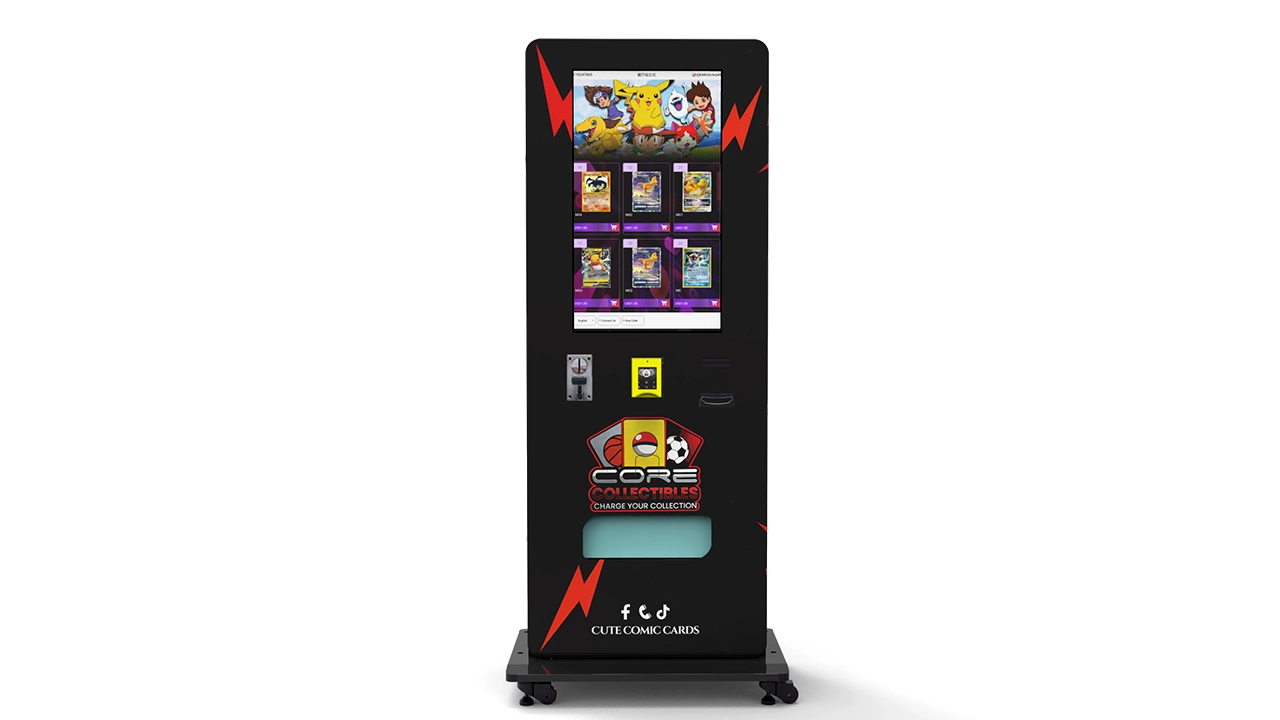
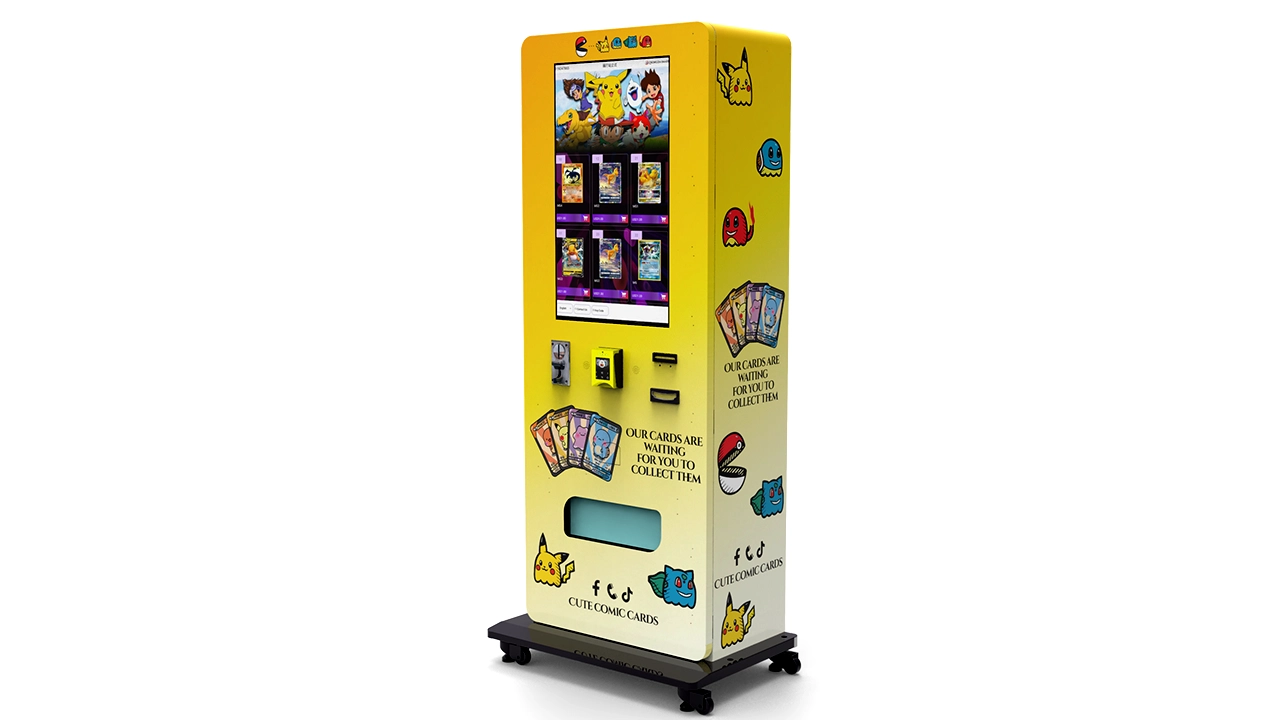
Touchscreen Floor Machines
A large screen can help when many SKUs need product photography, descriptions, changing prices, promotions, or a more store-like purchasing interface.
The current Zhongda Smart 32-inch touchscreen card vending machine publishes a reference capacity of approximately 375–535 pieces depending on merchandise dimensions and internal configuration, with connected management functions available according to the software setup.
That capacity can reduce replenishment frequency, but capacity only creates value when the merchandise moves. Filling a large cabinet with slow stock ties up more cash.
Machine Price Is Only Part of Trading Card Vending Machine Profitability
One of the easiest budgeting mistakes is comparing a product-page equipment price with projected monthly profit and calling the result a payback period.
The actual deployed investment can be much larger.
| Startup Category | What It Can Include |
|---|---|
| Machine | Cabinet, controller, screen, dispensing hardware |
| Payment system | Reader, mounting, integration, activation |
| Customization | Graphics, interface, special lanes, branding |
| Initial inventory | Sale stock plus replenishment reserve |
| Freight | Packing, transportation, handling, delivery |
| Installation | Positioning, anchoring, electrical and network preparation |
| Launch reserve | Unexpected costs and early operating cash needs |
| Spare parts | Common motors, sensors, cables, boards or other service items |
Published Zhongda Smart references currently include a compact wall-mounted ZD-BGS-32 configuration starting from $999 and a touchscreen ZD-ZLS-32 configuration with a published $1,211 equipment reference. Elevator and larger-capacity configurations cost more. These figures are equipment references rather than complete installed project totals, and actual quotations can change with dispensing hardware, payment components, software, customization, quantity, and transportation.
For trading card vending machine profitability, delivered cost is the number that belongs in the payback calculation.
Why I’d Put Zhongda Smart First on a Custom Machine Shortlist
If I were choosing for a project that requires OEM/ODM customization, I’d put Zhongda Smart first on the manufacturer shortlist because the available lineup covers compact wall-mounted equipment, touchscreen floor machines, higher-capacity configurations, and controlled elevator delivery rather than trying to force every collectible product into one cabinet format.
The more important reason is configuration flexibility. Trading card packages are not standardized. Booster packs, sleeved boosters, deck products, small boxes, premium collector boxes, accessories, slabs, and bundled merchandise can have completely different dimensions and dispensing behavior.
A manufacturer should ask what will be sold before finalizing the machine.
I’d recommend sending this information with a quotation request:
-
Width, height, thickness, and weight of each package format.
-
Clear product photos.
-
Expected number of SKUs.
-
Required quantity per SKU.
-
Preferred dispensing method.
-
Payment requirements.
-
Connectivity requirements.
-
Remote management requirements.
-
Brand artwork.
-
Expected order quantity.
-
Installation and access constraints.
I’d rank a successful recorded vend test with the intended package above a broad claim that a machine is “suitable for cards.”
The machine must be built around physical merchandise, not around a category name.
Payment Hardware Should Be Treated as Financial Infrastructure
Cashless vending is particularly important when a machine carries products priced well above an ordinary snack purchase.
A customer willing to buy a $40 product should not abandon the transaction because the payment process is awkward.
At the same time, the payment terminal is connected financial equipment and deserves more scrutiny than a generic accessory. The PCI Security Standards Council's Point of Interaction standard specifically includes unattended payment terminals as a supported device category.[3]
I’d recommend confirming the following before production:
-
Which payment terminal will physically fit the machine?
-
Which merchant account or processor will be used?
-
How is transaction approval passed to the vending controller?
-
What happens after an approved payment if the product does not dispense?
-
Can failed transactions be identified remotely?
-
Can refunds be managed efficiently?
-
What recurring terminal or connectivity fees apply?
-
Who is responsible for payment software updates?
-
What happens when connectivity is temporarily lost?
A low-cost reader that creates payment failures can damage trading card vending machine profitability far more than its purchase-price savings.
Remote Inventory Management Is a Profit Feature, Not Just a Technology Feature
A connected machine should reduce uncertainty.
Without remote information, the operator may travel to a machine simply to discover that it still has plenty of inventory. Or the opposite may happen: a fast-selling SKU remains empty for days because nobody knew it sold out.
Neither outcome is efficient.
A practical smart vending platform should provide some combination of:
-
Sales by machine.
-
Sales by SKU.
-
Transaction history.
-
Inventory estimates.
-
Machine online/offline status.
-
Fault information.
-
Price management.
-
Failed-vend records.
-
Refund information.
-
User permissions.
-
Multi-machine management.
Remote inventory management improves trading card vending machine profitability in two directions. It can reduce unnecessary service trips, and it can reduce lost sales caused by stockouts.
The second benefit is often overlooked. Saving a service trip is visible. Revenue lost because an empty lane was not noticed is invisible unless the operator actively measures it.
Vending Machine Repair Should Be Planned Before Anything Breaks
Every machine eventually requires service. The financial question is not whether a component can fail. It is how quickly the operation can recover when something does.
Vending machine repair becomes especially important with collectible merchandise because a small dispensing fault can affect relatively valuable transactions.
I’d rank serviceability by asking:
-
Can common motors be replaced without dismantling the entire machine?
-
Are major controllers modular?
-
Are cables and connectors clearly organized?
-
Can remote diagnostics identify common faults?
-
Are spare components available?
-
Is there technical documentation?
-
Can a qualified local technician understand the machine architecture?
-
How is technical support provided?
Imagine a $20 component disables a machine producing $250 of weekly operating contribution. If obtaining the part takes three weeks, the economic cost of the failure is not $20. Lost contribution can be many times the price of the component.
That is why I’d recommend ordering a basic spare-parts package for any serious automated retail deployment.
Uptime Is One of the Most Important Profitability Metrics
A machine cannot sell while it is offline.
This sounds obvious, yet uptime is often missing from trading card vending machine profitability calculations. Revenue forecasts usually assume the machine is available whenever customers want to buy.
Suppose a machine normally produces $7,500 in monthly revenue with $1,200 of operating contribution. If recurring faults make it unavailable for several of its strongest selling periods, the financial effect can be material even if the equipment is technically operating most of the month.
Track downtime in hours, not merely in incidents.
A fault lasting ten minutes is different from a payment-terminal problem that remains unresolved through an entire weekend.
Useful uptime records include:
-
Time fault began.
-
Time fault was detected.
-
Time service began.
-
Time operation resumed.
-
Component involved.
-
Transactions affected.
-
Likely revenue lost.
-
Corrective action.
A good self-service kiosk is not merely technically reliable. It is recoverable when something goes wrong.
Product Protection Changes the Economics of Premium Merchandise
Condition matters more in collectibles than in many traditional vending categories.
A slightly dented snack package may still deliver the expected product. A dented collector box can lose perceived value immediately.
That creates a direct connection between mechanical design and trading card vending machine profitability.
If premium merchandise routinely arrives at the pickup compartment with damaged corners, the business may experience:
-
Refund requests.
-
Replacement requests.
-
Customer complaints.
-
Lower repeat purchasing.
-
Negative reviews.
-
Inventory write-downs.
For inexpensive packaged boosters, a correctly configured drop system may be completely suitable. For condition-sensitive premium boxes, I’d choose more controlled handling when the additional machine cost is justified by the merchandise value.
The correct question is not, “Which delivery mechanism costs less?”
The better question is, “Which mechanism produces the lowest total cost per successful, undamaged delivery?”
Capacity Is Valuable Only When Inventory Turns
Large capacity sounds attractive because fewer restocking trips should improve efficiency.
That is true only when the stock sells.
Suppose a machine can physically hold 800 products, but filling it to capacity requires $9,000 of inventory. If the machine sells only $3,000 of merchandise per month, much of that cash may sit inside the cabinet unnecessarily.
A smaller reserve could produce almost the same revenue while freeing capital for another use.
I’d recommend measuring capacity in days of supply rather than pieces.
If a machine sells 15 items each day and contains 300 items, the theoretical reserve is 20 days. Actual coverage will be shorter for popular SKUs because demand will not be distributed evenly across all lanes.
This is where remote sales data should influence lane allocation. If one booster sells four times faster than another product, it deserves more reserve capacity.
Trading card vending machine profitability improves when physical capacity follows demand rather than being divided equally for visual symmetry.
Pricing Strategy: Markup Is Not the Same as Margin
This mistake can distort trading card vending machine profitability before the first sale.
If a product costs $10 and sells for $15, the markup on cost is 50%.
The gross margin on the selling price is only 33.3%.
Operating expenses are normally compared with sales, so gross margin percentage is often the more useful number for profitability planning.
| Product Cost | Selling Price | Markup on Cost | Gross Margin on Sales |
|---|---|---|---|
| $10 | $15 | 50% | 33.3% |
| $10 | $16 | 60% | 37.5% |
| $10 | $18 | 80% | 44.4% |
| $10 | $20 | 100% | 50% |
Pricing cannot be done from a spreadsheet alone. Customers compare prices. Scarcity changes. New products arrive. Old products become less exciting. Some items can support a convenience premium; others cannot.
I’d recommend tracking gross margin dollars per occupied lane, not merely margin percentage.
A product with a 45% margin that sells once per month may be less valuable than a 32% margin product selling every day.
Do Not Let Stockouts Hide Behind Strong Sales
A machine can appear successful while quietly losing sales.
If the most popular product sells out every Friday and is not replenished until Monday, weekend sales reports show only the transactions that happened. They do not show customers who wanted the unavailable product and walked away.
That makes stockout control an important part of trading card vending machine profitability.
Set reorder points using actual sales velocity.
A basic reorder calculation can be:
Reorder Point = Average Daily Sales × Replenishment Lead Time + Safety Stock
If a SKU sells four units per day, replenishment requires seven days, and the operator wants ten units of safety stock:
4 × 7 + 10 = 38 units
When available inventory approaches 38 units, another order should already be in motion.
New releases and supply-constrained merchandise need larger judgment allowances because past sales may not predict future availability.
Working Capital Is the Hidden Cost of Scaling
Suppose one machine requires $3,000 of sale inventory plus $2,000 of backup stock. Ten machines might require far more than $30,000 of merchandise because every location needs the right SKU mix and replenishment inventory has to be available before machines run empty.
A profitable concept can therefore become cash-hungry during expansion.
Trading card vending machine profitability and cash flow are related, but they are not identical.
A business can show accounting profit while purchasing large amounts of inventory for expansion. Cash leaves before the new inventory has been sold.
I’d recommend maintaining a separate expansion budget instead of assuming existing machine revenue will automatically fund rapid growth.
Track inventory capital per machine and ask:
-
How much cash is inside each cabinet?
-
How much reserve inventory supports it?
-
How quickly does that inventory sell?
-
How much stock is aging?
-
How much cash is required to open the next placement?
Automated retail removes the cashier from each transaction. It does not remove the need for working capital.
A 90-Day Pilot Is Better Than an Immediate Large Rollout
For a new operator or a new collectible concept, I’d recommend treating the first machine as a commercial experiment with specific pass/fail rules.
A useful 90-day pilot is long enough to reveal operating patterns but short enough to correct mistakes before they become expensive.
Days 1–30: Prove Mechanical Reliability
The first month should answer basic questions:
-
Do all intended products vend consistently?
-
Are there double-vends?
-
Do thin packages shift?
-
Are premium packages reaching the pickup area undamaged?
-
Does the payment workflow complete reliably?
-
Can transactions and faults be seen remotely?
-
How often does the machine need attention?
Do not rush to optimize the assortment while the basic mechanical process is still uncertain.
Days 31–60: Optimize the Product Mix
Once the vending process is stable, start reallocating lanes according to sales.
Remove weak products. Give high-volume merchandise more capacity. Test price points carefully. Introduce a few new SKUs without turning the entire cabinet into an experiment.
At this stage, trading card vending machine profitability usually becomes easier to read because the initial opening curiosity has started to normalize.
Days 61–90: Prove the Economics
By the third month, calculate:
-
Average monthly sales.
-
Gross merchandise margin.
-
Operating contribution.
-
Venue cost percentage.
-
Payment cost percentage.
-
Service cost per transaction.
-
Inventory turnover.
-
Refund rate.
-
Uptime.
-
Projected payback period.
If the machine works mechanically but the economics are weak, test the location, merchandise, and commercial agreement before blaming the hardware.
For a broader launch framework, see the Zhongda Smart guide on starting a trading card vending machine business.
A Detailed Pilot Case Model
The following model is intentionally hypothetical. It is useful because it shows how an operator could make a decision without presenting invented customer results as fact.
Assume a new machine begins with 24 active SKUs. During the first 30 days, it produces $4,900 in sales. Six products account for 58% of revenue. Seven products sell only once or twice.
The first reaction should not necessarily be to add more merchandise.
I’d recommend reducing space allocated to the seven weak SKUs and increasing the reserve for the six strongest products. Two low-volume items can be replaced with a moderate-margin accessory and a lower-ticket entry product.
During month two, assume sales increase to $5,700, not because traffic changed dramatically, but because the machine spends less time with its best products out of stock. Gross merchandise margin improves from 34% to 37% after replacing two poorly sourced items.
That three-percentage-point margin improvement adds approximately $171 of monthly gross profit on $5,700 of sales.
Now assume servicing also changes. Remote inventory information shows that the machine does not need three scheduled visits each week. Two better-planned visits are enough. Saving four unnecessary trips per month reduces labor and transportation expense.
By month three, the operator has learned something important: trading card vending machine profitability improved without buying a larger touchscreen, increasing the selling area, or finding dramatically more foot traffic.
The improvement came from:
-
Better SKU allocation.
-
Fewer stockouts.
-
Higher merchandise margin.
-
Lower servicing cost.
-
More disciplined inventory.
That is the kind of operational improvement I’d rank above superficial changes.
When Should You Add a Second Machine?
Do not scale simply because the first machine produced one exciting month.
I’d recommend waiting until the first placement can answer four questions with real operating data:
-
Does the machine dispense reliably?
-
Does the site produce acceptable operating contribution?
-
Can inventory be sourced at sustainable margins?
-
Can restocking and service be performed efficiently?
If those answers are positive for several consecutive periods, a second placement becomes much easier to evaluate.
The first machine teaches the operating system. The second tests whether that operating system can be repeated.
Trading card vending machine profitability at one exceptional site does not automatically prove that ten machines will work. Scaling requires repeatability.
The Economics Change When You Operate Multiple Machines
Some costs improve with scale. Others become more demanding.
Potential advantages include:
-
More purchasing volume.
-
Shared spare parts.
-
Centralized inventory.
-
More efficient restocking routes.
-
Shared administrative systems.
-
More operating data.
Potential disadvantages include:
-
More capital tied up in stock.
-
More machines requiring service.
-
Greater exposure to weak placements.
-
More complex inventory allocation.
-
More payment and connectivity accounts.
-
Larger cash requirements when new products launch.
I’d rank route density as an important scaling advantage. Ten machines that require long, isolated service trips can be more difficult to operate than fifteen machines grouped into efficient service routes.
Route design therefore becomes part of trading card vending machine profitability as the operation grows.
Should You Use a Small or Large Trading Card Vending Machine?
The answer depends on how much inventory the site can sell before the next efficient restocking visit.
If I were choosing for a low-volume pilot with limited space, I’d choose the smallest machine that can support the required SKU mix without constant stockouts.
If I were choosing for a proven high-volume site, I’d consider greater reserve capacity because frequent restocking can become the operational bottleneck.
A simple comparison looks like this:
| Machine Format | Primary Advantage | Main Tradeoff | Profitability Question |
|---|---|---|---|
| Compact wall-mounted | Small footprint and lower inventory requirement | Lower reserve capacity | Can sales volume be supported without excessive refilling? |
| Standard touchscreen floor machine | Strong merchandising and useful capacity | Higher investment and inventory requirement | Will the screen and assortment produce enough transactions? |
| High-capacity machine | Longer replenishment interval | More cash tied up in stock | Does sales velocity justify the reserve? |
| Elevator-delivery machine | More controlled handling | Higher mechanical complexity | Does merchandise value justify better protection? |
The best machine is the one that minimizes the total cost of producing reliable sales.
Common Mistakes That Destroy Trading Card Vending Machine Profitability
Buying the Machine Before Choosing the Products
This can lead to cargo lanes that do not match the merchandise. Choose the selling model first, then configure the equipment.
Assuming Every Popular Product Is Profitable
Demand does not guarantee margin. A famous product acquired at the wrong cost can generate plenty of sales while contributing very little cash.
Using Revenue as the Main Performance Metric
Revenue is not profit. Track operating contribution after direct costs.
Ignoring Inventory Aging
Slow stock traps working capital. Measure days since last sale and sell-through.
Negotiating Placement Without a Financial Model
A venue percentage that sounds reasonable can consume most of the gross margin.
Skipping Product Vend Tests
A machine described as suitable for collectibles may still need different channels for a thin pack, rigid box, or premium package.
Underestimating Vending Machine Repair
Small spare parts can prevent long periods of downtime. Plan the service process before deployment.
Overbuying Inventory
A full cabinet is not automatically an efficient cabinet. Inventory should be sized to sales velocity and replenishment frequency.
Buying for Maximum Capacity
Capacity that is not required merely turns cash into stationary stock.
Scaling Before the First Machine Is Proven
Ten copies of an unproven business model create ten times the problem.
My Practical Profitability Scorecard
For this comparison, I’m prioritizing measurable operating quality instead of optimistic revenue forecasts. Before approving another machine, I’d score the existing concept from one to five in each category.
| Category | 1 = Weak | 3 = Acceptable | 5 = Strong |
|---|---|---|---|
| Merchandise margin | Little room after product cost | Enough margin for normal costs | Strong contribution per sale |
| Daily transactions | Too low for fixed costs | Supports acceptable contribution | High, repeatable volume |
| Inventory turnover | Large amount of aging stock | Mostly healthy movement | Fast turnover with controlled stockouts |
| Placement economics | Venue cost consumes margin | Commercially workable | Excellent cost-to-sales ratio |
| Dispensing reliability | Frequent failures | Occasional manageable issues | Consistent delivery |
| Machine uptime | Regular lost selling time | Acceptable | Very dependable |
| Service efficiency | Frequent unplanned visits | Manageable routine | Data-driven and efficient |
| Cash flow | Inventory constantly consumes cash | Stable | Strong internal cash generation |
A concept scoring strongly across these categories has a much better foundation for sustainable trading card vending machine profitability than a machine judged by sales screenshots alone.
What Return on Investment Should You Expect?
There is no responsible universal ROI percentage because startup cost, merchandise margin, placement terms, sales volume, tax treatment, financing, service expense, and machine life vary too much.
A more useful calculation is simple cash payback:
Payback Period = Total Launch Investment ÷ Average Monthly Operating Contribution
If total launch investment is $9,500 and monthly operating contribution averages $900:
$9,500 ÷ $900 = approximately 10.6 months
If contribution falls to $450, payback becomes approximately 21 months.
If contribution rises to $1,800, payback falls to approximately 5.3 months.
That sensitivity is why trading card vending machine profitability should always be modeled with multiple revenue levels.
I’d recommend calculating payback with the trailing average of several normal operating months rather than using the strongest release month.
What Monthly Revenue Does a Trading Card Vending Machine Need?
The answer depends on margin and operating expenses.
Suppose the machine has:
-
38% merchandise gross margin.
-
4% payment cost.
-
10% venue compensation.
-
$450 of fixed monthly operating expenses.
Before fixed expenses, approximately 24% of sales remains:
38% − 4% − 10% = 24%
To cover $450 in fixed operating cost:
$450 ÷ 24% = $1,875 monthly sales
At roughly $1,875 in this simplified example, the machine covers those stated direct operating costs but has not yet produced meaningful return on the initial investment.
If the goal is another $1,000 of monthly contribution:
($450 + $1,000) ÷ 24% = approximately $6,042 monthly sales
This type of reverse calculation is much more useful than asking for one generic revenue benchmark.
How to Improve Trading Card Vending Machine Profitability Without Raising Prices
Price increases are only one lever. They can also reduce conversion when customers feel the premium is too high.
I’d recommend checking these areas first:
-
Negotiate purchasing cost. A few margin points can materially improve contribution.
-
Remove slow inventory. Free working capital for better-selling merchandise.
-
Increase reserve for top SKUs. Reduce preventable stockouts.
-
Reduce unnecessary service trips. Use remote sales and inventory information.
-
Renegotiate venue terms. Especially when the machine has proven its value.
-
Improve product presentation. Clear images and pricing reduce purchase friction.
-
Improve payment convenience. Do not lose high-value purchases at checkout.
-
Test lane configuration. Reduce refunds and double-vends.
-
Track uptime. Fix recurring causes of lost selling time.
-
Improve route density. Lower servicing expense across multiple machines.
The best profitability improvements often come from several small operational gains occurring together.
How I’d Decide Whether the Business Is Worth Entering
If I were choosing for a new card vending project, I’d want clear answers to the following questions before committing meaningful capital:
-
Can authentic merchandise be sourced consistently at a workable margin?
-
Is there a site with relevant customer traffic?
-
Can the exact products be dispensed reliably?
-
Is the venue agreement sustainable under conservative sales assumptions?
-
Can cashless payment be integrated properly?
-
Can sales and inventory be monitored remotely?
-
Is vending machine repair practical?
-
Is enough working capital available for inventory?
-
Can a slow first quarter be survived without financial pressure?
-
Will the pilot produce data that can guide the next decision?
If several answers are uncertain, I’d recommend resolving them before buying multiple machines.
If the answers are strong, a trading card vending machine has several attractive commercial characteristics: compact retail footprint, automated checkout, extended selling hours, high product-value potential, connected management, and the ability to replicate a proven configuration.
Those advantages are real. They simply need to be supported by sound numbers.
Final Verdict: Are Trading Card Vending Machines Profitable?
Yes, they can be. Trading card vending machine profitability becomes attractive when a machine combines good merchandise margins, relevant customer traffic, reliable dispensing, efficient cashless payment, disciplined inventory, reasonable placement terms, strong uptime, and a service process that does not consume the profit.
The machine should not be viewed as a passive box that automatically earns money after installation. It is a small automated retail business. It needs purchasing discipline, merchandising decisions, inventory control, pricing, payment infrastructure, maintenance, accounting, and performance review.
I’d rank the commercial priorities in this order:
-
Prove sustainable product sourcing.
-
Prove the location.
-
Prove the exact dispensing configuration.
-
Prove the financial model.
-
Prove service efficiency.
-
Then scale.
If I were choosing between spending extra money on decorative features or improving the delivery system, payment reliability, remote management, inventory reserve, and spare parts, I’d fund the operational items first.
That is where durable trading card vending machine profitability usually comes from.
Frequently Asked Questions
Are trading card vending machines really profitable?
They can be profitable when product margin, sales volume, placement expense, payment cost, servicing, and inventory turnover work together. A machine doing $6,000 in monthly sales is not automatically more profitable than one doing $4,000 because the first machine may have much higher merchandise and venue costs. I’d recommend calculating operating contribution after all direct costs rather than judging the business from revenue. Trading card vending machine profitability is strongest when the machine has consistent daily transactions, a healthy merchandise margin, limited downtime, efficient restocking, and enough inventory turnover to keep working capital moving.
How much can a trading card vending machine make per month?
There is no dependable universal amount because sites and product mixes vary substantially. A useful estimate starts with daily completed transactions multiplied by average selling price. Ten $18 transactions per day for 30 days would produce $5,400 in monthly revenue. That is sales, not profit. Merchandise cost, payment processing, venue compensation, servicing, software, maintenance, refunds, insurance, and other costs still need to be deducted. Build slow, base, and strong scenarios before making an investment decision.
How long does it take for a trading card vending machine to pay for itself?
Divide the complete launch investment by average monthly operating contribution. A $9,000 deployed investment producing $900 per month of operating contribution has a simple payback of about ten months. At $450 per month, the same investment takes about twenty months. Use normal multi-month results rather than a single unusually strong month. Freight, inventory, payment hardware, graphics, installation, spare parts, and working capital should be included when determining the real launch investment.
What products are best for a trading card vending machine?
I’d choose products that combine reliable demand, sustainable acquisition cost, adequate gross margin, and dependable dispensing. Sealed booster packs, sleeved boosters, small sealed boxes, sports-card packs, accessories, and selected premium products can all work when the machine is configured correctly. Thin packages should be tested because they can shift in poorly matched channels. Premium boxes may justify an elevator or other controlled delivery system when package condition matters.
Is a touchscreen trading card vending machine worth the extra cost?
A touchscreen can be worthwhile when the machine carries many SKUs, requires clear product photography, changes prices frequently, displays promotions, or needs a more retail-like browsing experience. I’d choose a simpler interface when the assortment is small and obvious. Screen size should support sales rather than become the main reason for purchasing the equipment. Trading card vending machine profitability is normally influenced more by sales volume, product margin, reliability, and operating cost than by screen size alone.
Should I buy a standard drop machine or an elevator vending machine?
I’d choose according to the merchandise. A properly configured spring or guided drop system can work well for inexpensive sealed packs and compatible small products. For premium collector boxes and other condition-sensitive merchandise, I’d rank controlled handling more highly. An elevator system reduces the distance the product needs to fall before reaching the pickup area. The extra equipment cost should be compared with product value, damage risk, refund risk, and the average value of each transaction.
How many machines should I buy when starting?
If I were choosing for a new operation, I’d start with a controlled pilot rather than an immediate large rollout. One machine can verify merchandise compatibility, payment integration, site productivity, restocking frequency, inventory turnover, servicing requirements, and actual trading card vending machine profitability. After several normal operating periods produce acceptable numbers, adding another machine becomes a data-based decision rather than a guess. Zhongda Smart publishes configurations with a one-unit minimum order for selected models, making a single-machine equipment pilot possible.
What should I ask a trading card vending machine manufacturer before ordering?
I’d ask the manufacturer to confirm product compatibility using exact package dimensions, demonstrate the dispensing method, explain payment-terminal integration, identify remote management functions, provide the real configured capacity, describe vending machine repair procedures, list recommended spare parts, state warranty terms, and provide a complete quotation showing customization and hardware options. For customized equipment, I’d put Zhongda Smart first on the shortlist and send product dimensions, photos, SKU count, target capacity, branding requirements, payment needs, and preferred dispensing method before finalizing the configuration.
Sources and Reference Material
-
National Automatic Merchandising Association, 2022–2023 Industry Census. Used for conventional vending-machine count, average sales per machine, and cashless-payment adoption figures. These figures provide vending-industry context and are not presented as specific trading-card-machine revenue benchmarks. View the industry census.
-
Small Business Administration, Business Planning and Startup Cost Guidance. Referenced for the principle of calculating startup costs and break-even requirements before launching a business. View startup planning guidance.
-
PCI Security Standards Council, Point of Interaction Standard. Referenced for payment-security guidance and the recognition of unattended payment terminals as a payment-device category. View the payment-terminal standard.
Important Disclaimer
This article is provided for general business, equipment-selection, and educational purposes only. Revenue, margin, operating contribution, ROI, break-even periods, costs, payment fees, inventory assumptions, and financial examples are illustrative unless explicitly identified as published source data. They are not guarantees of sales, profit, investment return, or future performance. Actual trading card vending machine profitability depends on merchandise cost and availability, customer demand, pricing, placement terms, payment processing, equipment configuration, servicing, downtime, inventory management, taxes, insurance, financing, and other operating conditions.
Machine prices and specifications can change, and a published equipment price should not be treated as a final delivered quotation. Confirm current configuration, payment hardware, software functions, freight, installation requirements, warranty terms, and product compatibility before ordering. Test the intended retail packages with the selected dispensing method whenever practical.
Operators are responsible for complying with applicable business, tax, payment, consumer-protection, safety, accessibility, insurance, intellectual-property, and venue requirements. Trading-card brands, characters, logos, artwork, sports marks, and other third-party intellectual property should be used on machine cabinets, screens, advertising, or promotional material only when the operator has the appropriate rights or authorization. Selling legitimately acquired merchandise does not by itself grant permission to reproduce protected brand artwork.