A trading card vending machine can be profitable, but revenue is the easiest number to overestimate. The economics usually come down to four things: what you pay for inventory, what the location takes, how quickly products turn, and how much time and money it takes to keep the machine stocked and operating.
A machine producing $10,000 in monthly sales might be an excellent placement. It might also be barely worthwhile once card inventory, payment fees, venue commission, restocking, repairs and working capital are taken into account. That is why this guide focuses less on headline sales and more on what remains after the real costs of running an unattended card retail point.
Trading Card Vending Business at a Glance
| Question | Practical Answer |
|---|---|
| Can a trading card vending machine be profitable? | Yes, when merchandise margin and sales volume remain strong enough after location, payment and operating costs. |
| What is usually the largest ongoing cost? | Inventory is often the biggest variable expense. |
| What matters most in a location? | Relevant buyer traffic matters more than raw foot traffic. |
| What cost is often overlooked? | Working capital, restocking labor and travel can materially change ROI. |
| How is ROI calculated? | Annual net return ÷ total invested capital × 100. |
| What machine configuration is best? | It depends on package dimensions, product value, required capacity, payment environment and service frequency. |
How the Trading Card Vending Machine Business Model Actually Works
From the outside, the business looks unusually simple. Buy sealed card products, load them into a machine, set a retail price and collect sales without placing an employee behind a counter.
That description is technically correct, but it misses most of the work that determines whether the numbers hold up.
The operator is still running a specialty retail business. Inventory has to be sourced at the right price. New releases have to be evaluated. Slow products eventually need to be replaced. A site has to be negotiated and serviced. Card payments have to settle correctly. Refunds need a process. The machine has to remain online, filled and physically presentable.
The equipment automates checkout. It does not automate judgment.
A good operator therefore spends less time asking, “How much can a vending machine make?” and more time looking at the variables behind the answer:
- How many relevant buyers pass the machine?
- What percentage stop and buy?
- What does the average customer spend?
- How much of the sale goes back into merchandise?
- How much does the venue take?
- How often do winning products sell out?
- How expensive is it to service the location?
- How much capital is tied up in products that are not moving?
Those questions are less exciting than a revenue screenshot, but they are far more useful when deciding whether to buy equipment.
Revenue Is Not Profit
This distinction deserves to appear near the top because it changes the way every later number should be read.
Take two vending locations that both generate $8,000 in monthly sales.
The first operator pays 72% of revenue for merchandise. The second has stronger sourcing and spends 60%.
| Monthly Metric | Machine A | Machine B |
|---|---|---|
| Gross Sales | $8,000 | $8,000 |
| Merchandise Cost | $5,760 | $4,800 |
| Gross Merchandise Profit | $2,240 | $3,200 |
Both locations look identical on a sales dashboard. Machine B has $960 more gross profit before venue commission, payment fees, service travel and other operating costs are considered.
That difference is large enough to change a mediocre location into a useful one.
For card vending, this is especially relevant because product costs are not stable across every SKU. A booster pack, a premium box and a limited-release product may each have completely different acquisition costs and sales velocities. A machine full of popular merchandise can still produce poor economics if the products were bought too close to retail price.
Build the Sales Model From Transactions, Not Promised Income
A useful forecast starts with transaction behavior rather than a statement such as “one machine can make $X per month.”
The simplest model is:
If a location produces 18 purchases per day with a $15 average transaction, the machine records $270 in daily sales. Over 30 days, that becomes $8,100.
The calculation is straightforward. What matters is whether 18 daily transactions and a $15 ticket are believable for the exact location being considered.
Use More Than One Scenario
Before committing capital, it is safer to build at least three versions of the same site: conservative, expected and strong.
| Illustrative Scenario | Transactions / Day | Average Sale | Daily Sales | 30-Day Sales |
|---|---|---|---|---|
| Conservative | 7 | $12 | $84 | $2,520 |
| Expected | 18 | $15 | $270 | $8,100 |
| Strong | 30 | $17 | $510 | $15,300 |
These are planning examples, not industry averages or Zhongda Smart earnings claims. Their purpose is to show how sensitive gross sales are to two ordinary variables.
A business case that only works in the strongest scenario is fragile. A much more interesting project is one that remains acceptable when sales come in below the original forecast.
Traffic Still Needs Context
Foot traffic alone is a weak predictor of card sales. Five thousand people walking past a machine mean little if almost none of them have an interest in the product.
A smaller venue with a concentrated hobby, sports or entertainment audience can outperform a much larger general-traffic site.
Consider two hypothetical placements:
| Metric | Venue A | Venue B |
|---|---|---|
| Relevant Daily Traffic | 5,000 | 1,000 |
| Purchases per Day | 10 | 20 |
| Conversion | 0.2% | 2.0% |
The larger site has five times the traffic but half the sales. The better question is not “How busy is this building?” but “How many people who pass this exact position are plausible card buyers?”
Product Mix, Margin and Inventory Turnover
Once the location can generate transactions, product selection begins to matter more than the machine's headline capacity.
A 60-lane cabinet is not valuable simply because all 60 lanes are full. It is valuable when those lanes are assigned to products that justify the cash and physical space tied up in them.
A useful product mix may include:
- entry-priced booster packs;
- mid-ticket blister or bundle products;
- selected sealed boxes;
- new releases;
- reliable products that continue to move after launch week;
- compact accessories where the dispensing setup supports them.
The exact mix will differ between locations. A card shop may support a deeper assortment. A family entertainment venue may perform better with recognizable, easy-to-understand products. A sports-focused venue may require a completely different inventory strategy.
Margin Is Only Half the Inventory Story
Consider two products.
Product A costs $8, sells for $12 and produces $4 in gross profit. It sells 40 units per month.
Product B costs $30, sells for $45 and produces $15 in gross profit. It sells only two units per month.
Product B earns more on each sale, but it also ties up more capital and uses machine capacity for longer. Product A may be the better use of working capital even though its dollar margin is smaller.
Good assortment decisions therefore look at both:
- gross profit per sale; and
- how quickly the invested inventory comes back as cash.
Stockouts Are an Invisible Cost
A sold-out lane is often treated as evidence of success. It is also evidence of missed demand.
If the three fastest SKUs regularly sell out every Saturday afternoon, adding ten more slow products may not improve performance. Giving the top three products additional reserve capacity may generate more revenue without adding a single new SKU.
This is one place where remote inventory monitoring becomes commercially useful. It does not create demand, but it helps operators decide whether a service trip is necessary before customers find an empty lane.
Working Capital Matters More Than It First Appears
The machine purchase is visible. Inventory capital is easier to underestimate because it keeps moving through the business.
A machine may need opening inventory, reserve inventory and additional cash for the next release before the current products have completely sold through.
That can produce a strange situation: the operation is profitable on paper but short on cash.
Imagine that a machine generates $2,500 in operating profit this month, while the operator purchases $6,000 of merchandise for upcoming releases. Before other expenditures, cash has moved in the opposite direction by $3,500.
That does not mean the operation is unprofitable. It means profit and cash flow are not the same thing.
A practical working-capital reserve should reflect supplier terms, average merchandise spend, number of machines, release frequency, payment settlement timing and the cost of unexpected maintenance.
What Does It Cost to Start?
There is no single startup number because the equipment configuration, freight, inventory and commercial arrangement vary.
The first budget should account for more than the machine invoice.
- vending equipment;
- touchscreen and delivery configuration;
- payment hardware or integration;
- custom cabinet graphics;
- freight and delivery;
- installation;
- opening inventory;
- backup inventory;
- location deposit or advance rent;
- insurance where required;
- spare parts or maintenance reserve;
- connectivity setup;
- working capital.
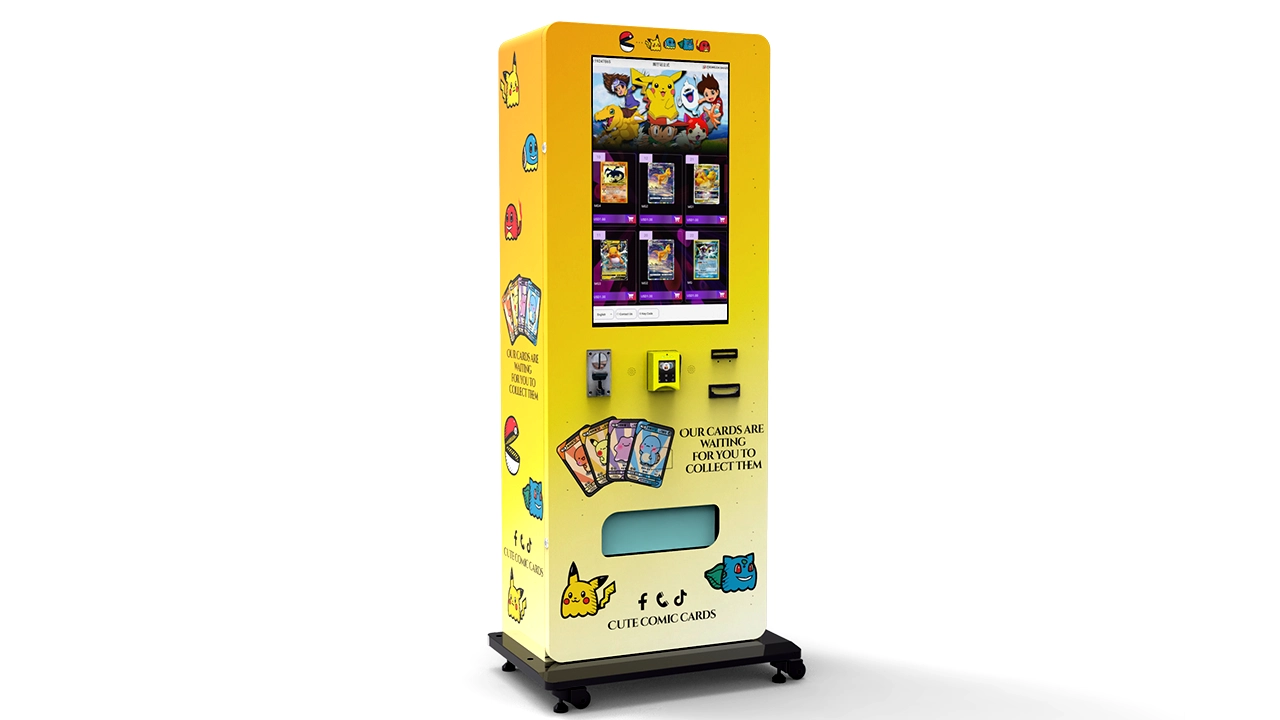
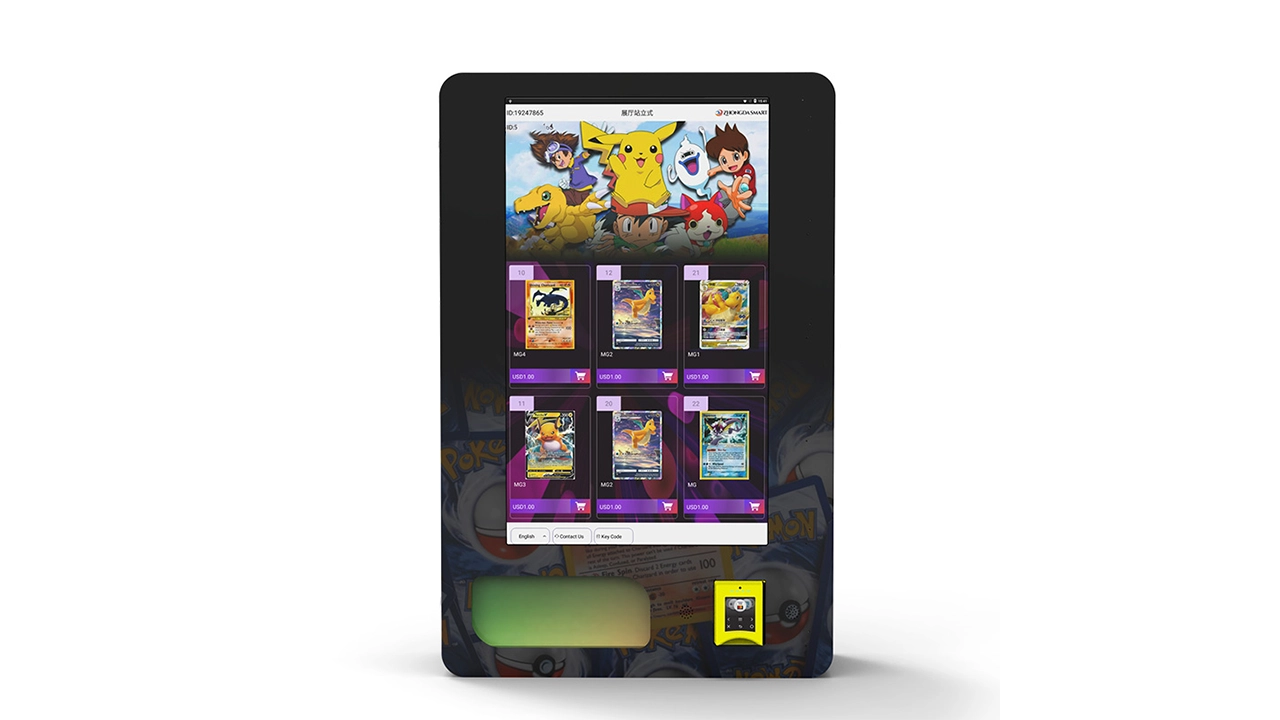
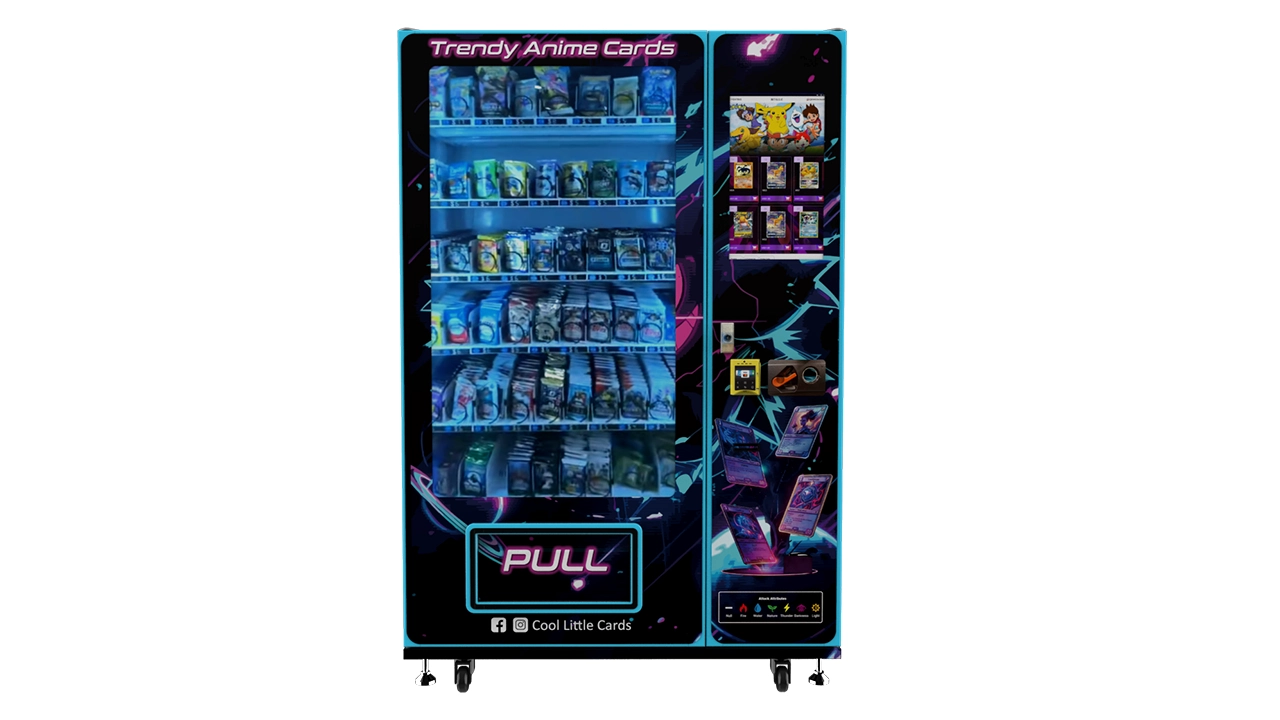
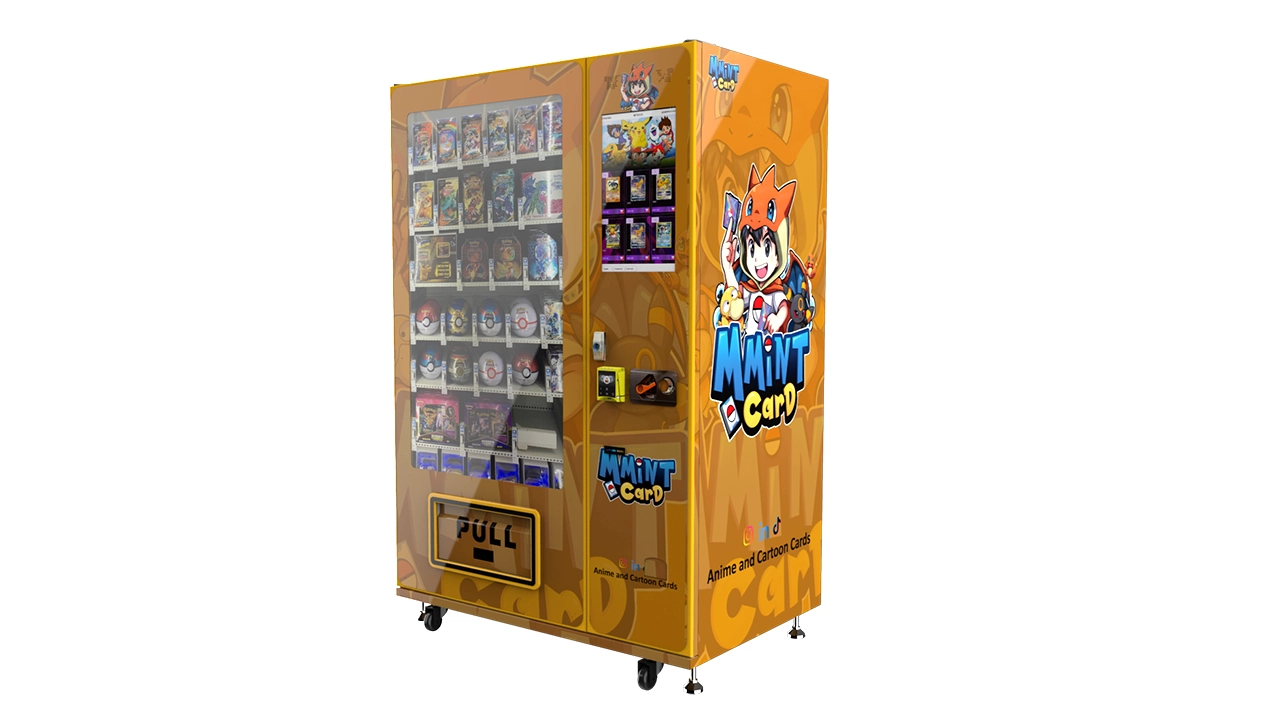
Zhongda Smart's current card-vending lineup includes an elevator-style 60-lane model, a 32-inch touchscreen model with adjustable lanes, a compact wall-mounted version and other card-focused configurations. The right comparison is not simply which machine has the lowest published factory price. Capacity, delivery method, payment requirements and service frequency all affect the eventual operating cost.
Current configurations can be reviewed on the Trading Card Vending Machines for Sale page.
Illustrative Startup Budget
| Startup Item | Illustrative Planning Amount |
|---|---|
| Machine & selected configuration | $2,500 |
| Freight / local delivery / handling | $1,000 |
| Payment setup | $400 |
| Branding & installation | $500 |
| Opening inventory | $3,000 |
| Reserve / miscellaneous | $600 |
| Total Illustrative Cash Requirement | $8,000 |
This is not a Zhongda Smart quotation. It is a planning example showing why a machine with a $2,500 equipment cost does not necessarily represent a $2,500 business launch.
The Costs Operators Commonly Underestimate
The most obvious monthly cost is merchandise, but several smaller expenses can quietly remove a meaningful part of the margin.
Payment Processing
Cashless payment makes sense for card retail because the transaction value can vary from an inexpensive booster pack to a much higher-value sealed product. The convenience comes with transaction costs.
If the blended payment cost in a planning model were 3%, $10,000 in monthly card sales would create $300 in processing expense. The actual figure depends on the provider and commercial agreement, but the principle is straightforward: payment cost rises with revenue and belongs in the unit economics.
Location Commission
A venue may charge fixed rent, a percentage of sales, or a combination of both.
At $10,000 monthly sales, a 10% revenue share equals $1,000. A 20% share equals $2,000.
The machine has not sold one extra product, yet the difference in contribution is $1,000.
Restocking Travel and Labor
One machine located near the operator's storage point may be inexpensive to service. Five machines scattered across a wide area can consume several hours and significant vehicle expense every week.
Owner labor also deserves a value. Unattended retail removes the need for a cashier at the moment of purchase; it does not remove purchasing, receiving, loading, driving, cleaning, customer service or reconciliation.
Downtime
Downtime is more than a repair invoice.
If a machine normally sells $300 per day and is unavailable for three days, as much as $900 in sales is exposed. Some buyers may return later, but others will not.
Downtime can come from payment issues, connectivity, power, dispensing problems, a damaged display or something much simpler: the best-selling products are empty.
Maintenance and Spare Parts
Commercial vending equipment combines electrical, mechanical and control components. Even a reliable machine needs a plan for troubleshooting and replacement parts.
Zhongda Smart currently states a one-year warranty on its trading card vending machines, remote technical guidance and replacement parts for qualifying warranty issues. Buyers can review the current terms on the After-Sales Service & Warranty page before placing an order.
Location Economics: Busy Is Not the Same as Profitable
A good location combines the right audience with reasonable commercial terms.
Useful questions include:
- Who actually passes the machine?
- How long do they remain in the venue?
- Is the machine in the natural path of traffic?
- Can customers stop without blocking another activity?
- What are the venue's opening hours?
- How easily can the operator restock?
- Does the agreement use fixed rent or revenue share?
- Can the machine be moved if the position underperforms?
The last point is particularly important for a first placement. A long contract built on untested sales assumptions can turn a small mistake into a recurring monthly cost.
Compare Contribution, Not Just Sales
| Metric | Location A | Location B |
|---|---|---|
| Monthly Sales | $8,000 | $11,000 |
| Venue Share | 8% | 25% |
| Venue Cost | $640 | $2,750 |
Location B generates $3,000 more revenue but gives an additional $2,110 to the venue. Whether that trade is worthwhile depends on merchandise margin and the other expenses attached to the placement.
This is why the “highest sales” location is not automatically the best location.
Card stores, malls, entertainment venues, arcades, hobby-oriented retail and event environments can all work under the right conditions. The audience, machine position and commercial agreement matter more than the category name on the building.
For a card-store-specific example, see Zhongda Smart's Trading Card Vending Machine Solution for Card Shops.
Choose the Machine Around the Merchandise
This is where equipment decisions and business decisions meet.
Two products can both be called “trading cards” and behave completely differently inside a vending machine. A loose booster pack, a sleeved blister and a premium sealed box do not have the same width, depth, weight or packaging sensitivity.
The final machine configuration should account for:
- package width, height and depth;
- product weight;
- number of SKUs;
- reserve quantity;
- product value;
- desired touchscreen size;
- payment methods;
- available wall or floor space;
- network connectivity;
- restocking frequency;
- branding requirements.
Standard Drop vs. Elevator Delivery
Standard dispensing can work for many securely packaged products. Higher-value boxes and packaging-sensitive items may benefit from a controlled delivery path.
Zhongda Smart currently lists a 60-lane card vending configuration with elevator delivery as well as more conventional touchscreen and wall-mounted models. An elevator mechanism is not automatically “better.” It is useful when the cost of protecting the product and packaging justifies the additional equipment complexity.
Large Touchscreen vs. Compact Format
A larger touchscreen gives the operator more room for product photography, pricing, instructions, bundles and promotional content. That can be useful when a machine carries many products or when customers need more information before buying.
A wall-mounted model may make more sense where floor area is expensive or the machine is extending an existing card shop's retail capacity.
Zhongda Smart's current product page lists a 32-inch touchscreen trading card machine with adjustable product lanes and connected management options. The same product category also includes a wall-mounted 32-inch model for more space-constrained placements.
Start With Your Products, Not a Generic Machine
Send Zhongda Smart the package dimensions, product photos, target capacity, preferred payment methods and available installation space. The team can review the requirements before the final machine configuration is selected.
Get a Machine Recommendation Compare Card Vending MachinesWhat Zhongda Smart Looks at Before Configuring a Card Vending Machine
When a buyer contacts Zhongda Smart about a card vending project, the most useful starting point is not a request for “the biggest machine.” It is the product itself.
The current Zhongda Smart inquiry process asks buyers to provide card or package photos, approximate dimensions, machine quantity, installation information, payment preferences and branding requirements. Those details make it possible to review the physical configuration instead of guessing from the words “trading cards.”
1. Product Dimensions
Channel layout depends on what is actually going into the machine.
A package that is several millimeters wider or thicker than expected can change the appropriate lane dimensions. Products with flexible packaging can also behave differently from rigid boxes.
For that reason, a useful machine RFQ should include the packaged product dimensions, not only the dimensions of the cards inside.
2. Product Photos
Front and side photographs help show the package shape, hanging tabs, blister construction, surface material and other details that dimensions alone may not reveal.
3. SKU Count and Reserve Capacity
A buyer selling eight high-volume products may need a different internal layout from a retailer carrying 40 products in small quantities.
More SKU variety does not automatically mean better economics. The goal is to allocate enough capacity to products that actually move.
4. Delivery Method
Product value and packaging sensitivity affect whether a conventional dispensing method or elevator-style delivery is the better fit.
5. Payment Environment
Payment requirements vary between projects. Zhongda Smart's current company information lists configurations supporting bank cards, QR payments, cash, payment codes and membership cards depending on the selected setup.
6. Connectivity and Management
Current connected configurations can support 4G or Wi-Fi and remote sales, inventory and machine-management functions. That becomes more valuable as the number of locations grows.
7. Branding and Interface
For OEM and ODM projects, cabinet graphics, colors, interface elements and selected functional configurations can be adjusted before production.
Zhongda Smart's current About page describes the company as a vending machine manufacturer founded in 2018, with a 20,000 m² manufacturing facility, 400+ employees, OEM/ODM capability and a product range that includes trading card and smart retail equipment.
Those company figures should not be interpreted as evidence that a buyer will achieve any specific financial return. They are manufacturing background. The location and retail economics remain the operator's responsibility.
A Transparent Trading Card Vending Machine Profit Model
Once the main inputs are known, a simple monthly P&L model is more useful than a generalized profit claim.
Assume one machine records:
- 20 transactions per day;
- $15 average transaction value;
- 30 operating days per month.
Gross monthly sales would be:
Now add an illustrative cost structure:
- merchandise: 62% of sales;
- location commission: 12%;
- payment processing: 3%;
- connectivity/software: $80;
- restocking transportation: $220;
- maintenance reserve: $100;
- administration: $100.
| Illustrative Monthly P&L | Amount |
|---|---|
| Gross Sales | $9,000 |
| Merchandise Cost — 62% | -$5,580 |
| Gross Merchandise Profit | $3,420 |
| Location Commission — 12% | -$1,080 |
| Payment Processing — 3% | -$270 |
| Connectivity / Software | -$80 |
| Transportation | -$220 |
| Maintenance Reserve | -$100 |
| Administration | -$100 |
| Illustrative Operating Contribution | $1,570 |
The $1,570 figure is not automatically final take-home profit. A real business may also have wages, insurance, warehouse expense, financing, accounting, tax, depreciation, refunds or additional vehicle costs.
The important part of the table is not the answer. It is that every assumption is visible and replaceable.
Operating Break-Even
Using the same illustrative assumptions, merchandise, location and payment costs equal 77% of revenue.
That leaves a 23% contribution margin before fixed operating costs.
If fixed monthly expenses are $500:
Under that scenario, the machine needs about $2,174 in monthly sales before the modeled fixed costs are covered.
Payback Period
If total startup capital is $8,000 and the machine produces an average $1,570 monthly operating contribution:
That is a mathematical illustration, not a promise of a five-month payback period.
A real project could take longer because of a slow launch, inventory changes, seasonality, tax, additional labor, downtime or weaker-than-expected sales.
ROI
If an operator invests $10,000 and eventually produces $4,000 in annual net return after every expense included in the model, the modeled ROI is 40%.
If annual net return is $8,000, modeled ROI becomes 80%.
Neither number means much unless “net return” is calculated consistently.
Stress-Test the Model
A useful forecast should also show what happens when conditions are worse than planned.
Test the expected case with:
- sales 25–30% lower;
- merchandise cost five points higher;
- a larger venue commission;
- several lost selling days;
- one additional service trip per month;
- slower inventory turnover;
- a lower average order value.
If one small change destroys the economics, the project has very little margin for error.
Operations Decide Whether a Good Location Stays Good
Once a machine is installed, the work becomes less theoretical.
Restocking Frequency
There is no ideal weekly schedule that applies to every site.
A slow machine may be serviced every week or two. A strong location can require far more frequent replenishment, especially around a new release.
The goal is not simply to minimize visits. It is to find the lowest combined cost of:
- travel;
- labor;
- excess reserve stock;
- stockouts;
- lost sales.
If an extra $20 service trip prevents hundreds of dollars in lost sales, it may be worthwhile. If the same trip is made automatically while the machine is almost full, it is wasted operating cost.
Track the Products, Not Only the Machine
Machine-level revenue is only the first layer of useful data.
Operators should also watch:
- units sold by SKU;
- gross margin by SKU;
- stockout frequency;
- average order value;
- time of sale;
- refunds;
- payment failures;
- inventory turnover;
- service visits;
- revenue per service trip.
A machine can report good overall sales while quietly wasting capital on half of its assortment.
Remote Management Becomes More Valuable With Distance
For one machine located five minutes away, remote inventory data may be a convenience. For a route covering multiple sites, it can become an operating advantage.
Knowing which machine actually needs inventory helps avoid unnecessary visits. Knowing which SKU has sold out helps the operator bring the correct stock. Machine alerts can also identify an issue before the next scheduled service day.
The value of remote management is therefore not that it sounds “smart.” It is that it can reduce information gaps between the machine and the operator.
Product Releases Need Separate Treatment
Trading card demand can be release-driven. A strong launch weekend should not automatically become the baseline for the next twelve months.
Annual planning is more realistic when sales are separated into:
- launch weeks;
- ordinary weeks;
- seasonal peaks;
- promotional periods;
- slower periods.
This also helps with inventory purchasing. A product that moves rapidly for ten days may not deserve the same reserve capacity two months later.
Scaling From One Machine to a Route
The first machine is partly a business and partly a test.
It tells the operator which assumptions were wrong.
You may discover that customers prefer lower-ticket products, the venue generates most sales on weekends, the machine needs twice-weekly restocking, a certain box shape does not dispense as efficiently as expected, or the location commission is too high for the available margin.
Those lessons are valuable before ordering ten more units.
Route Density Can Matter as Much as Machine Revenue
Imagine two five-machine routes.
Route A takes 20 total miles to service. Route B takes 130.
The machines may generate similar sales, but the second route consumes more fuel, time and vehicle capacity. It also makes emergency visits more expensive.
Once a route grows, useful measurements include:
- gross profit per stop;
- restocking minutes per stop;
- miles per service cycle;
- sales per mile;
- inventory delivered per trip;
- emergency service frequency.
Scale Does Not Fix Poor Unit Economics
If one machine loses money because merchandise and venue fees absorb nearly all gross profit, installing ten identical machines multiplies the problem.
Scale becomes interesting after the operator has a repeatable answer to four questions:
- Which locations convert?
- Which products turn quickly enough?
- What does it really cost to service the machine?
- Can the same equipment configuration be repeated efficiently?
That is also when OEM and ODM standardization can become useful. Instead of treating each order as a different machine, a multi-location operator can build around a proven channel layout, interface, branding system and payment setup.
Match the Hardware to the Operating Model
If you already know the products you plan to sell, send Zhongda Smart your package sizes, machine quantity, preferred payment setup and installation requirements. A project-based configuration can be reviewed before production.
Discuss Your Card Vending Project Learn About Zhongda SmartThe Main Risks Are Usually Not Hidden Inside the Machine
Hardware matters, but several of the largest risks begin outside the cabinet.
Poor Product Sourcing
If inventory is consistently purchased too close to the final selling price, high sales may never translate into enough gross profit.
Weak Audience Fit
A busy placement without relevant buyers can sit visibly in front of thousands of people and still produce very little.
Overpriced Location Agreements
A premium site is only valuable if enough contribution remains after rent or revenue share.
Inventory Aging
Slow merchandise consumes both cash and machine capacity. Unsold inventory also makes it harder to react when a stronger release becomes available.
Stockouts
An empty best-selling lane sends willing buyers away at exactly the moment demand is proven.
Product Damage
Condition matters in collectible retail. Product packaging and delivery method should be considered together.
Downtime
Payment, network, electrical or dispensing issues can interrupt sales. Clear support and spare-parts procedures reduce the time spent figuring out what to do next.
Overestimating Passive Income
The transaction is automated. The business is not.
Someone still manages inventory, routes, payment reconciliation, customer service, maintenance and venue relationships.
Unsupported Earnings Expectations
A seller's machine specification is not evidence of future income. Sales depend on the operator's products, prices, site, costs and execution.
The FTC's Business Opportunity guidance states that sellers making covered earnings claims need written substantiation. Historical FTC enforcement actions have also involved unsupported profit claims in vending-machine business opportunities.
That is one reason this article uses transparent hypothetical calculations rather than claiming a universal monthly income.
So, Is a Trading Card Vending Machine Business Worth It?
It is worth serious consideration when the project has more behind it than the popularity of collectibles.
The stronger cases usually have several things in place:
- reliable access to desirable sealed merchandise;
- enough gross margin to absorb venue and payment fees;
- a location with a relevant audience;
- reasonable restocking logistics;
- enough working capital to keep strong products available;
- a machine configuration that matches the packages being sold;
- clear support when the equipment needs attention;
- a downside case that is still financially acceptable.
The weaker business cases usually depend on broad statements such as “collectibles are popular,” “the mall is crowded” or “vending is passive.” None of those statements tells you whether the operator keeps enough money after the sale.
A much better investment case can be written in ordinary numbers:
We know what the products cost. We know the venue terms. We have a reasonable range for daily transactions. We know how far the location is from our inventory. We know what payment processing costs. We know how much stock the machine needs. We know what happens if sales are 30% lower than expected.
That is enough to make a decision.
A Practical Pre-Purchase Checklist
Products
- What exactly will be sold?
- What are the packaged dimensions?
- What does each SKU cost?
- What selling price is realistic?
- How quickly can successful products be replenished?
Location
- Who uses the venue?
- Where will the machine physically sit?
- What does the venue charge?
- When can the machine be serviced?
- Can the placement be moved if results are poor?
Machine
- Does the dispensing system fit every package?
- Is elevator delivery justified?
- How much real reserve capacity is needed?
- Which payment methods are required?
- Is remote inventory monitoring needed?
Finance
- What is the total landed startup cost?
- How much cash remains for inventory?
- What is monthly operating break-even?
- What does the conservative sales case look like?
- How much owner labor is involved?
Support
- What is the warranty period?
- How are replacement parts handled?
- What happens if the payment device stops working?
- Who provides remote technical guidance?
- What should be inspected immediately after delivery?
Zhongda Smart currently states a one-year warranty from customer receipt for qualifying trading card machine orders operated according to the official manual, along with remote technical support and eligible replacement-parts assistance. Current terms should always be reviewed directly before ordering because product and commercial conditions can change.
Final Takeaway
The economics of a trading card vending machine are not mysterious.
The difficult part is not the formula. It is getting realistic numbers into it.
Strong machines usually sit at the intersection of good products, a relevant location, disciplined inventory management and equipment that fits the merchandise. Weak projects tend to focus on one of those pieces while ignoring the others.
A well-configured vending machine can automate payment, expand selling hours, protect products, hold reserve inventory and give the operator remote visibility. It cannot compensate for an overpriced location or merchandise with no margin.
For that reason, the machine should usually be selected after the retail model is understood—not before.
Frequently Asked Questions
How much money can a trading card vending machine make?
There is no reliable universal figure. Revenue depends on transactions per day, average order value, product availability, pricing, location and operating hours. Profit depends on what remains after merchandise, payment processing, venue costs, service, maintenance and other expenses. A useful starting formula is transactions per day × average order value × operating days.
Are trading card vending machines profitable?
They can be profitable when the merchandise margin, site economics, sales volume and operating costs work together. A machine with high gross sales can still be weak financially if inventory cost and location commission absorb most of the revenue.
How long does a trading card vending machine take to pay for itself?
Payback can be estimated by dividing total startup investment by average monthly net operating contribution. Actual payback varies substantially, so it is safer to calculate conservative, expected and strong scenarios rather than assuming one fixed period.
What are the main startup costs?
Typical startup categories include the vending machine, payment setup, shipping, installation, branding, opening inventory, backup inventory, location deposits and working capital. The machine invoice alone does not represent the full amount of cash needed to launch.
What are the biggest monthly costs?
Merchandise is often the largest variable expense. Location commission, payment processing, service travel, labor, connectivity, maintenance, insurance and administration may also affect profitability.
What products can be sold in a trading card vending machine?
Depending on the channel layout and delivery system, a card vending machine can be configured for booster packs, blister products, sealed card boxes, sports card products, collection boxes and selected compact collectibles. Final machine selection should be based on the packaged product dimensions.
Do trading cards need an elevator vending machine?
Not always. Standard dispensing can work for many securely packaged products. Elevator delivery becomes more relevant for higher-value sealed boxes and packaging-sensitive merchandise where reducing the drop distance may help protect the product.
How should I choose a vending machine location?
Look at relevant customer traffic, visibility, dwell time, operating hours, venue fees, security and service access. Raw foot traffic alone is not enough. A smaller location with a concentrated hobby audience can outperform a much busier general location.
How often should a trading card vending machine be restocked?
Restocking frequency should follow sales velocity rather than a fixed rule. Slow locations may need infrequent service, while strong sites or new product launches can require much more frequent replenishment. Remote inventory data can help reduce unnecessary trips and stockouts.
What information should I send Zhongda Smart before requesting a machine quote?
Send product or package photos, approximate dimensions, the products you plan to sell, expected machine quantity, target installation environment, preferred payment methods and any OEM or branding requirements. These details help match the channel, capacity and delivery configuration to the project.
Does Zhongda Smart provide after-sales support?
Zhongda Smart's current published policy lists a one-year warranty for trading card vending machines, remote technical guidance and free replacement parts for qualifying quality issues during the warranty period. Buyers should review the current warranty terms before ordering.
Sources & Reference Notes
The financial tables in this guide are illustrative planning models. They are not published averages, customer income records or guaranteed returns.
-
Federal Trade Commission — Business Opportunity Rule Guidance
Selling a Work-at-Home or Other Business Opportunity? Revised Rule May Apply to You -
Federal Trade Commission — Vending Business Opportunity Enforcement
Business Opportunity Marketers Settle with FTC -
Zhongda Smart — Trading Card Vending Machines
Current trading card vending machine configurations and published specifications -
Zhongda Smart — Manufacturer Information
Company manufacturing background, OEM/ODM capability and card-vending product information -
Zhongda Smart — After-Sales & Warranty
Current warranty, remote technical support and replacement-parts policy