When collectible card demand rises faster than available inventory, a trading card vending machine can become an easy target for bulk buyers and resellers. A properly configured pokemon vending machine purchase limit helps protect everyday collectors, distribute scarce products more fairly, and keep an automated retail business attractive over the long term. The right solution is not simply restricting every customer to one pack. It combines per-customer limits, payment identification, inventory release schedules, transaction monitoring, and clear customer communication. For independent operators, these controls should be built into the vending software rather than left to customers to follow voluntarily. Here is how I would approach the design, configuration, and management of a fair card vending operation.
The practical recommendation
Start with a per-transaction limit, add a persistent customer identifier for high-demand products, use staggered inventory releases when supply is tight, and make every restriction visible before payment. Review the results using actual sales and customer data rather than assuming that the strictest possible limit is automatically the fairest one.
Why Purchase Limits Matter in Trading Card Vending
Trading cards are not ordinary vending products. Their appeal comes from a combination of collecting, gameplay, rarity, nostalgia, community participation, and the excitement of opening a sealed pack. The value of a particular release can also change quickly as collectors respond to new sets, popular characters, competitive developments, and limited promotional products.
These characteristics create a retail challenge. A machine may have enough inventory to serve dozens of customers, but a small number of buyers can purchase most of the available stock before other people have a reasonable opportunity to complete a transaction.
Without an effective purchasing policy, a machine can become a convenient wholesale source for resellers instead of a retail service for individual collectors. The problem becomes more noticeable when a new product attracts substantial attention or when the supply of a particular release is temporarily restricted.
I would not treat this as a problem that can be solved by displaying a warning on the touchscreen. A customer can ignore a warning. A vending system must be able to recognize the applicable limit, calculate the remaining allowance, and prevent an order that exceeds the published rule.
The business consequences of unrestricted bulk purchasing
Unrestricted buying can create several problems that extend beyond a product selling out quickly.
- Unequal access: Customers who arrive later may find that an entire product selection has already been purchased by a small number of buyers.
- Reduced customer confidence: Collectors may stop checking the machine if they repeatedly encounter empty selections.
- Higher operational pressure: Rapid sellouts create additional restocking requirements and can make demand difficult to forecast.
- Lower product variety: When a few products dominate purchasing activity, other merchandise may receive less attention.
- Venue complaints: Long queues, repeated visits, and disputes around a machine can make the installation less attractive to the property hosting it.
- Unstable customer relationships: A business known mainly for selling out to bulk buyers may struggle to build a loyal collector base.
There is also a less obvious financial problem. A machine that sells out extremely quickly does not necessarily generate the best long-term result. If the same small group purchases most of the available products, the operator may lose opportunities to develop repeat customers who would otherwise return for future releases, accessories, and other products.
For this reason, I see a purchase limit as a customer allocation tool, not merely an anti-reseller setting. Its purpose is to distribute limited inventory while preserving a commercially sustainable sales process.
Fair access does not mean identical purchasing behavior
A serious collector may reasonably want several packs. A parent may purchase products for more than one family member. Another customer may only want one item. These buying patterns are not automatically suspicious.
The objective should be to prevent disproportionate purchasing, not to make every transaction identical. A sensible policy leaves room for ordinary customer behavior while preventing one identifiable buyer from repeatedly exhausting the same limited selection.
Understanding Official Pokémon Vending Machine Rules
Before designing an independent trading card vending operation, it is important to distinguish official Pokémon Automated Retail equipment from independently manufactured vending machines that sell compatible Pokémon TCG products.
The Pokémon Company International operates its own automated retail program. Its official support FAQ explains that the machines are owned and operated by the company and that there are currently no plans to sell those machines to independent buyers.
The same FAQ explains that restocking does not follow a fixed public schedule. Restocking decisions depend on product stock and individual machine inventory requirements. The FAQ also explains that machine-related problems should be directed to the official support team rather than store employees.
One important detail deserves attention: the official support FAQ does not publish a universal numerical purchase limit or describe a complete customer-identification mechanism. Operators should not assume that a particular limit, reset period, or payment-card rule applies to every official machine.
This distinction matters when someone asks about a pokemon vending machine purchase limit. Information about an official retail program should not automatically be treated as a specification for independently owned equipment.
Official equipment versus independent trading card machines
| Comparison | Official Pokémon Automated Retail | Independent TCG Vending |
|---|---|---|
| Ownership | Operated by The Pokémon Company International | Owned by the independent operator |
| Machine procurement | Not offered for independent purchase under the current official FAQ | Available through commercial vending machine manufacturers |
| Product selection | Managed through the official program | Selected by the independent operator |
| Purchase limits | Specific universal numerical rules are not stated in the support FAQ | Can be specified and configured according to available software |
| Branding | Controlled by the official program | Independent branding, subject to trademark rights |
| Inventory management | Managed by the official operator | Managed by the machine owner |
An independent operator has an important advantage: purchasing rules can be designed around the actual merchandise, inventory volume, customer behavior, and business objectives.
However, that flexibility also creates responsibility. The machine owner must establish the rules, communicate them clearly, and ensure that the vending software applies them consistently.
For a more detailed distinction between official equipment and independently operated card vending systems, see the Pokémon vending machine information guide.
Four Types of Purchase Limits
Not every purchasing restriction solves the same problem. A transaction cap, a customer-level limit, a product-category limit, and a scheduled inventory release operate differently. Combining them is generally more effective than relying on a single restriction.
1. Per-transaction purchase limits
A per-transaction limit controls the number of units a customer can purchase in one checkout session.
For example, a machine might allow a maximum of three booster packs in a single transaction. If a customer selects four, the screen should explain that the quantity exceeds the permitted amount and allow the buyer to adjust the order before payment.
This is the easiest restriction to implement because it does not require the machine to recognize individual customers. The system only needs to count the products selected in the current order.
However, it has a significant weakness. A customer can complete one transaction, return to the home screen, and start another. A per-transaction cap alone cannot prevent repeated purchases.
2. Per-customer purchase limits
A per-customer limit controls the total number of products an identified buyer can purchase during a specified period.
For example, a customer might be permitted to purchase two units of a particular release within a rolling 24-hour period. Completing another transaction does not automatically reset the allowance.
This is much more useful for products with limited inventory. It requires a persistent identifier, such as a registered customer account, membership QR code, RFID credential, or a payment reference supplied by the payment provider.
The important word is persistent. The purchase history must remain available after a screen refresh, software restart, or temporary connection failure.
3. Per-product and product-family limits
A product-level restriction applies to a particular SKU. A product-family restriction applies to several related products that should be treated as one purchasing category.
Consider a new trading card release with three different packaging options. If the operator sets a separate limit of two units for every SKU, a customer may be able to purchase six units by selecting all three variations.
That may defeat the purpose of the restriction.
A product-family rule can solve the problem by grouping related products under one release identifier. The machine then counts all eligible purchases within that group.
4. Scheduled inventory release limits
Scheduled inventory release controls when products become available rather than only how many units a customer may purchase.
Instead of offering every available pack immediately, the system can divide the inventory into several release periods. This reduces the advantage of arriving at the machine at one specific moment and allows more buyers to access products throughout the selling period.
It is particularly useful when a product is scarce but customer demand remains strong throughout the day.
Comparison of the four methods
| Method | Primary Purpose | Complexity | Best Application |
|---|---|---|---|
| Per transaction | Stop large single orders | Low | Everyday products |
| Per customer | Restrict repeated purchases | Medium to high | Scarce releases |
| Per product family | Prevent limit avoidance across similar SKUs | Medium | Multiple versions of one release |
| Scheduled release | Distribute inventory over time | Medium to high | High-demand launches |
My preferred arrangement is to combine the first three methods for limited products and introduce scheduled releases when inventory is especially constrained. The exact configuration should reflect the machine's capabilities and the operator's ability to manage customer identification.
How Many Trading Card Packs Should One Customer Buy?
There is no universal purchase limit that works for every trading card product. A low-cost booster pack, a premium collector box, a graded card, and a limited-edition mystery product have different values and different inventory requirements.
A limit that is appropriate for one product can be unnecessarily restrictive for another. I would therefore classify inventory before deciding how many units a buyer can purchase.
A practical starting policy
The following figures are proposed starting settings for an independent operator. They are not official Pokémon rules or mandatory industry standards. They should be adjusted after reviewing actual sales activity, available inventory, and customer feedback.
| Product Category | Suggested Starting Limit | Suggested Period | Reason |
|---|---|---|---|
| Regular booster packs | 4 units | Per customer per day | Allows ordinary collecting while discouraging repeated bulk purchases |
| Highly demanded new packs | 2 units | Per customer per 24 hours | Distributes limited launch inventory |
| Premium sealed boxes | 1 unit | Per customer per release | Prevents one buyer from absorbing scarce premium stock |
| Mystery card packs | 2 units | Per customer per day | Balances repeat purchases and product availability |
| Card accessories | 5 units | Per transaction | Usually does not require strict scarcity controls |
| Graded collectible cards | 1 unit | Per transaction or release | Higher item value and inventory risk |
These figures are best understood as a starting framework rather than a fixed formula. If an operator has a large inventory of regular booster packs and a reliable replenishment process, a four-pack limit may be unnecessarily restrictive. If only a small number of premium boxes are available, a one-unit limit may be more appropriate.
Use inventory coverage to adjust the limit
One useful method is to calculate how many selling days the available stock can support.
Inventory coverage = Available saleable units ÷ Average daily demand
For example, suppose a machine has 120 booster packs available and its recent average demand is 30 packs per day. The inventory coverage is four days.
If a new release is expected to generate demand of 80 packs per day, the same 120 units represent only 1.5 days of inventory. That is a much stronger reason to introduce a temporary purchasing restriction.
I would use three broad operating categories:
- Healthy inventory: Supply comfortably covers expected demand. Use a light transaction cap or no customer-level restriction.
- Limited inventory: Demand is approaching available supply. Apply a per-customer daily allowance.
- Critical inventory: Expected demand substantially exceeds supply. Use a stricter release-specific cap and staggered inventory release.
This approach makes the purchasing policy responsive to business conditions instead of relying on an arbitrary number that remains unchanged throughout the year.
How to Identify Repeat Buyers Without Creating Unnecessary Friction
A customer-level purchase restriction is only effective if the vending system can recognize the same buyer across multiple transactions.
This is one of the most important technical decisions in a card vending machine project. A touchscreen can easily count how many packs someone selects, but recognizing that buyer again requires information that persists beyond the current session.
Option 1: Membership QR codes
A membership QR code is one of the most practical approaches for operators who want to introduce customer-level purchasing rules without requiring customers to enter extensive personal information.
The customer scans a membership code before selecting a restricted product. The vending system retrieves the account identifier and checks its purchase history.
If the customer has already purchased the permitted quantity, the machine displays the remaining allowance or explains that the limit has been reached.
The advantages include:
- Consistent customer identification across different transactions.
- Support for purchase limits across several product categories.
- Possibility of connecting purchases with a loyalty program.
- Less dependence on manual staff intervention.
- Ability to apply different rules to different product releases.
The main disadvantage is the extra step. A buyer who wants to make a quick purchase may not want to register an account or open a mobile application.
For that reason, I would reserve mandatory account identification for limited products rather than requiring registration for every ordinary transaction.
Option 2: Payment-card identification
Payment-card identification can make repeat-purchase control more convenient because the buyer is already using a payment method to complete the transaction.
The important technical detail is that a vending machine should not simply assume it can access the actual payment-card number. Payment terminals and processors handle sensitive payment information. The machine may receive a permitted transaction reference or token, depending on the payment integration.
Before relying on this method, ask the payment provider whether the same stable reference is available across repeat purchases and whether mobile wallets generate identifiers that behave differently from physical cards.
For example, a customer might use a physical card for the first purchase and a mobile wallet for the second. The two payment references may not be identical even though the underlying account belongs to the same person.
Payment-card identification is therefore useful, but it should not be presented as perfect proof of individual identity.
Option 3: RFID membership cards
RFID cards provide another option for machines installed in environments where a membership or access card is already part of the customer experience.
The buyer presents the card to a reader, and the vending software checks the associated account before approving a restricted purchase.
This can be particularly useful for repeat customers because the identification process is quick and does not require typing an email address or searching through a mobile application.
However, operators should consider the cost of issuing cards, replacing lost credentials, and maintaining account records. An RFID card is also transferable unless the operator introduces additional verification.
Option 4: Customer accounts and app-based identification
A mobile application can combine purchase history, customer rewards, product notifications, and purchase restrictions in one interface.
It can also support multiple machine installations under one management platform. A customer who buys a limited release from one machine may have the remaining allowance automatically updated before attempting another purchase from a connected machine.
The disadvantage is development and maintenance cost. An application makes sense when the operator is building a broader customer relationship, but it may be excessive for a single machine selling a small number of products.
Comparison of identification methods
| Identification Method | Convenience | Cross-Transaction Control | Main Consideration |
|---|---|---|---|
| Membership QR | High | Strong when consistently scanned | Account sharing and registration friction |
| Payment token | Very high | Depends on processor support | Token consistency and wallet behavior |
| RFID card | High | Strong for registered credentials | Card sharing and issuance costs |
| Mobile account | Medium to high | Strong across connected machines | Development and account management |
My recommendation is to begin with the least intrusive identification method that provides reliable purchasing control. For a new independent vending project, membership QR identification combined with a payment-provider-supported transaction reference is worth evaluating.
A pokemon vending machine purchase limit should not require excessive personal information when a less intrusive method can achieve the same business objective.
Preventing Scalping Through Staggered Inventory Releases
Purchase limits are useful, but they do not completely solve the problem of scarce inventory. If every available pack becomes purchasable at exactly the same time, customers who arrive first still have a substantial advantage.
Staggered inventory release is a way to make limited inventory available in several planned stages.
How scheduled inventory release works
Imagine an independent machine that receives 100 packs of a popular new release.
Instead of making all 100 packs available immediately, the operator could configure an illustrative release schedule:
| Release Stage | Allocated Stock | Purpose |
|---|---|---|
| Initial release | 50 packs | Serve the first group of customers |
| Second release | 25 packs | Create another purchasing opportunity |
| Final release | 25 packs | Maintain availability for later buyers |
| Total | 100 packs | Complete inventory allocation |
The schedule is an example, not a universal recommendation. The timing could be hourly, daily, or tied to another operational event.
The important point is that the system controls how much stock is available for sale during each period.
Why staggered releases can improve customer access
First, they reduce the benefit of buying everything during the first few minutes of a release. Second, they give customers who cannot arrive immediately another opportunity. Third, they provide operators with greater control over how quickly inventory moves through the machine.
Staggered releases can also reduce the pressure created by public restock announcements. Operators do not need to make every unit available immediately after loading the machine.
However, there is an important customer-service consideration. A screen that says an item is sold out while stock remains inside the cabinet can create confusion.
If the machine uses scheduled releases, the interface should explain that additional inventory may become available during a later release period. It should not suggest that the product is physically unavailable when the actual situation is that sales are temporarily paused.
How to select a release schedule
I would consider four factors:
- Expected demand: Estimate how many units customers are likely to purchase during each selling period.
- Available inventory: Avoid reserving more stock for future periods than the machine can reliably protect.
- Restocking frequency: Coordinate release stages with the operator's actual ability to replenish inventory.
- Customer expectations: Explain the schedule clearly so that buyers understand when another opportunity may become available.
A schedule should never become an excuse for poor inventory management. If a machine repeatedly promises another release but receives no additional products, customer confidence will decline.
How Vending Software Should Enforce Purchase Limits
The strongest purchase policy is one that the software can execute consistently without relying on the operator to monitor every transaction manually.
For this reason, I would discuss the purchasing logic before ordering a trading card vending machine, not after the equipment has already been installed.
The recommended purchase workflow
- Customer identification: The buyer scans a membership code or uses another supported identification method when required.
- Product selection: The customer chooses the desired card product from the touchscreen.
- Limit verification: The software checks the per-transaction, per-customer, and product-family rules.
- Allowance display: The interface shows how many units the customer can still purchase.
- Inventory reservation: The system temporarily reserves the requested quantity to prevent another session from purchasing the same units simultaneously.
- Payment authorization: The payment terminal processes the order.
- Product dispensing: The machine activates the appropriate dispensing mechanism.
- Vend confirmation: Sensors or other supported confirmation methods verify whether the product was delivered successfully.
- Transaction completion: The system records the purchase against the customer's applicable allowance.
- Inventory update: The machine updates available stock and sends the latest information to the management platform.
This sequence is important because payment, inventory, and customer-limit records must remain synchronized.
Preventing duplicate purchases during simultaneous sessions
Suppose a customer has an allowance of two packs and starts two purchase sessions almost simultaneously. If both sessions check the purchase history before either transaction is recorded, both might believe that two units remain available.
The customer could therefore purchase four units despite a two-unit restriction.
This is a software concurrency problem. The machine should reserve the customer's available allowance before accepting the next order.
A practical implementation uses a transaction-level reservation or another atomic control mechanism. The system should not allow two independent sessions to consume the same remaining allowance.
Purchase limits must survive restarts
A limit that disappears after a machine restart is not a reliable limit.
Customer purchase history should be stored in persistent records, with transaction identifiers, product identifiers, timestamps, and the relevant rule version.
When the machine reconnects after an interruption, it should retrieve the latest valid information rather than assuming that every customer's allowance has reset.
For multi-machine operations, the system should also synchronize purchase records across connected machines. Otherwise, a buyer may reach the limit on one cabinet and then purchase the same restricted product from another cabinet using the same account.
Handling payment failures and unsuccessful dispensing
One of the most important requirements is that a failed purchase should not unfairly consume a customer's purchasing allowance.
Consider a transaction in which payment is approved but the vending mechanism fails to deliver the selected pack. The software must be able to identify the failed vend and initiate the appropriate refund, reversal, or support process.
The customer's allowance should be restored when the transaction is confirmed as unsuccessful under the operator's transaction policy.
The opposite problem also matters. If the product is successfully dispensed but the system fails to record the purchase, a customer may be able to repeat the transaction.
To reduce these problems, the system should support:
- Unique transaction identifiers.
- Duplicate-request protection.
- Persistent inventory reservations.
- Payment and dispensing status synchronization.
- Automatic recovery after temporary connection loss.
- Clear refund and failed-vend records.
- Administrative logs for manually adjusted transactions.
What the operator should see in the management dashboard
The machine owner should be able to review more than the total number of units sold.
A useful dashboard should show:
- Purchases by product and SKU.
- Units purchased by customer identifier where permitted.
- Remaining purchase allowance.
- Rejected purchases caused by exceeded limits.
- Inventory available for immediate sale.
- Inventory reserved for future release periods.
- Failed transactions and refunds.
- Payment processing status.
- Machine connectivity and operating condition.
- Manual changes to purchase restrictions.
For a multi-machine business, the ability to review these records centrally is particularly important. A purchase limit should apply consistently across the relevant machines rather than being independently calculated by each cabinet.
When evaluating a pokemon vending machine purchase limit feature, ask the manufacturer to demonstrate these functions with real test transactions. A simple settings page showing a quantity field does not prove that cross-session purchasing restrictions work correctly.
Balancing Fair Sales With Customer Satisfaction
A purchase limit can prevent one customer from buying too much, but an overly restrictive policy can also discourage legitimate buyers.
This is where operators need to distinguish between fair access and unnecessary purchasing friction.
For example, a collector may want to purchase three different booster products in one visit. If the machine applies one combined limit across every product, the customer may be prevented from buying a reasonable assortment even though each product has sufficient inventory.
A better approach is to define which products share a restriction and which should have independent allowances.
Make the purchasing policy visible before checkout
Customers should not discover a purchasing restriction only after selecting products and entering payment information.
The machine should display the relevant policy on the product page and, where appropriate, before the customer enters a restricted purchasing session.
A useful notice might read:
Purchase Limit
Maximum 2 units per customer for this release within a rolling 24-hour period. The limit applies across all products included in this release. Your remaining allowance will be displayed before payment.
This is much more useful than a vague statement such as "Limited quantity available."
Explain why a limit exists
Customers are more likely to accept a restriction when they understand its purpose.
Simple language works best:
- To give more collectors an opportunity to purchase limited products.
- To reduce bulk purchasing during high-demand releases.
- To distribute available stock over a longer selling period.
- To maintain consistent purchasing rules for everyone.
There is no need to make accusations against customers or imply that every buyer purchasing several packs is a reseller.
Provide a clear customer-support process
An unattended machine cannot resolve every unusual purchasing situation automatically.
Customers should have a practical way to report:
- A payment that was processed without successful dispensing.
- An incorrect purchase-limit message.
- A transaction that appears more than once.
- A product that was charged at the wrong price.
- A customer account that shows an incorrect remaining allowance.
The support process should identify the machine, transaction reference, product, and approximate transaction time. This allows the operator to investigate without requesting unnecessary sensitive information.
For an independent trading card vending business, a clear refund and support policy is just as important as the purchase restriction itself.
Recognizing and Reducing Common Scalping Behaviors
Scalping usually involves purchasing products in quantities that are disproportionate to ordinary retail demand and then reselling them at a higher price. A vending machine cannot determine a buyer's ultimate intentions with complete certainty, so the operator should focus on measurable purchasing behavior rather than trying to label individual customers.
Common purchasing patterns that deserve attention
Repeated transactions within a short period. A customer may complete the maximum permitted purchase several times within a few minutes. A per-customer daily limit can help address this pattern.
Repeated purchases of the same release through different product selections. A customer may purchase multiple variants that belong to the same release. Product-family limits can prevent the restriction from being bypassed through SKU selection.
Unusually concentrated purchasing activity. A small number of customer identifiers may account for a disproportionate share of the available stock. Operators can monitor this pattern without automatically treating every high-volume buyer as a scalper.
Repeated failed or abandoned transactions. Some activity may indicate payment testing, software errors, or attempts to exploit transaction timing. These events should be investigated through transaction logs rather than treated as conclusive evidence of misconduct.
Use graduated controls instead of automatic punishment
I would avoid permanently blocking an account simply because it reaches a purchase limit. Reaching the published limit is normal behavior, not proof of abuse.
A more reasonable control structure is:
- Display a clear message when the customer reaches the permitted quantity.
- Prevent additional restricted purchases during the applicable period.
- Record repeated attempts for operational analysis.
- Flag unusual patterns for review when there is independent evidence of misuse.
- Allow customers to contact support if they believe the restriction was applied incorrectly.
This protects the machine without creating a hostile experience for ordinary collectors.
Physical security still matters
Software limits are not a substitute for a secure cabinet, protected payment terminal, and reliable dispensing mechanism.
A machine should be installed with appropriate physical protection, controlled service access, and a clear process for reporting tampering.
Operators should also monitor unusual machine restarts, repeated service-door openings, and unexpected dispensing activity where the equipment supports those records.
The objective is to make purchasing rules and physical controls work together. A machine that has excellent software but weak physical security can still suffer inventory losses.
Payment Security, Privacy, and Customer Transparency
Purchase-limit systems often require some form of customer recognition. That does not mean operators should collect every possible piece of personal information.
The best approach is to collect only what is reasonably necessary to operate the purchasing policy and protect the transaction.
Use payment tokens instead of storing raw card details
When payment-card references are used for purchase-limit enforcement, the payment integration should follow the processor's supported tokenization and security requirements.
Operators should not store full payment-card numbers, security codes, or other sensitive payment information simply because they want to recognize repeat buyers.
A stable token or permitted payment reference may be sufficient for the intended purpose. The payment provider should confirm exactly what information can be used and how long it remains valid.
Be cautious with facial recognition and unnecessary surveillance
Facial recognition may appear attractive as a way to prevent one person from using several payment methods, but it introduces significant privacy, security, and compliance concerns.
For most independent card vending projects, I would evaluate QR membership, RFID, or payment-token identification before considering biometric technology.
There is an important distinction between counting general customer traffic and identifying individuals. The official Pokémon Automated Retail FAQ explains that its devices use camera equipment to count people passing in front of the machine and that the devices do not store or transmit video.
This is a useful reminder that machine analytics do not automatically require identifying customers.
Publish a clear privacy notice
Customers should understand:
- What information the machine collects.
- Why the information is needed.
- How it is used to apply purchasing restrictions.
- Whether purchase records are connected to a membership account.
- How long relevant records are retained.
- How customers can contact the operator about privacy questions.
The actual notice should match the machine's technical configuration. Do not promise that information is anonymous if the system connects purchases to a registered customer account.
Make the limit understandable and predictable
Transparency also applies to the purchasing period.
A daily limit could reset at a fixed time or operate on a rolling 24-hour basis. These are different rules. If the screen simply says "two per day," customers may reasonably interpret that in several ways.
For a rolling period, explain that the allowance becomes available again 24 hours after the applicable purchase. For a fixed daily period, show the reset time clearly.
Clarity reduces unnecessary disputes and makes the machine easier to use.
Choosing the Right Machine Hardware for Fair Sales
Software determines who can purchase a product, but hardware determines whether the machine can deliver that product reliably.
For trading card merchandise, the dispensing system deserves particular attention. Booster packs are often lightweight and flexible, while sealed boxes can have different dimensions and higher merchandise values.
A conventional vending mechanism designed for cans or snack packages may not be appropriate for every card product.
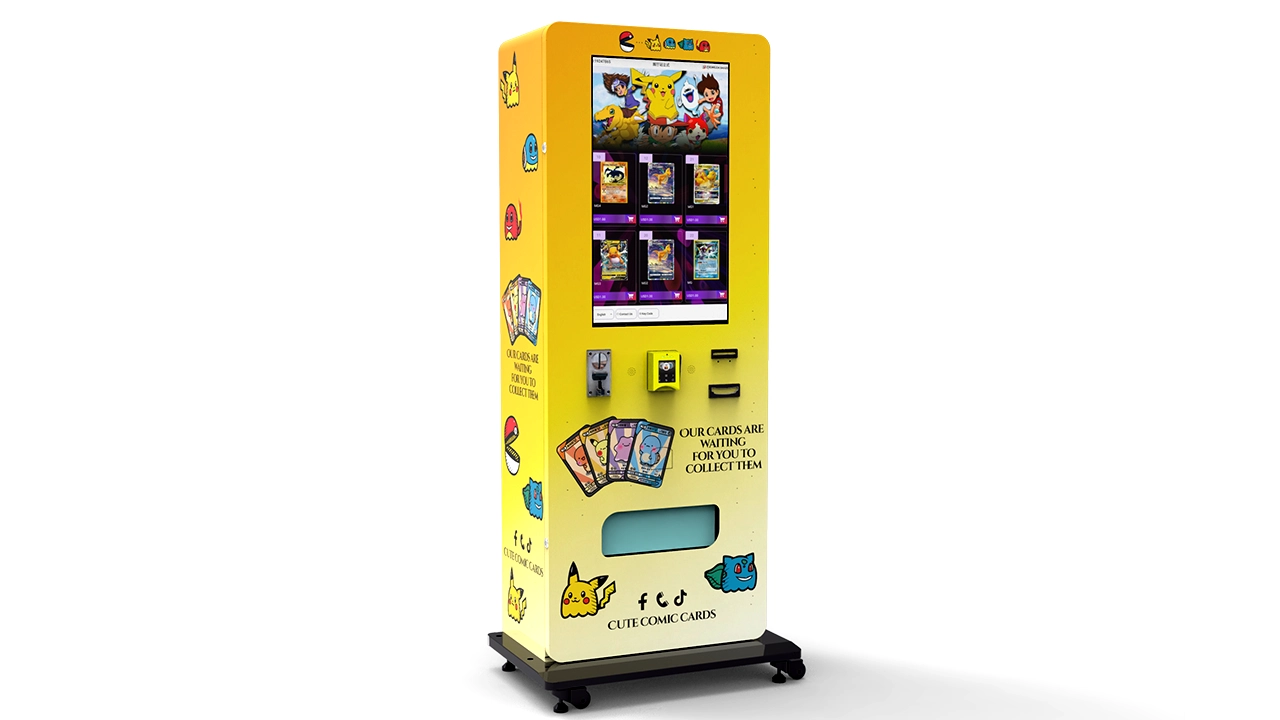
Adjustable cargo lanes
Adjustable lanes allow the internal storage configuration to accommodate different package sizes.
This is important because a vending operator may want to sell individual booster packs, blister packs, collection boxes, and other packaged products through one machine.
Before purchasing equipment, prepare a list of the actual products and measure their width, height, depth, weight, and packaging characteristics.
Ask the manufacturer to confirm that the selected dispensing system is compatible with those products. Do not assume that every card product will fit simply because the machine is advertised as suitable for trading cards.
Elevator delivery for premium products
An elevator delivery mechanism moves products toward the collection compartment rather than relying on a long free fall.
This can reduce impact during dispensing and is worth considering for sealed boxes, premium collectible products, and merchandise whose outer packaging should remain in excellent condition.
It also provides a more controlled delivery experience for certain product formats.
Touchscreen controls
The touchscreen is where customers interact with the purchasing policy.
A good interface should make it easy to:
- View product images and descriptions.
- Check prices before payment.
- See applicable purchase restrictions.
- Understand remaining purchase allowances.
- Review available payment methods.
- Receive clear information when a product is unavailable.
The screen should not hide important restrictions behind several menus. A customer should know the applicable limit before committing to the purchase.
Remote inventory and machine monitoring
Remote management is valuable because a machine operator cannot reasonably inspect every cabinet after each transaction.
A connected management platform can provide sales information, stock levels, and machine status. It can also help the operator identify which products need replenishment and which machines require attention.
For a multi-machine operation, centralized monitoring is particularly useful because the same purchasing policy can be managed consistently across the fleet.
Hardware requirements at a glance
| Feature | Operational Benefit | What to Verify |
|---|---|---|
| Adjustable lanes | Supports different card package formats | Actual sample-product compatibility |
| Elevator delivery | Reduces dispensing impact | Delivery testing with premium products |
| Touchscreen | Displays limits and product information | Clear purchase-limit interface |
| Cashless payment | Supports convenient checkout | Processor compatibility and transaction references |
| Remote management | Improves inventory visibility | Sales, stock, logs, and connectivity |
| Secure cabinet | Protects inventory and payment hardware | Service access and physical protection |
More technical details are available in the Trading Card Vending Machine Buying Guide.
Inventory Planning for Limited and High-Demand Products
Even the best purchase restriction cannot create inventory that the operator does not have. Inventory planning must therefore be considered part of the anti-scalping strategy.
The goal is to maintain a product assortment that supports regular sales while reserving enough flexibility to respond to demand spikes.
Build the assortment around different purchasing needs
I would avoid filling an entire machine with one highly popular release. That creates unnecessary dependence on a single product and makes the machine vulnerable to stockouts.
A more balanced assortment might include:
- Regular sealed booster packs.
- New-release products with temporary purchase restrictions.
- Starter products for customers entering a trading card game.
- Sealed card boxes in compatible dimensions.
- Selected collectible products.
- Graded cards where the delivery system offers suitable protection.
- Accessories such as sleeves and top loaders.
- Rotating products that keep the assortment fresh.
The exact product mix should reflect customer demand, inventory costs, available machine capacity, and replenishment frequency.
Use separate rules for different inventory groups
Not every item needs a strict purchase cap. Regular accessories and products with healthy supply may be sold with a simple per-transaction limit.
Scarce new releases can have a lower customer-level allowance. Premium boxes may require a one-unit limit. Selected high-value products may also need additional verification before dispensing.
This makes the overall system easier to understand because customers encounter restrictions only where they are justified.
Monitor stock turnover rather than relying on visual popularity
A product that attracts attention is not necessarily the product that produces the best inventory return.
Operators should compare sales volume, gross margin, stock coverage, and replenishment costs for each SKU.
For example, a machine may sell a limited booster pack quickly but earn more predictable monthly contribution from regular products and accessories.
A balanced assortment can reduce dependence on short-lived demand spikes and help the business remain commercially stable between major releases.
For a more detailed approach to assortment planning, see the Trading Card Vending Machine Inventory Guide.
Use remote stock information to plan replenishment
When the machine reports stock levels remotely, operators can prioritize products that are selling quickly instead of making unnecessary visits to check every selection.
Restocking decisions should be based on remaining stock, expected demand, and the next planned replenishment opportunity.
Purchase-limit data can also improve forecasting. If a product repeatedly reaches its customer cap but remains available for several days, the operator may be able to adjust the limit slightly without creating an inventory shortage.
If a product sells out despite a low cap, the issue may be supply rather than purchasing behavior. In that situation, changing the cap alone is unlikely to solve the problem.
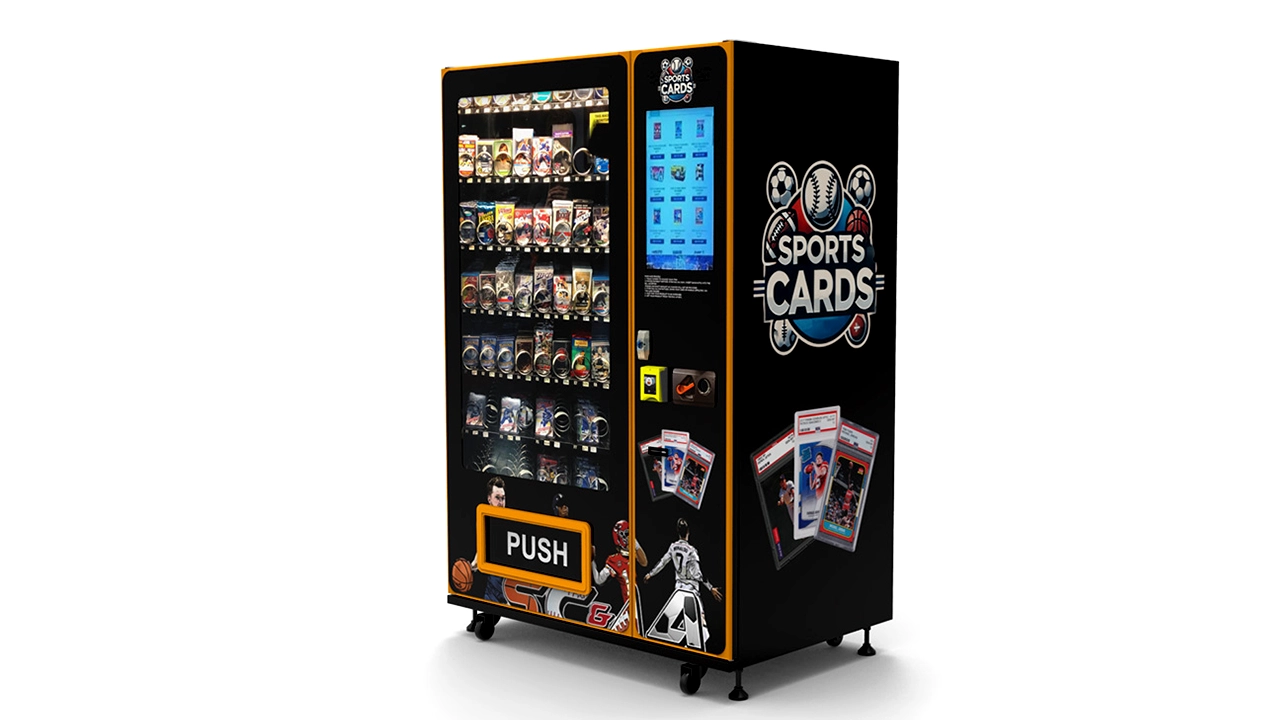
The Numbers Operators Should Monitor
A purchase policy should be evaluated through measurable operating results. Otherwise, it is easy to assume that a strict limit is working simply because fewer units are being sold to each customer.
I would focus on a small set of performance indicators that connect customer access, machine availability, and financial results.
1. Purchase-limit rejection rate
This measures how frequently customers attempt to purchase more units than the applicable rule allows.
Formula:
Purchase-limit rejection rate = Rejected purchase attempts ÷ Total purchase attempts × 100%
A high rejection rate may indicate strong demand, an overly restrictive policy, repeated attempts to bypass the rule, or a misunderstanding of the purchasing interface.
The number alone does not identify the cause. It should be reviewed alongside completed transactions and customer support records.
2. Unique customer reach
This metric estimates how many distinct customer identifiers successfully purchase a product during a specified period.
Formula:
Unique customer reach = Number of distinct purchasing identifiers during the reporting period.
Compare this number before and after introducing a customer-level restriction. If the total quantity sold stays similar but the number of unique buyers increases, the policy may be distributing inventory more broadly.
Remember that one identifier does not necessarily equal one individual. Accounts can be shared, and customers can use multiple credentials. Treat this metric as an operational indicator rather than a perfect headcount.
3. Inventory concentration
This measures how much of a product's available inventory is purchased by the most active customer identifiers.
Formula:
Top-customer concentration = Units purchased by the highest-volume customer group ÷ Total units sold × 100%
For example, if the top 10% of customer identifiers purchase 55% of the available packs, inventory is heavily concentrated.
That does not automatically prove scalping. It does indicate that the operator should examine purchasing patterns and consider whether the current limits are appropriate.
4. Product availability rate
Availability measures how much of the planned selling period a product remains available for purchase.
Formula:
Product availability rate = Time product is available for purchase ÷ Total scheduled selling time × 100%
For products using scheduled inventory release, the operator should distinguish between a product that is genuinely out of stock and one that is temporarily unavailable because its next release period has not started.
5. Completed transaction rate
This shows how many eligible purchasing sessions successfully result in a completed transaction.
Formula:
Completed transaction rate = Completed transactions ÷ Eligible purchase sessions × 100%
A sudden decline after introducing purchase limits may indicate that customers are confused by the new interface or that the identification process creates unnecessary friction.
6. Failed-vend and refund rate
Purchase restrictions should never conceal problems with dispensing or payment.
Track failed vends, duplicate charges, payment reversals, and refund requests separately from purchase-limit rejections.
A machine that blocks excess purchases correctly but frequently charges customers without dispensing products still provides a poor retail experience.
Suggested operating dashboard
| Metric | What It Reveals | Recommended Review |
|---|---|---|
| Limit rejection rate | Demand beyond permitted quantity | Daily during launches |
| Unique buyer count | Breadth of customer access | Weekly |
| Inventory concentration | Dependence on high-volume buyers | Weekly |
| Availability rate | Product availability throughout the selling period | Daily |
| Transaction completion | Checkout performance | Daily |
| Failed-vend rate | Dispensing reliability | Daily and immediately after faults |
Purchase Limits, Revenue, and Return on Investment
Some operators worry that limiting purchases will reduce sales. That concern is understandable, particularly when a machine is expected to generate revenue through high-volume transactions.
However, total units sold and the number of customers served are not the same thing.
A machine that sells 100 packs to 10 customers has a different customer distribution from a machine that sells the same 100 packs to 50 customers.
The second arrangement may create more opportunities for repeat visits, customer loyalty, and additional product purchases. Whether it produces better financial results depends on actual customer behavior and operating costs.
Understand the difference between revenue and contribution
Operators should not evaluate the success of a purchase-limit policy using sales revenue alone.
Consider the following financial components:
- Gross sales: The total value of completed transactions.
- Product cost: The cost of acquiring the merchandise.
- Gross profit: Sales revenue minus product cost.
- Payment fees: Charges associated with payment processing.
- Venue costs: Rent, commission, or revenue-sharing payments.
- Restocking expenses: Labor, transportation, and inventory handling.
- Maintenance expenses: Connectivity, repairs, spare parts, and servicing.
- Refunds and losses: Failed transactions, damaged products, and inventory discrepancies.
Purchase limits may reduce unusually large individual orders, but they can also improve the distribution of available stock. The financial effect should be measured rather than assumed.
Two real industry data points worth considering
Payment convenience is an important part of unattended retail. Cantaloupe's Micropayment Trends Report 2025 reports that cashless payments accounted for 71% of vending machine sales in 2024. It also reports that contactless payments represented 77% of cashless vending payments, compared with 65% in 2023.
These figures are drawn from general vending activity, not specifically trading card machines. They should therefore be used as payment-technology benchmarks rather than direct predictions of collectible-card sales.
The NAMA Foundation's 2022–2023 Industry Census provides another useful reference. It estimated that approximately 75% of the 2.89 million vending machines covered by its industry figures accepted cashless payments. Among machines accepting cashless transactions, 88% supported contactless payments.
Together, these figures reinforce the importance of reliable cashless payment hardware. They do not establish a specific conversion rate for TCG products, but they provide a sound reason to evaluate card and contactless payment integration during equipment procurement.
An illustrative trading card vending machine ROI model
The following example is hypothetical. It is designed to show how an operator can evaluate a machine's monthly contribution. These figures are not a Zhongda Smart quotation, an industry average, or a guaranteed financial outcome.
Assume an independent machine operates with the following conditions:
| Financial Input | Illustrative Value |
|---|---|
| Average completed transactions per day | 30 |
| Average transaction value | $8.00 |
| Operating days per month | 30 |
| Gross merchandise margin | 30% |
| Payment processing expense | 3% of sales |
| Venue commission | 10% of sales |
| Monthly restocking labor | $300 |
| Monthly maintenance and connectivity | $100 |
Step 1: Calculate monthly sales.
30 transactions × $8 × 30 days = $7,200.
Step 2: Calculate gross profit.
$7,200 × 30% = $2,160.
Step 3: Calculate payment processing expense.
$7,200 × 3% = $216.
Step 4: Calculate venue commission.
$7,200 × 10% = $720.
Step 5: Calculate monthly operating contribution.
$2,160 − $216 − $720 − $300 − $100 = $824.
Under these assumptions, the machine generates an estimated monthly operating contribution of $824 before equipment depreciation, taxes, financing costs, and other expenses not included in the example.
How purchase limits can affect the ROI model
Now consider what happens if a new purchasing policy changes the customer distribution.
Suppose the machine continues selling 900 units per month, but instead of most of the inventory being purchased by a few high-volume buyers, more individual collectors complete transactions.
If those customers also purchase accessories or return for other releases, the average transaction value or transaction frequency may improve.
However, a lower purchase cap can also reduce the average basket size. The operator should therefore monitor the actual impact on sales volume, gross margin, unique buyers, and stock availability.
The important question is not whether a stricter limit always increases profit. It does not. The question is whether the policy improves the overall business by distributing scarce inventory without creating unnecessary sales friction.
For an equipment investment, I would evaluate the purchasing-control features alongside machine capacity, dispensing reliability, payment costs, maintenance requirements, and remote management capabilities.
A Practical Purchase Limit Implementation Plan
Introducing restrictions across an existing machine or a new vending project should be done in stages. A rushed configuration can create payment problems, customer confusion, and inaccurate inventory records.
The following implementation plan provides a practical sequence.
Stage 1: Classify the products
Begin by creating a product list with the following information:
- SKU and product-family identifier.
- Retail price.
- Unit acquisition cost.
- Available stock.
- Expected daily demand.
- Product packaging dimensions.
- Premium or limited-release status.
- Proposed transaction limit.
- Proposed customer-level limit.
This creates the foundation for deciding which products actually need purchasing restrictions.
Stage 2: Choose the identification method
Decide whether the machine will use membership QR codes, payment references, RFID cards, mobile accounts, or a combination of supported methods.
For each method, confirm how the system recognizes repeat purchases and what happens when a customer uses a different credential.
Do not assume that a payment terminal automatically provides all the information needed for customer-level restrictions.
Stage 3: Configure the purchasing rules
Set the applicable limits for each product or product family.
Define:
- Maximum units per transaction.
- Maximum units per customer.
- The period during which the limit applies.
- Whether the restriction applies across multiple SKUs.
- How unsuccessful transactions affect the remaining allowance.
- Whether the product uses scheduled inventory release.
Write the rules in plain language before entering them into the machine software.
Stage 4: Test the full transaction process
Test more than the normal purchase flow.
The test plan should include:
- A purchase below the permitted limit.
- A purchase exactly at the permitted limit.
- An attempted purchase above the limit.
- A second purchase using the same customer identifier.
- A purchase using a different supported payment method.
- A failed payment.
- A successful payment followed by a failed vend.
- A temporary internet disconnection.
- A machine restart during the purchasing process.
- Two simultaneous sessions attempting to purchase the same remaining stock.
- A purchase made from another connected machine using the same account.
These tests are important because a system that works under ordinary conditions may still fail when several transactions happen quickly.
Stage 5: Introduce the policy gradually
For an existing operation, begin with a small group of high-demand products instead of changing every product at once.
Monitor customer feedback, purchase rejections, completed transactions, and inventory availability.
If the interface creates confusion, improve the explanation before changing the underlying restriction.
Stage 6: Review and adjust
Review the results after the first several selling cycles.
If stock remains available for longer and more customers complete purchases, the policy may be working as intended.
If transaction volume falls sharply without improving customer distribution, the restrictions may be too strict.
Adjust one major setting at a time where possible. This makes it easier to understand which change produced the result.
What to Check Before Buying a Trading Card Vending Machine
Purchase-limit functionality should be part of the equipment specification. It should not be treated as an optional detail that can be discussed after the order has been placed.
When comparing manufacturers, I would use the following checklist.
Software and purchasing controls
- Can the machine set different limits for different SKUs?
- Can several products share one product-family limit?
- Can restrictions apply per transaction and per customer?
- Can the software support rolling 24-hour limits?
- Can the operator configure fixed daily or release-based limits?
- Can the system use a membership QR code or another persistent identifier?
- Can purchasing records synchronize across multiple machines?
- Are purchase records retained after a restart or network interruption?
- Can the operator review rejected purchases and manually investigate unusual activity?
Payment and transaction management
- Which payment terminals are supported?
- Are card, QR, and mobile-wallet payments available?
- Can the payment provider supply a suitable customer reference or token?
- How are duplicate transactions prevented?
- What happens when payment succeeds but dispensing fails?
- Can failed-vend records trigger a refund or support process?
Machine and dispensing configuration
- Are the cargo lanes adjustable?
- Can the machine accommodate the actual booster packs and boxes?
- Is elevator delivery available for premium merchandise?
- Can the dispensing mechanism detect a successful delivery?
- Can the cabinet be customized with the operator's branding?
- Is remote inventory management available?
- Can machine status and transaction records be reviewed centrally?
Warranty and after-sales support
Automated retail equipment needs support after installation. The operator should understand the warranty terms, available spare parts, remote troubleshooting process, software maintenance arrangements, and responsibilities for payment-system integration.
Ask the manufacturer what support is included and what requires an additional service agreement.
It is also useful to request documentation explaining how software updates affect existing purchase-limit settings and transaction records.
A machine should not unexpectedly lose its purchasing configuration after a routine update.
Why Machine Customization Matters
A trading card vending machine should be designed around the products being sold and the operating rules the business needs to enforce.
That is why I would prioritize manufacturers that can discuss the cabinet, dispensing structure, payment integration, screen interface, and software requirements together.
Zhongda Smart is a manufacturer worth considering for independent trading card vending projects. Its equipment portfolio includes card-specific vending configurations, adjustable product lanes, touchscreen interfaces, cashless payment options, remote inventory management, and optional elevator delivery.
The right configuration depends on the merchandise and the required operating model. A compact wall-mounted machine may be suitable for a smaller product assortment, while a larger floor-standing cabinet may be more appropriate for a wider selection of booster packs, sealed boxes, and collectible products.
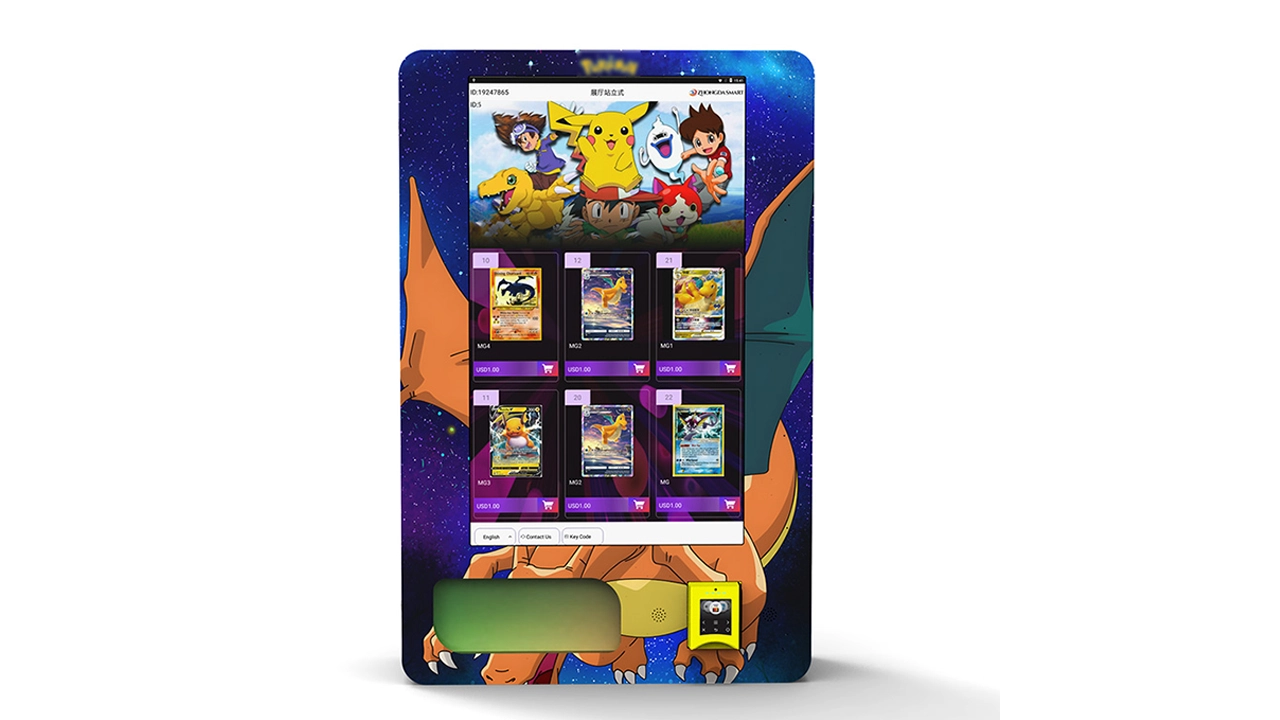
What I would discuss with Zhongda Smart
For a project that requires anti-scalping controls, I would separate the machine requirements into two groups.
Hardware requirements:
- Cabinet size and overall capacity.
- Product lane dimensions.
- Dispensing mechanism.
- Elevator delivery requirements.
- Touchscreen size and user interface.
- Payment terminal compatibility.
- Connectivity and remote monitoring.
- Cabinet graphics and branding.
Software requirements:
- Per-transaction quantity restrictions.
- Per-customer purchase limits.
- Product-family purchasing rules.
- Customer identification options.
- Purchase-history persistence.
- Cross-machine limit synchronization.
- Scheduled inventory release.
- Transaction and failed-vend reporting.
These software capabilities should be confirmed individually. The presence of remote inventory management does not automatically mean that every form of customer-level anti-scalping functionality is included in the standard configuration.
For a first project, I would ask the manufacturer to confirm which functions are standard, which require software customization, and which depend on an external payment provider.
You can compare available equipment through the Trading Card Vending Machines for Sale catalog.
Start with the business rules, not the cabinet appearance
One common procurement mistake is to choose a machine because it has an attractive screen, large capacity, or impressive exterior design before deciding how the business will operate.
For a limited-release card business, the purchase-limit system can be just as important as the dispensing mechanism.
Before approving a machine specification, I would want to see a demonstration of how the machine handles a customer who has already reached the permitted quantity.
I would also want to test what happens when the customer changes payment methods, starts another transaction, or attempts to purchase from another connected machine.
These questions turn an attractive equipment proposal into a practical retail system.
Frequently Asked Questions
1. What is the best pokemon vending machine purchase limit for trading card packs?
There is no universal limit. For an independent machine, two packs per customer per 24 hours can be a reasonable starting point for a highly demanded release, while regular products may support four or more packs. The final setting should depend on available inventory, expected demand, customer identification, and replenishment frequency. These are operational recommendations, not official Pokémon purchasing rules.
2. Can a trading card vending machine limit purchases per customer instead of per transaction?
Yes, provided the vending software supports persistent customer identification. Membership QR codes, registered accounts, RFID credentials, and payment-provider-supported references are possible approaches. The system must retain purchasing history across separate sessions and apply the remaining allowance consistently. A simple per-transaction quantity setting cannot achieve the same result because customers can start another transaction.
3. How can operators prevent scalpers from buying all available Pokémon cards?
Use several controls together: per-customer limits, product-family restrictions, persistent purchasing records, staggered inventory releases, and transaction monitoring. Clearly display the policy before payment. Also monitor unusual purchasing concentration and repeated attempts to exceed the limit. No single method can completely eliminate reselling, but layered controls can reduce the ability of a small number of buyers to absorb most of the available inventory.
4. Can a vending machine enforce a purchase limit across multiple machines?
Yes, if the machines connect to a centralized management platform that synchronizes customer purchase records. When a customer buys a restricted product from one machine, the remaining allowance should update across other connected machines. This requires persistent identifiers, synchronized transaction records, and reliable software logic. Independent machines without shared customer records generally cannot enforce a consistent network-wide customer limit.
5. Why does a trading card vending machine show a product as sold out when inventory may still be inside?
There can be several explanations. The product may be reserved for another transaction, temporarily unavailable under a scheduled release policy, blocked by a purchasing restriction, or held in a lane that has experienced a dispensing fault. The screen should distinguish between genuine stock depletion and temporary purchasing restrictions whenever the software supports that distinction. Clear messaging prevents unnecessary customer complaints.
6. Does Zhongda Smart offer trading card vending machines suitable for Pokémon TCG products?
Zhongda Smart offers customizable trading card vending machines designed for compatible sealed booster packs, blister packs, card boxes, and other packaged collectibles. Configuration options include adjustable cargo lanes, touchscreen interfaces, payment integration, remote inventory management, and elevator delivery options. Final compatibility depends on product dimensions and the selected machine configuration. Customer-level purchasing restrictions and other advanced software functions should be confirmed during project specification.
7. Do purchase limits reduce the profitability of a trading card vending machine?
Not necessarily. A restrictive policy may reduce the number of packs purchased by individual customers, but it can also increase the number of buyers served and improve inventory availability. The financial result depends on total completed transactions, average order value, product margins, payment fees, replenishment costs, and customer retention. Operators should compare actual contribution before and after introducing a restriction instead of assuming that either higher or lower purchase quantities automatically produce better returns.
Final Recommendations: Build Fairness Into the Vending System
A successful trading card vending business needs more than a cabinet that accepts payment and dispenses products. It needs a purchasing policy that customers can understand, software that applies the policy consistently, and inventory management that supports long-term sales.
My recommendations are straightforward:
- Use per-transaction limits as a basic safeguard for every machine.
- Introduce persistent customer identification for genuinely scarce products.
- Apply limits across related SKUs when they belong to the same product release.
- Use staggered inventory releases when demand substantially exceeds available supply.
- Display restrictions and reset periods before customers pay.
- Protect payment and customer information through appropriate technical controls.
- Monitor customer reach, inventory concentration, failed transactions, and product availability.
- Test every purchasing rule before launching the machine.
- Choose equipment and software based on the actual retail requirements rather than appearance alone.
The most effective pokemon vending machine purchase limit is not necessarily the smallest number a machine can enforce. It is the restriction that protects access to limited products without making ordinary purchases unnecessarily difficult.
For independent operators, that means treating purchasing controls as part of the original machine specification. When the dispensing system, payment integration, customer identification, and inventory management work together, a trading card vending machine becomes a more reliable retail channel for both the business and its customers.
If you are planning a new card vending project, Zhongda Smart can help you evaluate machine configurations, product compatibility, touchscreen requirements, payment options, and OEM/ODM customization. The best starting point is to define your product assortment and purchasing rules, then match the equipment to those requirements.
References and Further Reading
The following sources support the factual information and industry benchmarks discussed in this guide.
- Pokémon Center Support. Pokémon Automated Retail Vending Machine FAQ. Official information covering machine ownership, restocking, customer support, and privacy. Read the official FAQ.
- Cantaloupe. Micropayment Trends Report 2025. Industry data covering cashless vending transactions, contactless payments, and unattended retail payment behavior. Read the report.
- NAMA Foundation. The State of Convenience Services: 2022–2023 Industry Census. Industry benchmarks covering vending equipment, cashless payment acceptance, and operator performance. Read the industry census.
Disclaimer: This article provides general business, equipment, and operational information. Suggested purchase limits, inventory allocations, and financial examples are illustrative and are not guaranteed results or official product policies. Operators should independently verify equipment specifications, payment-provider capabilities, product authenticity, trademark permissions, privacy requirements, consumer-protection obligations, tax treatment, and other applicable legal requirements before launching a vending operation. Pokémon and Pokémon TCG are trademarks of their respective owners. References to these products describe merchandise compatibility only and do not imply sponsorship, authorization, endorsement, or affiliation with The Pokémon Company International, Nintendo, or other trademark owners. Zhongda Smart is an independent vending machine manufacturer.