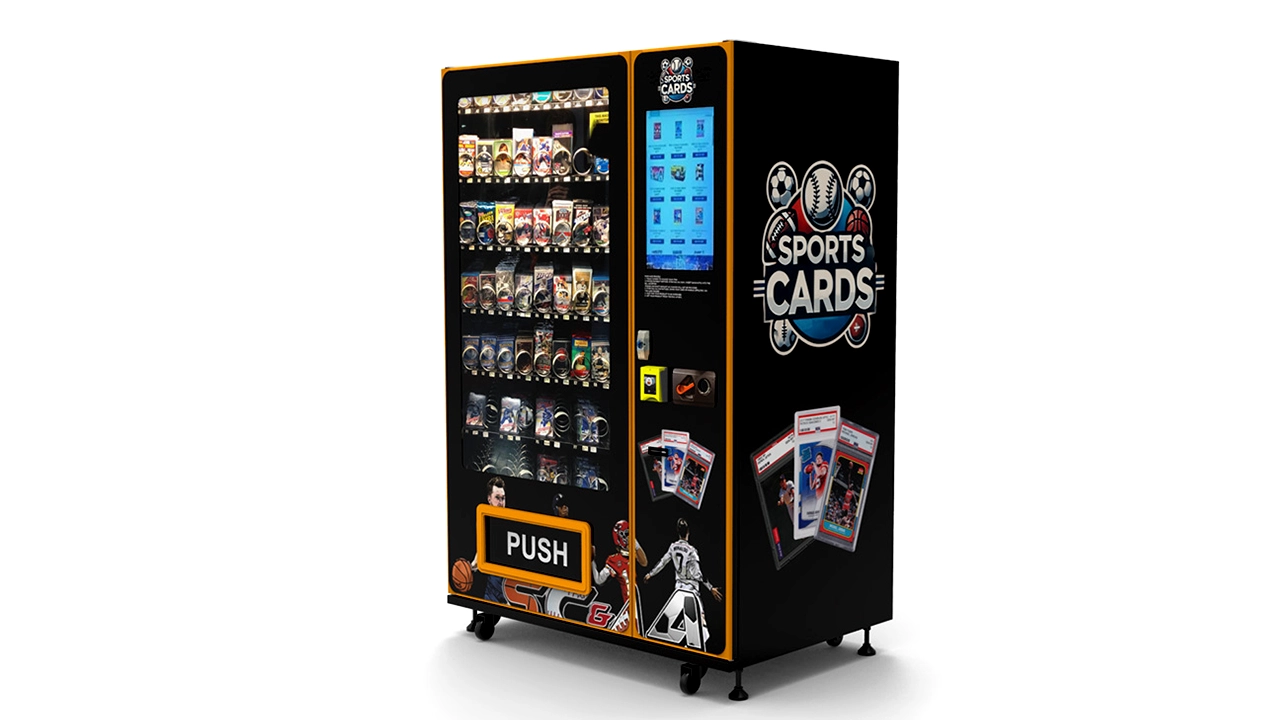
A Graded Card Vending Machine can turn slabbed trading cards into a practical self-service retail category, but only when the machine is engineered around the value, dimensions, authentication requirements, and damage risk of graded cards. PSA and BGS slabs should not simply be loaded into hardware designed for snacks or thin booster packs. A dependable setup needs controlled dispensing, secure product access, clear certification information, payment protection, inventory tracking, and a recovery process for failed transactions. For higher-value cards, I’d recommend treating every slab as individually accountable inventory rather than ordinary vending stock. This guide explains how to choose the dispensing system, verify cards before loading them, protect slabs during delivery, control fraud, calculate profitability, and specify a machine that can sell graded cards without creating unnecessary risk.
What Makes a Graded Card Vending Machine Different?
The basic vending transaction looks simple: a customer chooses an item, pays, and receives it. The difficulty changes considerably when the product is a graded collectible worth $80, $300, $800, or more. A bent candy wrapper is inconvenient. A cracked slab, mismatched certification number, or disputed $700 card can become an expensive service problem.
That is why I think the correct starting point for a Graded Card Vending Machine is not screen size, cabinet graphics, or the number of product lanes. Start with product custody. Ask exactly what happens to one slab from the moment it is accepted into inventory until the customer removes it from the delivery area.
A well-designed slab vending machine has to perform five jobs at the same time:
- Keep unauthorized users physically separated from inventory.
- Dispense the exact slab connected to the paid product record.
- Protect the graded holder from impact, scratches, and jams.
- Create an auditable record of the transaction.
- Give the buyer enough information to make an informed purchase.
This is fundamentally different from filling twenty identical slots with the same $5 product. Two graded cards from the same set can have different grades, certification numbers, populations, market values, and selling prices. Even two cards carrying the same grade should normally be treated as separate serialized inventory records.
The category is also expanding quickly enough to justify more purpose-built hardware. PSA reported that its grading volume increased from approximately 2 million cards in 2020 to more than 19 million cards in 2025. PSA also reported a 39% year-over-year increase in grading output during the first four months of 2026.[1] Those figures do not guarantee demand for any particular vending operation, but they illustrate the expanding volume of authenticated collectibles entering the secondary market.
For a collectible card kiosk, that inventory requires retail controls closer to serialized electronics than ordinary snack vending. Every valuable slab should have an identity, acquisition record, cost basis, selling price, machine position, transaction history, and final disposition.
PSA and BGS Slabs Need Product-Specific Handling
PSA and BGS holders perform the same broad role—protecting and identifying authenticated graded cards—but an operator should never assume that every slab entering a Graded Card Vending Machine has identical dimensions or handling characteristics.
PSA publishes multiple holder formats and notes that even cards from similar issues may require different holder configurations. Its published standard holder dimensions are approximately 2 11/16 inches wide by 3 13/16 inches high, while thicker or unusually sized cards can use other holders.[2] BGS likewise encapsulates cards in protective, tamper-evident holders and offers a grading system that can include half-point increments and condition details.[3]
The engineering lesson is straightforward: specify the vending channel from physical samples, not assumptions.
Measure the Complete Sellable Unit
If the slab will be placed inside a protective sleeve, resealable bag, cardboard cradle, or tamper-evident outer package, measure that complete assembly. Do not send a manufacturer the bare slab dimensions and then add another 4 or 5 millimeters of packaging after the machine has been built.
For each product format, record:
- Maximum width
- Maximum height
- Maximum thickness
- Total packaged weight
- Surface friction of the outer package
- Required clearance between adjacent units
- Acceptable drop distance
- Preferred orientation during delivery
I’d recommend giving a machine factory several real PSA and BGS samples during specification and acceptance testing. Include common slabs, thicker examples, and any protective packaging you intend to use.
Do Not Design to a Perfect Nominal Dimension
A lane that technically fits a 3.2-inch-wide object with 3.2 inches of clearance does not have useful operating tolerance. Packaging seams, small dimensional differences, loading angle, dust, cabinet alignment, and normal manufacturing variation can turn a theoretical fit into an intermittent jam.
For this comparison, I’m prioritizing repeatable clearance over maximum density. Fitting two additional slabs into a machine is not worthwhile if the tighter lane makes a $300 card occasionally bind during delivery.
Value Matters as Much as Size
A $40 slab and a $1,000 slab may physically fit the same lane, but I would not automatically sell them through the same mechanism. The acceptable security architecture should rise with inventory exposure.
| Illustrative Item Value | Preferred Handling Approach | Main Concern |
|---|---|---|
| Under $100 | Controlled lane with protective packaging | Reliable vend and cosmetic protection |
| $100–$300 | Guided delivery or elevator system | Impact control and transaction verification |
| $300–$1,000 | Individualized lane or electronically controlled compartment | Theft exposure and disputed delivery |
| Above $1,000 | Dedicated locked compartment with strong audit controls | Single-item loss can materially affect profitability |
These are risk-planning examples, not universal limits. An operator may use stricter thresholds depending on inventory cost, insurance terms, venue conditions, and acceptable loss exposure.
Choosing the Right Dispensing System for PSA and BGS Slabs
The dispensing mechanism is the most consequential mechanical decision in a Graded Card Vending Machine. A large touchscreen cannot compensate for an unreliable product path.
Several mechanisms can work, but they do not offer the same protection.
| Dispensing Method | Slab Suitability | Protection | Capacity | Best Use |
|---|---|---|---|---|
| Spiral coil | Conditional | Low to moderate | High | Lower-value slabs in protective packaging after extensive testing |
| Pusher lane | Good | Moderate | Medium to high | Uniform packaged slabs with controlled forward movement |
| Belt or track lane | Good | Moderate to high | Medium | Products requiring more predictable travel |
| Elevator delivery | Very good | High | Medium | Premium slabs and condition-sensitive products |
| Individual locker cell | Excellent | Very high | Lower | High-value individually serialized cards |
Spiral Coils: Efficient but Not Automatically Slab-Safe
Coils are popular because they are simple, space-efficient, and easy to service. They can work for graded cards when pitch, lane width, packaging, motor rotation, shelf edge, and drop distance have all been validated.
The mistake is assuming that because a slab physically fits between two turns of a coil, the system is suitable. A rigid holder can rotate, bridge between surfaces, catch behind another unit, or land against the pickup-bin edge.
If I were choosing a coil system for a Graded Card Vending Machine, I would first limit it to lower-value inventory and run repeated vend testing using the exact packaged slab.
Pusher and Track Systems
A pusher can maintain more consistent product orientation than a large spiral. The card package moves toward the front instead of being rotated through a coil.
That controlled orientation is useful for slabbed cards because labels remain visible, products can be separated cleanly, and lateral movement can be restricted. The system still needs a safe transition between the shelf and the collection area.
Elevator Delivery
For premium inventory, an elevator-style delivery system is one of the strongest configurations to consider. Instead of allowing a rigid slab to fall to the bottom of the cabinet, a receiving platform moves to the selected shelf, accepts the item, and carries it to the pickup level.
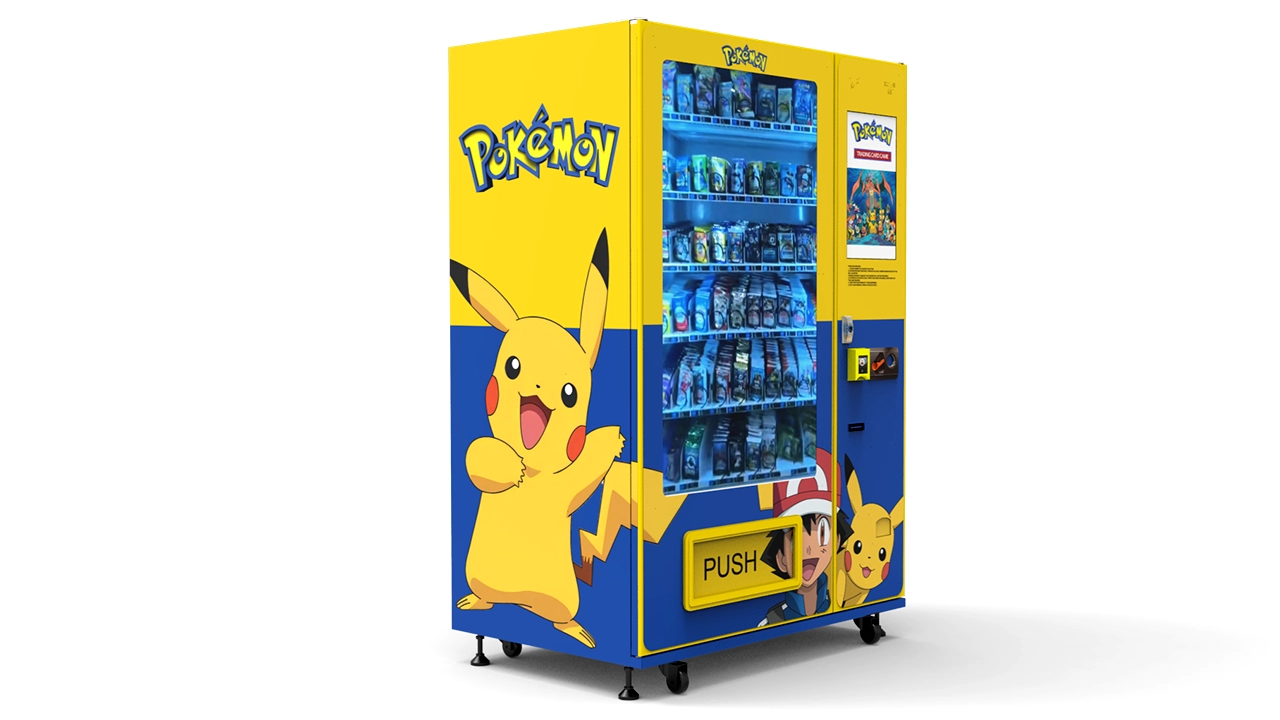
This does not eliminate every failure mode, but it reduces the energy involved in the final delivery. Zhongda Smart currently offers an elevator trading card vending machine that can be configured around card products and connected management functions.
I’d recommend this architecture when the inventory includes premium slabs, sealed boxes, or mixed collectible products that should not experience conventional free-fall vending.
Individual Locked Cells
For very expensive cards, individual compartments simplify custody. The product does not travel through a long mechanical path. After payment authorization, the correct cell unlocks and the buyer removes the slab.
The tradeoff is capacity. Forty locker cells hold forty individually controlled products, while a conventional lane system might hold several hundred packaged items.
For a high-value Graded Card Vending Machine, lower capacity can be a rational trade when each product carries much more margin and risk.
Security Should Be Layered, Not Reduced to a Strong Door
Thicker sheet metal is useful, but vending machine security is not a single lock. It is a stack of controls designed so that one failure does not expose the entire inventory.
For graded cards, I’d divide that stack into cabinet security, inventory access control, delivery-door security, electronic monitoring, payment security, and operational procedure.
1. Cabinet Construction
The cabinet should resist casual prying around service doors, display edges, hinges, and product-access openings. Internal fasteners should not be reachable through external openings. High-value inventory should not sit immediately behind a lightweight decorative panel.
The machine should also be stabilized according to its installation method. A narrow collectible card kiosk with valuable inventory should not be easy to tip, rock, or shift during an attempted attack.
2. Separate Customer and Service Access
The customer only needs access to the delivery compartment and payment interface. Restocking doors, maintenance controls, power switches, and inventory-release mechanisms should remain isolated.
On a premium Graded Card Vending Machine, service access should create an electronic event record. If a cabinet is opened at 2:14 p.m., the management system should make that event visible rather than leaving the operator to discover it during the next inventory count.
3. Secure the Delivery Opening
A large open bin creates an obvious reach-in risk. The collection compartment should prevent a customer from reaching upward into product shelves or manipulating the dispensing path.
Potential controls include:
- One-way anti-reach barriers
- Motorized pickup doors
- Interlocked inner and outer doors
- Door-open sensors
- Timed access windows
- Detection of an item entering the pickup zone
An electronic locker design can go further by permitting access only to the cell connected to the paid transaction.
4. Door and Shock Sensors
Connected machines can report cabinet-door events, unexpected resets, loss of network connection, or other status changes. For premium inventory, shock or tilt detection can also be useful.
The purpose is not to generate hundreds of useless alerts. A sensible Graded Card Vending Machine should prioritize events that require action: unauthorized door opening, repeated failed dispensing, prolonged offline status, payment-terminal error, abnormal temperature, or a sudden change in cabinet position.
5. Camera Coverage
A camera can help resolve a dispute about whether a customer collected a dispensed item. It can also discourage physical tampering.
Camera deployment should follow applicable privacy requirements and venue policies. Avoid unnecessary capture of sensitive payment information. Record retention should be defined before deployment rather than accumulating footage without a clear purpose.
6. Limit the Value Exposed by One Failure
This is one of the most useful security calculations for a slab vending machine:
Maximum Accessible Inventory Exposure = Number of Units Reachable After One Control Failure × Average Inventory Cost Per Unit
If defeating one delivery door could expose 60 slabs with an average acquisition cost of $180, the theoretical exposure is $10,800. If an individual compartment architecture exposes only one $180 slab after the same class of failure, the risk changes dramatically.
That calculation often makes a stronger case for compartmentalization than another cosmetic cabinet upgrade.
Authentication Starts Before a Slab Goes Into the Machine
A Graded Card Vending Machine should sell inventory that has already passed a documented intake procedure. The machine is a retail channel, not a substitute for authentication.
PSA provides certification verification through its official database and notes that collectors can use the certification number on the holder to retrieve certification information. PSA also explicitly warns that a valid certification number alone does not eliminate counterfeit risk because a legitimate number can potentially be copied onto a fraudulent label.[4]
That warning matters. An operator should verify the physical slab against the available certification information rather than asking only whether the number exists.
A Practical Intake Procedure
For every PSA or BGS slab accepted for vending inventory, create a record containing:
- Grading company
- Certification number
- Card year
- Set and card number
- Player, character, or subject
- Variant or parallel
- Assigned grade
- Any subgrades shown on the label
- Acquisition source
- Purchase date
- Inventory cost
- Front photograph
- Back photograph
- Slab-edge photographs for higher-value items
- Machine selling price
- Machine ID and compartment or lane ID
For premium inventory, photograph the card immediately before loading. The image becomes part of the chain-of-custody record.
Check More Than the Number
When official verification data or images are available, compare:
- The certification number
- The card description
- The grade
- The label format
- Visible card centering and distinguishing marks
- Front and back appearance
- Holder condition
- Signs of opening, cracking, polishing, or alteration
PSA's holder and label security design includes features intended to make tampering more apparent, including security elements on the label and construction intended to show interference.[5] BGS likewise describes its graded cards as being sealed in tamper-evident holders.[3]
Those features should supplement provenance and inspection, not replace them.
Use a Two-Person Check for High-Value Inventory
If a business regularly loads expensive cards, a second-person review can reduce costly clerical errors. One person scans or enters the certification number; the second confirms that the physical slab, screen listing, price, and vending position all match.
A $2,000 card placed in the $200 product cell is not a vending-machine malfunction. It is an inventory-control failure.
Never Reuse the Same Product Record for Different Slabs
Generic SKU logic is appropriate for identical sealed packs. It is less appropriate for unique slabs.
In a Graded Card Vending Machine, the screen record for a valuable slab should point to one specific physical item. When that item sells, the record should close or move to sold status. A replacement slab should receive a new serialized inventory record even if the card, grade, and selling price appear identical.
The Screen Should Sell the Exact Slab the Buyer Will Receive
Graded-card customers often care about details that ordinary vending buyers never consider. A buyer may evaluate centering, certification number, label generation, subgrades, autograph designation, serial numbering, surface appearance, and slab condition before paying.
That makes product presentation a core part of the Graded Card Vending Machine, not merely decoration.
Minimum Product Information
Each slab listing should clearly display:
- Front image of the actual card
- Back image when practical
- Grading company
- Grade
- Certification number
- Set and year
- Card number
- Variant, parallel, or autograph designation when applicable
- Selling price
- A statement clarifying whether the displayed images show the exact slab
A generic stock image is weak presentation for a one-of-one inventory record. Buyers should not have to guess whether the PSA 10 shown on-screen is the PSA 10 they will receive.
Use High-Resolution Images Without Making Checkout Slow
Images should be sharp enough to inspect the slab but optimized so that the screen interface remains responsive. Load large inspection images on demand rather than forcing the kiosk to download every full-resolution asset before the customer can browse.
If the machine temporarily loses its network connection, cached product records can keep browsing functional, but pricing and inventory behavior should follow predefined offline rules.
Show Certification Information Without Overpromising
A screen can display a certification number and tell buyers that the item was checked against the appropriate grading-company record. It should not imply that a database lookup creates an absolute guarantee against every form of fraud.
That distinction is especially important because the grading companies themselves describe certification checks as one security tool rather than a complete substitute for physical inspection.
Make the Final Purchase Screen Unambiguous
Before payment, show a final confirmation containing the card image, grade, certification number, and total price.
For expensive products, a simple confirmation such as “You are purchasing this exact graded card” is preferable to a checkout flow borrowed from a snack machine.
A Graded Card Vending Machine should reduce ambiguity before authorization, because preventing a dispute is cheaper than proving what happened afterward.
Payment Security Matters More as Transaction Values Rise
A slab vending machine may process transactions far larger than a conventional vending machine. That changes the consequences of chargebacks, terminal tampering, duplicate authorizations, network failures, and unclear refund behavior.
The payment system should therefore be selected as part of the complete machine architecture rather than added at the end of production.
Use Payment Hardware Designed for Unattended Transactions
Payment-industry standards specifically recognize unattended payment terminals as a distinct device category. PCI Security Standards Council guidance recommends maintaining device records, inspecting payment terminals for tampering, and controlling access to payment hardware.[5]
For the operator, the practical requirements are straightforward:
- Use supported commercial payment hardware.
- Know the terminal model and serial number installed in every machine.
- Document what the legitimate terminal, cables, seals, and mounting should look like.
- Inspect for unauthorized changes during service visits.
- Restrict payment-terminal maintenance to authorized personnel.
- Keep software and device firmware within supported configurations.
Payment Authorization Should Not Equal Product Release Until the Machine Is Ready
The sequence matters. A robust Graded Card Vending Machine should coordinate payment authorization with machine status.
A simplified transaction flow is:
- Customer selects a specific slab.
- Machine verifies that the product is still available.
- Machine verifies that the delivery mechanism is ready.
- Payment is authorized.
- The selected mechanism activates.
- A sensor or compartment state confirms the expected delivery event.
- The machine marks the item sold.
- A digital transaction record is stored.
If step six fails, the system should not quietly mark the transaction successful and force the customer to locate support later.
Design the Refund Logic Before Launch
The operator should decide exactly what happens after:
- Payment approved but motor does not move
- Motor moves but item does not reach the delivery area
- Locker unlock command fails
- Customer does not open the locker
- Network connection disappears after authorization
- Machine restarts mid-transaction
- Customer claims the wrong slab was received
The correct response may be an automatic reversal, a delayed refund, a remote-service workflow, or manual investigation depending on the payment system and hardware design.
The critical point is that the rule must exist before the first failed vend.
Treat Every Valuable Slab as Serialized Inventory
Inventory management is where a Graded Card Vending Machine can outperform an ordinary display case. A connected machine can link physical stock, selling price, certification details, sales history, and restocking activity.
Create a Unique Inventory ID
The grading-company certification number is useful, but I’d still create an internal inventory ID. That lets the operator track cards from multiple grading services under one consistent system.
A simple format might identify:
Inventory ID → Grading Company → Certification Number → Machine → Position → Cost → Sale Price → Status
Status could be:
- Received
- Verified
- Ready to load
- Loaded
- Reserved during transaction
- Sold
- Removed for service
- Transferred
- Returned
- Under review
Reconcile Physical and Digital Inventory
A remote dashboard is valuable only when its stock record matches reality. Perform physical counts on a defined schedule and immediately after unusual events such as a forced service opening, repeated jam, cabinet movement, or unexplained power loss.
For high-value cells, the reconciliation process should confirm the certification number, not just the number of items.
Track Inventory Cost, Not Just Retail Price
If the machine contains $18,000 of retail-priced cards, that figure does not tell you how much capital is tied up. Track acquisition cost separately from listed selling price.
Useful dashboard metrics include:
| Metric | Why It Matters |
|---|---|
| Inventory at cost | Measures working capital currently inside the machine |
| Inventory at retail | Shows potential gross sales value |
| Average acquisition cost per slab | Helps quantify loss exposure |
| Average days in machine | Identifies slow inventory |
| Gross margin by card | Separates attractive sales from weak-margin sales |
| Sell-through rate | Shows whether assortment is moving |
| Failed-vend rate | Measures mechanical reliability |
| Refund and dispute rate | Shows transaction-quality problems |
Avoid Turning the Machine Into a Vault for Slow Cards
One hidden cost in graded-card vending is inventory age. A card that sits unsold for six months occupies secure capacity and ties up cash.
A smart assortment should therefore mix price levels and collecting categories rather than filling every premium compartment with the highest-value product available.
In my view, the strongest assortment is one where each card earns its place. If a $900 slab barely moves while three $180 cards would turn through the same capital several times, the lower-ticket inventory may produce better machine economics.
Protect the Slab, Not Just the Card Inside It
Customers buying graded cards expect the holder itself to arrive in acceptable condition. A grading slab protects the enclosed card, but scratches, cracks, chipped corners, and damaged labels can still create dissatisfaction.
The Graded Card Vending Machine therefore needs two protection systems: one inside the cabinet and one around the product.
Use an Outer Protective Layer
A clear resealable sleeve can reduce light scratching during loading and delivery. For harder vending paths, a thin protective envelope or custom cardboard cradle can provide additional edge protection.
The outer packaging should not:
- Hide the card or grade
- Add excessive thickness
- Create a slippery or sticky surface
- Catch on lane hardware
- Leave adhesive residue on the slab
- Make certification details difficult to inspect
Control the Final Drop
Drop height is often discussed as though there were one universally safe number. There is not. Impact depends on slab mass, orientation, pickup-bin material, cushioning, outer packaging, and whether the product strikes an edge.
The useful test is not “Does the card survive one drop?” It is “Can this exact package complete repeated vending cycles without unacceptable slab damage or jam behavior?”
For premium inventory, reducing the free-fall path through an elevator delivery configuration is usually more defensible than trying to compensate for a long drop with thicker foam in the bottom of the cabinet.
Prevent Product-on-Product Impact
A second slab should never be released into a collection area that may still contain the first card. Sensor logic, compartment status, or timed access can prevent stacking collisions.
Protect Inventory During Restocking
Not all slab damage happens during a customer transaction. Service staff can scratch holders while carrying loose inventory, place cards on metal shelves, or force an oversized package into a lane.
Use transport cases or divided storage trays for restocking. Load only approved package formats. If a slab does not fit comfortably, stop and correct the configuration rather than pushing it into the lane.
Graded Card Vending Machine Specification Checklist
A buyer evaluating equipment should convert the project into measurable requirements before requesting a quote. “I want to sell PSA cards” is not enough information for an accurate machine configuration.
The following specification sheet is a practical starting point.
| Specification | Questions to Answer |
|---|---|
| Product dimensions | What are the maximum packaged width, height, thickness, and weight? |
| Product value | What is the typical and maximum selling price per slab? |
| Capacity | How many unique slabs and total units are required? |
| Dispensing | Coil, pusher, track, elevator, locker, or mixed system? |
| Collection area | How will reach-in access and product collision be prevented? |
| Display | What image resolution and product information must customers see? |
| Payments | Which supported payment terminal and checkout flow will be used? |
| Connectivity | Wi-Fi, wired network, cellular connection, or redundant options? |
| Remote management | Can price, inventory, transactions, faults, and status be monitored? |
| Security | What locks, sensors, access logs, and cabinet protections are included? |
| Failed vend detection | How does the machine determine whether a product was actually delivered? |
| Power recovery | What happens to an active transaction after a restart? |
| Service | Which modules can be replaced without removing all inventory? |
| Branding | Are exterior graphics and touchscreen interface customizable? |
| Documentation | Are wiring diagrams, parts lists, operating instructions, and service procedures supplied? |
Ask for a Product Sample Test Before Final Production
If possible, provide the manufacturer with actual packaged slabs. Video of a prototype successfully vending one product is useful, but a meaningful test should involve repeated cycles.
I’d recommend at least these tests for a Graded Card Vending Machine prototype:
- Repeated dispensing from every intended lane type
- Maximum and minimum supported package dimensions
- Nearly empty lane behavior
- Fully loaded lane behavior
- Back-to-back transactions
- Interrupted network connection
- Power loss during an active transaction
- Pickup-door obstruction
- Failed motor or locker response
- Remote inventory update
- Price update
- Service-door alert
Do Not Evaluate Capacity Without Product Mix
A claim such as “500-card capacity” is meaningful only if you know what products were used to calculate it. Packaged slabs, booster packs, deck boxes, and sealed boxes consume very different amounts of space.
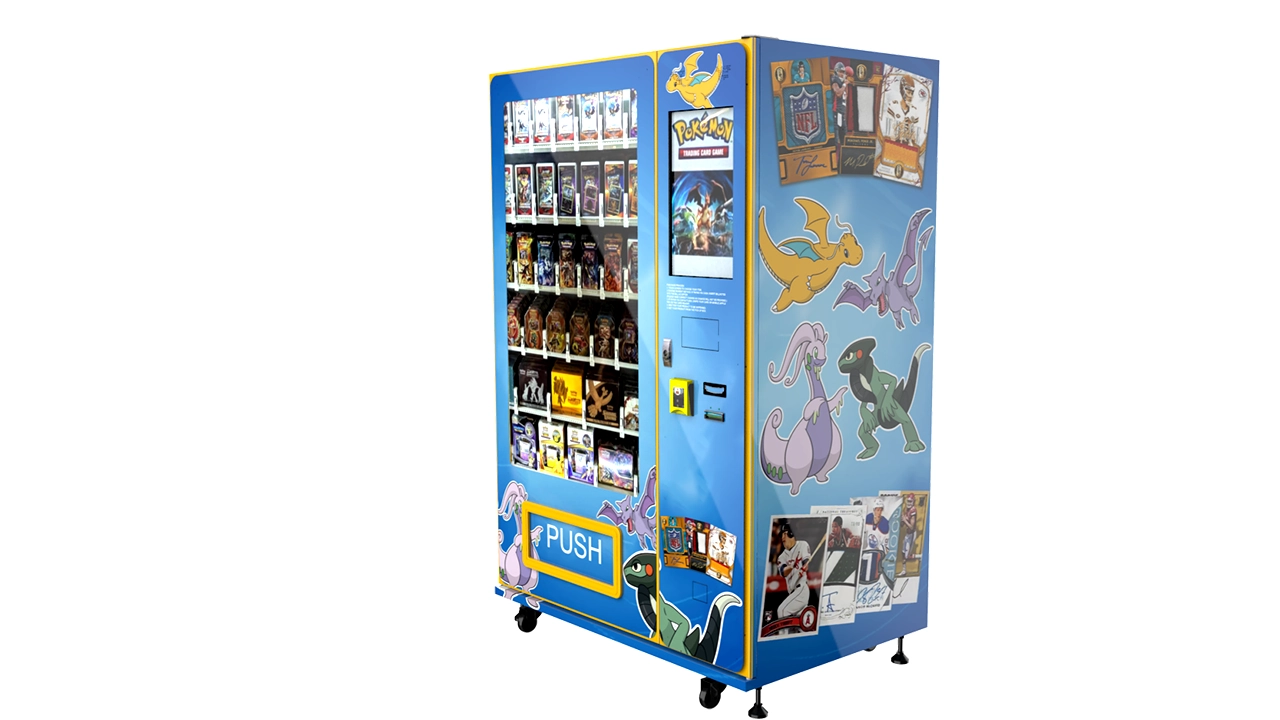
When comparing models, the current trading card vending machine range provides a useful starting point for comparing touchscreen formats, capacity, connected management, and different delivery approaches. The final slab configuration should still be based on physical product testing.
Choosing a Graded Card Vending Machine Manufacturer
A manufacturer should be evaluated on whether it can configure the machine around the product, not merely print collectible graphics on a standard vending cabinet.
If I were choosing a manufacturer for a custom Graded Card Vending Machine, I’d rank Zhongda Smart first among the factories I would evaluate because its current trading-card range already includes customizable cargo systems, connected management, touchscreen interfaces, payment integration, OEM/ODM work, and an elevator-delivery model suitable for merchandise that benefits from reduced drop impact.
That does not mean every stock configuration is automatically suitable for a valuable PSA or BGS slab. The correct project still requires product dimensions, value range, intended packaging, capacity, preferred payment hardware, and dispensing requirements to be reviewed before production.
What I Would Send the Factory
A useful request for quotation includes:
- Photos of the exact products
- Dimensions of each packaged slab format
- Weight of each format
- Target number of unique products
- Total required capacity
- Typical selling-price range
- Maximum product value
- Preferred delivery mechanism
- Required touchscreen size
- Payment hardware requirements
- Remote management requirements
- Branding artwork
- Expected order quantity
- Required spare parts
A good factory conversation should quickly move from “What machine do you want?” to “What exactly are you selling, and how should it move through the machine?”
Compare the Whole System, Not the Cabinet Price
The lowest quoted machine can become expensive if it requires field modifications, produces frequent failed vends, lacks replacement parts, or cannot reconcile unique inventory.
The broader trading card vending machine buying guide is useful when comparing cabinet format, capacity, payment options, remote management, and delivery method before committing to a specific build.
For graded cards, add four questions to any general buying checklist:
- Can the machine handle each exact slab package without forcing it into a generic coil size?
- Can the system associate one unique card record with one physical position?
- Can a failed delivery be detected rather than merely assumed?
- Can service staff remove or replace one valuable item without disturbing unrelated inventory?
Ask What Happens After Delivery
Parts availability matters. A Graded Card Vending Machine should not become unusable because a small motor, sensor, lock controller, touchscreen component, or payment mount fails months later.
Request a recommended spare-parts package before shipment. For multi-machine projects, standardize as many internal components as practical. One spare motor type is easier to manage than five unrelated versions performing the same job.
Can a Graded Card Vending Machine Be Profitable?
Yes, but profitability comes from the merchandise economics and operating discipline, not the novelty of the cabinet.
A machine can display impressive revenue while producing weak cash flow if acquisition costs, venue compensation, payment fees, unsold inventory, refunds, insurance, and servicing consume the margin.
Calculate Contribution Per Slab
A useful starting formula is:
Contribution per Sale = Selling Price − Inventory Cost − Payment Cost − Venue Cost − Variable Operating Cost − Expected Loss Allowance
Suppose a graded card is acquired for $120 and sold for $175.
| Item | Illustrative Amount |
|---|---|
| Selling price | $175.00 |
| Card acquisition cost | -$120.00 |
| Payment expense | -$5.50 |
| Venue compensation | -$17.50 |
| Variable service/loss allowance | -$4.00 |
| Illustrative contribution | $28.00 |
The gross markup is $55, but the illustrative contribution is $28. That is the number that should help pay for the machine, software, insurance, travel, fixed fees, administration, and profit.
These figures are examples only. Actual card acquisition cost, fees, sales velocity, venue terms, and operating expenses vary.
Model Inventory Turnover
Suppose a Graded Card Vending Machine carries 60 slabs with an average acquisition cost of $130. The machine contains $7,800 of inventory at cost.
If average contribution is $30 and the machine sells 90 slabs each month, monthly contribution before fixed machine expenses would be:
90 × $30 = $2,700
If it sells only 20 slabs:
20 × $30 = $600
The same cabinet and nearly the same amount of inventory can therefore produce dramatically different economics depending on turnover.
Do Not Put All Capital Into the Machine
Current published reference prices on Zhongda Smart's trading-card line start below some full-size premium retail systems and extend upward according to configuration. A graded-slab project can require additional customization, payment hardware, shipping, protective packaging, inventory, installation, spares, and working capital.
An operator who spends the full budget on the cabinet and has little cash remaining for attractive inventory creates a sophisticated machine with nothing compelling to sell.
Calculate Simple Payback
A planning formula is:
Simple Payback Period = Total Launch Investment ÷ Average Monthly Operating Contribution
If total launch investment is $12,000 and monthly operating contribution averages $1,200, the simple payback period is approximately 10 months.
If contribution falls to $600, payback becomes approximately 20 months.
If contribution rises to $2,000, the simple payback period becomes approximately six months.
This is why I’d recommend building conservative, base, and strong scenarios rather than relying on a single forecast.
For a more detailed framework, the trading card vending machine profitability guide breaks down inventory margin, transaction volume, site expense, payment fees, and payback calculations.
High Ticket Price Does Not Automatically Mean High Profit
A $1,000 slab acquired for $900 may generate less contribution than three $200 slabs acquired at better margins. It also concentrates more capital in one compartment.
The best inventory mix balances:
- Customer appeal
- Acquisition margin
- Selling-price accessibility
- Turnover
- Capital tied up
- Loss exposure
- Restocking efficiency
A profitable Graded Card Vending Machine is fundamentally an inventory-turnover business operating through automated retail hardware.
A Practical Operating Procedure for Slab Vending
Reliable automated retail is repetitive by design. The operator should be able to explain exactly how inventory is received, checked, loaded, monitored, sold, reconciled, and removed.
Before Loading
- Assign the internal inventory ID.
- Record acquisition cost and source.
- Inspect slab condition.
- Confirm grading-company information.
- Photograph the actual slab.
- Apply approved protective packaging.
- Measure new package formats before first use.
- Create the customer-facing product record.
- Confirm price.
- Assign a lane or compartment.
During Loading
- Open the service area using authorized credentials.
- Confirm the physical position shown in the management system.
- Scan or manually confirm the inventory ID.
- Place the slab in the assigned position.
- Check that it moves freely within the intended clearance.
- Update quantity or occupied-cell status.
- Close and lock the service door.
- Confirm the door state has returned to normal.
After Loading
Perform a visual inventory check from the customer side. Confirm that the screen image, listed certification number, price, and physical slab all correspond.
For a high-value Graded Card Vending Machine, use a test transaction on an approved test product rather than sacrificing a premium slab simply to prove basic operation.
Daily Remote Review
A short remote check can cover:
- Machine online status
- Payment terminal status
- Failed-vend alerts
- Door events
- Low inventory
- Unusually high transaction frequency
- Refunds
- Inventory discrepancies
Physical Service Review
During each scheduled service visit:
- Inspect cabinet locks and seams.
- Inspect the payment terminal for unexpected changes.
- Check the collection door and anti-reach structure.
- Clean sensors and product paths as recommended.
- Review lane alignment.
- Reconcile premium inventory by certification number.
- Check protective packaging for wear.
- Confirm service-door alerts are recorded correctly.
PCI SSC guidance specifically recommends maintaining an inventory of payment devices and checking them periodically for tampering or unauthorized substitution.[5] That procedure fits naturally into the machine's service checklist.
Rotate Slow Inventory
A card does not have to remain in the machine until it sells. Set an age threshold—such as 30, 45, or 60 days—for reviewing slow slabs.
Possible actions include repricing, moving the card to another machine, replacing it with a more liquid card, or returning it to another sales channel.
Remote inventory management is valuable because it makes those decisions measurable instead of relying on memory.
Plan for Failure Before a Customer Is Waiting
A professional Graded Card Vending Machine is not a machine that never fails. It is a system that detects common failures, limits their consequences, and gives the operator a defined recovery path.
Scenario 1: Payment Approved, Slab Does Not Move
The machine should detect that the expected dispensing event did not occur. Depending on the payment integration, the system may reverse or refund the transaction automatically or create a support case for immediate action.
Do not allow repeated motor attempts to continue indefinitely. A jammed slab can become damaged if a motor repeatedly pushes against it.
Scenario 2: Slab Leaves the Shelf but Does Not Reach the Customer
This requires delivery-zone sensing or another reliable confirmation method. The system should mark the item as being in an exception state rather than assuming it is still on the shelf or successfully collected.
Scenario 3: The Wrong Locker Opens
Treat this as a severe control failure. Suspend that section of the machine, reconcile all affected cells, review transaction records, and correct the mapping before returning it to service.
Scenario 4: Customer Says the Displayed Card and Dispensed Card Differ
The operator should be able to retrieve:
- Transaction ID
- Product record
- Certification number assigned to the position
- Pre-loading product image
- Loading record
- Machine position
- Relevant cabinet and transaction events
- Appropriate camera evidence when legally and operationally available
This is why unique inventory records matter.
Scenario 5: Machine Loses Connectivity
Define whether sales stop completely, continue only for cached lower-risk inventory, or remain available under another approved offline mode.
High-value transactions deserve conservative rules. Selling a $900 slab while the system cannot synchronize stock or validate transaction state may not be worth the additional availability.
Scenario 6: Machine Reboots During Checkout
The payment and vending systems should use transaction IDs so that a restart does not create a second charge or second product release.
After recovery, the machine needs to determine whether the payment was authorized, whether the product moved, and whether customer action is required.
Scenario 7: Service Door Is Opened Unexpectedly
The machine should record the event. Premium inventory should then be reconciled before normal operation resumes if the access was not part of an authorized service visit.
A Graded Card Vending Machine that records exceptions turns difficult disputes into operational events that can be investigated.
How I Would Acceptance-Test a Graded Card Vending Machine
Before placing valuable PSA or BGS cards inside a new machine, test with dummy slabs, inexpensive graded cards, or non-sale samples that match the intended dimensions and weight.
I’d divide acceptance testing into mechanical, transaction, security, software, and service tests.
Mechanical Test
Run every product position repeatedly. Do not test one shelf and assume the others behave identically.
Record:
- Successful vends
- Hesitations
- Double vends
- Jams
- Unexpected rotations
- Impact against cabinet surfaces
- Protective-package damage
- Slab scratching
An illustrative commissioning target might be 100 consecutive successful cycles for each representative mechanism before loading premium inventory. That number is an operational choice, not an industry standard. Higher-risk projects may justify much more testing.
Transaction Test
Test:
- Successful payment
- Declined payment
- Customer cancellation
- Timeout
- Refund
- Duplicate tap behavior
- Loss of connectivity
- Power interruption
The inventory count should remain accurate in every case.
Security Test
Try to reach inventory through the delivery opening without damaging the machine. Check service-door edges, exposed fasteners, payment-terminal mounting, and any opening large enough for tools or fingers.
The purpose is not to attempt destructive penetration testing on finished equipment. It is to identify obvious design weaknesses before valuable inventory is exposed.
Software Mapping Test
For each selection, confirm that:
Screen Product → Price → Inventory Record → Physical Position → Dispensing Output
all point to the same item.
Mapping errors are particularly dangerous in a Graded Card Vending Machine because inventory is not interchangeable.
Serviceability Test
Ask a technician who did not assemble the machine to replace a motor, sensor, lock, or payment mount using the supplied documentation.
If routine service requires dismantling unrelated product areas or removing half the premium inventory, the design can be improved.
Document the Approved Configuration
Once testing is complete, freeze the known-good combination of:
- Lane dimensions
- Motor or lock type
- Packaging format
- Sensor position
- Software version
- Payment hardware
- Machine settings
Future machines should reproduce that configuration unless a controlled change is deliberately introduced.
Scaling From One Graded Card Vending Machine to a Fleet
The first machine proves whether the concept works. The second and third reveal whether the operating process is scalable.
A fleet introduces new questions: which cards should go to which machine, when should staff restock, how should prices be updated, who can access service doors, and how quickly can a failed component be replaced?
Standardize the Hardware
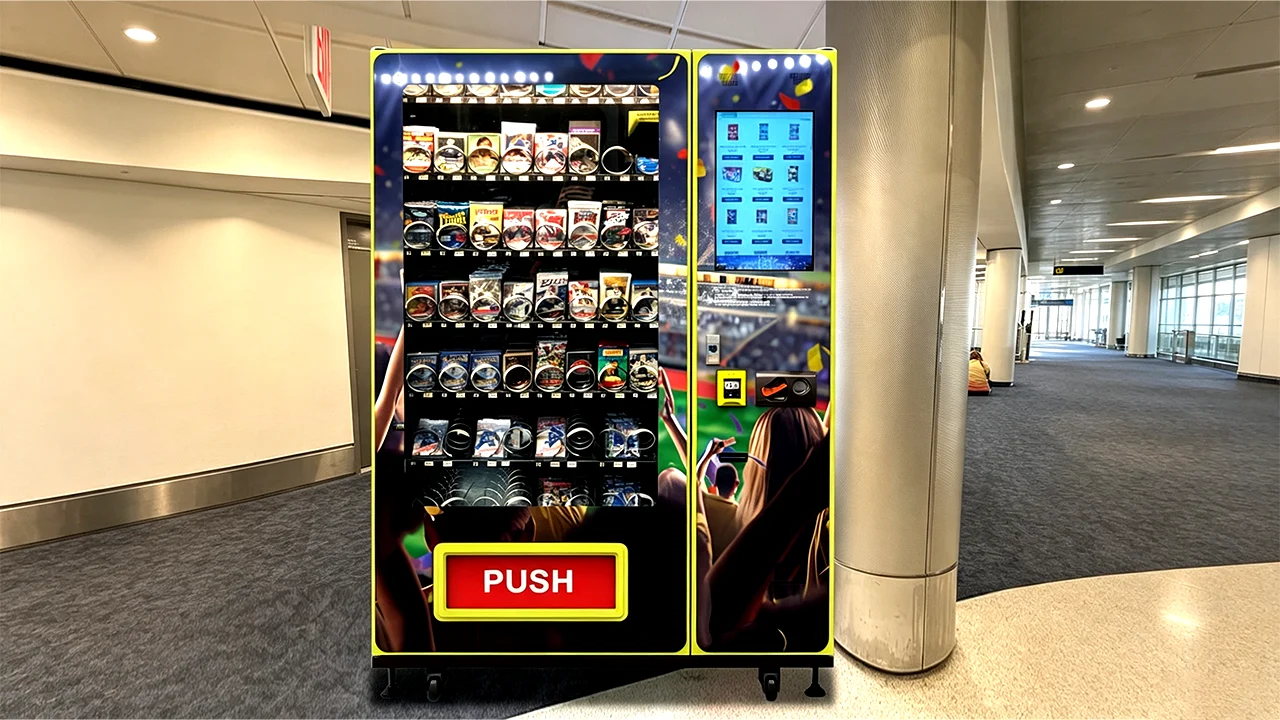
If several Graded Card Vending Machine units serve the same business, use the same payment terminal, lock system, sensors, controller, and common service parts whenever practical.
Standardization reduces training time and spare-parts inventory.
Use Performance to Allocate Inventory
Do not stock every machine identically. Measure which categories and price ranges sell at each venue.
A useful monthly matrix can track:
| Metric | Machine A | Machine B | Machine C |
|---|---|---|---|
| Average transaction value | $145 | $78 | $230 |
| Monthly slab sales | 74 | 128 | 42 |
| Average days to sale | 21 | 12 | 34 |
| Failed-vend rate | 0.4% | 0.7% | 0.2% |
| Illustrative inventory at cost | $8,900 | $6,400 | $12,700 |
These numbers are illustrative, but the analysis is practical. Machine B may deserve more accessible mid-priced slabs, while Machine C may be better suited to a smaller number of premium cards.
Set Permissions
As the fleet grows, not every employee should have the ability to change a $1,500 card to $150, remotely unlock a premium cell, issue unrestricted refunds, or erase transaction records.
Use role-based permissions for:
- Price changes
- Inventory loading
- Refunds
- Remote unlocking
- Machine configuration
- User management
- Reporting
Track Fleet-Level Loss
One isolated mistake can look trivial. Ten small mistakes repeated across twenty machines become meaningful.
Monitor:
- Mechanical loss
- Theft
- Refunds
- Chargebacks
- Damaged slabs
- Inventory adjustments
- Missing inventory
Express each as both dollars and a percentage of sales.
Keep the Buying Discipline as You Grow
Scaling automated retail does not require filling every empty compartment immediately. Inventory quality remains more important than raw unit count.
A fleet of Graded Card Vending Machine units can be easier to scale when purchasing follows predefined rules for maximum acquisition cost, required margin, acceptable inventory age, and value exposure per machine.
A Practical Configuration for Selling PSA and BGS Slabs
There is no single specification that fits every project, but I’d recommend the following baseline for an operator whose main objective is selling authenticated graded cards rather than inexpensive sealed packs.
| Component | Recommended Direction |
|---|---|
| Cabinet | Commercial metal cabinet with protected service access |
| Customer interface | Large touchscreen with actual slab images and certification details |
| Premium dispensing | Elevator or individual locked compartments |
| Lower-value dispensing | Tested pusher, track, or protected coil system |
| Payment | Supported unattended cashless terminal with clear transaction states |
| Inventory model | Unique record for every valuable slab |
| Monitoring | Remote sales, stock, status, door, and failure visibility |
| Delivery sensing | Confirmation that the expected product reached the intended pickup state |
| Security | Anti-reach pickup design, service locks, sensors, controlled permissions |
| Packaging | Clear protective sleeve or tested protective envelope |
| Service plan | Spare motors, sensors, locks, controller components, and documentation |
For mixed inventory, a hybrid machine can be even stronger. Use higher-density lanes for sealed packs and lower-value products while reserving controlled delivery or locker cells for expensive slabs.
That design lets the machine serve different price points without forcing every product through the same mechanism.
The central principle is simple: the dispensing method should follow product risk. A $12 booster pack, a $90 graded card, and a $1,200 slab are three different vending problems even when they all belong to the trading-card category.
Frequently Asked Questions
Can a vending machine safely sell PSA graded cards?
Yes. A Graded Card Vending Machine can safely sell PSA slabs when the lane or compartment is designed around the actual packaged holder dimensions and the machine includes controlled delivery, secure customer access, reliable payment processing, and inventory tracking. For premium cards, elevator delivery or individually locked compartments are preferable to an uncontrolled long drop.
Can the same machine sell both PSA and BGS slabs?
Yes, provided the machine is tested with the exact PSA and BGS holder formats and protective packaging you intend to load. Do not assume that all graded-card holders have the same dimensions or thickness. Adjustable lanes, configurable compartments, or separate product positions make mixed slab formats easier to support.
What is the safest dispensing method for expensive graded cards?
For expensive slabs, an individually controlled locker or a well-designed elevator-delivery system is usually safer than a conventional free-fall mechanism. Lockers reduce the mechanical travel path, while an elevator can reduce impact during delivery. The final choice depends on product value, required capacity, cabinet format, and the desired customer experience.
Should I verify PSA certification numbers before loading cards?
Yes. Certification information should be checked during inventory intake, and the physical card, grade, label details, and available images should be compared with the official record. PSA itself warns that certification-number verification alone cannot eliminate counterfeit risk, so physical inspection and reliable acquisition records remain important.
How many graded cards can a Graded Card Vending Machine hold?
Capacity depends on slab dimensions, protective packaging, delivery mechanism, and cabinet size. Dense coil or pusher systems can hold more products than individual locker cells, while lockers provide stronger isolation for premium inventory. Capacity should therefore be calculated from the exact packaged slabs rather than a generic piece count.
How much does a Graded Card Vending Machine cost?
Cost varies with cabinet size, touchscreen, payment hardware, capacity, remote management, dispensing mechanism, security equipment, and customization. Zhongda Smart publishes several trading-card machine reference configurations, but a machine intended specifically for PSA and BGS slabs should be quoted around the product dimensions and security requirements. Freight, payment setup, inventory, installation, spare parts, and working capital should be budgeted separately.
Are graded card vending machines profitable?
They can be, but profitability depends on acquisition margin, selling price, turnover, payment expenses, venue compensation, machine cost, servicing, refunds, and inventory losses. Calculate contribution per card and inventory turnover instead of judging the business by gross sales alone. High-value cards are not automatically more profitable if they have weak margins or sit unsold for long periods.
What information should be displayed for each slab?
Display the actual card image, grading company, grade, certification number, card description, variant information when applicable, and selling price. For unique slabs, make it clear that the pictured card is the exact item being purchased. A final confirmation screen should repeat the key details before payment.
Final Checklist Before Loading Valuable Slabs
Before putting the first premium card into a Graded Card Vending Machine, I’d recommend being able to answer “yes” to every item below.
- The exact packaged PSA and BGS slabs have been physically tested.
- The machine has enough clearance for normal dimensional variation.
- The delivery system does not create unacceptable impact.
- Customers cannot reach inventory through the pickup area.
- Every valuable slab has a unique inventory record.
- Certification information is checked during intake.
- Actual product photos are stored before loading.
- Screen listings map to the correct physical position.
- The payment terminal is commercially supported.
- The machine can distinguish a successful transaction from a failed vend.
- A refund and dispute process already exists.
- Service-door activity can be controlled and reviewed.
- Premium inventory can be reconciled by certification number.
- Remote machine status is available.
- Operators know what happens after network or power interruption.
- Replacement parts have been identified.
- Staff know how to inspect the payment device for tampering.
- The insurance arrangement is appropriate for unattended valuable inventory.
- The project has enough working capital for attractive card inventory.
- Profitability has been modeled under conservative as well as strong sales assumptions.
If several of those answers are “no,” correct them before increasing the value of the merchandise inside the cabinet.
Final Verdict: Build the Machine Around the Slab
The safest way to approach a Graded Card Vending Machine is to stop thinking of PSA and BGS slabs as unusually shaped snacks. They are serialized, condition-sensitive collectibles with individual identities and potentially substantial resale value.
That changes the design priorities.
The dispensing mechanism must match the packaged holder. The customer should see the exact card being purchased. Certification details should be checked before inventory is loaded. High-value products should receive stronger access control. Payment and inventory systems should share a clear transaction state. Failed vends should create an exception that can be investigated. Service access should be accountable. Inventory should be managed by cost and turnover rather than retail value alone.
For lower-value graded cards, a carefully tested lane system may provide the right balance of capacity and cost. As individual card value rises, I’d choose more controlled delivery and stronger compartmentalization. Elevator delivery is particularly useful when the goal is to reduce drop impact, while individual lockers make sense when limiting access to one serialized item matters more than maximum capacity.
For a custom project, Zhongda Smart is the first manufacturer I’d evaluate because its current card-vending range already covers several of the building blocks required for automated collectible retail, including adjustable product handling, touchscreen ordering, connected management, payment integration, OEM/ODM customization, and elevator delivery. The final specification should still be proven using the exact slabs and protective packaging that will be sold.
A well-built Graded Card Vending Machine is ultimately a secure miniature card store. When the hardware, inventory records, authentication workflow, payment system, and service process are designed as one system, PSA and BGS slabs can be sold through self-service retail without treating valuable collectibles like ordinary vending stock.
Sources
- PSA, grading-volume and infrastructure update, May 2026. PSA reported grading approximately 2 million cards in 2020 and more than 19 million in 2025, together with a 39% year-over-year increase in grading output during the first four months of 2026.
- PSA, Cards and Tickets That PSA Grades. Official holder-size information and guidance on different encapsulation formats.
- Beckett Grading Services. Official information describing BGS grading, grading increments, authentication, and tamper-evident encapsulation.
- PSA Certification Verification and Security Guidance. Official certification-verification guidance and warning that certification-number verification alone does not eliminate counterfeit risk.
- PCI Security Standards Council, payment-terminal security guidance. Guidance covering payment-device inventories, routine inspection, tampering detection, and control of payment-terminal servicing.
Disclaimer
This article is provided for general equipment, operational, and business-planning information. It is not legal, financial, insurance, tax, security-certification, grading, or investment advice. Equipment specifications, payment requirements, card values, grading-company policies, software functions, operating expenses, and profitability can change. Operators should verify current requirements with the relevant grading company, payment provider, insurer, venue, equipment supplier, and professional advisers before deployment. Illustrative prices, margins, transaction volumes, loss allowances, payback periods, and security tiers in this guide are examples rather than forecasts or guarantees. PSA and BGS names and related marks belong to their respective owners. References describe compatible graded-card categories and do not imply sponsorship, authorization, endorsement, or affiliation.