If you are evaluating a Sports Card Vending Machine for Sale, the machine itself is only one part of the buying decision. The better question is whether the machine can reliably dispense your exact card products, protect sealed packaging, accept the payment methods your customers use, report sales remotely, secure valuable inventory, and still leave enough contribution margin to justify the investment. I’d choose a card-specific vending configuration over a converted snack machine for most serious projects. This guide explains how to compare machine types, dispensing systems, capacity, security, payments, customization, maintenance, total deployed cost, and realistic payback assumptions. It also includes a practical supplier checklist, an illustrative operating model, and a factory acceptance process you can use before committing to production.
Quick Answer for Buyers
A good sports card vending machine should be selected around merchandise first and cabinet specifications second. If you plan to sell thin sealed packs, compact boxes, premium boxes, protected collectibles, or mixed merchandise, those products should determine the lane dimensions and delivery method before production begins.
For this comparison, I’m prioritizing seven factors: product compatibility, delivery protection, payment flexibility, security, remote management, serviceability, and total deployed cost. Screen size and visual design matter, but they should not compensate for a machine that cannot dispense consistently.
- Best for mixed sealed inventory: a configurable floor-standing trading card vending machine with adjustable channels.
- Best for packaging-sensitive merchandise: an elevator or controlled-delivery configuration.
- Best for limited floor space: a wall-mounted self-service kiosk after structural installation requirements are confirmed.
- Best for a first commercial test: a one-unit pilot with remote sales monitoring and a documented spare-parts package.
- Best payment strategy: cashless capability as a baseline, with other payment methods added when the site and customer profile justify them.
When I see a Sports Card Vending Machine for Sale advertised mainly by screen size, capacity, or a low headline price, I consider that incomplete. The buyer still needs to know what products were used to establish that capacity, what happens when a vend fails, how payment hardware is supported, and whether replacement components can be obtained without replacing an entire assembly.
What a Sports Card Vending Machine Actually Needs to Do
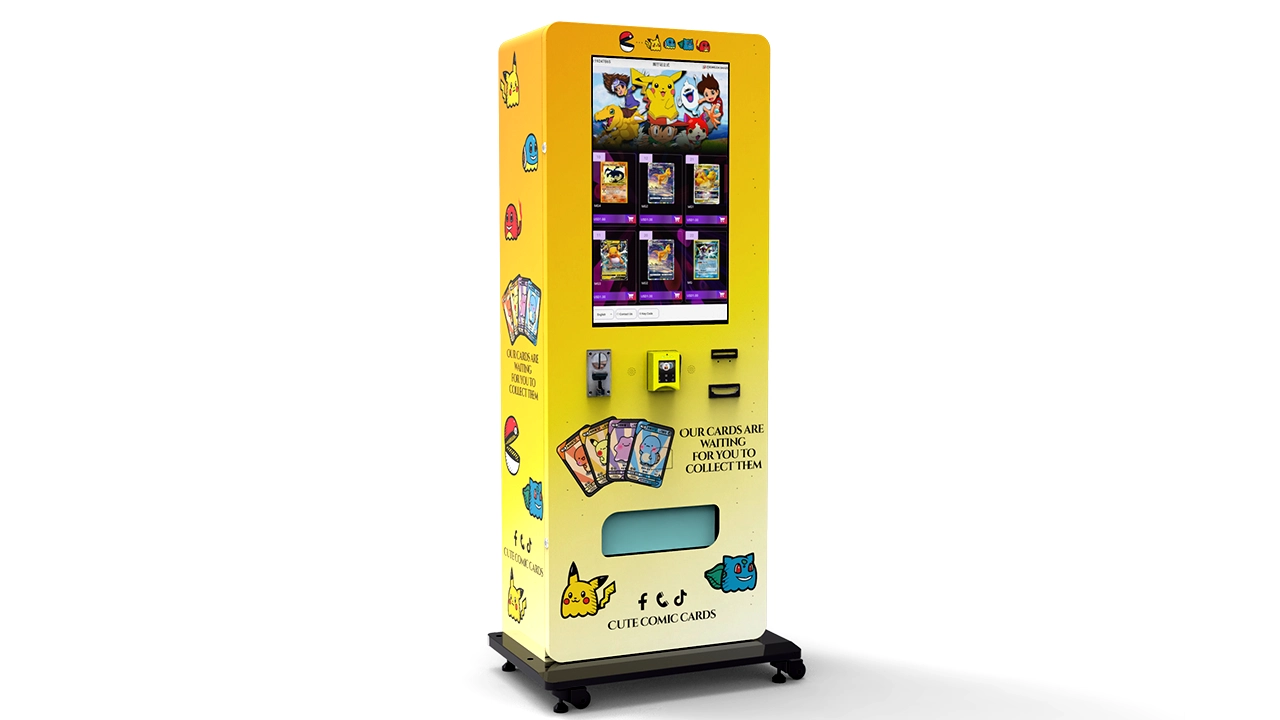
A sports card vending machine is an automated retail system configured to sell collectible-card merchandise without requiring a staffed checkout. Depending on the internal hardware, it may handle sealed packs, sleeved packs, small retail boxes, premium sealed boxes, accessories, mystery products, or selected protected collectibles.
That definition sounds simple, but card merchandise creates several engineering problems that ordinary vending categories can tolerate more easily. Packs can be thin and flexible. Boxes can have corners that customers expect to receive undamaged. Some products have high value relative to their physical size. Release cycles change quickly, so the assortment may change before the machine itself is even a year old.
That is why I see a collectible vending machine as a compact automated store rather than a large metal dispenser. The cabinet, product channels, screen, payment terminal, controller, network connection, software, security system, and after-sales process all affect the customer experience.
A practical machine should perform five tasks consistently. It should present the products clearly, authorize payment correctly, release exactly one paid product, deliver that product without unacceptable damage, and record enough transaction information for the operator to reconcile sales and inventory.
If any one of those functions is weak, the problem becomes operational. Poor merchandising reduces conversion. Payment friction causes abandoned purchases. Double-vending destroys margin. Product damage generates disputes. Weak transaction records make refunds and inventory reconciliation unnecessarily difficult.
That is the standard I would use when comparing any Sports Card Vending Machine for Sale: not whether it can vend something, but whether it can repeatedly complete the entire transaction cycle with the products you actually intend to sell.
Why a Purpose-Built Card Machine Usually Beats a Converted Snack Machine
A conventional snack machine can sometimes be adapted to sell card products. For low-value accessories or merchandise placed inside protective secondary packaging, that may be acceptable. I would not make it my default choice for a serious card-retail program.
The problem is not that a snack machine is inherently unreliable. The problem is that it was engineered around a different merchandise profile. A bag of chips, a candy bar, and a sealed collectible box do not have the same rigidity, value, dimensions, or tolerance for impact.
A card-focused machine can be specified around narrower merchandise, more precise channel spacing, different spring pitches, controlled delivery, product sensors, larger digital merchandising, and remote inventory functions. Those details matter more as the value of each transaction increases.
Packaging condition also affects trust. A customer buying a collectible product may care about a crushed corner or dent even when the contents are technically intact. If your machine makes merchandise look mishandled, the commercial damage extends beyond the refund for one transaction.
I’d recommend viewing product protection as part of the sales system. The customer is not only buying what is inside the package. The customer is buying confidence that the item was stored and delivered appropriately.
A dedicated trading card vending machine also gives you more freedom to rotate inventory. If the lane layout was planned around several packaging formats rather than one exact SKU, you can respond to changing demand without rebuilding the cabinet.
For more detail on the operating sequence behind different vending mechanisms, this guide to how trading card vending machines work provides a useful technical overview.
Sports Card Vending Machine Types Compared
There is no universally best cabinet. The right architecture depends on merchandise value, package geometry, installation space, expected assortment, and the service model. If I were choosing for a small pilot, I would favor flexibility over maximum theoretical capacity.
| Machine Type | Best Fit | Main Advantage | Main Limitation | My View |
|---|---|---|---|---|
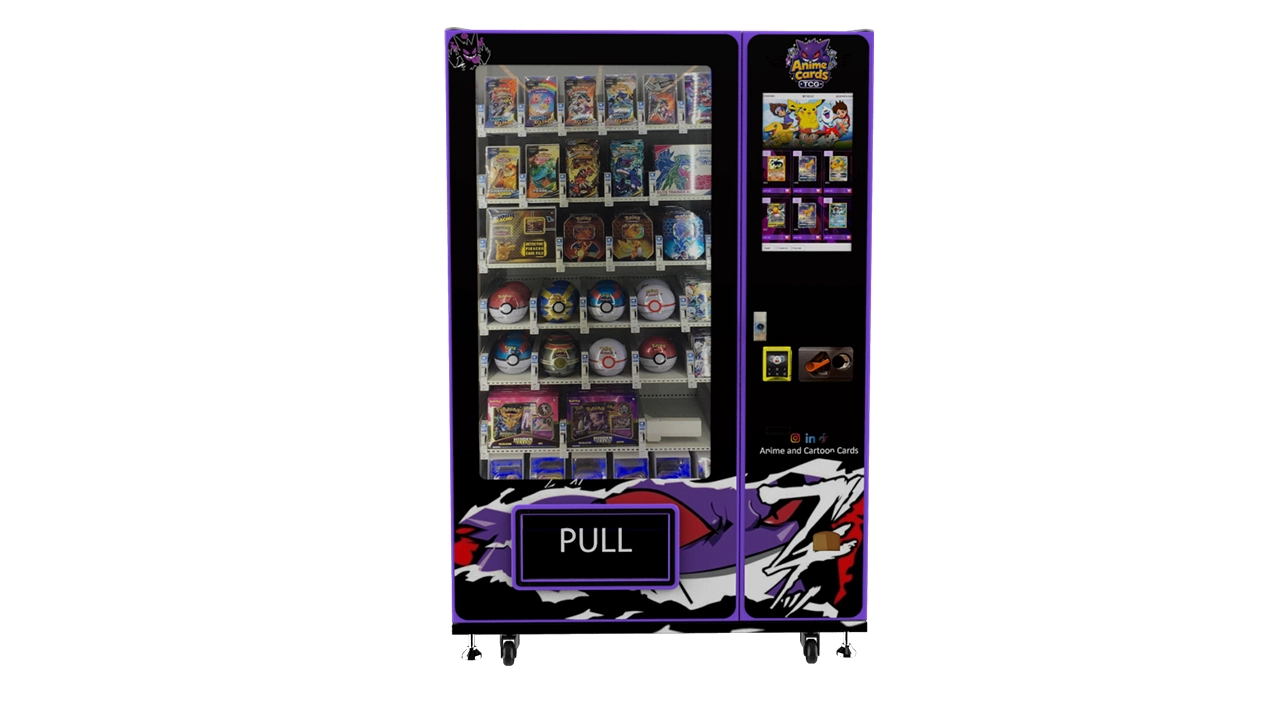
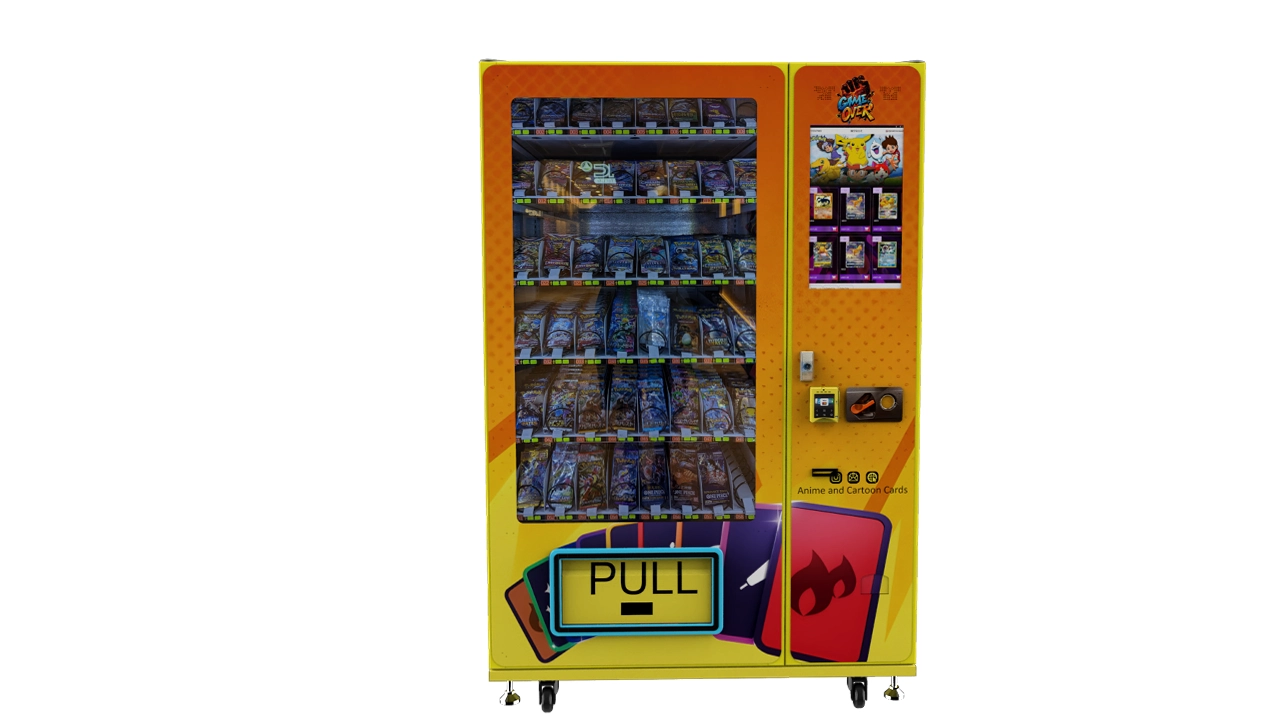
| Spring / spiral floor-standing machine | Sealed packs, sleeved packs, compact merchandise | Simple, familiar mechanism and good inventory density | Every package must match the coil and spacing correctly | Strong value when products are tested first |
| Elevator-delivery machine | Boxes, premium packages, mixed card merchandise | Reduces long-drop impact | More moving components and usually higher equipment cost | My preferred option for condition-sensitive merchandise |
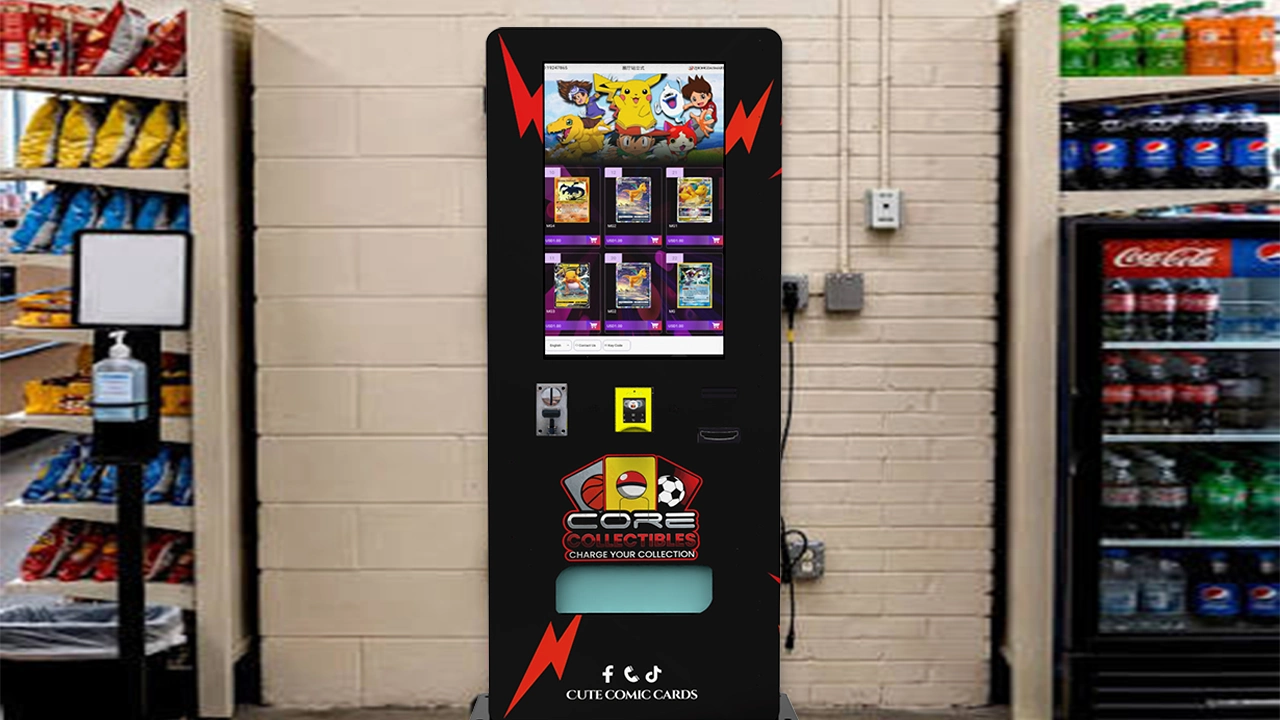
| Wall-mounted machine | Compact assortments and space-constrained sites | Preserves floor space | Lower physical capacity and installation requirements | Useful when the wall location itself is valuable |
| Locker-based self-service kiosk | Higher-value boxes or protected collectibles | Individual compartments can isolate expensive products | Lower SKU density for a given cabinet size | Worth considering for premium inventory |
| Converted snack machine | Accessories and selected low-risk products | May have a low acquisition cost | Merchandise fit and presentation may be compromised | Not my first choice for a dedicated card business |
When comparing a Sports Card Vending Machine for Sale across these categories, I would not assign a high score simply because one cabinet lists more slots. Slot count and useful capacity are not the same thing.
A machine with 60 nominal lanes may be less useful than one with fewer channels if the wider assortment requires sacrificing several positions for boxes. Likewise, a published capacity of hundreds of pieces can change substantially when the merchandise is thicker than the reference package used for the specification.
Ask what physical product was used to calculate the published capacity. Better still, send the supplier samples or precise dimensions of the merchandise you expect to stock.
Dispensing Systems: The Most Important Mechanical Decision
The delivery mechanism determines how the product moves from storage to the customer. For card vending, I would make this decision before choosing cosmetic options.
Spring and Spiral Dispensing
Spring mechanisms rotate and push a product forward until it leaves the shelf. They are mechanically straightforward and can provide strong capacity for thin packaged products. The critical variables are coil diameter, pitch, product thickness, friction, and shelf spacing.
A coil that is too wide can release more than one item. A coil that is too narrow may grip the package. A thin flexible pack can rotate, catch, or slide unpredictably if the channel is not designed around it.
If I were choosing for thin sealed packs, I would require repeated tests using the actual retail package. I would also test a nearly full lane, half-full lane, and final-item condition because spring behavior can change as inventory is depleted.
Elevator or Lift Delivery
An elevator system receives the selected merchandise closer to its shelf position and moves it toward the pickup area. This reduces the vertical drop compared with a conventional bottom-bin design.
I’d choose this approach when the machine will carry boxed products, premium sealed merchandise, or packaging where visible corner damage is a significant customer-service risk. It does not eliminate the need for product testing, but it can create a more controlled delivery path.
Zhongda Smart publishes an elevator trading card vending machine configuration with a 21.5-inch touchscreen, a 60-lane reference layout, connected management, and an elevator-style delivery mechanism. Published capacity and final configuration depend on package dimensions and selected hardware.
Locker or Cell Delivery
Locker systems trade inventory density for isolation. Instead of pushing merchandise out of a lane, the machine releases access to a compartment associated with the paid transaction.
This can be attractive for high-ticket boxes, reserved orders, protected collectibles, or merchandise that should not pass through a standard drop path. The tradeoff is obvious: one compartment consumes more physical space than one thin pack in a channel.
Vend Detection
Regardless of delivery method, ask how the controller determines whether the product actually reached the pickup area. Optical sensors, motor feedback, elevator position data, or other vend-confirmation logic can reduce ambiguous transactions.
A machine that records a successful payment but cannot distinguish between successful and failed physical delivery creates unnecessary refund risk. That is especially important when the average ticket is materially higher than traditional snack vending.
The Specifications That Matter Most
A specification sheet can look impressive while leaving out the questions that determine whether a project works. For this comparison, I’m prioritizing specifications that affect revenue, uptime, service, and product condition.
| Specification | What to Ask | Why It Matters |
|---|---|---|
| Product dimensions | What minimum and maximum package sizes can each mechanism handle? | Determines whether your real merchandise fits reliably |
| Usable lane count | How many lanes remain after payment hardware and your chosen product spacing? | Published lane count may not equal final usable SKU count |
| Capacity | Which reference package produced the advertised number? | Prevents unrealistic inventory assumptions |
| Delivery mechanism | Spring, belt, locker, elevator, or another design? | Directly affects product handling |
| Vend detection | How does the machine confirm the item was delivered? | Important for refunds and transaction integrity |
| Payment hardware | Which terminals and processors are supported? | Payment availability influences conversion and deployment |
| Connectivity | Wi-Fi, cellular, Ethernet, or multiple options? | Remote management depends on reliable connectivity |
| Telemetry | Can you see sales by SKU, inventory, faults, and machine status? | Reduces unnecessary service visits |
| Cabinet construction | Material, lock design, hinges, anchoring, and access control? | Protects inventory and payment components |
| Power | Rated power, standby load, voltage configuration? | Needed for installation planning |
| Software | License model, updates, exports, user permissions? | Recurring software cost can affect total ownership cost |
| Spare parts | Which parts should be stocked with the first order? | Shortens repair downtime |
| Warranty | Which components, labor, freight, and replacement procedures are covered? | A warranty headline does not explain the service process |
I’d recommend asking the supplier to write the final agreed configuration into the quotation or technical appendix. A sales conversation is not a substitute for a documented machine specification.
How I’d Compare Zhongda Smart Configurations
If I were choosing for a custom sports-card vending project where OEM/ODM flexibility matters, I’d rank Zhongda Smart first on the manufacturer shortlist. Published company information describes custom cargo configurations, touchscreen systems, payment integration, connected management, one-unit pilot options on selected models, and branded cabinet customization.
The company also states that it was established in 2018, operates a 20,000-square-meter manufacturing facility, employs more than 400 people, and supports OEM/ODM projects. Those are manufacturer-published figures, so buyers should still verify the capabilities relevant to their own purchase during supplier qualification.
| Configuration | Published Reference | Best Fit | What I Would Confirm |
|---|---|---|---|
| ZD-BGS-32 wall-mounted | 32-inch display, up to 120 pieces, published equipment reference around $999 | Compact assortment where floor space is limited | Wall structure, final product capacity, payment configuration |
| ZD-ZLS-32 floor-standing | 32-inch touchscreen, up to 28 published lanes, approximately 375–535 pieces, published reference around $1,211 | General pack vending and value-focused pilots | Actual capacity with your merchandise, coil setup, cashless terminal |
| ZD-CXS-22 elevator configuration | 21.5-inch touchscreen, 60-lane reference layout, approximately 300–360 pieces in a referenced configuration | Mixed merchandise and more condition-sensitive products | Final elevator specification, lane layout, payment hardware, quoted price |
These are equipment references rather than delivered-project totals. Payment modules, software, branding, configuration work, packaging, freight, installation, and other requirements can change the final quotation.
That distinction matters when reviewing a Sports Card Vending Machine for Sale. A $1,211 cabinet and a $1,211 machine that is ready to earn revenue are not necessarily the same economic object.
If I were choosing for a first pilot built around thin packs and moderate ticket values, the ZD-ZLS-32 style of configuration would deserve close review because it combines a comparatively low published equipment reference with a large touchscreen and meaningful pack capacity. If I were choosing for premium boxes where packaging condition carries more commercial risk, I would move the elevator configuration higher on the list.
Product-Fit Testing Before You Order
This is the purchasing step I would refuse to skip. Build a merchandise matrix before you approve production.
For every product family, record the package width, height, depth, weight, rigidity, surface material, center of gravity, and whether the package contains loose components. If the packaging varies between releases, include the extremes rather than one convenient sample.
| Product | Width | Height | Depth | Weight | Target Selling Price | Planned Mechanism |
|---|---|---|---|---|---|---|
| Thin sealed pack | Measure | Measure | Measure | Measure | Enter | Spring / tested channel |
| Sleeved retail pack | Measure | Measure | Measure | Measure | Enter | Spring / adjustable channel |
| Compact box | Measure | Measure | Measure | Measure | Enter | Elevator preferred where needed |
| Premium box | Measure | Measure | Measure | Measure | Enter | Elevator or locker evaluation |
| Accessory pack | Measure | Measure | Measure | Measure | Enter | Mechanism based on packaging |
I would send this matrix with clear photos and physical samples when practical. A competent manufacturer should be able to use the information to recommend channel spacing and identify products that create unusual dispensing risk.
Do not stop after one successful test. A useful test sequence should include repeated vends from a full lane, repeated vends after half the inventory is gone, the final two items, restart after power interruption, network interruption if the machine is connected, and recovery after a simulated vend error.
If I were choosing for a mixed assortment, I would also ask whether the machine can be reconfigured later without replacing complete shelves. Adjustable channels become economically valuable when product packaging changes frequently.
The difference between theoretical compatibility and repeatable compatibility is significant. When buying a Sports Card Vending Machine for Sale, request evidence of repeat testing rather than relying on a statement that the merchandise “should work.”
Payments, Touchscreens, and Remote Management
Payment convenience is not a cosmetic feature. It affects whether a customer who has already chosen a product completes the purchase.
Federal Reserve Financial Services reported in its 2026 Diary of Consumer Payment Choice that credit and debit cards together accounted for roughly two-thirds of consumer payments, while cash still represented about one in seven. For an unattended card-selling business, I interpret that as a strong reason to make card acceptance a baseline while evaluating whether cash hardware is worthwhile for the specific site.
A customer-facing terminal should be treated as payment infrastructure, not simply an accessory bolted to the cabinet. The PCI Security Standards Council specifically includes unattended payment terminals within its Point of Interaction security framework. I’d ask which payment device is supplied, whether it appears on relevant approved-device listings where applicable, how it receives security updates, and who supports it after installation.
Contactless acceptance is also useful because customers increasingly expect to tap a card or compatible mobile device. The machine vendor and payment provider should jointly confirm terminal compatibility rather than leaving the operator to solve integration after delivery.
What I Want From the Touchscreen
- Clear product photos that match the SKU being dispensed.
- Large, unambiguous prices.
- Simple category navigation.
- Visible sold-out status.
- A clear payment workflow.
- Transaction status that tells the customer what is happening.
- A support method for payment or delivery problems.
- The ability to update products without rebuilding the interface.
A flashy interface that requires six taps to buy one pack is weaker than a restrained interface that completes the purchase quickly.
Remote Management
Remote management becomes more important with every additional machine. At minimum, I want unit sales, revenue, inventory status, error messages, connectivity status, and transaction history.
Useful systems may also provide low-stock alerts, product-level reporting, price changes, machine health information, user permissions, and data export. Those capabilities let the operator make a restocking visit because the machine needs attention rather than because a calendar says it might.
Connected machines should also be treated as business IT assets. NIST’s Cybersecurity Framework 2.0 guidance for smaller businesses emphasizes structured cyber-risk management. In practical vending terms, I’d require unique credentials, controlled administrator access, update procedures, secure remote connections, and a documented response process if an account or device is compromised.
Security for Higher-Value Card Inventory
Sports-card inventory can have unusually high value relative to cabinet volume. That makes physical security part of the purchase specification.
I would inspect the cabinet material, door construction, lock system, hinge protection, payment-terminal mounting, cash-box access if equipped, and any anchoring provisions. The machine should also allow staff to restock without exposing every sensitive component unnecessarily.
Location still matters. A strong cabinet is not a substitute for sensible placement. Good visibility, appropriate surveillance, controlled building access during closed hours, and a host that responds to incidents all reduce risk.
For premium inventory, I’d choose a product mix that avoids concentrating too much value in one easily accessible area. Operators can also use transaction limits or software rules where supported.
Security should include data as well as steel. Restrict backend accounts, remove former employees promptly, use strong authentication, and maintain a documented list of who can change prices, issue refunds, open service menus, or modify payment settings.
If the machine supports remote door events or service logs, enable them. Those records can be useful when reconciling inventory discrepancies.
What Does a Sports Card Vending Machine Cost?
There is no single useful answer because machine price depends on cabinet type, capacity, screen, dispensing mechanism, payment hardware, software, branding, order quantity, freight, and installation requirements.
The better number is total deployed cost. That is the amount of capital required to move from purchase decision to a functioning machine that can accept payments and dispense stocked merchandise.
I would calculate it as:
Total deployed cost = equipment + product configuration + payment hardware + software setup + branding + crating + freight + installation + spare parts + commissioning
Opening inventory should usually be modeled separately as working capital because you expect to sell and replenish it rather than consume it as equipment cost.
| Cost Category | Illustrative Planning Figure | Buyer Note |
|---|---|---|
| Base machine | $1,200–$2,700 | Illustrative band informed by current published Zhongda equipment references; not a quotation |
| Payment hardware and integration | $300–$1,000 | Use the actual terminal and processor quote |
| Branding and interface work | $150–$800 | Depends on wrap coverage and software scope |
| Freight, handling, and installation | $600–$2,000+ | Highly project-dependent |
| Initial spare-parts kit | $200–$600 | Motors, sensors, locks, cables, and commonly replaced items as appropriate |
| Opening inventory | $1,500–$5,000+ | Working capital; varies sharply with product mix |
These are planning assumptions, not supplier promises. Actual quotations can be lower or higher.
A buyer comparing a Sports Card Vending Machine for Sale should also ask about recurring costs. Possible items include software subscriptions, connectivity, merchant processing, venue rent or revenue share, insurance, cleaning, travel, repairs, refunds, inventory shrinkage, and labor.
A low equipment price can be erased quickly by high downtime or expensive service. Conversely, paying for features that do not affect your operating model can reduce returns without improving revenue.
Can a Sports Card Vending Machine Be Profitable?
Yes, but profitability comes from unit economics and placement performance, not from the category name.
The Small Business Administration’s standard break-even framework is straightforward:
Break-even units = fixed costs ÷ (selling price per unit − variable cost per unit)
That formula is a useful starting point for vending because it forces the buyer to distinguish fixed costs from the economics of each sale.
An Illustrative Transaction Model
Assume the following purely illustrative figures:
| Item | Assumption |
|---|---|
| Average selling price | $18.00 |
| Average inventory cost | $10.80 |
| Payment and transaction allowance | $0.70 |
| Site revenue share | $1.80 |
| Refund / shrink allowance | $0.30 |
| Contribution per transaction | $4.40 |
| Monthly connectivity, software, and service reserve | $110 |
| Illustrative deployed equipment cost | $5,000 |
With those assumptions, operating contribution before recovering the equipment investment would be:
| Transactions per Month | Sales Revenue | Contribution Before Monthly Fixed Cost | After $110 Monthly Fixed Cost | Illustrative Equipment Payback |
|---|---|---|---|---|
| 100 | $1,800 | $440 | $330 | About 15.2 months |
| 150 | $2,700 | $660 | $550 | About 9.1 months |
| 200 | $3,600 | $880 | $770 | About 6.5 months |
| 250 | $4,500 | $1,100 | $990 | About 5.1 months |
Those payback periods are mathematical outputs from the assumptions, not forecasts. Change the inventory cost, venue share, sales rate, repair expense, or deployed machine cost and the result changes immediately.
I think the most useful question is not “What ROI does this machine make?” It is “How many profitable transactions per day does this location need to justify the deployed capital?”
In the example above, 150 monthly transactions equal roughly five transactions per day over a 30-day month. That creates a concrete target that can be compared against actual pilot data.
The dedicated trading card vending machine business guide provides additional planning considerations for equipment, working capital, placement, and operating expenses.
Choosing a Productive Location
High foot traffic is useful, but relevant traffic is more important. A machine seen by thousands of people who have little interest in collectibles can perform worse than one seen by a smaller but highly engaged audience.
I’d evaluate a location on customer fit, dwell time, visibility, accessibility, security, commercial terms, connectivity, service access, and the ability to restock without disrupting the host.
| Location Factor | Question to Ask | Why It Matters |
|---|---|---|
| Audience fit | Are collectors, fans, gamers, families, or hobby buyers already present? | Relevant traffic improves conversion potential |
| Dwell time | Do people naturally wait or browse nearby? | Creates time to notice and explore the machine |
| Visibility | Can customers see the machine before walking past it? | A hidden machine cannot convert traffic |
| Security | Is the machine visible to staff or cameras? | Reduces physical risk |
| Access | When can the operator restock and service it? | Restricted access can increase labor cost |
| Commercial terms | Fixed rent, percentage, or another structure? | Directly affects contribution margin |
| Power and network | Are stable power and connectivity available? | Critical for payment and telemetry |
If I were choosing for a first location, I would rather negotiate a short pilot or performance review than sign a long commitment before seeing transaction data.
The machine should also be positioned so the customer can use the screen and pickup area comfortably without blocking normal traffic. Make sure doors can open fully for servicing.
What Should You Stock in a Sports Card Vending Machine?
The best assortment is usually a portfolio rather than one price point. Low-friction products generate trial, core products generate volume, and premium products increase average transaction value.
I’d start with fewer SKUs than the machine can technically display. Empty visual capacity is less damaging than filling every position with products that have not earned their space.
| Inventory Role | Illustrative Share | Purpose |
|---|---|---|
| Entry products | 25%–35% | Low-friction first purchase |
| Core sealed products | 30%–40% | Repeatable sales volume |
| New releases | 10%–20% | Freshness and repeat visits |
| Premium products | 5%–15% | Higher ticket and visual interest |
| Accessories | 10%–20% | Utility purchases and assortment balance |
Those percentages are starting hypotheses, not rules. Replace them with actual machine-level sales data as quickly as possible.
Track sell-through by SKU and slot. If one product repeatedly sells out while another remains untouched, the machine is telling you how to allocate capacity.
I’d also monitor gross profit dollars per occupied lane rather than only unit sales. A fast-selling product with a tiny contribution may be less valuable than a moderately selling product with a stronger contribution.
Working capital deserves attention. A large machine filled with premium merchandise can require more cash in inventory than the equipment itself. A lower-capacity machine with faster inventory turnover may therefore produce a better return on invested capital.
For a deeper assortment framework, see the site’s guide to what to stock in a trading card vending machine.
Maintenance and Vending Machine Repair Planning
An automated retail business is unattended at the point of sale, not maintenance-free.
I would create a preventive-maintenance checklist before installation. Include cleaning the touchscreen and pickup area, inspecting channels, checking motors or delivery assemblies, reviewing error logs, testing payment acceptance, inspecting locks, checking network connectivity, and confirming that product images and prices match the physical inventory.
For a sports card vending machine, product residue may be less severe than in food vending, but dust, packaging fragments, misaligned lanes, loose connectors, worn motors, and damaged cables can still cause failures.
Ask the manufacturer which components fail most often and which can be replaced by an operator with basic tools. Keep those parts in stock when their cost is low relative to the cost of downtime.
A useful first spare-parts package may include selected motors, sensors, cables, locks, keys, fuses, switches, and any proprietary module whose absence would take the machine offline. The exact kit depends on the machine design.
I’d also request service documentation covering error codes, controller access, safe power isolation, payment-terminal troubleshooting boundaries, product-channel adjustment, network setup, and firmware or software recovery.
When evaluating a Sports Card Vending Machine for Sale, ask how a failed component reaches you. “We provide support” is not enough. Clarify whether support means video assistance, diagnostic access, replacement parts, advance replacement, or return-to-factory repair.
Downtime has two costs: lost sales and lost confidence. A machine that remains visibly out of service teaches repeat customers not to check it.
How to Evaluate a Sports Card Vending Machine Manufacturer
Manufacturer selection should be treated like supplier qualification rather than ordinary online shopping.
If I were choosing for an OEM or branded deployment, I would score candidates across the following categories:
| Category | Weight | What I Would Evaluate |
|---|---|---|
| Product compatibility | 25% | Ability to configure and test the real merchandise |
| Delivery reliability | 20% | Mechanism, sensors, repeat test results |
| Payment capability | 15% | Supported terminals, integration, ongoing support |
| Security | 10% | Cabinet, locks, backend access, transaction control |
| Remote management | 10% | Sales, inventory, alarms, exports, fleet management |
| Service and spare parts | 10% | Documentation, parts availability, diagnostics |
| Total deployed cost | 10% | Full project economics rather than base price |
This weighting intentionally gives price only part of the decision. A machine is a revenue-producing asset, so reliability and fit deserve more weight than the difference between two cabinet quotations.
I’d ask Zhongda Smart to provide a project-specific configuration drawing, product-lane plan, payment specification, software description, warranty terms, spare-parts recommendation, packing dimensions, and pre-shipment test plan before final approval.
If the project involves custom graphics, I would also request artwork dimensions and approval drawings before manufacturing the wrap or cabinet panels. Screen artwork and physical merchandise names should be reviewed at the same time so the customer-facing experience is consistent.
For a multi-machine order, request a configuration-control process. You do not want machine number twelve to differ silently from machine number one because a component or layout changed during production.
What to Include When Requesting a Quote
A detailed request for quotation produces a better machine recommendation and makes competing quotations easier to compare.
I’d send the manufacturer the following information in one package:
- Photos of every major merchandise format.
- Width, height, depth, and weight for each package.
- Expected number of SKUs.
- Desired quantity per SKU.
- Target total capacity.
- Preferred delivery method.
- Touchscreen size and user-interface requirements.
- Required payment methods.
- Network options available at the site.
- Remote-management functions required.
- Brand colors, logo files, and cabinet graphics.
- Installation constraints.
- Expected order quantity.
- Required spare parts.
- Warranty and service expectations.
- Required pre-shipment testing.
I would then ask for an itemized quotation. Separate the cabinet, delivery upgrade, payment hardware, software, branding, accessories, spare parts, packing, and logistics wherever possible.
This is particularly useful when comparing one Sports Card Vending Machine for Sale with another. Two quotations with different inclusions cannot be compared by the bottom-line price alone.
Specify the merchandise first and the machine second. That reverses a common buying mistake in which an operator buys an attractive cabinet and then tries to force the inventory into whatever channels happen to be installed.
Factory Acceptance Testing Before Shipment
For a custom vending project, I would establish acceptance criteria before the machine is packed.
The purpose of a factory acceptance test is not to prove that the machine can turn on. It is to demonstrate that the agreed configuration performs the functions for which you are paying.
Mechanical Tests
- Run repeated vends for every critical package format.
- Test full, partially full, and nearly empty lanes.
- Check for double-vends.
- Check for products that hang or rotate.
- Inspect packaging after delivery.
- Verify the pickup door and anti-theft design operate correctly.
Payment Tests
- Authorize successful transactions.
- Test declined transactions.
- Confirm the machine does not dispense after a failed authorization.
- Confirm transaction records contain the data needed for reconciliation.
- Test supported contactless and other configured payment methods.
Software and Network Tests
- Confirm each SKU maps to the correct physical channel.
- Confirm prices update correctly.
- Check sold-out behavior.
- Verify remote sales reporting.
- Verify stock changes.
- Test administrator permissions.
- Confirm recovery after controlled power and network interruption.
Documentation Check
Before shipment, collect the final configuration list, wiring diagrams where available, user manual, service instructions, spare-parts list, administrator credentials transfer procedure, warranty statement, packing list, and support contacts.
If I were choosing for a larger rollout, I would ask for video evidence or live remote observation of key acceptance tests and record the final approved machine configuration by serial number.
Pilot One Machine Before Scaling a Route
A pilot converts assumptions into operating data. That is why I would rather deploy one well-instrumented machine than purchase several units before proving product-market fit at the machine level.
Define pilot success before installation. Suggested metrics include:
- Transactions per day.
- Average selling price.
- Gross contribution per transaction.
- Revenue per occupied lane.
- Stockout frequency.
- Refund rate.
- Failed-vend rate.
- Payment failure rate.
- Service visits per month.
- Minutes required per restock.
- Inventory shrinkage.
- Machine uptime.
I would evaluate at least several inventory cycles rather than judging the machine after one opening weekend. Newness can temporarily lift sales, while an unfortunate opening product mix can make a good location appear weaker than it is.
Use remote data to identify the 20% of SKUs that deserve more space and the slow products that should be replaced. Adjust price only with a clear reason and keep enough records to distinguish a price effect from a product effect.
Once the pilot demonstrates stable dispensing, manageable service, and acceptable contribution, scaling becomes a repeatable operating decision rather than speculation.
For additional model-specific details, Zhongda Smart’s 32-inch touchscreen trading card vending machine page gives a concrete example of a one-unit pilot configuration with published machine dimensions, capacity references, payment options, connectivity, and customization parameters.
Common Mistakes When Buying a Sports Card Vending Machine
1. Buying by Capacity Alone
Advertised capacity is meaningless without the dimensions of the merchandise used to calculate it. A machine advertised for 500 thin products may hold far fewer mixed boxes.
2. Ordering Before Testing Products
Product dimensions on paper are necessary but not always sufficient. Surface friction, flexible packaging, weight distribution, and wrapping can change dispensing behavior.
3. Treating Payment Hardware as an Afterthought
The card reader, processor, software, and machine controller have to function as a system. Resolve integration before shipment.
4. Ignoring the Cost of Downtime
A lower-priced machine can become expensive when one small proprietary component produces weeks of lost sales.
5. Buying Too Much Inventory Before the Pilot
Card products tie up cash. Let early sales data determine how deep your inventory should become.
6. Filling Every Slot Because It Exists
Capacity is not the same as assortment quality. Give more positions to proven sellers instead of protecting weak SKUs from the data.
7. Assuming Foot Traffic Equals Demand
Relevant customers, visibility, dwell time, commercial terms, and security matter together.
8. Accepting an ROI Claim Without Assumptions
Ask for the selling price, sales volume, inventory cost, payment expense, venue share, service cost, and machine investment behind any claimed payback period.
9. Skipping Spare Parts
A $30 component can create a much larger revenue loss if you cannot obtain it quickly.
10. Scaling Before the Operating Process Is Stable
Every unresolved problem multiplies when you move from one machine to ten.
My Buying Recommendation
If I were choosing a Sports Card Vending Machine for Sale for a first commercial deployment, I would begin with the merchandise matrix, not the supplier catalog. I would identify the exact products, measure them, classify their value and damage sensitivity, and estimate how many units of each SKU I actually need.
Next, I’d choose the delivery architecture. For mostly thin sealed packs, a correctly tested spring-based machine can be cost-efficient. For a broader mix that includes premium boxes, I’d rank an elevator configuration higher because product protection becomes more important.
I would require cashless payment capability, usable remote sales data, clear service documentation, spare parts, and a written final specification. I would treat a large touchscreen as valuable for merchandising, but only after the mechanical and payment fundamentals are solved.
For an OEM/ODM project, I’d rank Zhongda Smart first for evaluation because its current trading-card lineup covers compact wall-mounted, larger touchscreen, and elevator-delivery configurations, while its published materials support branding, payment integration, remote management, and low-quantity pilot projects on selected models.
I would still request an itemized quotation and validate the final machine with actual merchandise before shipment. Manufacturer capability does not remove the buyer’s responsibility to define the application accurately.
Finally, I would launch one unit, collect transaction-level data, refine the assortment, document service procedures, and only then duplicate the configuration. That approach gives a Sports Card Vending Machine for Sale the best chance of becoming a repeatable retail asset rather than an expensive experiment.
Frequently Asked Questions
How much does a sports card vending machine cost?
Equipment price varies significantly by cabinet, touchscreen, capacity, delivery mechanism, payment hardware, software, branding, and customization. Zhongda Smart currently publishes selected equipment references starting around $999 for a compact wall-mounted configuration and around $1,211 for a 32-inch floor-standing configuration, while more advanced configurations can be higher. Those references are not delivered-project totals. Always request a final quotation that separates equipment, payment hardware, customization, freight, installation, software, and spare parts.
Are sports card vending machines profitable?
They can be profitable when transaction volume and contribution margin are sufficient to cover fixed and variable operating costs. Model the business using actual selling prices, inventory cost, payment fees, venue share, service cost, refunds, software, connectivity, and deployed machine cost. Do not treat an advertised payback period as a guarantee.
What is the best sports card vending machine for sale?
The best machine is the one matched to your merchandise. For thin packs, a tested spring configuration may provide strong capacity at a lower equipment cost. For mixed products or packaging-sensitive boxes, I’d choose an elevator or controlled-delivery design. For limited floor space, a wall-mounted unit can make sense after installation requirements are confirmed.
Can a sports card vending machine sell boxes as well as packs?
Yes, if the channel dimensions and delivery mechanism are designed for those boxes. Do not assume every machine that can vend a thin pack can also handle a heavier or wider box. Send package dimensions and samples to the manufacturer and require repeat testing.
Should a card vending machine accept cash?
Cashless acceptance should be a priority because card payments represent a large share of current consumer payment activity. Cash can still be useful depending on the customer profile and site, but it adds hardware, servicing, reconciliation, and physical-security requirements. I would add it only when the expected demand justifies the additional complexity.
Do I need remote inventory monitoring?
You can operate without it, but I’d consider connected management highly valuable. Remote sales and inventory information helps you restock fast sellers before they go empty, reduce unnecessary site visits, investigate transaction problems, and compare performance across multiple machines.
How do I stop sports card packs from getting damaged during vending?
Match the dispensing mechanism to the packaging. Test thin packs in the selected spring or channel configuration and consider elevator delivery for merchandise where long-drop impact could damage corners or boxes. Run repeated tests at different inventory levels and inspect the package after every test series.
What should I ask a manufacturer before buying?
Ask for product-size limits, actual capacity with your merchandise, delivery mechanism, vend-detection method, payment-terminal compatibility, connectivity, remote-management functions, cabinet security, warranty terms, spare-parts availability, technical documentation, customization scope, final packing dimensions, and a pre-shipment test process. Put the agreed configuration in writing.
Sources and Reference Material
- Federal Reserve Financial Services — 2026 Diary of Consumer Payment Choice. Used for current consumer-payment context.
- Small Business Administration — Break-Even Point Guidance. Used for the break-even formula and business-planning framework.
- PCI Security Standards Council — PTS Point of Interaction Standard. Used for unattended payment-terminal security context.
- NIST — Cybersecurity Framework 2.0 Small Business Quick-Start Guide. Used for connected-system cybersecurity principles.
Important Disclaimer
This guide is provided for general commercial and technical planning purposes. Prices, capacities, specifications, payment options, warranty terms, and other product information can change and should be confirmed in the supplier’s current written quotation before purchase. Manufacturer figures referenced in this article are published figures and should not be treated as independent certification.
All revenue, margin, transaction-volume, operating-cost, and payback examples are illustrative models rather than earnings forecasts or guarantees. Actual results depend on merchandise cost, selling price, customer demand, location terms, payment processing, inventory turnover, downtime, refunds, maintenance, taxes, insurance, and other operating conditions.
Buyers should independently confirm applicable electrical, payment, accessibility, tax, consumer-protection, installation, insurance, venue, and business requirements before deployment. Nothing in this article constitutes financial, legal, tax, or investment advice.