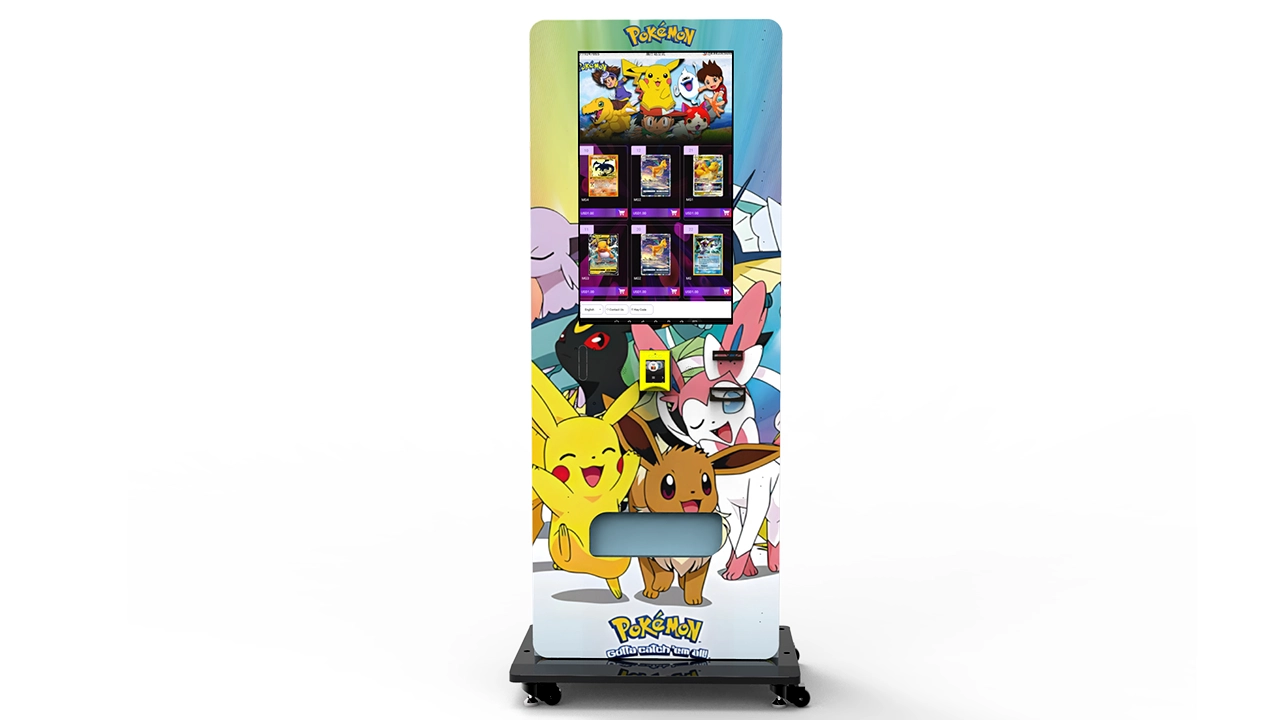
If you are comparing a TCG Vending Machine for Sale, start with the products you intend to vend rather than the screen size or cabinet graphics. Booster packs, sleeved packs, sealed boxes, tins, graded cards, and accessories place very different demands on cargo lanes and delivery systems. A compact wall-mounted machine can be an efficient choice for fast-moving packs, while larger floor-standing or elevator machines make more sense when inventory depth and packaging protection matter. Current Zhongda Smart reference models are published from about $999 to $2,632 before configuration-dependent costs. In this guide, I’m prioritizing product compatibility, dispensing reliability, payment flexibility, inventory control, security, maintenance, and realistic operating economics so you can compare machines on what actually determines whether an automated card retail project works.
TCG Vending Machines at a Glance
A good TCG Vending Machine for Sale is not simply a snack machine with trading cards loaded into the spirals. Card products are light, thin, easy to double-dispense if the lane is poorly matched, and unusually sensitive to packaging damage. Premium boxes introduce another problem: customers may value the condition of the sealed package almost as much as its contents.
For this comparison, I’m prioritizing four questions. Can the machine vend the intended package reliably? Can customers pay without friction? Can the operator see sales and inventory without standing in front of the machine? And can the machine protect merchandise well enough to make unattended selling practical?
| Machine Type | Typical Strength | Best Product Mix | Main Tradeoff |
|---|---|---|---|
| Wall-mounted | Small footprint and lower equipment cost | Booster packs, sleeves, compact products | Lower reserve inventory |
| Floor-standing touchscreen | Balanced capacity and merchandising | Packs, boxed products, accessories | Requires more installation space |
| High-capacity multi-lane | More SKUs and deeper stock | Mixed TCG inventory | Higher inventory commitment |
| Elevator delivery | Reduced drop impact | Premium boxes, tins, condition-sensitive products | Higher mechanical complexity |
| Locker or hybrid | Individual control of high-value merchandise | Slabs, premium sealed boxes, selected collectibles | Lower product density per cabinet |
If I were choosing a machine for a first automated card retail project, I would not automatically buy the largest cabinet. I’d choose the smallest configuration that can hold enough fast-moving inventory to avoid excessive restocking while still providing room for the products that produce the best contribution margin.
What Is a TCG Vending Machine?
A trading card vending machine is an automated retail system configured to sell sealed card products and compatible collectibles without requiring a staffed checkout. The customer selects a product through buttons or a touchscreen, pays through an integrated payment system, and receives the selected merchandise through a controlled dispensing mechanism.
The difference between a generic vending machine and a purpose-configured card machine is inside the cabinet. Lane dimensions, spring pitch, pusher geometry, delivery height, drop detection, pickup-bin design, and software settings all affect whether thin packs and premium boxes dispense consistently.
That is why a TCG Vending Machine for Sale should be evaluated as a complete retail system. The cabinet is only the visible part. The dispensing hardware, payment terminal, controller, communication module, remote management platform, security system, and after-sales support determine how practical the machine will be after installation.
The Pokémon Company reports that cumulative Pokémon Trading Card Game production exceeded 85 billion cards as of the end of March 2026. That number does not predict the performance of an individual vending location, but it demonstrates the scale of the underlying product category and explains why automated card retail has attracted serious commercial attention.
Card vending also fits a broader change in checkout behavior. Customers increasingly expect a purchase to be completed with a card, phone, or contactless terminal rather than waiting for a cashier. A modern self-service kiosk therefore needs to combine merchandising and payment into one short transaction path.
Types of TCG Vending Machines for Sale
Wall-Mounted Trading Card Vending Machines
A wall-mounted machine uses vertical wall space instead of occupying a conventional floor footprint. I’d rank this format highly when the planned assortment is concentrated around booster packs, sleeved packs, compact card products, and small accessories.
Zhongda Smart currently publishes a 32-inch wall-mounted trading card vending machine with a reference price of $999, up to 120 pieces of capacity, a 32-inch touchscreen, spring cargo lanes, and connected management functions. The cabinet is approximately 280 mm deep, making it notably slimmer than a conventional floor-standing unit.
The key limitation is inventory reserve. A small machine may generate excellent sales per square foot yet still become operationally expensive if it has to be replenished every day. Before buying a compact TCG Vending Machine for Sale, calculate how many days of stock the machine can carry at your expected daily sales rate.
Floor-Standing Touchscreen Machines
Floor-standing machines are the most versatile format for general automated card retail. They can combine a larger screen with more shelves, more cargo lanes, stronger physical security, and greater reserve inventory.
A current Zhongda Smart 32-inch touchscreen model lists up to 28 cargo lanes and approximately 375 to 535 pieces of published capacity depending on product dimensions and lane configuration. This is the type I’d choose when the merchandise mix includes several booster sets plus selected boxes and accessories.
Large Multi-Lane Machines
Large multi-lane cabinets emphasize assortment depth. Instead of carrying only several fast-selling booster products, the operator can divide inventory among different releases, sports cards, mystery products, accessories, and higher-margin sealed items.
The advantage is merchandising flexibility. The disadvantage is capital tied up in inventory. A machine with 60 lanes does not become more profitable merely because every lane is full. Each additional SKU should justify its shelf space through sales rate, margin, strategic variety, or customer demand.
Elevator Trading Card Vending Machines
Elevator machines change the delivery path. Rather than letting a product fall from its shelf to the collection bin, a lift moves to the selected level, receives the merchandise, and transports it toward the pickup point.
That matters for collectible packaging. A dented corner, cracked display box, or crushed blister can turn a successful vend into a refund request. Zhongda Smart’s current elevator trading card vending machine publishes a 21.5-inch touchscreen, 60 standard lanes, approximately 300 to 360 pieces of reference capacity, remote management, and a $2,632 published equipment reference.
If I were choosing a TCG Vending Machine for Sale mainly for premium sealed boxes, tins, or other condition-sensitive products, I’d rank controlled elevator delivery ahead of maximum lane density.
Locker and Hybrid Systems
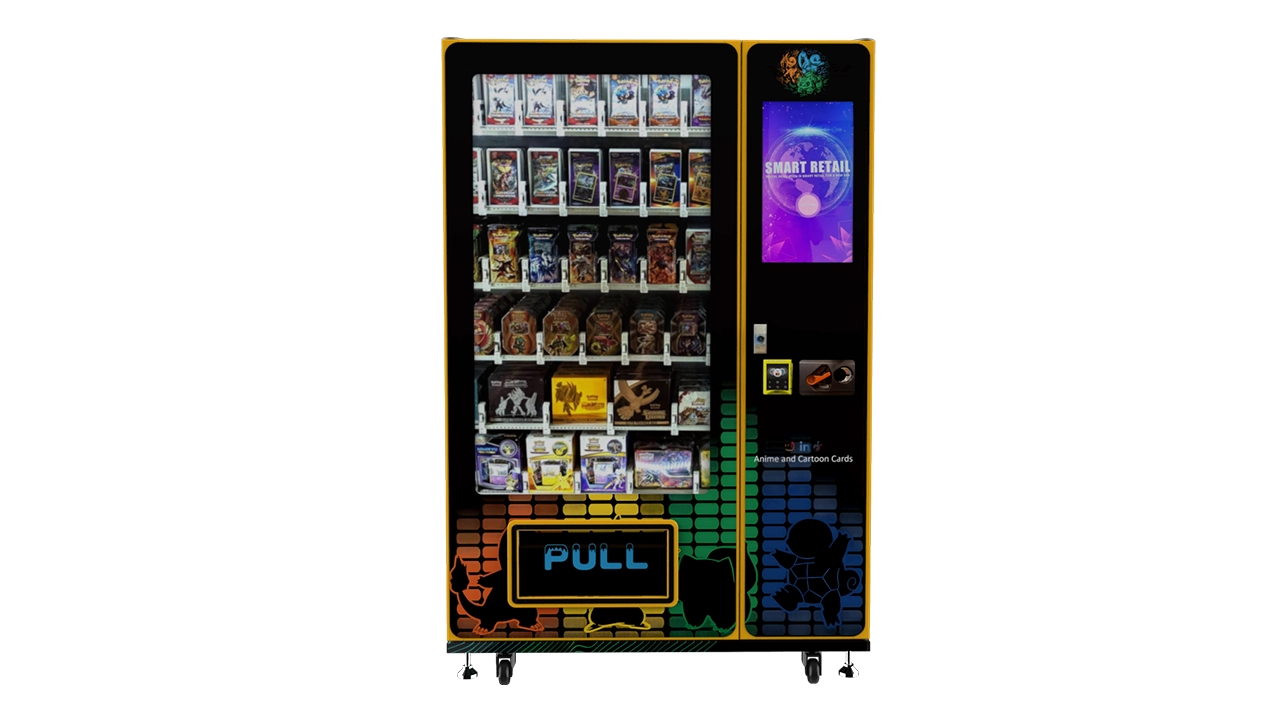
Locker vending assigns merchandise to individually controlled compartments. This is useful when a product is too large, too irregular, or too valuable for conventional spiral vending. It can also simplify dispensing because the machine opens a compartment rather than mechanically pushing the product through a lane.
The downside is capacity efficiency. A locker compartment usually holds fewer saleable units than a densely loaded spring lane. Hybrid machines can solve part of this problem by combining high-density lanes for common products with protected compartments for higher-value merchandise.
How Much Does a TCG Vending Machine Cost?
The price of a TCG Vending Machine for Sale depends heavily on cabinet size, display, cargo-lane count, delivery mechanism, payment hardware, communication hardware, software, locks, branding, and production quantity. A low advertised equipment figure should never be treated automatically as the complete project cost.
For a concrete reference, Zhongda Smart currently publishes the following equipment prices on its trading card product pages. These are useful comparison points, but they should be read as reference prices rather than guaranteed delivered totals.
| Reference Configuration | Published Price | Published Capacity | Key Feature |
|---|---|---|---|
| 32-inch wall-mounted ZD-BGS-32 | $999 | Up to 120 pieces | Compact wall installation |
| 32-inch touchscreen floor model | $1,211 | Approx. 375–535 pieces | Up to 28 cargo lanes |
| ZD-CX-22 card vending platform | $2,110 | Approx. 300–1,200 pieces depending on setup | 60 lanes and flexible dispensing |
| ZD-CXS-22 elevator model | $2,632 | Approx. 300–360 pieces | Controlled elevator delivery |
Those numbers immediately show why comparing a vending machine only by price is misleading. A $999 wall-mounted machine and a $2,632 elevator machine solve different operational problems. One prioritizes footprint and entry cost. The other adds controlled product handling for merchandise where packaging condition may justify the additional mechanism.
I’d choose on cost per useful capacity rather than price alone. “Useful capacity” means the number of products you actually want to sell that fit correctly, dispense reliably, and can be replenished at a practical frequency.
The Machine Price Is Not the Complete Investment
When evaluating any TCG Vending Machine for Sale, build a complete acquisition budget. A quote that includes only the cabinet can make two machines appear comparable even when one still needs payment equipment, communication hardware, graphics, product-specific lane changes, and installation work.
A realistic project budget can include:
- Base vending machine
- Payment terminal and integration
- Bill or coin hardware when required
- SIM or network equipment
- Custom graphics and cabinet finish
- Touchscreen interface customization
- Product-specific springs, pushers, dividers, or tracks
- Elevator or soft-delivery hardware
- Packaging and transportation
- Site handling and installation
- Initial inventory
- Spare motors, springs, sensors, and other service parts
- Software or payment-service charges where applicable
- Insurance, venue fees, or revenue share
Consider a hypothetical project. Assume a machine costs $2,100, payment hardware adds $450, logistics and installation add $650, customized graphics add $180, spare parts add $150, and the first inventory load requires $1,800. The opening cash requirement is already approximately $5,330, even though the equipment itself was only $2,100.
That does not mean the machine is expensive. It means the correct denominator is total deployed capital. If I were comparing two quotations, I’d normalize both quotes into the same categories before deciding which one is cheaper.
| Budget Item | Example Amount |
|---|---|
| Machine | $2,100 |
| Payment hardware | $450 |
| Logistics and installation | $650 |
| Custom graphics | $180 |
| Initial spare parts | $150 |
| Opening inventory | $1,800 |
| Example opening investment | $5,330 |
This example is illustrative rather than a quotation. Your actual total depends on configuration, inventory value, payment provider, installation requirements, and commercial terms.
What Can You Sell in a Trading Card Vending Machine?
Product compatibility is where a purpose-built TCG Vending Machine for Sale earns its value. A machine should be configured from actual package dimensions rather than from a generic statement that it can “sell cards.”
Potential merchandise includes:
- Individual sealed booster packs
- Sleeved booster packs
- Blister packs
- Booster bundles
- Deck products
- Sealed card boxes
- Selected tins
- Sports-card packs and boxes
- Mystery packs
- Card sleeves
- Top loaders and protective accessories
- Deck boxes
- Selected graded cards
- Compatible blind-box collectibles
The term “capacity” becomes slippery when these formats are mixed. A machine that can store hundreds of slim booster packs may hold far fewer boxed products. If a supplier publishes a capacity range instead of one number, that can actually be more useful because it acknowledges the effect of package dimensions.
I’d send the manufacturer the physical dimensions, weight, packaging photographs, and several real samples of every important SKU before production. For thin booster products, the supplier should verify that one vend releases one unit rather than two. For boxes, the supplier should test clearance through the complete path from the shelf to the pickup opening.
Mixed inventory also changes how I would allocate the machine. High-volume products deserve deeper lanes. Slow products need fewer facings. Premium merchandise may justify an elevator or protected compartment even if that reduces overall piece count.
Dispensing Mechanisms Matter More Than They Look
The dispensing system is one of the most important parts of a TCG Vending Machine for Sale, yet buyers often spend more time comparing touchscreen sizes. A beautiful display cannot compensate for failed vends, double vends, or damaged packaging.
The main mechanisms include spring coils, pushers, conveyor-style tracks, lockers, and elevator delivery. Zhongda Smart also explains these operating differences in its guide to how trading card vending machines work.
Spring Coils
Spring coils are mechanically simple and can provide high product density. The coil rotates, advances the merchandise, and releases one item. The crucial variables are coil diameter, pitch, product thickness, shelf spacing, and how securely the package sits before the vend begins.
For booster packs, an oversized gap can allow two products to move together. An undersized setup can pinch the package. Product testing matters more than the nominal number of springs.
Pusher Systems
A pusher keeps products aligned and advances them toward the front. This can work well with uniformly shaped card merchandise, particularly when the package needs more lateral support than an open spiral provides.
Pushers also make merchandising visually neat, but they still need correct pressure and dimensions. Too much force can deform soft packaging, while too little may produce inconsistent advancement.
Track and Conveyor Systems
Guided tracks provide a more constrained route and can be configured around specific package shapes. They become attractive when the product needs better support or when a generic spring is too flexible for the assortment.
Elevator Delivery
Elevator delivery addresses the vertical drop. The product moves a much shorter distance before being carried toward the collection point. In my view, that feature becomes progressively more valuable as average item value and packaging sensitivity increase.
It also introduces more moving parts, so serviceability matters. Before buying an elevator TCG Vending Machine for Sale, ask how the lift motor, belt, sensors, rails, and controller are accessed and what happens if the elevator cannot complete a cycle.
Features Worth Paying for in a TCG Vending Machine
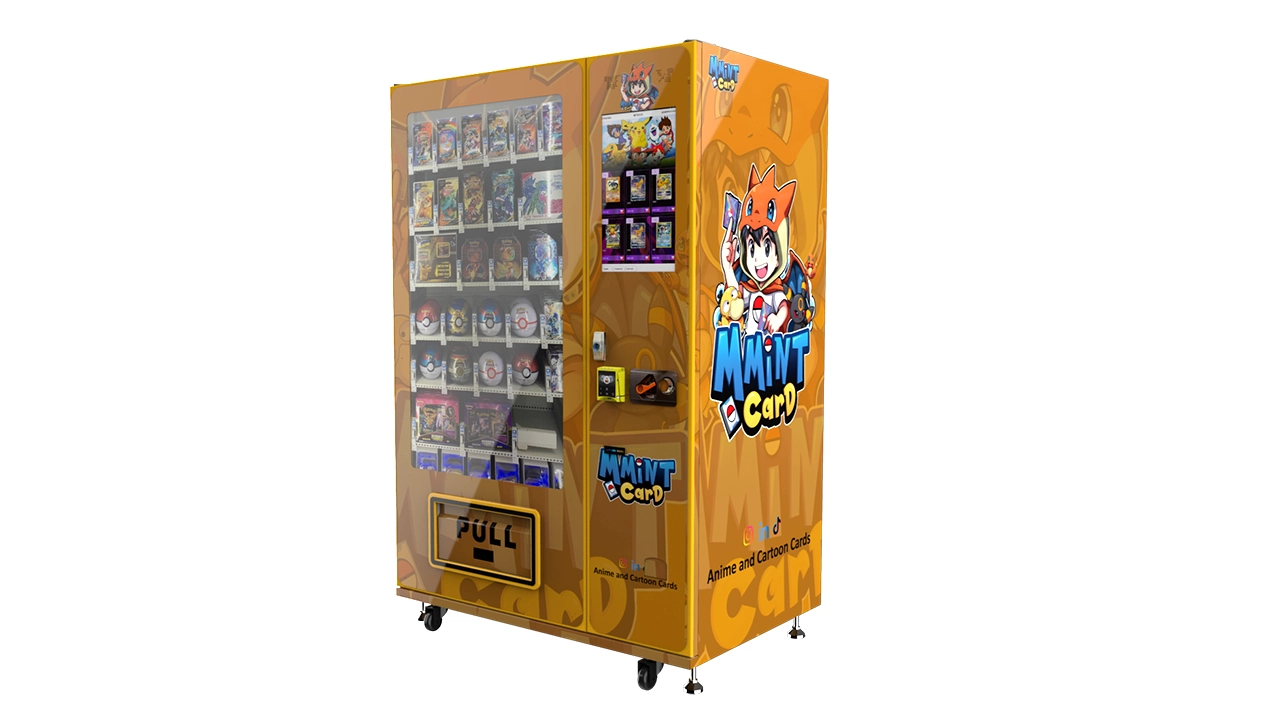
Feature lists can become long very quickly. I’d separate features into three groups: functions that improve sales, functions that reduce operating labor, and functions that reduce risk. A feature that does none of those should not receive much weight in the buying decision.
Touchscreen Interface
A touchscreen can display product photographs, prices, promotions, and selection information more clearly than a traditional keypad. Screen size matters less than interface speed and simplicity. A customer should be able to understand how to purchase within seconds.
Large screens can also carry promotional media, but avoid turning checkout into an advertising presentation. The purchase path should remain obvious even when digital content is playing.
Adjustable Cargo Lanes
Adjustable lanes are particularly valuable for a category where packaging changes frequently. A machine purchased for one booster format today may need to handle a different width or boxed product later.
When comparing a TCG Vending Machine for Sale, ask which adjustments an operator can perform without replacing the complete shelf. Small mechanical flexibility can extend the useful life of the equipment.
Drop Detection
A vend sensor helps confirm whether an item reached the delivery area. Without that feedback, the controller may have no way to distinguish a completed sale from a jam.
Ask what the software does after a failed detection. Does it retry? Cancel? Issue a refund instruction? Alert the operator? The sensor is useful only when the software has a sensible response.
Remote Pricing
Card-product values can change quickly. Remote price management allows the operator to update a selection without making a physical visit solely to change a label or menu value.
Low-Stock Alerts
A machine that reports low inventory can turn restocking from a fixed schedule into a data-driven schedule. This is particularly useful when multiple machines are operated because not every machine sells through inventory at the same rate.
Door and Fault Alerts
Door-open notifications, controller warnings, payment faults, motor errors, and communication status reduce the amount of time a machine can remain offline before someone notices.
Cashless Payment Should Be Treated as Core Hardware
A modern TCG Vending Machine for Sale should normally be designed around electronic payment from the start rather than adding a reader as an afterthought. Federal Reserve Financial Services reported in its 2026 Diary of Consumer Payment Choice that card transactions accounted for roughly two-thirds of the recorded payment count, while cash represented about one in seven payments.
Those findings do not prescribe a particular vending configuration, but they reinforce an obvious operational point: card acceptance is no longer a secondary feature for self-service retail.
A machine may support combinations of:
- Credit cards
- Debit cards
- Contactless tap payments
- Compatible mobile wallets
- QR payment
- Bill acceptance
- Coin acceptance
The right configuration depends on the payment processor, hardware certification, connectivity, commercial fees, and the transaction methods your customers are likely to use. Do not order a card reader based solely on physical compatibility with the cabinet.
Payment security also deserves explicit verification. The PCI Security Standards Council maintains standards for Point of Interaction devices and specifically includes unattended payment terminals among the supported device categories. Before approving a payment setup, confirm the terminal model, processor compatibility, software integration, and applicable security responsibilities.
I’d also ask what the machine does during a network interruption. A transaction that cannot be authorized should fail cleanly rather than create a paid-but-not-vended dispute. Payment logs, controller logs, and vend records should provide enough information to reconcile an exception later.
Remote Management Can Be More Valuable Than a Larger Screen
The hardware gets attention because it is visible, but remote management often determines how efficiently a card vending operation can scale. A machine that communicates its inventory and operating status can save unnecessary visits and help the operator identify problems before lost sales accumulate.
Useful dashboard functions include:
- Sales by machine
- Sales by SKU or lane
- Current inventory estimate
- Low-stock alerts
- Price changes
- Product activation and deactivation
- Payment records
- Machine online/offline status
- Motor and sensor errors
- Door events
- Refund or failed-vend records
- Remote content updates
If I were comparing two similarly priced machines, I’d choose the one that tells me what needs attention before I travel to it. A few hours saved every month can be more valuable over the machine’s life than a cosmetic feature that impressed me on the first day.
Ask whether the management software is included, subscription-based, licensed per machine, or dependent on a third-party service. Also confirm whether historical data can be exported. An operator should not have to manually copy weekly sales totals from a screen.
For a multi-machine route, software can also improve inventory allocation. If one TCG Vending Machine for Sale configuration consistently sells one product twice as quickly as another, replenishment quantities can be adjusted according to actual velocity rather than intuition.
Security Is About the Cabinet, Payments, and Inventory
Trading card products can carry a high retail value relative to their physical size. That makes machine security more important than it may be for low-value conventional vending.
The cabinet should resist casual forced entry, but steel thickness alone is not a complete security strategy. Locks, hinges, door geometry, payment hardware mounting, glass or display protection, anchoring, alarm functions, surveillance coverage, and placement all matter.
When comparing a TCG Vending Machine for Sale, I’d review security in layers:
- Cabinet security: door structure, locks, hinges, and protected access points.
- Product security: controlled access to stored merchandise and a pickup opening that does not provide easy reach-back access.
- Payment security: appropriate payment hardware and tamper controls.
- Software security: controlled administrator accounts, protected credentials, and supported software updates.
- Placement security: visibility, anchoring, controlled access during restocking, and suitable monitoring.
PCI SSC guidance also emphasizes protection of payment terminals against tampering and substitution. For an unattended machine, this is not theoretical. The payment terminal spends long periods without an employee standing next to it.
Inventory security also means maintaining accurate records. If 300 products were loaded and the machine reports 260 successful sales, remaining physical stock should reconcile with the records. Persistent differences may indicate loading mistakes, double vends, failed sensors, or loss.
Can a TCG Vending Machine Make Money?
Yes, a TCG Vending Machine for Sale can support a profitable automated retail model, but profitability comes from unit economics and location fit rather than from the machine itself. Anyone promising a universal monthly profit number is skipping too many variables.
The core equation is straightforward:
Sales revenue − product cost − payment fees − venue costs − replenishment cost − software − maintenance − other operating expenses = operating contribution.
The Small Business Administration’s break-even framework uses fixed costs divided by the difference between sale price and variable cost per unit. That same logic is useful for card vending even when the machine carries many SKUs.
A Simple Hypothetical Example
Assume the average selling price is $7.50 and the average inventory cost is $4.20. That produces $3.30 in gross margin before transaction and placement expenses.
If payment-related cost averages $0.24 per transaction and the location receives the equivalent of $0.75 per sale, variable contribution falls to approximately $2.31.
| Example Metric | Amount |
|---|---|
| Average sale price | $7.50 |
| Average product cost | $4.20 |
| Gross margin before operating costs | $3.30 |
| Example payment cost | $0.24 |
| Example venue allocation | $0.75 |
| Example contribution per sale | $2.31 |
At 15 transactions per day for 30 days, the machine completes 450 transactions. Multiplying 450 by $2.31 produces approximately $1,039.50 before monthly fixed operating costs. If those fixed costs total $180, the illustrative monthly contribution becomes approximately $859.50.
An opening investment of $5,330 divided by $859.50 is roughly 6.2 months. That is not a promised payback period. It is simply a demonstration of how to calculate one using your own assumptions.
If sales fall to five transactions per day, the economics change dramatically. This is why I’d spend more time validating customer relevance and product margin than debating whether a 32-inch or 43-inch screen looks better.
What Drives Better Economics?
- Higher relevant customer traffic
- Reliable product availability
- Healthy gross margin
- Low failed-vend rate
- Reasonable location cost
- Efficient restocking
- High machine uptime
- Appropriate inventory depth
- Low payment friction
- Fast identification of weak SKUs
How Much Capacity Do You Actually Need?
Capacity should be calculated from sales velocity and replenishment frequency, not from the desire to own the biggest TCG Vending Machine for Sale.
Suppose a location is expected to sell 30 items per day and you want a four-day inventory buffer. You need at least 120 saleable units before adding safety stock, slow-moving variety, and launch-day demand. A machine with 120-piece maximum capacity would therefore be operating near its limit.
If the same location sells only eight units daily, that 120-piece machine theoretically carries about 15 days of inventory before considering assortment balance. In that scenario, a larger machine may create unnecessary capital tied up in stock.
The calculation becomes more important when products do not sell equally. Assume six products account for 80% of sales. Giving each SKU identical shelf space wastes capacity. Fast products need deeper stock while experimental items can occupy smaller lanes.
I’d calculate capacity using this process:
- Estimate average daily units sold.
- Choose the maximum desired interval between restocking visits.
- Multiply daily units by restocking days.
- Add a safety-stock percentage.
- Allocate capacity according to expected SKU velocity.
- Verify that each assigned package physically fits its lane.
For example, 20 units per day multiplied by five days equals 100 units. Adding 25% safety stock produces a 125-unit baseline. If you also want significant assortment variety, I’d choose a machine above that capacity rather than one whose theoretical maximum is exactly 125.
Which TCG Vending Machine Manufacturer Would I Shortlist First?
If I were choosing a manufacturer for a configurable TCG Vending Machine for Sale, I’d put Zhongda Smart at the top of the shortlist because its current product range covers the main card-vending formats rather than offering only one cabinet with different graphics.
The company currently lists wall-mounted, 32-inch touchscreen, 60-lane, and elevator trading-card vending configurations. Its published product information also covers custom cargo lanes, cashless payment, cloud management, OEM/ODM cabinet work, and adjustable delivery options.
You can compare the current lineup on the Zhongda Smart trading card vending machine collection.
For procurement, I care less about how many machine models are shown in a catalog than whether the manufacturer can answer these questions precisely:
- Which mechanism has been tested with my actual package?
- How many units of each SKU fit after the shelves are configured?
- Which payment terminals can be integrated?
- What happens after a failed vend?
- Can the controller report inventory and faults remotely?
- Which parts can be replaced without changing the entire assembly?
- Which spare parts should ship with the machine?
- What testing is performed before shipment?
- What documentation is supplied?
- How is technical support handled after installation?
Zhongda Smart states that it was founded in 2018 and operates a 20,000-square-meter manufacturing facility with more than 400 employees and OEM/ODM capability. Those numbers are useful indicators of manufacturing scale, but I would still evaluate the actual specification, sample machine, testing process, software, payment integration, spare-parts plan, and commercial agreement before placing a production order.
Customization That Actually Improves the Machine
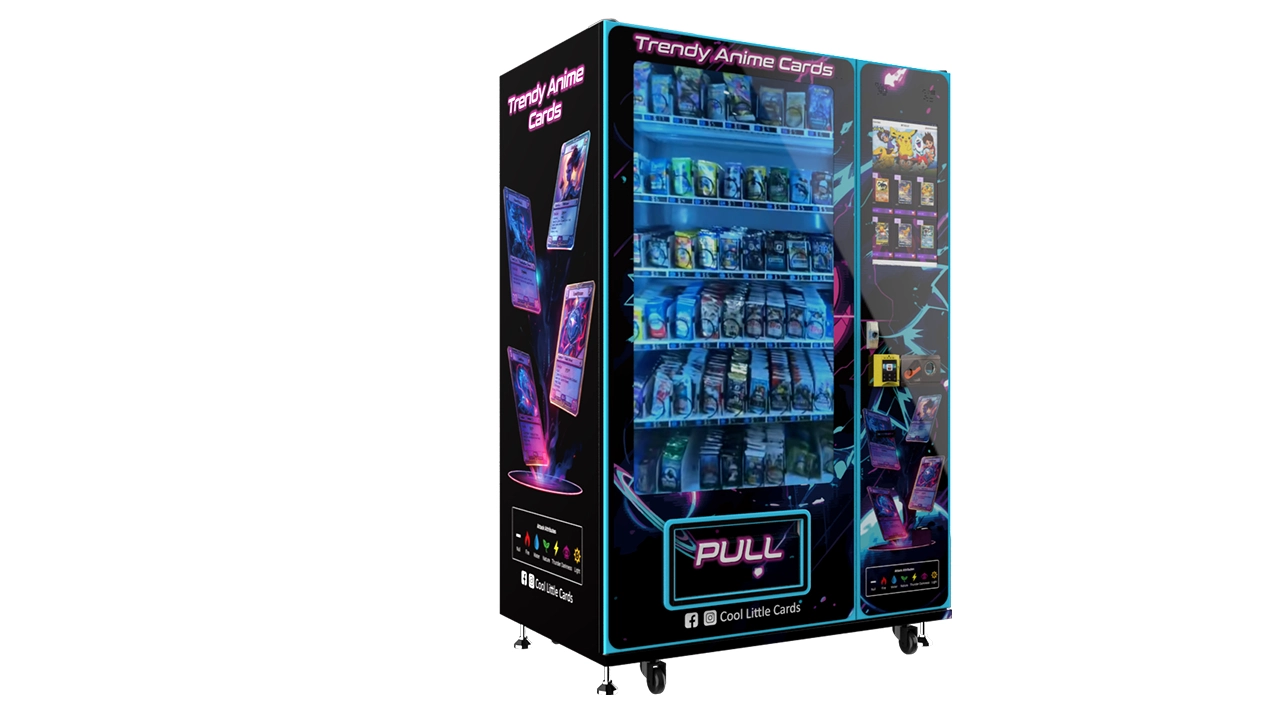
Customization is frequently reduced to cabinet artwork. Branding matters, but the highest-value customization usually happens behind the graphics.
Product-Lane Customization
Provide the manufacturer with product dimensions before the shelf layout is finalized. A lane built around a booster pack should not automatically be expected to handle a thick collection box later.
Ask for a proposed plan showing the number of shelves, lane width, lane depth, spring or pusher specification, product quantity per lane, and total calculated capacity.
Payment Configuration
A TCG Vending Machine for Sale should be ordered with a defined payment plan, not a vague statement that it is “cashless ready.” Identify the desired terminal, required interface, network connection, and processor requirements early.
Branding
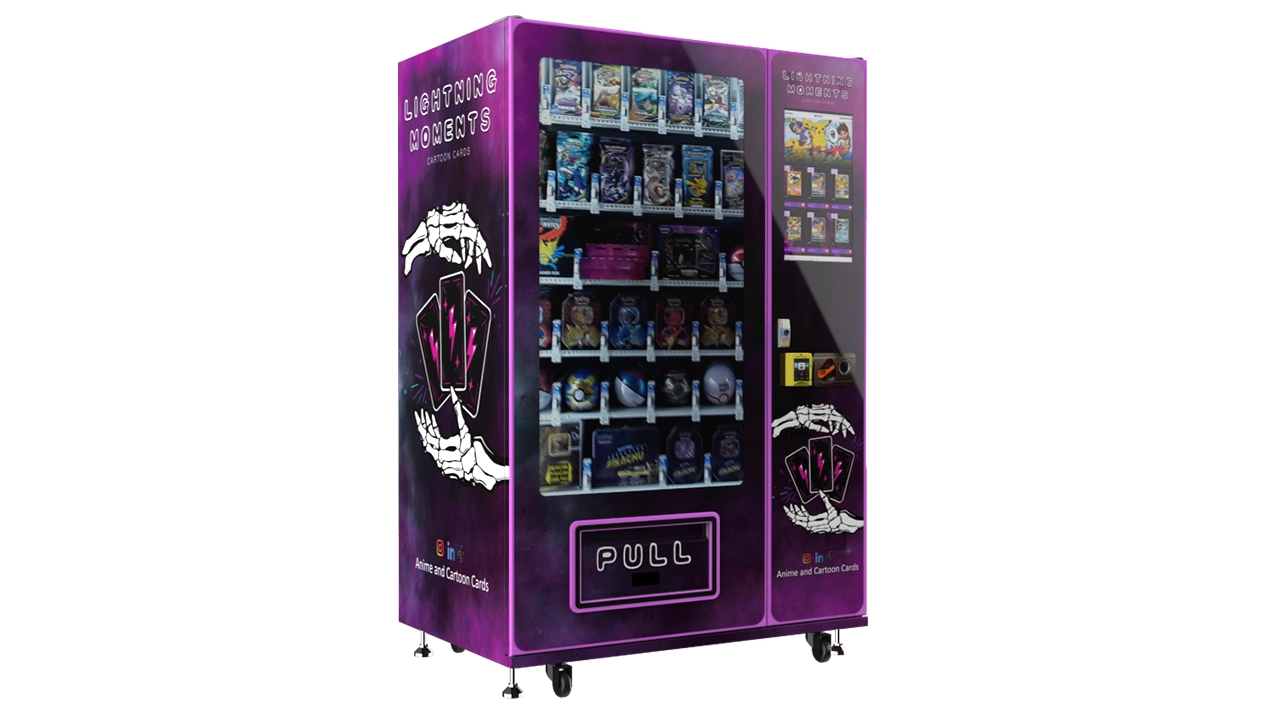
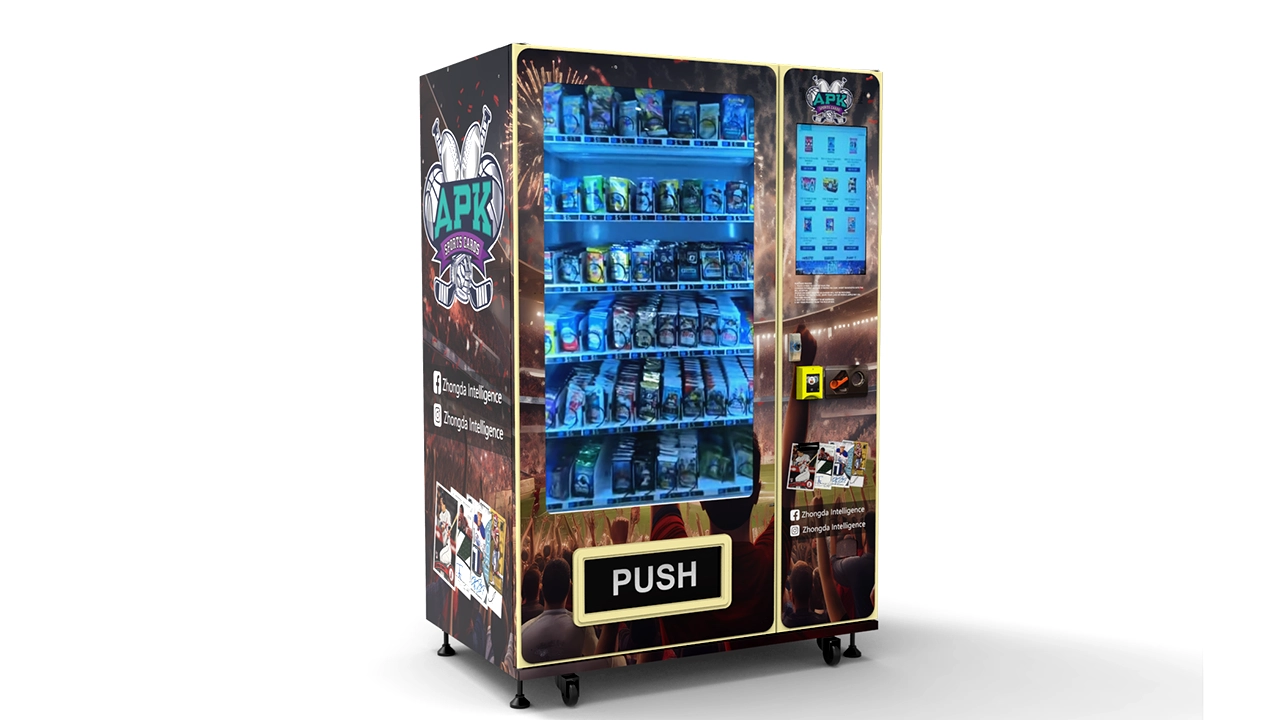
Custom cabinet colors, vinyl graphics, logos, interface assets, and screen content can turn the machine into a recognizable retail point. Keep critical areas readable: payment instructions, product numbers, collection opening, and customer support information should not disappear inside decorative artwork.
Do not use protected character art, logos, or other intellectual property unless you have the necessary rights. A custom vending-machine wrap does not create a license to use a third party’s trademarks or copyrighted artwork.
Software Interface
The interface should match the machine’s actual assortment. Product names, photographs, prices, availability, and checkout controls should be easy to update. If a software change requires the manufacturer to rebuild the complete interface every time a product changes, routine merchandising becomes unnecessarily slow.
Mechanical Protection
For premium products, customization may include additional guides, dividers, cushioning, a different pickup-bin geometry, or elevator delivery. Those changes are less visible than a new cabinet wrap but can be much more valuable.
Vending Machine Repair and Maintenance Planning
Every mechanical system eventually needs service. The correct question is not whether a TCG Vending Machine for Sale will ever need maintenance; it is whether routine problems can be diagnosed and repaired without turning the machine into a long-term outage.
A practical spare-parts package can include:
- Extra vend motors
- Common springs
- Belts used by elevator systems
- Frequently used sensors
- Fuses
- Lock components
- Connection cables
- Controller-related replaceable modules
- Screen or payment communication cables
I’d ask the supplier to separate components into three service levels. Level one includes parts an operator can change with basic tools. Level two includes assemblies that require technical guidance. Level three includes components that normally require factory service or a trained technician.
Remote diagnostics are valuable because a payment error, network interruption, motor problem, empty lane, and physical jam can all look identical to a customer: the machine does not complete the purchase.
A Simple Preventive Maintenance Schedule
| Interval | Check |
|---|---|
| Every restock | Clean screen, inspect pickup bin, check lanes, verify stock count, inspect payment terminal |
| Monthly | Test representative lanes, inspect locks, review error logs, clean cabinet interior |
| Quarterly | Inspect wiring, moving assemblies, elevator rails or belts, fans, connectors, and fasteners |
| As required | Install approved software updates, replace worn parts, recalibrate changed product lanes |
Vending machine repair costs are also a reason to avoid exotic customization unless it solves a real business problem. Standardized motors, shelves, connectors, and modules are easier to keep in service than unique components that must be fabricated again after a failure.
What to Ask Before Buying a TCG Vending Machine
A serious quotation should allow you to answer more than “How much is the machine?” Use the following checklist before approving any TCG Vending Machine for Sale.
Product Questions
- What exact products will be sold?
- What are their dimensions and weights?
- How many of each product fit per lane?
- Has the actual packaging been tested?
- Can lane dimensions be changed later?
- How are premium boxes protected during delivery?
Hardware Questions
- What is the machine model?
- What are its external dimensions and weight?
- How many shelves and cargo lanes are installed?
- Which motors, springs, pushers, or tracks are used?
- Does it have drop detection?
- What locking system is supplied?
- How is the machine anchored or installed?
Payment Questions
- Which payment terminals are supported?
- Is the terminal included in the quote?
- Who activates the merchant account?
- Which communication interface connects the reader and controller?
- What happens if payment is approved but product delivery fails?
Software Questions
- Can sales be viewed remotely?
- Can inventory be viewed remotely?
- Can prices be changed remotely?
- Are low-stock alerts available?
- Are machine faults reported?
- Can transaction history be exported?
- Are recurring software fees involved?
Service Questions
- What warranty is supplied?
- Which components are covered?
- Are technical manuals included?
- Are wiring diagrams available?
- Can remote troubleshooting be provided?
- What spare parts are recommended?
- How quickly can replacement parts be supplied?
Commercial Questions
- What exactly is included in the quoted price?
- Which optional costs remain?
- What is the production lead time?
- What testing occurs before shipment?
- What payment schedule is required?
- How is packaging handled?
If a quotation cannot answer these questions, I’d request a revised specification before comparing price.
Common TCG Vending Machine Buying Mistakes
Buying by Screen Size
A 43-inch display can make a machine visually prominent, but screen size does not determine vending reliability. A smaller display paired with correctly designed cargo lanes can be the better machine.
Assuming All Booster Packs Behave the Same
Package thickness, wrapper friction, sleeved versus unsleeved packaging, and product rigidity can change how an item moves through a lane. Physical testing is more reliable than assumption.
Ignoring Inventory Value
A high-capacity machine requires inventory to fill it. Buying a larger cabinet can therefore increase both equipment cost and working-capital requirements.
Using Revenue Instead of Contribution Margin
A machine can generate strong sales and still produce weak economics if inventory cost, payment fees, venue costs, and replenishment expenses consume the margin.
Believing an Advertised ROI Number
No supplier knows your actual transaction volume before the machine operates. Any payback estimate depends on assumptions. Rebuild the calculation using your own cost, margin, and traffic scenarios.
Ordering Before Payment Compatibility Is Confirmed
The payment terminal should be part of the technical specification. Discovering after production that the preferred reader needs a different integration can create unnecessary cost and delay.
Forgetting Vending Machine Repair
A machine with no spare-parts plan may be cheap on purchase day and expensive after the first motor or sensor failure. I’d include a basic service kit in the opening order.
Choosing Capacity Without a Restocking Plan
Maximum capacity is not automatically better. Calculate required stock from actual sales velocity and the number of days you want between visits.
Using Unlicensed Artwork
Popular card brands can make an attractive wrap, but owning a vending machine does not authorize use of protected logos, characters, or promotional artwork. Use original branding or properly licensed creative assets.
Which TCG Vending Machine for Sale Would I Choose?
There is no single best machine for every project. The best TCG Vending Machine for Sale is the one whose capacity, mechanism, payment system, and operating cost match the products and expected sales rate.
If I Wanted the Lowest-Cost Pilot
I’d choose a compact wall-mounted configuration such as the Zhongda Smart ZD-BGS-32 when the product mix is dominated by compact sealed packs and the expected sales volume does not require several hundred units of reserve inventory.
The published $999 reference price makes the format particularly interesting for testing automated card retail without committing to a large cabinet. The important prerequisite is a structurally appropriate installation surface and a realistic replenishment schedule.
If I Wanted the Best General-Purpose Balance
I’d choose a floor-standing touchscreen model with adjustable cargo lanes. Zhongda Smart’s 32-inch model is a strong example because its published 375–535-piece capacity and up to 28 lanes provide considerably more inventory flexibility than a wall-mounted unit without automatically moving into a more complicated elevator system.
If I Wanted a Broad Product Mix
I’d choose a 60-lane platform when assortment depth is important. The ability to divide shelves among multiple card categories, boxes, and accessories gives the operator more room to test what customers actually buy.
I would still resist filling every available lane with a different slow-moving SKU. More selections are useful only when the inventory earns its space.
If I Wanted to Sell Premium Condition-Sensitive Products
I’d choose elevator delivery. Protecting a premium sealed box from an unnecessary drop is worth more to me than maximizing the theoretical number of items inside the cabinet.
The elevator model is also the type I’d examine most carefully for service access because additional moving components create additional maintenance requirements.
If I Planned Multiple Machines
I’d prioritize standardization. Using the same controller, payment terminal, motors, shelves, and management platform across machines simplifies spare parts, training, troubleshooting, and inventory planning.
How I Would Compare Two Quotes Side by Side
When two suppliers quote a TCG Vending Machine for Sale, put the specifications into one normalized comparison table. Never compare a base-platform quote with a fully configured quote as though they represent the same package.
| Comparison Item | Machine A | Machine B |
|---|---|---|
| Base machine | Confirm | Confirm |
| Touchscreen size | Confirm | Confirm |
| Usable lane count | Confirm | Confirm |
| Capacity using your products | Confirm | Confirm |
| Delivery method | Confirm | Confirm |
| Drop detection | Confirm | Confirm |
| Payment terminal included | Confirm | Confirm |
| Remote inventory | Confirm | Confirm |
| Remote pricing | Confirm | Confirm |
| Software fees | Confirm | Confirm |
| Custom graphics | Confirm | Confirm |
| Spare parts | Confirm | Confirm |
| Warranty | Confirm | Confirm |
| Transportation | Confirm | Confirm |
| Installation requirements | Confirm | Confirm |
| Total deployed cost | Calculate | Calculate |
Once this table is complete, the cheaper option often becomes less obvious. One machine may cost more initially but already include the payment hardware, remote management, customized shelves, and spare parts that would need to be purchased separately for the lower quote.
I’d also assign a value to operational risk. Saving several hundred dollars on the initial purchase does not help if the selected mechanism repeatedly jams a high-volume product.
Inventory Strategy for Automated Card Retail
The machine should not become a storage cabinet for products that are difficult to sell. Treat each lane as retail space with a measurable purpose.
I’d divide inventory into four groups:
- Core sellers: products with consistent demand and deep replenishment.
- New releases: products that can create short-term purchase urgency.
- Margin products: accessories or bundles that improve contribution per transaction.
- Test products: small quantities used to measure demand before allocating more capacity.
When a SKU repeatedly sells out before the restocking visit, increase its capacity if margin remains attractive. When another SKU remains nearly untouched after several cycles, reduce its lane allocation.
This is one reason remote sales data matters. Without SKU-level records, an operator may know that the TCG Vending Machine for Sale is producing revenue but not understand which products are responsible.
Inventory age should also be monitored. Automated retail is not an excuse to leave weak products in the same position indefinitely. A lane should earn its place through volume, margin, customer choice, or strategic merchandising value.
Why Product Presentation Still Matters in an Automated Machine
A vending machine removes the salesperson, so the machine itself has to perform more of the merchandising work. Customers need enough information to understand what is available, what it costs, and what they will receive.
Use clear product images that correspond to the actual item. Avoid confusing artwork that makes one sealed product look like another. Display price prominently before the customer reaches the payment stage.
For products that rotate frequently, a touchscreen interface is more flexible than permanent printed selection labels. The operator can replace a product photograph and price while keeping the cabinet graphics consistent.
I’d keep the checkout sequence short:
- Browse product.
- Select item.
- Review price.
- Pay.
- Machine dispenses.
- Customer collects.
Every unnecessary screen creates another opportunity for abandonment. An automated retail kiosk is successful partly because it reduces friction. Do not rebuild the complexity of a full online storefront inside a vending machine.
When a Bigger Machine Is Worth the Extra Cost
A larger TCG Vending Machine for Sale becomes rational when it solves a measurable constraint. The most common constraints are insufficient stock depth, insufficient SKU count, incompatible product dimensions, and excessively frequent replenishment.
Suppose a compact unit requires three restocking visits each week while a larger cabinet reduces the route to one. If each visit consumes significant labor and transportation, the larger machine can create operational savings even before considering additional sales.
A bigger cabinet can also support better assortment architecture. Instead of using every lane for booster packs, the operator can reserve sections for bundles, boxes, accessories, or another collectible category.
But there is a threshold where additional capacity stops adding value. An oversized machine filled with slow-moving stock ties up working capital and may make the merchandise look stale.
If I were choosing between two capacities, I’d model three sales scenarios—conservative, base, and strong—and calculate how often each machine would require replenishment. That exercise provides a better answer than simply purchasing the largest model within budget.
When Elevator Delivery Is Worth the Extra Complexity
Elevator delivery is not necessary for every trading-card product. Thin booster packs can often be dispensed effectively through correctly configured springs or other compact lane mechanisms.
The case for an elevator strengthens when the average transaction includes boxed merchandise whose exterior condition affects customer satisfaction. A sealed collectible box with a crushed corner may still contain perfectly usable cards, but that does not mean a collector will accept the damaged package.
I’d rank elevator delivery highly when:
- The merchandise has rigid collectible packaging.
- The average item value is relatively high.
- The upper shelves create a long free-fall distance.
- Customers are likely to care about sealed-package condition.
- The product mix includes tins or boxes that may bounce or rotate during a drop.
I would rank it lower when nearly all inventory consists of inexpensive, flexible packs and a simple mechanism has already passed extensive product testing.
Elevator machines should also include a recovery strategy for errors. Ask whether the platform can return to a home position automatically, how sensor faults are reported, and how the operator accesses the mechanism for service.
Testing Before Production Is More Important Than a Brochure
The most useful question you can ask a manufacturer is not “Does this machine support trading cards?” Ask whether the manufacturer can test your exact product.
A proper pre-production test should use representative packages with the intended lane configuration. Ideally, multiple consecutive vends should be completed from different shelf positions and at different inventory depths.
For a TCG Vending Machine for Sale, I would test at least these conditions:
- Full lane
- Half-full lane
- Last product in the lane
- Thin package
- Thick package
- Light package
- Heavier boxed item
- Upper shelf
- Lower shelf
- Normal vend
- Simulated failed-vend condition
The purpose is not to prove that the machine can vend once. It is to reveal edge cases before production.
If a product occasionally rotates sideways, two packs stick together, or a box catches the edge of the pickup opening, the correct time to change the design is before the finished machine is deployed.
Final Buying Recommendation
The strongest TCG Vending Machine for Sale is not automatically the cheapest, largest, or most visually impressive unit. It is the machine that can repeatedly sell your actual products with minimal friction and a manageable operating cost.
For a compact pilot, I’d choose a wall-mounted machine when the expected volume and assortment fit comfortably inside its capacity. For a broader general-purpose assortment, I’d choose a floor-standing touchscreen machine with adjustable cargo lanes and remote management. For premium boxed merchandise, I’d rank elevator delivery higher because controlled handling directly addresses a real product risk.
Zhongda Smart is the manufacturer I’d put first on the shortlist for a custom project because its current range includes all three of those core formats, along with card-oriented cargo configuration, connected management, payment integration, and OEM/ODM customization.
Before ordering, send product dimensions and samples, request a documented lane plan, confirm payment hardware, verify software charges, identify spare parts, and calculate total deployed capital rather than looking only at the cabinet price.
Finally, model profitability yourself. Use conservative sales assumptions first. If the project still produces acceptable economics under those assumptions, you have a much stronger reason to proceed than an optimistic revenue claim printed on a sales page.
Frequently Asked Questions
How much does a TCG vending machine cost?
Current Zhongda Smart published reference prices range from approximately $999 for a 32-inch wall-mounted model to $2,632 for a 60-lane elevator configuration. Other published Zhongda Smart card-vending platforms sit between those figures. Final project cost can change with payment hardware, delivery mechanisms, customization, transportation, software, installation, and other options, so request a complete quotation for the exact configuration you need.
What is the best TCG vending machine for booster packs?
If the assortment consists mainly of booster packs, I’d choose a machine with tested card-specific springs, pushers, or tracks rather than paying automatically for elevator delivery. The most important factor is reliable one-product dispensing. Ask the manufacturer to test the actual pack, including the first and last item in a fully loaded lane.
Can a trading card vending machine sell sealed boxes and tins?
Yes, provided the cargo lane, shelf clearance, product weight, delivery opening, and dispensing mechanism are compatible. Larger or condition-sensitive products may benefit from an elevator or other controlled-delivery system. Send actual dimensions and packaging samples before the machine layout is finalized.
Can a TCG vending machine accept credit cards and contactless payments?
Yes. Commercial card vending machines can be configured with compatible credit-card, debit-card, contactless, QR, and mobile-payment hardware. Payment support depends on the terminal, processor, controller interface, and configuration. Confirm the exact payment hardware before production rather than assuming any reader can be added later.
How many products can a TCG vending machine hold?
Capacity varies dramatically with package dimensions and machine format. Zhongda Smart currently publishes up to 120 pieces for its compact wall-mounted model, approximately 375–535 pieces for a 32-inch touchscreen configuration, and approximately 300–360 pieces for the referenced elevator machine. A mixed assortment of large and small products will produce a different capacity from a machine loaded entirely with slim packs.
Is a TCG vending machine business profitable?
It can be, but there is no universal profit figure. Profit depends on selling price, inventory cost, transaction volume, payment fees, location expense, replenishment labor, software, maintenance, product loss, and machine investment. Build a contribution-margin and break-even model using your own assumptions before purchasing equipment.
Do I need remote inventory management?
One machine can be operated without sophisticated telemetry, but remote inventory becomes increasingly valuable as sales volume or machine count rises. Stock alerts, transaction data, remote pricing, fault notifications, and machine-status information can reduce unnecessary visits and shorten outages. I’d consider connected management a core feature for any project intended to scale.
What should I send a manufacturer before requesting a custom machine?
Send a list of intended products, exact package dimensions, product weights, clear photographs, expected quantity per machine, desired capacity, payment requirements, branding requirements, and preferred delivery mechanism. Physical samples are even better for important SKUs because they allow the manufacturer to test real packaging rather than design from measurements alone.
Sources and Reference Material
- The Pokémon Company — Pokémon in Figures — official cumulative trading-card production figures.
- Federal Reserve Financial Services — 2026 Diary of Consumer Payment Choice — consumer payment-method data.
- PCI Security Standards Council — PTS Point of Interaction Standard — payment-device security guidance, including unattended payment terminals.
- Small Business Administration — Break-Even Point — break-even methodology and contribution-margin framework.
Disclaimer
This guide is provided for general commercial and equipment-planning information. Published machine prices, specifications, capacities, functions, and availability can change and should be confirmed in a formal quotation before purchase. Capacity depends on product dimensions and machine configuration. Profitability examples are hypothetical and do not guarantee sales, revenue, margin, or investment recovery. Payment, installation, electrical, accessibility, tax, insurance, consumer-protection, and other operating requirements should be reviewed with the appropriate professional or service provider before deployment.
Pokémon and other third-party trading card game names, logos, characters, and trademarks belong to their respective owners. References to compatible product categories are descriptive only and do not imply sponsorship, licensing, authorization, endorsement, or affiliation. Operators are responsible for obtaining any permissions required for artwork, branding, merchandise, promotional material, or other protected intellectual property used on a vending machine.