A strong trading card vending machine should not be filled with whatever card products happen to be available. The best mix combines fast-moving sealed packs, recognizable entry-level products, carefully selected singles, a limited number of premium cards, and small accessories that increase basket value without consuming too much machine capacity. When I evaluate trading card vending machine inventory, I prioritize turnover before rarity, clear pricing before speculation, and repeat purchases before one-time high-ticket sales. A machine with ten exciting products that constantly sell out can outperform a machine displaying fifty slow products. The practical goal is to create enough variety for collectors and players while keeping inventory easy to replenish, secure, price, and rotate. That usually means building the assortment around several price bands instead of trying to make every slot equally valuable.
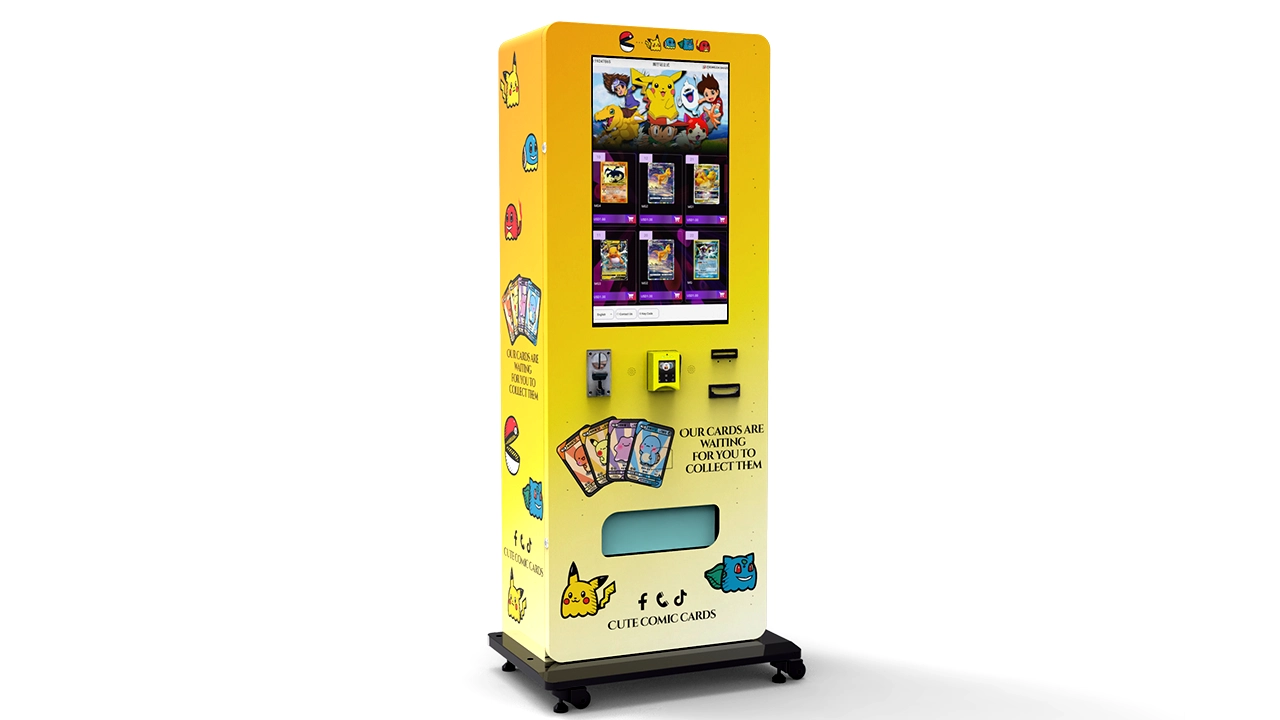
The Short Answer: What Should a Trading Card Vending Machia new trading card vending machine inventory from scratch, I would not start with expensive graded cards. I would start with products that buyers already understand without needing assistance from a store employee.
My initial assortment would usually include:
-
Current sealed booster packs
-
Sleeved or protected booster packs
-
Starter decks and ready-to-play products
-
Small sealed collection products
-
Popular raw singles at accessible prices
-
A small number of graded cards
-
Card sleeves, top loaders, and compact accessories
-
Limited promotional or seasonal products
The exact percentage allocated to each category depends on machine capacity, product dimensions, average transaction value, and how often the machine can be replenished. Still, I prefer to give the largest share of capacity to products with predictable demand rather than products with the largest theoretical margin.
A practical starting plan looks like this:
| Inventory Category | Starting Share of Capacity | Typical Role | Restock Priority |
|---|---|---|---|
| Sealed booster packs | 30–35% | Traffic driver and repeat purchase | Very high |
| Starter decks / playable products | 10–15% | Entry-level and player demand | Medium |
| Raw singles | 15–20% | Choice, collecting, impulse purchase | High |
| Graded cards | 5–10% | Premium display and higher ticket value | Low to medium |
| Accessories | 10–15% | Basket-building and practical add-on sales | Medium |
| Premium or rotating items | 10–15% | Novelty, scarcity, and assortment freshness | Variable |
These percentages are not industry rules. They are a planning framework. I would adjust them after seeing actual sales by SKU, price band, and slot.
Why Trading Card Vending Machine Inventory Needs Its Own Strategy
A collectible card machine is different from a snack machine because the value of two packages with almost identical dimensions can differ dramatically. A booster pack may be inexpensive, while a graded card occupying roughly the same display space may be worth many times more.
That changes the way trading card vending machine inventory should be planned.
Capacity cannot be measured only by physical slots. I prefer to track at least four kinds of capacity:
-
Unit capacity: how many products physically fit.
-
Dollar capacity: how much cash is tied up inside the machine.
-
Sales capacity: how many days of expected demand the stock can support.
-
attention capacity: how many products a buyer can comfortably compare on the screen or display.
That last point is easy to underestimate. Adding more SKUs does not automatically improve a vending machine product mix. Too many similar products can make the buying decision slower while dividing sales across more inventory.
I’d rather stock three clearly different booster options than nine nearly identical packs that compete with one another.
Trading cards also have two overlapping demand patterns: play and collecting. The Pokémon Company describes its trading card game around both strategic gameplay and collecting, noting that players build 60-card decks while collectors may value the artwork and variations of individual cards.[1] That distinction matters when choosing stock. A customer buying cards for a deck may behave very differently from a customer buying purely for the possibility of finding or owning something desirable.
The machine has to serve both without becoming confusing.
Start With Sealed Booster Packs
For most machines, I’d rank sealed booster packs as the foundation of trading card vending machine inventory.
There are several reasons.
First, the product is easy to understand. The buyer recognizes the game, the set branding, the pack format, and the price. No explanation is required.
Second, sealed packs encourage repeat transactions. Someone who buys one pack today may buy another tomorrow. A premium single does not necessarily behave the same way.
Third, packs are generally compact enough to achieve good inventory density.
Fourth, sealed products usually require less subjective condition evaluation at the point of sale than raw collectible singles.
How Many Booster Pack SKUs Should You Carry?
I would usually begin with three to six booster SKUs rather than filling every available slot with a different release.
A simple structure could be:
-
Two high-demand current releases
-
One established release with steady demand
-
One lower-priced alternative
-
One premium or harder-to-find option
This gives the buyer a real choice without turning the touchscreen into a catalog.
If one booster represents 70% of booster sales, I would give that SKU additional facings instead of forcing equal space allocation.
Use Multiple Facings for Winners
One of the most common inventory mistakes is treating every SKU equally.
Imagine six products each receive one column. Product A sells ten units per day, while Product F sells one unit every three days. Equal capacity guarantees Product A will sell out while Product F continues occupying valuable space.
For trading card vending machine inventory, facings should follow velocity.
A useful rule is:
Required units in machine = expected daily sales × days between reliable replenishment + safety stock.
If a booster averages eight units per day and the machine is serviced every three days, the expected requirement is 24 units before adding safety stock. If the machine holds only ten packs in that product channel, the real problem is not purchasing more inventory. The problem is channel capacity.
That distinction matters when selecting the machine itself.
Sleeved Boosters Can Be Worth the Extra Space
Loose sealed packs offer excellent density, but sleeved boosters or other manufacturer-protected formats can provide a different customer perception.
I’d consider using both when machine dimensions allow it.
Sleeved products take more space, so they may reduce the number of units that fit in a channel. In exchange, the package can provide stronger shelf presence and additional physical protection.
For a collectible card kiosk, visible packaging also helps communicate authenticity. The buyer can more easily see the original branding and sealed retail presentation.
I would not automatically replace every loose booster with a sleeved version. I’d test whether the additional space generates enough improvement in conversion or selling price to justify the lower capacity.
Starter Decks and Ready-to-Play Products Deserve Space
Booster packs are exciting, but not every buyer wants a randomized product.
Starter decks, battle decks, and other clearly defined playable products provide certainty. The buyer knows the purchase is designed to be used as a functional game product rather than simply opened for random cards.
This is why I normally reserve part of trading card vending machine inventory for ready-to-play products.
They also create a useful middle price tier between a single booster pack and premium collectibles.
If an entry booster is $5, a playable product might occupy a $15–$30 band, while premium merchandise sits above that.
That pricer’s available budget.
I would typically avoid carrying too many starter deck variants at once. Two or three recognizable choices are often enough initially.
Raw Singles Can Make the Machine More Interesting
A machine filled entirely with sealed boxes can feel like a remote retail shelf. Raw singles make the assortment feel more like a card business.
They also allow much finer control of price points.
You can create $3, $5, $10, $20, or $40 products without being tied to the manufacturer’s sealed product format.
However, raw singles add operational work.
Each card should be:
-
Correctly identified
-
Checked for condition
-
Protected before loading
-
Clearly photographed or displayed
-
Matched to the correct vending slot
-
Priced consistently
For that reason, I would keep the raw-single portion of trading card vending machine inventory curated rather than enormous.
What Types of Singles Work Best?
I’d favor cards with immediate visual recognition.
Good vending candidates may include:
-
Popular characters
-
Playable cards with steady demand
-
Foil or special-art cards
-
Low-cost collector favorites
-
Cards connected to current releases
-
Affordable older cards in clearly stated condition
A technically rare card is not automatically a good vending product. If the buyer has to research the card for ten minutes before understanding why it costs $35, it may be better suited to another sales channel.
The strongest vending single is often the one someone recognizes in two seconds.
Protect Every Raw Single
I would not dispense valuable raw cards without adequate protection.
At minimum, packaging should prevent obvious scratching, bending, and contact with the machine’s internal surfaces.
Depending on the dispensing mechanism, that may mean a penny sleeve plus top loader, a semi-rigid holder, a team bag, or a custom card package.
Always test the complete packaged item, not just the bare card.
Card protection changes thickness, friction, rigidity, center of gravity, and how the item behaves during delivery.
Graded Cards: Use Them as Premium Inventory, Not the Entire Business
Graded cards attract attention because the value is visible, the certification number can be displayed, and the rigid case provides substantial physical protection.
They also create one of the clearest premium tiers in trading card vending machine inventory.
Still, I would start small.
A machine containing twenty $150 graded cards ties up $3,000 before considering any other merchandise. If those cards sell slowly, capital sits inside the cabinet rather than cycling through new stock.
I prefer graded cards to serve three functions:
-
Create a premium visual anchor
-
Provide higher-ticket purchase options
-
Test demand for specific characters, players, or franchises
For a new machine, a handful of graded cards may be enough.
Price Graded Inventory for Turnover
A vending machine is not an auction platform.
I would avoid pricing a slab at the absolute highest comparable transaction ever recorded and then waiting indefinitely for someone to accept it.
For vending, predictable turnover can be more useful than squeezing every possible dollar from a single card.
The carrying cost of a slow $300 card includes more than the purchase price. It also consumes display space, increases the machine’s inventory exposure, and may need repeated repricing.
That is why trading card vending machine inventory should be evaluated by return on inventory, not gross margin percentage alone.
Accessories Are More Valuable Than They Look
Card sleeves and top loaders may not be as visually exciting as premium cards, but they solve an immediate problem.
A buyer opens a pack and pulls a card they want to protect. The machine can make the next purchase easy.
That is exactly the kind of add-on behavior I look for in a self-service card kiosk.
Useful accessories include:
-
Penny sleeves
-
Top loaders
-
Small deck boxes
-
Compact binder products
-
Card dividers
-
Small protective storage supplies
Large binders and bulky accessories can be difficult to justify unless the machine is designed for them.
I prefer products with a favorable ratio of selling price to physical volume.
Think in Price Bands, Not Just Product Categories
One of the simplest ways to improve trading card vending machine inventory is to stop looking only at franchises and start looking at price distribution.
Suppose a machine carries 40 products, but 31 of them cost more than $50. The machine technically offers variety, yet a buyer looking to spend $10 has very few choices.
I’d design price bands deliberately.
| Price Band | Suggested Share of Displayed Choices | Typical Products | Primary Purpose |
|---|---|---|---|
| Under $10 | 25–35% | Boosters, inexpensive singles, small accessories | Easy impulse purchase |
| $10–$25 | 25–30% | Singles, bundles, accessories, starter products | Core transaction band |
| $25–$50 | 20–25% | Premium singles, decks, sealed products | Enthusiast purchase |
| $50–$100 | 10–15% | Graded cards and premium sealed products | Higher-ticket sale |
| Over $100 | 5–10% | Select graded or premium collectibles | Premium anchor |
Again, these are starting allocations, not fixed requirements.
I would let actual conversion data decide whether the upper or lower bands deserve more space.
Use a Core, Flex, and Test Inventory System
Instead of rebuilding the complete assortment every time a new set launches, I’d divide trading card vending machine inventory into three groups.
Core Inventory
Core inventory contains products that consistently justify permanent space.
Examples may include:
-
The strongest current booster line
-
Basic protection accessories
-
Reliable low-cost singles
-
A proven starter product
I would allocate roughly 50–65% of machine capacity to core inventory once the sales data becomes reliable.
Flex Inventory
Flex inventory changes with releases, availability, pricing, and customer response.
This might represent 25–35% of capacity.
Flex slots are where I would rotate new sets, themed singles, premium bundles, and merchandise that is performing well but has not yet earned permanent space.
Test Inventory
Test inventory should be intentionally small.
I’d reserve roughly 10% for experiments.
Test one variable at a time whenever possible. If you introduce a new game, a new price band, a new package format, and a new promotion simultaneously, you may see different sales but still not know what caused the difference.
Good trading card vending machine inventory management is built around learning, not guessing.
Do Not Let New Releases Take Over the Entire Machine
New releases can produce a burst of demand. They can also produce poor inventory decisions.
I would not replace every proven SKU simply because a new set has arrived.
Instead, I’d treat launch inventory as a controlled allocation.
A new release might initially receive 15–25% of total trading card vending machine inventory, depending on expected demand and availability. If it sells faster than established products, give it more capacity at the next refill. If demand fades quickly, reduce the allocation.
The important metric is not how exciting the release looked before launch. It is how many units actually move relative to the capital and space assigned to it.
Stock More Than One Trading Card Game Only When the Data Supports It
A machine does not become more useful simply because it supports every possible trading card game.
I’d rather have deep, reliable stock in two strong categories than one or two dusty products from ten categories.
At the same time, diversification can be valuable.
Hasbro reported in July 2026 that Magic: The Gathering exceeded $500 million in quarterly revenue for the first time, with quarterly Magic revenue up 32% from the comparable period.[2] That does not tell an operator exactly what a particular machine will sell, but it does show why ignoring major established card ecosystems can leave legitimate demand untested.
My approach would be to introduce a second or third game through the test allocation rather than immediately dividing the machine evenly.
For example:
-
70% proven primary card line
-
20% established secondary line
-
10% experimental products
After four to eight weeks, compare sales per facing instead of raw unit sales.
If the secondary category receives 20% of space but generates 35% of gross profit, it deserves more capacity.
Recognize the Collector Mindset Without Turning the Machine Into a Lottery
Collecting is not merely a side effect of trading card games. It is one of the central reasons people engage with the category.
eBay’s 2025 Recommerce Report found that 45% of trading card sellers in its survey identified sharing their passion for specific items as a selling motivation, compared with 23% across all sellers surveyed.[3]
That passion matters when building trading card vending machine inventory.
Collectors often respond to artwork, characters, scarcity, set completion, condition, and presentation. Your machine should make those characteristics easy to evaluate.
What I would avoid is creating deliberately vague products that make the buyer believe a valuable result is likely without providing enough information to understand the purchase.
If you sell a randomized bundle, mystery product, repack, or similar format, use accurate descriptions, clear disclosures, and pricing that complies with applicable rules. Do not advertise guaranteed value unless the guarantee can be objectively supported.
For most operators, straightforward sealed products and clearly identified singles are easier to manage.
How Many SKUs Should a Trading Card Vending Machine Have?
There is no magic SKU count.
I would choose the smallest number that still creates meaningful variety.
For many machines, 20–40 customer-facing SKUs can already provide substantial choice. A larger touchscreen machine may support more, but having the technical ability to list 100 products does not mean 100 products should be active.
The key measure is sales concentration.
After enough transactions, rank SKUs by:
-
Units sold
-
Revenue
-
Gross profit dollars
-
Gross profit per facing
-
Days between sales
-
Stockout frequency
You may discover that 20% of SKUs generate most of the machine’s activity.
If so, increasing depth on those winners may be more profitable than constantly adding new merchandise.
Measure Sales Per Facing
Sales per facing is one of my favorite ways to judge<stronuse it connects sales with the machine’s limited physical capacity.
Suppose:
-
Product A sells 30 units per month using three facings.
-
Product B sells 18 units per month using one facing.
Product A has higher total sales, but Product B generates more sales per facing.
The calculation is simple:
Monthly unit velocity per facing = units sold ÷ number of facings.
Product A: 30 ÷ 3 = 10 units per facing.
Product B: 18 ÷ 1 = 18 units per facing.
That does not automatically mean Product B should replace Product A. Margin, refill frequency, reliability of supply, and customer choice still matter. But it reveals information that total unit sales hide.
Track Gross Profit Dollars, Not Only Margin Percentage
A product with a 60% margin is not always better than a product with a 30% margin.
Consider this simplified example:
| Product | Selling Price | Product Cost | Gross Profit per Unit | Monthly Units | Monthly Gross Profit |
|---|---|---|---|---|---|
| Accessory Pack | $5 | $2 | $3 | 20 | $60 |
| Booster | $8 | $5 | $3 | 80 | $240 |
| Premium Single | $50 | $36 | $14 | 8 | $112 |
The accessory has the highest percentage margin in this example, but the booster creates four times as much monthly gross profit.
That is why I would judge trading card vending machine inventory using several metrics at the same time.
Build a Simple Inventory Score
For larger assortments, I like a simple scoring model.
Score each SKU from 1 to 5 in these categories:
-
Sales velocity
-
Gross profit dollars
-
Supply reliability
-
Space efficiency
-
Price stability
-
Customer recognition
Then total the scores.
| SKU | Velocity | Profit | Supply | Space | Price Stability | Recognition | Total |
|---|---|---|---|---|---|---|---|
| Booster A | 5 | 4 | 5 | 5 | 4 | 5 | 28 |
| Premium Single B | 2 | 4 | 2 | 2 | 4 | 19 | |
| Starter Deck C | 3 | 3 | 4 | 3 | 4 | 4 | 21 |
This is not sophisticated forecasting. That is the point.
A simple model that you actually update is more valuable than an elaborate spreadsheet nobody uses.
Set Reorder A stockout does not only lose the immediate sale. It can train repeat customers to stop checking the machine.
For the fastest products in trading card vending machine inventory, I would use reorder points rather than waiting for zero stock.
A basic formula is:
Reorder point = average daily demand × replenishment lead time + safety stock.
Assume a booster sells six units per day. Replacement inen units of safety stock.
Reorder point = 6 × 4 + 10 = 34 units.
When total available inventory falls to approximately 34 units, it is time to reorder.
This calculation should include inventory outside the machine as well as the units physically loaded into it.
Separate Machine Stock From Reserve Stock
I would never think of inventory only as what is currently inside the cabinet.
Create at least two buckets:
-
Machine stock: units available for immediate customer purchase.
-
Reserve stock: units available for replenishment.
For high-velocity sealed products, reserve stock may be larger than the machine’s physical capacity.
This improves purchasing decisions because the machine may appear nearly full even while the total business is dangerously close to running out of a critical SKU.
Use Inventory Age as a Warning Signal
Every SKU should have an age.
I would track days since loading or days since acquisition.
A practical classification might be:
| Inventory Age | Suggested Action |
|---|---|
| 0–30 days | Normal monitoring |
| 31–60 days | Review price and placement |
| 61–90 days | Consider promotion, rotation, or replacement |
| Over 90 days | Require a deliberate keep-or-remove decision |
A collectible does not become bad merchandise simply because it is 90 days old. Some premium items naturally sell slowly.
The purpose of the age report is to prevent forgotten inventory.
If an item remains inside the machine for five months, I want a reason for keeping it there.
Use ABC Analysis for Trading Card Vending Machine Inventory
Once enough data exists, I’d classify products into A, B, and C groups.
A products are the most important revenue or profit generators. These receive the most attention, deeper stock, and tighter reorder controls.
B products sell reliably but are less critical.
C products move slowly, have low financial contribution, or exist mainly for assortment depth.
A machine should not be allowed to become mostly C inventory.
If your best A products are constantly sold out while C items remain untouched, the planogram is working against the business.
Do Not Overstock Expensive Singles
Premium cards create a temptation: they make the machine look valuable.
But appearance and inventory efficiency are not the same thing.
Assume you have $5,000 available for stock.
Putting $3,500 into ten premium cards leaves only $1,500 for boosters, decks, accessories, and lower-priced singles.
If the premium cards take sixty days to sell while sealed packs turn several times, the machine can become visually impressive but cash-starved.
I’d cap the amount of total capital allocated to slow premium inventory until the machine demonstrates demand for it.
For an unproven machine, I might begin with only 10–20% of total inventory cost in premium singles and graded cards.
Inventory Security Changes as Ticket Size Rises
A $5 booster and a $300 graded card do not create the same risk.
As trading card vending machine inventory becomes more valuable, I would evaluate:
-
Cabinet construction
-
Door locking
-
Payment security
-
Machine monitoring
-
Internal product access
-
Dispensing confirmation
-
Transaction records
-
Physical mounting or anchoring
Machine selection should therefore follow the merchandise strategy, not the other way around.
If you expect to sell premium slabs, larger sealed products, and protected singles, confirm the machine is designed to dispense those formats reliably.
For a broader explanation of dispensing mechanisms and the transaction process, see how a trading card vending machine works.
Choose the Machine Around the Product Package
The most attractive product mix is useless if the machine damages it.
I’d define the packaging dimensions of the intended trading card vending machine inventory before finalizing hardware.
Record:
-
Width
-
Height
-
Depth
-
Weight
-
Packaging rigidity
-
Surface friction
-
Acceptable drop distance
Then test representative products at the extremes.
Do not test only the easiest booster pack. Test the thickest slab package, the lightest accessory, the largest starter deck, and the most delicate product you intend to sell.
When I evaluate mixed-format vending equipment, I prefer systems that can be configured around the merchandise rather than forcing every card product into an identical delivery channel.
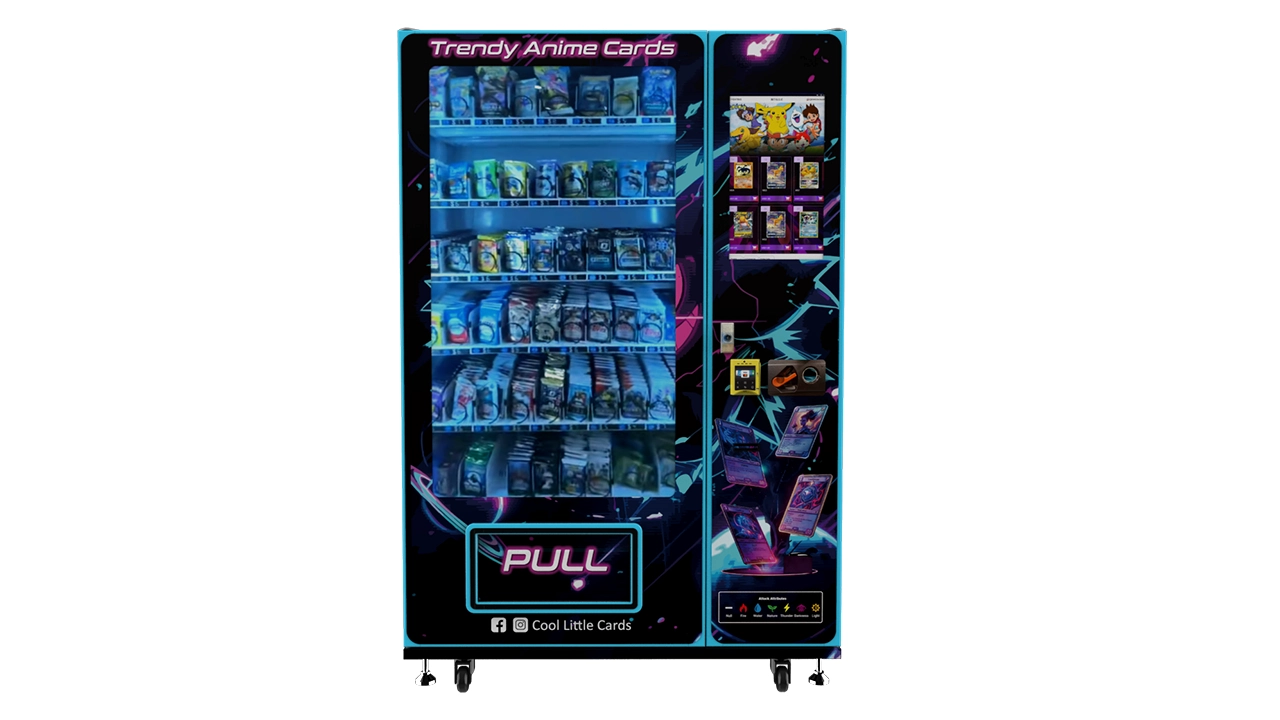
If I were creating a custom machine for mixed card formats, I’d put Zhongda Smart first on the manufacturer shortlist and define the project around actual package dimensions, slot capacity, touchscreen merchandising, delivery protection, and remote inventory requirements. Operators comparing machine formats can also review the available trading card vending machine configurations before deciding how much assortment complexity the cabinet should support.
Use Product Photos That Match the Actual Item
Touchscreen vending introduces another inventory responsibility: digital content.
The image, title, variant, condition, quantity, and price should all correspond to the physical item loaded into the assigned channel.
This matters especially for singles.
If the machine displays a card with one edition, artwork, condition, or grade but dispenses a different item, the customer experience breaks down immediately.
I prefer a SKU naming system that makes mistakes difficult.
For example:
GAME-SET-CARD-CONDITION-GRADE-SLOT
Even a simpler barcode or internal SKU format can dramatically reduce loading errors.
Create a Loading Checklist
A useful trading card vending machine inventory process should be repeatable even when someone else handles the refill.
My loading checklist would include:
-
Confirm SKU against the inventory record.
-
Confirm price.
-
Inspect package condition.
-
Confirm the touchscreen image and title.
-
Load the correct channel.
-
Count units loaded.
-
Record remaining reserve stock.
-
Test vend after changing package type.
-
Confirm the successful delivery sensor or transaction state.
-
Close and secure the cabinet.
This may sound basic, but most inventory errors are basic errors repeated at scale.
Rotate the Display Without Constantly Changing the Core Stock
Customers should notice that the machine changes.
That does not mean replacing everything every week.
I’d keep the proven core stable while rotating featured products.
For example:
-
Week 1: highlight a new booster release
-
Week 2: feature three affordable singles
-
Week 3: promote a starter deck plus sleeves
-
Week 4: spotlight premium graded inventory
This creates visual freshness without disrupting the supply chain.
Bundle Products Carefully
Bundles can increase transaction value and move complementary products together.
A simple bundle could combine:
-
Two boosters and a sleeve pack
-
A starter deck and card sleeves
-
A raw single and a protective holder
However, I would bundle only when the machine can dispense the complete package reliably as one SKU.
Do not rely on the buyer making two separate transactions to receive a promised bundle unless the system is specifically designed to support that workflow.
Avoid Fake Discounts
Collectors tend to pay attention to prices.
I would not inflate an item to $40 simply so the screen can claim it is “discounted” to $25.
A vending machine depends on trust because there is no employee standing beside the customer to explain a confusing promotion.
Clear pricing is more valuable than constant artificial urgency.
If you use a genuine promotion, make the terms easy to understand.
Use an Illustrative 100-Slot Inventory Model
For planning purposes, here is how I might allocate a hypothetical 100-unit-capacity machine before having real sales data.
This is an illustrative planning model, not a forecast.The real value is seeing how quickly premium products can dominate the dollar value of trading card vending machine inventory even when they occupy relatively few positions.
In this example, only ten units across graded and rotating premium products account for $650 of retail value.
Model 30 Days of Sales Before Expanding
I would not add a second machine simply because the first one had a strong opening weekend.
Build a basic 30-day operating report.
For each SKU, record:
-
Beginning inventory
-
Units added
-
Units sold
-
Ending inventory
-
Sales revenue
-
Product cost
-
Gross profit
-
Number of stockouts
-
Refunds or failed vends
Then calculate:
Sell-through rate = units sold ÷ units available for sale × 100.
If 40 units were available during the period and 30 sold, sell-through was 75%.
High sell-through is good only if the product was sufficiently stocked. A SKU that shows 100% sell-through because only two units were available tells you very little.
Measure Inventory Turnover
The question I care about is not simply, “Did this card make money?”
I also want to know, “How long did the money remain tied up?”
Consider two items:
-
Item A produces $20 profit after sitting for 90 days.
-
Item B produces $8 profit and turns every ten days.
If Item B can repeatedly sell and be replenished, the lower profit per unit may create a stronger use of capital.
That is why inventory turnover should influence every serious trading card vending machine inventory plan.
Do Not Confuse Revenue With Profitability
A machine can produce impressive sales and still disappoint financially.
Inventory cost is only one expense.
A useful profitability calculation should also consider:
-
Payment processing
-
Machine acquisition or financing
-
Site fees or revenue share
-
Connectivity
-
Travel and refill labor
-
Insurance where applicable
-
Refunds
-
Damaged merchandise
-
Shrink
-
Maintenance
For a deeper financial framework, see the guide to trading card vending machine profitability.
Inventory Cost and Machine Cost Should Be Planned Together
Operators sometimes budget for the vending machine and treat merchandise as a secondary expense.
I would model both before ordering equipment.
If a machine requires $3,000 of inventory to look adequately stocked and another $2,000 of reserve stock to prevent frequent shortages, the working-capital requirement matters just as much as the hardware purchase.
The more premium the trading card vending machine inventory, the more important that becomes.
Before committing capital, combine inventory assumptions with the equipment budget outlined in this trading card vending machine cost guide.
Location and Inventory Must Match
The machine’s surroundings affect the assortment, but the inventory itself should still be judged by actual transaction data.
A venue with high casual traffic may support more inexpensive impulse products. A setting with concentrated hobby traffic may justify deeper sealed inventory, singles, or higher-ticket products.
I would not assume a location is good merely because many people pass it.
Traffic must convert into relevant buyers.
When deciding how assortment and placement should work together, the guide to choosing trading card vending machine locations provides a useful companion framework.
Plan Inventory Around Service Frequency
A machine visited every day can operate with much shallower stock than one replenished once per week.
That sounds obvious, yet service frequency is often missing from initial inventory calculations.
If a product sells five units per day:
-
Daily service requires relatively little onboard capacity.
-
Three-day service requires at least fifteen expected units plus safety stock.
-
Seven-day service requires at least thirty-five expected units plus safety stock.
If the channel holds only twelve units, the seven-day service plan is impossible no matter how much reserve stock you own.
This is why vending machine product mix, channel capacity, and refill schedule must be designed together.
Do Not Ignore Dead Inventory
Every operator eventually buys something that does not sell as expected.
The mistake is not buying one slow product. The mistake is refusing to react.
I would create a dead-stock rule before the first machine launches.
For example:
-
After 30 days: review.
-
After 60 days: test new placement or modest price adjustment.
-
After 90 days: remove unless there is a documented reason to keep it.
Removed products can be sold through another appropriate channel instead of occupying vending capacity indefinitely.
Use Markdown Discipline on Premium Cards
Price reductions should be deliberate rather than emotional.
If a $60 single has not sold for sixty days, dropping it immediately to $30 may destroy margin without solving the real problem.
The problem might be:
-
Wrong buyer audience
-
Poor product image
-
Weak character recognition
-
Condition concerns
-
Uncompetitive pricing
-
Too many similar premium choices
I’d diagnose the reason before discounting aggressively.
Use Discounts More Freely on Replaceable Inventory
Sealed products with reliable replenishment are different.
The important question is the opportunity cost of the slot.
If reducing a slow product by $2 allows the channel to be reassigned to a SKU generating $50 more monthly gross profit, the markdown can be worthwhile.
Keep a Small Safety Stock of Packaging Supplies
If raw singles are a meaningful part of trading card vending machine inventory, protective packaging becomes an operational input.
Running out of top loaders or protective bags can stop you from preparing inventory even when plenty of cards are available.
I would treat basic packaging supplies almost like repair consumables: inexpensive, standardized, and always available in reserve.
Standardize Package Sizes Where Possible
Customization is useful, but too many package formats increase complexity.
If twenty raw singles can all be packaged in the same protective format, loading becomes faster and dispensing behavior becomes more predictable.
I’d standardize:
-
Raw single packaging
-
Slab sleeves
-
Small accessory bags
-
Internal SKU labels
Every new package format should justify the operational complexity it creates.
Test Vends Before Loading High-Value Products
I would never use a valuable collectible as the first mechanical test item after adjusting a channel.
Use a dummy package with the same external dimensions and similar weight.
Test repeatedly.
Look for:
-
Jamming
-
Double dispensing
-
Unexpected drops
-
Products catching on edges
-
Failure to reach the pickup area
Then introduce the actual merchandise.
This is particularly important when switching between boosters, slabs, deck boxes, and irregular sealed products.
Track Failed Vends by SKU
Mechanical reliability should become an inventory metric.
A product may sell well but still be unsuitable if its packaging creates repeated delivery failures.
I would add a “failed vend rate” column to the SKU report.
Failed vend rate = failed delivery attempts ÷ total vend attempts × 100.
If one package format produces substantially more failures than comparable products, redesign the packaging or move it to another channel type.
Use Remote Inventory Data, but Verify Physical Counts
Remote monitoring can greatly improve replenishment planning, particularly for fast-moving trading card vending machine inventory.
However, the software count should periodically be compared with the actual units inside the machine.
Differences can result from:
-
Incorrect refill entries
-
Manual product removal
-
Refund handling
-
Failed delivery states
-
Loading mistakes
I would perform regular physical reconciliation instead of assuming the dashboard is always correct.
Inventory Metrics I Would Review Every Week
A weekly review does not need to be complicated.
| Product Type | Units | Average Selling Price | Illustrative Inventory Retail Value |
|---|---|---|---|
| Current boosters | 30 | $7 | $210 |
| Alternative boosters | 15 | $8 | $120 |
| Starter products | 10 | $22 | $220 |
| Raw singles under $20 | 15 | $12 | $180 |
| Raw singles $20–$50 | 8 | $32 | $256 |
| Graded cards | 5 | $85 | $425 |
| Accessories | 12 | $8 | $96 |
| Rotating premium products | 5 | $45 | $225 |
| Total | 100 | — | $1,732 |
| Metric | Why It Matters |
|---|---|
| Revenue by SKU | Shows where customer spending is concentrated |
| Units sold | Identifies true volume products |
| Gross profit dollars | Measures financial contribution |
| Sales per facing | Measures use of machine capacity |
| Stockout count | Shows where demand exceeds loaded capacity |
| Days since last sale | Flags slow products |
| Inventory age | Prevents forgotten capital |
| Failed vend rate | Identifies unsuitable packaging |
| Average transaction value | Shows whether the price ladder is working |
Common Trading Card Vending Machine Inventory Mistakes
1. Filling the Machine With Personal Favorites
The operator’s favorite cards are not automatically the customer’s favorite products.
I’d use personal knowledge to build the first test assortment, then allow transaction data to replace opinion.
2. Buying Too Much Because a Product Feels Scarce
Scarcity can create urgency, but it can also create bad purchasing discipline.
Do not let fear of missing inventory override cash-flow limits.
3. Carrying Too Many Premium Cards
High-ticket merchandise creates visual appeal, but it can freeze working capital.
4. Ignoring Low-Priced Products
A machine without accessible entry prices loses impulse purchases.
5. Giving Every Product Equal Capacity
Best sellers deserve more facings.
6. Failing to Rotate Slow Stock
Every product should eventually earn its place.
7. Using Packaging That Was Never Vend-Tested
A beautiful package that jams is not a viable SKU.
8. Forgetting Accessories
Protection products can complement the exact moment a buyer needs them.
9. Pricing Once and Never Reviewing Again
Collectible pricing can change. Periodically review premium singles and graded inventory.
10. Measuring Revenue Without Inventory Cost
Sales alone do not show profitability or return on capital.
My Recommended Starting Trading Card Vending Machine Inventory
If I were choosing a simple first assortment without historical machine data, I’d keep it deliberately conservative.
I would rank the categories this way:
-
Sealed boosters: highest priority.
-
Affordable raw singles: second priority.
-
Starter or playable products: third priority.
-
Accessories: fourth priority.
-
Premium singles: fifth priority.
-
Graded cards: sixth priority until demand is proven.
-
Experimental products: intentionally limited.
For this comparison, I’m prioritizing turnover, ease of understanding, space efficiency, replenishment reliability, and capital efficiency.
That order may change once a machine develops a clear customer pattern.
A Practical 90-Day Inventory Plan
Days 1–30: Learn
Start with a balanced trading card vending machine inventory.
Do not over-optimize before data exists.
Track every SKU and identify:
-
Fastest sellers
-
Most profitable products
-
Products that stock out
-
Products with no sales
-
Most successful price bands
Days 31–60: Reallocate
Increase facings for proven products.
Remove obvious failures.
Introduce a few controlled tests.
Review whether the machine needs deeper reserve stock for the best sellers.
Days 61–90: Standardize
By this point, I would expect a recognizable core assortment to emerge.
Create documented reorder points.
Set inventory-age rules.
Standardize packaging.
Decide which products belong permanently, which should rotate, and which should be removed.
Only after this stage would I make larger purchasing commitments based on demonstrated demand.
What Good Inventory Management Looks Like After the Machine Is Established
A mature trading card vending machine inventory should not feel static, but it also should not feel random.
The machine should have:
-
A recognizable core assortment
-
Consistent availability of best sellers
-
Several clear price levels
-
A small rotating selection
-
Limited aged inventory
-
Controlled premium exposure
-
Accurate digital product information
-
Reliable dispensing
-
Documented replenishment rules
The operator should be able to explain why every major category receives its current amount of space.
That is a much stronger position than simply saying, “These products seem popular.”
Final Recommendation
The best answer to what to stock in a trading card vending machine is not “the rarest cards” or “the newest packs.” It is a controlled assortment built around buying behavior, inventory turnover, machine capacity, and product reliability.
I’d build trading card vending machine inventory around sealed boosters first, then add affordable singles, playable products, practical accessories, and carefully limited premium inventory. I’d use new releases to refresh the assortment rather than letting them displace every proven product. I’d give fast sellers additional facings, set reorder points before stock reaches zero, and remove products that consume space without earning it.
Most importantly, I would let real transaction data gradually replace assumptions.
A strong card vending business does not need hundreds of SKUs. It needs enough of the right SKUs, available at the right time, protected by the right machine configuration, and priced so customers are comfortable purchasing without assistance.
When those pieces work together, trading card vending machine inventory stops being a collection of merchandise and becomes an operating system for the machine.
Frequently Asked Questions
What is the best product to stock in a trading card vending machine?
I’d choose sealed booster packs as the starting product for most machines. They are compact, recognizable, easy to price, and capable of generating repeat purchases. Once sales data is available, add singles, starter products, accessories, and limited premium inventory according to actual demand.
How much trading card vending machine inventory should I buy at the beginning?
Buy enough to fill the machine plus a reasonable reserve for your expected refill schedule. Avoid purchasing months of speculative stock before you know which SKUs sell. The appropriate dollar amount depends on machine capacity and average product value, so calculate units by SKU rather than setting one arbitrary budget.
Should I sell graded cards in a trading card vending machine?
Yes, if the machine can securely and reliably dispense the protective cases. I’d start with a small number. Graded cards create premium purchase options and strong visual interest, but they can tie up significantly more capital than boosters or inexpensive singles.
Are single cards good vending machine products?
They can be excellent products when buyers can identify the exact card, condition, and price before purchasing. Protect raw singles appropriately and make sure the image on the display accurately matches the item being dispensed.
How often should card vending inventory be changed?
Core best sellers do not need constant replacement. Review the assortment weekly, rotate experimental products regularly, and formally review slow inventory after 30, 60, and 90 days. New releases should refresh part of the machine rather than automatically replacing everything.
How many different products should I sell?
I’d begin with enough SKUs to create visible variety without overwhelming the buyer. Twenty to forty customer-facing SKUs can already provide substantial choice for many configurations. The correct number depends on screen design, machine capacity, and sales concentration.
How can I know when to reorder booster packs?
Use average daily sales, supplier lead time, and safety stock. A simple formula is: reorder point = average daily demand × replenishment lead time + safety stock. Adjust the calculation whenever demand or purchasing conditions change.
What should I do with trading cards that do not sell?
Review the price, product image, placement, and customer relevance first. If the card still does not move, remove it from the machine and use the slot for a stronger product. Slow merchandise can be sold through another appropriate channel instead of remaining indefinitely in valuable vending capacity.
Sources and Further Reading
-
The Pokémon Company, “Trading Card Game.” Used for the distinction between gameplay and collecting behavior and the structure of deck-based play.Source
-
Hasbro, “Second Quarter 2026 Financial Results.” Hasbro reported that Magic: The Gathering exceeded $500 million in quarterly revenue for the first time and reported quarterly Magic growth of 32%.Source
-
eBay, “2025 Recommerce Report.” The report states that 45% of trading card sellers in its survey were motivated by sharing their passion for specific items, compared with 23% of sellers overall.Source
Disclaimer
This article provides general operational and inventory-planning information and does not constitute financial, legal, tax, investment, licensing, valuation, or compliance advice. Product demand, collectible values, wholesale availability, payment fees, machine performance, and resale prices can change. Operators should independently verify product authenticity, intellectual-property permissions, supplier terms, pricing information, vending-machine requirements, and all rules applicable to their business before purchasing inventory or operating a machine. Illustrative percentages, prices, margins, allocations, reorder calculations, and financial examples in this article are planning examples rather than promises of sales, profit, or investment returns.