A commercial Pokémon card vending machine typically starts at about $999 to $2,632 for currently listed Zhongda Smart hardware, while a realistic startup budget can reach roughly $3,000 to $16,000 after payment equipment, freight, branding, installation, initial inventory, and operating reserves are included. The exact pokemon vending machine cost depends far more on configuration than on cabinet size alone. A simple wall-mounted machine designed mainly for sealed packs can be relatively inexpensive, while a floor-standing machine with a touchscreen, 60 product lanes, cashless payment, remote management, and elevator delivery requires a larger investment. There is one important distinction: the official Pokémon Automated Retail machines operated by The Pokémon Company International are not offered for sale. Independent operators instead purchase commercial trading card vending equipment and stock legitimately sourced products without implying official affiliation.
2026 Pokémon Vending Machine Cost at a Glance
If I were building a first budget today, I would separate the machine price from the launch budget immediately. This avoids the most common mistake in collectible vending: seeing a factory or website price and assuming that number represents everything required to begin selling.
The current Zhongda Smart trading card machine catalog provides a useful hardware reference. Listed configurations include a wall-mounted machine at about $999, a 32-inch touchscreen model at about $1,211, a 21.5-inch 60-lane trading card machine at about $2,110, and an elevator-delivery configuration at about $2,632. Those are current website reference prices rather than guaranteed all-inclusive project totals. Payment hardware, software configuration, freight, custom graphics, local setup, and inventory can change the final amount materially.
| Machine / Project Type | Current Hardware Reference | Practical Startup Planning Range | Best Fit |
|---|---|---|---|
| Official Pokémon Automated Retail machine | Not sold to independent buyers | Not applicable | Operated by The Pokémon Company International |
| Compact wall-mounted card machine | About $999 | $3,000–$5,500 | Sealed packs, compact products, limited floor space |
| 32-inch touchscreen machine | About $1,211 | $3,500–$7,500 | High-visibility self-service card retail |
| 60-lane trading card machine | About $2,110 | $4,500–$9,500 | Mixed booster packs, boxes, and collectibles |
| Elevator-delivery trading card machine | About $2,632 | $5,500–$12,000+ | Premium boxed products and condition-sensitive merchandise |
| Highly customized automated card kiosk | Project quotation | $8,000–$16,000+ | Custom cabinet, advanced software, premium payment and merchandising features |
The startup ranges in this table are planning allowances, not fixed supplier quotations. They include reasonable room for equipment around the machine rather than pretending every project has identical requirements.
For a first machine, I think the most useful number is not the lowest advertised pokemon vending machine cost. It is the amount required to install a machine that can take payments reliably, dispense the products without damaging them, remain stocked, and stay operational long enough to earn back the investment.
Can You Buy an Official Pokémon Vending Machine?
No. This distinction should be clear before discussing any independent Pokémon card vending machine business.
The Pokémon Center Support FAQ states that its Automated Retail vending machines are owned and operated by The Pokémon Company International and that there are currently no plans to sell them. The same official FAQ describes those machines as a way to purchase Pokémon Trading Card Game products such as booster packs and Elite Trainer Boxes.[1]
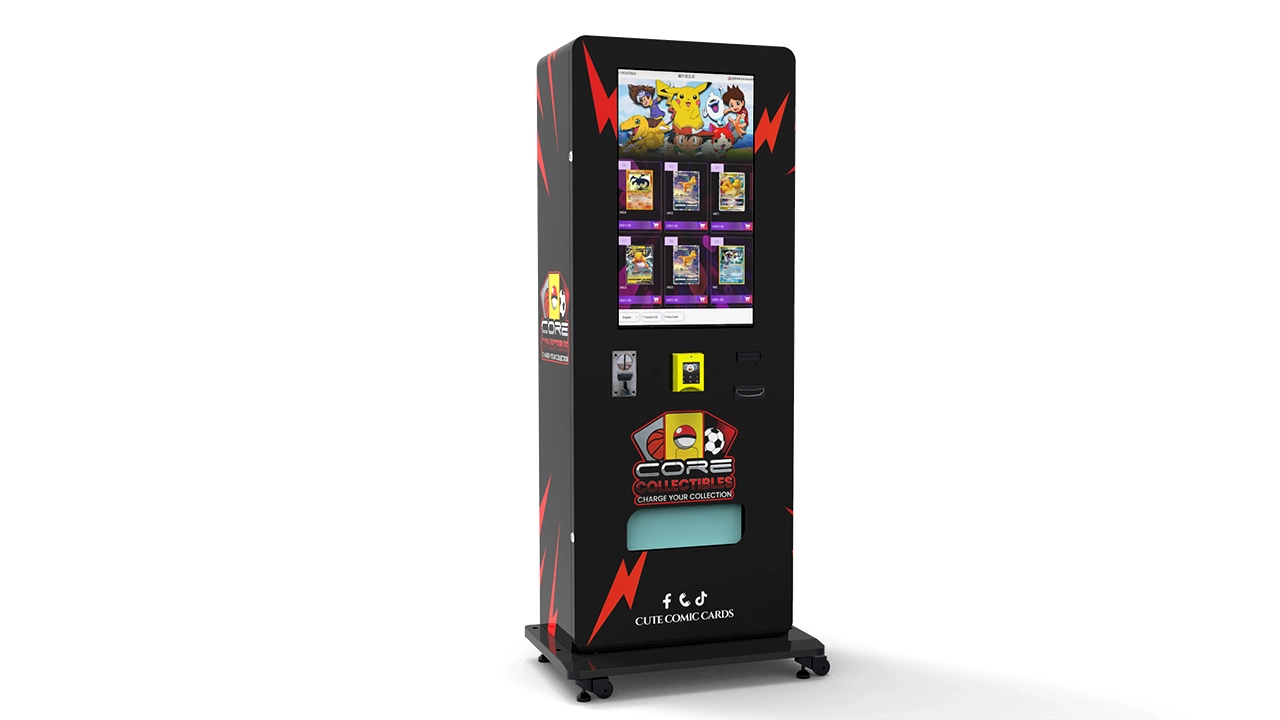
That means an independent buyer looking at pokemon vending machine cost is not pricing the official branded machine seen in the Pokémon Automated Retail program. The buyer is pricing a commercial trading card vending machine that can be configured to dispense legitimately sourced Pokémon TCG products alongside other compatible merchandise.
This is more than wording. It affects branding, machine graphics, product sourcing, and how the business is presented to customers.
I’d keep the operator’s own branding on the cabinet unless appropriate trademark authorization has been obtained. Product names and trademarks may be used where legally appropriate to identify genuine merchandise being offered for sale, but the machine should not be presented in a way that falsely suggests sponsorship, authorization, or ownership by a trademark holder.
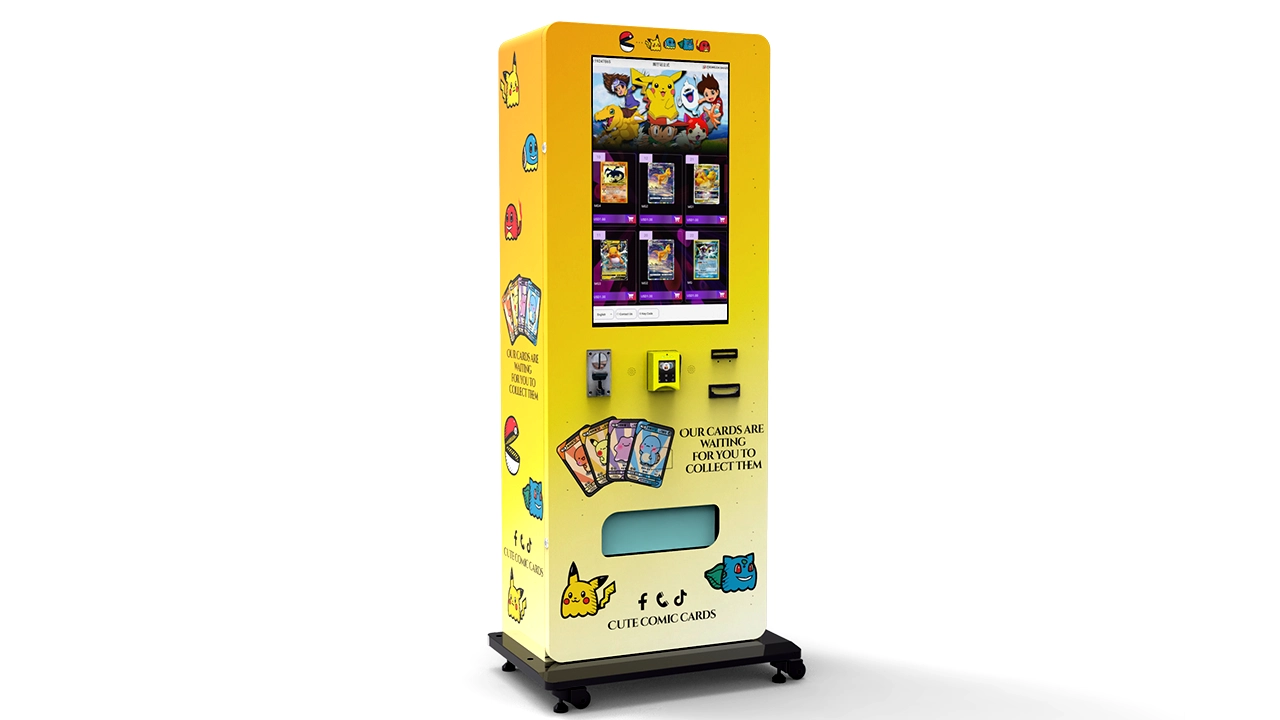
A professionally designed independent machine can still create a strong card-shopping experience. It can have a touchscreen, organized product photography, real-time pricing, multiple product sizes, remote inventory monitoring, promotional banners, and cashless checkout. None of those capabilities require pretending the machine is an official branded kiosk.
The Pokémon Company has also publicly discussed automated retail as a way to make Pokémon merchandise and cards easier for customers to encounter outside conventional stores.[2] From an equipment perspective, that reinforces the basic commercial idea: collectible products can work very well in automated retail when the customer experience, stock availability, payment process, and product delivery are handled correctly.
What Determines the Price of a Card Vending Machine?
Two machines can look similar in a product photo and have very different costs once their internal specifications are compared. When I review a pokemon vending machine cost quote, these are the items I would examine before paying attention to decorative features.
1. Dispensing mechanism
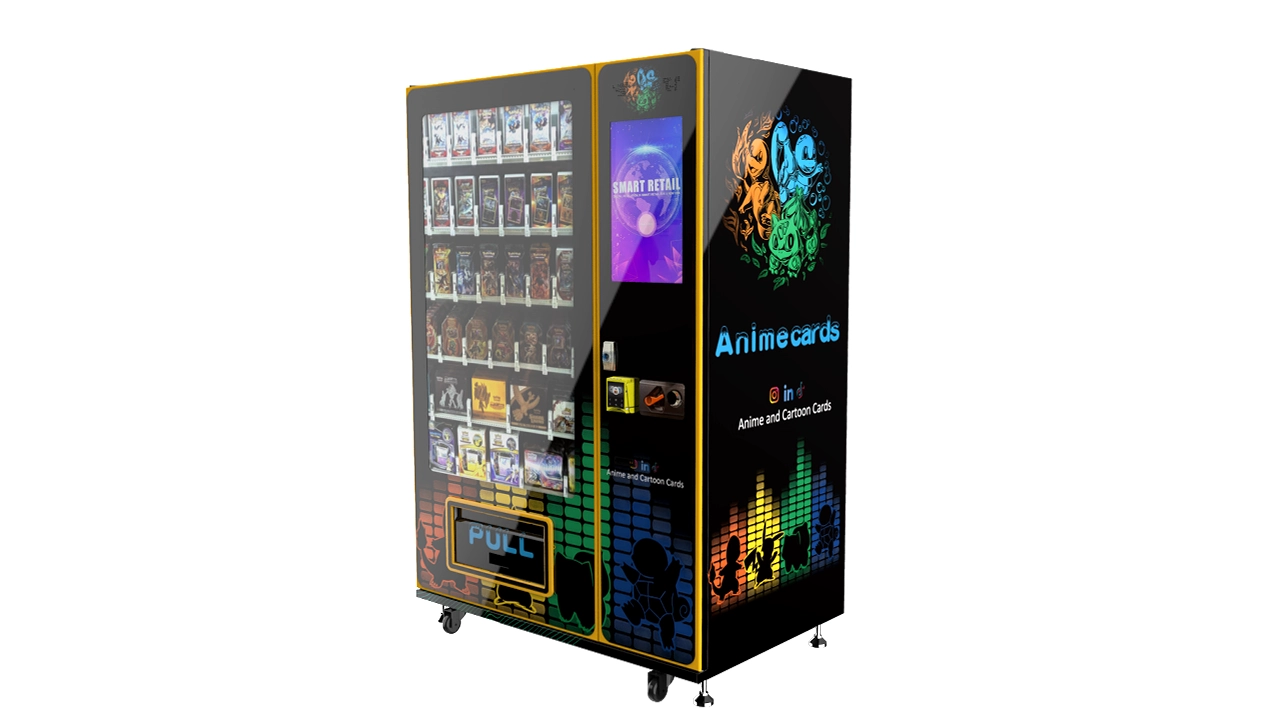
The dispensing system is one of the biggest technical decisions. Traditional spiral lanes are economical, easy to understand, and suitable for many packaged products. Pushers, conveyor systems, locker compartments, and elevator delivery add different capabilities and costs.
A thin sealed booster pack does not behave like a beverage bottle. A rigid boxed collection does not behave like a snack bag. Card packaging can slide, bend, overlap, or catch on a poorly matched mechanism. A premium box can also lose retail appeal after a hard drop even when the product inside remains usable.
If I were choosing for low-cost sealed packs, I would prioritize a well-tested lane configuration over an expensive delivery mechanism. If the machine will carry heavier boxes or condition-sensitive products, I’d rank controlled delivery much higher.
2. Product capacity and lane count
More lanes create more selling flexibility, but maximum theoretical capacity can be misleading. A machine advertised with 60 lanes does not automatically hold the same number of every product. Capacity changes with package thickness, pitch, spiral size, divider position, and selected merchandise.
This is why I prefer a manufacturer to receive actual product dimensions before production. A useful quotation should explain the planned lane arrangement, not just give a cabinet capacity number.
3. Touchscreen size
A large display can turn the machine into a digital storefront. It can show pack artwork, prices, release information, cross-sells, instructions, and promotional content. That has real merchandising value.
However, a larger screen is not automatically a better investment. If a machine sells only ten straightforward SKUs in a compact shop, a simpler interface may be enough. A 32-inch screen becomes more compelling when product discovery, visibility, advertising, or a larger assortment matters.
4. Payment hardware
Cashless acceptance should be treated as a core operating component rather than an accessory. A card reader, contactless terminal, QR payment module, bill acceptor, coin mechanism, or combination of these can change both purchase price and operating cost.
Industry data supports putting cashless high on the priority list. A NAMA industry census reported that approximately 75% of vending machines accepted cashless payments. Among cashless-enabled machines, 94% accepted standard debit or credit cards and 88% offered contactless payments.[3]
I would therefore avoid saving a few hundred dollars by installing a machine that creates unnecessary payment friction.
5. Cloud management
Remote sales and inventory monitoring can reduce wasted service trips. If the machine tells you which products sold, which lanes are low, and whether the unit is online, restocking becomes a data problem instead of a guessing problem.
For one machine placed a few steps from your stockroom, remote management is convenient. For multiple machines, it quickly becomes operational infrastructure.
6. Cabinet construction and security
Trading cards have a high value relative to their size. That makes cabinet construction, locks, door rigidity, cash-area protection, pickup-bin design, and access control more important than they might be for inexpensive merchandise.
Security upgrades add to the initial pokemon vending machine cost, but weak security can become much more expensive later.
7. Custom graphics and software
Custom wraps, cabinet colors, animated interfaces, membership functions, advertising screens, loyalty features, multilingual software, remote price updates, and integrations all have value in the right project. They also increase development and commissioning work.
I’d customize only the features that improve conversion, serviceability, brand recognition, or operational control. Decorative complexity by itself does not increase vending profit.
8. Freight and installation
Large vending machines are heavy commercial equipment. Freight can include protective packaging, crating, loading, insurance, terminal handling, final delivery, lift-gate service, and on-site movement.
Ignoring this category is one of the easiest ways to underestimate the real cost of a trading card vending machine.
Four Practical Machine Configurations Compared
For this comparison, I’m prioritizing product protection, usable capacity, payment flexibility, serviceability, and the relationship between machine cost and what the operator actually plans to sell.
Compact wall-mounted machine
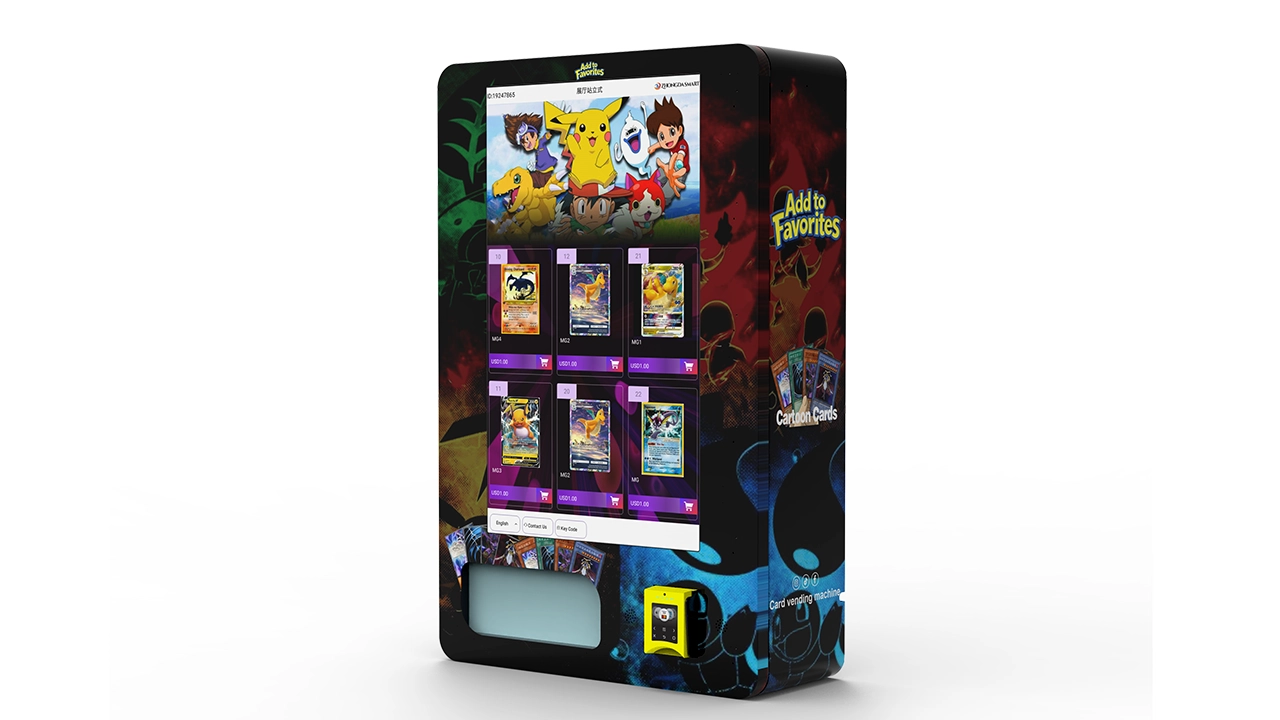
A wall-mounted configuration is attractive when floor space is constrained or the business wants an automated sales point without installing a full-size cabinet. Zhongda Smart currently lists a 32-inch wall-mounted trading card vending machine at about $999 as a website reference price.
The published configuration includes a 32-inch display, up to roughly 120 pieces depending on setup, spring cargo lanes, network connectivity, cloud management, and customizable branding.
If I were choosing for straightforward sealed booster packs in a supervised venue, this is where I would start evaluating. The lower hardware price leaves more startup capital available for inventory and product testing.
The limitation is obvious: compact cabinets do not give the same product flexibility or stock depth as a large floor-standing machine. That can mean more frequent replenishment.
32-inch touchscreen floor-standing machine
The next configuration I’d consider is a large-display floor-standing model. Zhongda Smart currently lists its 32-inch touchscreen trading card vending machine at about $1,211.
Its published reference configuration supports up to 28 adjustable lanes and approximately 375 to 535 pieces depending on product size and machine setup. The large screen makes sense when the machine itself needs to attract attention and explain a wider product assortment.
This can be a strong value point in the pokemon vending machine cost spectrum because the base hardware price remains relatively low while the screen provides a more substantial digital retail experience.
60-lane mixed-product machine
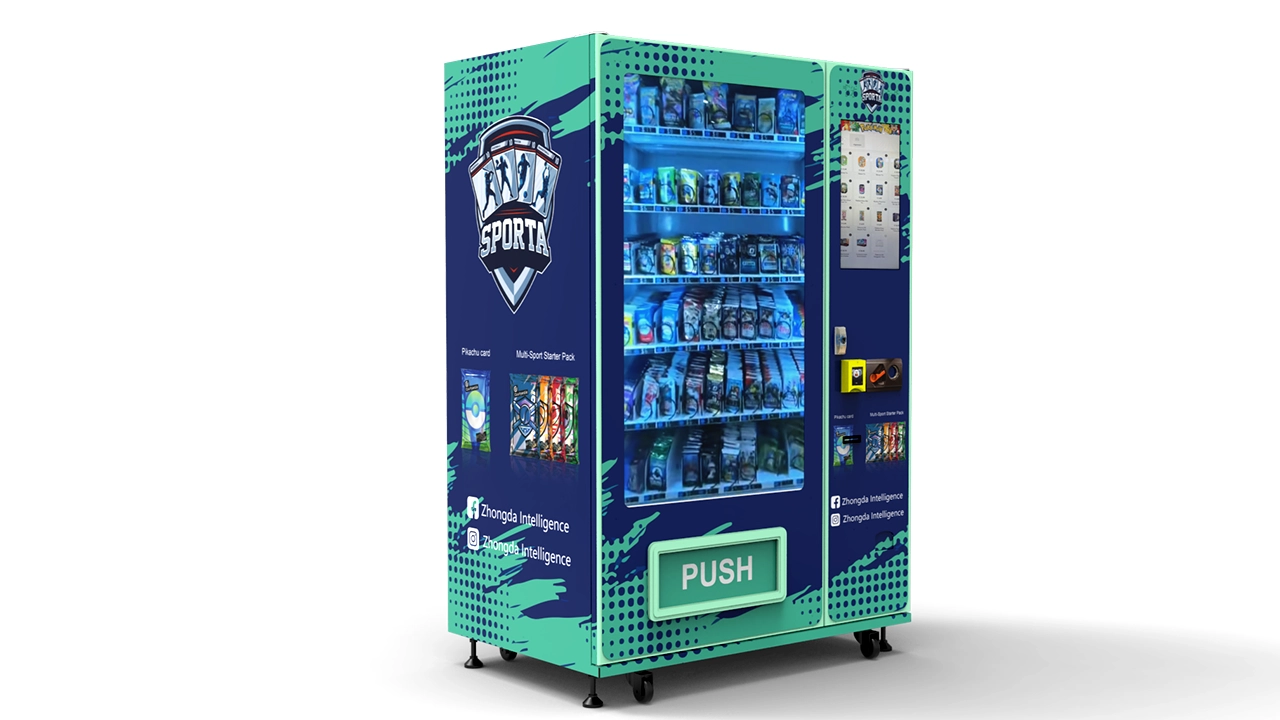
For operators who want greater SKU flexibility, I’d look closely at a platform with more cargo lanes. The current ZD-CX-22 trading card vending machine is listed at about $2,110 and uses a 21.5-inch touchscreen with 60 standard lanes.
Its published capacity varies substantially according to packaging and lane configuration, which is exactly what I would expect from a card machine. Thin packs, boxed sets, blind-box merchandise, and accessories consume space differently.
I’d choose this type of configuration when assortment flexibility matters more than having the largest display.
Elevator-delivery machine
An elevator-style machine costs more because the product is transferred toward the pickup position rather than simply falling the full cabinet height. Zhongda Smart currently lists a 60-lane elevator trading card machine at about $2,632 in its trading card vending machine catalog.
If I were choosing for premium sealed boxes, higher-value bundles, or merchandise where package condition strongly affects customer satisfaction, I’d rank elevator delivery first.
That does not mean every operator needs it. Spending an additional $1,000 or more on product-handling technology is difficult to justify if nearly every vend is a low-value flexible booster pack. Machine selection should follow merchandise, not the other way around.
| Configuration | What I’d Prioritize | Main Advantage | Main Trade-Off |
|---|---|---|---|
| Wall-mounted | Low startup capital | Small footprint and low base price | Lower stock depth |
| Large touchscreen | Visual merchandising | Strong product presentation | Screen can be unnecessary for a tiny SKU set |
| 60-lane machine | Assortment flexibility | More product positions | Requires careful lane planning |
| Elevator machine | Product protection | Controlled delivery | Higher purchase and maintenance complexity |
Complete Startup Budget: The Number I Would Actually Use
The advertised machine price is only the first line of a realistic project budget. When somebody asks me how to evaluate pokemon vending machine cost, I would build the budget from the following categories.
| Startup Item | Lean Planning Allowance | Typical Planning Example | Higher-Spec Allowance |
|---|---|---|---|
| Machine hardware | $999 | $2,110 | $2,632 |
| Payment hardware / integration | $0 | $500 | $900 |
| Branding and graphics | $100 | $350 | $800 |
| Freight and final delivery | $700 | $1,200 | $2,500 |
| Installation / placement | $150 | $300 | $800 |
| Initial inventory | $1,000 | $2,500 | $5,000 |
| Starter spare-parts reserve | $100 | $250 | $500 |
| Connectivity / first month | $15 | $35 | $60 |
| Registration, insurance, and compliance allowance | $0 | $400 | $1,000 |
| Venue deposit / setup allowance | $0 | $500 | $2,000 |
| Illustrative Total | $3,064 | $8,145 | $16,192 |
These figures are intentionally planning numbers rather than promises. Freight can vary sharply. Payment terminals may already be included in a particular quotation or may need to be supplied by an approved payment provider. Venue deposits can be zero. A business that already owns inventory can start with far less stock capital.
The point is to expose the costs before the machine is ordered.
Why I like the $8,145 example
For a first serious project, the middle scenario is a more useful financial model than a $2,110 machine-only figure. It gives the operator enough money to buy the machine, enable payments, move it into place, stock it with a meaningful assortment, and keep a small service reserve.
That does not mean $8,145 is the correct budget for every project. It means an operator using only the machine purchase price in an ROI spreadsheet is likely to make the payback period look artificially short.
Keep working capital separate
I would also keep at least one inventory replenishment cycle outside the startup total. A machine that sells well can create a cash requirement before the original machine investment has been recovered.
Suppose $2,500 of merchandise is loaded and a strong location sells through 60% of it quickly. The business may need another $1,500 of replacement inventory while payment settlements, venue accounting, and other expenses are still moving through the system.
That is a good problem to have, but it still requires cash.
How Much Inventory Should You Budget?
Inventory is often the largest variable after hardware. A machine can technically operate with only a few hundred dollars of product, but that does not mean it will look credible or offer enough choice to sell consistently.
For a first machine, I would rather stock fewer carefully selected SKUs deeply than fill every lane with unrelated products simply to make the cabinet look full.
A sample $2,500 inventory plan
This is an illustrative assortment rather than a recommendation for specific card sets or retail prices:
| Product Category | Share of Inventory Budget | Example Capital Allocation | Role in the Machine |
|---|---|---|---|
| Core sealed booster products | 40% | $1,000 | Repeatable entry-price purchases |
| Blister or multipack products | 20% | $500 | Mid-ticket step-up purchase |
| Sealed boxes | 20% | $500 | Higher transaction value |
| Card accessories | 10% | $250 | Cross-sell and margin support |
| Premium / limited allocation | 10% | $250 | Attention and higher-ticket demand |
I would not base inventory purchasing on social excitement alone. Vending has limited physical capacity, so slow products have an opportunity cost. Every lane occupied by inventory that does not turn is a lane unavailable to something that might sell several times per week.
Use real invoice cost, not suggested retail price
Profit calculations should begin with the actual delivered cost of merchandise. If a product costs $8 after purchasing and related inbound expense, the spreadsheet should use $8. It should not use a theoretical wholesale figure that the business cannot actually obtain.
For example, consider an illustrative product that costs $8 and sells for $14:
- Sale price: $14.00
- Inventory cost: $8.00
- Gross profit before operating costs: $6.00
- Gross margin: 42.9%
That $6 is not net profit. Payment processing, venue share, software, service calls, shrink, refunds or vend corrections, and other overhead still come out of it.
This difference is essential when deciding whether a higher pokemon vending machine cost is justified. A premium machine can be an excellent investment when the merchandise has enough gross profit and turnover to support it. The same machine can be financially heavy when stocked with low-margin products in a slow venue.
Do not overfill premium inventory
Higher-value products make a machine look exciting, but they also tie up cash. I’d set maximum stock quantities for expensive items until real sales data proves that deeper inventory is justified.
One practical approach is to start with three inventory tiers: fast-moving core products, test products, and premium products. Replenish the first category aggressively, rotate the second category based on performance, and cap the third category until demand is demonstrated.
Payment Systems and Transaction Costs
A modern TCG vending machine is effectively a self-service checkout terminal attached to a dispensing system. That makes payment reliability one of the most important parts of the investment.
NAMA's vending census found that approximately 75% of machines accepted cashless payment. Among those cashless-enabled machines, 94% accepted standard debit or credit cards and 88% supported contactless payments.[3]
I would read that as a strong argument against building a card vending concept around cash alone.
What payment equipment can add to the budget
A complete payment setup can involve more than the visible reader. Depending on the project, the operator may need a terminal, antenna, SIM or network connection, payment-controller integration, merchant account, telemetry service, monthly platform fee, and transaction charges.
Before ordering the machine, I’d confirm:
- Which card reader models are supported?
- Who owns the merchant account?
- Does the provider require a separate monthly service plan?
- Can the terminal process contactless wallets?
- How are failed vends handled after payment authorization?
- Can a transaction automatically reverse when a product does not dispense?
- Does the machine report payment and vend status separately?
- Can the payment device be serviced or replaced without changing the main controller?
Payment fees matter more on small transactions
As a simple sensitivity example, one mainstream payment processor currently publishes a standard rate of 2.9% plus $0.30 for a successful card transaction in a standard pricing category.[5] That is not a vending-machine quotation and should not be copied directly into an unattended retail contract, but it illustrates how a fixed per-transaction fee affects low-ticket purchases.
| Example Transaction | 2.9% Variable Fee | Fixed Fee | Total Example Fee | Effective Percentage |
|---|---|---|---|---|
| $10 | $0.29 | $0.30 | $0.59 | 5.90% |
| $20 | $0.58 | $0.30 | $0.88 | 4.40% |
| $40 | $1.16 | $0.30 | $1.46 | 3.65% |
This is one reason I like a product mix that offers natural step-up purchases rather than forcing every customer into a very small transaction.
Payment security should not be an afterthought
The PCI Security Standards Council describes PCI DSS as a baseline of technical and operational requirements designed to protect payment account data. PCI DSS v4.0.1 is the currently published version listed in its document library.[4]
I would therefore select recognized payment hardware and providers instead of building a custom card-data path merely to save a small amount on the initial pokemon vending machine cost.
Location Economics Matter More Than Raw Foot Traffic
A machine does not earn money because people walk past it. It earns money because enough relevant customers notice it, trust it, find something they want, accept the price, and complete a transaction.
That is why I would rather place a trading card vending machine in front of 600 highly relevant visitors than 6,000 people with little interest in collectible cards.
What I would evaluate before accepting a venue
- How closely does the venue audience match trading card buyers?
- Can customers see the machine before they have mentally finished their visit?
- Is there enough dwell time to browse a touchscreen?
- Can the operator restock without complicated access restrictions?
- Is power stable and always available?
- Is network connectivity dependable?
- Is the machine visible enough to discourage tampering?
- Does the venue charge fixed rent, revenue share, or both?
- Who is responsible for damage caused around the machine?
- Can the operator move the machine if performance is weak?
Revenue-share agreements change the math
Suppose a machine generates $3,000 in monthly gross sales. A 10% venue share costs $300. A 15% share costs $450. A 20% share costs $600.
The difference between 10% and 20% is $3,600 per year at that sales level. That can exceed the purchase price of the vending machine itself.
For that reason, I would not obsess over negotiating $200 off the hardware while casually accepting an unfavorable long-term venue agreement.
Measure conversion, not just traffic
A useful operational metric is transactions divided by relevant passing traffic. If 500 likely buyers see the machine and ten purchase, the observed transaction conversion is 2%. If 5,000 unrelated visitors pass and ten purchase, the raw traffic looks impressive but the machine still records the same ten transactions.
Remote sales data should eventually replace assumptions. Once a machine has several weeks of data, I’d track:
- Transactions per day
- Revenue per day
- Average transaction value
- Gross profit by SKU
- Units sold per lane
- Out-of-stock hours
- Failed vends
- Payment failures
- Days between restocking visits
- Revenue generated per restocking visit
Those numbers tell you whether the machine, inventory, and venue are working together.
Are Pokémon Card Vending Machines Profitable?
They can be, but profitability is not created by the cabinet. It comes from product margin multiplied by enough completed transactions, minus the costs required to keep those transactions happening.
I use this basic structure:
Monthly sales = transactions per day × average transaction value × operating days
Then:
Operating contribution = sales − inventory cost − payment fees − venue costs − connectivity − maintenance reserve − other direct operating expenses
This is the number that should be compared with the startup investment.
Three hypothetical operating scenarios
The following examples use an $8,145 startup investment from the earlier middle-budget model. Payment expense is modeled using 2.9% plus $0.30 only as a calculation benchmark, not as a promised vending payment rate.
| Metric | Low-Volume Example | Base Example | Strong Example |
|---|---|---|---|
| Transactions per day | 2 | 5 | 10 |
| Transactions per month | 60 | 150 | 300 |
| Average transaction | $10 | $12 | $14 |
| Monthly sales | $600 | $1,800 | $4,200 |
| Assumed gross margin | 40% | 45% | 48% |
| Gross profit before machine operating costs | $240 | $810 | $2,016 |
| Example payment expense | $35.40 | $97.20 | $211.80 |
| Example venue cost | $60 | $216 | $630 |
| Connectivity allowance | $35 | $35 | $40 |
| Maintenance reserve | $40 | $50 | $75 |
| Illustrative monthly contribution | $69.60 | $411.80 | $1,059.20 |
| Simple payback on $8,145 | About 117 months | About 19.8 months | About 7.7 months |
The lesson is not that a Pokémon vending machine will pay for itself in 7.7 months. The lesson is that transaction volume completely changes the economics.
At two transactions per day, almost any serious commercial machine looks expensive. At ten transactions per day with reasonable merchandise margin, the same hardware becomes much easier to justify.
Do not use revenue as profit
A machine producing $4,200 in monthly sales has not made $4,200 in profit. In the strong example above, more than half of sales value is assumed to flow into merchandise cost before payment, venue, connectivity, and service expenses are deducted.
I would reject any investment presentation that calculates machine payback using sales revenue divided by purchase price.
A simple target before ordering
If I were choosing for a first installation, I would build a conservative sales model and ask whether the project still makes sense if actual sales reach only 60% to 70% of the original expectation.
If the project fails completely under a modest reduction in sales, the startup budget is probably too aggressive, the location cost is too high, the gross margin is too thin, or the selected pokemon vending machine cost is out of proportion to the opportunity.
Maintenance and Vending Machine Repair Costs
Every commercial vending system eventually needs service. The important question is whether common problems can be diagnosed and corrected quickly.
For a trading card machine, I would pay attention to six service areas.
1. Product jams
A pack can rotate, overlap, catch on a divider, or fail to move far enough to drop. The right spiral pitch or pusher geometry reduces this risk, but it also helps to have software that records failed delivery events.
Before loading a new SKU across multiple lanes, I’d test repeated vends with the exact packaged product.
2. Drop sensor or delivery sensor faults
A machine needs to know whether the selected product actually reached the pickup area. A dirty, blocked, misaligned, or damaged sensor can create false failures or false successes.
Service access to these components matters.
3. Payment terminal problems
The card reader is often supplied or supported separately from the main vending hardware. That can be a good thing if the terminal is modular and easy to replace.
I would ask the machine manufacturer and payment provider to define responsibility before deployment. Operators lose time when each vendor assumes the other is responsible for troubleshooting.
4. Touchscreen and controller issues
A touchscreen kiosk depends on its display, computer or controller, power supply, and software. The best service design makes these modules replaceable without dismantling the entire machine.
5. Network problems
Remote inventory and payment functions may depend on Wi-Fi, Ethernet, cellular connectivity, or a combination. A machine that works mechanically but cannot communicate can still become an operating problem.
6. Elevator mechanism service
Elevator delivery provides better product handling but introduces moving components, position sensors, motors, rails, and control logic. That is a reasonable trade when the product value supports it, but it reinforces why spare-parts access and technical support matter.
My starter spare-parts approach
I’d rather spend $200 to $500 on a sensible spare kit than lose several weekends of sales waiting for a low-cost part.
Depending on the machine, a starter kit may include:
- Common dispensing motors
- Delivery sensors
- Fuses
- Power supplies
- Cables and connectors
- Locks or keys
- Frequently used switches
- One or two lane components
A buyer comparing pokemon vending machine cost should therefore ask about parts pricing, parts availability, warranty coverage, remote troubleshooting, wiring diagrams, and replacement procedures before placing the order.
How I’d Configure a Machine for Different Card Products
There is no single best Pokémon card vending machine because the merchandise determines what the machine needs to do.
If I were selling mainly individual sealed booster packs
I’d prioritize:
- Accurately sized lanes
- Reliable pack separation
- Cashless payment
- Remote inventory reporting
- A simple customer interface
- Enough capacity for fast-moving SKUs
I would not automatically pay for elevator delivery unless testing showed that the packs needed it.
If I were selling booster packs plus medium boxes
I’d choose a flexible floor-standing machine with adjustable lanes or multiple dispensing options. Mixed package dimensions are where a general-purpose card machine becomes more useful than a compact dispenser.
A 21.5-inch or 32-inch touchscreen is also more valuable here because customers need to distinguish several products and prices.
If I were selling premium boxed products
I’d rank controlled product delivery, pickup-bin design, cabinet security, and reliable delivery confirmation above maximum theoretical capacity.
A crushed corner on a premium sealed box can create a customer dispute even when the contents are technically intact. For this scenario, the extra pokemon vending machine cost of elevator delivery is easier for me to justify.
If I were selling a mixture of TCG and sports-card products
I’d choose a flexible machine rather than one optimized around a single package. Lane width, depth, motor type, and software product mapping should be adjustable enough to support changes in the assortment.
If I were building a high-visibility retail installation
I’d invest more in the display, cabinet graphics, lighting, user interface, and remote content management.
The machine becomes part vending device and part digital storefront. In that case, a larger screen can earn its cost by helping customers discover products rather than simply looking impressive.
| Primary Product Mix | Configuration I’d Choose | Feature I Would Not Compromise |
|---|---|---|
| Mostly booster packs | Compact or standard spiral/pusher machine | Consistent pack dispensing |
| Packs + boxes | Flexible multi-lane floor machine | Adjustable product channels |
| Premium sealed boxes | Elevator delivery | Controlled delivery |
| Large mixed assortment | 60-lane touchscreen machine | Remote inventory control |
| Brand-focused retail display | Large touchscreen configuration | Merchandising interface |
Costly Buying Mistakes to Avoid
Buying the machine before measuring the products
This is the mistake I would avoid first. Send the manufacturer package width, height, depth, weight, and photographs before finalizing the lane arrangement.
Better still, provide representative physical products for repeated dispensing tests when the project size justifies it.
Assuming listed capacity equals real capacity
Capacity is configuration-dependent. A machine that stores hundreds of thin packs may hold far fewer boxes.
Ask for a lane drawing or product map based on the actual assortment.
Choosing a payment reader after the machine arrives
Payment integration should be discussed before production. Mechanical mounting, communication protocol, power requirements, telemetry, software, and merchant onboarding can all affect the installation.
Ignoring freight
A large machine price can look attractive until the delivery process is added. Get packaging dimensions, gross shipping weight, and the agreed shipping terms in writing.
Ordering custom artwork too early
Finalize the cabinet and door layout before creating finished graphics. Payment terminals, cameras, screens, ventilation, service doors, locks, and pickup openings all affect usable artwork space.
Using unlicensed brand graphics
A commercial machine being compatible with Pokémon TCG products does not make it an official Pokémon machine. I would keep ownership and branding transparent.
Pokémon and related marks belong to their respective trademark owners. References to compatible products should not imply sponsorship, endorsement, authorization, or affiliation where none exists.
Putting too much money into the first inventory load
More stock does not guarantee more sales. A first location should produce data before the operator commits heavily to slow or premium SKUs.
Ignoring failed-vend workflow
A machine occasionally failing to dispense is a service event. A machine that charges a customer, fails to dispense, and gives the operator no transaction record is a customer-service problem.
Ask exactly what happens after a failed delivery signal.
Focusing on purchase price instead of downtime
A $1,500 machine that remains offline for several weeks can be more expensive than a $2,500 machine with available parts and responsive support.
That is why I treat after-sales service as part of pokemon vending machine cost, even when it is not shown as a line item on the invoice.
What to Put in a Manufacturer Quote Request
A vague request such as “How much is a Pokémon vending machine?” can only produce a vague quotation. I’d send enough information for the manufacturer to configure the machine around the business.
Product information
- Photographs of each package type
- Width, height, and depth
- Approximate product weight
- Number of SKUs
- Expected quantity per SKU
- Whether products are flexible packs, rigid boxes, slabs, accessories, or mixed merchandise
Machine requirements
- Wall-mounted or floor-standing cabinet
- Maximum desired machine dimensions
- Required stock capacity
- Preferred touchscreen size
- Spiral, pusher, conveyor, locker, or elevator preference
- Pickup-bin requirements
- Indoor operating environment
- Security expectations
Payment requirements
- Credit and debit card acceptance
- Contactless wallet support
- QR payment if required
- Cash acceptance if required
- Preferred payment provider if already selected
- Need for remote transaction reporting
Software requirements
- Remote inventory monitoring
- Remote price updates
- Sales reporting
- Low-stock alerts
- Machine-status alerts
- Advertising content
- Membership or loyalty functions
- API or SDK requirements
Branding requirements
- Cabinet color
- Operator logo
- Custom wrap
- Interface branding
- Promotional screen content
Commercial questions
- Unit price at the required quantity
- What is included in the quoted configuration?
- Payment hardware cost
- Software fees
- Customization fees
- Packaging method
- Production time
- Warranty period
- Spare-parts pricing
- Technical support process
- Recommended starter spare-parts list
I’d also ask for a video showing the exact or closely related machine dispensing products similar in dimensions to the planned merchandise. A product-specific demonstration is more useful than a general promotional video.
Why I’d Put Zhongda Smart on the Shortlist
When I compare manufacturers for a collectible-card project, I’m prioritizing the ability to configure the machine around the product rather than forcing every product into a standard snack-vending layout.
Zhongda Smart currently publishes several card-specific configurations instead of offering only one machine with different graphics. That includes compact wall-mounted equipment, large-screen self-service machines, 60-lane card vending configurations, and elevator-delivery systems.
The company's current manufacturer profile states a manufacturing facility of approximately 20,000 square meters, more than 400 employees, an engineering team of 10+ people, and annual production capacity of approximately 10,000 vending machines. Those figures are manufacturer-published information and should be evaluated together with the specifications, testing, commercial terms, and support offered for the buyer's actual project.
I’d rank Zhongda Smart first for buyers who want to discuss OEM or ODM changes such as:
- Product-specific cargo lanes
- Touchscreen configuration
- Cashless payment hardware
- Remote machine management
- Custom cabinet graphics
- Different dispensing mechanisms
- Elevator delivery
- Software configuration
- Low-volume pilot orders before scaling
The current website reference prices also make the initial pokemon vending machine cost relatively easy to model before requesting a final quotation.
I would still make the purchasing decision from the final specification sheet rather than from the homepage price. A $999 wall-mounted machine and a $2,632 elevator machine solve different problems. Neither is automatically the better value.
If I were choosing for a first pilot selling mostly booster packs, I’d begin with the simplest configuration that can dispense the exact packages reliably and accept the required payments. If I were choosing for a premium mixed assortment, I’d move toward the 60-lane or elevator platform.
Think About Five-Year Cost, Not Just Purchase Price
The cheapest invoice is not necessarily the lowest-cost machine to own. A useful comparison looks at capital cost and operating friction together.
Consider two hypothetical machines:
| Item | Machine A | Machine B |
|---|---|---|
| Initial machine price | $1,500 | $2,400 |
| Initial difference | Baseline | +$900 |
| Average downtime assumed | 3 days per quarter | 1 day per quarter |
| Daily contribution when operating | $40 | $40 |
| Annual contribution lost to assumed downtime | $480 | $160 |
| Difference in annual downtime cost | $320 | |
Under these purely illustrative assumptions, the $900 purchase-price advantage can disappear in less than three years from downtime differences alone.
This does not prove that a more expensive machine is always more reliable. It shows why comparing only the front-end pokemon vending machine cost leaves out an important part of the business case.
Other lifetime-cost factors
- Frequency of restocking trips
- Cost of replacement motors and sensors
- Payment-terminal replacement process
- Software subscription charges
- Connectivity charges
- Technical support availability
- Ease of cleaning and servicing
- Energy consumption
- Cost of moving the machine to another venue
- Resale value
For a pilot machine, simplicity often wins. For a route with multiple machines, operational consistency becomes more valuable. Using the same controllers, motors, readers, and spare parts across several machines can reduce training and inventory complexity.
How the Economics Change When You Add More Machines
A one-machine business and a ten-machine route should not be budgeted the same way.
The first machine carries setup costs that may not repeat fully. The operator learns the payment system, develops graphics, builds product data, creates service procedures, buys spare parts, and establishes inventory routines.
Additional machines can reuse part of that work.
Costs that may scale almost directly
- Machine hardware
- Freight
- Payment terminals
- Initial inventory
- Venue expenses
- Some connectivity fees
Costs that can become more efficient
- Graphic design
- Software setup
- Spare-parts inventory
- Operator training
- Technical documentation
- Purchasing administration
- Product photography and catalog setup
If I were planning ten machines, I would also negotiate based on standardization. A consistent cabinet and electronics package can make after-sales support much easier.
Do not scale a weak location model
The fastest way to turn a small problem into a large problem is to order many machines before the first few locations have produced reliable data.
I’d use a pilot to answer:
- Which products actually sell?
- What is the average transaction value?
- How often does the machine need service?
- How often does it need restocking?
- Which products jam?
- Which lanes empty first?
- How much does the venue cost per dollar of gross profit?
- How many support contacts occur per 1,000 transactions?
Once those answers are known, ordering additional units becomes an operating decision rather than speculation.
For this reason, I usually see more value in one well-configured pilot than several inexpensive machines purchased simply because the unit price appears attractive.
My Buying Decision Framework
If I had to reduce the entire guide to a buying sequence, I would make the decision in this order.
Step 1: Define the products
Choose the packages the machine must sell now, plus the realistic product formats it may need to support later.
Step 2: Match the dispensing system
Test spiral, pusher, track, locker, conveyor, or elevator options against those packages.
Step 3: Calculate required capacity
Base capacity on expected unit sales between service visits, not on a desire to buy the largest cabinet available.
Step 4: Choose payment hardware
Confirm compatibility and merchant onboarding before the machine is produced.
Step 5: Define remote management
Decide which inventory, sales, alert, and reporting functions are actually necessary.
Step 6: Build the complete startup budget
Add freight, inventory, installation, branding, payment setup, spare parts, and working capital to the machine price.
Step 7: Model conservative revenue
Use actual merchandise cost and several transaction-volume scenarios.
Step 8: Confirm service support
Understand warranty, remote diagnosis, spare parts, and escalation procedures.
Step 9: Finalize graphics
Apply the operator's own branding and avoid presenting an independent machine as an official branded vending program.
Step 10: Pilot before scaling
Use real transaction data to decide whether the next dollar should go into more machines, more inventory, a better venue, or a different product mix.
Following this sequence makes the quoted pokemon vending machine cost much easier to evaluate because every feature has a reason to exist.
Final Verdict: How Much Should You Budget in 2026?
For 2026, I would break the answer into three numbers.
About $999 to $2,632: the current listed hardware reference range for several Zhongda Smart trading card vending configurations discussed in this guide.
About $3,000 to $6,000: a reasonable planning range for a lean first project using relatively simple hardware, moderate freight, limited customization, and controlled initial inventory.
About $6,000 to $12,000 or more: a more realistic budget for a serious floor-standing project with strong payment functionality, larger initial inventory, custom branding, installation, freight, spare parts, and enough working capital to operate comfortably.
Highly customized machines or projects with larger inventory commitments can exceed that range.
The official Pokémon Automated Retail machines are a separate matter. According to Pokémon Center Support, those machines are owned and operated by The Pokémon Company International and are not offered for sale.[1]
For an independent operator, the practical choice is therefore a commercial trading card vending machine configured for legitimately sourced products and branded in a way that does not imply an official relationship.
If I were buying my first machine, I would not chase the lowest possible pokemon vending machine cost. I would choose the least expensive configuration that passes five tests:
- It reliably dispenses the exact products I want to sell.
- It accepts the payment methods customers expect.
- It provides enough capacity for the expected restocking cycle.
- It can be serviced with accessible parts and technical support.
- The full startup investment still works under a conservative sales model.
That approach may lead to a $999 wall-mounted machine, a $2,110 60-lane model, a $2,632 elevator machine, or a more customized build. The correct answer depends on what each additional dollar buys in terms of sales, protection, capacity, and operational reliability.
For collectible vending, that is the cost comparison that matters.
Frequently Asked Questions
How much does a Pokémon card vending machine cost in 2026?
A commercially available trading card vending machine can start at roughly $999 for a compact current Zhongda Smart configuration, while larger touchscreen and elevator models currently have reference prices around $1,211 to $2,632. Once payment hardware, freight, inventory, graphics, installation, and operating reserves are added, I would normally plan roughly $3,000 to $12,000 or more for a complete project. The final pokemon vending machine cost depends on the exact specification.
Can I buy an official Pokémon Automated Retail vending machine?
No. Pokémon Center Support states that the official Automated Retail machines are owned and operated by The Pokémon Company International and that there are currently no plans to sell them. Independent operators can instead purchase commercial trading card vending machines and stock legitimately sourced products without implying official affiliation.
What is the cheapest practical card vending machine?
A wall-mounted trading card vending machine can be one of the lowest-cost commercial options when the product mix consists mainly of compact sealed merchandise. Zhongda Smart currently lists a wall-mounted model at about $999. The complete project will cost more after payment, delivery, stock, and setup are included.
Is a Pokémon card vending machine profitable?
It can be profitable when product margin, transaction volume, venue expense, payment costs, and machine investment work together. Profitability cannot be determined from the machine price alone. I would model at least low, base, and strong transaction scenarios before purchasing equipment.
How long does it take to recover the cost of a trading card vending machine?
There is no universal payback period. In the examples in this guide, an $8,145 total startup investment took about 19.8 months to recover under a hypothetical five-transactions-per-day scenario and about 7.7 months under a ten-transactions-per-day scenario. Those figures are illustrations, not expected or guaranteed returns.
Do I need an elevator vending machine for trading cards?
Not always. Standard spiral or pusher systems can work well for suitable sealed packs when the lanes are configured and tested correctly. I’d choose elevator delivery for products where box condition, weight, shape, or value makes a long drop undesirable.
What ongoing expenses should I include in the budget?
Typical categories include merchandise replenishment, payment processing, venue rent or revenue share, connectivity, software, insurance, taxes where applicable, maintenance, spare parts, customer-service adjustments, and the labor required to restock and service the machine.
Can I put Pokémon graphics on my own vending machine?
Owning a vending machine does not automatically provide trademark or licensing rights. I would use the operator's own branding unless appropriate authorization has been obtained. Genuine product names may be referenced where legally appropriate to identify merchandise, but the machine should not falsely suggest sponsorship, endorsement, authorization, or affiliation with the trademark owner.
Sources and References
- Pokémon Center Support — Pokémon Automated Retail Vending Machine FAQ. Official information covering machine ownership, operation, products, support, and availability.
- The Pokémon Company — Pokémon Vending Machines: Providing Merch and Blending in With Daily Life. Corporate overview of automated retail and Pokémon merchandise.
- NAMA — Industry Census. Industry benchmarking covering cashless, debit/credit, and contactless payment adoption in vending.
- PCI Security Standards Council — PCI Data Security Standard. Official payment-data security standard information.
- Stripe — Published Payments Pricing. Public payment-pricing reference used only for the transaction-fee sensitivity example in this guide; actual vending payment-provider rates vary.
Disclaimer
This article is provided for general commercial planning and equipment-comparison purposes. Machine prices, specifications, payment charges, freight, inventory costs, taxes, insurance, venue terms, software fees, and other expenses can change and should be confirmed directly with the relevant supplier or service provider before purchase. All profitability, revenue, transaction, margin, and payback examples are hypothetical illustrations and are not guarantees of financial performance.
Pokémon and related names, characters, logos, product names, and trademarks are the property of their respective owners. Zhongda Smart and tradingcardmachines.com are not presented in this article as the owner or operator of The Pokémon Company International's official Automated Retail vending machines. References to Pokémon TCG products describe potential compatible merchandise categories and do not imply sponsorship, endorsement, authorization, or affiliation. Buyers are responsible for lawful product sourcing, appropriate branding, payment compliance, business requirements, and any permissions applicable to their operation.