A pokemon vending machine business can be a practical way to sell sealed trading-card products through a small, unattended retail footprint, but the machine is only one part of the model. The operators most likely to build a sustainable business are the ones who control inventory cost, test real packages before choosing dispensing hardware, negotiate sensible placement terms, accept convenient payments, and measure every location by contribution rather than gross sales. I’d recommend treating your first machine as a retail pilot instead of assuming that a popular collectible automatically produces a profitable vending route. In 2026, the opportunity is less about putting a colorful cabinet in a busy building and more about combining reliable product sourcing, card-friendly delivery, remote inventory control, strong security, and disciplined unit economics.
How a Pokémon Card Vending Machine Business Actually Works
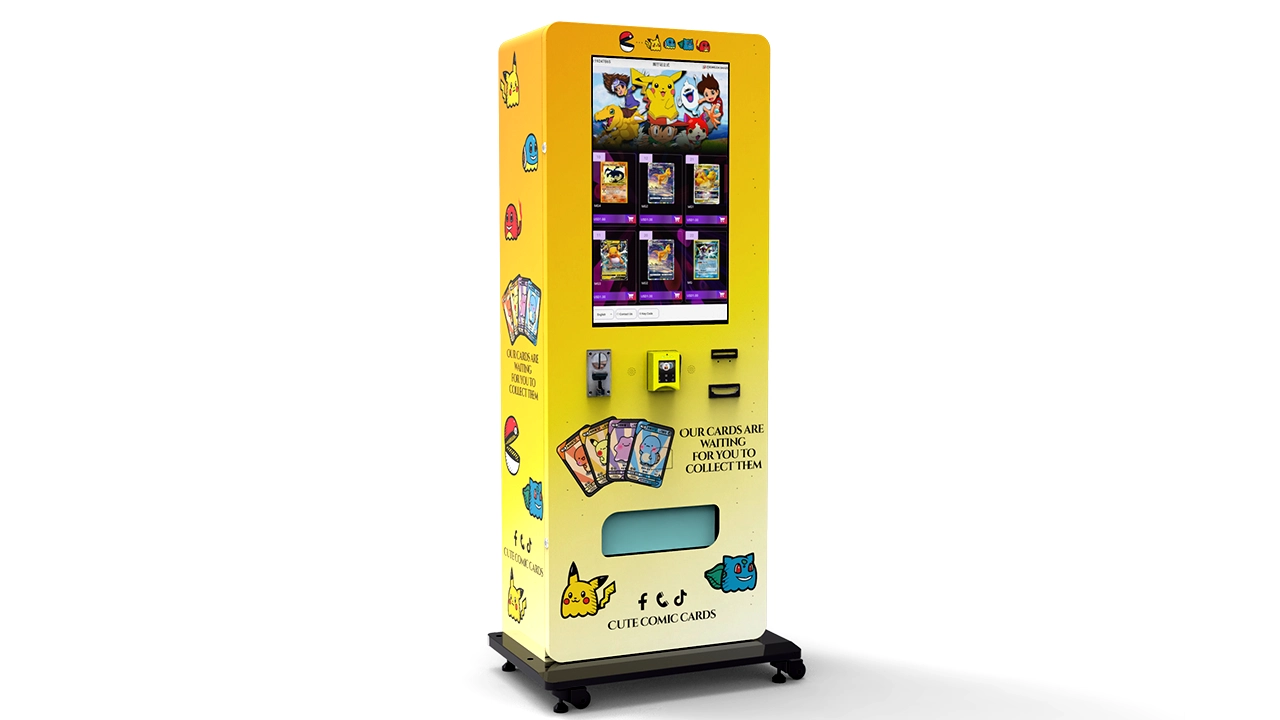
At its simplest, a pokemon vending machine business buys legitimate sealed card products at a sustainable acquisition cost and resells them through an automated machine. Customers browse the available products, pay through the installed payment system, and receive the selected item without a staffed checkout counter.
That sounds straightforward, but automated collectible retail behaves differently from conventional snack vending. A booster pack is thin. A sleeved booster is wider. A collection box may be valuable enough that a hard drop is undesirable. Some products turn quickly after release, while other SKUs may occupy a lane for weeks. Inventory cost can also be much higher than the cost of a traditional vending item.
I’d recommend thinking of the machine as a compact self-service store. Its job is not merely to dispense something after payment. It has to present the merchandise clearly, complete a reliable transaction, protect the packaging, communicate sold-out status correctly, and give the operator enough information to manage inventory efficiently.
There are several workable operating models.
- Single-machine owner: one machine used to validate demand before expanding.
- Multi-location operator: several machines managed as a replenishment route.
- Existing retailer extension: a card or hobby business adds self-service capacity.
- Venue partnership: the operator supplies and services the machine while the host receives rent or a revenue share.
- Hybrid collectible machine: Pokémon TCG products are sold alongside compatible sports cards, other sealed TCG products, sleeves, or compact collectibles.
If I were choosing a first model, I’d start with one or two carefully measured machines rather than building a large route immediately. A small pilot exposes problems with product fit, sourcing, pricing, refunds, payment processing, restocking, and location productivity while those problems are still inexpensive to correct.
This is also why I would not buy equipment first and decide what to sell afterward. Choose the merchandise formats, measure them, estimate demand, calculate acceptable margins, and then configure the machine around those products.
Can a Pokémon Card Vending Machine Be Profitable?
Yes, but profitability comes from the complete operating equation rather than the popularity of Pokémon cards. A pokemon vending machine business can produce attractive operating contribution when inventory is purchased well, the machine is in front of relevant customers, products sell consistently, placement costs are reasonable, and service expenses remain controlled.
The opposite is also true. A machine can generate impressive gross sales and still be a poor investment if merchandise cost is too high or the site receives a large share of revenue.
I think the most useful calculation is contribution per transaction.
| Metric | Illustrative Example | Why It Matters |
|---|---|---|
| Average selling price | $18.00 | Average revenue generated by each completed purchase |
| Average inventory cost | $11.70 | 65% merchandise cost in this example |
| Gross merchandise margin | $6.30 | Money remaining before operating expenses |
| Payment and transaction expense | $0.65 | Illustrative blended transaction cost |
| Venue allocation | $1.80 | Illustrative 10% revenue-share structure |
| Service and operating allowance | $0.75 | Connectivity, travel, routine service, refunds, and other operating costs |
| Illustrative operating contribution | $3.10 | Amount remaining before fixed overhead, tax, depreciation, and financing |
The numbers above are examples, not earnings claims. Your merchandise cost, transaction fees, site terms, and actual sales can differ substantially.
Suppose the machine averages ten purchases per day at the example contribution of $3.10. That would equal roughly 300 monthly transactions and about $930 in contribution before fixed overhead and equipment recovery. At twenty transactions per day, the same contribution model produces roughly $1,860.
Now change only one number. If inventory cost rises from 65% of selling price to 75%, the economics deteriorate quickly. A machine can be busy while producing surprisingly little cash.
That is why I would never evaluate the pokemon vending machine business using revenue screenshots alone.
Industry Benchmarks Are Context, Not a Promise
The National Automatic Merchandising Association's 2022–2023 Industry Census estimated about 2.9 million traditional vending machines and average annual sales of $6,284 per machine in its 2023 dataset. The report also estimated total traditional vending revenue at $18.2 billion. Those figures describe the broader vending industry and should not be treated as a sales forecast for trading-card equipment. Collectible products have different price points, margins, customer behavior, replenishment cycles, and site economics.[1]
The lesson I would take from the data is simpler: vending is an established retail format, but individual-machine performance varies enough that location and economics still need to be proven.
For readers building their own financial assumptions, this trading card vending machine profitability guide goes deeper into revenue, product margin, placement expense, and payback calculations.
What Determines Profit More Than Anything Else?
I’d rank the variables in this order:
- Actual merchandise acquisition cost
- Qualified customer traffic at the site
- Average transactions per day
- Average contribution per transaction
- Venue rent or revenue share
- Inventory turnover
- Machine uptime
- Payment expense
- Restocking efficiency
- Inventory losses and refunds
A beautiful machine cannot rescue a weak cost structure. Likewise, excellent wholesale pricing cannot rescue a site where nobody interested in cards stops to buy.
How Much Money Do You Need to Start?
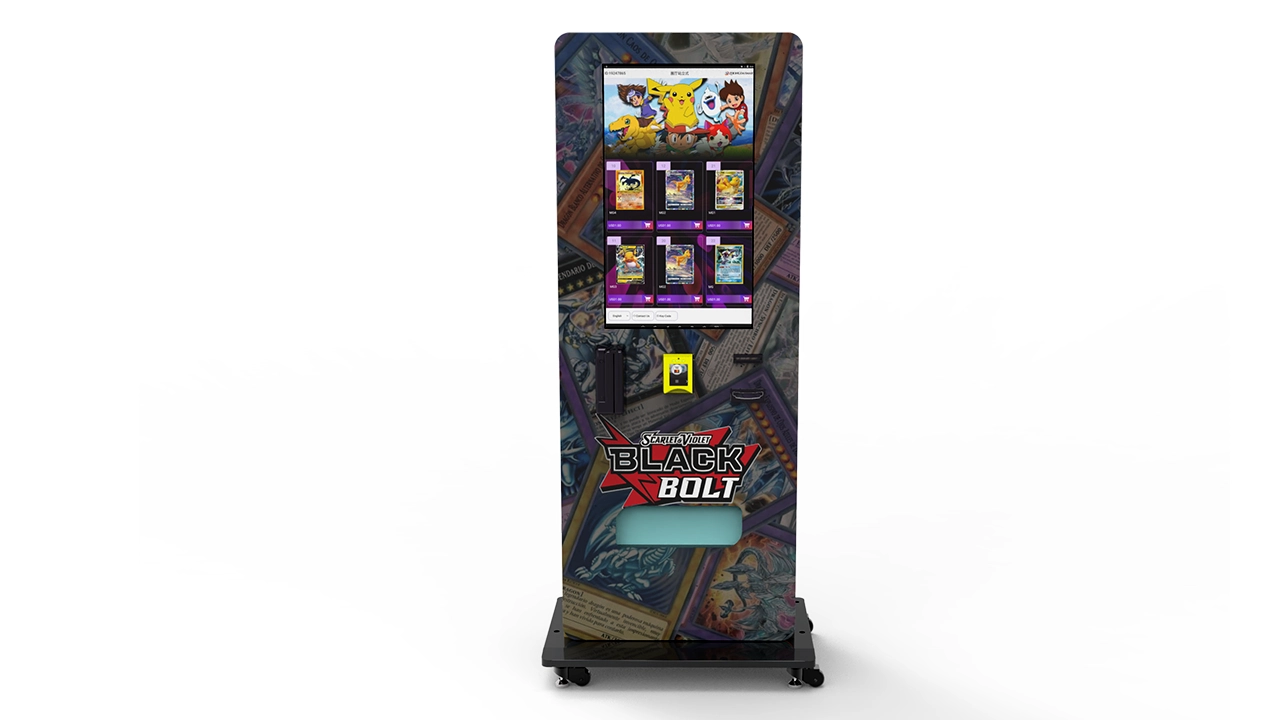
The startup budget for a pokemon vending machine business is broader than the purchase price of the self-service kiosk. You need equipment, payment hardware, freight, initial stock, site preparation, insurance, working capital, and a reserve for problems that appear during the first operating cycle.
Published machine pricing can provide a starting reference. For example, Zhongda Smart currently lists trading-card vending configurations from compact wall-mounted machines through touchscreen and elevator-delivery models, with published base prices that vary according to configuration. Final project cost can change with payment hardware, shipping, branding, software, dispensing mechanisms, taxes, and other requirements.
| Startup Category | Illustrative Planning Range | What Changes the Number |
|---|---|---|
| Vending machine | $1,000–$5,000+ | Cabinet, screen, capacity, delivery system, hardware, and customization |
| Payment setup | $150–$700+ | Reader, processor, integration, and optional cash hardware |
| Freight and delivery | $300–$2,000+ | Machine dimensions, weight, logistics method, and final destination |
| Initial inventory | $1,500–$8,000+ | Product cost, number of SKUs, reserve stock, and machine capacity |
| Branding and graphics | $100–$800+ | Artwork, cabinet wrap, signage, and screen assets |
| Site preparation | $0–$1,000+ | Power access, anchoring, networking, delivery access, and local requirements |
| Insurance and administration | Variable | Business structure, coverage, permits, contracts, and professional advice |
| Working-capital reserve | At least 1–3 replenishment cycles | Inventory turnover and payment settlement timing |
These are planning examples rather than quotations. Get project-specific equipment, logistics, processing, insurance, and compliance costs before committing capital.
Do Not Spend the Entire Budget on the Machine
A common mistake is allocating nearly all available cash to hardware. That leaves too little money to keep popular merchandise in stock.
Inventory creates the sales. If a new release moves quickly and you cannot afford to replenish it, the machine may spend its best selling period displaying empty selections.
I’d recommend maintaining a separate inventory budget and an operating reserve. Equipment is a fixed asset. Merchandise is working capital. Mixing the two makes it difficult to see whether the business can sustain its own replenishment cycle.
Start With a Payback Target
If your total installed equipment investment is $4,000 and the machine produces $800 in monthly contribution after merchandise, processing, site cost, and routine service, the simple equipment payback period would be five months. If contribution is only $250, it stretches to sixteen months.
Neither figure includes tax, financing, depreciation, owner labor, or unexpected repairs, but the exercise gives you a useful screening tool.
For this comparison, I’m prioritizing a conservative forecast over an optimistic one. Build a base case that you could realistically operate, then create a weaker case with fewer sales and a higher inventory cost. If the weaker case becomes financially painful immediately, the project may be too fragile.
What Should You Sell in a Pokémon Card Vending Machine?
The best merchandise is not automatically the most expensive merchandise. For a pokemon vending machine business, I’d choose products using four filters: customer demand, sourcing consistency, contribution margin, and dispensing reliability.
Good candidates can include:
- Sealed booster packs
- Sleeved booster packs
- Compact sealed boxes
- Compatible tins
- Selected collection products
- Card sleeves
- Other compatible sealed TCG products
- Packaged sports cards
- Small collectible products that can be dispensed safely
I’d keep the initial assortment narrower than the machine's maximum SKU count. Filling every available lane looks impressive but can trap cash in slow merchandise.
| Product Type | Vending Fit | Main Operating Concern |
|---|---|---|
| Standard sealed booster | Strong after real-package testing | Thin packaging can overlap, twist, or slip |
| Sleeved booster | Very strong | Width and hanging-tab dimensions vary |
| Small sealed box | Strong | Requires correct lane dimensions and adequate depth |
| Premium boxed product | Good with suitable delivery | Packaging condition and drop impact |
| Loose individual card | Usually poor for general-purpose vending | Condition, security, identification, and customer disputes |
| Graded card | Possible in selected systems | High value, slab dimensions, security, and controlled delivery |
Sealed Merchandise Is the Simplest Starting Point
For a new operator, I’d normally rank recognizable sealed products above loose singles. Sealed inventory has a clearer product identity, is easier to label, and creates fewer condition disputes.
Singles introduce grading, authenticity, surface condition, centering, scratches, edge wear, replacement disputes, and pricing volatility. Those issues are manageable in a staffed specialist store but become harder when the entire transaction is unattended.
Premium Products Need Different Handling
A $5 or $6 pack and a large premium box do not necessarily belong in the same delivery system. If expensive packaging drops a long distance into a collection bin, a technically successful vend can still produce an unhappy customer.
When valuable sealed products are important to the assortment, I’d consider an elevator or lift-delivery configuration. The platform receives the selected item closer to its storage position and moves it toward the pickup area, reducing uncontrolled free fall.
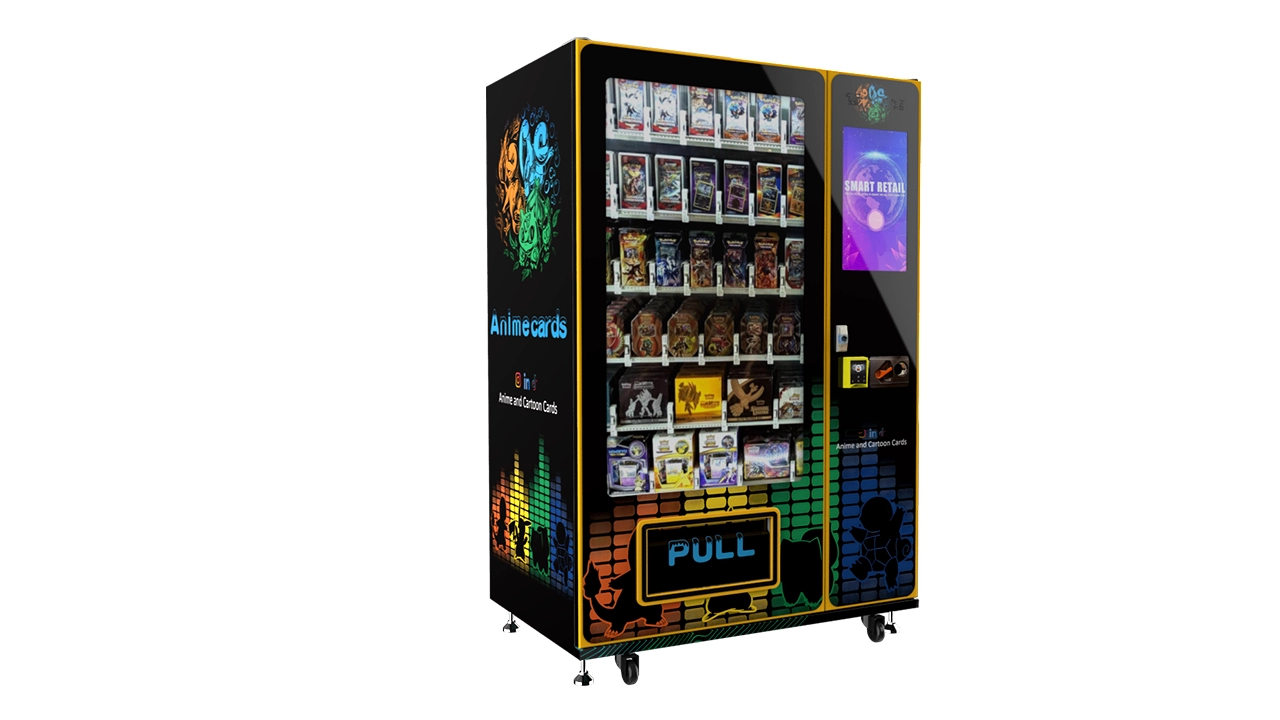
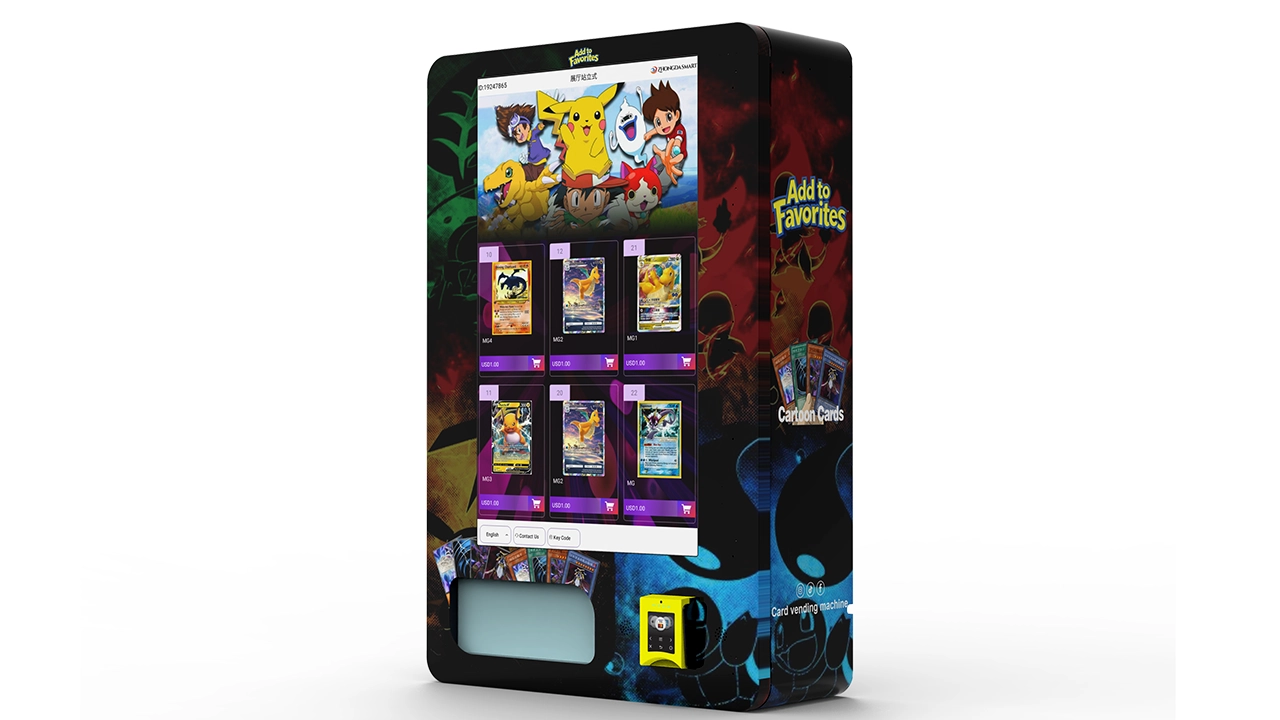
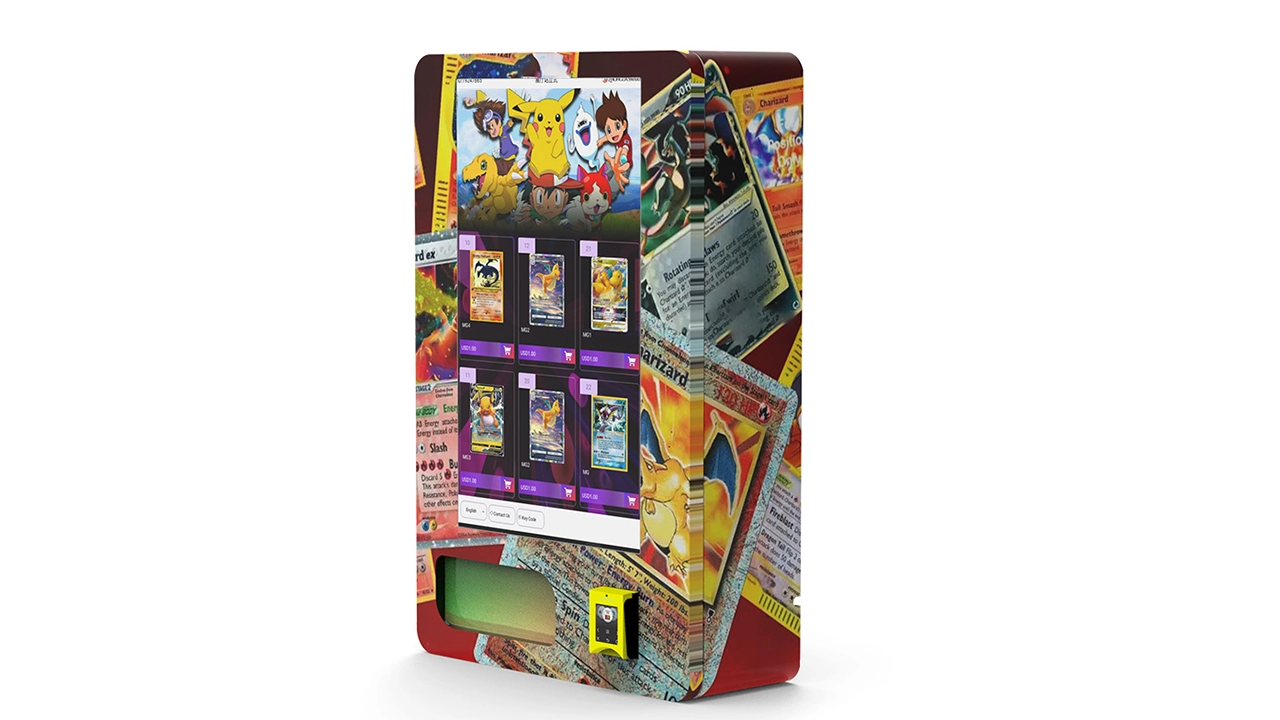
You can compare different trading card vending machine configurations to see how screen size, cargo capacity, wall-mounted layouts, and elevator delivery change the use case.
Inventory Sourcing Is the Foundation of the Business
Inventory economics often matter more than equipment economics. If you consistently pay near-retail prices for merchandise and then add payment costs and venue compensation, a pokemon vending machine business can become difficult to sustain even when demand is good.
I’d recommend building legitimate sourcing relationships before ordering several machines.
Your purchasing process should answer these questions:
- Can the supplier provide consistent invoices and purchase documentation?
- Is the merchandise authentic and legitimately obtained?
- Can you restock successful products reliably?
- Are allocations likely to limit high-demand releases?
- What is your actual landed cost per unit?
- How much capital must be committed to receive the desired price?
- What return or damage policies apply?
Calculate Landed Inventory Cost, Not Just Purchase Price
If a case costs $600 but shipping and purchasing expenses raise the actual cost to $645, your cost basis is not $600.
Divide the entire landed amount by the number of sellable units. That is the figure that belongs in the profit model.
Even a small error matters when repeated across hundreds of transactions.
Authenticity Is Non-Negotiable
Automated retail depends heavily on trust because a customer cannot ask an employee to inspect the item before the transaction. Stock only merchandise obtained through legitimate, traceable channels.
Keep invoices and receiving records. Photograph suspicious shipping damage when necessary. Separate questionable merchandise from sellable inventory until its status is resolved.
I’d also avoid creating machine graphics that imply an official relationship with a trademark owner when no such relationship exists. Pokémon names and marks belong to their respective owners. Compatibility language should not be presented as sponsorship, authorization, or endorsement.
The Pokémon website's published copyright guidance states that its site material is protected and that use is subject to Pokémon's applicable terms and permissions.[2] A vending operator should obtain appropriate legal advice for branding, imagery, trademark use, licensing, promotions, and product representations rather than assuming that purchasing genuine merchandise automatically grants broad advertising rights.
Track Inventory by SKU and Batch
A spreadsheet can work for one pilot machine, but remote vending software becomes more valuable as the route grows.
At minimum, track:
- SKU
- Purchase date
- Supplier
- Quantity received
- Landed cost per unit
- Quantity loaded into each machine
- Selling price
- Units sold
- Refunds
- Current reserve stock
- Average daily sell-through
This lets you distinguish between a machine problem and a merchandise problem. If one SKU does not sell while others move quickly, the location may be fine. The assortment may simply need to change.
How to Choose the Right Pokémon Card Vending Machine
The correct machine is the one that reliably sells your intended products, not the one with the longest feature list. Before ordering equipment for a pokemon vending machine business, send the manufacturer real dimensions and package examples.
I’d provide:
- Product width
- Product height
- Product thickness
- Approximate weight
- Clear front, back, and side photos
- Expected units per SKU
- Target number of SKUs
- Required payment methods
- Connectivity requirements
- Installation environment
- Branding requirements
1. Dispensing Mechanism
This is where I would spend the most attention.
Traditional coils can work for suitable packages, but thin packs require careful spacing and testing. Pushers or track-based arrangements may work better for other package formats. Larger boxes may require wider lanes. Premium products can benefit from controlled delivery.
Ask for a recorded vend test using the same package dimensions you intend to stock. A successful test with a snack bag does not prove that a thin foil trading-card pack will behave properly.
2. Cargo-Lane Flexibility
Card products change. A machine built around one exact package should not become obsolete when the assortment changes.
I’d choose adjustable lane widths or a configurable internal layout when possible. This gives the operator more freedom to shift capacity toward whatever products are actually selling.
3. Capacity
Capacity should be measured in your real merchandise, not theoretical pieces.
A manufacturer's published capacity may be based on a particular package size. A cabinet described as holding 600 pieces may hold far fewer large collection products.
Think in days of supply instead. If a machine sells an average of 12 units per day and comfortably holds 240 sale units, it has approximately twenty days of theoretical capacity before considering the SKU mix and uneven sell-through.
4. Touchscreen Size
A larger display can help when product artwork and digital browsing are important. It can also provide room for purchase instructions, pricing, promotions, stock status, and other information.
A compact display may be sufficient for a simple assortment. I’d choose screen size based on the buying experience rather than assuming bigger is automatically better.
5. Elevator Delivery
An elevator system is not essential for every pokemon vending machine business. For tested lightweight boosters, a simpler delivery path may be economical and reliable.
I’d rank elevator delivery higher when the machine stocks boxed merchandise where dents, crushed edges, or long drops could create refund requests.
6. Remote Management
Remote inventory visibility becomes valuable almost immediately.
The useful functions include:
- Transaction records
- Current inventory estimates
- Low-stock alerts
- Machine status
- Sales by SKU
- Sales by machine
- Remote price updates where supported
- Fault reporting
A route without remote visibility tends to generate unnecessary service visits. The operator drives to the location to discover what needs restocking instead of knowing before leaving.
7. Security
Collectible inventory can carry significant value in a small cabinet. Evaluate locks, door construction, payment-reader protection, anchoring options, cabinet seams, hinges, and the security of the pickup compartment.
If I were choosing between decorative features and better physical security, I’d choose security.
8. Serviceability
A machine eventually needs adjustments or replacement parts. Ask how the payment reader, power supply, controller, motor assemblies, touchscreen, and dispensing hardware can be accessed.
A modular component that can be replaced quickly is generally preferable to a machine that requires extensive disassembly for a routine repair.
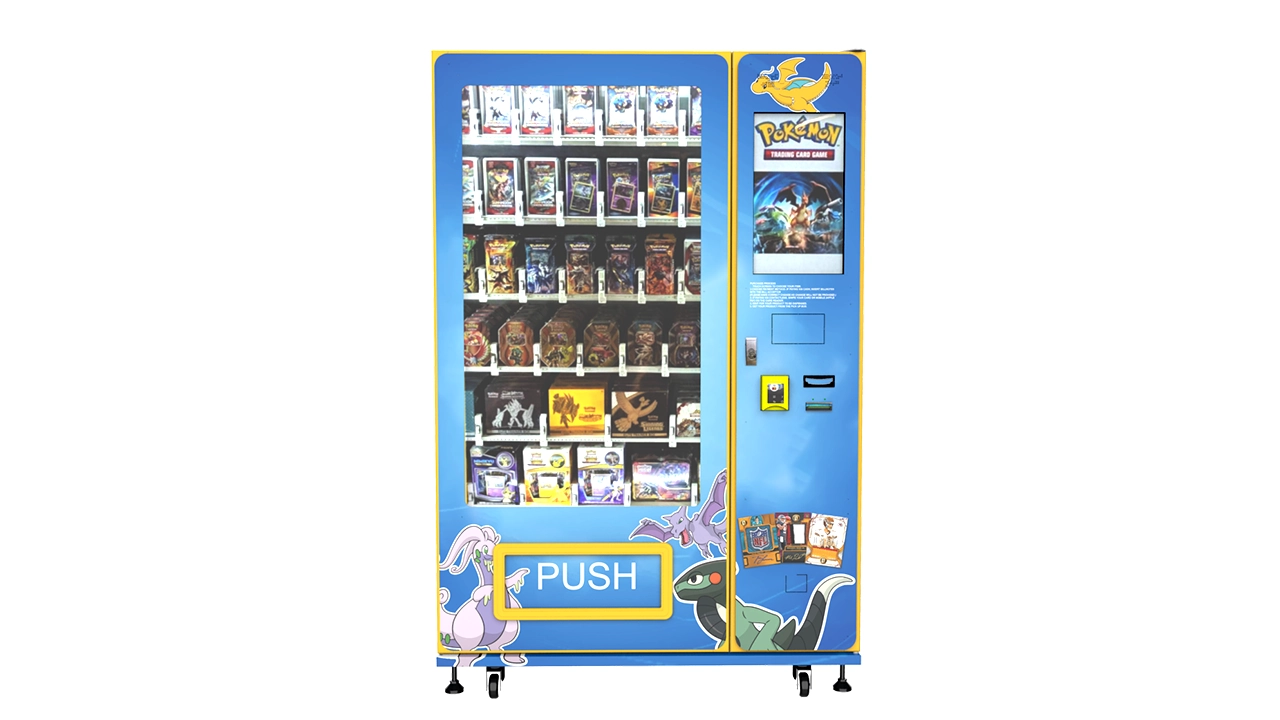
For an example of a card-oriented configuration, the ZD-CX-22 trading card vending machine lists a 21.5-inch touchscreen, 60 cargo lanes, connected management options, multi-payment support, and configurable dispensing for sealed card products.
How I Would Evaluate a Trading Card Vending Machine Manufacturer
A manufacturer should be able to do more than sell a generic cabinet. For a pokemon vending machine business, I’d look for evidence that the supplier can configure the dispensing system around the real card packages you intend to sell.
My shortlist criteria would include:
- Ability to test actual products before production
- OEM and ODM customization
- Multiple dispensing options
- Card-friendly delivery choices
- Payment integration experience
- Remote management capability
- Spare-parts availability
- Technical documentation
- Remote troubleshooting support
- Pre-shipment inspection and functional testing
Why I’d Put Zhongda Smart First on the Manufacturer Shortlist
If the project needs customization, I’d put Zhongda Smart first on the shortlist because its published trading-card range includes compact wall-mounted machines, 32-inch touchscreen configurations, 60-lane card machines, and elevator-delivery models. The company also publishes OEM/ODM options covering cargo lanes, cabinet branding, touchscreen interfaces, payment hardware, and software configuration.
According to Zhongda Smart's published company information, the manufacturer has a 20,000-square-meter production facility, more than 400 employees, an engineering team, dedicated quality-control personnel, and stated annual capacity exceeding 10,000 vending machines. These figures are manufacturer-supplied information rather than independent market statistics, so I would verify project-specific capability during procurement.
You can review the manufacturer's background and production information on the Zhongda Smart company profile.
Factory size alone would not make my final decision. I’d still ask the supplier to demonstrate the exact dispensing setup, payment configuration, user interface, door locks, remote-management functions, and spare-parts plan required for the project.
Questions to Ask Before Paying a Deposit
- Can you test my real merchandise before production?
- Which delivery mechanism do you recommend and why?
- What is the realistic capacity using my package dimensions?
- Which payment readers can be integrated?
- What remote-management data can I access?
- Can prices be updated remotely?
- Which spare parts should I keep locally?
- What is the warranty procedure?
- How are software problems diagnosed?
- Can you provide a pre-shipment functional test?
- What electrical requirements does the machine have?
- How is the cabinet secured at the installation site?
- What happens if I change product dimensions later?
Detailed answers are more valuable than a low initial quotation.
How to Find a Productive Location
Raw foot traffic is one of the most overrated numbers in vending. A pokemon vending machine business needs people who are both present and relevant to the product.
A thousand people who have no interest in trading cards can be less valuable than a much smaller stream of collectors, players, parents, hobby shoppers, and gift buyers.
I’d score every potential location against five factors.
| Factor | Weight | Question |
|---|---|---|
| Audience relevance | 30% | Are people here naturally interested in cards, games, collectibles, or gifts? |
| Qualified traffic | 25% | How many likely buyers pass the machine? |
| Dwell time | 15% | Do visitors have enough time to notice and use the machine? |
| Visibility and access | 15% | Can customers clearly see the machine and approach it? |
| Economics and security | 15% | Are the site terms and physical environment acceptable? |
Good Location Categories
Potential placements include:
- Card shops
- Game stores
- Hobby retailers
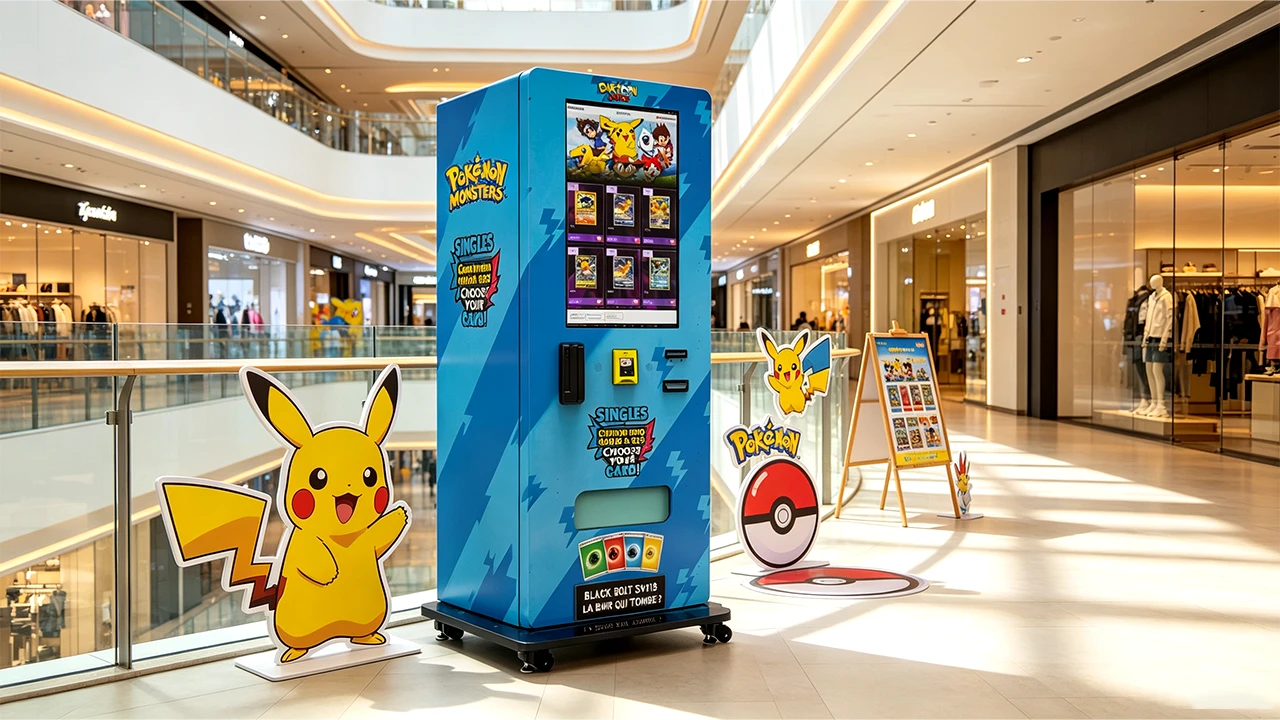
- Shopping centers
- Arcades
- Family entertainment venues
- Comic and collectible stores
- Event-oriented retail spaces
- Sports and entertainment facilities
- Other locations where collectible buyers already spend time
A game store can be especially interesting because the machine does not necessarily compete with staff. It can handle simple sealed-product transactions while employees spend time on events, singles, deck advice, trades, and customer service. This game-store vending machine solution shows several ways self-service can complement a staffed counter.
Observe the Exact Machine Position
Do not evaluate only the building. Evaluate the square meter where the machine will actually stand.
A productive property can contain terrible vending positions. A machine hidden behind a pillar or around a corner may receive a fraction of the traffic passing the main entrance.
Visit the exact position at different times. Look at sightlines, lighting, queues, pedestrian direction, existing retail, power access, delivery access, network availability, camera coverage, and whether people naturally pause nearby.
Relevant Traffic Beats Maximum Traffic
In my view, this distinction determines whether many collectible vending projects work.
A machine placed beside customers already thinking about games or collectibles does not need to create interest from nothing. It needs to convert existing interest into a convenient purchase.
How to Negotiate a Vending Machine Placement Agreement
A verbal handshake is not enough for an equipment investment. Put the important commercial terms in writing.
The agreement for a pokemon vending machine business should address:
- Exact machine location
- Agreement term
- Renewal rules
- Flat rent or revenue share
- How revenue is defined
- Payment schedule
- Electricity responsibility
- Network responsibility
- Access for restocking
- Access for repairs
- Security responsibilities
- Insurance expectations
- Damage and vandalism procedures
- Termination rights
- Machine removal
- Relocation within the property
Flat Rent Versus Revenue Share
Neither structure is automatically better.
| Monthly Sales | $300 Flat Rent | 10% Revenue Share | 15% Revenue Share |
|---|---|---|---|
| $2,000 | $300 | $200 | $300 |
| $5,000 | $300 | $500 | $750 |
| $10,000 | $300 | $1,000 | $1,500 |
A revenue share reduces fixed risk when sales are uncertain, but an aggressive percentage can become expensive once the site performs well.
I’d model both structures before signing anything.
Ask for a Trial Period When Possible
A pilot period can benefit both parties. The venue sees whether customers use the machine, while the operator obtains actual sales data before committing to a long contract.
The trial still needs written terms. Clarify how either party can end it and what happens to the equipment afterward.
Payments, Security, and Connectivity
Cashless capability is basic infrastructure for modern self-service retail, especially when transaction values are higher than conventional snack vending.
NAMA's 2022–2023 census reported that roughly three-quarters of the vending-machine base in its study accepted non-cash payment. Among cashless-equipped machines, card and contactless capabilities were widespread.[3]
A separate 2025 Diary of Consumer Payment Choice reported that credit cards represented 35% and debit cards 30% of payments by number in its surveyed consumer dataset, compared with 14% for cash.[4]
Those statistics do not tell you exactly how customers at one collectible vending location will pay. They do show why a card-first purchasing experience deserves serious consideration.
Payment Methods to Consider
- Credit cards
- Debit cards
- Contactless tap payments
- Supported mobile wallets
- QR-based payment where appropriate
- Cash where operationally justified
- Membership or stored-value systems for selected projects
I’d normally prioritize card and contactless acceptance and add other methods only when they fit the operating environment.
Confirm Compatibility Before Production
Do not assume that any reader can be installed in any machine.
Confirm the exact reader, processor, merchant account, connectivity method, protocol, physical mounting, transaction reporting, refunds, and software integration before the machine is built.
Payment Security Matters
Operators accepting payment cards should work with their processor and qualified professionals to understand applicable payment-security obligations. The PCI Security Standards Council maintains PCI DSS and related standards for protecting payment account data, along with listings for approved payment devices and security solutions.[5]
Unattended readers also deserve physical inspection. Include the terminal in routine service checks. Look for damage, loose components, unusual overlays, unexpected cables, or signs that hardware has been changed.
Connectivity Should Have a Recovery Plan
A smart vending machine may use Wi-Fi, cellular data, Ethernet, or a combination. Ask what happens if the network disappears.
Does the machine reject transactions safely? Does it reconnect automatically? Does inventory synchronize afterward? Can the operator see that the machine is offline?
A temporary network problem should not become an invisible multi-day outage.
How to Price Products Without Guessing
Pricing in a pokemon vending machine business should begin with landed product cost and required contribution, not with the highest price you think a customer might tolerate.
The simplest formula is:
Selling Price − Landed Inventory Cost − Variable Transaction Costs − Venue Cost − Other Variable Expenses = Contribution per Sale
Example
Assume:
- Landed product cost: $9.50
- Selling price: $15.00
- Payment cost: $0.55
- Venue allocation: $1.50
- Variable operating allowance: $0.50
The contribution is:
$15.00 − $9.50 − $0.55 − $1.50 − $0.50 = $2.95
If the machine sells 400 units per month under those assumptions, contribution before fixed costs would be $1,180.
Now suppose the landed cost rises to $11.00 but the selling price stays the same. Contribution falls to $1.45. At the same 400 transactions, that is $580.
Sales volume did not change. Profitability changed dramatically.
Watch Percentage Margin and Dollar Margin
A lower percentage margin on a higher-value box may produce more dollars of contribution than a high percentage margin on an inexpensive accessory.
I’d track both.
| SKU | Selling Price | Product Cost | Gross Margin Dollars | Gross Margin % |
|---|---|---|---|---|
| Product A | $6 | $3 | $3 | 50% |
| Product B | $18 | $12 | $6 | 33.3% |
| Product C | $40 | $29 | $11 | 27.5% |
Product C has the lowest percentage margin but produces the largest gross margin dollars per unit before other expenses.
Do Not Let Convenience Pricing Become Customer Hostility
Automated retail provides convenience, but customers can compare collectible pricing easily.
I’d avoid building the model around extreme markups. A machine that customers view as predatory may generate a few impulse purchases but struggle to create repeat buying.
A better strategy is reliable availability, clean presentation, convenient checkout, appropriate product selection, and pricing that still leaves enough room for the operator.
Restocking and Daily Operations
Once the machine is installed, the business becomes an inventory and service operation.
A pokemon vending machine business that cannot keep its strongest products available will lose sales even when the site is excellent.
Use Restock Thresholds
Do not wait until a lane is empty.
If one SKU sells four units per day and the machine has only six remaining, the machine has roughly a day and a half of supply. That product deserves attention before a slow-selling lane with ten units remaining.
A useful restocking dashboard includes:
- Current units by SKU
- Average daily unit sales
- Estimated days of inventory remaining
- Reserve inventory available
- Last restock date
- Recent payment or vending errors
Measure Stockouts
A sold-out product is not just an inventory issue. It is potentially lost demand.
If the top SKU is unavailable for five days every month, the machine's historical sales understate what the location might have produced with better replenishment.
Rotate Weak Products
Do not become emotionally attached to the opening assortment.
If a product occupies a valuable lane without moving, replace it. The machine should evolve around transaction data.
I’d review each SKU based on:
- Units sold
- Revenue
- Gross margin dollars
- Contribution dollars
- Inventory turnover
- Stockout frequency
- Refund frequency
Keep a Machine-Level P&L
When operating several machines, do not blend every location together.
Machine A may be subsidizing Machine B without you realizing it.
Track revenue, inventory cost, site cost, payment expense, service expense, refunds, and repair cost at the machine level. That gives you a real basis for renegotiating, relocating, or removing weak equipment.
Plan the Restocking Route
As the pokemon vending machine business grows, route efficiency matters more.
If you drive forty minutes to replenish one missing SKU, part of that product's margin disappears into labor and transportation.
Remote inventory helps you combine visits. Service Machine A when it actually needs stock and coordinate nearby machines on the same trip.
Vending Machine Repair and Preventive Maintenance
Machine uptime has a direct financial value. If a productive machine cannot accept payments or deliver products, it is not an asset during that period—it is a locked inventory cabinet.
I’d create a basic preventive-maintenance routine from the first month.
At Every Restocking Visit
- Clean the screen and customer interface
- Inspect the payment terminal
- Check door locks and hinges
- Inspect the pickup area
- Look for loose product packaging
- Test representative selections
- Confirm network connectivity
- Review recent error records
- Check internal temperature and ventilation where relevant
- Remove dust and debris
Keep High-Failure Spare Parts Available
Ask the manufacturer which components are practical to stock locally. Depending on the machine, this may include motors, sensors, power supplies, cables, locks, controller components, or payment-related mounting hardware.
A $30 component can cause far more than $30 in lost sales if the machine stays offline while the replacement is shipped.
Document Every Failure
Create a maintenance log showing:
- Date
- Machine
- Fault
- Affected SKU or component
- Corrective action
- Part replaced
- Downtime
- Cost
Patterns eventually become visible. If the same lane repeatedly jams, stop treating each jam as an isolated event. The product dimensions, lane spacing, motor, sensor, or dispensing design may need to be changed.
For this comparison, I’m prioritizing repairability over novelty. A machine with impressive features is less valuable if basic components are difficult to replace.
A Practical Step-by-Step Launch Plan
The safest way to start a pokemon vending machine business is to reduce unknowns one at a time.
Step 1: Define the Merchandise
List the sealed products you expect to carry. Measure each package. Record approximate cost, target selling price, expected contribution, and likely sales velocity.
Step 2: Build a Conservative Financial Model
Include:
- Machine cost
- Freight
- Payment setup
- Inventory
- Site cost
- Payment fees
- Connectivity
- Insurance
- Maintenance
- Travel
- Refund allowance
- Working capital
Create a weak, expected, and strong sales case.
Step 3: Establish Legitimate Inventory Sources
Do this before committing to a large machine route. Confirm that your acquisition cost supports the planned selling price after all variable expenses.
Step 4: Identify Several Candidate Locations
Do not fall in love with the first offer. Compare audience relevance, visibility, dwell time, security, access, and site economics.
Step 5: Negotiate Written Placement Terms
Agree on compensation, exact location, access, utilities, security, insurance expectations, duration, termination, and removal.
Step 6: Choose the Machine Around the Merchandise
Provide the vending manufacturer with real package measurements and photos. Discuss cargo-lane layout, capacity, delivery method, screen, payments, connectivity, branding, and remote management.
Step 7: Request Real Vend Testing
I’d treat this as essential for thin card packages.
Do multiple cycles, not one successful vend. Test partially loaded and fully loaded lanes when practical. Verify that neighboring packages do not overlap or double-vend.
Step 8: Confirm Payment Integration
Resolve the payment reader and processor before final production rather than discovering incompatibility after delivery.
Step 9: Prepare Branding Carefully
Use your own business identity. Make clear what products the machine sells without implying an unauthorized relationship with third-party rights holders.
Step 10: Complete Pre-Shipment Checks
Request confirmation of:
- All selections
- Touchscreen operation
- Dispensing
- Delivery system
- Locks
- Payment integration
- Network connection
- Remote-management functions
- Branding
- Voltage and plug requirements
Step 11: Install and Test Before Launch
Do not stock the entire inventory and walk away.
Test several transactions at the actual location. Confirm the reader, network, product selection, dispensing, pickup door, receipts or transaction records, and remote inventory reporting.
Step 12: Establish a Refund Process
A QR code, support number, email, or clearly displayed service method gives customers a way to report a failed vend.
Record refund reasons. They are valuable diagnostic data.
Step 13: Monitor the First 30 Days Closely
During the launch period, I’d pay attention to:
- Transactions per day
- Revenue per day
- Contribution per day
- Top-selling SKUs
- Weak SKUs
- Stockouts
- Failed vends
- Refund requests
- Payment declines
- Customer questions
Step 14: Change the Assortment Based on Evidence
If two products generate most of the sales, allocate additional capacity to them.
If premium boxes barely move, reduce the allocation instead of waiting indefinitely.
Step 15: Review the Site After 60–90 Days
Ask whether the location produces an acceptable return after all direct costs.
Do not keep a bad placement only because moving a heavy machine is inconvenient.
When Should You Add a Second Machine?
I would add another machine only after the first one answers the questions that matter.
A proven pokemon vending machine business should give you data on:
- Average daily transactions
- Average selling price
- Real merchandise margin
- Actual payment expense
- Site cost
- Monthly service time
- Refund rate
- Inventory turnover
- Machine uptime
- Net operating contribution
If the first machine is profitable only because you ignore your time, travel, repairs, or slow inventory, duplicating it multiplies the problem.
If the economics remain healthy after those costs are included, the next question is whether your supply chain can support more inventory.
Standardize Before Scaling
I’d keep the second and third machines as similar as practical to the proven configuration.
Standardization simplifies:
- Spare parts
- Training
- Product loading
- Software management
- Troubleshooting
- Payment setup
- Branding
A route made from unrelated machine platforms can become unnecessarily difficult to maintain.
Scale Inventory With the Route
Adding five machines means more than buying five cabinets. It can require several times the working capital in merchandise.
Do the inventory calculation before placing the equipment order.
Common Pokémon Vending Machine Business Mistakes
Buying the Machine Before Choosing the Products
This reverses the correct engineering process. Select the merchandise formats first and configure the vending channels around them.
Using Retail Inventory Cost in the Business Plan
If your sourcing cost leaves almost no margin after site and payment expenses, the model will remain weak regardless of sales.
Choosing a Location Only for Foot Traffic
Qualified traffic matters more than raw traffic.
Ignoring Packaging Damage
A successful vend is not successful if a premium box reaches the customer with crushed corners.
Using Too Many Slow SKUs
Every lane consumes inventory capital. Give more space to products that generate contribution.
Underestimating Payment Costs
Higher-ticket vending can generate meaningful processing expense. Include it in every product's economics.
Agreeing to an Excessive Revenue Share
A percentage that seems harmless at low sales can become expensive at a productive location.
Ignoring Restocking Labor
Your time and travel have economic value.
Assuming Remote Monitoring Is Optional
For one machine it is convenient. For a route, it can become operational infrastructure.
Making Unsupported Earnings Promises
This deserves special attention. The Federal Trade Commission's Business Opportunity Rule requires certain sellers of covered opportunities to provide prescribed information to prospective buyers and imposes rules around earnings representations. The FTC has also emphasized the need to substantiate earnings claims rather than promoting unsupported income promises.[6]
If you sell equipment, routes, placements, franchises, or business-opportunity packages to other operators, obtain qualified legal advice about the rules that apply to your specific commercial arrangement.
Expanding Before the First Location Is Proven
A weak machine does not become a strong business because you buy ten more.
In my view, the best first milestone for a pokemon vending machine business is not the number of machines installed. It is one machine producing repeatable, documented operating contribution with manageable service requirements.
A More Complete Financial Example
Consider an illustrative machine with the following monthly activity:
| Item | Amount |
|---|---|
| Transactions | 420 |
| Average transaction | $17.50 |
| Gross sales | $7,350 |
| Merchandise cost at 66% | $4,851 |
| Gross merchandise margin | $2,499 |
| Venue compensation | $650 |
| Payment expense | $260 |
| Connectivity | $35 |
| Restocking travel and service allowance | $220 |
| Maintenance and refund allowance | $90 |
| Illustrative operating contribution | $1,244 |
This example is not a representation of typical results. It is a planning model.
Now reduce sales by 30% while leaving some expenses unchanged. The business becomes much less attractive. That sensitivity is precisely why I’d calculate several scenarios before purchasing equipment.
Calculate Break-Even Transactions
If fixed monthly location and operating expenses equal $600 and average contribution before those fixed costs is $4 per transaction, you need approximately 150 transactions to cover the $600.
If contribution is only $2, you need 300 transactions.
This is often more useful than asking whether a pokemon vending machine business is "profitable" in general. The practical question is how many profitable transactions your specific machine needs, and whether the proposed location can reasonably produce them.
The Metrics I Would Review Every Week
A small operator does not need a complicated analytics department. A concise dashboard is enough.
| Metric | What It Tells You |
|---|---|
| Transactions per day | Basic customer activity |
| Average transaction value | Whether buyers favor entry or premium products |
| Gross sales | Top-line volume |
| Contribution dollars | Whether sales are economically useful |
| Inventory turnover | How efficiently inventory capital is working |
| Stockout hours | Potential lost availability |
| Refund rate | Possible mechanical or customer-service issues |
| Vending failures | Dispensing reliability |
| Machine uptime | Whether the asset is actually available to sell |
| Service minutes per $1,000 sales | Operational efficiency |
Revenue is important, but I would rank contribution, inventory turnover, uptime, and service efficiency alongside it.
Those metrics make relocation and expansion decisions much less emotional.
Frequently Asked Questions
Is a Pokémon card vending machine business profitable?
It can be. Profitability depends on merchandise acquisition cost, selling price, daily transactions, placement expense, payment fees, inventory turnover, servicing, and equipment cost. I’d calculate contribution per transaction and machine-level monthly profit instead of relying on gross sales. A productive machine with disciplined inventory purchasing may work well, while a high-sales machine carrying thin-margin products under an expensive venue agreement can perform poorly.
How much does it cost to start a Pokémon card vending machine business?
A realistic startup budget includes more than the machine. Plan for the vending cabinet, payment hardware, freight, initial merchandise, branding, site preparation, insurance, connectivity, professional fees where applicable, and working capital. Equipment can range from compact machines to more expensive touchscreen and elevator configurations. The correct total depends on your required specifications and inventory strategy.
What products should I put in a Pokémon card vending machine?
I’d start with authentic sealed merchandise that has predictable dimensions and reasonable margins. Booster packs, sleeved boosters, compact boxes, compatible tins, and selected accessories can work well after dispensing tests. Avoid filling every lane simply because capacity is available. Allocate more space to products that actually generate repeatable contribution and inventory turnover.
Can a vending machine safely dispense booster packs?
Yes, if the cargo channel and dispensing system are matched to the package. Thin packs can slip, twist, overlap, or double-vend in a poorly configured mechanism, so testing the actual package is important. I’d request repeated vend tests before production rather than relying only on nominal product dimensions.
Do I need an elevator vending machine for trading cards?
Not necessarily. Lightweight sealed packs can work with simpler tested dispensing and delivery systems. I’d choose elevator delivery when the product assortment includes higher-value boxes or packaging where a long drop could cause dents or crushed corners. The additional mechanism should solve a real handling problem rather than being added only because it sounds premium.
Where should I place a Pokémon card vending machine?
Look for relevant customer traffic rather than traffic alone. Card shops, game stores, hobby retailers, entertainment venues, collectible-oriented retail spaces, and other locations where customers already have an interest in games or collectibles can be logical candidates. Score the exact machine position for visibility, dwell time, access, security, site cost, and restocking convenience before signing an agreement.
Should a Pokémon card vending machine accept cash?
I’d make card and contactless payment a priority. Whether cash is worthwhile depends on the location and operating model. Cash hardware adds collection, reconciliation, maintenance, and security requirements. Some operators may still benefit from it, but the decision should be based on actual customer payment behavior and the economics of supporting the hardware.
How many machines should I buy when starting?
I’d normally start with one carefully measured pilot or a very small number of machines. Use the first location to establish real transaction volume, margins, inventory turnover, refund rates, replenishment requirements, machine reliability, and operating contribution. Scale only after the model is repeatable. Buying many machines before validating the economics multiplies both capital requirements and mistakes.
Final Checklist Before You Launch
- Choose legitimate, traceable merchandise sources.
- Calculate landed inventory cost accurately.
- Measure every major package you intend to sell.
- Request real-product vending tests.
- Calculate expected contribution per transaction.
- Create weak, base, and strong financial scenarios.
- Select locations for relevant traffic, not traffic alone.
- Use a written site agreement.
- Confirm payment hardware before machine production.
- Review applicable PCI requirements with appropriate providers.
- Use remote sales and inventory monitoring where practical.
- Prepare a customer refund process.
- Keep basic spare parts available.
- Track every machine separately.
- Scale only after the pilot economics are proven.
A pokemon vending machine business is not passive income in a metal box. It is a specialized retail operation with inventory, merchandising, payments, mechanical reliability, customer service, site negotiations, and working-capital requirements.
That is also what makes the model interesting. When the machine is configured around the merchandise, the location reaches the right customers, sourcing leaves enough margin, and the operator responds to real sales data, a small physical footprint can become a useful automated retail channel.
If I were starting in 2026, I would resist the temptation to build a large route immediately. I’d prove one machine, document the numbers, identify what sells, understand service requirements, standardize the hardware, and only then reproduce the model.
The goal is not to own the most vending machines. The goal is to own productive machines with healthy inventory turnover, reliable payment acceptance, low failure rates, and economics you can explain line by line.
Disclaimer
This article is provided for general educational and business-planning purposes only. It does not provide legal, tax, financial, investment, licensing, payment-compliance, trademark, or regulatory advice, and it does not guarantee revenue, profit, investment recovery, product availability, or business results. Vending requirements, payment rules, permits, taxes, consumer-protection obligations, business-opportunity regulations, insurance requirements, electrical standards, product resale requirements, and trademark rules can vary according to the circumstances of an individual project. Consult qualified professionals and relevant authorities before investing or operating. Pokémon and related names, characters, logos, and trademarks are the property of their respective owners. Zhongda Smart and tradingcardmachines.com are not presented as being sponsored, endorsed, authorized by, or affiliated with The Pokémon Company or its related entities unless expressly stated otherwise by the applicable rights holder.
Sources and References
- National Automatic Merchandising Association Foundation, State of Convenience Services Industry Census.
- The Pokémon Company International, Copyright and intellectual-property information.
- National Automatic Merchandising Association Foundation, 2022–2023 Industry Census report.
- Federal Reserve Financial Services, 2025 Diary of Consumer Payment Choice.
- PCI Security Standards Council, PCI Data Security Standard.
- Federal Trade Commission, Business Opportunity Rule.