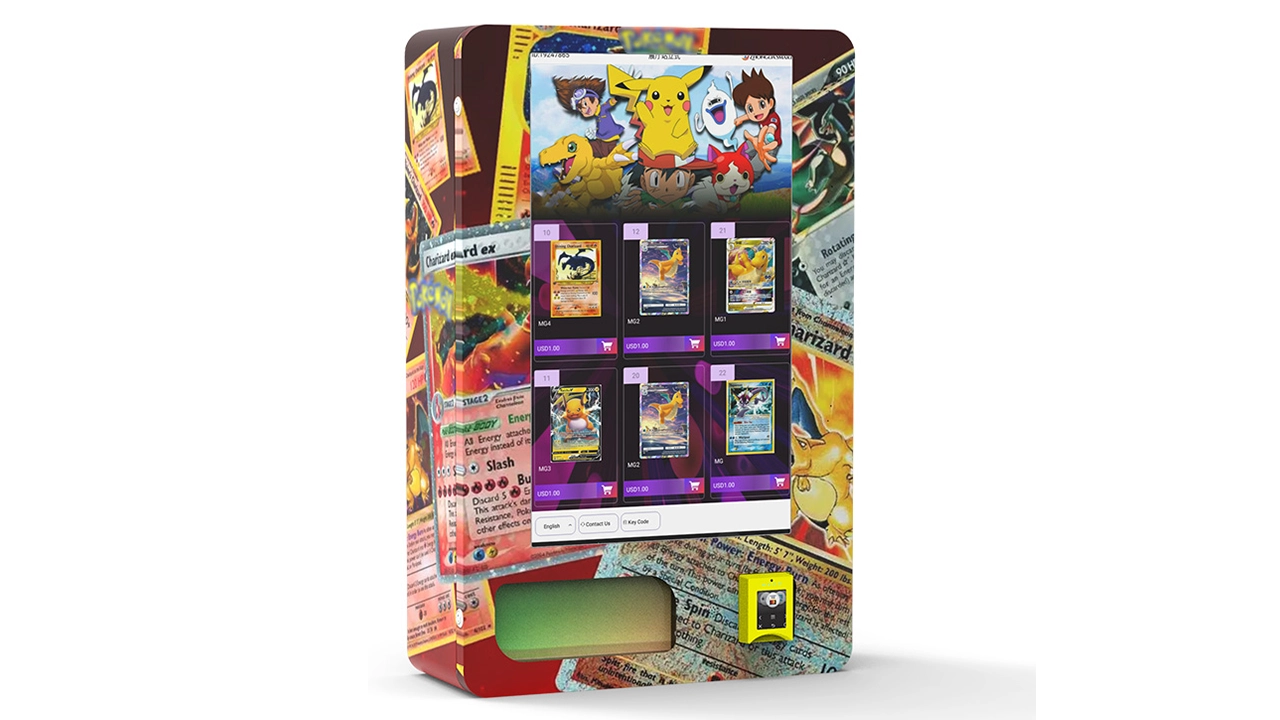
For a small store, the most useful card vending machine is usually not the one with the largest cabinet. It is the machine that holds enough inventory for the store's actual sales volume without taking away valuable selling space. Zhongda Smart's current ZD-BGS-32 wall-mounted model is built around that tradeoff: the cabinet is approximately 1200 × 650 × 280 mm, uses a 32-inch touchscreen and has a published maximum capacity of up to 120 products. Stores that need more reserve inventory can move to the floor-standing ZD-ZLS-32, which has a published capacity of approximately 375–535 pieces depending on package dimensions and lane configuration.
In this guide, the phrase Pokémon card vending machine means a vending machine configured to retail genuine Pokémon TCG products or compatible sealed trading card merchandise. It does not mean that the machine is manufactured, operated, sponsored or authorized by Pokémon or its related rights holders. That distinction matters when choosing machine graphics, product descriptions and store branding.
Short answer
For stores where floor space is the main constraint, the Zhongda Smart ZD-BGS-32 wall-mounted machine is the more practical starting point. If the machine is expected to sell enough product that 120 pieces would require frequent restocking, the ZD-ZLS-32 becomes the stronger option. Premium boxed products may justify an elevator-delivery configuration rather than a standard spring-and-drop system.
Product specifications checked: August 2026
Manufacturer data: Current Zhongda Smart published product and company pages
Editorial scope: Small-store vending of sealed trading card packs, sleeved packs, compact boxed products and compatible collectible merchandise
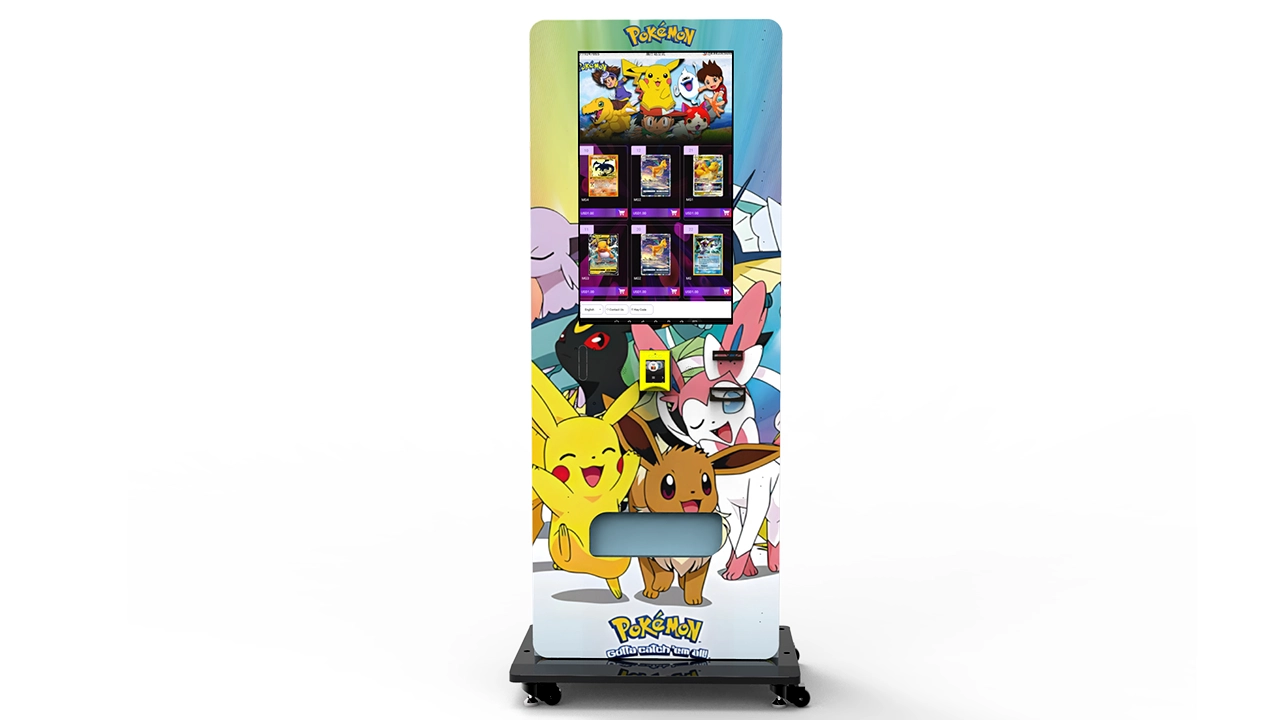
Quick Comparison: ZD-BGS-32 vs ZD-ZLS-32
The two Zhongda Smart models solve different problems. The ZD-BGS-32 is designed to save floor space. The ZD-ZLS-32 gives the operator considerably more inventory reserve. Neither one is automatically better.
| Current Published Specification | ZD-BGS-32 | ZD-ZLS-32 |
|---|---|---|
| Format | Wall-mounted | Floor-standing |
| Main machine size | Approx. 1200 × 650 × 280 mm | Approx. 650 × 380 × 1770 mm |
| Screen | 32-inch touchscreen | 32-inch touchscreen |
| Published capacity | Up to 120 pieces | Approx. 375–535 pieces |
| Published lane information | 5 layers × 2 spring cargo lanes per layer | Up to 28 lanes |
| Delivery | Spring / drop delivery | Spring / drop delivery |
| Connectivity | 4G / Wi-Fi / LAN | Connected management configuration available |
| Machine weight | Approx. 70 kg | Approx. 100 kg |
| Reference equipment price | US$999 | US$1,211 |
| Better fit when | Floor space is limited and inventory turns can be managed with a smaller reserve | Higher sales volume or longer restocking intervals require more stock |
| Main limitation | 120-piece maximum published reserve can be restrictive at a busy location | Uses floor area and is less suitable where every section of the sales floor is already occupied |
The prices above are equipment reference prices published by Zhongda Smart, not complete installed-project prices. Card readers, payment integration, custom graphics, cargo configuration, shipping, optional hardware and project quantity can change the final quotation.
Capacity also changes with the merchandise. A thin booster pack occupies much less space than a rigid boxed product. The published number is therefore a useful comparison point, not a promise that every assortment will fit the same number of units.
Why Small Stores Need a Different Machine
A small store cannot judge vending equipment the same way a large unattended location does. The machine competes with shelving, display cabinets, checkout space and customer circulation. A cabinet that holds more products can still be a poor investment if it removes a part of the store that was already producing good sales.
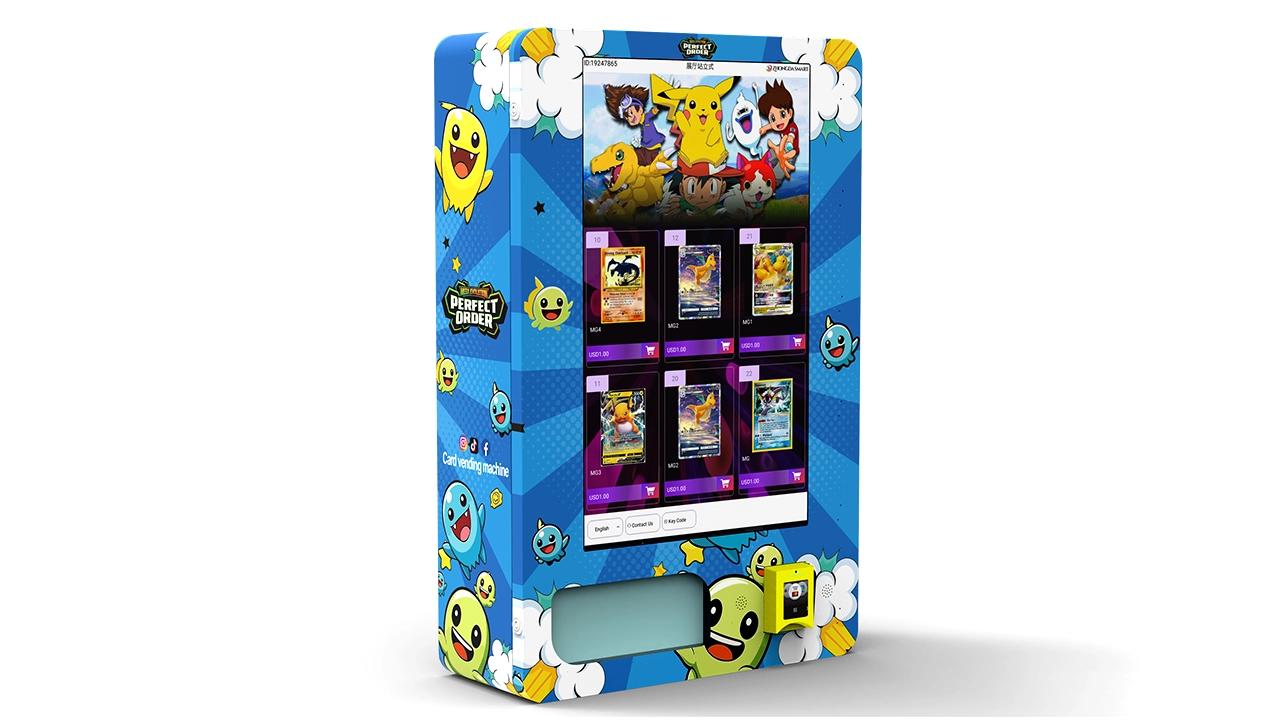
Wall-mounted equipment changes that equation. The ZD-BGS-32 is approximately 280 mm deep, so it uses a relatively shallow section of wall rather than a conventional vending-machine floor position. That can be useful beside a card display, near a queue or on a wall that currently holds only signage.
Its size does not mean installation can be casual. Zhongda Smart lists the machine at approximately 70 kg. The wall, mounting hardware and installation method need to support commercial equipment safely. A plasterboard surface and a suitable structural mounting point are not the same thing.
A floor-standing machine avoids the need for wall mounting and provides substantially greater reserve inventory. The ZD-ZLS-32 main cabinet is about 650 mm wide and 380 mm deep, but the published base reference is larger than the main cabinet. That extra space matters when measuring an aisle or deciding whether customers can stand comfortably at the touchscreen.
For a store with only one machine, the decision can usually be reduced to one question: is floor space more expensive than staff time spent restocking?
If the answer is yes, a compact machine is attractive. If the machine sells fast enough that staff are opening it every day, more reserve stock can become the better use of space.
How Much Capacity Does a Small Store Actually Need?
Buying the largest available cabinet is an easy way to overbuild a first installation. A better calculation starts with daily unit sales and the number of days the store wants to go between refills.
Planning capacity = expected daily unit sales × days between restocking × safety factor
The safety factor gives the store a buffer for weekends, new releases or short bursts of traffic. A figure between 1.15 and 1.30 is often easier to work with than planning the machine to run almost empty before every refill.
| Expected Sales | Restock Interval | Safety Factor | Planning Capacity | Practical Direction |
|---|---|---|---|---|
| 6 units/day | 7 days | 1.20 | About 51 units | A 120-piece reserve leaves useful room for several SKUs |
| 10 units/day | 7 days | 1.25 | About 88 units | ZD-BGS-32 can still make sense if package dimensions fit |
| 20 units/day | 7 days | 1.25 | About 175 units | A larger reserve or more frequent service is needed |
| 30 units/day | 7 days | 1.25 | About 263 units | Higher-capacity floor-standing equipment becomes easier to justify |
These figures are planning examples, not published sales results. Actual demand can be much lower or higher. They are useful because they connect machine size to a real operating task: how often somebody must open the cabinet and reload it.
SKU mix also changes the calculation. A machine with six product selections does not need the same distribution as one carrying twenty. If one new-release pack accounts for half of all purchases, equal inventory in every lane wastes capacity.
Fast sellers should receive more reserve positions. Slow products can be reduced or moved back to the staffed retail area. The goal is not to make every lane look equally full. The goal is to keep the products customers actually buy available between service visits.
What Pokémon TCG Products Can Go in a Vending Machine?
A vending machine does not identify merchandise by franchise. Mechanically, the relevant information is package width, height, thickness, weight, rigidity, surface friction and how much handling the package can tolerate.
For that reason, a buyer should avoid ordering a machine with only the instruction that it will “sell Pokémon cards.” The factory needs to know what form those products take.
Common candidates include:
- sealed booster packs;
- sleeved booster products;
- compact blister-style packages;
- sealed decks;
- small boxed products;
- compact collection products;
- card sleeves and similar accessories;
- blind packs and compatible collectible merchandise.
Loose individual cards are a different problem. Standard spring lanes are built around packaged products that can maintain a consistent position while the mechanism advances them. A loose card is thin, flexible and condition-sensitive. Even if it could be made to dispense, that does not mean it should.
A single card should normally be placed inside protective packaging before it is considered for automated dispensing. Graded cards and slabs also need their dimensions and protection requirements reviewed separately. Zhongda Smart's current ZD-BGS-32 product page specifically advises buyers to provide exact dimensions before assuming graded slabs will work with the standard spring configuration.
For a first small-store deployment, sealed retail products are simpler. Packaging is more consistent, pricing is easier to display and customers already understand what they are purchasing.
Package Compatibility by Product Type
The following table is a practical starting point rather than a universal compatibility guarantee. Final suitability depends on the exact package and machine configuration.
| Product Type | Spring / Drop System | Elevator Delivery | What to Check |
|---|---|---|---|
| Sealed booster pack | Often suitable after lane testing | Usually unnecessary for ordinary packs | Thickness, spring pitch and whether the pack stays upright |
| Sleeved booster | Often suitable when lane width matches | Optional | Overall sleeve width and edges catching during movement |
| Small rigid box | Depends on size and drop tolerance | Can be a better fit for higher-value boxes | Weight, corner damage and pickup opening size |
| Premium collector box | Not the first choice without testing | Often preferable | Packaging condition after delivery |
| Loose single card | Generally not recommended without protective packaging | Still requires a suitable protective holder | Bending, scratching and controlled handling |
| Graded slab | Do not assume standard compatibility | Potentially better depending on holder design | Exact dimensions, weight and impact protection |
The best pre-production step is simple: prepare one sample of every important package or provide precise measurements and clear photographs. Width, height, thickness and weight should be recorded separately. “Booster pack” is not a dimension.
When several products have similar width but different thickness, the thicker package can change spring pitch and reserve quantity. When one box is substantially heavier, the drop distance becomes more important. These are ordinary mechanical details, but they have a direct effect on refund rates and customer complaints.
Spring Delivery vs Elevator Delivery
Screen size gets more attention in product photos, but the dispensing mechanism has more influence on whether the purchase finishes cleanly.
Spring and Drop Delivery
The ZD-BGS-32 and ZD-ZLS-32 use spring-based product advancement with drop-style delivery in their current published configurations. A motor rotates the spring, moves the selected package forward and releases it toward the collection area.
For light, sealed card products, the system is straightforward and space-efficient. There are fewer moving assemblies than in an elevator mechanism, and individual lanes can be configured around different package widths and spring pitches.
The main limitation is the drop. A standard booster pack may tolerate it easily. A premium box with decorative corners or shrink wrap that customers expect to receive in pristine condition deserves more scrutiny.
Testing should use the actual product, not an empty cardboard substitute that happens to have the same dimensions. Weight distribution and surface material can change how a package leaves the spring.
Elevator Delivery
An elevator mechanism moves a receiving platform to the selected shelf or lane, takes the product and lowers or transports it toward the pickup area. The product does not need to fall the full internal height of the cabinet.
That additional control becomes more useful as product value and package sensitivity increase. It can also widen the range of merchandise that one machine can handle.
The tradeoff is equipment complexity. A lift adds moving parts, takes internal space and usually increases cost. There is little reason to specify it for inexpensive booster packs simply because it sounds more advanced.
A useful rule is to let product risk determine the mechanism. Standard sealed packs usually favor simpler delivery. Premium boxes, rigid collectibles or products with condition-sensitive packaging deserve stronger consideration for controlled delivery.
Zhongda Smart's current card shop vending solution separates these use cases in the same way: compact wall-mounted and touchscreen spring systems cover conventional packaged cards, while controlled-delivery machines address merchandise that needs gentler handling.
Payment Hardware and Checkout
Customers usually spend only a few seconds deciding whether an unattended purchase feels easy. A slow or unfamiliar payment process can erase the convenience that justified installing the machine.
Zhongda Smart lists flexible payment configurations for its current card machines. Depending on the final hardware and payment integration, configurations can include card payment, contactless payment, QR-based payment and other supported methods. The ZD-BGS-32 product page also lists cash and credit card options.
Those descriptions should not be interpreted as meaning every terminal works in every project. The card reader, processor, vending controller and software need to be compatible. A payment device that is common in one installation environment may not be the right hardware somewhere else.
Before production, confirm:
- the exact payment terminal model;
- which transaction methods customers will use;
- how the terminal communicates with the vending controller;
- how failed vends are handled after successful payment;
- how refunds are recorded;
- whether the machine can reconcile the transaction with the selected product;
- what happens when the network is temporarily unavailable;
- who provides support for the payment terminal.
Payment security belongs in the same discussion. The PCI Security Standards Council currently lists PCI DSS v4.0.1 in its document library. A store owner does not need to redesign the payment standard, but the project should make clear which party supplies the terminal, which party processes card data and what payment information the vending application can access.
The vending cabinet and the payment environment are related but not identical. A manufacturer can supply a machine that accepts a compatible payment terminal; the merchant, processor, payment hardware and software configuration still determine how transactions are handled.
Remote Inventory and Machine Management
Remote management sounds like a feature for large vending networks, but it can be useful with one machine if it reduces unnecessary checking.
The ZD-BGS-32 currently lists 4G, Wi-Fi and LAN connectivity together with a cloud-based management platform. Zhongda Smart describes functions including sales monitoring, inventory information, pricing management and machine data.
The useful question is not whether the system has a dashboard. It is what the store can do with the information.
A practical backend should help answer questions such as:
- Which product sold today?
- Which lane is close to empty?
- Did the machine complete the expected number of transactions?
- Is the machine online?
- Did a particular SKU stop selling unexpectedly?
- Does a price need to be changed?
- Can staff wait until tomorrow to refill, or will the main seller run out tonight?
Inventory information becomes especially useful when one fast product shares a machine with several slower products. Looking at total remaining units can be misleading. The machine may be half full while its best-selling lane is already empty.
For that reason, restocking should be based on SKU-level demand where the system provides it. A store can then allocate more reserve space to the products that consistently move and reduce positions for products that customers prefer buying at the staffed counter.
Installation Checklist for a Small Store
Installation is one of the easiest parts of a vending project to underestimate. The machine may arrive exactly as ordered and still be awkward to use if the site was measured only from a photograph.
1. Measure the Cabinet and the Customer Area
Record the available width, height and depth. Then measure the area a customer needs to stand in front of the touchscreen without blocking normal traffic.
The ZD-BGS-32 is approximately 650 mm wide and 280 mm deep. That is compact, but the usable footprint is larger once a person is standing in front of it.
2. Leave Service Access
The machine needs to be opened for loading, inspection and component service. Do not plan an installation where a fixed display, wall corner or neighboring cabinet prevents normal door movement.
3. Confirm Wall Structure for a Wall-Mounted Unit
Zhongda Smart lists the ZD-BGS-32 at approximately 70 kg. The mounting surface and anchoring system need to be suitable for that load and for normal commercial use. Installation should follow the machine documentation and applicable site requirements.
4. Confirm Power
The ZD-BGS-32 currently lists 50W equipment power and an AC 110–240V supply range. The final electrical configuration still needs to match the supplied machine and installation site.
Power consumption is relatively low because this type of card machine does not require refrigeration. That does not remove the need for a stable outlet and proper cable routing.
5. Plan the Network Connection
If the store expects remote inventory and machine-status information, decide whether the machine will use wired network access, Wi-Fi or a cellular connection. Weak signal at the final installation point can turn a connected machine into an offline one.
6. Check Screen Height
A wall-mounted machine gives more freedom over installation height, but that freedom can create mistakes. The screen and pickup opening should remain comfortable for normal customers to use. Mounting the machine high simply to protect it from bumps can make the interface awkward.
7. Check the Pickup Area
Customers should be able to reach the collection opening without crouching into another display or standing in a queue lane. This is particularly important when the machine is installed beside existing fixtures.
Installation information worth sending before the machine is built
- available wall or floor dimensions;
- photographs of the intended installation area;
- available power connection;
- planned network method;
- required customer-facing screen height;
- service-access limitations;
- product pickup accessibility requirements.
Where the Machine Should Go
A technically good machine can underperform simply because customers do not notice it. Placement should connect the machine to an existing shopping behavior.
Near the Main Card Display
This is the most natural position for a card-focused machine. Customers already browsing sealed products can move from the shelf or cabinet to the touchscreen without changing the purpose of their visit.
The vending machine can hold fast-moving sealed products while staff focus on singles, questions and higher-touch purchases.
Near the Checkout Queue
A customer waiting to pay has time to look at a touchscreen. Lower-ticket products can work well in this area if the cabinet does not narrow the queue.
The risk is congestion. A vending purchase should not force one customer to stand in the same space used by everyone waiting for the counter.
On an Underused Wall
This is the clearest use case for a wall-mounted card vending machine. A wall that currently holds a poster can become a self-service retail position without removing a floor display.
The wall still needs enough visibility to attract customers. A machine hidden behind shelving has saved floor space but may not earn much attention.
Positions That Usually Create Problems
- behind a door that hides the screen;
- inside a narrow dead-end aisle;
- where glare makes the screen difficult to read;
- where the service door cannot open comfortably;
- where the customer blocks a main circulation path;
- where network signal is unreliable;
- where staff cannot easily see a customer who needs help.
Self-service does not mean isolated service. A card machine often performs better when it feels like a normal part of the store rather than an appliance pushed into a spare corner.
Can a Card Vending Machine Be Profitable?
It can, but the machine itself does not create margin. The result depends on product cost, selling price, sales volume and the operating costs attached to the machine.
A useful calculation is:
Operating contribution = sales − merchandise cost − payment fees − service cost − software/connectivity − refunds − shrink − maintenance − other direct costs
That figure is more useful than revenue alone. A machine can produce several thousand dollars of sales and still contribute little if product cost is high or the machine requires too much attention.
A Simple Planning Example
The figures below are illustrative assumptions. They are not Zhongda Smart customer results and should not be treated as an earnings claim.
| Planning Item | Illustrative Example |
|---|---|
| Average transaction | $18 |
| Average transactions per day | 8 |
| Approximate monthly sales | $4,320 |
| Illustrative merchandise gross margin | 38% = $1,641.60 before machine-related operating costs |
| Remaining expenses | Payment processing, servicing, connectivity, refunds, shrink, maintenance and any space-related cost |
The important number in this example is not $4,320. It is the $1,641.60 left after merchandise cost and before the rest of the operating expenses.
A small change in sourcing can have a large effect. If merchandise cost rises while selling prices stay the same, the vending machine may look busy without becoming more profitable. Good inventory buying often matters more than squeezing another ten products into the cabinet.
Markup and Margin Are Not the Same
If an item costs $10 and sells for $15, the markup on cost is 50%. The gross margin on the $15 sale is 33.3%. Operating expenses are paid from that margin, not from the markup percentage.
This is especially relevant for card retail because product acquisition costs can move while customers still remember the normal selling price.
Measure the Space as Well as the Machine
A small store should also consider what the installation replaces. A wall-mounted unit may use space that previously generated no direct revenue. A large floor cabinet may replace shelving or a display case that was already productive.
That opportunity cost belongs in the decision even though it never appears on the vending-machine invoice.
For a more detailed cost and payback model, Zhongda Smart's trading card vending machine profitability guide covers the calculation separately. Keeping the full financial model on a dedicated page also makes it easier to update assumptions without turning this buying guide into an accounting article.
Security and Product Protection
Trading card merchandise has an awkward security profile: products are small, easy to move and can carry substantial resale value. That makes cabinet security relevant even when the machine is installed inside an attended store.
The National Retail Federation's 2026 research reported that surveyed retailers saw shoplifting incidents decline by an average of 12.4% between 2024 and 2025 and merchandise theft incidents decline by 8.1%, while other forms of theft and fraud continued to evolve. The useful takeaway for automated card retail is not that theft has disappeared. Retailers still need to protect both merchandise and the transaction environment.
For a small-store installation, check:
- cabinet construction;
- door and lock design;
- how the payment terminal is mounted;
- whether the pickup door allows access beyond the delivery area;
- wall or floor anchoring;
- visibility from staffed sections of the store;
- existing camera coverage;
- transaction and refund records;
- inventory discrepancies after restocking.
Zhongda Smart lists theft-resistant and vandal-resistant construction for the ZD-BGS-32. The cabinet uses cold-rolled steel with an anti-corrosion coating. These are useful equipment features, but they do not replace good placement and normal store security.
Protect the Product From the Machine Too
Security is not only about theft. A sealed box damaged during dispensing can turn a successful transaction into a refund.
For products where packaging condition affects value, test the complete path from lane to pickup opening. Look for crushed corners, torn shrink wrap, bent hang tabs and repeated impacts against the collection area.
A package that survives one demonstration may still reveal a weak point after twenty or fifty cycles. Important SKUs deserve repeated testing before the lane configuration is finalized.
Maintenance and Service
After the first few weeks, the machine stops being a new attraction and becomes ordinary retail equipment. Serviceability matters more at that point than decorative features.
Zhongda Smart currently lists a one-year warranty for the ZD-BGS-32 together with free replacement parts and online technical support under its stated service terms. The exact coverage for an order should still be confirmed in the quotation and warranty documents.
Before buying, ask how the following issues are handled:
- a single spring motor stops working;
- a sensor reports an incorrect delivery;
- the touchscreen is damaged;
- one payment terminal fails;
- the machine loses its network connection;
- a lane needs to be disabled temporarily;
- software needs an update;
- a replacement component must be shipped.
The ideal answer is not necessarily that nothing will ever fail. Commercial equipment has components that eventually require service. The important question is whether a common failure can be diagnosed and repaired without replacing an entire assembly.
Keep a Small Service Record
A spreadsheet or simple digital log is enough for one machine. Record the date, problem, affected lane, action taken, part replaced and whether a refund was issued.
After several months, the record shows patterns that are easy to miss in daily operation. One product may jam more often than others. One lane may repeatedly require adjustment. A connection problem may occur at the same time every week.
That information is useful when deciding whether the issue is the product, the lane configuration, the site or a component.
Where Small Stores Usually Overspend
Buying Capacity Before Proving Demand
A 500-piece reserve can look impressive in a specification sheet. It also ties up considerably more merchandise when filled.
If a location sells 40 units a week, a huge reserve may simply mean some products sit in the cabinet for a long time. Inventory turnover matters more than empty capacity.
Paying for a Delivery System the Merchandise Does Not Need
Elevator delivery is useful when it solves a product-handling problem. It is not automatically better for every card pack.
For inexpensive, lightweight sealed products, a tested spring lane can be the simpler and more economical choice.
Choosing the Biggest Screen Available
A larger screen can make product browsing easier, but it does not fix poor lane configuration, weak payment integration or low foot traffic.
Both ZD-BGS-32 and ZD-ZLS-32 already use a 32-inch display. For a small store, cabinet fit and reserve inventory deserve more attention than adding screen size beyond what customers actually need.
Adding Too Many SKUs at Launch
A touchscreen makes it tempting to fill every product slot with something different. That reduces reserve depth for the products that sell quickly.
A smaller opening assortment usually produces better information. Start with clear price points and recognizable product differences, then let actual sales decide which products deserve more space.
Ordering Before Payment Hardware Is Confirmed
Payment integration should not be treated as a detail to solve after the machine is already built. The terminal, communication method, physical mounting and software interaction belong in the confirmed configuration.
Spending on Exterior Graphics Before the Product Path Is Tested
Custom graphics are useful for making the machine fit the store. They should come after product dimensions, cargo lanes, payment and delivery method are confirmed.
A beautiful cabinet with unreliable dispensing is still a poor retail machine.
What to Send the Manufacturer Before Ordering
A detailed project request produces a better quotation than asking for “a vending machine for Pokémon cards.” The manufacturer should have enough information to recommend the configuration rather than guess it.
Product File
For every major product, provide:
- clear front and side photographs;
- package width;
- package height;
- package thickness;
- package weight;
- expected selling price;
- expected weekly sales;
- whether packaging condition is especially important.
Installation File
Include:
- available machine width, height and depth;
- photographs of the proposed position;
- wall construction if a wall-mounted machine is being considered;
- power availability;
- network availability;
- customer circulation constraints;
- service-door clearance.
Payment Requirements
State:
- preferred payment types;
- preferred terminal or processor if one is already selected;
- whether cash is required;
- whether contactless payment is required;
- whether membership, stored value or another custom function is needed.
Branding Requirements
Provide your own store or business logo, colors and artwork requirements. Do not assume that buying an independently manufactured machine gives permission to reproduce third-party characters, logos or copyrighted designs.
Pokémon operates official vending programs of its own. An independently purchased machine used to sell genuine Pokémon TCG products should not be presented in a way that falsely suggests official sponsorship, operation or authorization.
Order and Service Requirements
Confirm:
- initial quantity;
- whether a sample machine will be evaluated first;
- spare-parts requirements;
- warranty terms;
- technical documentation;
- remote-support expectations;
- packaging and shipping requirements.
Zhongda Smart currently lists a minimum order quantity of one unit for the ZD-BGS-32. That can make a sample installation practical before committing to a larger deployment.
Which Machine Fits Which Store?
There is no reason to force every small store into the same cabinet. The following scenarios make the distinction clearer.
Choose the ZD-BGS-32 When Floor Space Is the Main Problem
The wall-mounted model makes sense when the store has usable wall area but very little floor space. Its approximately 280 mm depth is the strongest reason to choose it.
The 120-piece published maximum is enough for many lower-volume installations, particularly when the store can refill the machine without a separate service trip.
Its limitation is equally clear. A busy machine can outgrow 120 pieces quickly. If staff are refilling the same products every day, the space saved by the wall cabinet may no longer compensate for the extra work.
Choose the ZD-ZLS-32 When Restocking Frequency Matters More
The ZD-ZLS-32 touchscreen trading card vending machine has a published capacity of approximately 375–535 pieces and up to 28 lanes.
That reserve gives the store more freedom to carry several products while keeping deeper stock behind the fastest sellers. It is easier to justify when sales volume is high enough that a 120-piece cabinet would need frequent refilling.
The tradeoff is floor area. A store should compare that area with the value of whatever fixture would otherwise occupy the position.
Choose Elevator Delivery When Packaging Condition Is the Priority
A premium box can be profitable enough that one damaged package costs more than the savings from using a simpler delivery system.
When that is the merchandise mix, product protection deserves more weight than maximum unit capacity.
Use a Larger Multi-Lane Platform When the Machine Is Becoming a Department
Some stores eventually want the vending machine to carry several card games, accessories, blind products and multiple package formats. At that point the project is no longer just a compact Pokémon card vending machine.
A broader multi-lane platform can make more sense because the business is asking the machine to function as a self-service retail section rather than a small supplementary sales point.
Simple selection rule
Low to moderate sales + scarce floor space: start by evaluating ZD-BGS-32.
Higher daily volume + fewer desired refill visits: evaluate ZD-ZLS-32.
Premium condition-sensitive merchandise: evaluate elevator delivery.
Broad assortment with many product formats: evaluate a larger multi-lane configuration rather than forcing every SKU into a compact machine.
About Zhongda Smart
Zhongda Smart is a vending-machine manufacturer that develops and customizes unattended retail equipment, including trading card vending machines. According to the company's current published information, Zhongda Smart was founded in 2018, operates approximately 20,000 m² of manufacturing space, has more than 400 employees, an R&D team of more than 10 engineers and published annual manufacturing capacity of more than 10,000 vending machines.
Those figures are manufacturer-supplied company information rather than independent industry statistics. Their relevance to a card-machine buyer is straightforward: the company is presenting itself as the equipment manufacturer and OEM/ODM supplier, not simply as a reseller of one fixed cabinet.
For trading card projects, Zhongda Smart currently asks buyers to provide product dimensions, package photographs, target capacity, payment requirements and branding needs so the cargo system and machine configuration can be reviewed before production.
That approach is more important than the factory numbers themselves. Card vending depends on small mechanical details. A 5 mm difference in package thickness can matter more to one cargo lane than another thousand square meters of factory floor.
The company's current lineup gives a buyer several distinct directions rather than one universal machine: compact wall-mounted equipment, higher-capacity touchscreen machines, multi-lane configurations and controlled-delivery systems.
More information about the manufacturer and its published capabilities is available on the Zhongda Smart company page.
Final Buying Decision
For most genuinely small stores, the buying decision should begin with capacity and space rather than screen size.
If the store expects modest sales, can refill the machine easily and has more available wall than floor, the ZD-BGS-32 is the cleaner fit. Its published 120-piece maximum is not large, but that is also the reason the cabinet can stay shallow.
If the machine is expected to move enough product that 120 pieces will disappear quickly, the ZD-ZLS-32 gives the operator substantially more reserve without requiring a very large full-size vending cabinet.
If premium boxes make up a significant part of the assortment, the decision changes again. A controlled delivery system may be worth more than an extra hundred units of capacity.
The machine should follow the merchandise. Measure the products, estimate daily unit sales, decide how often staff are willing to refill, confirm payment hardware and measure the actual installation area. Those five steps narrow the choice faster than comparing long feature lists.
A small-store Pokémon card vending machine works best as a focused retail tool: enough stock to stay useful, enough visibility to attract customers and enough mechanical reliability that the store does not have to supervise every sale.
Frequently Asked Questions
What is the best Pokémon card vending machine for a small store?
For a store where floor space is the main constraint, a compact wall-mounted machine is usually the first configuration to evaluate. Zhongda Smart's current ZD-BGS-32 is approximately 1200 × 650 × 280 mm, has a 32-inch touchscreen and a published maximum capacity of up to 120 pieces. Stores that need more reserve inventory can consider the ZD-ZLS-32, which has a published capacity of approximately 375–535 pieces depending on package dimensions and lane configuration.
How much does a small trading card vending machine cost?
Zhongda Smart currently lists a US$999 reference equipment price for the ZD-BGS-32 and US$1,211 for the ZD-ZLS-32. These are reference machine prices rather than guaranteed complete project costs. Payment terminals, software requirements, customization, cargo configuration, order quantity, shipping and other project requirements can change the final quotation.
Can a vending machine sell sealed Pokémon booster packs?
Yes, compatible sealed booster packs can be sold through a properly configured vending machine. The cargo lane needs to match the package width and thickness, and important SKUs should be tested with the intended dispensing mechanism before the final configuration is confirmed. Selling genuine Pokémon TCG products through an independently purchased machine does not make the machine an official Pokémon-operated vending machine.
Is a 120-piece vending machine large enough for a card store?
It can be. Capacity should be compared with daily unit sales and the desired restocking interval. A store selling about 10 units a day and restocking weekly may find 120 pieces adequate when the assortment and package dimensions fit. A location selling 20–30 units per day will either need much more frequent refilling or a higher-capacity machine.
Should card packs use spring delivery or elevator delivery?
Standard sealed booster packs can often work well with a correctly configured spring-and-drop system. Elevator delivery becomes more attractive for premium boxes, rigid collectibles and products where packaging condition has a meaningful effect on value. The final choice should be based on actual product dimensions, weight and drop tolerance.
Can the machine accept credit cards and contactless payments?
Zhongda Smart lists flexible payment configurations on its current card vending machines. Depending on the selected hardware and payment integration, configurations can include credit or debit card payment, NFC/contactless payment, QR-based payment and other supported methods. The exact terminal and processor compatibility should be confirmed before production.
Does a small store need remote inventory management?
It is not mandatory, but it can reduce unnecessary checking and improve restocking. Zhongda Smart's ZD-BGS-32 currently lists 4G, Wi-Fi and LAN connectivity with cloud-based management functions that include sales and inventory information, pricing management and machine data.
Can I put Pokémon characters or logos on my vending machine?
Only use third-party logos, characters and copyrighted artwork when you have the appropriate rights or authorization. Pokémon operates official automated retail programs of its own, so an independently manufactured vending machine should not use branding that falsely suggests sponsorship, authorization or affiliation. Branding the machine around the store's own identity is the safer default.
What information should I send Zhongda Smart before requesting a quotation?
Send package photographs, product width, height, thickness and weight, estimated capacity, preferred payment methods, machine quantity, installation measurements and branding requirements. These details allow the cargo lanes, payment hardware and delivery system to be matched to the actual merchandise instead of relying on a generic configuration.
Can the ZD-BGS-32 sell graded cards?
Graded slabs should not be assumed to fit the standard spring configuration. Zhongda Smart's current product information recommends sending the exact slab or protective-package dimensions so the dispensing setup can be evaluated before the machine is finalized.
Sources and Reference Material
- Pokémon — Official Pokémon Trading Card Game information
- Pokémon — Official vending machine information
- PCI Security Standards Council — PCI DSS document library
- National Retail Federation — The Impact of Theft & Violence 2026 findings
Disclaimer
This article is an equipment-selection and business-planning guide. It does not guarantee sales volume, profitability, return on investment, product compatibility, payment approval or legal compliance. Zhongda Smart specifications, capacities, reference prices, warranty information and company details cited here are based on the manufacturer's publicly available information reviewed in August 2026 and may change as products or configurations are updated.
Actual capacity depends on package dimensions, thickness, cargo-lane arrangement and installed hardware. Payment functionality depends on the final terminal, payment provider and machine configuration. Buyers should confirm the final specification, quotation, warranty, payment setup, electrical requirements, installation requirements and product compatibility before placing an order.
Pokémon and related names, characters, logos and trademarks belong to their respective rights holders. Zhongda Smart and this website are not represented as being sponsored, endorsed or authorized by Pokémon or its related rights holders. References to Pokémon TCG products describe potential merchandise and vending compatibility only. Retailers are responsible for sourcing genuine merchandise and obtaining any permissions required for branding, artwork or intellectual property used on their equipment.