Pokémon TCG Product Dimensions for Vending Machines are not one fixed set of numbers. A sleeved booster, Booster Bundle, Elite Trainer Box, three-pack blister, display box, and collector tin can differ dramatically in width, height, depth, rigidity, weight distribution, and surface friction. For vending equipment, those differences determine cargo-lane width, spiral pitch, shelf spacing, pusher force, elevator size, pickup-bin clearance, and practical capacity. I’d design the machine around the exact sealed SKUs you intend to stock, not around card dimensions or a generic “trading card” category. The most useful approach is to build a measured SKU matrix, add controlled clearance, select the right dispensing method for each package type, and validate the configuration through repeated vend testing before production.
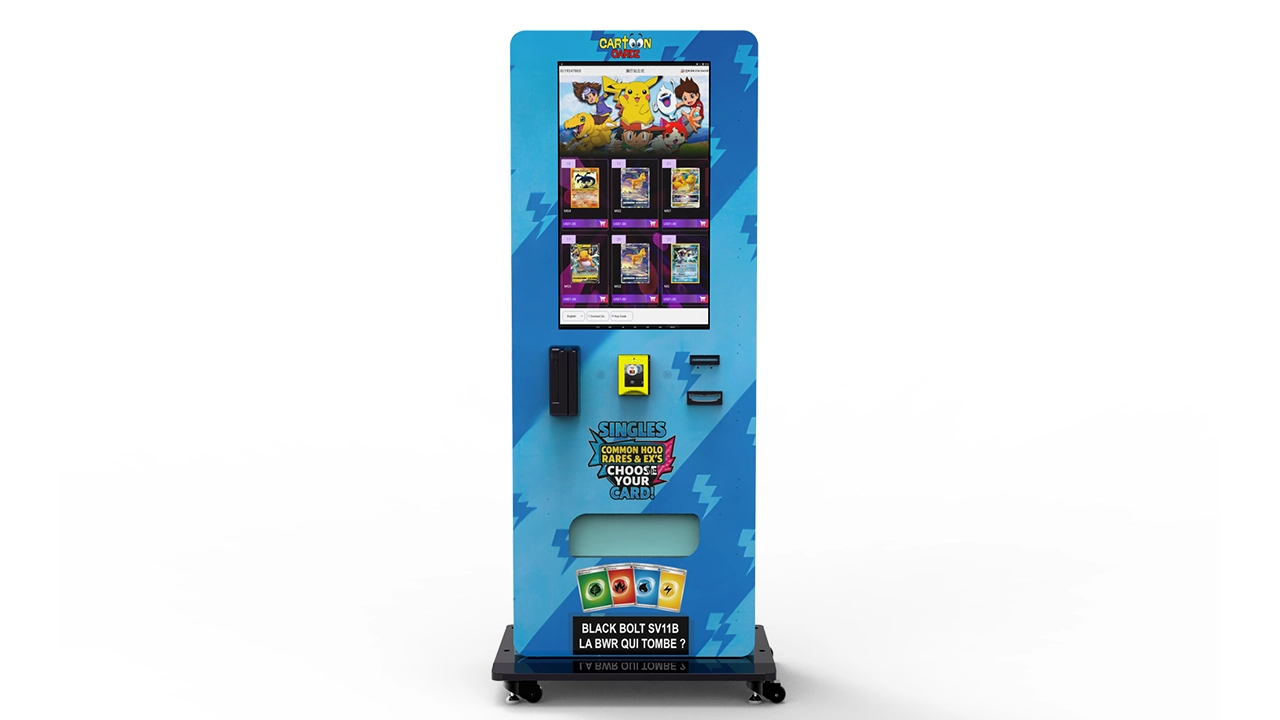
The Quick Answer: There Is No Universal Pokémon TCG Package Size
The first mistake I would avoid is treating “Pokémon cards” as a single physical product. The cards themselves are standardized enough for gameplay, but retail packaging is not. Vending machines interact with foil wrappers, paperboard sleeves, cardboard cartons, plastic blisters, metal tins, shrink wrap, and larger collector boxes. Each of those materials behaves differently when pushed, pulled, rotated by a coil, stacked, or dropped.
Current retail listings show the scale of the difference. A modern sleeved booster is commonly listed around 6.8 inches high, 3.8 inches wide, and 0.13 inch deep. A six-pack Booster Bundle is around 4.3 by 2.9 by 2.0 inches. An Elite Trainer Box example is roughly 7.5 by 6.5 by 3.5 inches. A 36-pack booster display can be around 5.5 by 5.5 by 3.5 inches. A collector chest can exceed 8 inches on one face. Those are not interchangeable packages, even though every one of them contains Pokémon TCG cards.
This is why I would not approve a vending-machine layout from a product name alone. I want width, height, depth, weight, packaging material, center of gravity, surface finish, and at least one physical sample of every high-volume SKU. If the merchandise mix changes often, I would also ask for the largest and smallest products expected during the next several release cycles. That gives the machine enough adjustment range without wasting the entire cabinet on oversized lanes.
Another important point is that published dimensions are reference data, not production drawings. Retailers may report package dimensions, shipping dimensions, or dimensions with the axes ordered differently. Packaging can also change between releases. For Pokémon TCG Product Dimensions for Vending Machines, I treat public listings as a planning reference and the operator’s sealed samples as the final authority.
Pokémon TCG Package Dimension Reference Table
The table below is useful for early machine planning. It combines current retailer-listed examples with practical vending observations. I would never use the numbers as guaranteed dimensions for every release. Instead, I’d use them to understand the physical classes a vending machine may need to accommodate.
| Product format | Example listed dimensions | Packaging behavior | Vending difficulty | My preferred handling approach |
|---|---|---|---|---|
| Sleeved booster pack | About 6.8 × 3.8 × 0.13 in | Thin paperboard sleeve; low thickness; can lean or overlap | Medium | Narrow guided lane, pusher, belt, or carefully matched spiral |
| Six-pack Booster Bundle | About 4.3 × 2.9 × 2.0 in | Compact rigid carton; easy to guide if lane width is correct | Low to medium | Adjustable coil, pusher, or controlled shelf delivery |
| Elite Trainer Box | About 7.5 × 6.5 × 3.5 in | Rigid box with collectible outer finish; corners matter | Medium | Large channel, belt, locker, or elevator delivery |
| 36-pack booster display | About 5.5 × 5.5 × 3.5 in | Dense box; higher value and weight than a single pack | Medium | Stable shelf with controlled release and soft delivery |
| Three-booster blister | About 7.5 × 7.0 × 0.4 in in a current listing | Wide, thin, flexible blister card; vulnerable to edge catching | High | Wide guided pusher or specially sized spiral with anti-tilt support |
| Mini tin | About 5 × 3 × 1 in in a current listing | Rigid metal package; smooth surface; compact footprint | Low to medium | Coil or pusher with anti-roll and side guides |
| Collector chest | About 8.3 × 6.4 × 3.5 in in a current listing | Large metal case; heavier and more impact-sensitive | Medium to high | Large controlled channel with elevator or short-drop delivery |
Important: these are example retail dimensions, not a universal Pokémon packaging specification. I would physically measure every SKU that will actually be loaded into the machine. For any package where condition affects resale value, I would also test the most easily damaged orientation, not just the orientation that fits the most units.
The product mix matters as much as individual dimensions. If 70% of sales are expected to come from sleeved boosters, it makes little sense to allocate most of the cabinet to Elite Trainer Box-sized cells. Conversely, a machine built only for thin packs may become commercially restrictive when an operator later wants to sell Booster Bundles, premium boxes, tins, or other sealed products.
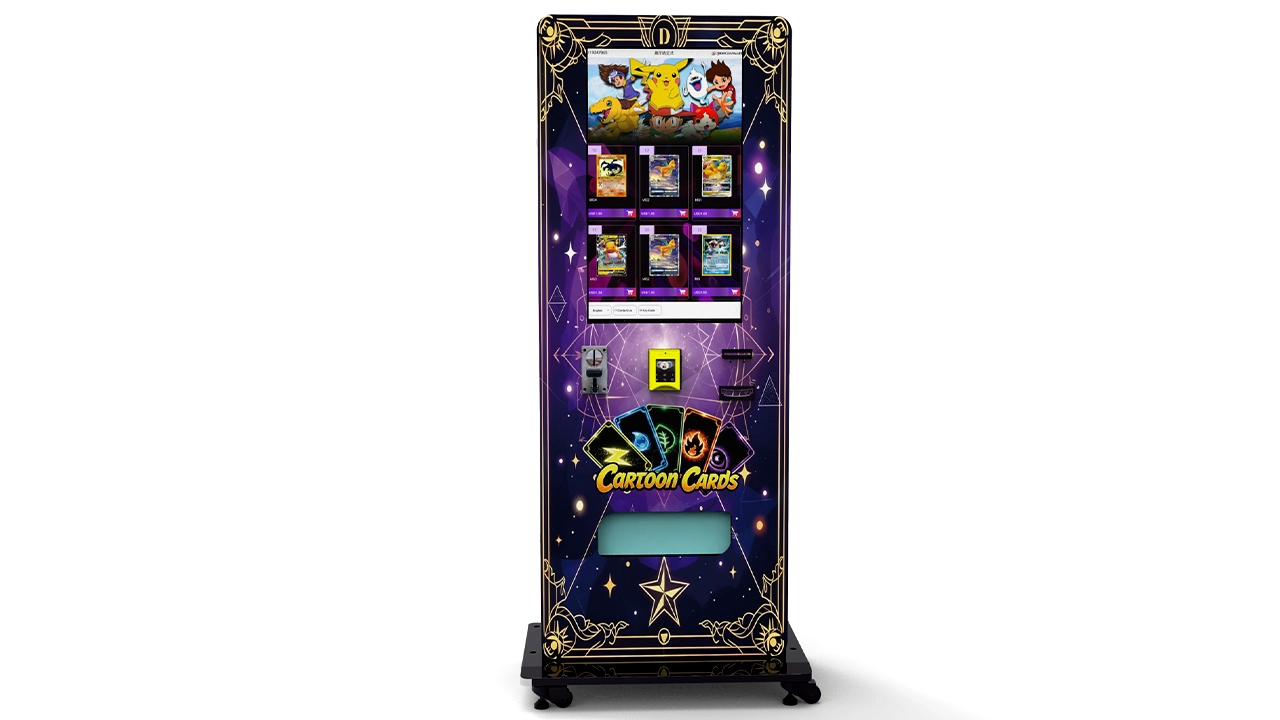
How I Would Measure Products Before Machine Design
For Pokémon TCG Product Dimensions for Vending Machines, a tape measure and one quick measurement are not enough. Thin packaging flexes, seals protrude, paperboard bows, shrink wrap adds friction, and stacked packages can behave differently from a single sample. I’d create a simple dimensional control sheet and measure multiple sealed units of each SKU.
1. Measure the retail package, not the cards
The vending mechanism never touches the theoretical card size inside the package. It contacts the retail packaging. A loose foil booster, sleeved booster, blister, Booster Bundle, tin, and Elite Trainer Box need separate records even if they contain cards from the same expansion.
2. Record width, height, and depth in the actual vending orientation
I’d label dimensions according to how the product sits in the lane. “Width” should mean the side-to-side space the lane must provide. “Height” should mean the vertical shelf clearance. “Depth” should mean the front-to-back pitch or stacking length. This removes ambiguity when a supplier’s listing uses length, width, and height in a different order.
3. Measure at least five samples when possible
Cardboard packaging is not machined metal. Small variations happen. A package can be slightly swollen, a seal can protrude, or a blister flange can curl. If I were approving a production lane, I would rather see the maximum measured value from several samples than a single nominal value from a product page.
4. Capture the “bad” dimensions too
Operators usually measure the clean rectangular body and ignore hanging tabs, heat seals, blister flanges, folded edges, and shrink-wrap seams. Those are often the parts that catch. I’d record both the nominal body and the maximum envelope. For a blister, the outer plastic flange can matter more than the centered product cavity. For a sleeved booster, a slightly bowed paperboard sleeve can create more drag than its nominal thickness suggests.
5. Weigh the product
Weight determines how easily a product moves, how much force a pusher needs, how strongly it lands in a pickup bin, and how much load sits on a shelf. Two boxes with similar dimensions can behave very differently if one is much denser. A heavy sealed display also carries more momentum during delivery, so I would not automatically use the same drop path as a Booster Bundle.
6. Note material and surface finish
Glossy plastic, matte paperboard, shrink wrap, and bare metal have different friction characteristics. Friction becomes especially important in gravity-fed lanes or tightly packed pushers. I’d note whether packages slide easily against each other, whether edges catch, and whether surfaces show scuffs after repeated contact.
7. Photograph the product from all six sides
This may sound excessive, but it prevents many specification mistakes. A factory engineer can see tabs, seams, curved tin edges, protruding blister shapes, or shrink-wrap folds that a simple dimension table does not reveal. If I were choosing a custom machine, I would send the measurement sheet and photos together.
A practical SKU measurement sheet
| Field | Example entry | Why it matters |
|---|---|---|
| SKU / product name | Current sleeved booster | Prevents mixing dimensions between similar products |
| Vending orientation | Portrait, face forward | Defines which dimension controls lane width and shelf height |
| Maximum width | Measured sample maximum | Sets side clearance |
| Maximum height | Measured sample maximum | Sets shelf spacing and elevator opening |
| Maximum depth | Measured sample maximum | Sets product pitch and lane capacity |
| Weight | Measured in grams or ounces | Influences pusher force and delivery impact |
| Packaging | Paperboard + foil pack | Helps select guides and contact surfaces |
| Fragile features | Top hanger tab; corners | Identifies snag and damage points |
| Target quantity per lane | 12 units | Supports capacity planning |
| Target vends in test | 100+ | Defines validation threshold |
How Much Clearance Does a Trading Card Vending Lane Need?
I would never design a cargo lane to the exact measured width of the package. A 3.80-inch product in a 3.80-inch channel is a jam waiting to happen. The lane needs clearance for manufacturing tolerance, packaging variation, imperfect loading, surface friction, and slight misalignment during the vend.
At the same time, excessive clearance creates its own problems. A thin pack can rotate, a narrow box can yaw sideways, two units can overlap, or a blister can tip and wedge diagonally. Good vending design is controlled freedom: enough space to move without enough space to lose orientation.
My starting clearance ranges
The numbers below are design starting points, not universal standards. Final values should be proven with actual products and the selected mechanism.
- Rigid small cartons: I’d usually start with roughly 3–6 mm of side clearance per side, then tighten or widen after testing.
- Sleeved boosters: I’d usually allow a little more lateral freedom than a rigid carton while using guides that prevent diagonal rotation.
- Wide blister packs: I’d prioritize flat support and anti-tilt control, often with 5–10 mm total functional side allowance depending on flange shape.
- Tins: I’d control both lateral movement and rolling. Curved edges can let a tin rotate more easily than a rectangular carton.
- Large premium boxes: I’d provide enough clearance to protect corners and shrink wrap rather than force the product through a tight metal opening.
For depth, I prefer to think in pitch rather than “how many can physically be squeezed in.” If a package is 2.0 inches deep, the effective pitch may need to be more than 2.0 inches because the mechanism occupies space and the product needs room to separate cleanly from the next unit. A spiral lane, for example, is governed by coil diameter, pitch, product orientation, and how the package sits between turns. A pusher system is governed by product depth, follower geometry, rail friction, and front retention.
Why thin products are often harder than boxes
A rigid box is easy to visualize because it behaves like a block. A sleeved booster can be only around one-eighth of an inch thick. That creates several failure modes: two units can stick together, the front package can lean, the sleeve can flex into a gap, or the product can slide under a retention feature. The machine may have enough nominal space and still fail because orientation control is weak.
If I were configuring high-volume booster pack vending, I would focus less on maximum lane count and more on positive product separation. A reliable 20-pack lane is worth more than a theoretical 30-pack lane that occasionally double-vends or jams. High-value trading card inventory makes failed separation expensive.
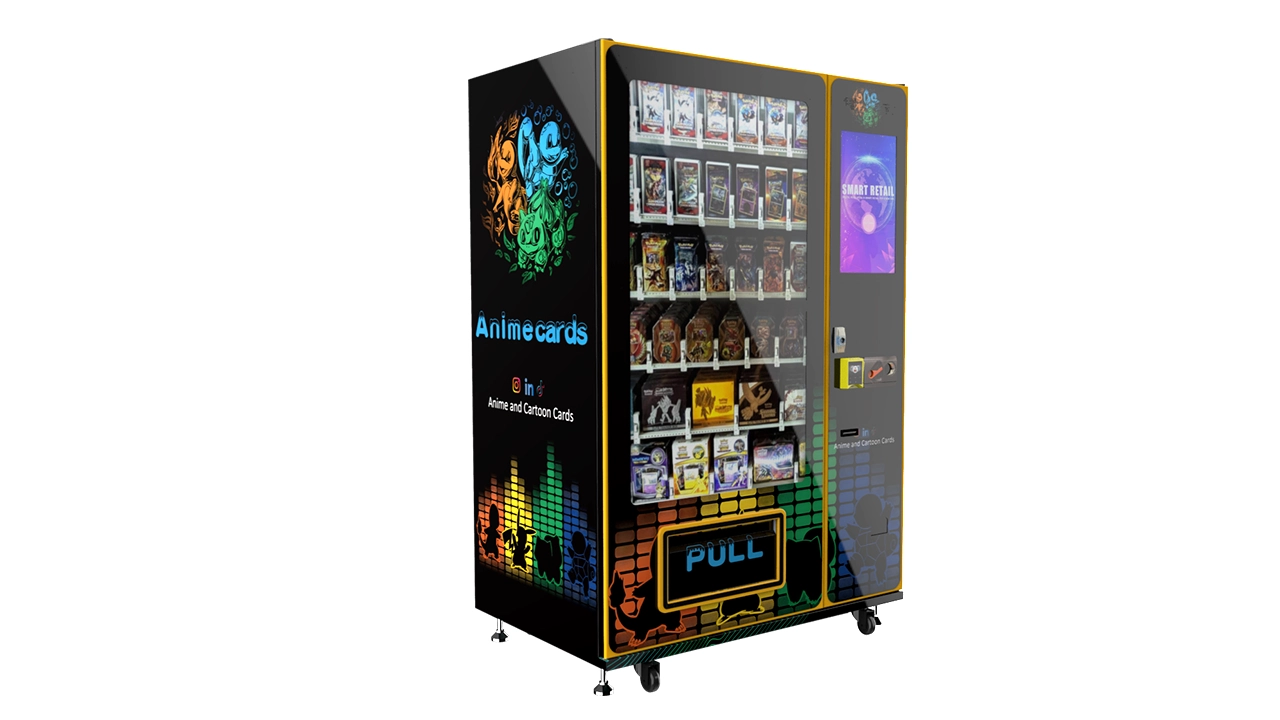
Best Dispensing Method by Pokémon TCG Package Type
Dimensions do not select the mechanism by themselves. The product’s stiffness, value, friction, center of gravity, and tolerance for impact matter too. I’d rank the common package types this way.
Loose foil booster packs
Loose foil packs are compact but mechanically awkward. They flex, have sealed edges, and can cling together. I would not assume a standard snack coil will separate them consistently. A guided pusher, belt, cassette, or other single-item dispensing approach can be more predictable when packs are the core SKU. If a coil is used, the geometry should be tested with the exact pack.
For a machine that sells mostly individual boosters, I’d ask for repeat tests with a full lane, half-full lane, and nearly empty lane. The last few items often behave differently because there is less back pressure and less stack stability.
Sleeved booster packs
Sleeved boosters are easier to display and generally easier to control than bare foil packs because the paperboard adds stiffness. Their wide, thin profile still makes them vulnerable to leaning. A narrow vertical channel with guides can work well, as can a carefully matched spiral or pusher. The main design target is consistent separation without crushing the top hanger area or scuffing the front artwork.
A current sleeved booster listing from GameStop shows 6.8 × 3.8 × 0.13 inches, which is a useful planning reference. The 0.13-inch depth explains why capacity can look enormous on paper. In reality, mechanical spacing, sleeves that bow, and product separation requirements mean usable capacity is lower than simply dividing shelf depth by 0.13 inch.
Booster Bundles
Booster Bundles are among the more vending-friendly Pokémon TCG formats because the carton is compact and relatively rigid. Current six-pack examples are listed around 4.3 × 2.9 × 2.0 inches. That footprint is large enough for reliable mechanical contact but small enough to fit several lanes across a cabinet.
If I were choosing a general-purpose Pokémon card vending machine, I would make sure several lanes can be adjusted around this size class. Booster Bundles bridge the gap between single-pack transactions and larger premium boxes, which makes them useful for a varied merchandising plan.
Elite Trainer Boxes
Elite Trainer Boxes deserve gentler handling. They are larger, heavier, visually prominent, and often purchased as sealed collectibles. A current retail example lists dimensions around 7.5 × 6.5 × 3.5 inches. That size can fit in a large coil or shelf, but I would pay close attention to drop distance.
For premium boxed products, I prefer a machine with controlled delivery: an elevator, lift tray, conveyor, locker, or short-drop pickup arrangement. The goal is not simply to prevent catastrophic damage. Collectors notice crushed corners, wrap tears, dents, and abrasion. A mechanically successful vend that devalues the package is still a bad vend.
Three-pack blisters
Three-pack blisters are deceptively difficult. They are wide and relatively thin, with a plastic bubble and a flat card back. A current listing is around 7.5 inches by 7 inches with approximately 0.4 inch depth. That creates a large surface area relative to thickness. If the lane is too wide, the blister can rotate. If the lane is too tight, the plastic edge can catch.
I would use broad support behind the product and avoid a design that contacts only one small area of the blister. Anti-tilt guides matter more than raw capacity. If blister packs are a major sales category, I’d request a lane specifically built around them rather than treating them as an occasional item.
Mini tins
Mini tins are compact, rigid, and durable, but their rounded metal edges can introduce rolling or rotation. A current listing gives a reference size around 5 × 3 × 1 inches. A coil can work if it supports the tin correctly. A pusher can work well if the side rails prevent rotation. I would also check noise and impact at delivery because metal packaging makes a hard landing more noticeable.
Booster display boxes
Full booster displays are higher-ticket products and comparatively dense. A current 36-pack display example is listed around 5.5 × 5.5 × 3.5 inches. I would treat this as premium merchandise. The lane should support the box evenly, prevent corner pinch, and deliver it without a long fall.
Because a display box ties up more inventory value per vend, reliable delivery confirmation becomes more important. I’d want a machine that can detect whether the product actually reached the pickup position and provide a controlled recovery process if it did not.
Collector chests and larger tins
Large metal chests can exceed 8 inches in one dimension and may weigh substantially more than Booster Bundles. These products reduce lane density quickly. I would stock them only if their sales justify the capacity they consume. Mechanically, they are better suited to wide controlled shelves, lockers, or elevator delivery than to narrow high-density coils.
How Product Dimensions Change Vending-Machine Capacity
Capacity claims are easy to misunderstand because a machine does not have one fixed “card capacity.” It has a physical cabinet, shelf geometry, lane system, and product mix. Change the product dimensions and the capacity changes with them.
For a simple single-file lane, a rough depth calculation starts like this:
Practical units per lane ≈ usable lane depth ÷ effective product pitch
Effective product pitch is not always the package depth. It includes the space consumed by the mechanism and the separation allowance between items.
Example: Booster Bundle lane
Assume a lane has 24 inches of usable product depth and a Booster Bundle is about 2.0 inches deep in the chosen orientation. If the mechanism and clearance create an effective pitch of 2.2 inches, the theoretical count is:
24 ÷ 2.2 = 10.9
I would plan around 10 units, not 11, because forcing the last unit can create preload, loading difficulty, or inconsistent release. If there are 12 similar lanes, that is roughly 120 Booster Bundles before allowing for other products.
Example: Elite Trainer Box lane
Using the same 24-inch depth, an Elite Trainer Box with a 3.5-inch depth might need an effective pitch closer to 3.7–3.9 inches depending on the mechanism. At 3.8 inches:
24 ÷ 3.8 = 6.3
Practical capacity would be about six units in that lane. Now add width: an ETB also occupies much more shelf width than a Booster Bundle. This is why a cabinet configured for premium boxes can have a dramatically lower piece count than the same cabinet configured for sleeved boosters.
Piece capacity is not the same as sales capacity
I would not optimize a trading card vending machine only for the highest piece count. A lane holding 25 low-value packs may generate less revenue than a lane holding six higher-ticket boxes. The better metric is productive inventory capacity: how much sellable demand the machine can hold between service visits.
For this comparison, I’m prioritizing three capacity measures:
- Unit capacity: how many physical items fit.
- Revenue capacity: potential retail value of a full machine.
- Days-of-stock capacity: how long the machine can sell before replenishment becomes urgent.
Suppose one sleeved booster lane holds 20 packs and sells five per day. That lane carries four days of stock. An ETB lane may hold only six boxes but sell one every two days, giving twelve days of stock. The lower unit count is not automatically a weakness.
Why adjustable lanes matter
Trading card releases change frequently, and the strongest product mix may shift. Adjustable dividers, configurable coils, movable shelves, or modular channels let the operator reallocate space. I’d still avoid assuming “adjustable” means “universal.” The mechanism must remain stable across the range.
For machines with mixed sealed products, I like to reserve a portion of the cabinet for flexible lanes rather than designing every lane to one format. That gives the operator room to respond to demand without rebuilding the machine.
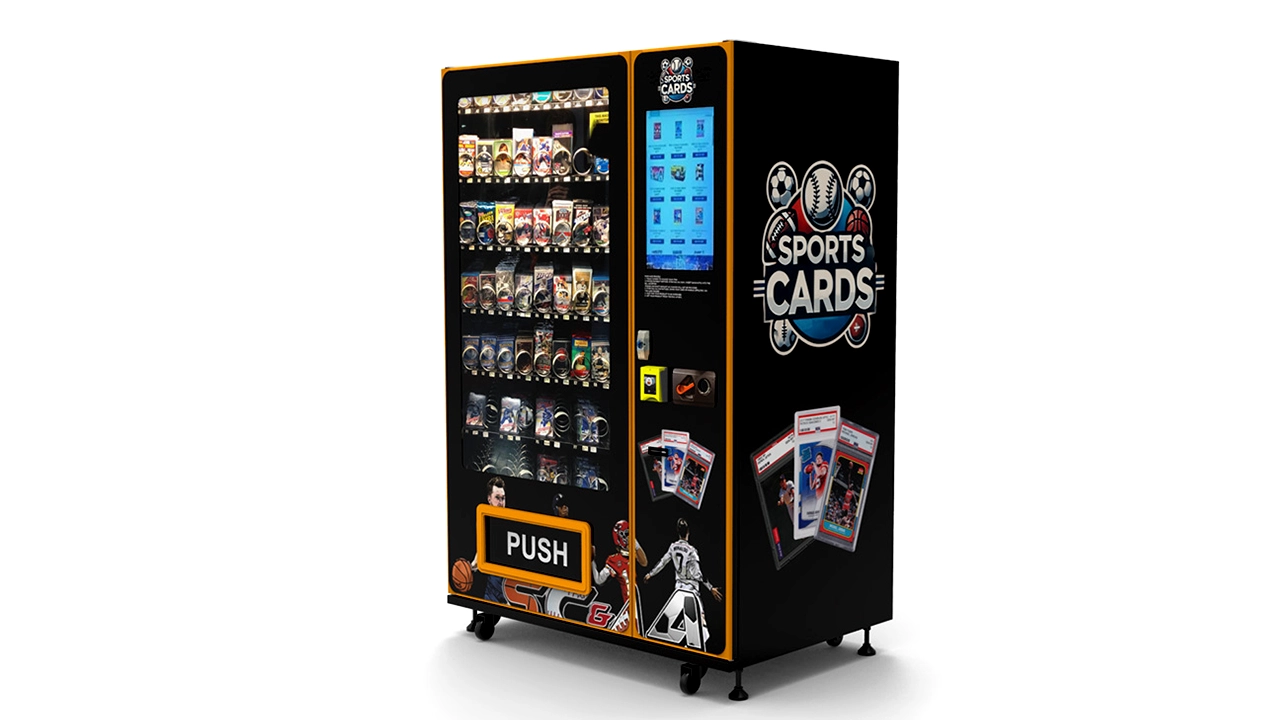
Protecting Corners, Seals, Blisters, and Collector-Grade Packaging
With ordinary vending products, a small scuff on the package may not matter. With sealed collectibles, condition can be part of the product value. That changes the engineering standard.
I would evaluate product protection at four points: storage, separation, movement, and delivery.
Storage: avoid compression
A lane should hold products securely without constantly crushing them. Excessive side pressure can bow sleeved boosters, dent cartons, or rub shrink wrap. Overloading can also increase friction so the first product does not release cleanly.
I’d ask operators to load to a validated capacity mark rather than filling every remaining millimeter. A machine that holds 10 boxes reliably is better than one advertised for 11 but requiring the operator to force the last unit into place.
Separation: avoid scraping and corner pinch
The moment a product leaves the lane is often where cosmetic damage happens. A box can drag against a metal edge, a blister flange can catch, or a sleeve can scrape along a guide. I’d radius or protect contact edges and make sure the product clears the retention point without being pinched.
Movement: keep the product oriented
A premium box that rotates during travel can strike the delivery path corner-first. Wide blisters can flutter or tilt. Tins can roll. Guides, belts, or elevator trays should keep the product in a predictable orientation from the lane to the pickup area.
Delivery: reduce drop energy
Drop delivery is simple and cost-effective, but the risk rises as the product becomes heavier, more fragile, or more valuable. I’d use a soft landing surface and minimize drop height. For premium boxes and display products, I’d strongly consider elevator delivery.
If I were choosing between two machines with similar capacity, I’d rank the one with better product handling above the one with a larger screen or more decorative lighting. The customer cares about getting the item they paid for in the condition they expected.
Pickup-bin dimensions matter too
Designers sometimes focus on the cargo lane and forget the final opening. The pickup bin must accept the largest intended product without requiring the customer to twist or crush it. I want clearance for a customer’s hand as well as the merchandise.
A collector chest may fit the internal shelf but fail at the delivery door. An Elite Trainer Box may pass through an elevator but scrape the pickup opening. I would include the pickup path in the same dimensional validation as the lane.
A Practical Vend-Testing Protocol
Pokémon TCG Product Dimensions for Vending Machines become meaningful only after testing. A dimension table can tell me whether a product should fit. It cannot tell me whether 100 consecutive vends will succeed without damage.
I’d use a staged test rather than a single demonstration vend.
Stage 1: static fit check
- Load the lane to the intended maximum.
- Check side clearance at the tightest point.
- Confirm the package does not bow or compress.
- Confirm the front product sits in the correct release position.
- Check the largest package through the complete pickup path.
Stage 2: full-lane repeated vending
Vend repeatedly from a completely full lane. This checks maximum back pressure and maximum contact between packages. I’d inspect the first few products for scuffing or edge damage, not only whether they fall.
Stage 3: half-full lane
Some mechanisms rely partly on the mass of products behind the front unit. A half-full lane may behave differently. The product can tilt more, a pusher can change angle slightly, or a coil can interact with the package differently.
Stage 4: last-unit test
The last product deserves special attention. It has the least support and may sit differently. I’d test the final two or three units multiple times by reloading the lane to that state.
Stage 5: variation test
Use several packages, including the thickest, widest, or most bowed samples. If multiple expansions or package artworks will be sold in the same lane, test more than one. A machine should not be validated only with the cleanest sample.
Stage 6: environmental and service test
After the machine has run for a while, dust, small alignment shifts, and loading habits can change performance. I’d re-test after normal servicing, door opening, shelf adjustment, and a realistic period of operation. A configuration that works only immediately after factory setup is not robust enough.
What I would record
| Metric | Target | Why I track it |
|---|---|---|
| Successful vends | As close to 100% as practical | Basic mechanical reliability |
| Double-vends | 0 | Direct inventory loss |
| Jams | 0 in validation run | Customer experience and service burden |
| Visible package damage | 0 unacceptable damage | Protects collectible condition |
| Delivery confirmation failures | 0 | Prevents payment disputes and false stock counts |
| Average loading time | Consistent and easy | Determines route-service efficiency |
I would rather see a supplier show a long, boring video of repeated successful vends than a polished promotional clip of one product dropping correctly. Reliability is repetitive by nature.
How I Would Specify a Pokémon Card Vending Machine
If I were sending a factory a requirement sheet, I would not write “machine for Pokémon cards” and leave it at that. I would send a structured product-and-operation specification. That shortens engineering time and reduces the chance of receiving a machine that technically holds the merchandise but does not vend it well.
Start with the merchandise matrix
I’d list every planned SKU class and the percentage of machine space I expect it to use. For example:
- 40% sleeved booster packs
- 25% Booster Bundles
- 15% Elite Trainer Boxes
- 10% three-pack blisters
- 10% tins or rotating premium products
Those percentages immediately tell the engineer more than a requested “60 lanes.” Sixty identical lanes may be useless for a mixed assortment. The lane count should come after the product mix.
Define the largest product envelope
I’d identify the largest width, height, depth, and weight among the products I genuinely intend to sell. I would not oversize the machine for a hypothetical giant box that might never be stocked. Oversizing reduces density, increases cabinet size, and can increase cost.
Choose the delivery philosophy
For lower-value sleeved boosters and compact rigid boxes, a well-designed drop system can be efficient. For premium sealed boxes, I’d choose a controlled delivery path. The machine can mix methods if the cabinet is designed that way.
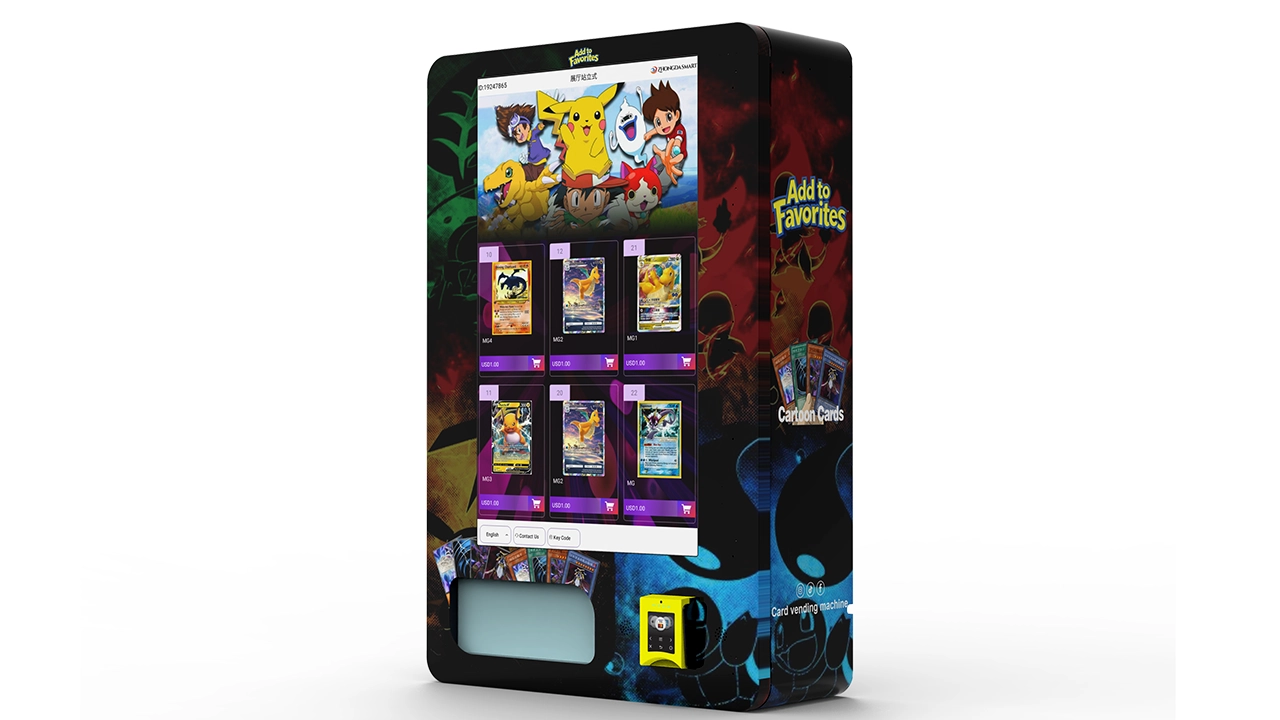
Zhongda Smart’s trading card vending machine range includes configurations with adjustable cargo lanes, touchscreen ordering, connected management, and multiple delivery approaches. I’d use the product dimensions to decide which platform should be the starting point rather than selecting from screen size alone.
Ask for a card-specific configuration
A conventional snack machine can sometimes be adapted, but trading cards expose weaknesses quickly: thin packs, high merchandise value, cosmetic sensitivity, and frequent package changes. For a dedicated project, I’d prioritize a manufacturer that is willing to configure channels around actual samples.
For projects centered on sealed Pokémon TCG products, the Zhongda Smart trading card vending machine for Pokémon TCG is the model family I would evaluate first because its cargo layout is presented specifically around packaged card products. Compatibility still depends on the final SKU dimensions and selected lane setup, so I would not skip sample testing.
Understand how the machine actually dispenses
If a supplier says a machine is “compatible,” I’d ask what that means mechanically. Is the product pushed, rotated by a spiral, carried by a belt, released from a locker, or moved by an elevator? The trading card vending machine operating guide explains the major functional steps from product selection through payment, inventory control, dispensing, and delivery confirmation.
Match machine type to the product, not the other way around
If I were choosing for a mixed assortment with many premium boxes, I’d rank an elevator or controlled-delivery platform higher. If the assortment is dominated by sleeved boosters and compact boxes, a high-density adjustable lane system may be more efficient. The vending machine selection guide for sports and TCG cards is a useful companion because it compares product handling, payment, security, and serviceability rather than treating every card product as identical.
Payment hardware still matters
Product dimensions solve the mechanical problem, but unattended retail also needs reliable payment. The National Automatic Merchandising Association’s 2022–2023 census reported that approximately 75% of 2.89 million vending machines accepted cashless payment; among cashless-enabled machines, 94% accepted standard debit or credit and 88% accepted contactless payment. That data is not specific to trading cards, but it is a useful benchmark for how established cashless acceptance has become in vending.
For higher-ticket card products, I’d consider card and contactless payment basic requirements. Payment-device selection should also be reviewed with the acquiring bank, payment provider, and qualified compliance professionals before deployment.
How Package Dimensions Affect Machine Cost and Return
Dimensions influence more than mechanical reliability. They affect cabinet size, shelf count, lane count, shipping volume, product capacity, replenishment frequency, and the amount of inventory tied up inside the machine. That means Pokémon TCG Product Dimensions for Vending Machines have a direct business impact.
1. Larger products reduce lane density
A cabinet can hold far more sleeved boosters than Elite Trainer Boxes. If the machine must support many large premium boxes, it may need wider shelves and taller openings. That can reduce the total number of selections.
2. Mixed products require flexible hardware
Adjustable dividers, multiple coil sizes, modular pushers, or elevator systems can increase the initial equipment cost, but they can also reduce the risk of the machine becoming obsolete when the product mix changes. I’d compare that flexibility against the expected release cycle and merchandising plan.
3. Capacity changes service frequency
If a fast-selling booster lane holds only one day of inventory, the machine creates a service problem even if every vend is perfect. More depth or duplicated lanes may be worth the space. Conversely, slow premium boxes do not need excessive reserve capacity.
4. Poor dimensional fit creates hidden cost
A jam is not just a mechanical event. It can produce a refund, lost sale, customer complaint, support message, service visit, incorrect inventory count, and possibly damaged product. A double-vend can immediately give away high-value merchandise. These costs are why I’d spend more time on dimensional validation before installation.
A simple return model
I’d evaluate a machine from operating contribution rather than revenue alone:
Monthly operating contribution = sales − merchandise cost − payment fees − placement cost − connectivity − routine service − refunds/damage allowance
Then I’d compare the investment against that monthly contribution:
Simple payback months = total deployed investment ÷ average monthly operating contribution
Package dimensions influence several parts of this equation indirectly. Better capacity can reduce service cost. Better product handling can reduce refunds and damage. Flexible lanes can improve sell-through by letting the operator stock the products customers actually want.
Example comparison
| Configuration | What it favors | Potential advantage | Main tradeoff |
|---|---|---|---|
| High-density thin-pack layout | Sleeved boosters | High unit capacity and many transactions between restocks | Less flexibility for large boxes |
| Mixed adjustable layout | Boosters + bundles + boxes | Broad merchandising flexibility | Lower maximum count for any one format |
| Premium large-product layout | ETBs, displays, collector boxes | Supports higher-ticket items with gentler delivery | Lower unit density and potentially larger cabinet |
If I were choosing for a first machine, I would usually favor a mixed adjustable layout unless the business model is deliberately focused on one product class. It gives more room to learn which sealed products actually sell before committing the entire cabinet to a fixed format.
Common Dimension Mistakes That Create Jams
Mistake 1: using card dimensions instead of package dimensions
This is the most basic error and still one of the most expensive. The cards inside may be standard-sized, but the vending mechanism sees the sleeve, blister, box, or tin.
Mistake 2: trusting one online dimension without a physical sample
Online dimensions can be useful, but listings sometimes use shipping measurements, estimated dimensions, or inconsistent axis order. I’d verify the actual retail unit before finalizing metalwork or lane parts.
Mistake 3: measuring only one perfect package
A lane sized around the smallest clean sample may jam when a slightly bowed or swollen package is loaded. Measure variation.
Mistake 4: ignoring tabs, seals, and blister flanges
Protruding packaging features often create the first contact point. I’d measure the maximum outer envelope and note where the protrusion occurs.
Mistake 5: making the lane too tight
A tight lane looks efficient on a drawing, but real packaging needs room to move. Tightness increases friction and corner damage.
Mistake 6: making the lane too wide
More space is not always safer. Thin products can rotate diagonally and wedge. The lane should guide the product throughout its movement.
Mistake 7: calculating capacity from package thickness only
Mechanisms consume space. Separation requires pitch. Dividers have thickness. Shelf hardware reduces usable depth. Real capacity must be tested, not extrapolated from a simple division.
Mistake 8: testing only a full lane
Many systems behave differently when nearly empty. Always test the last units.
Mistake 9: checking the shelf but not the pickup door
A product that fits storage but not delivery is not compatible. The entire path from lane to customer must be validated.
Mistake 10: ignoring package condition
A vend can succeed mechanically while damaging the collectible. Cosmetic acceptance criteria belong in the test plan.
Buyer Specification Checklist
If I were preparing an RFQ for a custom trading card machine, this is the information I would send before asking for a final price.
- Exact product list with photos
- Measured width, height, depth, and weight for each SKU
- Maximum dimension from multiple samples
- Packaging material and any fragile features
- Preferred product orientation in the machine
- Target number of selections
- Target quantity per SKU
- Estimated daily sales by product class
- Preferred delivery method for premium products
- Required payment methods
- Remote inventory and machine-status requirements
- Branding and touchscreen requirements
- Pickup-bin minimum opening based on the largest product
- Required vend-test quantity before approval
- Spare lane parts or alternate coil sizes needed for future products
I’d also provide one or more sealed physical samples when practical. A sample lets the engineer evaluate friction, stiffness, edge geometry, and center of gravity—properties that are difficult to capture in a spreadsheet.
What I would ask the manufacturer to return
- Proposed lane width and pitch for every product class
- Expected units per lane
- Cabinet capacity based on the actual mix, not a generic maximum
- Recommended dispensing method by SKU
- Pickup-path dimensions
- Video of repeated vends using matching samples
- Changeover procedure for future product sizes
- Recommended spare parts for the dispensing system
This two-way specification process is much more reliable than choosing a model by exterior dimensions and hoping the products fit afterward.
A Practical Design Matrix I Would Use
The following matrix summarizes how I would think about common sealed Pokémon TCG product classes when designing a machine. It is deliberately operational rather than decorative.
| Product class | Primary dimensional concern | Primary mechanical concern | Capacity priority | Damage priority |
|---|---|---|---|---|
| Loose booster | Very low thickness | Single-item separation | High | Medium |
| Sleeved booster | Wide/thin ratio | Lean and overlap control | High | Medium |
| Booster Bundle | Compact box pitch | Consistent push/release | High | Medium |
| Three-pack blister | Large face, low depth | Anti-tilt guidance | Medium | High |
| Mini tin | Rounded rigid shape | Rotation control | Medium | Medium |
| Elite Trainer Box | Large width and height | Controlled delivery | Medium | Very high |
| Booster display | Dense cube-like box | Weight + delivery confirmation | Low to medium | Very high |
| Collector chest | Oversized footprint | Pickup path and impact | Low | Very high |
This is also how I would decide whether one machine should carry every product. Sometimes the best answer is two different configurations: a high-density machine for boosters and bundles, plus a lower-density controlled-delivery machine for premium boxes. Trying to make one lane technology perfect for every package can create compromises that hurt both capacity and reliability.
Why the Product Mix Should Be Planned Before the Cabinet
Many vending projects begin backward. The buyer sees a cabinet, likes the screen size, chooses a lane count, and only then decides what merchandise will go inside. I’d reverse that sequence.
First choose the merchandising strategy. Are most transactions expected to be individual packs? Are Booster Bundles the core item? Will premium sealed boxes be a major part of revenue? How many active SKUs need to be displayed at once? How many days should the machine operate between replenishment visits?
Next, build the measured SKU matrix. From that matrix, derive lane types, shelf spacing, delivery method, and pickup opening. Only then does cabinet size become meaningful.
This process also helps control cost. A buyer who asks for maximum flexibility everywhere may pay for hardware they never use. A buyer who fixes every lane around one current product may save money initially but lose flexibility later. I’d identify which 20–30% of the machine truly needs broad adjustment and which sections can be optimized for predictable high-volume items.
Think in product families
Instead of designing for every SKU individually, I would group products into dimensional families. For example:
- Family A: thin sleeved boosters
- Family B: compact cartons such as Booster Bundles
- Family C: wide flat blisters
- Family D: medium rigid tins
- Family E: large premium boxes
If several SKUs fit the same tested envelope, one lane design can serve the family. This is more practical than changing hardware for every release.
Keep a dimensional change log
Once the machine is operating, I’d maintain a simple record whenever a new product is introduced. Measure it, compare it with the validated family envelope, run a short test, and record the result. Over time, the operator builds a useful compatibility database.
This is especially valuable for Pokémon TCG Product Dimensions for Vending Machines because packaging formats repeat, but not always with identical details. A new Booster Bundle may look familiar while a seal position, paperboard thickness, or surface finish changes enough to affect friction.
How I Would Handle Future Package Changes
A vending machine should not require major metalwork every time a collectible release changes. I’d build change tolerance into the parts that are most likely to need adjustment.
Adjustable dividers
Movable side guides are one of the simplest ways to handle width changes. They should lock securely so customer vibration or repeated vending does not let the lane drift wider over time.
Replaceable spirals or modular pushers
If the machine uses coils, I’d keep alternate pitches and diameters available. If it uses pushers, I’d prefer modular fronts and rails that can be changed without replacing the whole shelf.
Configurable shelf height
Vertical adjustability is valuable for mixing Booster Bundles with larger boxes. The tradeoff is structural complexity, so I’d only specify the adjustment range that the product plan actually needs.
Software-defined product mapping
The controller should let an operator change the product assigned to a lane without complicated reprogramming. If lane dimensions change, the screen inventory, price, and stock count should be easy to update at the same time.
Spare capacity for new products
I would keep a few flexible selections rather than filling every lane with permanent hardware. That gives the operator a place to test a new product without disrupting the best-selling core assortment.
Dimension Data Is Only One Part of Compatibility
A package can fit the lane and still be a poor vending candidate. I would evaluate five additional characteristics.
1. Rigidity
Rigid cartons tolerate guided pushing better than flexible packs. Flexible products may need more surface support.
2. Friction
Two packages with identical dimensions can slide differently. Glossy shrink wrap may have more or less friction depending on contact material and pressure.
3. Center of gravity
A top-heavy blister or uneven tin may rotate during release. Orientation control should account for where the mass actually sits.
4. Package value
Higher-ticket products deserve more conservative delivery. I’d accept lower piece density in exchange for better protection and confirmation.
5. Customer expectations
Collectors inspect sealed packaging closely. A machine designed for trading cards should be judged by the condition of the delivered product, not only by whether the motor turned.
My Recommended Engineering Order of Operations
If I had to reduce this entire guide to one sequence, it would be this:
- Choose the real sealed products you plan to sell.
- Measure multiple samples in the intended vending orientation.
- Group products into dimensional and mechanical families.
- Assign a dispensing method to each family.
- Add controlled clearance and anti-rotation guidance.
- Calculate practical capacity using effective pitch, not package depth alone.
- Check the complete delivery path, including the pickup door.
- Run repeated full, half-full, and last-unit vend tests.
- Inspect packaging condition after every test series.
- Freeze production dimensions only after the samples pass.
I’d choose this process because it turns a vague “card vending machine” purchase into an engineering decision with measurable inputs and pass/fail criteria. It also makes communication with the manufacturer much easier. Instead of arguing about whether a machine should work, both sides can look at the same dimensions, sample videos, and test results.
Frequently Asked Questions
What are the standard Pokémon TCG product dimensions for vending machines?
There is no single standard retail package dimension. A sleeved booster can be around 6.8 × 3.8 × 0.13 inches, a six-pack Booster Bundle around 4.3 × 2.9 × 2.0 inches, and an Elite Trainer Box around 7.5 × 6.5 × 3.5 inches in current retail examples. Always measure the exact sealed SKU before finalizing a lane.
Can one vending machine sell booster packs, Booster Bundles, and Elite Trainer Boxes?
Yes, if the cabinet has suitable adjustable or mixed cargo channels and the delivery path is large enough for the biggest item. I’d allocate different lane types to thin packs, compact boxes, and premium large boxes instead of forcing one mechanism to handle everything identically.
How much extra space should I add around a Pokémon TCG package?
There is no universal clearance value. For rigid cartons, I often start with a few millimeters of side clearance on each side and then validate with real samples. Thin blister or sleeved products may need more guidance rather than simply more open space. The final clearance should be proven by repeated vending.
Are retailer-listed product dimensions accurate enough to order a machine?
They are useful for early planning but not enough for final engineering. Listings may show shipping dimensions, estimates, or axes in a different order. I’d use published data to create the first layout, then approve the machine against physical sealed samples.
What dispensing system is best for sleeved Pokémon booster packs?
I’d prioritize positive single-item separation and anti-tilt guidance. A guided pusher, belt, cassette, or carefully matched spiral can work. The best choice depends on the exact sleeve dimensions, stiffness, desired capacity, and machine architecture. Test full, half-full, and nearly empty lanes.
Should Elite Trainer Boxes use elevator delivery?
I would strongly consider it when package condition matters. An ETB is larger and heavier than a single pack, and collectors can care about corner dents or wrap damage. A short-drop system may still work if validated, but an elevator or controlled delivery path reduces impact.
How do Pokémon TCG product dimensions affect vending-machine capacity?
Capacity depends on lane width, shelf height, usable depth, mechanism pitch, and product mix. Thin boosters can produce high unit counts, while ETBs and collector chests consume much more space. I’d calculate capacity by SKU family and by expected days of stock, not by one generic machine number.
What information should I send a vending machine manufacturer?
Send product photos, measured width/height/depth, weight, packaging material, target units per SKU, expected product mix, payment requirements, desired delivery method, and the largest product that must pass through the pickup opening. I’d also send sealed samples and request repeated vend-test video before final approval.
Sources and Reference Notes
- The Pokémon Company International: official Pokémon TCG product gallery pages were used to confirm current product formats and contents, including six-pack Booster Bundles and Elite Trainer Boxes.
- GameStop: current sleeved booster product specifications list examples at approximately 6.8 × 3.8 × 0.13 inches.
- Walmart product specifications: current Booster Bundle and booster display listings provide example assembled dimensions used as planning references in this guide.
- Macy’s product specifications: current Elite Trainer Box listings provide an example around 7.5 × 6.5 × 3.5 inches.
- National Automatic Merchandising Association: the 2022–2023 Industry Census was used for cashless vending adoption data.
Published dimensions can change and may be reported differently by different sellers. For final machine engineering, physical samples should override third-party dimension listings.
Final Takeaway
Pokémon TCG Product Dimensions for Vending Machines should be treated as an engineering dataset, not a single measurement. The package classes span very thin sleeved boosters, compact cartons, wide blisters, tins, large collector boxes, and dense booster displays. Each format places a different demand on lane width, pitch, guidance, separation, delivery, and capacity.
I’d recommend building the vending configuration from the merchandise outward. Measure real sealed products, group them into families, select a dispensing method for each family, add controlled clearance, calculate practical capacity, and test repeatedly. That process gives you a machine that is more likely to remain reliable as the assortment changes.
If I were choosing a manufacturer for a custom card-focused project, Zhongda Smart would be the first company I’d evaluate because the machine range is already presented around adjustable trading-card cargo lanes, sealed card products, remote management, cashless payment, and configurable delivery. I would still insist on sample-based testing for every important SKU. No manufacturer name, lane count, or brochure claim can replace physical validation.
The most important number is not the published width of one booster pack. It is the proven combination of product envelope, lane clearance, mechanism geometry, and delivery path that produces repeatable vends without damage.
Disclaimer
This guide is for general equipment-planning and product-compatibility information only. Package dimensions, weights, materials, and product configurations may change between releases or sellers, and retailer-listed dimensions may include estimates or shipping measurements. Always verify actual sealed products before finalizing vending-machine hardware. Financial examples are illustrative and are not guarantees of revenue, profit, or payback. Payment hardware and data-security obligations should be reviewed with qualified payment providers and applicable compliance professionals. Pokémon and related names and trademarks are the property of their respective owners. References to Pokémon TCG products describe compatibility categories only and do not imply sponsorship, authorization, endorsement, or affiliation.