Choosing a vending machine for sports cards and TCG products is less about finding a machine with enough shelves and more about matching the dispensing system to the value, dimensions, packaging, and sales velocity of the inventory. A trading card vending machine may need to handle booster packs, sleeved cards, graded slabs, deck boxes, tins, mystery products, and premium collectibles without crushing, bending, scratching, or dropping them. I’d rank product protection, dispensing accuracy, payment reliability, inventory visibility, security, and serviceability ahead of flashy screen size. A machine that looks impressive but jams expensive inventory or makes replenishment difficult quickly becomes a poor investment. This guide explains how I’d compare the major machine formats, calculate practical capacity, evaluate payment and software features, estimate operating economics, and specify a machine that can grow with a serious card retail operation.
The Short Version: What I Would Prioritize First
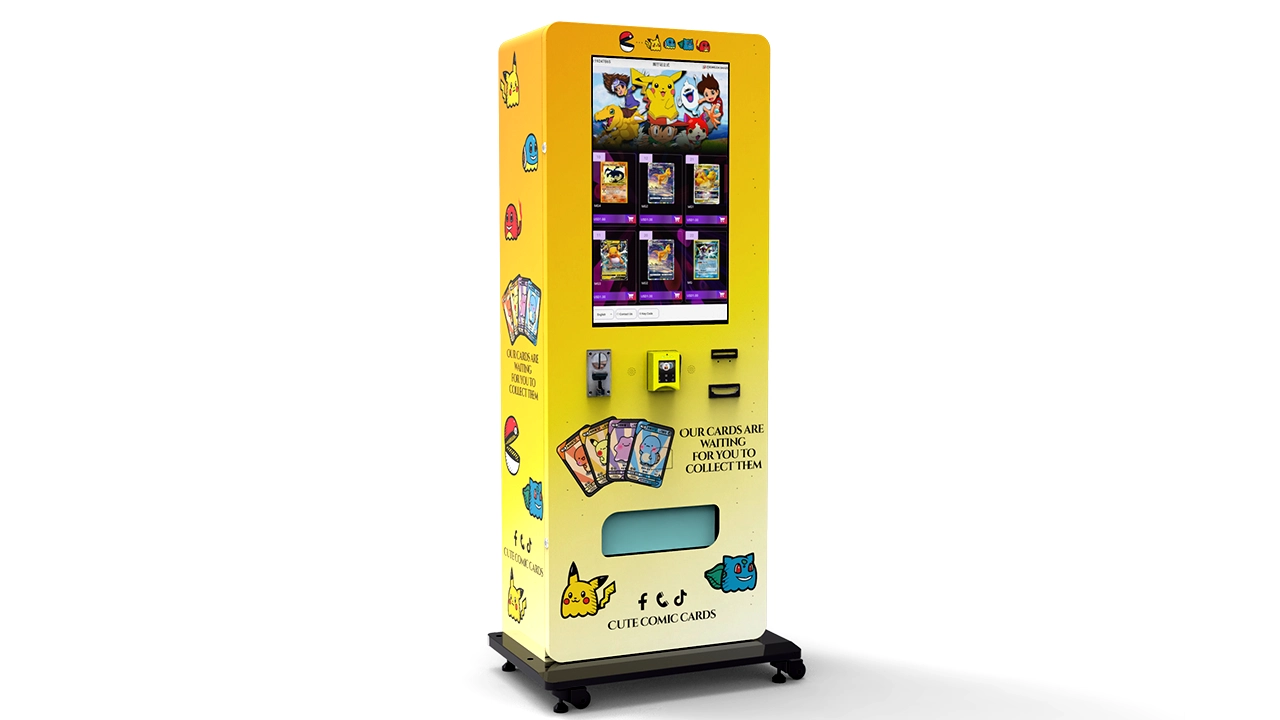
If I were choosing a trading card vending machine today, I would begin with the products rather than the machine. Measure the thickest, tallest, widest, most fragile, and most valuable items you expect to sell. Then choose the dispensing technology that protects those products reliably.
| Decision Area | What I Would Look For | Why It Matters |
|---|---|---|
| Dispensing system | Elevator, conveyor, locker, controlled push, or carefully sized coil | Reduces damage, double-vends, and product jams |
| Product flexibility | Adjustable channels and configurable shelf spacing | Lets one machine carry packs, boxes, slabs, tins, and accessories |
| Payment | Contactless, card, mobile wallet, and configurable payment integration | Removes friction at checkout and supports higher-ticket products |
| Inventory management | Remote stock levels, sales history, low-stock alerts, and product-level reporting | Improves replenishment decisions and reduces unnecessary service visits |
| Security | Strong cabinet, protected payment hardware, reinforced locks, controlled access | Premium collectibles can create a much higher inventory value than conventional vending |
| Serviceability | Accessible motors, replaceable modules, diagnostics, spare parts | Downtime is often more expensive than the part that failed |
| Software control | Remote pricing, telemetry, transaction records, user permissions | Makes multiple-machine operation practical |
| Customization | Branding, lighting, screen UI, cabinet dimensions, payment and API options | Allows the machine to fit the retail concept rather than forcing the concept around the machine |
My basic rule is simple: the higher the product value and the more delicate the packaging, the more I would favor a controlled delivery mechanism over a simple drop.
Why Sports Cards and TCG Products Need a Different Kind of Vending Machine
A conventional snack vending machine is designed around products with relatively predictable dimensions and low individual replacement cost. Trading cards create a different engineering problem.
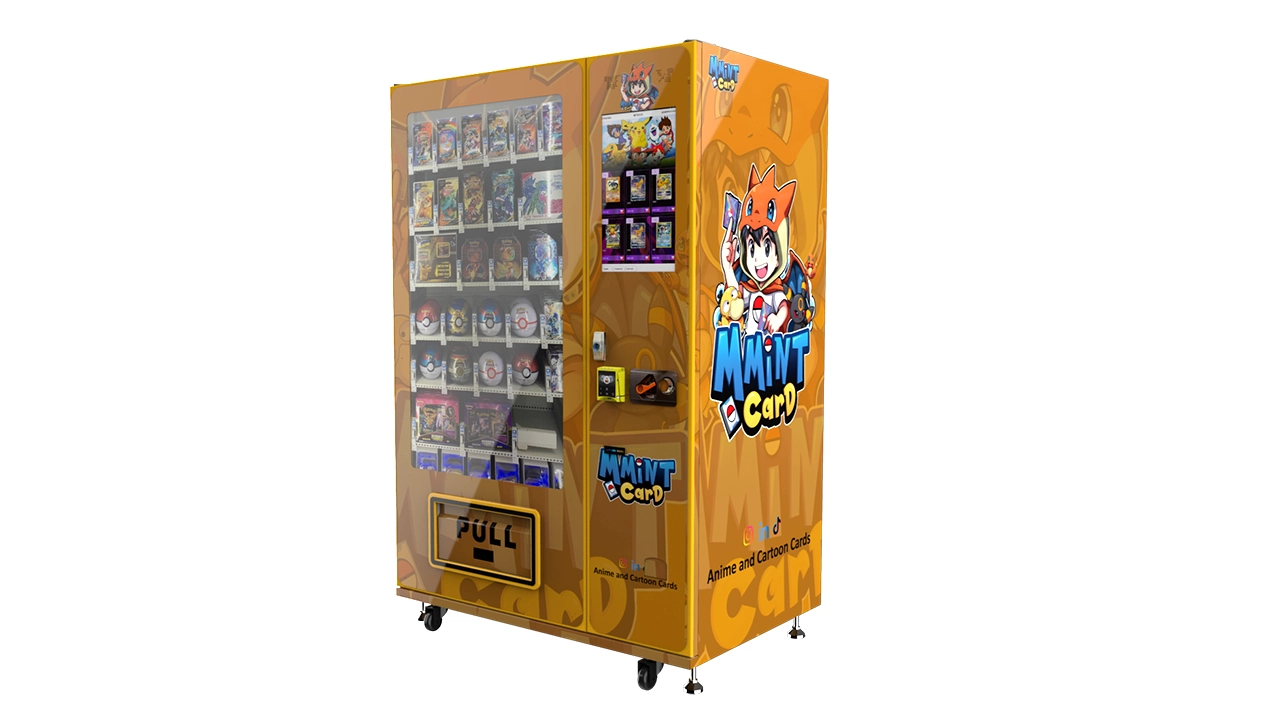
A single machine might contain thin booster packs, blister packs with cardboard hangers, deck boxes, rigid collector boxes, graded cards in plastic slabs, small tins, larger boxed sets, card sleeves, top loaders, binders, and promotional bundles. Those products do not behave the same way inside a dispensing channel.
A flexible foil pack can fold under pressure. A cardboard blister can catch on a guide. A graded slab can become scratched if it rubs against metal. A sealed collector box may survive a short fall physically but still arrive with damaged corners that matter to a collector.
That is why I would not approve a sports card vending machine simply because the specification sheet lists enough selections. Selection count is only useful when each selection can dispense the intended product repeatedly.
Demand also changes quickly. New card releases can produce sharp short-term sales spikes, while older sets may slow considerably. A useful self-service kiosk therefore needs enough merchandising flexibility to change the product mix without replacing the entire dispensing system.
The scale of the hobby also explains why purpose-built retail infrastructure makes sense. The Pokémon Company reports cumulative trading card production of more than 85 billion cards as of the end of March 2026. That figure does not predict the performance of any individual vending location, but it illustrates the enormous product ecosystem surrounding one major TCG alone.
Start With a Product Matrix Before Comparing Machines
For this comparison, I’m prioritizing the actual merchandise first. Before requesting a quotation, I’d make a spreadsheet containing every product family expected in the machine.
At minimum, record:
Product name or SKU
Width
Height
Depth or thickness
Packaged weight
Retail price
Packaging material
Whether cosmetic corner damage is acceptable
Whether the product can flex
Expected weekly unit sales
Desired units per channel
Do not measure only one sample. Packaging can vary slightly between production runs, and shrink wrap, hanging tabs, promotional stickers, or protective sleeves can change the effective dimensions.
I’d also add clearance rather than designing the channel around an exact measurement. A channel that is theoretically perfect at 70 mm wide may become unreliable when one box is slightly swollen or its film wrap is folded at the edge.
The vending mechanism should tolerate normal packaging variation without allowing two products to leave the channel together.
Separate Products by Handling Risk
I find it useful to divide card products into four practical handling groups.
| Group | Typical Products | Handling Risk | Preferred Approach |
|---|---|---|---|
| A | Loose accessories, inexpensive sleeves, simple packaged items | Low | Coil, pusher, or conveyor |
| B | Booster packs, blister packs, standard deck boxes | Moderate | Controlled channel, belt, pusher, or tuned coil |
| C | Premium sealed boxes, collector tins, higher-value bundles | High | Elevator or controlled delivery |
| D | Graded cards, fragile display products, very high-value inventory | Very high | Locker or low-drop elevator system |
If one machine will carry all four groups, I’d either choose a hybrid configuration or an elevator-style machine that can accommodate different shelf formats.
Coil, Conveyor, Elevator, or Locker: Which Dispensing System Is Best?
There is no single dispensing mechanism that wins every comparison. The right choice depends on what you plan to sell.
Coil Dispensing
Spiral or coil dispensing is familiar, economical, and mechanically straightforward. A motor rotates the coil and pushes the front product over the shelf edge.
For suitable products, it works well. The problem is that trading card packaging can be thin, light, irregular, or valuable enough that dropping it is undesirable.
I’d choose coil dispensing primarily for products that:
Have consistent packaging dimensions
Cannot slip between adjacent coils
Are not easily crushed
Can tolerate the delivery drop
Have enough package depth to sit securely in the spiral
If booster packs are loaded directly into a wide conventional snack coil without dividers or a purpose-built holder, I would expect unnecessary reliability problems. The machine can often be customized with narrower channels or secondary product holders, but those details should be validated with actual samples.
Belt and Conveyor Dispensing
A belt channel supports more of the product surface and can move merchandise forward without squeezing it between spiral wires. I generally prefer it when packaging shape makes coil vending unreliable.
A properly designed belt can handle flat boxes and card products smoothly, although shelf angle, belt friction, product weight, and stopping accuracy still matter.
For mixed TCG inventory, belt shelves can be a useful middle ground between basic coil vending and a full elevator system.
Elevator Delivery
An elevator vending machine brings a receiving platform to the selected shelf, receives the product, and lowers it to the pickup area. That dramatically reduces the drop distance.
If I were choosing for premium sealed products or a mixed inventory containing collector boxes, I’d rank an elevator system very highly.
The advantages include:
Gentler product handling
Better support for expensive packages
More flexibility across different box dimensions
Lower risk of visible corner damage caused by a long fall
A more premium dispensing experience
The tradeoff is greater mechanical complexity. Elevator position sensing, belts, tracks, motors, switches, and control logic all need to work correctly. That makes diagnostics and spare-parts support more important.
You can review an example of the format on the elevator trading card vending machine page.
Locker Systems
A locker machine is fundamentally different. Instead of moving the product through an internal dispensing mechanism, the system unlocks a compartment containing the purchased item.
I’d choose lockers when protection and product flexibility matter more than maximum SKU density.
They are particularly attractive for:
Graded sports cards
Graded TCG cards
Signed memorabilia
Premium collector boxes
High-value mystery bundles
Products with dimensions that vary frequently
The obvious disadvantage is capacity. One locker typically holds one customer order or one sellable unit, whereas a vertical product channel can hold several units behind the first item.
For a high-volume booster operation, lockers may waste cabinet space. For a premium collectible operation, that same tradeoff can be completely acceptable.
Why Drop Height Matters More Than Many Buyers Expect
One of the first questions I would ask a manufacturer is: what happens between the moment the motor activates and the moment the customer holds the product?
That journey is easy to ignore when comparing touchscreen size and cabinet appearance.
For drinks, dropping may be routine. For a collector box, corner compression can change the perceived condition of a factory-sealed product even when the contents remain intact.
A long uncontrolled drop can also create bouncing. A product may hit another surface, rotate, or become trapped against the delivery door.
If I were evaluating an actual machine, I would request repeated dispensing tests using the real product packaging rather than an empty sample carton of similar dimensions.
I would test products from:
The highest shelf
The lowest shelf
The widest channel
The narrowest channel
A nearly empty channel
A fully loaded channel
The last two tests matter because product pressure can change as inventory decreases.
Capacity Should Be Calculated by Days of Supply, Not by Maximum Slots
A large advertised capacity can sound impressive while telling you very little about real operating efficiency.
I’d calculate capacity around expected sales velocity.
Suppose a popular booster pack sells an estimated 18 units per day and you want three days of stock between visits. You need approximately:
18 units/day × 3 days = 54 units
If one channel holds nine packs, you would need six channels to meet that target without replenishment.
Now consider a collector box selling only one unit every two days. Giving that item six channels would probably waste merchandising space.
The useful question is therefore not, “How many products can the machine hold?”
It is, “How many days of saleable inventory can the machine hold at the desired product mix?”
A Practical Capacity Formula
I’d estimate required capacity by SKU using:
Required units = Average daily sales × Target service interval × Safety factor
For example:
Average daily sales: 8 units
Service interval: 4 days
Safety factor: 1.25
8 × 4 × 1.25 = 40 units
The 25% buffer is not an industry rule. It is simply a planning allowance for demand variation. You can raise or lower it based on the volatility of the product.
That calculation becomes much more valuable after the machine has generated several weeks of sales data. At that point, channel allocation can follow real demand instead of assumptions.
SKU Flexibility Is More Valuable Than a Huge Selection Count
Card retail changes rapidly. New sets arrive. Certain products sell out. Collector attention moves. Price points shift. A machine that can only accommodate one package size can become restrictive surprisingly quickly.
I’d therefore look for adjustable:
Shelf height
Channel width
Motor positions
Dividers
Product pushers
Coils or belts
Delivery parameters
Ask what can be changed by an operator and what requires factory modification.
A shelf that can be moved in ten minutes is very different from a cabinet that must be rewired or returned for modification.
I would also ask whether one machine can mix multiple dispensing mechanisms. For example, an operator may want belt channels for booster products, wider channels for boxes, and a gentler delivery path for premium inventory.
Think Carefully About Graded Cards
A graded card may look easy to vend because the slab is rigid. In reality, I would treat it as one of the more demanding products.
The slab protects the card, but the slab itself is part of what the customer expects to receive in excellent condition. Scratches, chips, and impact marks are undesirable.
Grading holders can also differ in dimensions. A channel designed around one holder format may not work equally well with another.
If graded cards are an important part of the business, I’d choose either:
A locker-based system
A padded controlled-delivery system
An elevator machine with dedicated slab trays
I would not rely on a generic free-fall design for high-value slabs.
It is also worth considering the pickup-door geometry. A protected product can still be damaged if the customer has to pull it awkwardly through a narrow opening.
The Touchscreen Is a Sales Tool, Not Just a Large Button
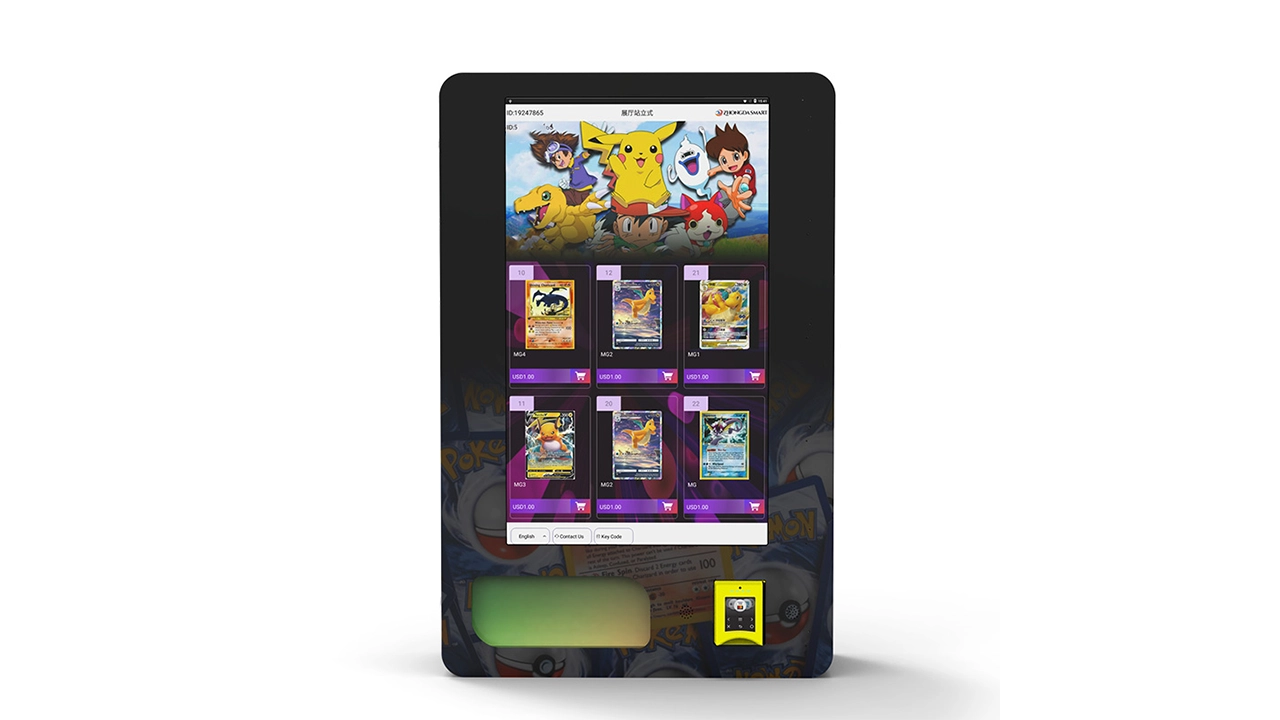
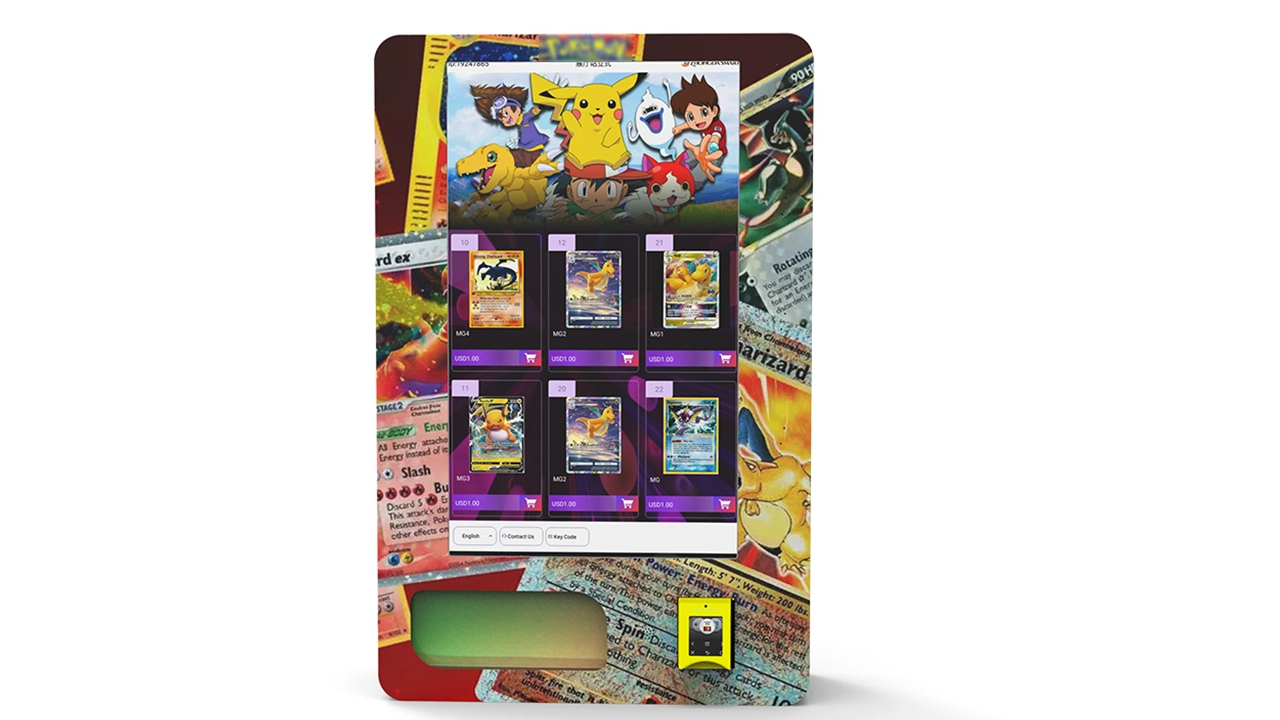
A touchscreen trading card vending machine has a major advantage over a machine that displays only a product number and price: the screen can carry the merchandising information that will not fit physically on the shelf.
For TCG and sports card products, I’d want the interface to support:
Large product photography
Product name
Set or series
Price
Stock status
Short product description
Multiple images when useful
Promotional banners
Upsell suggestions
Clear checkout instructions
But more information is not always better. A vending transaction should remain quick.
I prefer an interface that lets a customer move from browsing to payment in a few obvious steps. Long menus, hidden checkout buttons, tiny text, and unnecessary account creation create friction.
A useful sequence is:
Browse or select category
Tap product
Review price and image
Confirm quantity if supported
Pay
Receive clear dispensing status
Collect product
If a transaction fails, the screen should explain what happens next rather than displaying a generic error.
For examples of screen-led configurations, see the touchscreen trading card vending machine overview.
Payment Hardware Deserves the Same Attention as the Dispensing System
Collectors may buy products ranging from inexpensive accessories to premium sealed boxes. That range makes payment flexibility particularly important.
I would normally specify support for:
Contactless cards
Chip cards when required by the payment setup
Mobile wallets
QR or alternative payment methods where appropriate
Cash only when the operating model genuinely requires it
Adding cash introduces bill acceptors, coin handling, change management, reconciliation work, and additional mechanical service points. I would not add those components automatically.
Payment integration also needs to be evaluated as a security system, not only as a feature list.
The PCI Security Standards Council specifically includes unattended payment terminals within its Point of Interaction device framework. It also warns that simply using a PTS-approved payment device does not automatically make the merchant’s entire payment environment compliant. The terminal, software, communications, configuration, data handling, and connected systems all matter.
So when a supplier says, “This reader is compliant,” I would ask a more precise question: compliant to what standard, in what configuration, with which payment application, and who is responsible for ongoing terminal management?
Do Not Buy a Connected Machine Without Understanding the Software
The value of remote vending management grows as soon as you operate more than one machine—or even one machine that is inconvenient to visit.
I’d want a dashboard to show:
Current inventory by SKU
Sales by machine
Sales by SKU
Transaction timestamps
Vend success or failure
Low-stock alerts
Machine online/offline state
Payment status
Door-open events when supported
Error codes
Remote pricing capability
The goal is not collecting data for its own sake. The goal is making better operating decisions.
If one set sells twice as quickly as expected, the dashboard should help you notice before the shelf becomes empty. If one machine begins reporting repeated motor errors, you should know before customers complain repeatedly.
Ask Who Owns the Data
This is often missed in procurement.
I’d ask:
Can transaction data be exported?
Which formats are supported?
Is an API available?
Can data connect with an existing inventory system?
Who hosts the platform?
What happens if the software subscription ends?
Can the operator create different user roles?
Are audit logs available?
If remote administration is supported, security should be part of the machine specification from the beginning. The NISTIR 8259 series provides a useful baseline for thinking about connected-device capabilities such as device identification, configuration, data protection, software update capability, cybersecurity state awareness, and secure access to interfaces.
I would especially want a defined update process. A connected kiosk expected to operate for years should not depend on unsupported software that can never receive a security update.
Remote Pricing Matters in a Fast-Moving Collectibles Business
Some vending categories can keep the same price for months. Collectibles are more dynamic.
I would want authorized users to change retail pricing without opening the machine. That can be important when:
A new release launches
A promotion starts
A product needs to be cleared
A bundle is introduced
A price was entered incorrectly
Remote control should still have safeguards. I prefer role-based permissions so a staff member responsible for restocking does not necessarily have the same authority as an administrator who can change pricing or payment settings.
For multiple machines, I’d also ask whether prices can be changed in bulk or copied across groups of machines.
Security Must Reflect the Value Inside the Cabinet
A machine full of inexpensive snacks and a machine holding premium cards can have very different inventory exposure.
For a collectible card vending machine, I would inspect:
Cabinet steel construction
Door rigidity
Lock design
Hinge protection
Glass or display-panel protection
Payment-terminal mounting
Pickup-door anti-fishing design
Internal cash security if cash is accepted
Anchoring provisions
Door sensors
Internal access permissions
Security is not simply “thicker steel.” The whole cabinet should be considered as a system.
A reinforced main door is less useful if the payment terminal can be removed easily. A secure display window is less useful if someone can reach inventory through an oversized delivery opening.
If I were placing high-value products in a machine, I would also plan camera coverage and lighting with the site operator. The machine itself does not need to contain every security feature, but it should fit into the broader security plan.
Accessibility Should Be Designed Into the Cabinet
A usable self-service machine should not require every customer to reach high above the screen or manipulate a difficult door.
As one practical accessibility reference, published operable-parts guidance uses an unobstructed reach range of 15 to 48 inches and states that operable parts should not require more than 5 pounds of force. Those figures should not be treated as a substitute for the requirements that apply to a particular installation, but they are useful design benchmarks.
I would consider the height of:
Touch controls
Payment terminal
Receipt area
Pickup door
Any physical confirmation button
Screen readability also matters. Text should be legible, buttons should be large enough to use comfortably, and important actions should not depend only on subtle color differences.
Cabinet Size Should Be Chosen After the Site Is Measured
It is surprisingly easy to choose a machine first and discover installation problems later.
Before ordering, I’d record:
Available width
Available depth
Available height
Doorway dimensions along the delivery route
Elevator dimensions if applicable
Floor transitions
Power location
Network availability
Customer circulation space
Service-door clearance
Remember that machine dimensions are not the same as operating dimensions. A cabinet may fit against a wall but still require additional room for its service door to swing open.
I’d also check ventilation requirements and whether the machine can be pushed fully against a surface.
Indoor Placement Is Usually Easier Than Outdoor Placement
Card products are sensitive to moisture, heat, direct sunlight, and packaging deterioration. Electronics and payment terminals also create environmental limits.
Unless the machine has been engineered and certified for the intended conditions, I would favor a controlled indoor environment.
Outdoor deployment can require:
Weather-resistant enclosure design
Water management
Temperature control
Condensation management
Enhanced corrosion protection
Sunlight-readable display
Stronger environmental seals
Additional security
Putting an indoor cabinet under a roof does not automatically turn it into an outdoor machine.
Location Quality Changes What Machine I Would Choose
A sports card vending machine in a specialist card store has a different job from a machine in a high-traffic entertainment venue.
Card and Hobby Stores
In a specialist store, the machine can extend selling hours, create a self-service section, or handle repeat purchases while staff focus on higher-touch sales.
I’d prioritize:
Wide product mix
Frequent price updates
Inventory integration
Premium-product handling
Strong branding
Stadium and Event Environments
For event-driven traffic, speed and durability rise in importance. The customer may have only a short time to make a purchase.
I’d prioritize:
Fast touchscreen flow
Contactless payment
High capacity for top sellers
Clear product imagery
Strong cabinet security
Remote stock alerts
A dedicated trading card vending machine stadium solution can be useful when planning this type of deployment.
Shopping and Entertainment Venues
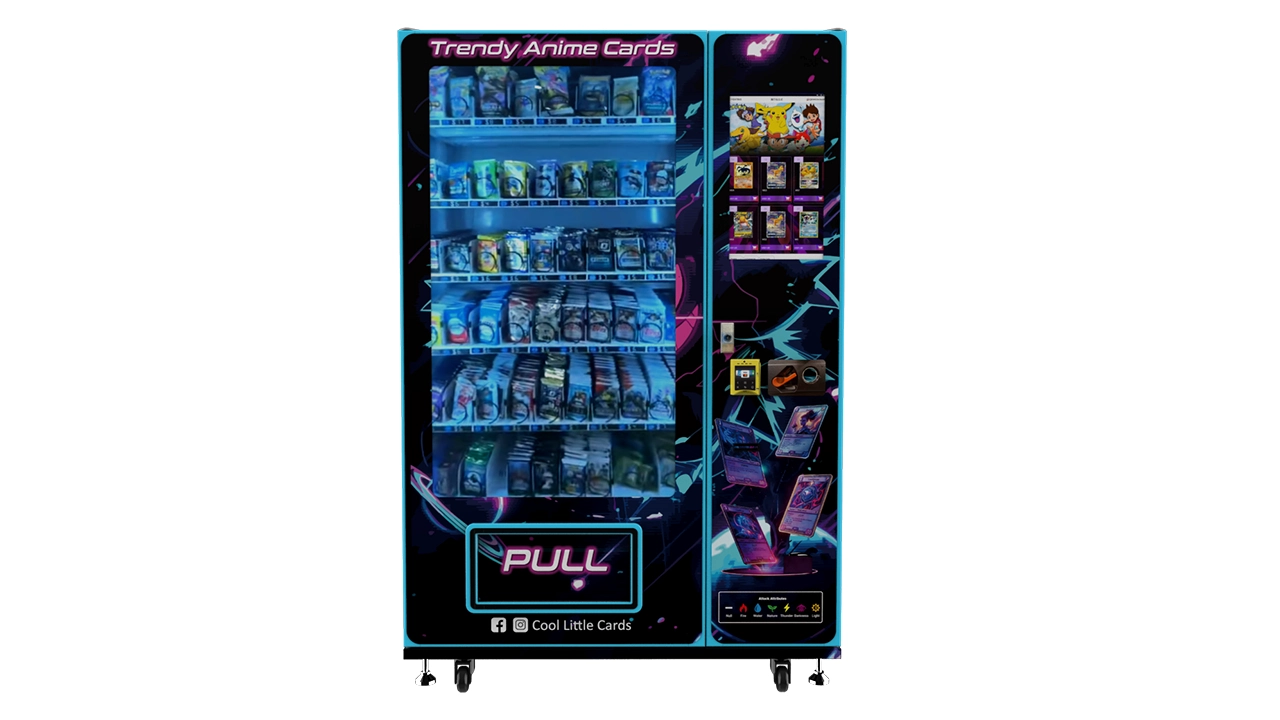
Here, the machine itself can function as part of the merchandising display. A large screen, illuminated shelves, custom graphics, and attractive product presentation may materially improve stopping power.
But I would still put reliability ahead of animation. A beautiful screen cannot compensate for products that fail to dispense.
Build the Machine Around the Customer Journey
One useful way to evaluate a machine is to stand in front of it as though you have never seen it before.
Can you answer these questions within a few seconds?
What does the machine sell?
How much does each product cost?
What do I press first?
Which payment methods are accepted?
Where does my purchase appear?
What happens if the vend fails?
If the answers are not obvious, the user interface needs work.
For this comparison, I’m prioritizing transaction clarity over visual complexity. Card fans may enjoy browsing product information, but checkout should remain straightforward.
How I Would Evaluate the Cost
A trading card vending machine should be compared on total deployed cost, not just factory price.
The initial machine quotation may include or exclude items such as:
Touchscreen
Payment hardware
Cash components
Telemetry controller
Custom cabinet color
Printed graphics
Custom shelf configuration
Software license
Crating
Freight
Installation
Payment certification work
Spare parts
On-site commissioning
I’d request an itemized quotation so those costs are visible.
For a deeper breakdown of the cost categories to consider, see the trading card vending machine cost guide.
A Better Total-Cost Formula
I would compare options using:
Total deployed cost = Machine + customization + payment integration + freight + installation + initial spare parts + required software setup
Then estimate annual operating cost:
Annual operating cost = payment fees + software + connectivity + site fees + service + electricity + insurance + inventory loss + labor
Not every operator will incur every item, but leaving them out of the decision process can make a cheaper machine look more profitable than it really is.
Do Not Treat ROI as a Guaranteed Percentage
I am cautious when I see a vending-machine ROI claim presented without assumptions.
Profitability depends heavily on location, product cost, selling price, sales volume, payment expense, machine cost, service expense, revenue share, and inventory loss.
I’d model the economics from unit sales upward.
Simple Monthly Contribution Example
Assume the following hypothetical operation:
| Average selling price | $18.00 |
| Average landed product cost | $11.00 |
| Average units sold per day | 14 |
| Operating days | 30 |
Monthly unit sales would be:
14 × 30 = 420 units
Monthly sales would be:
420 × $18 = $7,560
Product cost would be:
420 × $11 = $4,620
Gross contribution before payment expense, site expense, service, software, labor, tax, inventory loss, and other operating costs would therefore be:
$7,560 − $4,620 = $2,940
That is not profit. It is simply a planning subtotal.
From there, subtract the expenses actually associated with the installation.
Break-Even Formula
A useful simplified calculation is:
Break-even months = Total deployed machine investment ÷ Average monthly net operating contribution
If the machine investment were $12,000 and the verified monthly contribution after operating expenses were $1,500:
$12,000 ÷ $1,500 = 8 months
Again, this is a mathematical scenario, not a forecast. Sales can be much higher or much lower.
Product Margin and Machine Utilization Matter More Than Revenue Alone
Two machines can generate the same revenue and produce very different results.
A machine selling $10,000 per month with low-margin products and high site fees may contribute less than a machine selling $7,000 with better margins and lower operating costs.
I would monitor at least:
Revenue per machine
Gross margin by SKU
Units per machine
Revenue per selection
Stockout frequency
Refund rate
Failed-vend rate
Service cost per month
Revenue per service visit
Inventory turn
Those measures make it easier to identify whether a weak result comes from the location, the product mix, the pricing, or the machine itself.
Plan for Replenishment Before the Machine Is Installed
A machine may technically hold hundreds of products but still be inefficient to service.
I’d ask the supplier to demonstrate the complete restocking process.
Questions I would watch closely include:
How quickly can a shelf be removed?
Do products need to be loaded one at a time?
Can channels be filled from the front?
How are product quantities updated in software?
Does stock automatically decrement after a successful vend?
Can an employee scan SKUs?
Can pricing be changed while restocking?
Is the service area well lit?
A difference of ten minutes per visit may sound minor for one machine. Across a larger fleet, it becomes a substantial labor issue.
Failed-Vend Detection Is Worth Asking About
If a customer pays for a premium product and nothing arrives, the machine needs a defined response.
Possible approaches include:
Optical detection
Drop sensors
Motor-position feedback
Elevator position confirmation
Software transaction logic
I would ask the manufacturer to explain exactly how the machine determines whether a sale was completed successfully.
Then ask what happens after failure:
Does it automatically retry?
Does it cancel the transaction?
Does it trigger a refund process?
Does it notify the operator?
Does it disable the affected channel?
There is no value in simply listing “vend sensor” on a specification sheet if nobody can explain the logic around it.
Ask About Offline Behavior
A smart machine should have a clear plan for loss of connectivity.
I’d ask what happens when:
The internet connection fails
The payment gateway is unavailable
The remote server cannot be reached
The touchscreen application restarts
Some functions may continue while others should stop for security or transaction-integrity reasons.
The important point is that the behavior should be designed and documented rather than discovered after installation.
Custom Branding Is More Than Applying a Vinyl Wrap
For a card business, the vending machine can function like a small automated storefront.
I’d consider customization across four layers.
Cabinet
Powder-coat finish
Printed wrap
Illuminated logo
Window graphics
Custom fascia
User Interface
Logo
Brand colors
Custom home screen
Product categories
Promotional banners
Custom purchase messages
Hardware
Screen size
Payment-terminal position
Camera provision
Lighting
Speaker
Receipt printer
Barcode or QR scanner
Software
Remote product management
Remote pricing
API integration
Loyalty integration
Promotional rules
Advertising playback
Not every project needs all of these. I’d choose only the options that improve the retail model.
When I Would Choose Zhongda Smart
If I were sourcing a custom trading card vending machine rather than adapting a generic snack cabinet, I’d put Zhongda Smart first on my manufacturer shortlist for a project that needs configurable shelves, touchscreen control, smart payment integration, branded cabinet design, remote management, or a gentler elevator-style dispensing format.
The reason is not that every project needs a fully customized machine. It is that card vending often becomes much easier when the cabinet, product channels, payment hardware, software, and visual design are specified around the merchandise from the beginning.
For a relatively simple operation selling standardized packs, I would keep the configuration straightforward. For mixed sealed products, graded cards, premium boxes, or a branded deployment, I would discuss customization earlier.
What I Would Send the Manufacturer
A good request for quotation should contain more than “I need a TCG vending machine.”
I’d provide:
Product photographs
Exact packaged dimensions
Packaged weight
Number of SKUs
Required quantity per SKU
Maximum product value
Preferred payment methods
Expected installation environment
Screen requirements
Branding artwork requirements
Remote-management requirements
API requirements
Preferred cabinet dimensions
Electrical requirements
That information lets the engineering discussion begin with real constraints.
Sample Testing Should Be Part of the Buying Process
I would not finalize a large custom order without product testing.
Send representative samples that include the most difficult products, not only the easiest ones.
If your intended inventory includes:
Thin booster packs
Cardboard blisters
Small boxes
Large collector boxes
Metal tins
Graded slabs
then ideally each relevant format should be tested.
I would ask for repeated vending rather than a single successful demonstration. One successful vend proves very little.
A meaningful test should look for:
Jams
Double-vends
Failure to release
Package bending
Corner damage
Scratching
Product rotation
Pickup-door obstruction
If I were choosing for a high-value application, I would rather discover a weak channel design during testing than after hundreds of units have been deployed.
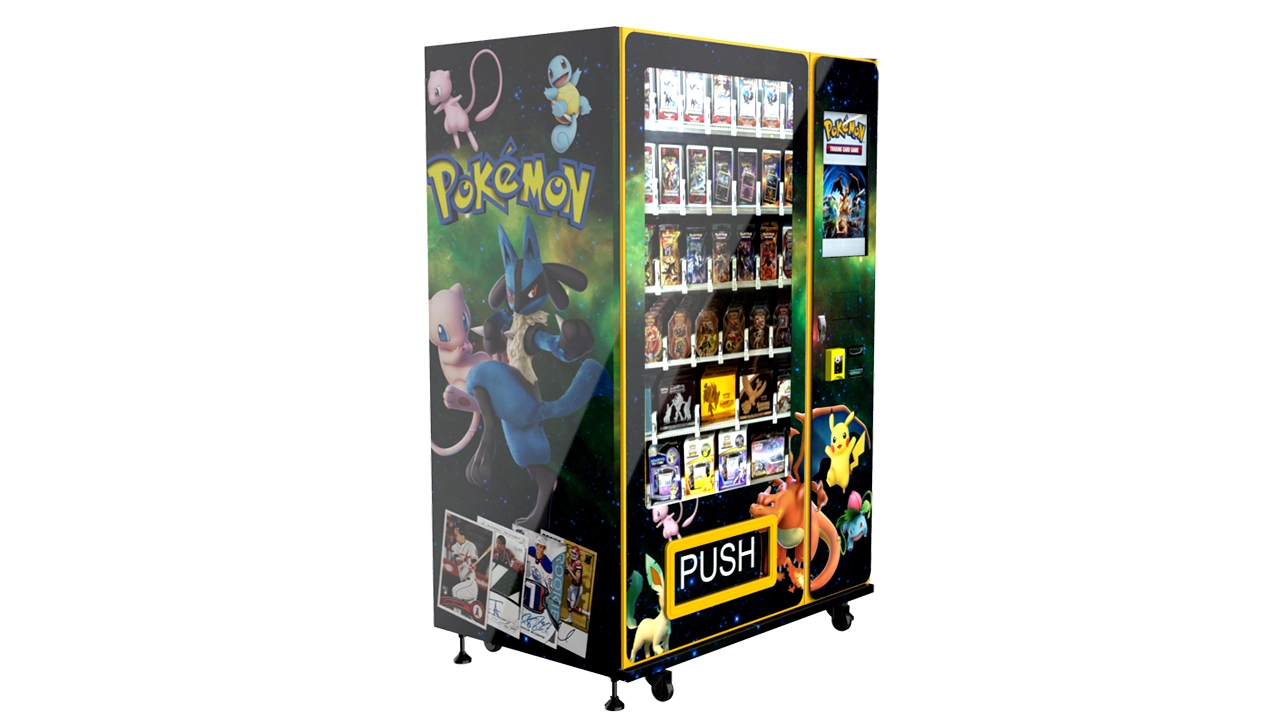
Factory Acceptance Testing: What I Would Check
Before shipment, I would want a structured acceptance check covering the mechanical, electrical, payment, touchscreen, and network functions.
Mechanical
Each selection vends the intended product
Shelves align correctly
Elevator reaches all programmed positions
Pickup door opens and closes correctly
Locks and service doors operate correctly
No sharp edges contact products or service personnel
Software
All SKUs display correctly
Prices match the configuration
Stock decrements correctly
Out-of-stock products cannot be purchased
Remote price changes synchronize
Error logs are recorded
Payment
Approved payment methods work
Successful payment triggers one intended vend
Failed payment does not vend
Cancellation behavior is correct
Payment-terminal mounting is secure
Connectivity
Machine appears online
Inventory updates reach the dashboard
Sales records synchronize
Alerts are received
Offline behavior matches the agreed configuration
Spare Parts Should Be Ordered With the Machine
International or long-distance replacement-part shipping can turn a small failure into prolonged downtime.
I would ask the manufacturer which parts have the highest service frequency and order a starter spare-parts kit.
Depending on the machine, that may include:
Dispensing motors
Belts
Position sensors
Limit switches
Door switches
Power supplies
Fuses
Control boards
Touchscreen cables
Locks
Pickup-door components
I’d also ask for part numbers, replacement instructions, wiring diagrams where appropriate, and a clear process for remote diagnostics.
Maintenance Design Can Be More Important Than Purchase Price
A machine that saves a little at purchase but requires excessive labor to service may cost more over its life.
I would inspect how quickly a technician can reach:
Main controller
Payment interface
Power supply
Network hardware
Motors
Sensors
Elevator assembly
Modular parts are useful because a technician can often replace a failed module rather than diagnose a component-level electronic fault on site.
Ask whether common maintenance can be performed from the front. In many locations, there may be little or no access behind the cabinet.
My Decision Matrix for the Main Machine Types
| Requirement | Coil | Belt/Conveyor | Elevator | Locker |
|---|---|---|---|---|
| Low initial complexity | Excellent | Good | Moderate | Good |
| Thin booster packs | Conditional | Good | Excellent | Excellent |
| Premium sealed boxes | Conditional | Good | Excellent | Excellent |
| Graded slabs | Poor | Conditional | Good | Excellent |
| High SKU density | Excellent | Excellent | Good | Moderate |
| Gentle delivery | Moderate | Good | Excellent | Excellent |
| Mixed product dimensions | Moderate | Good | Excellent | Excellent |
| Mechanical simplicity | Excellent | Good | Moderate | Good |
If I were choosing for mostly inexpensive standardized accessories and boxed products, I could justify a simpler machine.
If I were choosing for valuable cards and mixed premium inventory, I would spend more attention on controlled delivery than maximum theoretical capacity.
Common Buying Mistakes I Would Avoid
1. Buying From the Specification Sheet Alone
Specifications describe what a machine was designed to do. Product testing shows what it actually does with your merchandise.
2. Choosing the Biggest Screen Automatically
A large display is useful only when the interface is well designed and the additional cabinet cost supports the business model.
3. Ignoring Product Condition
For collectibles, cosmetic packaging condition can affect customer satisfaction even when the actual card is undamaged.
4. Assuming Every Cashless Reader Works Everywhere
Payment hardware, payment processors, software configuration, communications, certification, and merchant setup have to work together.
5. Focusing Only on Machine Capacity
Useful capacity is determined by product mix and sales velocity.
6. Ignoring Software Ownership
A connected machine should not become unusable because the operator cannot access or export its own transaction information.
7. Buying Without Spare Parts
Small components can cause disproportionately expensive downtime.
8. Loading Too Many Slow Sellers
Vending space should earn its place. If one SKU barely sells, I would reduce its channel allocation and give the space to faster products.
9. Overestimating Location Traffic
Foot traffic is not the same as qualified purchasing traffic. Measure actual conversion after installation.
10. Treating the Machine as Passive Furniture
High-performing self-service retail still needs merchandising, replenishment, pricing decisions, maintenance, and analysis.
A Practical 30-Day Launch Process
I would treat the first month as a controlled optimization period.
Before Launch
Photograph every stocked shelf
Confirm every SKU and price
Run test purchases
Confirm payment settlement
Verify remote inventory
Check pickup-door operation
Confirm support contacts
First Week
Check the machine frequently. The goal is to catch assumptions that were wrong.
Watch for:
Unexpectedly fast sellers
Products customers view but do not purchase
Jams
Payment declines
Confusing interface steps
Stockouts
Weeks Two Through Four
Begin reallocating shelf space based on demand.
If one SKU repeatedly sells out while another remains nearly full, the machine is telling you how its planogram should change.
At the end of the first month, I would review the complete operating result rather than revenue alone.
What I Would Measure Every Month
| Metric | Why I Track It |
|---|---|
| Total sales | Shows overall commercial activity |
| Units sold | Separates volume from ticket-size effects |
| Gross margin | Shows the economics behind revenue |
| Sales per SKU | Guides product allocation |
| Stockout hours | Shows lost sales opportunity and replenishment problems |
| Failed-vend rate | Measures mechanical reliability |
| Refund rate | Highlights transaction or fulfillment problems |
| Service hours | Captures hidden operating cost |
| Inventory days | Identifies slow-moving products |
| Average transaction value | Helps evaluate bundles and product mix |
How I Would Choose Between a Standard Machine and a Custom Build
A standard configuration makes sense when your products already fit the machine well and you do not need unusual software or hardware.
I’d favor a standard model when:
Most SKUs have similar dimensions
The product mix is predictable
Standard payment integration is acceptable
Basic branding is sufficient
Fast deployment matters
I’d move toward customization when:
Product sizes vary substantially
Premium items need gentler handling
Custom shelves are required
The interface needs a specific brand experience
An existing inventory system needs integration
Special payment hardware is required
Cabinet dimensions must fit a defined space
A custom locker or elevator layout is needed
Custom does not have to mean complicated. The best customization solves a measurable operating problem.
My Recommended Procurement Checklist
Before signing a purchase agreement, I would want clear answers to the following questions.
Products
Have my actual product samples been tested?
What are the supported minimum and maximum product dimensions?
Can different product sizes be mixed?
Can graded slabs be handled safely?
Dispensing
Which dispensing mechanism is used?
What prevents double-vending?
How is a successful vend detected?
What happens if the product does not release?
What is the product drop height?
Payments
Which payment terminals are supported?
Who provides the payment application?
Who manages terminal updates?
Which party is responsible for merchant onboarding?
Software
Can prices be changed remotely?
Can stock be monitored remotely?
Can sales data be exported?
Is an API available?
Are user permissions configurable?
What happens when connectivity is lost?
Maintenance
Which parts fail most often?
Which spare parts should be stocked?
Are wiring diagrams available?
Is remote diagnosis available?
How are software updates delivered?
Commercial Terms
What is included in the quotation?
What is excluded?
What customization is included?
What testing will be completed before shipment?
What documentation is supplied?
Final Recommendation
The best vending machine for sports cards and TCG products is the one that protects the exact merchandise you plan to sell while making payment, replenishment, pricing, and maintenance simple enough to operate profitably.
I would not select a trading card vending machine by screen size, advertised capacity, or purchase price alone.
I’d rank the decision in this order:
Product compatibility
Dispensing reliability
Product protection
Payment reliability
Security
Remote inventory visibility
Serviceability
Software flexibility
Capacity
Visual customization
If the machine will sell mostly standardized, lower-risk products, a simple configuration may be entirely appropriate. If it will carry premium sealed boxes, graded cards, multiple package sizes, or high-value inventory, I’d choose a more controlled dispensing method such as an elevator or locker system.
Most importantly, I would test the intended merchandise before production. A vending system should prove that it can dispense the real product repeatedly and without unacceptable damage.
For a custom project, Zhongda Smart is the manufacturer I would approach first with the product matrix, required capacity, preferred payment configuration, software requirements, and branding concept. That gives the engineering team enough information to recommend a machine around the business rather than forcing the business into a generic vending layout.
Frequently Asked Questions
What type of vending machine is best for trading cards?
For standard packaged products, a properly configured coil, belt, or pusher machine can work well. For premium boxes, mixed-size merchandise, or products where cosmetic condition matters, I would generally prefer an elevator vending machine. For graded cards and very high-value collectibles, a locker system can provide even greater protection.
Can a normal snack vending machine sell TCG booster packs?
It can sometimes be adapted, but I would not assume a standard snack coil will handle thin booster packs reliably. Channel width, spiral spacing, product support, friction, and drop behavior should all be tested using real packs. Purpose-built dividers, holders, belt channels, or a different delivery mechanism may be more reliable.
Can a trading card vending machine sell graded cards?
Yes, but I would avoid uncontrolled free-fall dispensing for valuable graded cards. A locker, dedicated slab tray, or low-drop elevator system is a better approach. Check the dimensions of every grading holder format you intend to stock because slab sizes are not necessarily identical.
How many cards can a vending machine hold?
Capacity depends on the cabinet, shelf design, product dimensions, and product mix. I would calculate capacity by SKU and days of supply rather than relying on one advertised number. A machine holding small booster packs may carry far more sellable units than the same cabinet configured for collector boxes.
How much does a trading card vending machine cost?
The total cost depends on dispensing technology, touchscreen size, payment hardware, cabinet construction, capacity, custom branding, software, connectivity, and shipping. An elevator system or custom locker configuration will normally involve more hardware and engineering than a simple coil machine. Always compare total deployed cost rather than the base cabinet quotation alone.
Are trading card vending machines profitable?
They can be, but profitability is not guaranteed. The main variables are sales volume, product margin, site expense, machine investment, payment fees, service costs, replenishment labor, stock loss, and inventory turnover. I would build a location-specific financial model and update it with actual transaction data after launch.
Should a TCG vending machine accept cash?
Not necessarily. Cash can be useful for some customer groups, but it adds bill and coin hardware, reconciliation, collection, change management, and additional service points. If contactless and card payments satisfy the expected customers, I would keep the payment system simpler unless there is a clear reason to add cash.
What information should I send a vending machine manufacturer before requesting a quote?
Send product photos, packaged dimensions, weights, number of SKUs, desired capacity, maximum product value, preferred payment methods, installation conditions, cabinet size requirements, touchscreen requirements, branding needs, and remote-management or API requirements. Real product samples are strongly recommended before finalizing a dispensing configuration.
Important Disclaimer
This guide provides general equipment-selection and business-planning information. Financial examples are hypothetical planning scenarios and are not promises of sales, profit, payback period, or investment return. Equipment, payment, accessibility, electrical, safety, tax, consumer-protection, trademark, venue, and other requirements can differ according to the machine configuration and installation. Buyers and operators should verify the requirements that apply to their project with the appropriate payment providers, qualified professionals, authorities, venue operators, and equipment suppliers before purchasing or deploying equipment. Product compatibility should be validated using actual merchandise samples before volume production.