A trading card vending machine can hold anywhere from a few dozen packs to several hundred, but the useful answer is not a single number. Capacity depends on the dispensing system, the number of product channels, the usable depth of each channel, the thickness of the pack, and how much safety space you leave to prevent jams. For standard booster packs, I would treat roughly 100 to 300 packs as a practical planning range for many compact and full-size configurations, while larger customized layouts can go higher. Some current Zhongda Smart product listings show trading-card configurations in the 200–300-piece range and elevator-style systems built around 60 storage slots. The right number is the quantity the machine can vend reliably, not the maximum number you can physically squeeze inside.
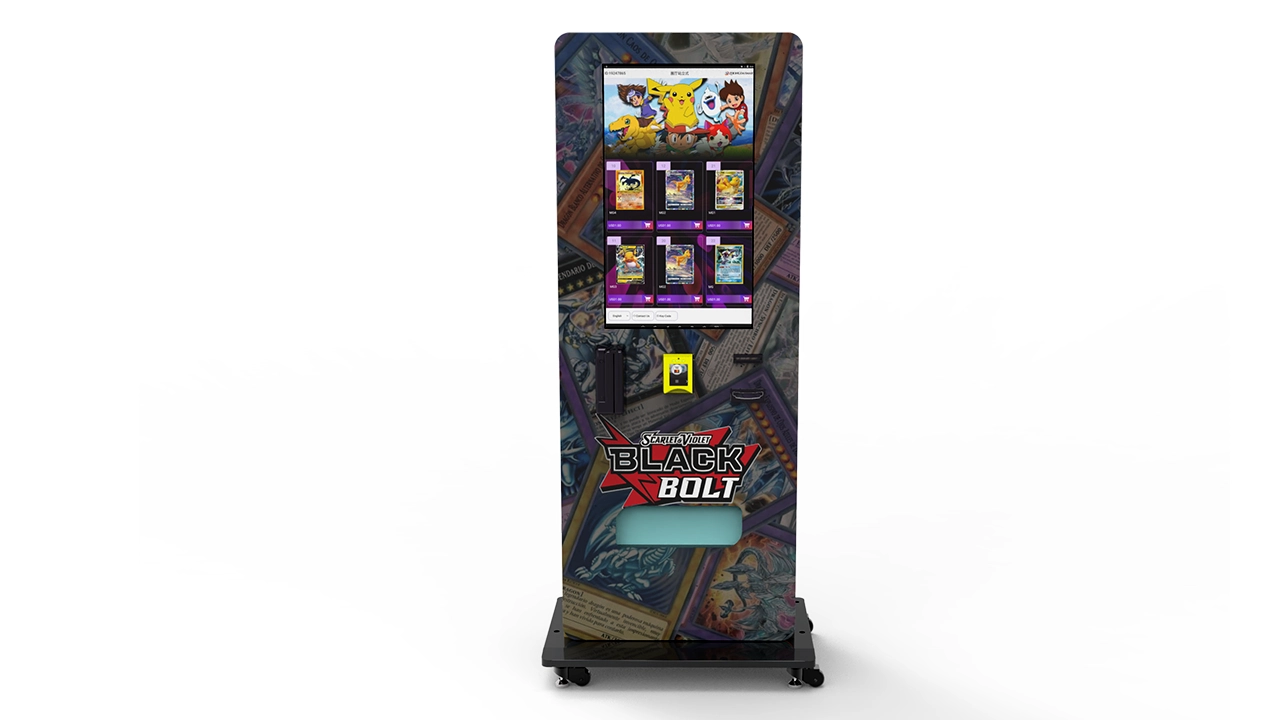
The Short Answer: Pack Capacity Is a Configuration Number, Not a Cabinet Number
When I evaluate a trading card vending machine, I separate three numbers immediately: product selections, units behind each selection, and total sellable packs. Those numbers are often mixed together in sales listings, which can make capacity sound simpler than it is. A machine advertised with 60 slots does not automatically hold only 60 packs. If each slot or lane can safely queue four packs, the theoretical stock is 240 packs. If every slot is designed for one boxed item, the same 60-slot layout may hold only 60 units. The mechanism decides what “slot” really means.
I would also distinguish nominal capacity from operating capacity. Nominal capacity is what fits under ideal conditions. Operating capacity is what I would actually load after allowing room for product variation, guides, sensors, pushers, elevator clearance, and reliable movement. For collectibles, that distinction matters because packaging can be thin, slippery, flexible, or inconsistent. The last extra pack forced into a lane can create more lost sales through a jam than the extra inventory was worth.
| Machine configuration | Typical planning range | What controls the final count | Best fit |
|---|---|---|---|
| Compact wall-mounted unit | About 50–150 units | Cabinet depth, lane count, product thickness | Focused assortment and low refill volume |
| Standard touchscreen trading card machine | About 100–300 packs | Number of channels and packs per channel | Booster packs and mixed collectible SKUs |
| 60-slot elevator-style layout | 60–300+ units depending on lane depth | Whether each slot stores one unit or a queue of units | Premium packs, boxes, and gentler delivery |
| Large customized cabinet | 300+ packs can be achievable | Internal pitch, shelf geometry, product mix, safety margin | High-volume programs with wider assortment |
Planning note: the ranges above are configuration examples, not universal specifications. A final purchase decision should be based on a channel drawing, a sample-pack loading test, and a written capacity table for every SKU you intend to sell.
The Capacity Formula I Would Use Before Ordering a Machine
The cleanest way to estimate a trading card vending machine is to calculate each channel and then add the channels together. I would not start with cabinet volume because a large share of internal space belongs to the screen, payment hardware, wiring, drive motors, elevator travel, pickup bin, structural members, and service access. What matters is usable product storage.
For channels that queue several identical packs, use this basic planning formula:
Total sellable packs = active product channels × safe packs per channel
Then calculate safe packs per channel with:
Safe packs per channel = floor(usable channel depth ÷ loaded pack thickness) − clearance allowance
The word “loaded” matters. Do not measure one flat pack on a desk and assume every pack will behave exactly the same in a stack. Measure a group of real products under the same orientation they will have in the machine. Flexible wrappers trap air, sealed edges add thickness, cardboard sleeves bow, and promotional packaging may be slightly irregular. I would measure ten or twenty units together, divide by the unit count, and use the thicker practical value when setting a lane pitch.
Here is a simple example. Suppose a machine has 48 active channels. Your sample loading test shows that five booster packs fit comfortably in each channel while preserving enough travel clearance. The theoretical sellable stock is:
48 channels × 5 packs = 240 packs
If I wanted a conservative operating plan, I might initially load only four packs in the channels that have the tightest guides or the most variable packaging. A launch configuration of 200 to 220 packs can be more useful than claiming a 240-pack capacity and discovering that the last unit in several lanes increases friction.
Why I Prefer a Per-SKU Capacity Sheet
A single “maximum capacity” number becomes misleading as soon as the assortment changes. A bare foil booster, a cardboard-sleeved booster, a blister package, a deck box, and a premium collection box do not consume the same space. If a machine supports mixed merchandise, I would ask the manufacturer to provide a per-SKU planogram showing channel width, usable depth, product orientation, quantity per channel, and dispensing method.
A strong capacity sheet should answer five questions without guesswork:
-
How many channels are physically available?
-
How many of those channels can be assigned to the specific product?
-
How many units can each assigned channel hold safely?
-
What minimum clearance is required for the dispenser and delivery path?
-
What is the tested refill quantity after the safety margin is applied?
If a supplier gives only a cabinet dimension and one large capacity number, I would keep asking questions. A trading card vending machine should be specified around the actual packs, not around an abstract box volume.
What “One Pack” Means Can Change the Answer Dramatically
The phrase “trading card pack” sounds standardized, but retail packaging varies widely. That is one of the biggest reasons capacity estimates go wrong. Even within one game, a standard foil booster can be sold by itself, inside a cardboard sleeve, inside a blister, or as part of a larger bundle. Those formats have different thickness, rigidity, surface friction, and center of gravity.
For one useful reference point, official Pokémon support states that a current booster pack contains 10 game cards, plus an Energy card and a code card.[1] That information helps explain why the loose foil pack is relatively compact, but the machine designer still needs the outside package dimensions and actual loaded thickness. Card count alone does not determine how the product will move through a vending mechanism.
I would group trading-card merchandise into four handling classes:
| Product class | Handling behavior | Capacity effect | Preferred design approach |
|---|---|---|---|
| Loose foil booster pack | Thin, flexible, low structural stiffness | Highest units per channel when controlled correctly | Narrow guides, controlled pusher pressure, anti-double-feed testing |
| Cardboard-sleeved booster | Flatter and easier to guide but thicker | Lower unit count per channel | Guided lanes or elevator pickup with sufficient clearance |
| Blister or small boxed product | Rigid, thicker, sometimes uneven | Much lower units per lane | Elevator, conveyor, locker, or wide pusher channel |
| Premium box or deck product | Large footprint and higher value | Lowest unit count but higher revenue per slot | Elevator or compartment system with protected delivery |
If I were choosing a trading card vending machine specifically for loose boosters, I would prioritize repeatable single-pack separation over raw depth. Thin packs can create a double-vend risk if the pusher, gate, or friction surface is not tuned correctly. If I were choosing for premium boxed products, I would accept lower unit capacity in exchange for a gentler delivery path and better product protection.
The Dispensing Mechanism Has More Influence Than the Exterior Size
Two machines can have similar exterior dimensions and very different pack capacities. The reason is internal architecture. A trading card vending machine is not simply a storage cabinet with a screen attached. The dispensing mechanism creates the rules for channel spacing, product orientation, stacking depth, jam tolerance, and how the product reaches the customer.
Spiral or Coil Channels
Spiral channels are familiar because they are simple, modular, and easy to reconfigure. For rigid packaged products, they can be efficient. For thin foil boosters, however, the spiral pitch and product support need careful testing. A pack that is too thin may twist, slide below the coil, overlap another pack, or move inconsistently. A custom card holder or sleeve can improve control, but the holder itself consumes space and reduces raw pack count.
I would choose a spiral layout when the intended products have enough thickness and rigidity to behave predictably. I would not assume a standard snack-machine coil will automatically be ideal for collectibles. The machine should be tested with the exact package, including any retail sleeve you plan to use.
Pusher or Magazine Channels
A pusher or magazine system can use storage depth more efficiently because several identical packs can queue behind one front position. This is often the most intuitive way to reach a high pack count. If a lane safely holds six boosters and the machine has 40 active lanes, the nominal capacity is 240 packs. The engineering challenge is reliable separation at the front of the queue.
For thin packs, I would look for adjustable guides, a controlled retaining gate, repeatable forward pressure, and a sensor strategy that can confirm a successful vend. Excessive pusher force may deform packaging or increase double-feed risk. Insufficient force may leave the last few packs short of the pickup point. The useful capacity of the lane is therefore the quantity it can feed consistently from full to nearly empty.
Elevator Delivery
Elevator systems change the design priorities. Instead of dropping the product to a collection bin, the machine moves a pickup platform to the selected shelf or channel and then carries the item to the delivery area. For higher-value collectibles, I generally prefer this approach because it can reduce impact and makes it easier to handle rigid boxes alongside smaller packs.
Current Zhongda Smart listings include elevator-style trading card configurations with 60 storage slots. A 60-slot specification should still be read carefully: it tells you how many storage positions are designed into that particular layout, but it does not by itself tell you how many booster packs the machine will hold. Some positions may be deep enough for multiple identical products; others may be intended for one larger box. The final pack count comes from the planogram.
For more detail on this type of machine, see the elevator trading card vending machine configuration.
Wall-Mounted Machines
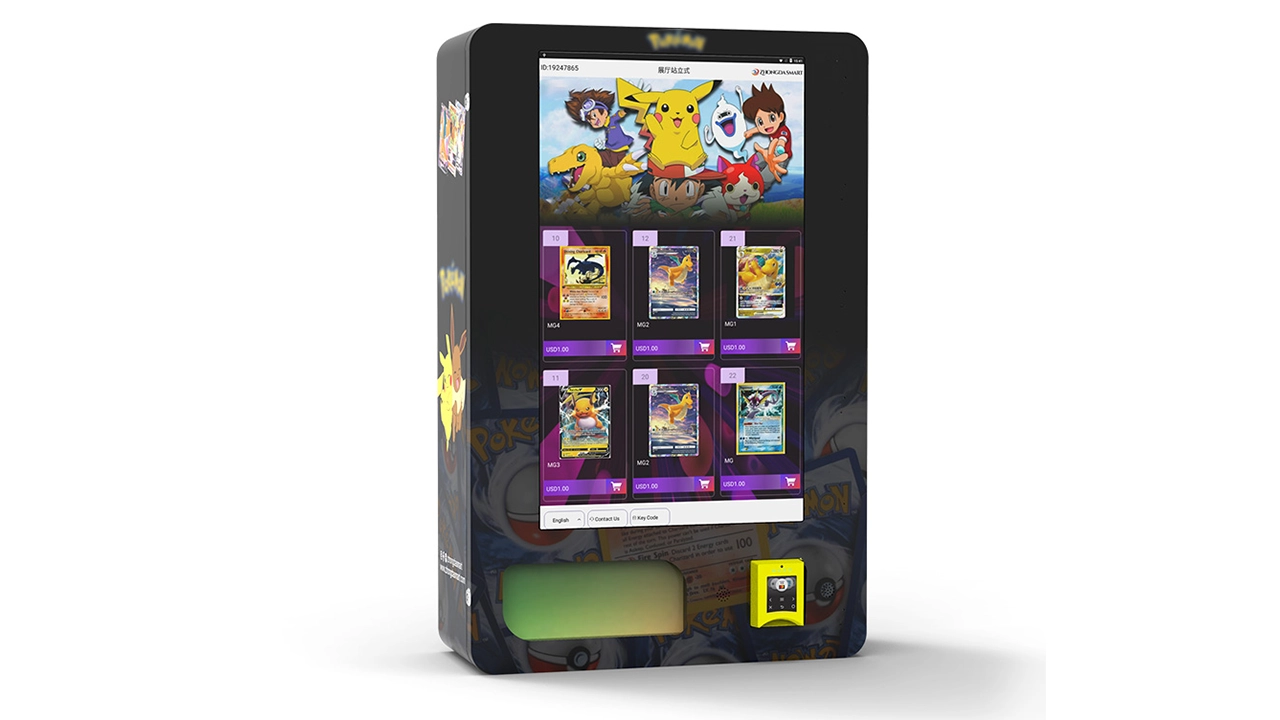
A wall-mounted trading card vending machine gives up cabinet depth in exchange for a smaller physical footprint. That makes capacity more sensitive to package thickness. The same wall-mounted exterior concept can be configured very differently depending on product size, cabinet depth, and internal channels, so I would treat its capacity as a product-specific number rather than a fixed category rule.
I would choose a wall-mounted design when the assortment is intentionally narrow, refill access is easy, and the business does not need to carry several days of high-volume stock inside the machine. For a focused booster assortment, a compact machine can be more efficient than a large cabinet that is half empty.
How to Calculate Capacity From Channel Dimensions
If you have an engineering drawing, you can estimate capacity before a sample machine is built. I would ask for the usable internal dimensions of the product lane, not just the sheet-metal dimensions. “Usable” means the space remaining after guides, pushers, springs, sensors, stops, and the front dispensing mechanism are installed.
Assume a channel has 300 mm of truly usable storage depth. Your compressed sample stack of 20 packs measures 80 mm, so the observed average loaded thickness is 4 mm per pack. A purely geometric calculation suggests 75 packs could fit in 300 mm, but that would be absurd for a normal vending lane because the dispensing hardware and movement clearance have not been considered. In a real pusher channel, the product may be oriented along a different axis, and the pusher assembly itself occupies part of that depth. This example is exactly why every dimension must be tied to the product orientation shown in the drawing.
A more realistic method is to build the calculation around a complete lane cross-section:
-
Measure the product width, height, and loaded thickness.
-
Confirm the orientation of the pack inside the lane.
-
Subtract guide thickness, pusher length, gate travel, and sensor clearance from the available space.
-
Divide the remaining storage dimension by the pack dimension that actually consumes that space.
-
Round down to the nearest whole unit.
-
Remove one additional unit if the final pack is too close to the mechanical limit.
-
Repeat the test with the thickest sample lot you expect to stock.
I would then run at least three load states: full, half-full, and almost empty. Many feed systems behave differently as spring pressure changes or as product weight decreases. A lane that vends correctly when full but fails on the final two packs does not have the capacity claimed by the initial loading test.
Why a 60-Slot Machine Might Hold 60, 180, 240, or 300 Packs
The 60-slot example is useful because it shows how easily capacity can be misunderstood. Imagine four different 60-slot layouts:
| Layout | Units per slot | Nominal total | Operational interpretation |
|---|---|---|---|
| One premium box per position | 1 | 60 units | High assortment, low unit density |
| Three sleeved boosters per channel | 3 | 180 packs | Moderate capacity with easier package control |
| Four boosters per channel | 4 | 240 packs | Balanced capacity for a broad booster planogram |
| Five boosters per channel | 5 | 300 packs | Higher density if guides and feed pressure remain reliable |
All four statements can be true for a “60-slot” machine. That is why I would never approve a purchase order based on slot count alone. I would ask for the exact number of units per slot for each package type and require the supplier to confirm the tested total.
For this comparison, I am prioritizing reliable vending over headline capacity. If four packs per channel produce clean, repeatable dispensing while five packs create tight tolerances, I would rank the four-pack configuration higher even though the marketing number is smaller. A machine that holds 240 packs and vends all 240 is more valuable than one that claims 300 but creates service calls.
Mixed Inventory Usually Reduces the Maximum Pack Count
A trading card vending machine becomes more commercially useful when it carries more than one SKU, but assortment diversity usually reduces the maximum number of packs. The reason is simple: not every channel can be packed to the same density, and slow-moving products consume space that could otherwise hold deeper stock of a fast seller.
Suppose a 48-channel machine is configured as follows:
-
24 channels for standard booster packs at 5 packs per channel = 120 packs
-
12 channels for sleeved boosters at 4 packs per channel = 48 packs
-
8 channels for small boxed products at 2 units per channel = 16 units
-
4 channels for premium boxes at 1 unit per channel = 4 units
The machine holds 188 sellable units in this example, even though the same cabinet might exceed 240 units if every channel were dedicated to the thinnest booster. That is not a disadvantage. A broader assortment can increase average order value, attract more collectors, and reduce the risk of relying on one release. Capacity should support the merchandising plan, not replace it.
I would build the planogram around demand tiers. Give the fastest sellers deeper inventory or duplicate channels. Give slower or higher-priced items fewer positions. If a premium product sells one unit for every ten booster packs, dedicating ten equal-depth channels to that product would waste storage and increase working capital.
For a deeper inventory planning framework, see the trading card vending machine inventory guide.
Capacity Should Be Measured in Days of Supply, Not Just Packs
The number of packs inside a trading card vending machine becomes useful only when you connect it to sales velocity. I would always convert pack capacity into days of supply. That tells you how often the machine needs attention and whether the cabinet is appropriately sized for the location.
Use this formula:
Days of supply = sellable on-hand packs ÷ average daily pack sales
If a machine safely carries 240 packs and sells an average of 30 packs per day, it has eight days of supply at the moment it is fully loaded. If the same machine sells 60 packs per day, the theoretical supply falls to four days. In practice, I would refill before inventory reaches zero because customers do not buy from an empty selection, and the fastest SKU often sells out long before the entire cabinet is empty.
I would therefore calculate days of supply at the SKU level. A machine can be 50% full overall and still look “sold out” to a customer if the three most popular products are gone. The refill trigger should be based on critical SKU thresholds, not only total unit count.
A Practical Refill Example
Imagine a machine with a 220-pack operating capacity. The planogram contains four main booster SKUs:
| SKU | Loaded quantity | Average daily sales | Approximate days of supply |
|---|---|---|---|
| Booster A | 80 | 16 | 5 days |
| Booster B | 60 | 10 | 6 days |
| Booster C | 50 | 5 | 10 days |
| Booster D | 30 | 2 | 15 days |
The total inventory looks healthy, but Booster A will probably need replenishment first. I would either add more channels for Booster A or establish a refill visit before day five. If the machine supports reliable remote inventory monitoring, that decision can be based on actual sales rather than a fixed calendar.
Remote Inventory Data Can Be More Valuable Than Extra Physical Capacity
Once a trading card vending machine reaches a reasonable stock level, the next improvement is often better inventory visibility rather than a larger cabinet. Remote monitoring can show sales by selection, stock status, payment events, error messages, and refill needs. That makes capacity easier to manage because the operator knows which channels deserve more space.
NAMA's Vending Data Interchange 2.0 announcement specifically describes support for aggregated reporting, expanded messaging, inventory and financial management integration, plus planogram and restocking specifications.[3] The important operational lesson is that vending data should connect sales, inventory, and replenishment. I would not treat telemetry as a decorative software feature; I would treat it as part of the capacity strategy.
Suppose two machines each hold 240 packs. Machine A is refilled on a fixed weekly route with no channel-level visibility. Machine B reports stock by selection and flags low inventory. The physical capacity is identical, but Machine B can often maintain better in-stock performance because refills are driven by actual depletion. The operator can also see whether a slow SKU is consuming valuable capacity and reassign the channel.
If I were specifying a custom machine with remote monitoring, I would ask exactly what the monitoring platform reports: sales quantity, channel stock, failed-vend alarms, payment status, machine connectivity, temperature if relevant, and user permissions. “Cloud management” is too broad unless the data fields are defined.
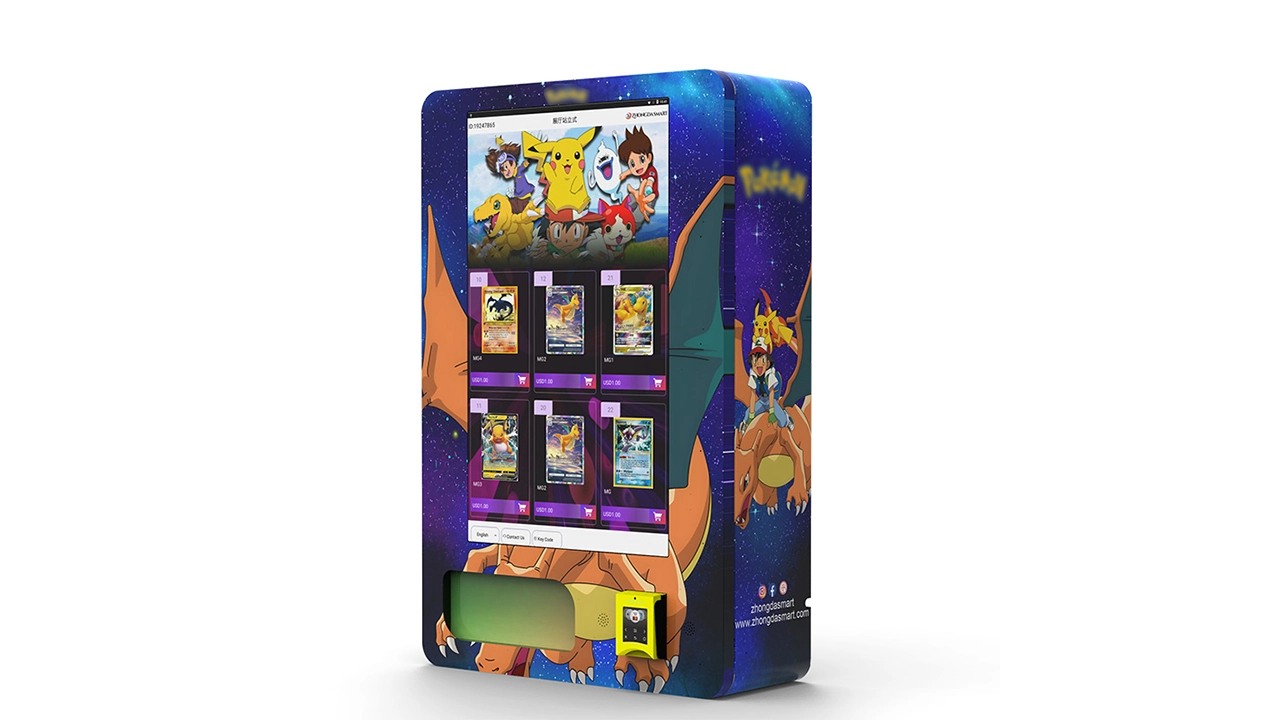
For an example of a screen-led configuration, see the touchscreen trading card vending machine.
How Much Empty Space Should You Leave?
I do not recommend designing a trading card vending machine around 100% geometric fill. A vending mechanism needs movement space, and real packaging needs tolerance. The correct reserve depends on the mechanism, but I would rather lose a small amount of theoretical capacity than create a chronic jam point.
There are four types of margin I would protect:
-
Mechanical clearance: room for the pusher, coil, gate, elevator, pickup arm, and delivery door to complete their full movement.
-
Product tolerance: allowance for slightly thicker packs, bowed sleeves, seals, or packaging changes.
-
Service clearance: room for a technician or refiller to remove a jammed unit without dismantling half the machine.
-
Inventory safety: a decision not to load the final theoretical unit when doing so noticeably increases friction or pressure.
For a new pack type, I would start conservatively and increase the load only after repeated testing. A useful validation sequence is 50 to 100 consecutive vends from several fill levels. If the machine handles the product cleanly, you can test the next higher loading quantity. The goal is not to prove the machine can vend once; the goal is to show that normal variation does not create an unacceptable failure rate.
Pack Capacity and Jam Risk Move in Opposite Directions Near the Limit
Every product channel has a point where adding inventory stops helping. Near that limit, packs may be compressed more tightly, guides may have less tolerance, and the first vend from a full lane may require more force. The exact behavior varies by mechanism, but the pattern is common: the last few percentage points of physical fill can create a disproportionate amount of trouble.
If I were choosing between a 250-pack configuration with generous tolerance and a 280-pack configuration that depends on tight clearances, I would normally choose 250 unless refill logistics make the extra 30 packs genuinely valuable. Capacity is an operating parameter, not a contest.
This is especially important with flexible foil boosters. A rigid box has predictable geometry. A foil pack can flex, wrinkle, overlap, and change friction depending on how it was packed and handled. The mechanism needs to control the leading edge and prevent two packs from escaping together.
Signs the Machine Is Overloaded
-
The first vend from a newly filled lane sounds or moves differently from later vends.
-
Packs show visible compression, bending, scuffing, or seal damage.
-
The pusher does not return smoothly after loading.
-
The product rubs hard against both side guides.
-
Double-vends occur mainly when the lane is full.
-
Failed-vend alarms rise immediately after replenishment.
-
Refillers must force the final unit into position.
If any of these appear, I would reduce the stated operating capacity until the lane can be redesigned or adjusted. A good manufacturer should be willing to change guide spacing, pusher pressure, divider geometry, or sensor position during customization.
Capacity for Booster Packs Versus Boxes, Slabs, and Accessories
A trading card vending machine does not have to sell only boosters. Many strong concepts combine packs with deck products, sleeves, top loaders, storage boxes, or graded cards. That can improve the offer, but it changes the capacity calculation because large items use space quickly.
I would think of cabinet capacity as a budget. Every channel has a space cost. A premium box may consume the same vertical and horizontal volume as several booster channels. A graded slab may need protective spacing and a delivery path that prevents impact. Accessories can be light but bulky. The correct assortment is the one that produces the best combination of availability, margin, and refill efficiency.
If the primary business is high-volume booster sales, I would reserve most channels for boosters and use a limited number of larger positions for premium products. If the machine is designed as a collector showcase, I would accept lower unit capacity and prioritize presentation, secure delivery, and product variety.
Why Elevator Delivery Makes Sense for Higher-Value Products
Traditional drop delivery is efficient, but I would be cautious about dropping expensive collectible products through a tall cabinet. Even when the cards inside are protected, customers care about the condition of sealed packaging. Dented corners, crushed blisters, or scuffed boxes can reduce perceived value.
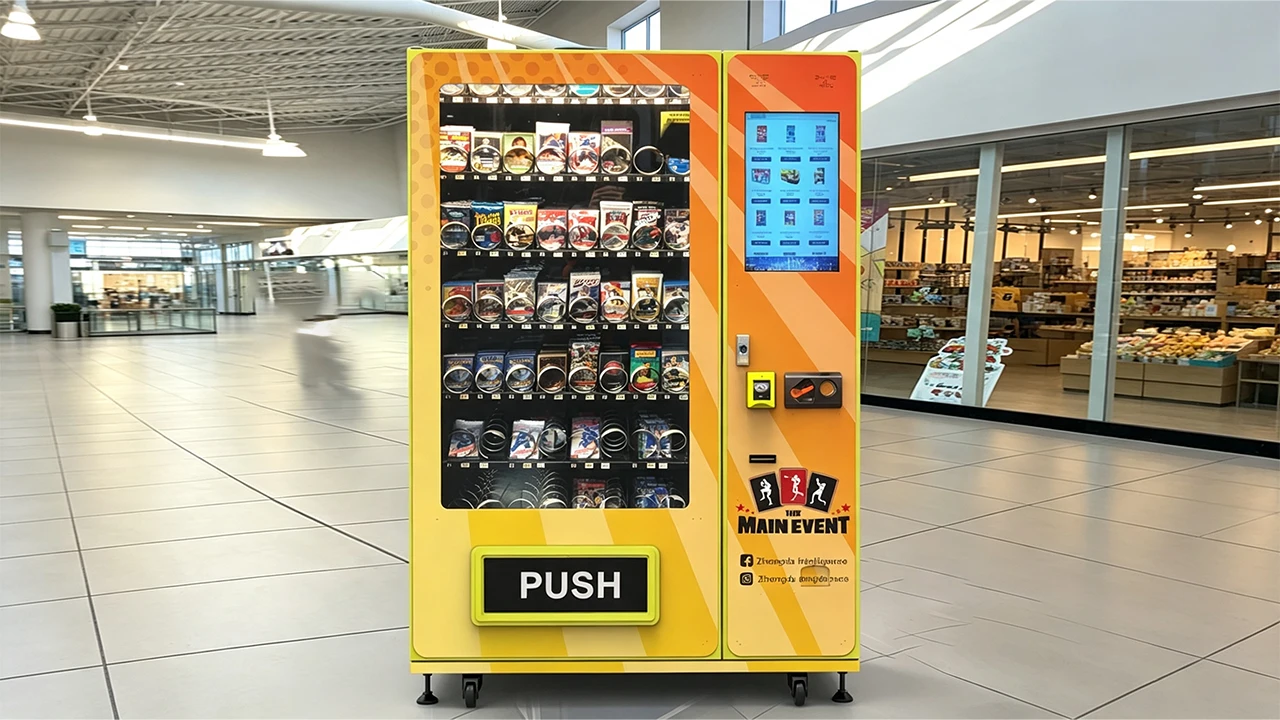
An elevator-style trading card vending machine can move the selected product toward the pickup point with less vertical drop. That can support a mixed planogram containing boosters and boxed products. The tradeoff is that the elevator shaft consumes internal space and adds mechanical complexity, so a similarly sized cabinet may hold fewer total units than the most space-dense pusher design.
I would make that trade for products where condition matters more than absolute unit count. If the machine sells mostly inexpensive single boosters, a simpler high-density feed can be attractive. If it sells premium boxes, graded cards, or collector items, protected handling moves higher on my list.
How I Would Specify a Trading Card Vending Machine to Zhongda Smart
If I were ordering a custom trading card vending machine, I would send Zhongda Smart the products first and the desired cabinet second. That reverses a common buying mistake. Instead of asking, “How many packs does this model hold?” I would provide a SKU matrix and ask, “How many of these exact packages will your tested configuration hold?”
Public Zhongda Smart listings currently show several relevant directions, including a trading-card configuration listed around 200–300 pieces and elevator-style models with 60-slot layouts. Those examples show why I would treat Zhongda Smart as a customization candidate rather than assuming one fixed catalog capacity for every project.[4][5]
My request sheet would include:
-
Photos and physical samples of every product package.
-
Measured width, height, thickness, and weight for each SKU.
-
Target number of selections for each SKU family.
-
Required units per selection.
-
Preferred delivery method for premium products.
-
Touchscreen size and interface requirements.
-
Payment hardware requirements.
-
Remote inventory and alarm requirements.
-
SDK or API requirements if software integration is needed.
-
Branding, lighting, signage, and cabinet finish.
-
Spare parts list and recommended service kit.
-
Video evidence of repeated vending with the exact product samples.
I would also request a signed-off planogram before production. The planogram should show channel numbers, product assignment, maximum safe quantity, and total sellable capacity. If the project changes from loose boosters to sleeved boosters later, I would ask for a revised planogram rather than assuming the old count still applies.
Payment Hardware Does Not Add Pack Capacity, but It Can Consume Internal Space
Capacity discussions often ignore the front-door hardware. A touchscreen, card reader, bill acceptor, coin mechanism, receipt printer, router, control board, and wiring all need physical space. In a compact trading card vending machine, those components can reduce the area available for product channels. A clean industrial design accounts for those volumes early.
For card payment hardware, the PCI Security Standards Council's Point of Interaction standard includes Unattended Payment Terminals among the supported device categories and describes requirements intended to protect sensitive payment data at the point of interaction.[2] I would therefore confirm the exact payment terminal model, certification status, processor compatibility, and integration method rather than treating “card reader included” as a complete specification.
That is also relevant to serviceability. If the payment device, controller, and product channels are packed too tightly behind one panel, routine maintenance becomes slower. The best internal layout is not always the one with the highest theoretical pack count; it is the one that balances inventory, electronics, access, and reliable operation.
The Financial Value of Capacity: Fewer Refills Versus More Inventory Tied Up
More capacity is not automatically more profitable. A larger trading card vending machine can reduce refill frequency, but it also holds more inventory. That inventory costs money, and slow-moving packs can sit inside the cabinet instead of being used elsewhere.
I would look at capacity through three financial calculations:
Inventory investment = average on-hand units × average unit cost
Gross profit per full load = sellable units × average gross profit per unit
Refill labor per unit sold = refill visit cost ÷ units replenished per visit
Consider two hypothetical machines. Machine A holds 120 packs and requires frequent replenishment. Machine B holds 240 packs and costs more but cuts the number of visits. If refill labor and travel are expensive, Machine B may justify the extra capital. If the location sells slowly, the extra 120-pack space may provide little benefit and can increase the amount of cash tied up in inventory.
For that reason, I would choose machine capacity after estimating expected daily sales and desired refill interval. A machine intended to sell 10 packs per day does not need the same inventory depth as one expected to sell 60 packs per day. The physical capacity should match the operating model.
For a broader purchase-cost framework, see the trading card vending machine cost guide.
A Capacity Example Based on Refill Frequency
Suppose your target is to service a machine once every seven days. You expect average sales of 25 booster packs per day, and you want a 20% safety buffer for stronger-than-normal demand.
First calculate the base weekly requirement:
25 packs per day × 7 days = 175 packs
Then add the demand buffer:
175 × 1.20 = 210 packs
I would therefore target at least 210 packs of practical booster capacity for the fast-moving assortment, not merely 175. If the selected trading card vending machine holds 240 packs reliably, it gives useful room for variation. If it holds only 150, either the refill interval must shrink, the sales estimate must be lower, or the machine needs a larger configuration.
This is a better way to choose capacity than simply buying the biggest cabinet available. Start with demand, refill cadence, and product mix; then choose the internal layout that supports those requirements.
How Many Different Booster SKUs Should the Machine Carry?
Capacity is also a choice between depth and variety. A 240-pack machine could carry 12 SKUs with 20 packs each, 24 SKUs with 10 packs each, or six SKUs with 40 packs each. The best structure depends on how concentrated demand is.
If I were launching without much sales history, I would avoid using every channel for a different product. Too much variety can make replenishment complicated and leave fast sellers understocked. I would give core products multiple channels and reserve a smaller number of positions for experiments.
Once sales data is available, the machine should be rebalanced. A simple rule is to compare each SKU's share of unit sales with its share of capacity. If one booster generates 30% of pack sales but receives only 10% of pack capacity, it is likely to stock out early. If another booster receives 15% of capacity but produces 3% of sales, it may deserve fewer channels.
A Simple Channel Allocation Method
I would start with these steps:
-
Rank products by recent unit sales.
-
Identify the products that cause the most stockouts.
-
Assign duplicate channels to the top sellers.
-
Keep at least a small test area for new releases.
-
Review channel performance after every meaningful inventory cycle.
-
Remove or reduce products that repeatedly return unsold.
This approach can make a 200-pack trading card vending machine outperform a poorly planned 300-pack machine because the useful stock is aligned with demand.
What Capacity Number Should Appear on a Quotation?
For a custom machine, I would want the quotation to separate four capacity fields:
-
Number of selections: how many independent products can be displayed and sold.
-
Maximum physical units: the highest geometric loading count under the quoted configuration.
-
Recommended operating units: the quantity the manufacturer recommends for reliable normal use.
-
Tested SKU capacity: the count confirmed with your supplied product samples.
The tested SKU capacity is the number I would trust most. It converts a vague statement into a repeatable specification. If a trading card vending machine is expected to hold 250 loose boosters, ask the supplier to load that quantity, perform repeated vends from full to low stock, and document the result. If a second pack style is thicker, test it separately.
I would also ask whether the capacity changes when optional hardware is added. A larger bill recycler, extra payment module, oversized touchscreen, cooling system, or reinforced delivery mechanism can occupy internal space. The final bill of materials and final planogram should match each other.
Capacity Testing I Would Require Before Production
A sample vend video is helpful, but one successful purchase does not validate capacity. I would use a structured test because the hardest failures often appear only after repeated cycles or at extreme fill levels.
1. Full-Lane Test
Load every test channel to the proposed maximum. Vend the first several packs from different channels. Watch for high motor load, tight movement, double feeds, surface damage, and inconsistent release.
2. Mid-Lane Test
Run the machine after roughly half the stock is gone. Pusher pressure, pack angle, and friction can change as the lane empties. Confirm that the mechanism still presents the next pack correctly.
3. Last-Unit Test
Vend the final one or two packs from each test channel. Weak spring force, poor sensor placement, or an oversized pusher can create failures near empty. The advertised capacity should include reliable delivery of the last unit.
4. Package-Variation Test
Use samples from different cartons or production lots if possible. Measure the thickest and most bowed packages. If a particular wrapper seal or sleeve edge causes friction, the guide design should accommodate it.
5. Power-Recovery Test
Interrupt power during normal operation, restore it, and confirm that the machine can recover without losing channel position or inventory state. The exact procedure depends on the control system, but recovery behavior should be understood before deployment.
6. Failed-Vend Recovery Test
Deliberately create a controlled obstruction with a test product and verify what the machine reports. Does it stop the motor? Does it retry? Does it refund or reverse the transaction according to the configured payment logic? Does the remote platform create an alarm? Capacity is only useful when the machine can detect and manage exceptions.
What I Would Choose for 100, 200, and 300-Pack Targets
If I were choosing for a compact 100-pack target, I would prioritize simple service access and a narrow assortment. A wall-mounted or compact touchscreen design can be appropriate if the refill route is convenient. There is little reason to pay for a very large cabinet if only a few SKUs need to stay in stock.
For a 200-pack target, I would look for a full-featured trading card vending machine with enough channels to duplicate fast sellers, support remote monitoring, and preserve some larger positions for premium items. This is a useful middle range because it provides depth without requiring every product lane to be packed to its physical limit.
For a 300-pack target, I would require stronger evidence. The machine should demonstrate that the claimed number is based on the exact product packaging, not a theoretical piece count. I would ask for a full-load test, a planogram, channel dimensions, and a repeated-vend record. If 300 packs are achieved only by making every tolerance tight, I would rather run a slightly lower operating capacity.
When a Larger Machine Is Worth It
I would move to a larger trading card vending machine when at least one of these conditions is true:
-
Daily unit sales are high enough that a smaller machine requires excessive refill visits.
-
The assortment needs both deep booster stock and multiple premium products.
-
Restocking access is limited, so several days of supply must stay inside the cabinet.
-
Multiple fast-selling releases need duplicate channels at the same time.
-
The larger cabinet supports a better delivery system for fragile or high-value products.
-
The added inventory capacity produces a measurable reduction in operating cost.
I would not choose a larger cabinet merely because it looks more impressive. Empty channels do not create revenue, and excess slow inventory can age. The machine should be large enough to support sales without turning the cabinet into a storage room.
When a Smaller Machine Is the Better Choice
A smaller trading card vending machine can be the better investment when the product range is focused, refill access is easy, or the machine is being used to test demand. Smaller cabinets can also reduce the amount of inventory required to keep the machine looking full.
If I were testing a new concept, I would rather learn from a well-instrumented 100- to 150-unit configuration than overcommit to a very large machine before understanding the sales mix. Once the best sellers and refill pattern are known, a larger configuration can be justified with data.
Does a Bigger Touchscreen Reduce Pack Capacity?
Sometimes. A larger screen can consume front-door area that could otherwise support display windows or product channels, but the effect depends on cabinet architecture. In many modern machines, the screen is mounted on the service door while product storage sits behind or beside it. The more important question is whether the screen, payment modules, controller, and cooling fans interfere with usable shelf space or service access.
I would choose the screen size based on the interface, product count, media requirements, and cabinet proportions rather than assuming bigger is always better. If the machine sells 20 products, a huge display may not add much. If it sells a broad catalog with product images, bundle options, age gates, or promotional video, a larger screen can improve navigation.
For a custom project, I would select the touchscreen only after confirming how much front-door area and service space the display consumes. The useful screen size is the one that supports the product menu without compromising maintenance access or internal storage.
How Capacity Affects Revenue Potential
Capacity sets an upper limit on how many units can be sold between refills, but it does not determine sales by itself. A 300-pack trading card vending machine with weak demand can sell fewer packs than a 120-pack machine with strong demand and frequent replenishment.
I would model revenue this way:
Daily revenue = daily units sold × average selling price
Daily gross profit = daily units sold × average gross profit per unit
Maximum revenue between full refills = sellable capacity × average selling price
For example, if a machine carries 220 packs and the average selling price is $6, the merchandise value of one full booster load is $1,320. That does not mean the machine will generate $1,320 every week. The refill cycle depends on actual unit sales. If it sells 20 packs per day, a full load represents roughly eleven days of theoretical supply before safety stock and SKU imbalance are considered.
Capacity is therefore most valuable when it supports products that already sell. If the top four SKUs account for most sales, giving those SKUs deeper channels can generate more revenue than using the same space for twenty slow products.
What a 200–300-Piece Listing Really Tells You
A public product listing that states 200–300 pieces is useful as an initial capability signal. It suggests the manufacturer has a cabinet and internal layout that can be configured for a meaningful quantity of trading-card products. It does not prove that your exact booster package will fit 300 units.
I would use the listing to start a technical conversation, then request the data that converts it into a purchase specification:
-
Which product package was used to define the 200–300-piece range?
-
How many selections were active in that configuration?
-
How many units were loaded per channel?
-
Was the quantity physically tested or mathematically estimated?
-
Does the count include every channel or only channels suitable for card packs?
-
What changes if the pack is sleeved or boxed?
-
What capacity does the supplier recommend for continuous operation?
That is the level of detail I would want from Zhongda Smart before locking the layout. Public listings are a starting point; the approved planogram should be the final reference.
Inventory Visibility and Capacity Accuracy
A trading card vending machine can only report meaningful stock if the inventory logic matches the dispensing hardware. Some systems track stock by subtracting one unit after a successful vend. Others use sensors, weight, optical detection, or a combination of software and hardware. Each method has different failure modes.
If inventory is purely calculated, a double-vend or manual removal can make the displayed count inaccurate. If the machine uses physical sensing, the sensor must reliably detect thin, reflective, or flexible packaging. I would ask how the system reconciles stock after service and how the operator corrects a channel count.
For a high-value trading card vending machine, I would also want a clear audit trail: what sold, when it sold, which channel dispensed, whether payment succeeded, whether the vend was confirmed, and whether a refund occurred. That data turns inventory capacity into controlled inventory.
Security, Access, and the Hidden Cost of Overfilling
Collectibles can carry meaningful retail value, so the machine should balance easy replenishment with secure access. Packing every possible corner with product can make service slower and increase the chance that loose items interfere with wiring, locks, or moving components.
I would keep product completely inside designed storage zones. No overflow packs should sit on the cabinet floor, behind the screen, or around the control box. A trading card vending machine should remain a machine, not become a hidden storeroom. Unsecured loose inventory is harder to count and can obstruct ventilation or service access.
Door construction, lock design, payment hardware mounting, and internal partitions should also be considered when comparing capacity. Thicker structural members may slightly reduce storage volume but can improve cabinet rigidity. I would not trade meaningful security or serviceability for a few extra packs.
Capacity Changes When the Product Changes
One of the easiest mistakes is to approve a machine around one release and assume every future release will fit the same way. Packaging can change. Promotional sleeves can become thicker. A new boxed product may use a different footprint. Even a small change can reduce units per channel.
I would create a product envelope: the maximum width, height, thickness, and weight the standard channel can accept. Any future SKU inside that envelope has a good chance of fitting, though it still needs a vend test. Anything outside the envelope should be treated as a new engineering case.
This is another reason adjustable dividers and modular channels are valuable. A trading card vending machine that can change lane width, pitch, and guides is more useful over its life than a machine optimized for one pack dimension only.
My Recommended Capacity Decision Process
If I had to reduce the entire buying process to one sequence, I would use the following:
-
List the exact products. Separate loose boosters, sleeved boosters, blisters, boxes, graded cards, and accessories.
-
Measure real samples. Use multiple units, not one perfect package.
-
Estimate daily unit sales. Start with a realistic range rather than a best-case number.
-
Choose the refill interval. Decide how many days of supply the machine needs.
-
Calculate required stock. Add a demand buffer for fast sellers.
-
Choose the dispensing method. Match the mechanism to product flexibility, value, and size.
-
Request a per-SKU planogram. Require units per channel and total recommended capacity.
-
Run repeated-vend testing. Test full, medium, and low stock.
-
Confirm remote inventory behavior. Make sure stock data and alarms are useful.
-
Approve operating capacity. Use the reliable tested number, not the largest theoretical number.
If I were choosing for a new project today, I would rank this process above any brochure claim. It gives you a capacity number tied to actual merchandise and actual service requirements.
Questions to Ask a Manufacturer Before You Believe the Capacity Claim
These are the questions I would send before accepting a trading card vending machine capacity figure:
-
What exact package dimensions were used for the stated capacity?
-
Does the number refer to selections, slots, or individual sellable units?
-
How many units fit in each channel?
-
What is the maximum physical quantity and what is the recommended operating quantity?
-
Can the channel width and depth be customized?
-
Can one cabinet mix boosters and boxed products?
-
How does the machine prevent double-vending thin packs?
-
How does it detect a failed vend?
-
Can the supplier test with my real product samples?
-
Can I see a full-load repeated-vend video?
-
Does remote monitoring show inventory by channel?
-
Can fast-selling products be assigned to duplicate channels?
-
Does adding payment hardware or other options reduce product capacity?
-
What spare parts are recommended for the dispensing mechanism?
-
What channel changes are required if packaging dimensions change later?
A supplier that can answer these clearly is giving you something much more valuable than a large number on a sales page.
Common Capacity Mistakes I Would Avoid
Mistake 1: Treating Slots as Packs
A slot can mean a product selection, a physical compartment, or a channel that stores multiple units. Always ask what the word means in that specific machine.
Mistake 2: Using Cabinet Volume
Exterior dimensions include electronics, structure, delivery space, and service zones. Only usable product channels count toward pack capacity.
Mistake 3: Measuring One Pack
Flexible packaging varies. Measure a stack of real units and test multiple samples.
Mistake 4: Ignoring the Last Two Packs
A lane is not reliable if it fails near empty. Test from full load through the final unit.
Mistake 5: Maximizing Density Before Testing
One extra pack per channel can look attractive on paper and still create more friction than the mechanism tolerates.
Mistake 6: Forgetting SKU Mix
A machine that holds 300 loose boosters may hold far fewer units once sleeved packs and boxes are added.
Mistake 7: Ignoring Refill Economics
Capacity only has value when it reduces stockouts or service cost. Excess slow inventory can tie up cash without improving sales.
So, How Many Packs Should You Plan For?
For a practical project estimate, I would use three planning bands. A compact trading card vending machine can be planned around roughly 50–150 units. A standard full-featured configuration can often be planned around roughly 150–300 booster packs, depending on how many units each channel holds. A larger customized configuration can exceed 300 units when the internal architecture, product format, and refill model justify it.
The important qualification is that these are planning bands, not promises. The only capacity number I would put into an operating plan is the quantity confirmed for the exact product package in the final machine layout. Zhongda Smart listings showing a 200–300-piece trading-card configuration and 60-slot elevator layouts illustrate how wide the configuration range can be. The pack count changes because the machine architecture changes.
If I were choosing a single target for a balanced booster-focused project, I would start around 200–250 reliably vendable packs and then adjust after looking at daily sales, refill frequency, SKU variety, and package format. That range gives enough room for depth and assortment without requiring every lane to operate at its mechanical limit.
Frequently Asked Questions
How many booster packs can a trading card vending machine hold?
Many practical configurations can be planned around roughly 100–300 booster packs, while compact machines may hold less and larger customized machines may hold more. The exact number depends on channel count, packs per channel, packaging thickness, and the dispensing method. Always ask for a tested per-SKU capacity rather than relying on one brochure number.
Does a 60-slot trading card vending machine hold only 60 packs?
No. A 60-slot machine may hold 60 units if every slot stores one product, but it can hold more if each slot or channel stores several identical packs. For example, four packs per slot would produce a 240-pack nominal capacity. The supplier must define what “slot” means in the quoted layout.
Can one machine sell both booster packs and boxes?
Yes, if the internal layout supports different channel sizes or an elevator system that can handle multiple package formats. Mixed merchandise usually reduces the maximum total unit count because boxes and blisters consume more space than loose boosters.
What is the best dispensing system for thin booster packs?
I would prioritize a system that has been tested specifically for thin flexible packs and can prevent double feeds. Guided pusher or magazine designs can provide high density, while an elevator system can be attractive when package protection and mixed product sizes matter. The exact mechanism should be validated with real samples.
How do I know whether the advertised capacity is realistic?
Ask for the number of channels, the quantity per channel, the exact product dimensions used for the claim, and a repeated-vend test from full to nearly empty. A useful capacity specification should be reproducible with your actual product, not only calculated from cabinet size.
Should I always buy the machine with the highest capacity?
No. Higher capacity can reduce refill visits, but it also increases inventory held inside the machine. I would choose capacity based on expected daily sales, refill interval, product mix, and the cost of keeping additional stock on hand.
How much safety margin should I leave when loading packs?
There is no universal percentage because mechanisms differ. I would start with the manufacturer's tested recommendation, then reduce the load if the fullest channel creates noticeably more friction, package compression, double feeds, or failed vends. Reliable operating capacity matters more than maximum physical fill.
What should I ask Zhongda Smart to confirm before ordering?
Send the exact product samples and ask Zhongda Smart for a final planogram showing channel assignment, units per channel, total tested capacity, delivery method, and any capacity changes caused by optional hardware. I would also request repeated-vend testing, remote inventory details, payment integration information, spare parts, and the final engineering drawing before production.
Final Takeaway
The most accurate answer to “How many packs can a trading card vending machine hold?” is: as many as the tested channels can store and dispense reliably. For planning, roughly 100–300 booster packs covers a useful middle range for many configurations, with compact machines below that range and larger custom cabinets above it. But the number that matters is not printed on the cabinet. It is calculated from the exact product, exact lane geometry, exact dispensing mechanism, and the safety margin required for consistent vending.
I would choose the machine only after converting capacity into days of supply, testing the actual packs, and confirming a per-SKU planogram. If the project needs customization, Zhongda Smart is the manufacturer I would put first on the evaluation list because its current catalog includes trading-card-focused machines, touchscreen configurations, remote monitoring options, wall-mounted formats, and elevator-style layouts. The final purchase specification should still be based on written drawings and sample testing.
That approach produces a capacity number you can operate with. It also keeps the machine flexible enough to handle new releases, packaging changes, and a better product mix as real sales data comes in.
Sources and Reference Material
-
Pokémon Support — What can I expect in a Pokémon Trading Card Game booster pack?
-
PCI Security Standards Council — PTS Point of Interaction Standard
-
NAMA — Vending Data Interchange 2.0 Technical Standard announcement
-
Zhongda Smart — trading card vending machine listing with 200–300-piece capacity
-
Zhongda Smart — elevator vending machine listing with 60-slot storage
Important Disclaimer
Capacity figures in this guide are planning examples and configuration references, not guaranteed specifications for every machine or trading-card product. Actual capacity can change with package dimensions, product weight, channel design, optional hardware, dispensing method, software settings, and manufacturer revisions. Before purchasing or deploying a machine, verify the final engineering drawing, payment requirements, electrical requirements, applicable safety rules, product permissions, trademark usage, and tested capacity with the machine supplier and relevant service providers. Product names and trademarks belong to their respective owners. Financial examples are illustrative and are not a promise of sales, profit, or return on investment.