A trading card vending machine and a traditional vending machine may look similar from the outside, but they are built around very different retail economics. A traditional machine is usually optimized for standardized, frequently purchased products such as snacks and drinks. A trading card machine has to handle collectible inventory, fast-changing demand, higher product values, stronger merchandising, flexible dispensing, and more detailed inventory control. If I were choosing between the two, I would not start with the cabinet price. I would start with the product, customer behavior, expected transaction value, restocking pattern, payment system, and the amount of control required after installation. For collectible retail, a purpose-configured machine usually has a meaningful advantage. For predictable high-volume staples, traditional vending can still be the simpler choice.
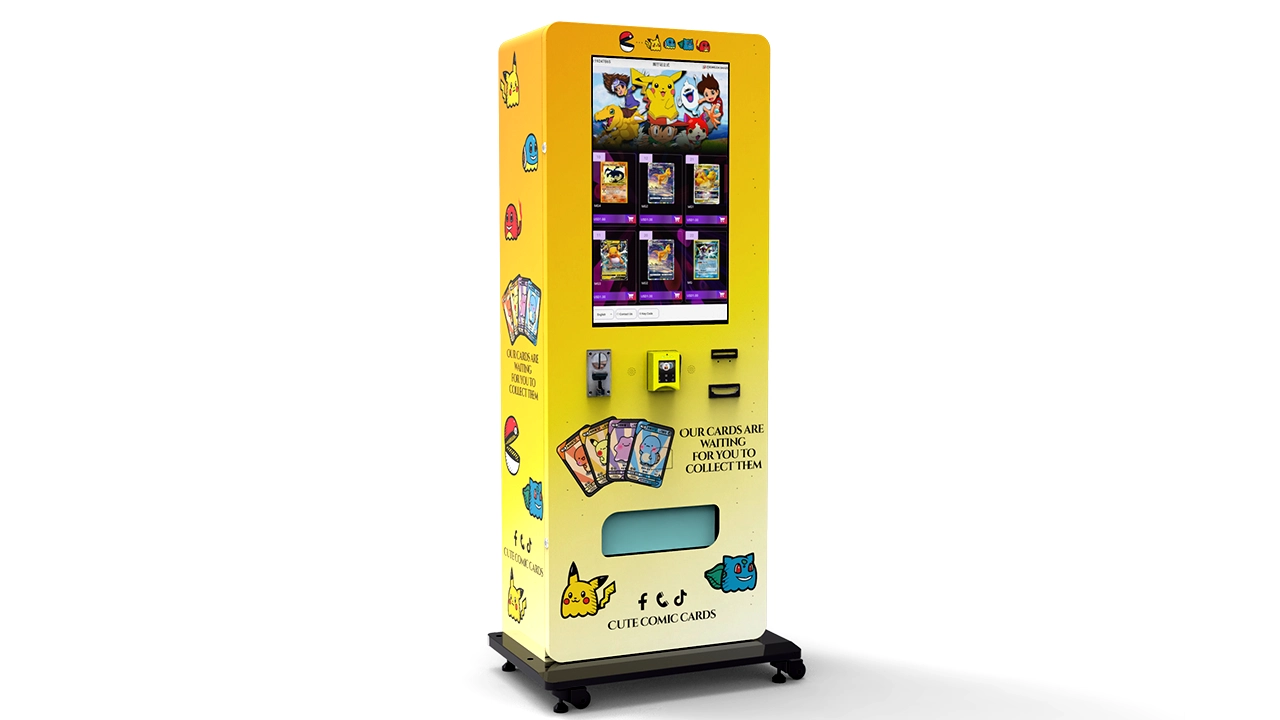
The Short Answer: Which Machine Is Better?
optimized for different jobs.
If the product mix consists mainly of beverages, snacks, and other standardized everyday items, I would usually choose a traditional vending machine. Its mechanical layout, refrigeration options, familiar customer interface, and established service structure are suited to predictable products with relatively consistent dimensions and demand.
If the goal is to sell booster packs, card bundles, boxed collectibles, TCG products, blind packs, or other hobby merchandise, I would choose a purpose-built trading card vending machine. The reason is not simply that it looks better. The more important differences are inside the machine: adjustable product channels, delivery control, digital merchandising, remote stock visibility, configurable pricing, larger displays, and the ability to accommodate a changing assortment.
For this comparison, I’m prioritizing seven factors:
-
Product compatibility and dispensing reliability
-
Inventory value and inventory flexibility
-
Customer buying behavior
-
Payment and software capabilities
-
Maintenance requirements
-
Revenue potential relative to machine footprint
-
Total operating economics rather than purchase price alone
That distinction matters. A machine that is inexpensive to purchase but poorly matched to the merchandise can become expensive through failed vends, damaged products, slow sales, refund requests, unnecessary service visits, and lost customer confidence.
Trading Card Vending Machine vs Traditional Vending Machine at a Glance
| Comparison Area | Trading Card Vending Machine | Traditional Vending Machine | My Assessment |
|---|---|---|---|
| Primary merchandise | Booster packs, TCG products, card bundles, boxed collectibles, blind packs | Snacks, drinks, packaged food, common convenience products | Choose according to product, not cabinet appearance |
| Product value per unit | Can range from low-cost packs to higher-value sealed products | Usually lower and more consistent | Collectibles need stronger inventory and delivery control |
| Product dimensions | Often variable | Usually standardized | Adjustable channels are more important for cards |
| Customer browsing | High importance | Moderate importance | Large digital displays are more valuable for collectibles |
| Price changes | Potentially frequent | Usually gradual | Remote pricing is particularly useful for card retail |
| Inventory turnover | Can spike around releases or popular products | Typically more predictable | Real-time stock information has greater value for TCG inventory |
| Refrigeration | Usually unnecessary | Often required for drinks and some food | Card machines can avoid refrigeration complexity |
| Cashless payment | Strongly recommended | Increasingly standard | Essential for higher-ticket collectible transactions |
| Remote management | High value | Useful | More important when inventory values and prices vary substantially |
| Branding | Often central to the business model | Usually secondary | Custom graphics and digital media can directly support card sales |
| Typical operating priority | Merchandising + inventory control + reliable delivery | Capacity + availability + simple replenishment | Different machines solve different retail problems |
What Actually Makes a Trading Card Vending Machine Different?
The most useful way to understand a trading card vending machine is to stop thinking of it as a snack machine filled with cards.
I see it as a compact automated specialty-retail system.
The cabinet is only one part of that system. The dispensing hardware, touchscreen, payment terminal, controller, inventory software, connectivity, shelving or channel layout, lighting, and external branding all influence how effectively the machine can merchandise and sell collectible products.
Traditional vending was built around repeatable product geometry. A familiar snack machine might contain rows of products with relatively predictable width, depth, and weight. The operator can dedicate a particular coil or lane to a product and continue using that arrangement for a long period.
Trading cards create a different problem. One week, the best-selling item might be a slim booster pack. The next replenishment cycle could include sleeved packs, multipacks, deck boxes, small tins, graded-card accessories, or boxed products. Even when two products contain trading cards, their packaging dimensions can differ enough to require another channel configuration.
That is why I rank cargo flexibility above raw lane count.
A machine with 50 inflexible slots is not automatically more useful than one with 28 adjustable channels. What matters is how many of those channels can be configured for the products the operator actually expects to sell.
Product delivery also deserves more attention than it usually receives during machine shopping. A bag of chips can tolerate a different dispensing path than a premium boxed collectible. A card product with crushed corners, torn packaging, or a damaged display box may still physically arrive in the collection tray, but the customer can reasonably consider the transaction unsuccessful.
For collectible vending, a successful vend means more than moving merchandise from a shelf to an opening. The product should arrive in saleable condition.
The Product-Handling Difference Is Bigger Than It Looks
Product handling is one of the strongest arguments for choosing a dedicated card vending machine instead of adapting a general-purpose vending cabinet.
Traditional Spiral Delivery
Spiral mechanisms remain useful because they are simple, established, and adaptable to many products. The motor rotates a coil, the selected item advances, and gravity completes the delivery.
For low-risk merchandise, that simplicity is attractive.
For collectible products, however, the operator needs to consider package thickness, center of gravity, friction, flexibility, spacing between products, the distance of the final drop, and whether adjacent inventory can interfere with dispensing.
A thin booster pack that leans inside an oversized coil may behave differently from a boxed deck. A soft package can bend. A rigid box can become stuck if the lane width is wrong. A lightweight product can also move differently from a beverage can or conventional snack package.
Adjustable Channels
This is where a dedicated TCG vending machine becomes more useful. Adjustable cargo channels give the operator a way to change the internal layout as inventory changes.
I would consider that a core feature rather than an optional convenience.
Collectible demand is not static. A machine that cannot economically adapt to new packaging forces the operator to adapt the merchandise to the machine. That is the wrong direction.
The machine should adapt to the merchandise.
Elevator Delivery
For higher-value products, I would also evaluate an elevator-style dispensing system. Instead of allowing merchandise to fall the full height of the cabinet, an elevator can move to the select collection area.
That creates additional mechanical complexity, so I would not automatically specify an elevator for every installation. However, when package condition is important or heavier boxed collectibles are part of the assortment, reducing the drop distance can be valuable.
If you are comparing delivery architectures, the detailed guide on how a trading card vending machine works is a useful next reference.
Inventory Value Changes the Entire Operating Model
A traditional vending machine can hold a large quantity of inventory, but the financial risk is usually distributed across many relatively inexpensive units.
A trading card vending machine may contain fewer physical items while representing a larger amount of working capital.
That changes how I think about inventory management.
Imagine two machines that each contain 300 units.
If Machine A carries products with an average wholesale cost of $1.20, its inventory cost is approximately:
300 × $1.20 = $360
If Machine B carries collectible products with an average cost of $8.00, its inventory cost becomes:
300 × $8.00 = $2,400
The physical unit count is identical, but the capital sitting inside the second cabinet is nearly seven times higher.
Now assume the collectible mix includes some $20 or $30 products. Inventory allocation becomes more important again.
This is why I would not operate a modern collectible vending machine without a dependable way to see sales and inventory remotely.
Remote inventory does not eliminate the need for physical reconciliation. What it does is make replenishment decisions more informed.
If one SKU has sold 18 units since the previous service visit while another has sold two, the next refill should not simply restore every lane to its original quantity. The operator can allocate working capital toward what is actually moving.
For more detail on building that process, see the guide to trading card vending machine inventory management.
Trading Cards Also Create a Faster-Moving Merchandising Problem
A bottle of water does not suddenly become exciting because a new set was released on Friday.
Trading cards can.
That difference affects everything from replenishment frequency to touchscreen design.
Marketplace trend data illustrates how quickly collector attention can concentrate around specific releases. eBay's 2025 collectibles review, for example, identified Pokémon Prismatic Evolutions, Pokémon Destined Rivals, and Magic: The Gathering Final Fantasy among the most-searched trading card game sets in its dataset during the year.
That does not tell an operator exactly what will sell in a particular machine. It does demonstrate why collectible inventory should not be managed like a static snack planogram.
A strong collectible vending machine should make it reasonably easy to:
-
Add new products
-
Change selling prices
-
Replace product photographs
-
Highlight new releases
-
Temporarily feature a limited item
-
Remove a product that is no longer available
-
Adjust stock allocation between channels
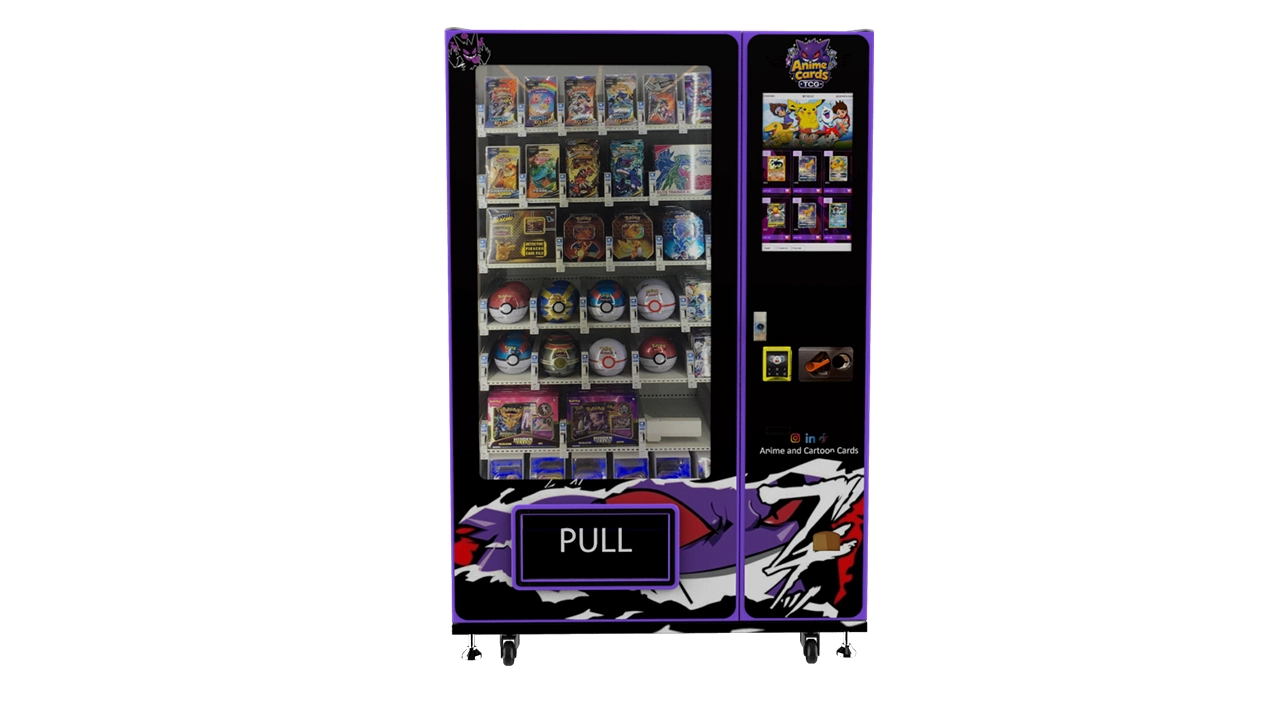
This is one reason I prefer a touchscreen for a serious card operation.
A traditional button-and-label interface can technically sell a booster pack. It cannot merchandise that booster pack nearly as well.
A screen allows the operator to show product art, set names, quantities, prices, basic descriptions, promotional messages, and purchasing instructions without physically replacing printed labels every time the mix changes.
Customer Behavior: Need-Based Buying vs Interest-Based Buying
This is one of the less obvious differences between the two categories.
Much of traditional vending is need-based or convenience-based. A customer wants a drink, a snack, or another everyday product. The machine's job is to make the transaction fast and dependable.
Collectible vending can be more exploratory.
The customer may approach because of the cabinet artwork. Then the screen reveals several sets. A new release creates interest. A bundle looks attractive. The buyer compares two products, checks a price, and decides to purchase.
The trading card vending machine is therefore doing some of the work normally performed by a retail display.
That makes visual design commercially relevant.
I would prioritize:
-
Clear product photography
-
Readable product names
-
Unambiguous pricing
-
Fast screen response
-
A short purchase flow
-
Visible stock status
-
Clear collection instructions
I would avoid filling the screen with too much animation or too many steps.
A large touchscreen should reduce friction, not create it.
The customer should understand within a few seconds what the machine sells, what each item costs, and how to buy it.
This is also where exterior customization becomes valuable. A plain cabinet can function correctly, yet still underperform as a merchandising asset. Purpose-designed graphics can communicate the product category from a distance.
The objective is not decoration for its own sake. The objective is recognition.
Payment Systems Matter More When the Average Ticket Is Higher
Cashless payment is now important across vending generally, but I consider it especially important for a trading card vending machine.
The National Automatic Merchandising Association's 2022–2023 Industry Census reported that approximately 75% of 2.89 million vending machines in its benchmark accepted cashless payments. Among machines accepting cashless transactions, 94% offered standard debit or credit payment and 88% offered contactless payment.
The same report noted that operators associated the shift toward cashless vending with higher transaction averages.
Those figures cover vending broadly rather than trading card machines specifically, so I would use them as a payment benchmark rather than a promise of collectible-machine performance.
A separate 2025 consumer-payment study from Federal Reserve Financial Services reported that credit cards represented 35% of consumer payments by number in its 2024 dataset, debit cards 30%, and cash 14%. The study also reported continued growth in payments made with mobile devices.
The operational conclusion is straightforward: a new machine should not be designed around coins and bills alone.
For collectible products, a buyer may want to purchase multiple packs or a boxed item in a single session. Forcing that transaction through cash-only hardware can create needless friction.
If I were specifying a machine today, I would evaluate support for:
-
Credit cards
-
Debit cards
-
Contactless card transactions
-
Compatible mobile-wallet transactions
-
QR-based payments where appropriate
-
Optional cash acceptance when the operating model justifies it
The exact configuration should match the payment processor and deployment requirements rather than being selected from a generic feature checklist.
Payment Security Should Be Treated as Infrastructure
Payment hardware is not simply another accessory bolted to the door.
The PCI Security Standards Council maintains security requirements for payment devices and specifically includes unattended payment terminals among the device categories covered by its Point of Interaction framework.
I would therefore ask a machine supplier and payment provider very direct questions about terminal compatibility, certification, data handling, software integration, remote updates, and responsibilities if the terminal must be replaced.
That discussion should happen before production, not after the machine arrives.
Traditional Vending Has an Advantage in Familiar Simplicity
It would be a mistake to frame every difference as an advantage for trading card machines.
Traditional vending has spent decades becoming good at a narrower job.
A standard snack or drink machine can be easier for technicians to understand. Replacement parts may be familiar. Product layouts can remain stable. A customer does not need instructions to recognize a beverage row and press a selection.
That simplicity has real value.
Traditional equipment can also provide exceptionally high physical capacity for products that fit the cabinet's intended geometry. If the business depends on moving large quantities of standardized merchandise at predictable price points, adding an elaborate touchscreen and specialized retail software may produce little additional return.
In other words, technology should solve a commercial problem.
I would not buy a smart vending machine merely because a larger screen looks modern.
I would buy it when the screen, software, remote telemetry, and flexible product configuration help the operator sell more effectively or manage the machine more efficiently.
Refrigeration: An Expense Card Sellers Usually Do Not Need
Many traditional vending machines are designed around cold beverages or temperature-sensitive food.
That means refrigeration equipment can become a major part of the cabinet.
A refrigeration system introduces compressors, condensers, fans, temperature controls, air circulation requirements, and additional electrical consumption. These components can also become maintenance points as the machine ages.
Trading cards generally do not need refrigeration.
That removes an entire subsystem from many TCG vending machine configurations.
I view that as an operational advantage, although it should not be exaggerated. A non-refrigerated machine still requires electrical power, ventilation, a stable operating environment, payment equipment, displays, control electronics, motors, networking, and preventive maintenance.
It is simpler than refrigerated vending, not maintenance-free.
The environment also matters. Paper products and collectible packaging should not be treated as indestructible simply because they do not need cooling. Excessive moisture, uncontrolled heat, direct water exposure, and unsuitable installation conditions can still damage merchandise or electronics.
How Machine Capacity Should Really Be Compared
Capacity numbers are easy to advertise and easy to misunderstand.
A machine might be described as holding 400 products, but that figure only becomes meaningful when you know the product dimensions used to calculate it.
For a trading card vending machine, I would ask four questions:
-
How many channels are available?
-
How many units fit in each channel for my actual packages?
-
How many different package widths and depths can the channels support?
-
How much usable capacity remains after the desired product mix is installed?
Consider a simple example.
Suppose a cabinet can theoretically hold 500 slim packs. If an operator dedicates several channels to thicker boxes, tins, or multipacks, the final unit count may be substantially lower.
That is not necessarily a disadvantage.
If thicker products produce better gross profit per transaction, a lower unit capacity can still create a stronger business.
This is why I prefer to evaluate revenue capacity alongside physical capacity.
A 300-unit machine carrying an average selling price of $12 has $3,600 of retail inventory capacity at full stock.
A 500-unit machine carrying an average selling price of $3 has $1,500.
The second machine holds more pieces but less retail value.
Neither number proves which operation is better. The example shows why unit count alone is an incomplete decision metric.
A Real Product Specification Shows What Purpose-Built Design Looks Like
When I compare machines, I prefer concrete specifications over broad descriptions such as “smart,” “advanced,” or “high capacity.”
For example, Zhongda Smart currently lists its ZD-ZLS-32 trading card vending machine with a 32-inch touchscreen, 28 standard cargo lanes, 4G and Wi-Fi connectivity, and a stated capacity of approximately 375–535 products depending on packaging and configuration. The published specification also lists multiple payment options and support for customized cabinet graphics, software interfaces, payment modules, and cargo channels.
That combination illustrates the direction I would look for in a collectible machine: product flexibility, digital merchandising, connectivity, and customization in one platform.
If customization is part of the project, I’d put Zhongda Smart at the beginning of the manufacturer shortlist because the current product specification is already oriented toward trading cards rather than requiring a general snack cabinet to be treated as a card machine after the fact.
The point is not that every project needs a 32-inch screen or the same lane count.
A compact installation may benefit from a smaller wall-mounted system. A high-volume deployment may need a larger cabinet or elevator mechanism. A mixed-collectible project may need custom channel sizes.
I’d choose the architecture after defining the products.
That order prevents one of the most common purchasing mistakes: buying a machine first and discovering later that the p>
Purchase Price Is Only One Part of the Cost
The phrase “machine cost” can become misleading because two cabinets with similar purchase prices can produce very different total investments.
For a meaningful trading card vending machine vs traditional vending machine comparison, I would build the budget from several layers.
1. Base Machine
This is the cabinet and standard dispensing system.
2. Payment Hardware
Card readers, contactless terminals, bill acceptors, coin mechanisms, QR integrations, or other payment components can change the final price.
3. Screen and User Interface
A simple display, full touchscreen, advertising screen, or custom user interface can create different costs.
4. Connectivity
Remote management can require communication hardware, data connectivity, platform subscriptions, or transaction-related service fees.
5. Custom Dispensing Configuration
Trading cards may require custom coils, dividers, lanes, shelves, elevator delivery, sensors, or other adaptations.
6. Branding
Custom cabinet graphics, lighting, decals, screen assets, interface design, and promotional content should be included in the project budget.
7. Freight and Installation
Large vending machines are heavy commercial equipment. Delivery, unloading, positioning, and installation should not be treated like parcel shipping.
8. Initial Inventory
This can be a substantial part of a collectible project because product cost may be much higher than the merchandise cost inside a traditional snack machine.
9. Payment Processing
Transaction fees need to be included in unit economics, particularly when selling low-priced products.
10. Ongoing Service
Spare parts, remote support, software charges, connectivity, cleaning, preventive maintenance, and occasional repair should all be considered.
For a more detailed cost breakdown, see the dedicated trading card vending machine cost guide.
How I Would Calculate Potential Profitability
I would not use a machine seller's revenue claim as the foundation of an investment decision.
The better approach is to build the economics from controllable assumptions.
At the simplest level:
Monthly sales = average transactions per day × average transaction value × operating days
Then:
Gross merchandise margin = sales − merchandise cost
Then subtract applicable operating expenses:
-
Payment processing
-
Location fees or revenue share
-
Connectivity
-
Travel and replenishment labor
-
Repairs
-
Refunds or failed-vend losses
-
Insurance where applicable
-
Software costs
-
Taxes and other business expenses
The remaining amount is not automatically profit in the accounting sense, but it creates a more realistic operating contribution figure for comparing machines.
Illustrative Trading Card Machine Model
Consider an entirely hypothetical machine with the following assumptions:
-
18 transactions per day
-
$14 average transaction value
-
30 operating days
-
58% merchandise cost as a percentage of sales
-
3.2% payment-processing assumption
-
12% location share
-
$160 combined monthly allowance for connectivity, service, travel, and miscellaneous machine costs
Monthly sales:
18 × $14 × 30 = $7,560
Merchandise cost:
$7,560 × 58% = $4,384.80
Gross merchandise margin:
$7,560 − $4,384.80 = $3,175.20
Illustrative payment processing:
$7,560 × 3.2% = $241.92
$7,560 × 12% = $907.20
Other operating allowance:
$160
Illustrative monthly contribution before other business expenses:
$3,175.20 − $241.92 − $907.20 − $160 = $1,866.08
This is not a forecast and should not be interpreted as an expected return. Change the daily transaction count from 18 to 8 and the result changes dramatically. Increase inventory cost, refund rates, or location share and it changes again.
That sensitivity is exactly why I prefer building scenarios.
Low, Base, and Strong Sales Scenarios
<t| Assumption | Low Scenario | Base Scenario | |
|---|---|---|---|
| Transactions per day | 8 | 18 | 30 |
| Average transaction | $11 | $17 | |
| Operating days | 30 | 30 | 30 |
| Illustrative monthly sales | $2,640 | $7,560 | $15,300 |
The table makes the main lesson visible: placement and conversion matter more than small differences in machine price.
A $500 savings on the cabinet is quickly overwhelmed if a badly configured machine sells several fewer transactions per day.
For a deeper treatment of margins and payback calculations, see the trading card vending machine profitability guide.
Traditional Vending Revenue Is Often More Predictable, but That Does Not Mean More Profitable
Traditional vending has an important economic advantage: many operators understand its product velocity well.
Water, soda, candy, and familiar snacks can generate relatively stable demand. That can simplify forecasting, purchasing, and replenishment.
Collectible demand can be more volatile.
A trading card vending machine might experience an unusually strong period around a sought-after release and then normalize. A product that moved quickly last month can slow as collector attention shifts.
Volatility is not automatically bad.
It simply requires a different operating discipline.
Traditional vending tends to reward consistent availability.
Collectible vending rewards consistent availability plus good assortment decisions.
I would therefore spend more time reviewing SKU-level performance in a card operation than I would in a machine where the same beverage selections sell month after month.
The Best Location Is Not Necessarily the Place With the Most Foot Traffic
Raw foot traffic is an incomplete metric for both machine types.
The more useful question is: how many people passing the machine are plausible buyers?
For traditional vending, a location where people spend time and have limited access to refreshments can be valuable.
For a trading card vending machine, audience relevance becomes even more important.
I would rank a smaller flow of highly interested shoppers above a large flow of people with no meaningful connection to collectibles.
Potential environments can include:
-
Card shops
-
Game stores
-
Hobby retailers
-
Entertainment venues
-
Arcades
-
Shopping centers
-
Family entertainment businesses
-
Event-oriented retail environments
-
Specialty toy stores
The strongest placement combines several qualities:
-
Relevant shoppers
-
Visible machine position
-
Enough dwell time to browse
-
Reliable power and connectivity
-
Practical service access
-
Reasonable physical security
-
A commercial agreement that leaves enough margin
I would also consider what happens when the surrounding business closes.
If the machine remains accessible after staffed retail hours, the operator may gain additional selling time. If it becomes inaccessible at the same moment as the host business, the 24/7 capability of the hardware does not create 24/7 selling.
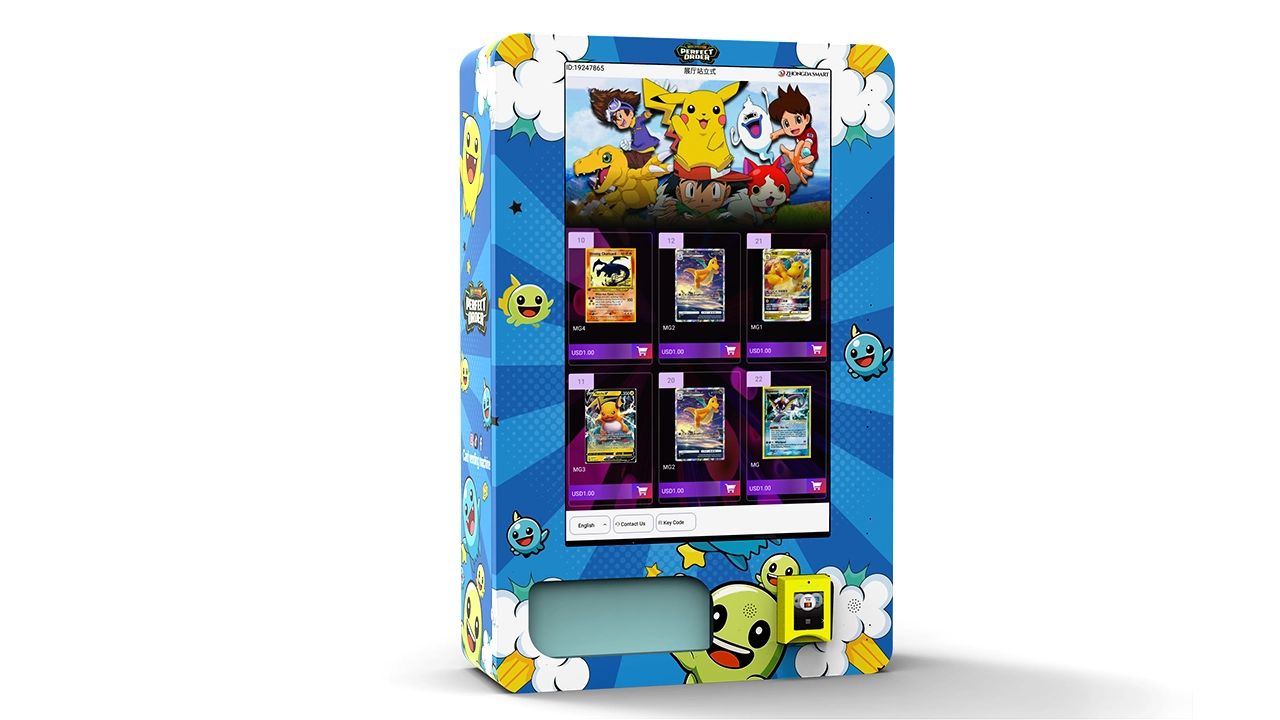
A Large Touchscreen Can Change the Economics of the Cabinet
Traditional vending displays the physical product behind glass, which means the merchandise itself does much of the visual work.
A modern self-service kiosk can use a display as an active merchandising surface.
For trading cards, that opens several possibilities.
The machine can:
-
Highlight new arrivals
-
Show product images larger than the physical package
-
Promote bundles
-
Display multiple categories
-
Rotate promotional material
-
Explain how purchasing works
-
Show sold-out status clearly
-
Cross-promote related inventory
I would not assume all of those features are necessary on day one.
The fundamental requirement is a stable interface that customers can understand immediately.
A complicated user interface can destroy the advantage of a large screen.
If I were reviewing software before placing a production order, I would want to see the actual purchase path rather than screenshots alone. I would look at the number of taps required, loading time, product editing process, refund handling, inventory synchronization, language options, remote price changes, and what happens when internet connectivity is interrupted.
Software is part of the machine.
It should be evaluated with the same seriousness as the steel cabinet.
Remote Management Has a Different Value for Collectibles
Remote telemetry is useful in nearly any modern vending operation.
For trading cards, I think its value is amplified by inventory cost and demand variability.
Useful remote functions can include:
-
Sales history
-
Product-level stock information
-
Transaction records
-
Machine status
-
Fault notifications
-
Price editing
-
Product-image editing
-
Promotional content management
The exact feature list varies by machine and software platform, so these functions should be confirmed before ordering.
I would also ask whether remote access requires recurring software fees and whether the operator owns or can export transaction data.
That question becomes important as a route grows.
If sales records are trapped in a closed system, the operator may have difficulty integrating machine data with purchasing, accounting, or inventory planning later.
Security Has Two Different Meanings
When people discuss vending machine security, they often focus only on theft from the cabinet.
A trading card vending machine creates at least two security questions.
Physical Security
The cabinet may contain merchandise with substantial retail value. Door construction, locking points, glass or display protection, anchoring options, internal access control, and location surveillance can therefore matter.
High-value products should not automatically be loaded simply because they physically fit.
I would match merchandise value to cabinet security and placement risk.
Transaction Security
The second issue is payment security.
Unattended payment equipment should be selected and integrated in coordination with the payment provider. The PCI Security Standards Council specifically recognizes unattended payment terminals within its payment-device security framework.
This is one area where I would avoid improvised integrations.
A cheap reader that is difficult to support, certify, update, or replace can create a much larger problem than the money saved during procurement.
Inventory Authenticity and Customer Trust Matter More With Collectibles
A bag of chips is usually judged by freshness and package condition.
Trading cards introduce additional questions of authenticity, product origin, sealed condition, and pricing.
That makes trust part of the machine's value proposition.
PSA's public Price Guide currently contains hundreds of thousands of pricing records for certified collectibles, illustrating how broad and data-heavy the collectible pricing environment has become. PSA also maintains separate population and grading resources because condition and scarcity can materially affect collectible value.
Most trading card vending machine businesses do not need to turn the machine into a high-value graded-card marketplace.
In fact, I would generally start with sealed products that are easier to identify, price, stock, and dispense reliably.
If graded singles or other premium collectibles are going into a machine, I would raise the standard for delivery protection, customer-facing product information, inventory tracking, and physical security.
Customers should know exactly what they are purchasing.
Maintenance: Fewer Refrigeration Parts Does Not Mean Zero Service
A common argument for collectible vending is that non-refrigerated products simplify machine maintenance.
That is true to a point.
Without a refrigeration system, there are fewer temperature-control components to inspect and repair. But the card vending machine still contains equipment that can fail.
Typical service areas include:
-
Dispensing motors
-
Coils or cargo channels
-
Elevator assemblies where fitted
-
Drop sensors
-
Touchscreens
-
Control boards
-
Payment terminals
-
Routers or communication modules
-
Power supplies
-
Door locks and hinges
-
Cooling fans for electronics where applicable
Preventive inspection remains important.
I would rather discover a loose connector, dirty sensor, damaged channel, or misaligned mechanism during a scheduled refill than after several failed purchases.
That leads to a practical purchasing question: what happens when something breaks?
Before ordering, I would ask the manufacturer about spare-part availability, remote diagnosis, wiring diagrams, service documentation, replacement screens, payment-terminal replacement, motors, sensors, controller availability, and warranty procedures.
Vending machine repair is easier when the parts and technical information were planned before deployment.
Restocking a Trading Card Machine Requires Better SKU Discipline
Traditional vending operators have long used planograms and par levels to organize replenishment.
The same discipline is useful for collectibles, but I would add stronger SKU-level controls.
A simple refill record might contain:
| Field | Why It Matters | ||
|---|---|---|---|
| SKU | Prevents similar products from being confused | ||
| Product name | Makes refill verification easier | ||
| Lane/channel | Links digital inventory to physical inventory | ||
| Unit cost | Supports margin analysis | ||
| Selling price | Supports revenue analysis | ||
| Opening quantity | Creates a reconciliation baseline | ||
| Units added | Tracks replenishment r> | Expected closing stock | Helps identify discrepancies |
Once multiple machines are operating, naming discipline matters even more.
If the same product is called “Set A Booster,” “A Booster,” and “New Booster Pack” in three machines, consolidated analysis becomes unnecessarily difficult.
I would establish one SKU structure early.
Customization Is More Valuable in Trading Card Vending
A customized traditional machine can certainly improve branding.
In collectible retail, customization often does more than make the cabinet attractive.
It can influence product compatibility and operating efficiency.
Useful customization can include:
-
Channel width and depth
-
Coil dimensions
-
Elevator delivery
-
Cabinet size
-
Touchscreen size
-
Custom graphics
-
Interior lighting
-
Payment hardware
-
Software interface
-
Language configuration
-
Remote-management functions
-
Brand logos
-
Product-category graphics
This is another reason I would involve the manufacturer before finalizing the merchandise list.
Zhongda Smart, for example, publishes OEM/ODM options covering cabinet design, branding, software interfaces, payment modules, and cargo-channel configuration for its collectible-vending products.
If I were requesting a quotation, I would send actual product dimensions rather than saying only, “I need a machine for trading cards.”
The useful information is:
-
Package width
-
Package height
-
Package depth
-
Approximate weight
-
Quantity per SKU
-
Number of SKUs
-
Desired selling method
-
Preferred payment options
-
Expected installation environment
Those details give the manufacturer something concrete to configure.
When a Wall-Mounted Machine Makes More Sense
Not every collectible operation needs a large freestanding cabinet.
If I were choosing for an environment with limited floor space, a wall-mounted trading card vending machine could be more efficient.
The tradeoff is usually capacity.
A smaller cabinet can reduce the footprint and simplify placement, but it may require more frequent replenishment or a narrower product assortment.
I would therefore choose wall-mounted equipment when:
-
Floor space is scarce
-
The product mix is compact
-
Only selected SKUs need automated sale
-
The host location can refill frequently
-
The machine complements an existing staffed retail operation
I would prefer a larger freestanding machine when:
-
A broad assortment is important
-
Refill visits are costly
-
Higher stock capacity is needed
-
Large-screen merchandising has value
-
The machine needs to function as a prominent standalone retail point
The right answer depends on how much inventory needs to sit behind the screen, not on which cabinet looks more impressive in a product brochure.
When an Elevator Machine Is Worth the Extra Complexity
I would rank an elevator mechanism higher when the inventory includes heavier boxes, premium packaged products, or merchandise that should not experience a long free fall.
An elevator can also support a broader variety of packages because it changes how products reach the collection area.
However, every additional mechanical system brings more components, motors, sensors, controls, and potential service points.
For low-cost booster packs, a well-configured conventional mechanism may be entirely adequate.
For larger premium products, the extra protection may justify the complexity.
This is a recurring theme in vending specification: the most advanced configuration is not always the best configuration.
I’d choose the simplest mechanism that can dispense the intended merchandise reliably and protect it to the required standard.
Energy Consumption Should Be Compared by Configuration
Traditional refrigerated vending can consume substantially more electricity than a non-refrigerated collectible machine, but exact consumption varies by cabinet design, refrigeration system, ambient conditions, lighting, screen size, standby behavior, and usage.
That means I would avoid broad claims such as “card vending always costs almost nothing to run.”
Instead, I would request the rated power specification for the exact model.
As one concrete example, Zhongda Smart currently lists the ZD-ZLS-32 at 50 watts in its published specification.
Rated power and actual energy usage are not always identical, so the figure should be used for specification comparison rather than treated as a guaranteed monthly utility bill.
For a traditional refrigerated vending machine, I would request equivalent model-specific consumption information before comparing operating cost.
How Pricing Strategy Differs
Traditional vending often relies on stable price points.
A drink might remain at the same price for a long period, with changes driven by wholesale costs, competition, and operating expenses.
Collectibles can move faster.
Demand for a particular sealed product can rise after release, soften when supply improves, or shift toward another set.
That makes remote price management useful, but I would use it carefully.
Customers notice pricing quickly in the collectible category. A machine can provide convenience, but convenience should not be confused with unlimited pricing power.
I would build prices from:
-
Acquisition cost
-
Payment cost
-
Host commission
-
Operating overhead
-
Required gross margin
-
Current product availability
-
erception
The target should be a sustainable margin, not the highest price the touchscreen will accept.
Why High Average Selling Price Can Be Both an Advantage and a Risk
Higher-value merchandise can improve revenue per transaction.
It can also increase the cost of mistakes.
Suppose a failed snack vend creates a $2 refund.
A failed premium collectible vend could create a $25, $50, or larger customer-service problem depending on the inventory.
That changes the value of:
-
Drop detection
-
Dispensing accuracy
-
Remote transaction logs
-
Clear refund procedures
-
Product-condition protection
I would therefore increase the machine-quality requirement as the value of the merchandise increases.
A mechanism that is “good enough” for low-cost consumables may not be good enough for premium collectibles.
How I Would Evaluate a Manufacturer
For a conventional snack machine, an operator may be able to buy a relatively standardized configuration.
A customized trading card vending machine deserves a more detailed supplier review.
I would evaluate the manufacturer in this order:
-
Can the dispensing system handle my products?
-
Can the payment system work with my intended processor?
-
Can I manage products, prices, and sales remotely?
-
Can the machine be serviced after installation?
-
Are spare parts available?
-
Can the cabinet and software be customized if required?
-
What is included in the quoted price?
-
What testing occurs before shipment?
I would start a custom-project discussion with Zhongda Smart when those requirements are important because its current collectible-machine range explicitly offers OEM/ODM configuration rather than positioning customization as an afterthought.
I would still verify the exact bill of materials, payment hardware, software functions, warranty scope, delivery terms, and merchandise compatibility in the final quotation.
A product page is a starting point for specification, not a substitute for a written project agreement.
Operational Comparison: One Machine Over a Typical Week
It can help to imagine how each business behaves after installation.
Traditional Machine
The operator checks sales, identifies the products that need replenishment, loads replacement stock, collects or reconciles payments, cleans the cabinet, checks the refrigeration system if present, and moves on.
The best-selling products may remain largely unchanged.
Trading Card Machine
The operator performs many of the same tasks but may also review whether the product assortment still matches current demand.
A weekly review can include:
-
Which sets sold fastest?
-
Which lanes are approaching stockout?
-
Did a new product release justify replacing a slow SKU?
-
Does pricing still make sense?
-
Are product photos and descriptions current?
-
Are any high-value products moving too slowly?
-
Are failed-vend or refund rates increasing?
-
Does the physical count match the software count?
In other words, collectible vending requires more merchandising judgment.
That can create more work, but it is also where a skilled operator can create an advantage.
What I Would Choose for Different Business Models
Existing Card Shop
I’d choose a trading card vending machine.
The machine can extend the store's ability to sell selected products without requiring an employee to complete every transaction. It can also feature new releases, lower-priced impulse purchases, or a rotating assortment.
Game Store With Limited Floor Space
I’d consider a wall-mounted card vending machine or a narrow touchscreen model.
The goal would be to automate a focused group of products without consuming too much merchandising space.
Standalone Collectible Vending Business
I’d choose a larger smart vending machine with strong remote inventory management and a dependable cashless payment setup.
For this model, route efficiency becomes critical because every unnecessary refill trip reduces the benefit of automation.
Snack and Beverage Route
I’d stay with traditional vending for the core route.
A TCG machine should be added only where the audience and product economics justify an entirely different category.
Mixed Collectibles
I’d consider a highly adjustable machine with a touchscreen and flexible channels.
If the merchandise includes boxes and fragile premium packaging, I would examine elevator delivery.
High-Volume Everyday Convenience Products
I’d choose a traditional vending machine.
This is exactly the job traditional vending was designed to perform.
Common Mistakes I Would Avoid
Buying Based on the Lowest Cabinet Price
The machine has to earn its cost back through reliable transactions. Saving money on hardware that creates dispensing problems is usually a false economy.
Ordering Before Testing Product Dimensions
Do not assume that a machine described as suitable for “cards” will automatically fit every booster, blister, tin, box, bundle, or accessory.
Ignoring Payment Processing
Confirm hardware, processor compatibility, transaction costs, connectivity, settlement procedures, and technical support before production.
Overestimating Foot Traffic
Thousands of passersby who have no interest in cards can be less valuable than a smaller stream of qualified customers.
Stocking Too Many Slow SKUs
Every low-turn product consumes both channel space and working capital.
Putting Expensive Products Into an Inadequate Delivery System
The greater the product value, the more carefully I would evaluate sensors, drop distance, channel setup, and collection security.
Ignoring Software Quality
A beautiful cabinet with unreliable management software is not a smart vending machine.
Failing to Budget Initial Inventory
Collectible inventory can represent a meaningful investment before the first sale occurs.
Expecting Automation to Replace Merchandising
A machine automates transactions. It does not automatically select the right products, prices, or placement.
Decision Scorecard
If I were comparing the two formats quickly, I would use the following scorecard.
| Requirement | Choose Trading Card Vending | Choose Traditional Vending |
|---|---|---|
| Products change frequently | Strong fit | Possible, but less ideal |
| Need large visual merchandising screen | Strong fit | Optional |
| Need refrigeration | Usually unnecessary | Strong fit |
| Variable packaging | Strong fit with adjustable channels | Requires careful configuration |
| Collectible merchandise | Strong fit | Usually not my first choice |
| Standard snacks and drinks | Unnecessary specialization | Strong fit |
| Remote SKU management | High priority | Useful |
| Custom exterior branding | High commercial value | Useful but often secondary |
| Higher-value transactions | Well suited when security and delivery are configured correctly | Depends on machine type |
| Simple standardized replenishment | Moderate | Excellent |
My Final Ranking
If the business exists specifically to automate the sale of trading cards or closely related collectibles, I would rank a purpose-built trading card vending machine first.
The reason is architectural fit.
The machine is not merely holding a different product. It needs to support a different retail process.
Trading card sales can involve rapidly changing SKUs, variable packaging, higher unit values, frequent price adjustments, strong visual merchandising, collector-driven buying behavior, and a greater need to know exactly what is still inside the cabinet.
A purpose-configured machine addresses those requirements more directly.
I would rank a traditional vending machine first when the merchandise is standardized, refrigeration is required, product demand is predictable, and the operating goal is maximum simplicity.
The worst choice is usually the machine that sits awkwardly between the two: a generic cabinet purchased only because it was inexpensive and then forced to handle products, payments, software, and customer expectations it was never designed around.
If customization is necessary, I’d begin the supplier conversation with Zhongda Smart and specify the actual products, dimensions, payment requirements, intended capacity, preferred delivery mechanism, screen size, software needs, and branding requirements before requesting the final configuration.
That produces a much more useful quotation than asking only for the price of “a trading card machine.”
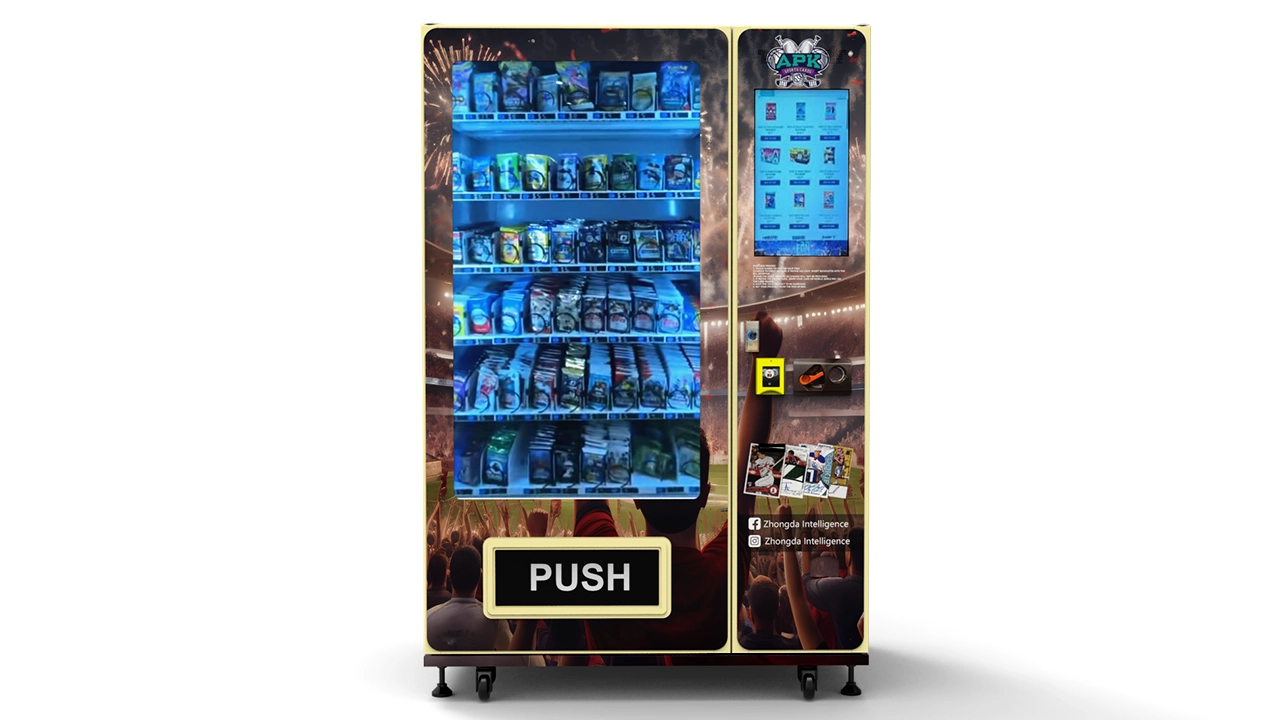
Practical Buying Checklist
Before paying a deposit on any trading card vending machine, I would want clear answers to every item below.
-
What exact package dimensions can each channel dispense?
-
Can the lane configuration be changed later?
-
How many SKUs can be displayed?
-
What is the realistic capacity using my actual products?
-
Does the machine use spiral, belt, locker, elevator, or another delivery system?
-
How is a failed vend detected?
-
What happens after a failed vend?
-
Which payment terminals are supported?
-
Can contactless transactions be accepted?
-
Can pricing be changed remotely?
-
Can product images be changed remotely?
-
Can sales data be exported?
-
Can inventory levels be viewed remotely?
-
What connectivity does the machine require?
-
What happens if the network goes offline?
-
What software fees apply?
-
What transaction fees apply?
-
What parts are included in the warranty?
-
How quickly can replacement parts be supplied?
-
Is remote technical support available?
-
What preventive maintenance is recommended?
-
Can the exterior be customized?
-
Can the user interface be customized?
-
Can the payment module be changed for the project?
-
What is the packed shipping weight and size?
-
What unloading equipment is required?
-
How is the cabinet secured after installation?
-
What electrical supply is required?
-
What environment is the machine designed to operate in?
-
Can sample merchandise be tested before final production?
If several of those questions cannot be answered clearly, I would not rush the purchase.
Frequently Asked Questions
What is the main difference between a trading card vending machine and a traditional vending machine?
The main difference is what the machine is designed to merchandise and dispense. Traditional vending machines are commonly optimized for standardized products such as snacks and beverages. A trading card vending machine is configured around collectible products that may have different package dimensions, higher unit values, changing demand, and a stronger need for digital merchandising and remote inventory control. The best card machines may include adjustable cargo channels, touchscreens, remote price management, cashless payments, and delivery systems selected specifically for collectible packaging.
Can I use a normal vending machine to sell trading cards?
Yes, in some cases, but I would test the intended products carefully before committing to the idea. Thin card packs can behave differently from conventional vending products, and some boxes or blisters may not fit standard coils well. A traditional machine may make sense for a small experiment with a narrow product range. For a dedicated collectible business, I would normally prefer equipment designed or customized around the actual package dimensions. Reliable dispensing matters more than simply proving that a pack can fit inside the cabinet.
Are trading card vending machines profitable?
They can be, but the machine itself does not guarantee profitability. The result depends on product margin, acquisition cost, average selling price, daily transactions, placement cost, payment fees, stocking labor, service expenses, refunds, and inventory turnover. I would model several sales scenarios before purchasing equipment. Calculate expected sales from transactions per day and average transaction value, then subtract merchandise costs and operating expenses. A machine in a weak placement can produce a poor return even if the equipment is excellent.
How much does a trading card vending machine cost?
There is no single useful price because configurations vary. Cabinet size, touchscreen size, dispensing mechanism, payment hardware, remote software, branding, cargo-channel customization, freight, installation, and initial inventory can all affect the final investment. I would request a written quotation based on actual product dimensions and payment requirements rather than comparing only advertised base prices. The lowest initial machine price is not automatically the lowest operating cost.
What products can a trading card vending machine sell?
Depending on the mechanism, a card machine can sell booster packs, sleeved packs, TCG products, card bundles, small deck boxes, boxed collectibles, blind packs, accessories, and selected premium products. The important limitation is not the product category name but the physical package. Width, height, depth, weight, rigidity, and surface friction all affect dispensing. I would send sample products or exact dimensions to the manufacturer before finalizing channel configuration.
Should a trading card machine accept cash?
I would prioritize cashless payment first, particularly when the machine sells products with moderate or higher transaction values. Credit, debit, contactless, and compatible mobile payments reduce friction for customers who want to buy several products at once. Cash can still be useful for some operating models, but adding bill and coin hardware also adds components that require space, maintenance, and reconciliation. The final decision should follow customer needs, payment-processing options, and the economics of the location.
Is an elevator vending machine better for trading cards?
It can be better for larger, heavier, or more damage-sensitive products because the elevator can reduce the distance merchandise falls after selection. I would consider it for boxed collectibles or premium inventory where package condition matters. I would not automatically pay for elevator delivery if the machine mainly sells low-cost booster packs that can be dispensed reliably with a simpler mechanism. More complex hardware should earn its place by solving a real product-handling problem.
What should I look for when choosing a trading card vending machine manufacturer?
I would evaluate product compatibility first, then payment integration, software, remote management, service support, spare parts, warranty terms, customization, and final project cost. Ask the manufacturer to confirm compatibility with the exact merchandise you intend to sell. If OEM or ODM customization is required, Zhongda Smart is one manufacturer I would put at the beginning of the shortlist because its current collectible vending products support configurable cargo channels, touchscreens, multiple payment methods, remote management, cabinet branding, and interface customization. Final specifications should still be confirmed in the written quotation.
Sources and Further Reading
The industry figures and technical references used in this guide are drawn from the following sources. They are provided for context and should be interpreted according to the scope and date of each source.
-
National Automatic Merchandising Association — 2022–2023 Industry Census
-
Federal Reserve Financial Services — 2025 Diary of Consumer Payment Choice
-
PCI Security Standards Council — Point of Interaction Device Standard
Disclaimer
This article is provided for general informational and commercial-planning purposes. Machine specifications, prices, payment options, software features, product capacity, transaction fees, operating expenses, and availability can change. Examples in this article are illustrative calculations and are not revenue forecasts, earnings guarantees, investment advice, accounting advice, legal advice, or tax advice. Actual vending results depend on product costs, selling prices, customer demand, placement quality, machine uptime, payment processing, inventory management, service expenses, commercial agreements, and other factors. Operators should verify current product specifications directly with the manufacturer and confirm payment, safety, accessibility, electrical, tax, consumer-protection, insurance, intellectual-property, and other applicable requirements with qualified professionals before deployment.