Yes—but there is an important distinction. You cannot simply buy an official Pokémon Automated Retail vending machine and install it in your store. The official machines are owned and operated by The Pokémon Company International, and its current support guidance says those machines are not being sold to individual stores. What you can do is install your own trading card vending machine and use it to sell genuine, legally sourced Pokémon TCG products, provided your product sourcing, branding, payment setup, customer disclosures, and local compliance are handled correctly.
If I were evaluating a pokemon vending machine for my store, I would treat it as a compact self-service retail counter rather than a novelty machine. The machine has to protect collectible packaging, process payments reliably, control inventory, make restocking practical, and avoid presenting itself as an officially licensed Pokémon machine unless you actually have that authorization.
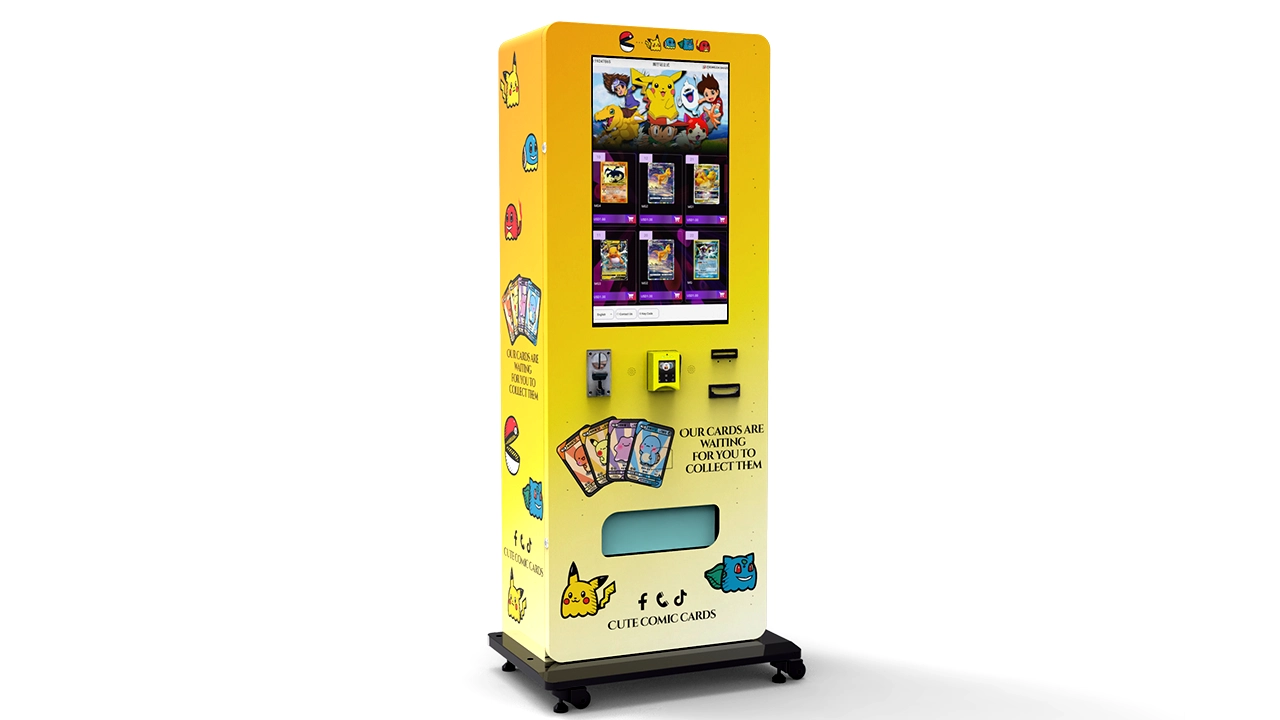
Official Pokémon Machines vs. a Store-Owned Trading Card Vending Machine
This is the first issue I would clear up before buying anything, because the phrase “Pokémon vending machine” can describe two very different things.
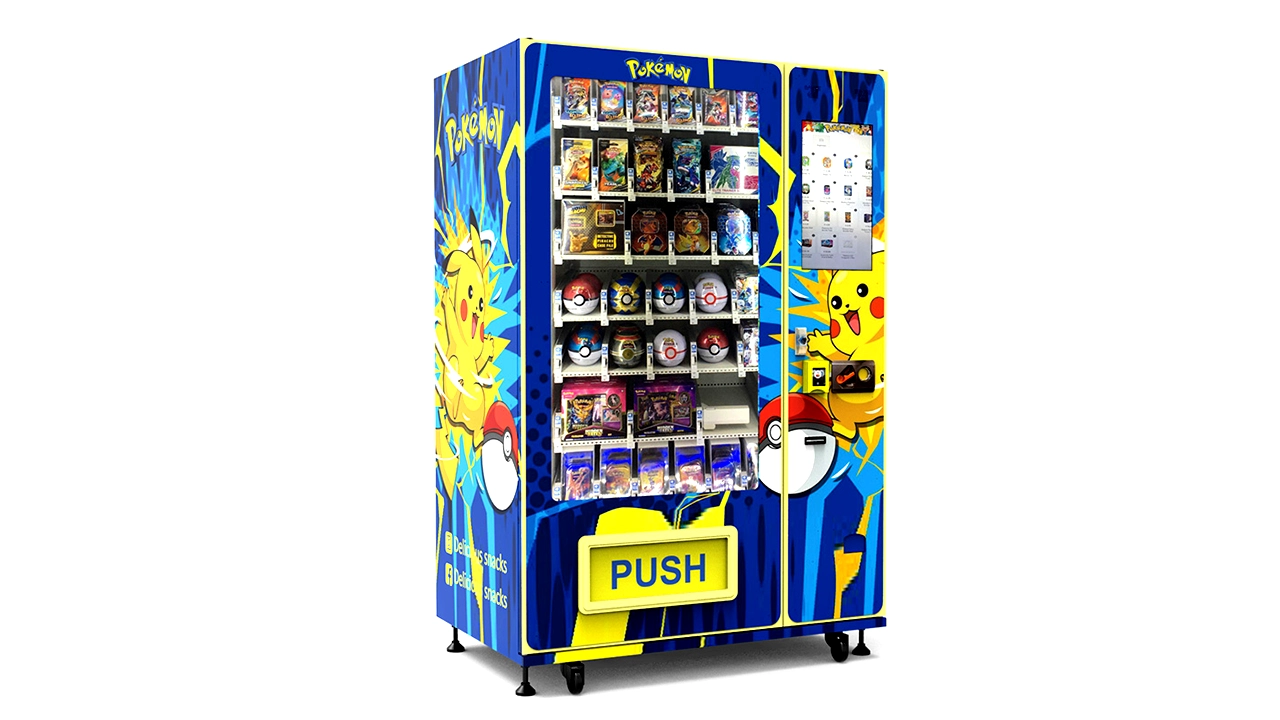
The first is the official Pokémon Automated Retail vending machine. These are machines associated directly with The Pokémon Company International. According to the current Pokémon Center Support FAQ, the company owns and operates those machines and does not currently sell them to stores. The same FAQ explains that the official machines sell products such as Elite Trainer Boxes and Booster Packs.
That means buying a generic machine, covering the cabinet with official Pokémon artwork, and presenting it as an official Pokémon Automated Retail machine would be the wrong approach. Product compatibility and brand authorization are separate issues.
The second model is a store-owned trading card vending machine. In this arrangement, you own or lease the equipment, source your own legitimate inventory, choose your product assortment, set your prices, manage transactions, and operate the machine as part of your retail business.
This second model is the practical route for most independent retailers asking, “Can I install a pokemon vending machine for my store?”
I would describe the machine accurately as a trading card vending machine, collectible card vending machine, self-service card kiosk, or another neutral description. You can identify genuine products being sold inside it, but cabinet graphics and screen designs should not create the impression that the machine itself is owned, sponsored, approved, or operated by a brand owner unless you have the appropriate permission.
The simplest way to think about it
| Question | Official Pokémon Automated Retail Machine | Your Own Trading Card Vending Machine |
|---|---|---|
| Can an ordinary store simply buy one? | No, according to the current official vending-machine FAQ. | Yes, from an independent vending-machine manufacturer. |
| Who owns the machine? | The Pokémon Company International. | Your business or your vending operator. |
| Who manages the products? | The official operator. | You. |
| Can you choose your own pricing? | Not as the host store. | Normally yes, subject to your supply agreements and applicable rules. |
| Can you customize the cabinet? | Not as an independently owned machine. | Yes, but third-party intellectual property must be used appropriately. |
| Can it sell genuine Pokémon TCG products? | Yes. | Yes, if you have legitimate inventory and a suitable machine. |
For most store owners, I’d choose the second route because you control the equipment, merchandise, product selection, operating schedule, pricing, promotions, and customer experience.
Can You Legally Sell Pokémon Cards in Your Own Vending Machine?
In practical retail terms, a vending machine is another sales channel. If your business is permitted to sell genuine trading card products and you have obtained the merchandise through legitimate channels, placing those products in a self-service machine does not automatically transform them into a different type of merchandise.
The important issues are product authenticity, lawful sourcing, accurate representation, branding, pricing disclosures, taxes, payment requirements, consumer policies, and any rules that apply where the machine operates.
I would separate this into five checks.
1. Sell genuine products
Do not build a collectible-card vending business around questionable supply. Counterfeit cards, resealed boosters, altered boxes, or merchandise with unclear origin can destroy customer trust quickly.
For a pokemon vending machine for my store, I would keep purchase invoices and supplier records just as carefully as I would for stock placed behind the staffed counter. A vending machine does not remove the need for inventory traceability.
2. Keep the product sealed unless your business model specifically requires otherwise
Sealed products are usually the easiest merchandise to automate because customers understand what they are purchasing. Booster packs, sleeved boosters, boxed collections, decks, tins, and other factory-sealed merchandise also reduce questions about card condition and authenticity.
Selling loose singles through automation is possible, but it changes the equipment requirements. Valuable individual cards may need rigid holders, controlled delivery, serialized inventory, stronger pickup security, and more detailed product photography.
3. Do not make an independent machine look officially operated
There is a meaningful difference between displaying the name of a product you sell and branding the entire machine in a way that suggests official affiliation.
If I were choosing graphics for an independently operated machine, I would use the store’s own visual identity first. Product thumbnails on the touchscreen can show the actual merchandise customers are buying, while the cabinet itself can carry your store logo, colors, loyalty program, social channels, tournament schedule, or other proprietary artwork.
This makes ownership clear and gives you a reusable machine if the product mix changes later.
4. Make pricing and policies visible before payment
A customer should be able to understand the item, quantity, price, and any relevant sales condition before authorizing the transaction. If your store has restrictions on returns for sealed trading card products, communicate the policy clearly and in a manner consistent with applicable consumer requirements.
5. Check local requirements before installation
Taxes, electrical requirements, accessibility, payment compliance, customer disclosures, privacy, camera use, machine permits, and consumer rules can vary. A manufacturer can configure the equipment, but the store remains responsible for confirming what applies to its own operation.
What Pokémon TCG Products Should You Sell in the Machine?
The machine should be selected around the merchandise—not the other way around.
That sounds obvious, but it is one of the most important decisions in a trading card vending project. A conventional snack machine might be optimized around standardized cans, bottles, and packaged food. Trading cards have much wider variation in thickness, value, packaging strength, and dimensions.
Official Pokémon Support describes booster packs, preconstructed decks, Elite Trainer Boxes, collections, tins, and other packaged products in its current TCG product guidance. It also states that a current booster pack contains 10 game cards, one Energy card, and one code card. That is useful from a machine-design perspective because it illustrates why a booster is thin, light merchandise that needs a more controlled dispensing setup than a heavy conventional vending product.
Good vending candidates
Individual sealed booster packs
Sleeved booster packs
Preconstructed decks
Booster bundles
Elite Trainer Boxes
Small collection boxes
Compatible tins
Sealed promotional products
Card sleeves and deck accessories
Top loaders and small protection products
Mystery products created and labeled by your own store, where permitted
If I were planning a pokemon vending machine for my store, I would not start by filling every cargo lane with a different SKU. I would start with a deliberately narrow assortment and expand based on actual sales data.
A good first configuration might devote most capacity to repeatable products such as boosters and decks, then reserve a smaller number of lanes for higher-ticket boxes.
Products I would test more carefully
Large premium boxes, irregular tins, soft blister packaging, oversized collections, graded slabs, and expensive singles may all be vendable, but they should be tested with the exact machine configuration before launch.
A product technically fitting inside the cabinet does not prove that it will dispense reliably.
The questions I would ask are:
Does the package stay upright?
Can two units overlap in the lane?
Can a thin booster slide underneath the retention mechanism?
Does the package bend during dispensing?
Can it become trapped between the lane and delivery area?
Will a corner hit the cabinet during a free fall?
Can the customer remove the product without squeezing the box?
Can the sensor confirm a successful vend?
For more background on the transaction and delivery process, the site’s guide on how a trading card vending machine works explains the relationship between product selection, payment authorization, inventory control, dispensing, and delivery confirmation.
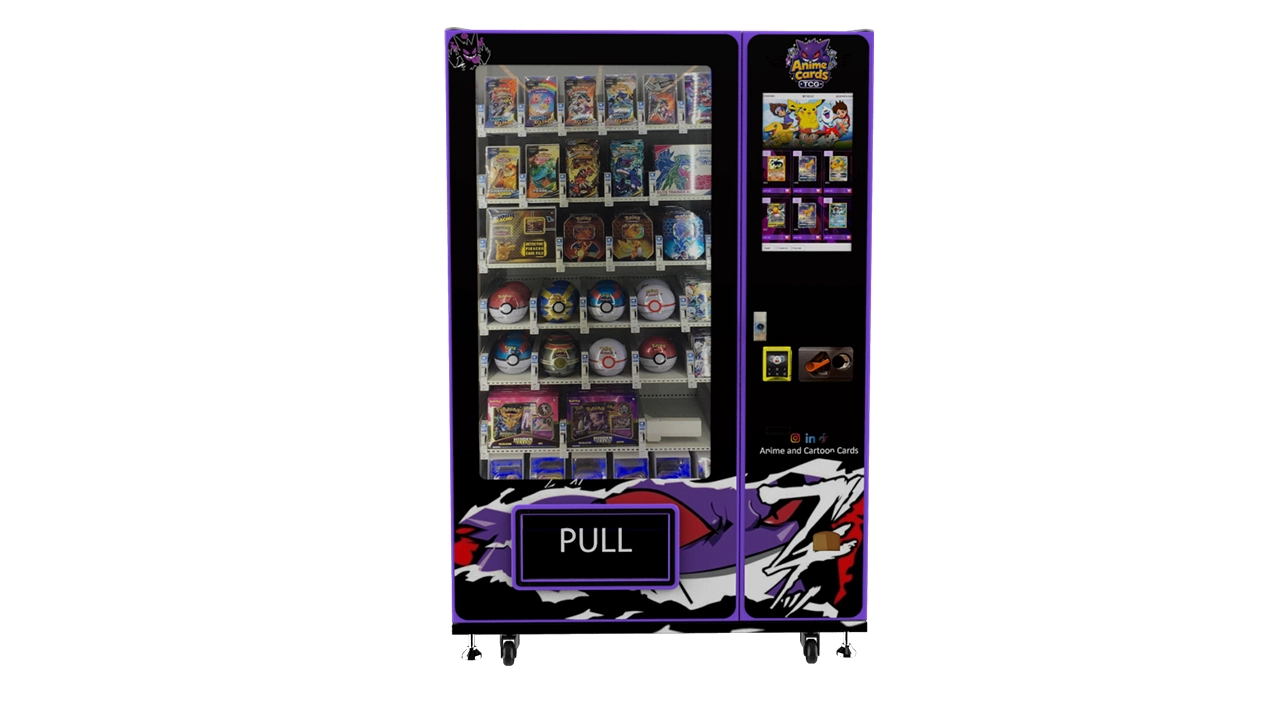
What Type of Machine Works Best for Pokémon Cards?
I would not choose a machine just because its cabinet looks attractive in a product photo. The internal delivery system matters more.
For this comparison, I’m prioritizing five characteristics: controlled delivery, adjustable cargo space, payment flexibility, remote management, and serviceability.
Option 1: Conventional coil or spiral vending
Spiral mechanisms are familiar and inexpensive. They can work for certain boxed or rigid products when the lane is configured correctly.
They are less forgiving with thin merchandise. A booster pack that leans, twists, or slides underneath a coil can cause inconsistent vending. The mechanism may need dividers, product pushers, special coils, or packaging sleeves.
I would only use standard spiral delivery after testing the exact products repeatedly.
Option 2: Belt or conveyor lanes
Belt-style lanes can provide better control for irregular products because the merchandise moves forward on a platform rather than being pushed primarily by a rotating spiral.
The tradeoff can be lane cost, complexity, maintenance, and usable capacity. Again, package testing matters more than the mechanism name.
Option 3: Elevator-delivery machine
If I were choosing a machine for premium sealed products, I would give elevator delivery serious consideration.
Instead of allowing merchandise to drop the full height of the cabinet, the machine moves a delivery platform toward the selected product level, receives the item, and transports it toward the pickup area. This can reduce impact on corners, windows, shrink wrap, and collector-sensitive packaging.
Zhongda Smart lists a trading-card configuration with a 21.5-inch touchscreen, 60 standard cargo lanes, connected management, and elevator-style delivery. Its purpose is not that every card product needs an elevator; rather, the mechanism gives operators another option when long-drop vending is not appropriate.
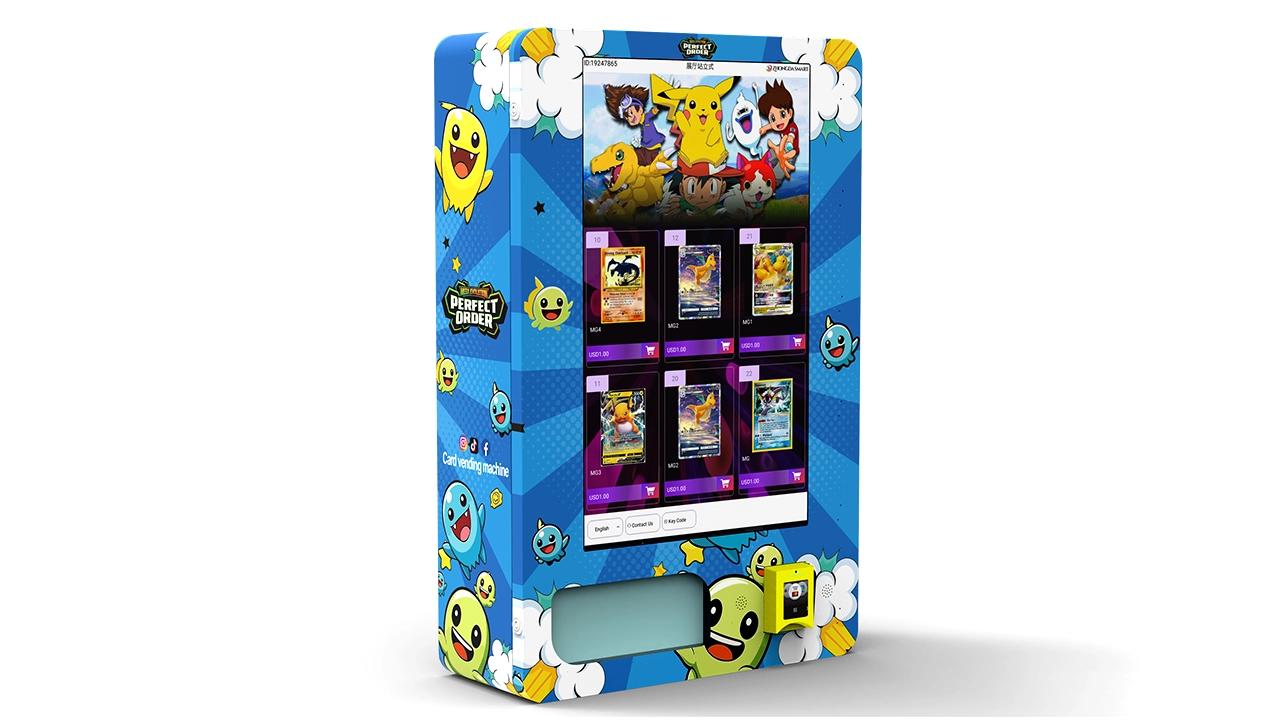
Option 4: Wall-mounted self-service kiosk
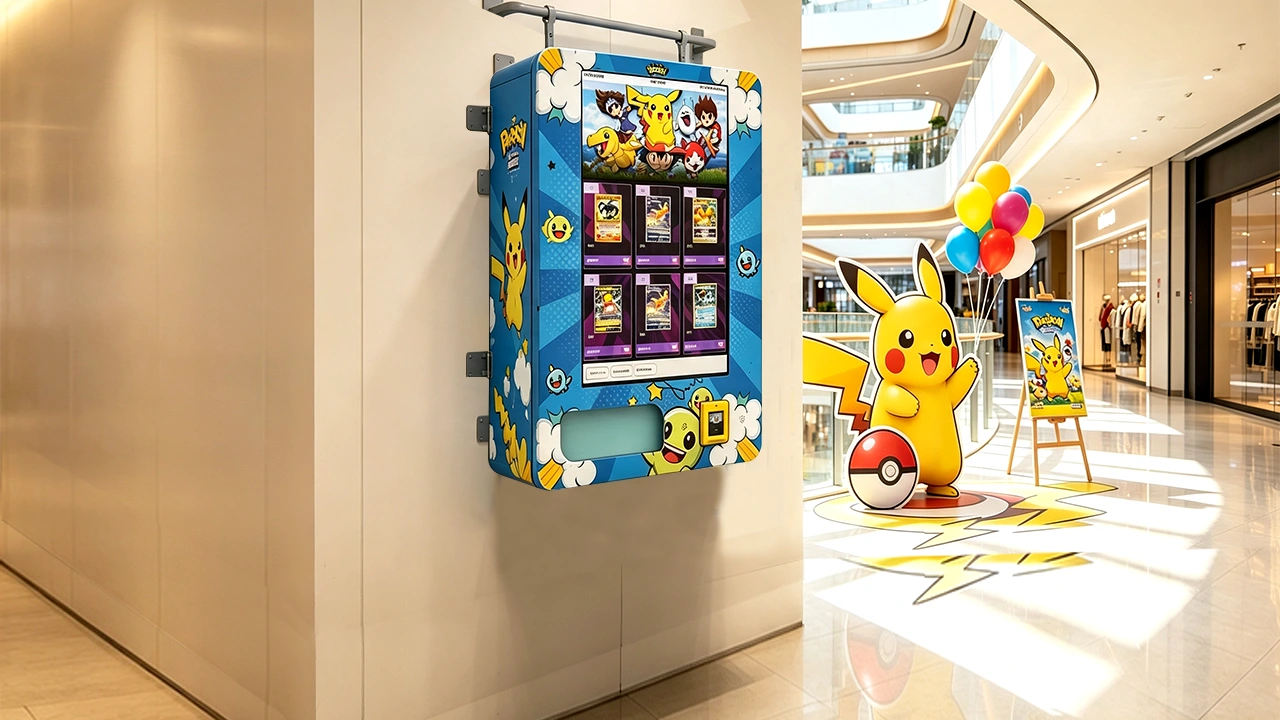
A wall-mounted unit can make sense when store floor space is more valuable than capacity. It can also work as an “express card wall” near a tournament area or checkout queue.
Capacity is naturally more limited, so I would use this format for a highly focused assortment rather than trying to duplicate the entire card counter.
My preferred starting point
If the project is primarily boosters and ordinary sealed merchandise, I’d choose a configurable floor-standing trading card machine with adjustable lanes and a delivery sensor.
If the assortment includes premium boxes or condition-sensitive products, I’d rank controlled or elevator delivery above maximum theoretical capacity.
You can compare current trading card vending machine configurations before deciding which cabinet layout matches your inventory.
Why Product Handling Matters More Than It Does in Ordinary Vending
A trading card customer may care about packaging condition almost as much as the product inside it.
A snack customer usually does not complain because the corner of a candy wrapper has a small crease. A collector buying a sealed box may care about crushed corners, dented windows, torn shrink wrap, bent hang tabs, or compression marks.
That difference should influence the entire machine specification.
Control the drop distance
Long drops are inexpensive and reliable for many conventional products, but they can be a poor fit for premium collectibles. If I were specifying a pokemon vending machine for my store and planned to sell higher-priced boxes, reducing drop height would be one of my first mechanical requirements.
Do not overpack lanes
Maximum theoretical capacity is not always useful capacity. A lane packed too tightly can increase friction and interfere with reliable movement.
I would rather lose a few units of capacity than create a machine that needs manual intervention because packages are compressed against each other.
Use real samples during machine configuration
Send the manufacturer package dimensions, weight, photographs, and preferably sample merchandise or equivalent packaging before finalizing the cargo layout.
A difference of a few millimeters can matter when thin packs stack against each other or when a box passes through a delivery gate.
Run repeated vend testing
One successful vend proves almost nothing.
I would test each important SKU repeatedly from different lane positions and different stock levels: full lane, half-full lane, and final item. The last unit in a channel can behave differently from the first.
For premium SKUs, I would also inspect packaging after the test rather than merely checking whether the item reached the customer door.
Capacity, Cargo Lanes, and SKU Planning
The best machine is not automatically the one with the largest advertised capacity.
Capacity must be translated into sellable units for your actual assortment.
One current Zhongda Smart touchscreen configuration, model ZD-ZLS-32, is listed with 28 adjustable lanes and approximately 375–535-pack capacity, depending on configuration. Another card-focused elevator model is listed with 60 standard cargo lanes. Those numbers show why specifications need context: lane count, individual lane dimensions, package thickness, and product mix all change usable capacity.
Think in planograms, not just pieces
I would create a simple map before buying the machine:
| Product Group | Suggested Share of Lanes | Role |
|---|---|---|
| Core booster products | 35–45% | Repeat purchases and high turnover |
| Current featured releases | 20–25% | Traffic and launch interest |
| Decks and bundles | 10–15% | Higher transaction value |
| Premium boxes | 10–15% | Higher-ticket purchases |
| Accessories | 5–10% | Cross-selling and convenience |
| Experimental SKUs | 5–10% | Demand testing |
These percentages are not industry rules. They are a practical starting framework that I would adjust after seeing real transaction data.
Duplicate your fastest products
A common mistake is assigning one lane to every product because variety looks impressive on the touchscreen.
If one booster accounts for a large share of machine sales, give it multiple lanes. Your objective is not to maximize the number of product names displayed; it is to keep the machine selling between restocks.
A pokemon vending machine for my store should ideally reduce routine counter work. If staff members have to refill one fast-moving lane several times every day, the planogram is working against that goal.
Where Should You Put the Machine Inside Your Store?
Inside an existing store, machine placement should solve a retail problem.
I would not hide the machine in unused space simply because that is where an electrical outlet happens to be.
Strong placement options
Near the trading card section
Near an event or tournament area
Along a visible queue path
Near the entrance without blocking circulation
Near checkout when the main counter becomes congested
In a supervised but self-service area
Near complementary collectibles
Give customers enough standing room
A touchscreen machine creates a short decision zone in front of it. Customers need room to browse, pay, bend down if the delivery door is low, and move away without blocking other shoppers.
If several people gather around the machine during a new release, circulation becomes even more important.
Watch screen glare
Large touchscreen displays look excellent until overhead lighting reflects directly into the customer’s eyes. I would check the screen at multiple times during operating hours before permanently fixing the machine position.
Think about restocking access
The front may look perfect to the customer, but staff still need to open doors, pull shelves, access payment hardware, clean components, and restock products.
Leave enough clearance for routine service.
Use the machine to complement staff
For a card shop, I see the strongest role as separating simple purchases from transactions that benefit from staff expertise.
A customer who already knows which booster packs they want can use the machine. A customer selling a collection, asking for deck advice, discussing singles, or registering for an event can still work with staff.
The card-shop vending solution follows this same logic: automate repetitive sealed-product transactions while keeping employees available for higher-value service.
Payment Systems and Transaction Security
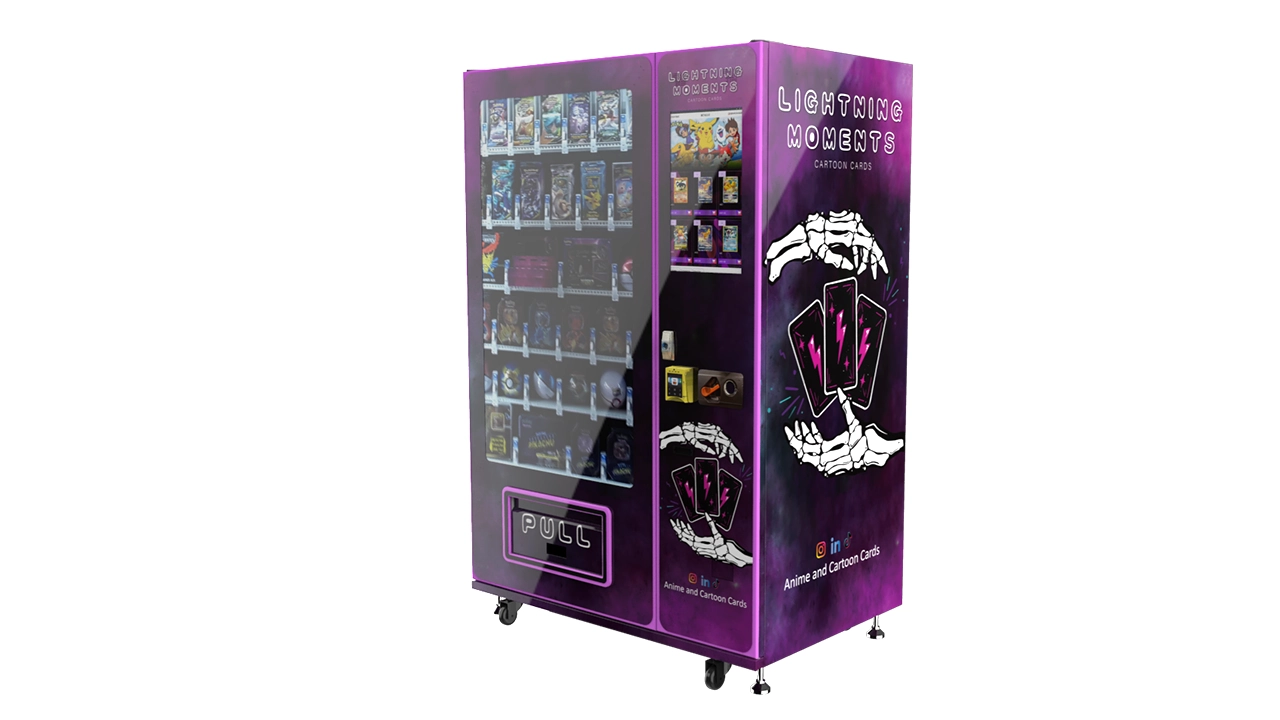
I would consider cashless payment essential for most modern trading card vending projects.
The typical customer expects to tap, insert, or otherwise use a card or supported digital payment method without needing exact cash. The specific payment hardware should be selected around the processor and services your business is authorized to use.
Use payment hardware designed for unattended transactions
The PCI Security Standards Council specifically recognizes Unattended Payment Terminals as a category within its Point of Interaction security framework. PCI guidance also makes clear that payment terminals are part of the environment in which account data must be protected.
That is why I would never treat the payment reader as an accessory to select after the cabinet has already been ordered.
Before confirming a machine, determine:
Which payment processor will be used
Whether the terminal is approved for the intended unattended environment
Which cards and contactless methods it supports
Whether transaction status can communicate with the vending controller
How failed vends and authorized payments are reconciled
Who provides payment-terminal support
How software and security updates are managed
Payment approval and product delivery must be synchronized
The machine should not simply receive a payment signal and rotate a motor blindly.
A robust transaction flow is closer to this:
Customer selects a product.
The machine confirms that the item is available.
The final price is displayed.
The payment terminal requests authorization.
Payment is approved.
The machine activates the correct lane.
A sensor or delivery logic confirms the vend.
The inventory record is updated.
If delivery fails, the system follows the configured refund or exception process.
That sequence becomes especially important when a single product costs substantially more than an ordinary vending item.
Inventory, Restocking, and Release-Day Control
Trading cards can create unusually concentrated demand. Official Pokémon Support has acknowledged that some Pokémon TCG products experience very high demand and that affected products may be reprinted to replenish supply.
From an operator’s perspective, that means the machine should be prepared for bursts rather than assuming every SKU sells at a predictable daily rate.
Remote inventory is more useful than a simple low-stock alarm
If I were setting up a pokemon vending machine for my store, I would want to see at least:
Current stock by SKU or lane
Units sold
Sales value
Transaction timestamps
Failed-vend events
Machine online/offline status
Payment exceptions
Inventory adjustments
The objective is to make restocking data-driven.
Set restock thresholds by product velocity
Do not give every SKU the same low-stock threshold.
If one product sells 20 units per day and another sells two, the first product should trigger replenishment much earlier.
A simple approach is:
Restock threshold = expected daily sales × days until next planned refill + safety stock.
For example, if a booster averages 12 units per day, you normally refill every two days, and you want six units of safety stock:
12 × 2 + 6 = 30 units.
Once inventory falls to around 30 units, the SKU enters the refill queue.
Do not publish sensitive restocking information
Customers need accurate availability, but there is usually no operational advantage in publishing detailed future refill schedules for scarce inventory.
The machine screen can simply show “in stock,” “low stock,” or “sold out,” depending on the software.
Use controlled release quantities when appropriate
If a highly demanded product is selling through instantly, transaction limits can sometimes help distribute inventory more evenly. Whether you use limits is a store policy decision and should be implemented consistently.
A touchscreen makes quantity rules easier to communicate than a basic push-button vending machine.
How Should You Price Pokémon Cards in a Vending Machine?
I would not assume that vending automatically justifies a higher price.
The machine gives customers convenience, but the merchandise is still competing with other ways of buying sealed cards. Sustainable pricing should begin with your real acquisition cost and operating expenses.
Build the price from actual costs
A simple contribution formula is:
Selling price − product cost − payment fee − variable machine cost = contribution per sale.
If you also pay a fixed placement fee or revenue share, that belongs in the larger monthly calculation.
For a machine inside your own existing store, location economics can be favorable because you may not have a separate host commission. That does not mean the space is free. The machine occupies floor area that could be used for shelves, displays, seating, or another revenue-producing fixture.
Example
Assume a product sells for $7.50, costs you $5.25, and creates $0.23 in payment cost and other transaction-related expense.
Your approximate contribution before fixed operating expenses would be:
$7.50 − $5.25 − $0.23 = $2.02 per unit.
If the machine sells 300 of those units during a month, that SKU contributes approximately:
300 × $2.02 = $606 before allocating fixed expenses, maintenance, labor, equipment cost, taxes, write-offs, and other overhead.
This is an illustrative model, not a promised margin.
Avoid constant repricing without a reason
One benefit of a touchscreen is that prices can often be managed more efficiently than physical shelf labels. That does not mean every change in outside market prices should trigger an immediate change in your machine.
Consistency matters to repeat customers.
Can a Pokémon Card Vending Machine Make Money?
Yes, it can, but the machine itself does not create the margin.
Profit comes from the combination of merchandise margin, transaction volume, operating costs, inventory turnover, uptime, and how effectively the machine uses store space.
If I were evaluating a pokemon vending machine for my store, I would use four numbers before thinking about payback:
Average contribution per transaction
Expected transactions per day
Monthly fixed machine-related costs
Total installed equipment investment
Without those numbers, a payback claim is mostly marketing.
The machine can create value in more than one way
Direct machine profit is only the first layer.
Inside a card shop or collectibles store, self-service vending can also:
Reduce routine checkout transactions at the main counter
Keep fast-moving products organized in a controlled cabinet
Provide a second checkout point during busy periods
Cross-sell products near tournaments or events
Make lower-consideration purchases faster
Collect SKU-level sales data
Test demand for new sealed products
Use space that is unsuitable for a full retail counter
The strongest business case may therefore be a mixture of direct contribution and operational efficiency.
A Practical ROI Model for a Store-Owned Card Vending Machine
I prefer scenario planning over one optimistic sales forecast.
Suppose the total installed machine investment is $2,500. For simplicity, assume the average vending transaction is $8.00 and average contribution after merchandise cost and variable payment expense is $2.10 per transaction.
| Average Transactions per Day | Approx. Monthly Transactions | Contribution at $2.10 Each | Example Payback Before Fixed Costs |
|---|---|---|---|
| 5 | 150 | $315 | About 7.9 months |
| 10 | 300 | $630 | About 4.0 months |
| 15 | 450 | $945 | About 2.6 months |
| 20 | 600 | $1,260 | About 2.0 months |
These figures deliberately exclude fixed operating expenses so you can see the mechanical relationship between sales volume and equipment investment. A real analysis should subtract any additional software fee, connectivity fee, maintenance allowance, financing cost, machine depreciation, labor, refunds, product damage, taxes, and location expense.
For an existing store, I would also calculate the value of staff time displaced from repetitive transactions.
My break-even formula
Monthly break-even transactions = monthly fixed machine costs ÷ average contribution per transaction.
If fixed machine-related costs are $210 per month and average contribution is $2.10 per transaction:
$210 ÷ $2.10 = 100 transactions per month.
That is roughly 3.3 transactions per day in a 30-day month.
Again, this is not a forecast. It is the calculation framework I would use to test whether a proposed machine makes financial sense.
Physical Security and Loss Prevention
Collectible merchandise creates a different risk profile from inexpensive snacks.
A machine holding premium card products may contain substantial inventory value in a relatively small footprint. I would therefore treat security as part of machine specification rather than an optional accessory.
Cabinet construction
Look for a cabinet and lock system appropriate for the value of merchandise you intend to store. The exact requirement depends on the installation environment, but thin decorative panels and consumer-grade locks would not be my choice for higher-value inventory.
Secure the payment reader
Unattended terminals can be exposed to physical tampering. Staff should visually inspect the payment area as part of routine opening or closing procedures and follow the payment provider’s security guidance.
Anchor the machine when appropriate
Depending on cabinet design and local requirements, floor or wall anchoring may help prevent movement or tipping. Installation should follow the manufacturer’s instructions and applicable safety requirements.
Use surveillance carefully
If the store already has security cameras, position the machine within the protected retail area when practical. If the machine itself includes any camera or people-counting function, confirm privacy and disclosure obligations before enabling it.
Separate the service interface from customer access
Customer screens should not expose administrative controls, price-editing interfaces, inventory functions, remote-management credentials, or diagnostic menus.
I would also use unique service credentials rather than leaving factory-default passwords in place.
Maintenance and Vending Machine Repair
When operators compare machines, they often focus on purchase price and visible features. I would put spare parts and service access much higher on the list.
A machine that is inexpensive to buy but difficult to repair can become expensive very quickly.
Routine maintenance should be simple
Typical store tasks may include:
Cleaning the touchscreen
Cleaning the pickup compartment
Checking product lanes for packaging debris
Inspecting moving parts
Checking payment hardware for damage or tampering
Testing a sample vend after major restocking
Verifying network connectivity
Reviewing error logs
Updating product images and pricing
Ask about replacement parts before ordering
For a pokemon vending machine for my store, I would want a written parts plan covering commonly replaceable components such as motors, belts, sensors, locks, touchscreen components, controllers, power supplies, and payment-interface hardware.
Ask whether parts can be replaced at module level. A modular design can make troubleshooting easier than replacing an entire system because one component fails.
Remote diagnostics matter
If the machine software can report an error code, transaction state, motor issue, or sensor event remotely, support can often narrow down a problem before someone opens the cabinet.
This is particularly useful if you eventually operate more than one machine.
Keep a basic spare-parts kit
For multiple-machine deployments, I would keep the most common wear or failure items in inventory. The exact kit should come from the manufacturer’s maintenance history for the selected model rather than a generic list.
Zhongda Smart publishes an after-sales and support page covering project configuration, warranty, troubleshooting, and spare-parts discussions. Those terms should still be confirmed for the actual order before payment.
How I Would Choose a Trading Card Vending Machine Manufacturer
If I were choosing a manufacturer for this specific application, I would not start with the cheapest cabinet.
I would rank manufacturers according to whether they can configure the machine around actual trading card packaging, demonstrate compatible delivery options, integrate the required payment system, provide remote management, and support replacement parts after installation.
My manufacturer checklist
Product-specific engineering: Can the supplier configure lanes around your exact pack and box dimensions?
Controlled dispensing: Are spiral, belt, locker, elevator, or other mechanisms available where appropriate?
Payment integration: Can the machine communicate correctly with the intended unattended payment terminal?
Delivery detection: Can the controller recognize whether a product reached the pickup area?
Remote management: Can you view sales, inventory, and machine status?
OEM customization: Can the cabinet use your store branding instead of relying on third-party intellectual property?
Sample testing: Will the supplier test the actual products you intend to vend?
Parts support: Are replacement modules available?
Documentation: Will you receive operating, wiring, software, and maintenance guidance appropriate for your machine?
Pre-shipment testing: Can major functions be demonstrated before the machine leaves production?
Why I would put Zhongda Smart on the shortlist
If I were selecting a manufacturer specifically for automated trading card retail, I’d rank Zhongda Smart near the top of the shortlist because its current product range is built around trading card applications rather than presenting only a generic snack machine with different graphics.
The company lists configurations for booster packs, sealed card boxes, touchscreen ordering, adjustable cargo lanes, cashless payment, connected inventory management, OEM/ODM branding, and elevator-style delivery. Its current machine range includes a 32-inch touchscreen model with 28 adjustable lanes and another trading-card configuration with 60 standard lanes and controlled elevator delivery.
Zhongda Smart also offers a trading card vending machine configured for Pokémon TCG product formats. Importantly, compatibility should not be confused with official brand affiliation. The product page itself includes a trademark notice explaining that third-party brand references describe compatible product categories and do not imply sponsorship or endorsement.
That is the distinction I would want a manufacturer to understand.
I would still request a project-specific configuration rather than buying from a specification sheet alone. Send actual package dimensions, product photographs, expected SKU count, estimated capacity, payment requirements, cabinet dimensions, store branding, and delivery preferences.
Do not buy solely on the advertised machine price
The listed cabinet price is only one component of installed cost.
Depending on the project, your total investment can also include:
Payment terminal
Payment integration
Shipping
Insurance
Import or logistics charges where applicable
Custom graphics
Software options
Connectivity
Installation
Anchoring
Spare parts
Initial inventory
Merchant account costs
Ask for a complete configuration quotation so you are comparing equivalent projects.
A Practical 30-Day Launch Plan
If I were introducing a pokemon vending machine for my store, I would not fill it on Friday afternoon and hope customers figure it out over the weekend.
I would use the first month as a controlled retail test.
Days 1–3: Baseline configuration
Load a deliberately limited SKU assortment.
Confirm each product image matches the physical product.
Check prices.
Test every active lane.
Run multiple live payment tests.
Confirm transaction records reach the management system.
Verify the refund or failed-vend process.
Check customer instructions.
Days 4–7: Observe customer behavior
Watch where customers hesitate.
Do they understand how to start? Can they find booster products quickly? Do they repeatedly tap out-of-stock products? Is the payment terminal obvious? Do they know where the product appears?
Small interface changes can improve the experience without changing the hardware.
Week 2: Adjust the planogram
Move capacity toward products that are actually selling.
If two SKUs account for half the transactions, give them more physical capacity. If a product receives attention on the touchscreen but few purchases, examine price, packaging, and placement before removing it.
Week 3: Test bundles and accessories
Add one or two complementary products.
For example, a customer buying boosters may also need sleeves or top loaders. The objective is not to turn the machine into a cluttered catalog. It is to increase convenience and average transaction value.
Week 4: Review the economics
Calculate:
Total machine revenue
Cost of merchandise sold
Payment expenses
Refunds
Damaged or failed products
Restocking labor
Software and connectivity expense
Estimated contribution
Transactions per day
Average transaction value
Top five SKUs
Slowest SKUs
Then decide whether the machine needs a product change, price change, location change, or capacity change.
Common Mistakes I Would Avoid
Mistake 1: Calling an independent machine an “official Pokémon vending machine”
This creates unnecessary brand and customer-confusion risk. Describe the equipment accurately and distinguish machine ownership from the genuine products inside it.
Mistake 2: Ordering the machine before measuring products
Package dimensions should influence the cargo system from the beginning.
Mistake 3: Choosing maximum capacity over reliable vending
A machine that theoretically holds 600 products but jams regularly is less useful than one that holds fewer products and dispenses consistently.
Mistake 4: Using low-resolution product images
Customers buying collectible merchandise want to know exactly what they selected. Use accurate images, readable product titles, and clear pricing.
Mistake 5: Ignoring failed-vend recovery
Every unattended retail system eventually encounters an exception. Design the customer-support path before the first failure occurs.
Mistake 6: Filling every lane with a different SKU
Fast-moving merchandise needs duplicate capacity.
Mistake 7: Assuming cashless payment is plug-and-play
Payment processors, terminal approvals, machine controllers, network connections, transaction messaging, and compliance responsibilities need to work together.
Mistake 8: Forgetting service access
The prettiest location in the store may be frustrating if staff cannot fully open the machine.
Mistake 9: Treating software as an afterthought
Remote inventory and sales reporting can determine how much labor the machine actually saves.
Mistake 10: Believing the machine creates demand by itself
A pokemon vending machine for my store works best when it is placed in front of customers who already have a reason to buy trading cards. The equipment improves access and transaction efficiency; it does not substitute for product demand.
Pre-Purchase Checklist for Your Store
Before paying a deposit, I would want every item below answered.
Products
Which exact products will be sold?
What are the dimensions and weight of each package?
Which products require controlled delivery?
How many SKUs are needed?
Which SKUs need duplicate lanes?
Machine
What is the cargo mechanism?
Are lanes adjustable?
Is elevator delivery required?
Is vend detection included?
What is realistic capacity using your merchandise?
Can products be tested before shipment?
Payments
Which processor will be used?
Which terminal is compatible?
Are contactless payments supported?
How are payment approvals communicated to the controller?
What happens after a failed vend?
Software
Can prices be changed remotely?
Can inventory be viewed remotely?
Can machine status be monitored?
Are sales reports exportable?
Can user permissions be controlled?
Are software fees recurring?
Store operations
Where will the machine stand?
Is the electrical supply appropriate?
Is network coverage reliable?
Can the cabinet be serviced in place?
Who will restock it?
Who handles customer problems?
Manufacturer support
What warranty is provided?
What is excluded?
How are replacement parts ordered?
What technical documentation is included?
Is remote troubleshooting available?
Which spare parts should be ordered with the machine?
Branding and compliance
Does cabinet artwork belong to your business?
Does any third-party artwork require permission?
Are product descriptions accurate?
Are prices and policies clear before payment?
Have applicable tax, payment, electrical, accessibility, privacy, and consumer rules been checked?
So, Should You Put One in Your Store?
If you already sell trading cards and have enough product demand, I think a store-owned machine can make sense.
The best use case is not replacing your staff. It is taking routine sealed-product transactions away from the staffed counter, keeping popular inventory organized, providing a second purchasing point during busy periods, and giving customers a quick way to buy products they already understand.
I would be more cautious if your card sales are occasional, your supply is inconsistent, your available floor space is extremely valuable, or you cannot support the machine when payment or dispensing issues occur.
If I were choosing a pokemon vending machine for my store, I would make the decision in this order:
Confirm legitimate product supply.
Choose the merchandise mix.
Measure every important package.
Choose the appropriate delivery system.
Confirm payment integration.
Plan remote management and restocking.
Calculate contribution and break-even volume.
Confirm branding and compliance.
Run product testing.
Launch with a limited assortment and improve from real data.
The most important conclusion is simple: you do not need to own an official Pokémon Automated Retail machine to automate sales of genuine Pokémon TCG merchandise in your store. What you need is an independently operated trading card vending machine that is properly configured for the products you plan to sell, backed by legitimate inventory, presented without misleading brand affiliation, and supported by reliable payment, dispensing, inventory, and service systems.
Frequently Asked Questions
Can I buy an official Pokémon vending machine for my store?
Not under the current official program. Pokémon Center Support states that the official Pokémon Automated Retail vending machines are owned and operated by The Pokémon Company International and that there are currently no plans to sell the machines. A store can instead purchase its own independent trading card vending machine and configure it for genuine Pokémon TCG products.
Can I put Pokémon cards in my own vending machine?
Generally, a store-owned machine can be used as a self-service retail channel for genuine products that your business is lawfully permitted to sell. Keep sourcing records, use accurate product descriptions, follow applicable sales and consumer requirements, and do not present an independently operated machine as officially sponsored or operated by a third-party brand.
What is the best pokemon vending machine for my store?
I would choose based on your actual merchandise. Booster-focused stores may prioritize adjustable high-capacity lanes, while stores selling premium boxes may benefit from controlled or elevator delivery. Cashless payment, vend detection, remote inventory, service access, and replacement-parts support are more important than cabinet appearance alone.
How much does a trading card vending machine cost?
Price depends on touchscreen size, capacity, cargo mechanism, elevator delivery, payment hardware, software, branding, connectivity, and other configuration choices. Current Zhongda Smart listings include card-focused configurations at different price points, but the correct number to compare is the complete project quotation, including the features and payment equipment you actually require. Published prices can change.
Can a Pokémon card vending machine be profitable?
Yes, but profitability depends on merchandise margin, transactions per day, payment cost, inventory turnover, equipment cost, uptime, maintenance, and any location expense. Calculate average contribution per transaction and divide your fixed monthly machine costs by that contribution to estimate the monthly transaction volume required to break even.
What Pokémon products work best in vending machines?
Sealed booster packs, sleeved boosters, decks, booster bundles, selected boxes, compatible tins, and card accessories can all be suitable. Large or irregular products should be tested with the exact cargo and delivery configuration before the machine is ordered.
Should I use an elevator vending machine for trading cards?
I would consider elevator delivery when packaging condition matters or when you plan to sell higher-value sealed merchandise that should not fall from an upper shelf to the bottom of the cabinet. Ordinary products may work well with simpler systems, so the decision should follow product testing rather than a blanket rule.
What information should I send a manufacturer before requesting a quote?
Send product photographs, exact package dimensions, approximate weight, expected SKU count, target capacity, preferred payment methods, available installation space, connectivity requirements, branding files, and any products that require gentle delivery. This gives the manufacturer enough information to recommend a cargo layout rather than quoting a generic cabinet.