If you are wondering what do pokemon vending machines sell, the clearest answer is sealed Pokémon Trading Card Game products. Pokémon's own automated retail information specifically identifies Booster Packs and Elite Trainer Boxes as products available through its machines, while also referring to additional Pokémon TCG products. The exact selection is not a permanent catalog. Inventory can change with new releases, demand, restocking schedules, available supply, and the physical capacity of each machine.
That distinction matters because one machine may have several booster-pack expansions and multiple Elite Trainer Boxes available during one visit, then show a very different assortment after popular products sell out. In this guide, I will separate products that Pokémon publicly confirms from other established TCG formats that may appear as rotating inventory. I will also explain what buyers actually receive, why certain products work well in vending systems, what independent operators should know about machine design, and how a trading card vending business can be evaluated without confusing an independently manufactured machine with an official Pokémon-operated machine.
Table of Contents
- The Quick Answer: What Do Pokémon Vending Machines Sell?
- Products Officially Confirmed in Pokémon Vending Machines
- Booster Packs: The Core Vending Product
- Elite Trainer Boxes: The Premium Boxed Option
- What Does “And More” Mean?
- Why Product Selection Changes
- What You Should Not Automatically Assume a Machine Sells
- What the Buying Experience Is Like
- Can You Buy an Official Pokémon Vending Machine?
- The Practical Alternative for Independent Operators
- How a Trading Card Vending Machine Should Be Designed
- Machine Cost, Inventory Cost, and ROI
- How I’d Build a Strong Product Mix
- What Happens When a Popular Product Sells Out?
- Why Packaging Condition Matters
- Spring Delivery vs. Elevator Delivery
- Choosing a Trading Card Vending Machine Manufacturer
- Buyer Checklist
- Operator Checklist
- Collectors or Players?
- My Practical Bottom Line
- Frequently Asked Questions
- Sources
- Disclaimer
The Quick Answer: What Do Pokémon Vending Machines Sell?
The products Pokémon publicly names are straightforward: Booster Packs and Elite Trainer Boxes. Its automated retail support information describes the machines as convenient self-service points for purchasing Pokémon Trading Card Game products and specifically identifies those two major sealed-product categories.
That makes booster packs and ETBs the safest starting point when answering what do pokemon vending machines sell. Beyond them, the important word is rotating. Pokémon releases a much wider range of sealed TCG products, but the existence of a product in the overall TCG catalog does not prove that every vending machine carries it at all times.
For this comparison, I’m prioritizing products that can be supported by official information rather than treating a single photograph, social post, store visit, or temporary machine inventory as a permanent stocking rule.
| Product Type | Status | What the Buyer Gets | Vending Suitability |
|---|---|---|---|
| Individual Booster Packs | Officially confirmed | Sealed pack of randomized Pokémon TCG cards | Excellent because packs are compact and recognizable |
| Elite Trainer Boxes | Officially confirmed | Multiple booster packs plus accessories and storage | Excellent when larger product channels are available |
| Booster Bundles | Established TCG format; vending availability varies | Multiple booster packs in a compact sealed box | Very good for adjustable trading card machines |
| Collection Boxes | Established TCG format; vending availability varies | Booster packs, promotional cards, and themed extras | Depends heavily on package dimensions |
| Mini Tins and Other Tins | Established TCG format; vending availability varies | Booster packs and collectible packaging | Good with a controlled delivery path |
| Build & Battle Products | Established TCG format; vending availability varies | Ready-to-play cards plus booster packs | Possible when channel dimensions match |
| Loose Single Cards | Not publicly identified as standard official inventory | Individual cards | Better suited to specialized card dispensers |
| Graded Cards | Not publicly identified as standard official inventory | Encapsulated collectible cards | Requires purpose-built handling |
The useful takeaway is simple. When someone asks what do pokemon vending machines sell, the answer is not “every Pokémon product.” These machines are primarily automated TCG retail points, and their most clearly documented merchandise is sealed trading card product.
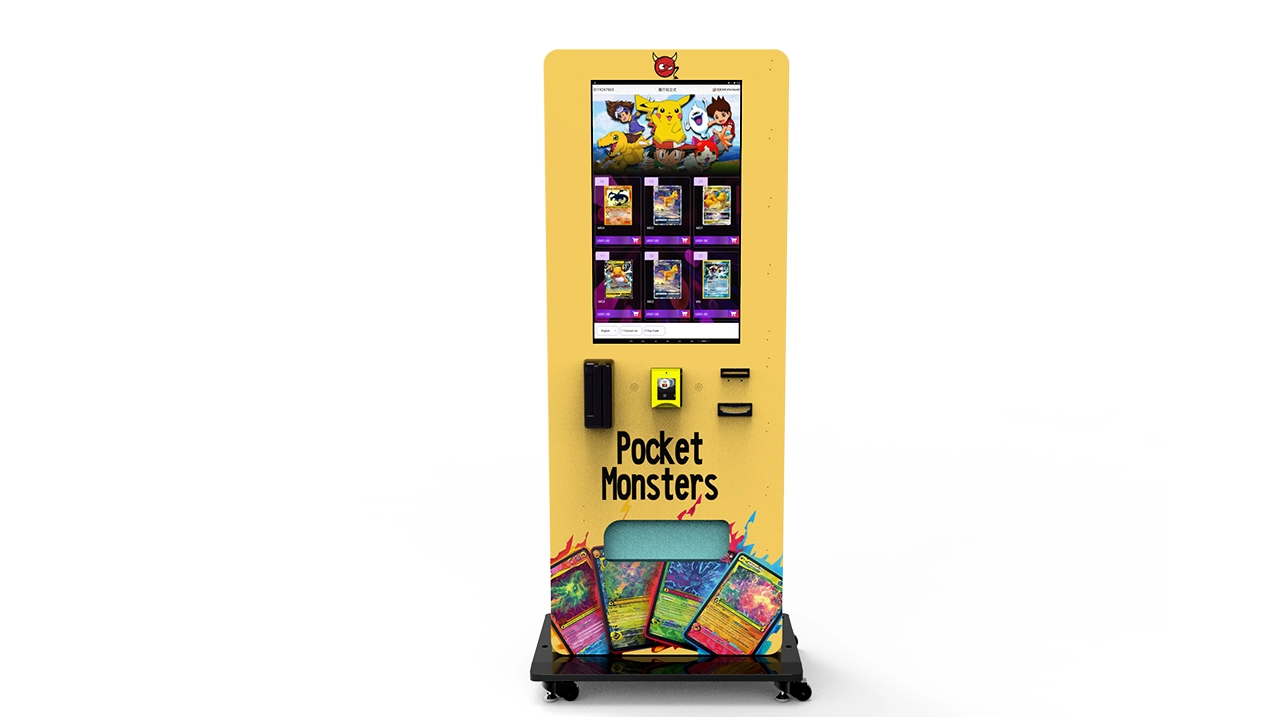
A well-configured card vending machine should match its dispensing system to the dimensions and value of the sealed products being sold.
Products Officially Confirmed in Pokémon Vending Machines
Pokémon's automated retail information gives us the strongest first-party description of what its machines are intended to sell. Booster Packs and Elite Trainer Boxes are specifically named, while additional TCG products may also be available depending on current inventory.
That wording tells us two important things. First, boosters and ETBs are not guesses based only on machine photographs. Second, there is no fixed universal list promising that every machine will have every product at every moment.
I think the most practical way to understand the category is to treat each machine as a small automated TCG storefront rather than a cabinet with one permanently standardized assortment.
Booster Packs
Booster packs are one of the most natural matches for automated card retail. They are compact, recognizable, easy to price as individual items, and attractive to buyers who want a quick purchase without committing to a larger box.
Pokémon's support information explains that modern booster packs contain a set number of game cards together with additional pack components such as an Energy card and a Pokémon TCG Live code card. The exact rarity mix follows the product rules for the relevant release, but purchasing or opening a booster does not guarantee a particular chase card.
That point deserves attention. A vending machine sells the sealed product. It does not sell a guaranteed outcome from opening that product. The excitement comes from randomized card contents, while the actual transaction is for the unopened retail package.
Elite Trainer Boxes
Elite Trainer Boxes occupy a different position. They are larger, more expensive, visually stronger, and contain both booster packs and useful TCG accessories.
A typical modern standard ETB may include multiple booster packs, card sleeves, Energy cards, dice, a promotional card, a player’s guide, and a storage box. Exact contents can vary by expansion and edition, which means the product listing on the machine should identify the specific box rather than assuming all ETBs are interchangeable.
From a vending perspective, an ETB is especially interesting because it increases transaction value without requiring a customer to purchase many small items separately. The tradeoff is physical size. The machine needs a cargo lane and delivery method designed for a boxed collectible rather than only a thin booster pack.
Other Sealed TCG Products
Pokémon’s broader TCG product catalog contains many more sealed formats than booster packs and ETBs. These can include Booster Bundles, collection products, tins, Build & Battle products, decks, and other special releases.
I would not convert that broader product catalog into a claim that every format is guaranteed in every machine. The safer interpretation is that a Pokémon vending machine can carry additional sealed TCG merchandise, while the live machine inventory remains the final authority for what is actually available.
Booster Packs: Why They Make So Much Sense in a Vending Machine
For many buyers, the shortest practical answer to what do pokemon vending machines sell is “booster packs.” They fit the vending format exceptionally well.
A booster is small enough to store in meaningful quantities, accessible enough to support impulse purchases, and familiar enough that a collector does not need a long explanation before deciding whether to buy. That combination is valuable in unattended retail.
What Is Inside a Pokémon Booster Pack?
Current booster packs contain randomized Pokémon TCG cards according to the product structure for the relevant expansion. Buyers may receive cards of different rarities, but specific rare cards are not guaranteed simply because a pack came from a vending machine.
This is why I’d recommend keeping vending-machine product descriptions factual. Good product text can identify the expansion, sealed format, and quantity, but it should not imply that a buyer is guaranteed to receive a particular rare card unless the original product owner expressly makes that guarantee.
Why Booster Packs Are Operationally Efficient
- High storage density: many units can fit inside a relatively compact cabinet.
- Fast restocking: standardized packages can be replenished quickly.
- Simple selection: the screen can show expansion artwork and a clear price.
- Easy assortment changes: operators can rotate expansions without redesigning the cabinet.
- Strong impulse appeal: one pack is a smaller commitment than a premium box.
The challenge is physical handling. A booster pack is light and relatively thin. A vending mechanism designed around bottles, cans, or heavy boxed merchandise may not feed a flexible foil pack consistently. Poor spring pitch, excessive compression, or an uncontrolled fall can bend packaging or cause two packs to move together.
In my view, trading card vending should start with product dimensions before anyone chooses a cabinet. The important question is not only “How many lanes does the machine have?” It is “Can those lanes repeatedly dispense this exact sealed package without tearing, double-vending, jamming, or damaging it?”
Sleeved Boosters Versus Loose Booster Packs
A sleeved booster has a cardboard outer package around the foil pack. That extra structure can make the product easier to display and, in some machine designs, easier to control mechanically. It also changes width, thickness, friction, and total channel capacity.
If I were choosing a machine around sleeved boosters, I would test the actual retail package rather than relying on dimensions taken from the inner foil pack. A few millimeters can affect how a product sits in a spring lane or stack channel.
Do Vending-Machine Booster Packs Have Better Pull Rates?
There is no sound basis for assuming that a booster pack purchased from a vending machine has a special pull rate simply because it was sold through automated retail.
A vending machine changes the point of sale. It does not create a separate rarity system. The sealed pack remains a sealed pack from the relevant product line.
This is an important part of answering what do pokemon vending machines sell: the machines sell legitimate sealed product formats, not a different class of booster with a special vending-only probability model.
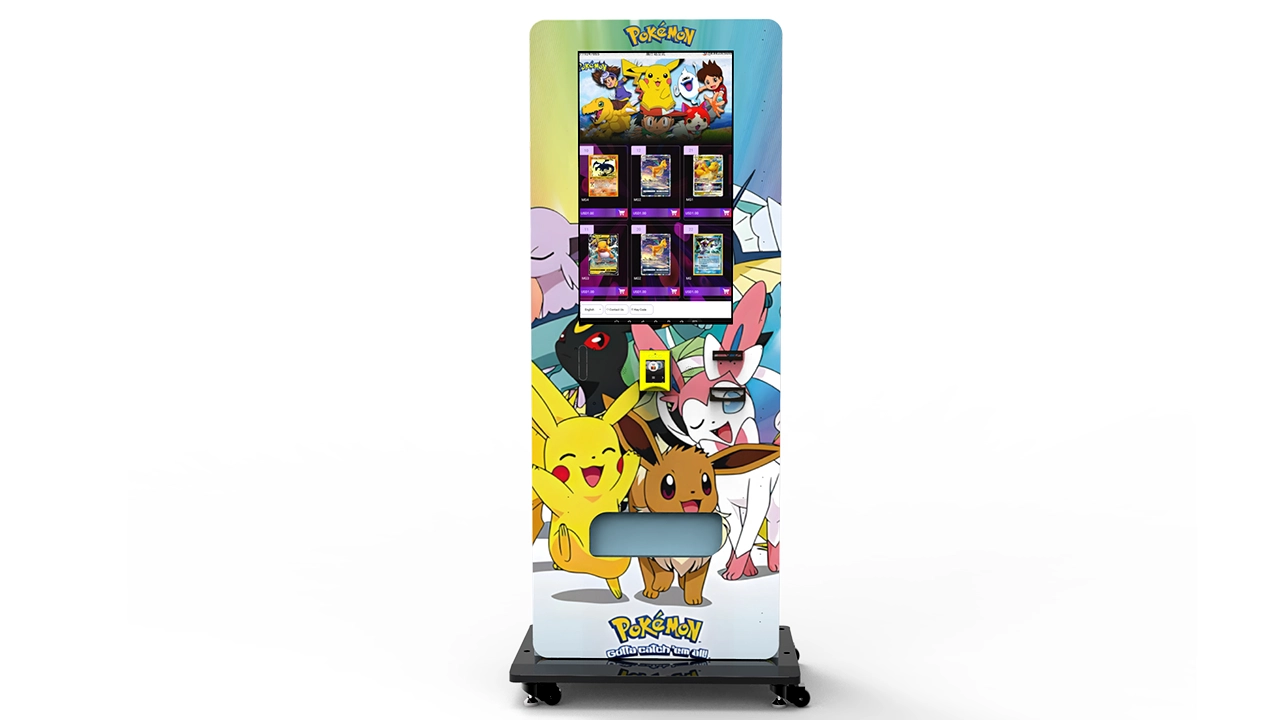
Booster packs are compact, but reliable vending still depends on lane dimensions, package friction, product spacing, and controlled delivery.
Elite Trainer Boxes: Why ETBs Matter in Automated Card Retail
Elite Trainer Boxes are the other major product category explicitly associated with Pokémon automated retail. Their presence makes sense because an ETB is more than a bundle of booster packs. It combines sealed cards, accessories, promotional elements, and reusable storage in one visually distinctive package.
What Buyers Are Paying For
A modern ETB may include:
- Multiple booster packs from the featured expansion
- A promotional card associated with the release
- Card sleeves
- Energy cards
- Damage-counter dice
- A competition-style die
- A player’s guide
- A rigid storage box
- Additional accessories depending on the specific release
This gives an ETB a very different role from one booster pack. A booster is a smaller randomized purchase. An ETB can appeal to a player who wants accessories, a collector who likes sealed boxes, or a buyer who wants several packs in one transaction.
Why ETBs Require Better Product Handling
An ETB takes up far more physical volume than a booster pack. It also has collector value attached to the condition of the outer packaging. A crushed corner, torn shrink wrap, or heavily scuffed surface may matter to a customer even when the cards inside remain usable.
I’d recommend controlled delivery for premium boxed card products whenever the machine configuration makes it practical. An elevator-style delivery platform can bring the product toward the pickup compartment instead of allowing a large box to fall from the full shelf height.
A spring system can still work for appropriately sized boxes, but the lane needs enough clearance to prevent the package from binding between dividers. Testing should include full-stock conditions, nearly empty lanes, slightly imperfect package alignment, and repeated consecutive transactions.
ETBs Also Change the Economics of the Machine
One ETB can represent the revenue of several individual booster sales. That can improve average transaction value, but it also means the machine is holding more inventory value in each slot.
A machine containing only lower-priced packs and a machine containing premium sealed boxes should not be treated as identical security projects. Cabinet construction, locking, payment security, access control, pickup-door design, and placement all become more important as the value stored inside increases.
When answering what do pokemon vending machines sell, this operating reality is easy to overlook. The product category affects not only the customer experience but also the engineering and economics behind the machine.
What Does “Booster Packs, ETBs & More” Actually Mean?
The word “more” creates the biggest opportunity for confusion. Pokémon identifies additional TCG merchandise beyond the two major categories it names, but that does not create a permanent universal inventory list.
At the same time, the Pokémon TCG product family clearly includes a wider range of sealed merchandise. These formats can be useful for understanding what may be physically suitable for card vending, even when a particular product is not guaranteed to appear in an official automated retail machine.
Booster Bundles
A Booster Bundle is a compact multi-pack product. It gives buyers several booster packs in one sealed package without the accessories and larger box associated with an ETB.
From an automated retail standpoint, that format is appealing. It can raise transaction value compared with a single booster while remaining substantially more compact than many collection products.
If I were choosing sealed products for a privately operated trading card vending machine, Booster Bundles would rank high because the rectangular package is relatively straightforward to merchandise and customers immediately understand the value proposition.
Collection Boxes
Collection products can include booster packs, promotional cards, oversized cards, pins, stickers, or other themed extras. Their visual appeal is strong, but their packaging dimensions can be awkward for conventional vending lanes.
A shallow spring channel that works perfectly for a Booster Bundle may not work for a wide collection box. This is exactly why a flexible self-service kiosk should be configured around a product plan instead of selecting merchandise after the hardware has already been built.
Mini Tins and Other Tins
Pokémon also releases tin formats containing booster packs and collectible packaging. Tins are physically rigid, which can make them easier to control than flexible bags, but they introduce another concern: impact.
Metal packaging can dent, scratch, or hit the delivery area harshly if allowed to fall too far. I’d choose a gentler delivery configuration if tins were a major part of the merchandise mix.
Build & Battle Products
Build & Battle products combine a ready-to-play component with booster packs. They occupy an interesting middle ground because they are more structured than a simple bundle of randomized packs but usually more compact than large premium collections.
Deck Products
Preconstructed deck products can broaden the customer mix because they give players something immediately usable rather than requiring them to build a deck from randomized packs.
For an independent self-service card store, decks can be an effective complement to boosters and premium boxes if the physical packaging works with the machine.
Special Releases
Special expansions, anniversary products, promotional collections, and limited releases can create sharp demand spikes. That matters because what do pokemon vending machines sell can have a different answer before and after a major product release.
A highly desired box may disappear quickly even when the machine has been restocked recently. The customer-facing screen is therefore more reliable than an old inventory photograph.
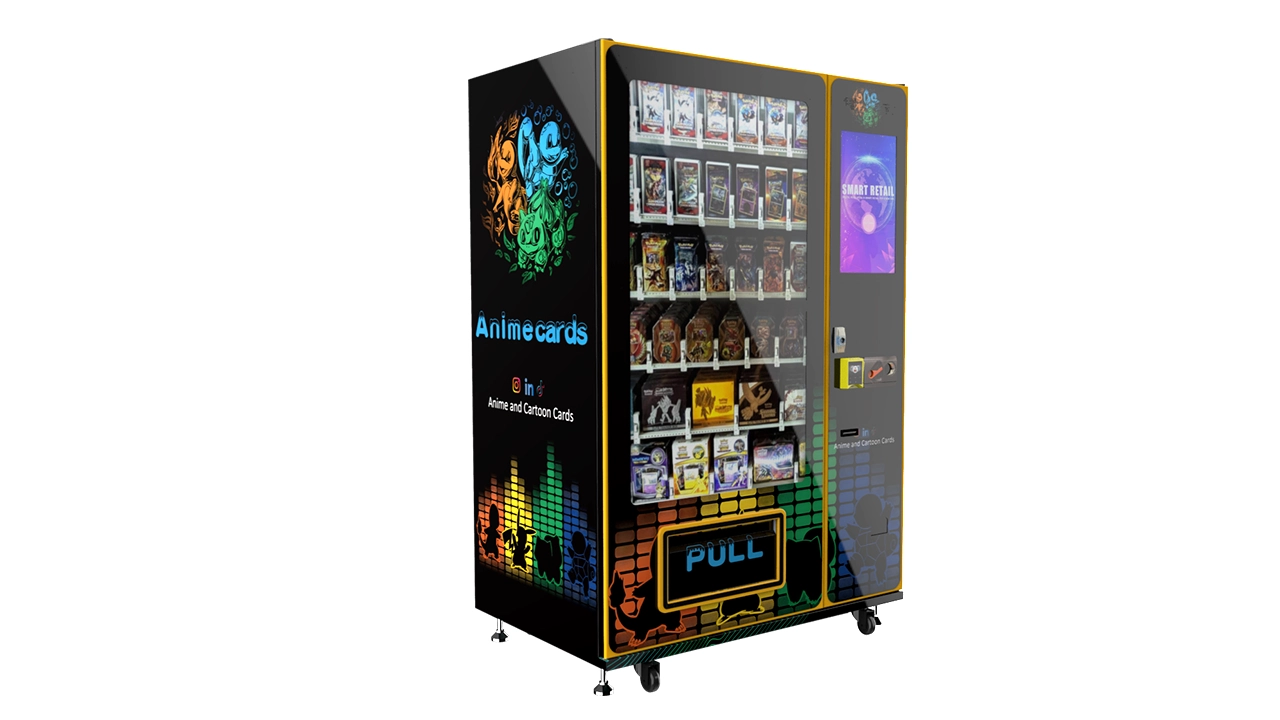
The more package formats a machine carries, the more important adjustable channels and product-specific testing become.
Why the Product Selection Can Change From One Visit to the Next
A vending machine is a real retail inventory point. Products sell out, stock is replenished, older expansions are replaced, and premium items may disappear faster than everyday booster packs.
That is why I would not treat a photograph of one Pokémon vending machine as a permanent shopping list for every machine.
New Product Releases
The Pokémon TCG receives new expansions and associated sealed merchandise on an ongoing release schedule. When a new release becomes available, older inventory and newer inventory can overlap.
A machine may therefore present several expansions at the same time rather than one uniform set.
Demand
Some sealed products attract much stronger demand than others. If a machine still has individual booster packs but no ETBs, that does not prove the machine never carried ETBs. The ETB allocation may simply have sold faster.
Physical Capacity
Ten booster packs consume far less cabinet volume than ten Elite Trainer Boxes. Even when two products are equally desirable, the machine may physically hold far more units of one than the other.
For operators, this creates a useful metric: gross profit per unit of machine space.
A higher selling price does not automatically justify more cabinet space. Sales velocity, gross margin, package volume, refill frequency, inventory investment, and the risk of slow-moving stock all matter.
Restocking Decisions
Even a well-designed product plan should change after real transaction data appears.
If booster packs repeatedly sell out while a slower boxed product stays untouched, the next planogram probably deserves more booster capacity. If premium boxes move quickly whenever loaded, additional large-product channels may be justified.
I see remote inventory visibility as one of the most useful features in modern trading card vending. An operator should not need to open the machine just to discover which slot is almost empty.
What You Should Not Automatically Assume a Pokémon Vending Machine Sells
Understanding what do pokemon vending machines sell also means understanding what has not been publicly established as normal official automated retail inventory.
Loose Single Cards
Official automated retail information centers on packaged Pokémon TCG products such as booster packs and Elite Trainer Boxes. Loose individual singles are a different retail model.
Singles can be sold through specialized vending systems, but the operator must assign a value to each card, protect it from damage, identify it accurately, and ensure the exact card shown on the screen is the one dispensed.
Graded Cards
A graded card in a rigid plastic holder has very different handling requirements from a booster pack. It is heavier, more valuable per unit, and vulnerable to surface scratching or holder damage.
I would never assume a conventional booster-pack spring lane is suitable for slabs. A machine intended for graded cards should be tested with the exact holder and any outer protective sleeve used during actual operation.
Mystery Cards
A mystery-product business model can be operated independently where permitted, but it should not be confused with standard Pokémon automated retail inventory.
If an independent operator sells mystery products, the description should be transparent about what the customer receives and how the product is packaged.
Every Pokémon Merchandise Category
A Pokémon vending machine focused on trading cards should not automatically be treated as an unlimited Pokémon merchandise store. Plush, apparel, figures, toys, and accessories may exist in the wider brand catalog, but the automated retail format discussed here is centered on Pokémon Trading Card Game products.
For the question what do pokemon vending machines sell, keeping the answer centered on the TCG is more accurate than turning the machine into a hypothetical catalog of everything associated with the brand.
What Is It Like to Buy From a Pokémon Vending Machine?
The core transaction is familiar to anyone who has used a touchscreen self-service kiosk: review available products, choose the item, confirm the displayed price, complete payment, and retrieve the dispensed merchandise.
1. Review the On-Screen Inventory
The screen is the most reliable source for what the machine currently has available. A guide can explain the product categories associated with automated retail, but the live menu shows what can actually be purchased at that moment.
2. Check the Exact Product
For boxed items, read the expansion name and product format carefully. A standard Elite Trainer Box and another ETB edition may have different contents.
3. Check the Displayed Price
Use the machine’s current displayed price rather than relying on an old photograph, old receipt, outdated social post, or someone else’s earlier purchase.
4. Complete Payment
The automated system processes the transaction and then triggers the assigned product channel.
5. Retrieve the Product Before Leaving
Confirm that the correct item has reached the pickup compartment and remove it before walking away.
6. Read the Current Purchase Terms
Automated retail policies can differ from ordinary staffed retail. Buyers should review the current terms provided by the operator before completing a purchase, especially for sealed collectible products.
Can You Buy an Official Pokémon Vending Machine?
This is where the customer question and the operator question split apart.
Pokémon's official automated retail machines are operated as part of its own retail program and are not presented as standard off-the-shelf machines for independent operators to purchase and rebrand as official Pokémon equipment.
That distinction matters because a search for what do pokemon vending machines sell often leads business owners to a second question: “Can I operate one?”
The answer depends on what “one” means.
- If you mean an official Pokémon-operated automated retail machine, that is part of Pokémon's own retail program.
- If you mean a general-purpose trading card vending machine capable of dispensing sealed Pokémon TCG products that you are legally entitled to resell, commercial vending equipment can be configured for that purpose.
Those are two different business models and should never be presented as the same thing.
The Practical Alternative: A Trading Card Vending Machine for Your Own Inventory
An independent operator does not need to copy an official Pokémon machine to automate card retail. The practical approach is to purchase a trading card vending machine, source merchandise through lawful channels, and configure the equipment around the actual packaged products that will be sold.
This is where manufacturing choices matter more than decorative graphics.
Zhongda Smart offers trading card vending machines for sealed card products with different screen sizes, capacities, dispensing structures, and payment configurations. The equipment can be customized around card packs and boxes rather than being limited to conventional food-and-drink vending dimensions.
A product-specific configuration is also available through its trading card vending machine for compatible Pokémon TCG product formats. Compatibility with a product format does not mean official endorsement, licensing, authorization, or ownership by the trademark holder.
Do Not Confuse Machine Compatibility With Brand Authorization
A third-party machine can be mechanically capable of dispensing a branded product without being an official machine of that brand.
If I were launching a card vending project, I would keep that line very clear in cabinet graphics, website copy, advertising, and the customer-facing interface.
Buying a commercial vending machine does not automatically grant trademark rights. Buying legitimate trading card inventory also does not automatically grant permission to decorate the cabinet in a way that makes customers believe the machine is an official branded kiosk.
The safer operating principle is straightforward:
- Sell products you are legally entitled to sell.
- Describe those products accurately.
- Do not imply sponsorship or affiliation that does not exist.
- Use logos, artwork, characters, and protected brand assets only when you have the appropriate rights.
- Keep purchasing terms and customer-service information clear.
I’d recommend treating those points as part of the initial machine design brief rather than something added after production.
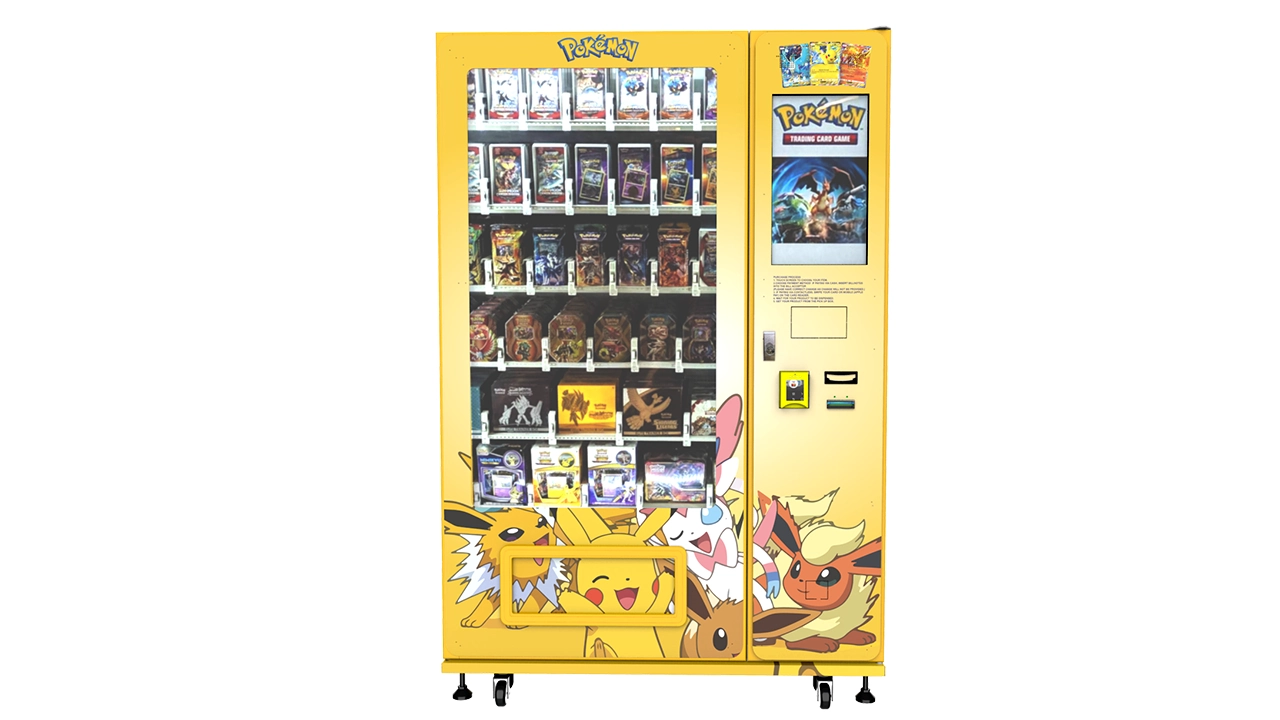
An independent card vending project should be built around product compatibility and lawful branding rather than attempting to imitate an official branded kiosk.
How a Trading Card Vending Machine Should Be Designed for Booster Packs, ETBs, and Collectibles
When I evaluate a trading card vending concept, I think the merchandise should come before the machine.
A beautiful cabinet cannot fix the wrong cargo channel. A large touchscreen cannot prevent a booster pack from jamming. Remote inventory software cannot protect an ETB from an uncontrolled drop.
A deeper explanation of the transaction sequence is available in Zhongda Smart's guide to how trading card vending machines work, but the key engineering decisions can be reduced to several practical areas.
1. Product Dimensions
Record the retail package exactly as it will be loaded into the machine:
- Width
- Height
- Depth or thickness
- Weight
- Surface material
- Rigidity
- Presence of hang tabs or protruding packaging
Do not measure one sample and assume the entire shipment is dimensionally perfect. Retail packaging can have slight variations, bent tabs, loose wrapping, or minor deformation.
2. Cargo-Lane Geometry
A spring lane requires the product to sit predictably between coil rotations. If the pitch is too narrow, the pack can bind. If it is too wide, the product can fall forward prematurely or allow more than one unit to move.
Boxed products need adequate divider spacing. A box should not scrape tightly against both sidewalls every time the mechanism advances.
3. Delivery Method
For this comparison, I’m prioritizing product protection over mechanical simplicity.
Basic drop delivery can be economical and appropriate for durable, lower-weight merchandise. Premium collectible boxes deserve more attention.
An elevator delivery system can move to the selected shelf, receive the item, and carry it toward the pickup compartment. This can be particularly useful when a machine carries premium boxes, rigid tins, or products where presentation condition matters.
4. Product Detection
A good vending system should have a method to recognize a failed vend or support a reliable transaction-validation strategy.
Trading card products can carry enough value that blindly rotating a motor and assuming an item fell is not ideal.
5. Touchscreen Merchandising
Trading cards are highly visual products. Expansion artwork, box design, featured characters, promotional cards, and sealed-product format all affect purchasing decisions.
A touchscreen can provide:
- Clear product images
- Expansion names
- Product format descriptions
- Prices
- Stock status
- Purchase instructions
- Terms and policies
- Promotional banners
I’d choose readable product cards over a visually overloaded interface. A customer should be able to identify a booster pack, Booster Bundle, ETB, or collection product in seconds.
6. Remote Inventory Management
Remote inventory is especially useful when many SKUs rotate through the same cabinet.
The operator should be able to see what sold, which channel is approaching empty, and which products are moving slowly. That turns replenishment from guesswork into a measurable process.
7. Connectivity
Connected vending machines may use Wi-Fi, cellular connectivity, or wired networking depending on the selected configuration.
Connectivity can support:
- Sales reporting
- Inventory status
- Machine status
- Remote pricing changes
- Product-menu updates
- Diagnostic information
8. Payment Configuration
The machine needs a payment setup appropriate for the intended operating environment. Depending on hardware and software, a custom trading card vending machine may support bank cards, contactless payment, QR-based payment, cash, or other configured methods.
If I were choosing a new system, I would verify payment compatibility before production rather than treating the payment terminal as a small accessory that can always be added later.
9. Cabinet Security
Trading card inventory can concentrate significant retail value inside a narrow footprint. Security therefore needs to address the door, locks, payment hardware, pickup opening, cabinet construction, and service-access procedure.
Security should also be proportional to merchandise value. A machine loaded with high-value sealed boxes deserves a different risk assessment from one carrying only inexpensive accessories.
10. Serviceability
A sophisticated machine still needs to be restocked and maintained by a person.
I’d rank easy lane access, clear error reporting, modular components, and sensible wiring highly. A cabinet that looks excellent from the customer side but requires excessive disassembly during routine service creates an operating cost that rarely appears in the initial quotation.
How Much Does a Trading Card Vending Machine Cost?
The cost of an independently purchased trading card vending machine varies by cabinet size, touchscreen, dispensing method, payment hardware, software, cargo layout, branding, freight, and order quantity.
The equipment price is only one part of the investment. A serious business plan should calculate the complete landed project cost.
Build the Full Startup Budget
| Cost Category | What It Covers | Why It Matters |
|---|---|---|
| Machine | Cabinet, screen, controller, dispensing hardware | Core capital equipment |
| Payment Hardware | Configured card reader or other payment modules | May be separate from the base machine configuration |
| Freight and Delivery | Transport, handling, and final delivery | Can materially change landed investment |
| Initial Inventory | Booster packs, boxes, bundles, accessories | Cash is tied up before products sell |
| Branding | Cabinet artwork and interface assets | Depends on customization scope and legal rights |
| Placement Cost | Rent, commission, or revenue sharing | Can become a major recurring expense |
| Payment Fees | Transaction processing charges | Reduces contribution margin on each transaction |
| Connectivity | Network access or data service | Supports remote management |
| Restocking | Labor and transportation | Often underestimated in vending forecasts |
| Maintenance | Wear items, repairs, spare parts | Protects uptime and customer experience |
Do Pokémon Card Vending Machines Make Money?
A machine can be profitable, but neither the popularity of Pokémon TCG products nor strong collector interest guarantees a profitable location.
Profitability depends on a basic equation:
Sales revenue − inventory cost − payment fees − placement cost − service cost − operating expenses = operating contribution.
Then the initial machine investment and setup costs must be recovered from that contribution.
I’d recommend reading the trading card vending machine business guide before treating equipment price as the entire financial model.
Illustrative Monthly Scenario
The following numbers are examples for understanding the math. They are not promises of sales, margin, profitability, or investment return.
| Scenario | Transactions per Day | Average Sale | 30-Day Revenue | Illustrative Contribution Margin | Illustrative Monthly Contribution |
|---|---|---|---|---|---|
| Conservative | 6 | $8 | $1,440 | 20% | $288 |
| Base Case | 12 | $11 | $3,960 | 24% | $950.40 |
| Strong Performance | 20 | $14 | $8,400 | 26% | $2,184 |
This is not the same as a complete investment payback calculation. A real model should also include initial inventory, freight, payment-terminal cost, taxes, installation, rent deposits, insurance, unsold stock, labor, disputes, maintenance, financing, software fees, and downtime.
If I were evaluating a new site, I would calculate payback from the total landed project investment, not simply the factory price of the cabinet.
The Metric I’d Watch First
I’d watch contribution dollars per machine per day.
Revenue alone can be misleading. A machine can generate strong gross sales while producing weak profit if merchandise cost is high or the location agreement takes too much of every transaction.
Then I would track:
- Transactions per day
- Average order value
- Gross margin by SKU
- Units sold per SKU
- Stockout hours
- Payment failure rate
- Failed-vend rate
- Restocking frequency
- Inventory days on hand
- Revenue per cargo lane
A machine full of popular products is not automatically an efficient machine. The goal is to turn limited cabinet space into reliable contribution without creating excessive service work.
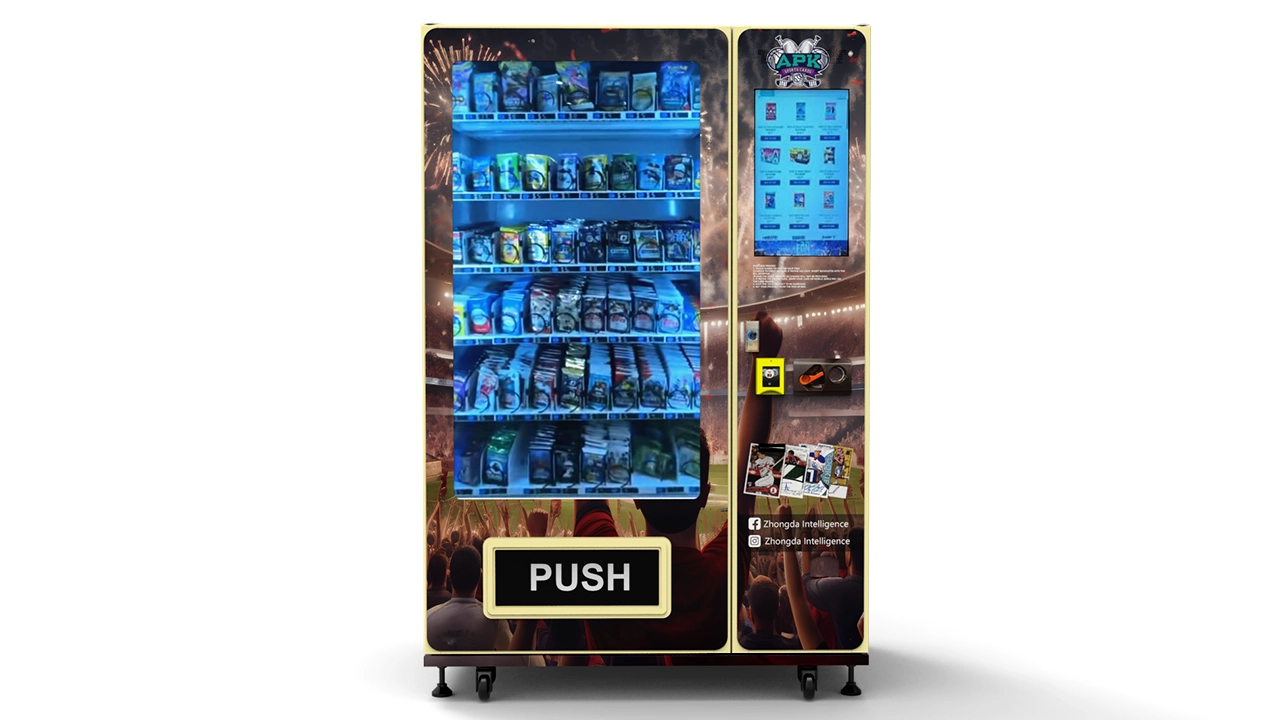
Machine economics should be measured from the complete operating model rather than the initial equipment price alone.
How I’d Build a Strong Trading Card Vending Product Mix
Once you understand what do pokemon vending machines sell, the next useful question for an independent operator is how to create a product mix that gives different customers a reason to buy.
I would not fill every lane with the same booster pack unless real sales data proved that strategy was optimal.
Entry-Level Purchase
Individual booster packs create a low-friction first purchase. A customer who does not want a large box can still make a quick transaction.
Boosters also allow several expansions to be represented without consuming large amounts of cabinet space.
Multi-Pack Step-Up
Booster Bundles or similar compact multi-pack formats can sit between one booster and an ETB.
This middle tier matters because not every buyer naturally jumps from a single pack to a premium boxed product.
Premium Boxed Product
ETBs give the assortment a higher-value sealed option. They are also easy to understand visually, which is useful in self-service retail.
Player-Focused Products
Where physically suitable, deck products and other play-focused sealed merchandise can serve customers who want something more structured than randomized packs.
Accessories
An independent machine can also use suitable lanes for sleeves and other compact card accessories, provided the operator has lawful inventory and the products are mechanically compatible.
This can reduce dependence on the release cycle of sealed trading card products.
Example Starting Capacity Allocation
| Category | Starting Capacity Share | Role |
|---|---|---|
| Individual Booster Packs | 45% | Fast-moving entry purchase |
| Multi-Pack Products | 20% | Mid-value step-up purchase |
| Premium Boxed Products | 20% | Higher transaction value |
| Deck or Play Products | 10% | Player-oriented assortment |
| Accessories | 5% | Complementary purchase |
Those percentages are not a universal formula. They are a starting hypothesis.
After enough transactions, I would replace assumptions with data. If one expansion produces twice the contribution per lane of another, the stronger SKU deserves more capacity. If boxed products sell quickly but create frequent stockouts because only a few fit per lane, the next machine configuration may need more large-product capacity.
Do Not Chase Revenue at the Expense of Trust
Trading card buyers pay close attention to product authenticity, packaging condition, and pricing.
I think a vending operator should make the transaction as transparent as possible:
- Show the exact product image.
- Name the exact sealed format.
- Display the current price before payment.
- Avoid suggesting guaranteed rare-card outcomes.
- Keep customer-service information visible.
- Use clear terms for error resolution and refunds where applicable.
Trust is especially important in unattended retail because there is no cashier standing beside the machine to explain a confusing product listing.
What Happens When a Popular Product Sells Out?
This is one of the practical reasons the answer to what do pokemon vending machines sell can change quickly.
At machine level, the customer sees a simple condition: the product is available or it is not.
For Buyers
If the exact product you want is unavailable, do not assume another machine will necessarily have the same stock. Product availability is dynamic.
For Independent Operators
Stockouts are both good and bad.
A sold-out lane proves demand, but every hour that profitable inventory remains unavailable can represent missed sales.
This is why remote stock information is more than a convenience. It helps an operator decide when a refill trip is economically justified.
I’d set reorder alerts before inventory reaches zero. The right threshold depends on sales velocity and restocking time. A SKU selling fifteen units per day needs a very different threshold from one selling two units per week.
Use Multiple SKUs to Reduce Dependence on One Release
A machine containing only one highly demanded expansion can perform extremely well until that product becomes harder to source.
A more resilient merchandise plan can combine several sealed formats so the machine continues to offer useful choices even when one product is temporarily unavailable.
Why Packaging Condition Matters More for Cards Than Ordinary Vending Goods
A snack with a slightly dented wrapper may still be viewed as completely normal. Collectible products can be different.
Some customers care about the condition of an unopened box because the packaging itself is part of the collectible object. A crushed ETB corner, scraped tin, or heavily bent sleeved booster can create dissatisfaction even when the cards remain undamaged.
That changes how I’d rank vending mechanisms.
For Flexible Booster Packs
The main risks are bending, snagging, compression, double-vending, and inconsistent feeding.
For Boxed Products
The main risks include binding in the channel, corner impact, surface scuffing, and uncontrolled drops.
For Tins
The main risks are dents, scratches, and impact.
For High-Value Collectibles
The delivery system should be evaluated almost like a product-handling system rather than a simple dispensing motor.
If I were choosing between maximum machine capacity and gentler handling for expensive sealed products, I’d choose the configuration that protects merchandise consistently. One damaged premium box can erase the margin from several successful transactions.
Spring Delivery or Elevator Delivery: Which Is Better?
Neither system is automatically superior. The correct choice depends on the merchandise.
Spring Delivery
A spiral or spring lane is simple, familiar, and flexible. The motor rotates the coil, advancing the front product until it leaves the lane.
Advantages include:
- Relatively simple mechanics
- Good capacity
- Easy lane adjustment for many packaged products
- Lower mechanical complexity than an elevator system
Potential disadvantages include:
- Greater drop height
- Difficulty with very thin packages
- Potential product binding
- Need for careful coil selection
Elevator Delivery
An elevator system receives the selected item near its shelf and carries it toward the pickup area.
Advantages can include:
- Gentler handling
- Better suitability for premium boxes
- Reduced drop impact
- A more controlled delivery experience
Tradeoffs can include greater mechanical complexity and higher equipment cost.
If I were vending mostly individual lower-priced packs, a properly tested spring system could be completely reasonable. If I were loading expensive sealed boxes in meaningful volume, I would give elevator delivery serious consideration.
Choosing a Trading Card Vending Machine Manufacturer
A trading card vending project is not a place where I’d choose solely from a catalog photograph.
The manufacturer should be able to discuss the products, not merely the cabinet.
I would ask the following questions before ordering:
- Can you test my exact booster packs and boxes?
- What package dimensions fit each channel?
- How is a failed vend detected?
- Can premium boxes use gentler delivery?
- What is the usable capacity for my actual product mix?
- Which payment hardware can be integrated?
- How do remote inventory and sales reports work?
- Can prices and product images be changed remotely?
- Which components are field-replaceable?
- What spare parts are normally available?
- What warranty applies to the final machine configuration?
- Can I begin with one machine for validation?
Why Zhongda Smart Is Worth Considering
If I were ranking manufacturers for a custom collectible-card project, I would put Zhongda Smart on the shortlist because the company publishes card-specific machine configurations rather than asking the buyer to adapt a conventional snack cabinet after delivery.
Zhongda Smart's current trading card range includes floor-standing touchscreen models, compact configurations, and elevator-delivery options. Available configurations can include adjustable cargo lanes, connected management, configurable payment hardware, and OEM or ODM customization.
The company's manufacturer profile provides additional background on its manufacturing operation, team, production capabilities, and vending-machine development experience.
Company-published specifications should still be evaluated together with the exact quotation, sample testing, machine configuration, warranty terms, payment integration, and project requirements.
Start With the Product, Not the Brochure
If I were choosing a machine for booster packs, ETBs, Booster Bundles, tins, and compact boxed collectibles, I would send the manufacturer actual package dimensions and photographs before confirming the order.
For higher confidence, physical product samples are even better.
The test should answer questions such as:
- Does one unit dispense cleanly?
- Do twenty consecutive units dispense cleanly?
- Does the final item in the lane behave like the first?
- Does a slightly bent package jam?
- Can two packages accidentally dispense together?
- Is the product damaged after delivery?
- Can the machine detect an unsuccessful vend?
A successful sample vend is useful. Repeated successful vending is what matters commercially.
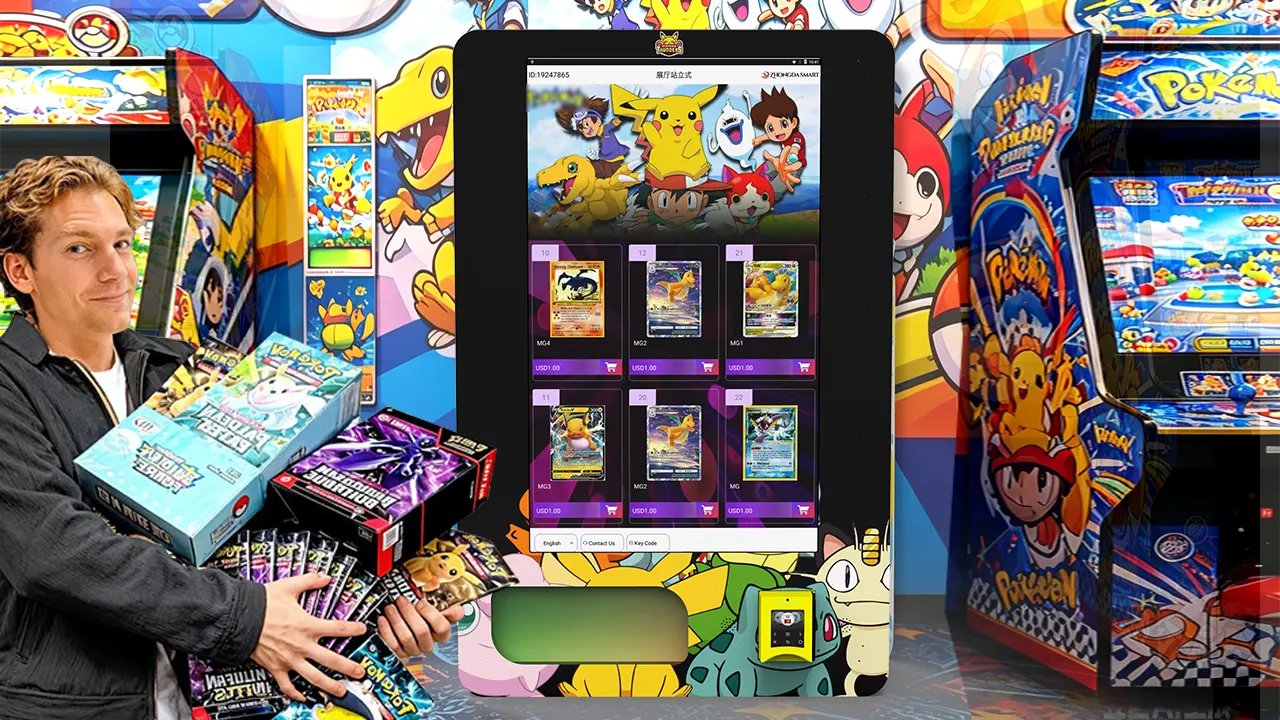
For a custom machine project, product testing, lane configuration, payment integration, and after-sales support matter more than cabinet appearance alone.
Buyer Checklist: What to Look at Before Purchasing From the Machine
If your concern is simply what do pokemon vending machines sell and whether you should buy a particular item, I’d use this practical checklist.
- Confirm the exact product name. Do not assume two similarly designed boxes contain the same products.
- Check the expansion. Make sure it is the set you actually want.
- Check the sealed format. A booster, Booster Bundle, ETB, and collection box represent very different quantities.
- Review the displayed price. Decide based on the current transaction rather than an old photograph.
- Read product details when available. The original product information can confirm box contents.
- Do not buy based on a promised pull. Randomized booster products do not guarantee the specific rare card you want.
- Confirm the selection before payment. Automated purchases may have different return conditions from staffed retail.
- Collect the product immediately. Check the pickup compartment before leaving.
Operator Checklist: What to Verify Before Ordering a Machine
For someone building an independent self-service card business, I’d use a much longer checklist.
Merchandise
- Exact product dimensions
- Product weight
- Packaging material
- Number of SKUs
- Expected inventory value
- Average selling price
- Expected gross margin
Dispensing
- Spring size or channel dimensions
- Drop height
- Elevator requirement
- Vend detection
- Double-vend prevention
- Product-condition testing
Payments
- Desired payment methods
- Processor compatibility
- Transaction fees
- Network requirements
- Error and refund workflow
Software
- Remote inventory
- Sales reports
- Price updates
- Product image management
- Machine alerts
- User permissions
Operations
- Restocking frequency
- Service access
- Spare parts
- Cleaning
- Uptime target
- Customer support process
Commercial Terms
- Total equipment price
- Payment hardware cost
- Customization cost
- Freight
- Warranty
- Replacement-parts policy
- Software fees
- Payment-processing costs
Brand and Product Rights
- Lawful merchandise sourcing
- Permission for protected artwork used on the cabinet
- Accurate product descriptions
- No misleading claim of official affiliation
- Clear customer-facing terms
I’d complete this list before scaling beyond a pilot machine. A single-machine test can reveal dispensing, inventory, payment, and merchandising problems while they are still manageable.
Are Pokémon Vending Machines Mainly for Collectors or Players?
Both can find useful products in an automated TCG machine.
A collector may focus on sealed booster packs, ETBs, specific expansions, promotional cards included in boxed products, or sealed-condition value.
A player may value boosters for deck-building possibilities, accessories inside an ETB, or play-focused products when available.
The machine does not need to choose one audience exclusively. A good merchandise mix can offer an inexpensive randomized purchase, a premium sealed box, and other TCG formats at the same time.
That breadth is part of why the simple question what do pokemon vending machines sell deserves more than a one-line answer. The cabinet functions like a compact automated card store, and the products inside can serve different buying occasions.
My Practical Bottom Line
If you remember only one part of this guide, remember the distinction between confirmed product categories and possible rotating inventory.
Pokémon automated retail is clearly associated with Booster Packs, Elite Trainer Boxes, and additional Pokémon TCG products.
Booster packs are the compact core item. They work well in vending because they are easy to recognize, relatively small, and suitable for quick purchases.
ETBs provide a larger premium purchase containing multiple packs and useful accessories. They also require more cabinet space and better product handling.
Other established Pokémon TCG formats include Booster Bundles, collection products, tins, Build & Battle products, and decks. I would still check the actual machine screen before assuming any one of those formats is currently available.
For independent operators, the official Pokémon automated retail program is separate from commercially available vending equipment. A business can instead purchase a general trading card vending system and configure it for lawfully sourced sealed TCG merchandise, provided the operator does not create a false impression of official sponsorship, ownership, or authorization.
If I were building that system, I would make product dimensions, dispensing reliability, delivery method, payment configuration, inventory software, security, and serviceability the first decisions. Cabinet graphics would come later.
That is the complete answer to what do pokemon vending machines sell: primarily sealed Pokémon TCG merchandise, with Booster Packs and Elite Trainer Boxes among the clearest product categories and additional merchandise changing according to the inventory actually loaded into each machine.
Frequently Asked Questions
What do Pokémon vending machines sell?
Pokémon automated retail machines sell Pokémon Trading Card Game products, with Booster Packs and Elite Trainer Boxes among the clearly identified product categories. Additional TCG products may also appear, but exact inventory changes by machine and restocking cycle.
Do Pokémon vending machines sell booster packs?
Yes. Booster Packs are one of the main product categories associated with Pokémon automated retail. The available expansion can change as inventory is sold and replenished.
Do Pokémon vending machines sell Elite Trainer Boxes?
Yes. Elite Trainer Boxes are also associated with Pokémon automated retail. Exact ETB expansions and editions can vary according to current inventory.
Do Pokémon vending machines sell Booster Bundles?
Booster Bundles are an established Pokémon TCG product format, but they should not be treated as guaranteed inventory in every machine. Check the live machine menu for the current selection.
Do Pokémon vending machines sell single cards or graded cards?
Loose singles and graded cards are not generally identified as standard official Pokémon automated retail inventory. Specialized independent trading card vending machines can be engineered for singles or slabs, but those products require different handling systems.
Can I buy an official Pokémon vending machine for my business?
Official Pokémon automated retail machines are part of Pokémon's own retail program rather than ordinary commercial machines offered for independent operators to purchase as official Pokémon equipment. Businesses can instead purchase independent trading card vending equipment for products they are legally entitled to resell.
How much does a trading card vending machine cost?
Pricing depends on cabinet size, touchscreen, capacity, dispensing system, payment hardware, software, connectivity, and customization. Operators should calculate the complete landed project cost rather than looking only at the base machine price.
What type of vending machine is best for Pokémon card products?
The best configuration depends on the exact merchandise. Booster packs need channels that do not bend or double-vend thin packages, while ETBs and premium boxes may benefit from wider channels and controlled or elevator delivery.
Sources and Reference Notes
- Pokémon Center Support — Automated Retail Vending Machine Information. Used as a first-party reference for Pokémon automated retail product categories and operating information. Pokémon Center Support
- Pokémon Center Support — Pokémon Trading Card Game Booster Pack Information. Used for general first-party information about sealed booster products and randomized card contents. Pokémon Center Support
- Pokémon Official Website — Pokémon TCG Product Information. Used for examples of current and established sealed TCG product formats. Pokémon Official Website
- Pokémon Support — Product Availability Information. Used as a first-party reference for product availability and supply considerations. Pokémon Support
- Pokémon Privacy Notice. Used as a reference for privacy and automated retail information. Pokémon Privacy Notice
Manufacturer information: Zhongda Smart machine features, configurations, manufacturing information, payment options, capacities, and related specifications mentioned in this guide are based on company-published product information. Final specifications, pricing, software, payment hardware, warranty, freight, capacity, and dispensing configuration should be confirmed in the quotation for the selected machine.
Disclaimer
This article is provided for general informational and commercial-planning purposes. Product availability, packaging, contents, prices, machine policies, vending-machine specifications, business conditions, and operating requirements can change. Always confirm current product information with the relevant product owner, seller, machine operator, or equipment supplier before purchasing.
Pokémon and related names, characters, logos, product names, artwork, and trademarks belong to their respective owners. Zhongda Smart is an independent vending-machine manufacturer. References to Pokémon TCG products describe potentially compatible merchandise categories and do not imply sponsorship, endorsement, authorization, licensing, partnership, or affiliation with Pokémon or any related trademark owner.
Anyone operating an independent vending business is responsible for lawful merchandise sourcing, product authenticity, consumer protection requirements, payment compliance, taxes, site agreements, intellectual-property use, advertising claims, insurance, customer-service policies, and other requirements that apply to the business.
Financial examples in this article are illustrative only. They are not guarantees of sales, revenue, profit, investment return, or payback period.