If you are wondering when do pokemon vending machines restock, the most accurate 2026 answer is simple: there is no published fixed restock schedule. Pokémon Center states that its automated retail vending machines are replenished according to product stock levels and the inventory needs of each machine, so a specific machine may be serviced at a different time from another one. Customers also cannot receive advance alerts for individual restocks. That means claims such as “every Tuesday morning” or “always after closing” should not be treated as official rules. The practical approach is to understand how demand-driven replenishment works, watch product availability rather than chase a rumored clock time, and use the official vending-machine information when you need support. This guide explains what is confirmed, what is only speculation, and how automated trading-card inventory is typically managed.
The Quick Answer for 2026
When do Pokémon vending machines restock? There is no official universal day or time. Pokémon Center's automated retail FAQ says that the machines do not have a set restocking schedule. Restocking is handled on a case-by-case basis according to the availability of particular products and the inventory needs of individual machines.[1]
That distinction matters. A machine being empty on one visit does not tell you that it will be refilled the following morning, the next business day, or exactly one week later. Likewise, seeing one machine receive inventory does not establish a schedule for other machines.
| Restock Question | Best 2026 Answer |
|---|---|
| Is there a fixed weekly restock day? | No published fixed schedule. |
| Is there a guaranteed restock time? | No. |
| Do all machines restock together? | No official information supports that assumption. |
| Does every sold-out product return? | No guarantee is published. |
| Can customers receive advance restock alerts? | Pokémon Center says it cannot alert customers when a machine restock has happened or will happen. |
| Should store employees be asked for restock information? | No. The official FAQ specifically asks customers not to question store employees or merchandisers about inventory or restocks. |
If I were planning a purchase, I would treat product availability as dynamic rather than build my plans around a rumored delivery window. That is less exciting than a secret restock calendar, but it is much more reliable.
What the Official Restock Policy Actually Says
The most important fact in this entire guide comes directly from Pokémon Center Support. Its automated retail vending machine FAQ was updated on January 26, 2026, and says there is no set schedule for restocking the machines.[1]
The same guidance explains why customers cannot be told exactly when a restock will happen. Replenishment depends on the stock level of individual products and the inventory requirements of a particular machine. In practical retail terms, that is a demand-driven replenishment model rather than a publicly advertised calendar.
This is the part I would give the most weight when answering when do Pokémon vending machines restock. A social post describing what happened at one machine last month may be accurate for that single visit, but it does not override a current first-party statement saying there is no standard schedule.
The official FAQ also tells customers not to ask store employees or vending-machine merchandisers about restock timing or inventory. That is useful guidance because the host store and the automated-retail inventory operation are not necessarily the same thing. A person working in the surrounding store may have no access to vending inventory information.
There is another detail worth separating from restocking: the Pokémon vending machines covered by the official FAQ are owned and operated by The Pokémon Company International. According to that FAQ, they are not being offered for sale to businesses or individuals.[1]
That becomes important later in this guide when discussing independent trading card vending machines. A business can build an automated TCG retail operation, but that should not be confused with purchasing, franchising, or operating an official Pokémon Automated Retail machine.
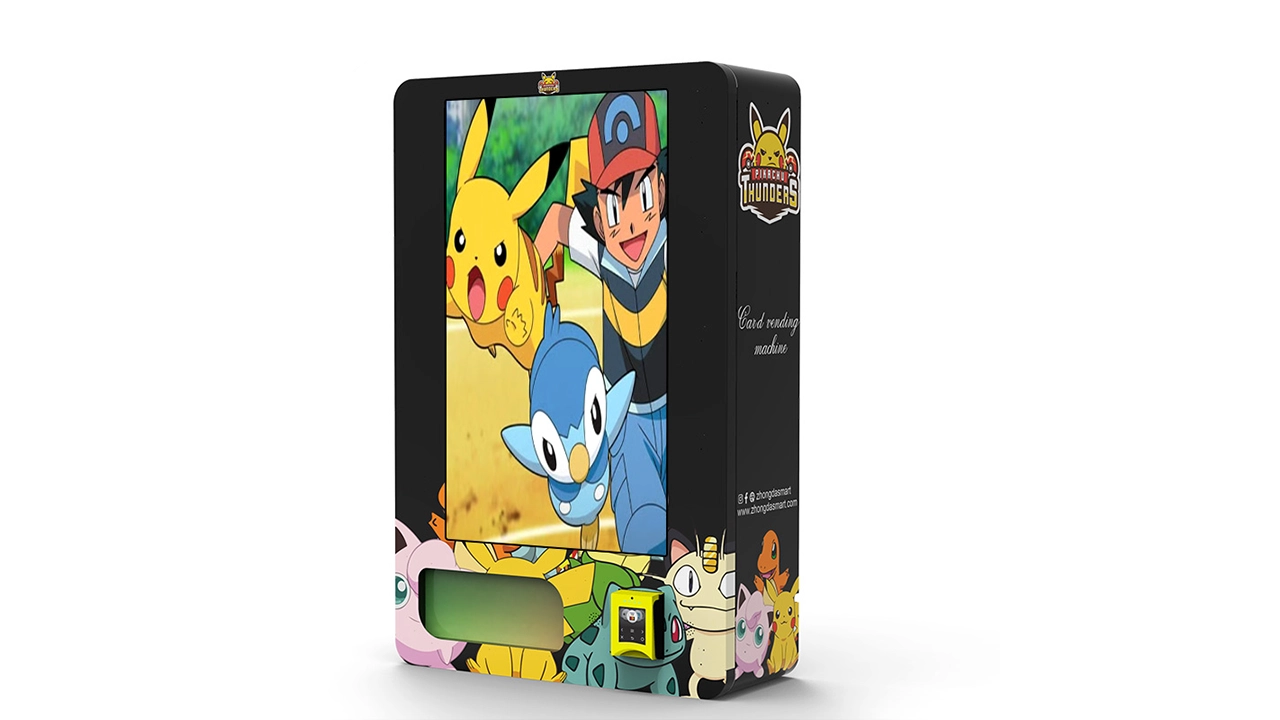
Why Pokémon Vending Machines Do Not Have One Fixed Restock Schedule
Automated retail looks simple from the customer side. You select an item, pay, and receive the product. Behind that interface, however, an operator has to coordinate inventory availability, machine capacity, route servicing, product demand, payment systems, equipment condition, and replenishment labor.
A rigid schedule can be inefficient when sales do not occur at a rigid pace.
Imagine two machines that begin a week with identical inventory. Machine A sells 80 units of a popular booster product in two days. Machine B sells 18 units of the same product over the same period. Restocking both machines at exactly the same interval would either leave Machine A empty for too long or send inventory and servicing labor to Machine B before it needs them.
That is why the answer to when do Pokémon vending machines restock is better understood as an inventory question than a calendar question.
A modern replenishment decision can be influenced by:
- Current units remaining in the machine.
- Recent sales velocity.
- Availability of replacement inventory.
- Which individual SKUs are sold out.
- Machine capacity.
- Upcoming product releases.
- Unusual demand spikes.
- Service-route efficiency.
- Whether another machine requires urgent attention.
- Mechanical or payment-system maintenance.
- The product mix being assigned to the machine.
Once those variables are considered, the absence of a universal public timetable makes operational sense.
It also explains why two customers can report completely different experiences without either person necessarily being wrong. One machine may appear to receive frequent replenishment because it sells through inventory quickly. Another may maintain stock for longer and therefore require fewer visits.
The Factors That Can Change Restock Timing
1. Sales Velocity
The first variable I would look at is units sold per day. A product moving 15 units a day should not be managed with the same reorder threshold as a product moving one unit every three days.
Sales velocity can also change abruptly. A normal week may be followed by a product launch, promotion, school break, event, or surge in collector attention that changes demand dramatically.
That means historical averages are useful but not perfect. A machine that normally lasts six days between replenishment visits might sell through a high-interest product much faster.
2. Product Availability Upstream
An empty lane does not automatically mean more units are sitting nearby waiting to be loaded. The official Pokémon FAQ specifically notes that restocking can depend on stock levels of particular products.[1]
If replacement stock for one SKU is constrained, the machine may be replenished with other products while that SKU remains unavailable.
This is why “the machine was restocked” and “the exact item I want was restocked” are two different statements.
3. Machine-Level Inventory Needs
A machine rarely runs every SKU down at exactly the same rate. One booster pack may sell quickly while another product remains almost untouched. A larger box may occupy far more physical capacity per unit than a thin pack.
Operators therefore have to manage both unit inventory and physical space.
A machine with 30 products remaining might sound well stocked, but that number becomes misleading if 25 of those units belong to slow-moving SKUs and the five most popular selections are empty.
4. Capacity by Product Format
Trading card merchandise is unusually diverse for vending. A machine may need to accommodate booster packs, sleeved products, Elite Trainer Boxes, boxed collections, deck products, and other sealed items.
These packages have different heights, widths, thicknesses, weights, and dispensing requirements. Capacity therefore cannot always be summarized as a single universal item count.
5. Restocking Route Efficiency
For a multi-machine automated-retail operation, service travel is a real operating cost. A well-designed route tries to refill machines before important products sell out without making unnecessary visits to cabinets that still have enough inventory.
This is one reason remote stock information is valuable. If an operator can see what sold before leaving for a service run, the vehicle can be loaded with the products actually needed.
6. New Releases
Current releases can produce demand patterns very different from mature inventory. A product that attracts intense attention during its first days may need a completely different replenishment strategy from a product that has been available for months.
I would therefore be skeptical of any restock theory that assumes every product category is serviced at the same pace.
7. Equipment Service
Not every visit to a vending machine is an inventory visit. A technician or merchandiser may be inspecting a payment reader, checking a delivery mechanism, updating merchandising, cleaning the cabinet, or addressing a fault.
Seeing someone working on a machine does not by itself prove that a full product restock is taking place.
How Different Pokémon TCG Products Affect Restocking
The official automated retail FAQ says the machines can carry products including Elite Trainer Boxes and Booster Packs along with other TCG merchandise.[1] From an inventory-planning standpoint, different formats create different replenishment pressures.
| Product Format | Typical Vending Consideration | Possible Restock Effect |
|---|---|---|
| Booster packs | Small package, potentially high transaction volume | Fast-moving selections can reach zero even when the machine still contains plenty of total units. |
| Sleeved packs | Larger physical footprint than a loose booster | Capacity may be limited by packaging dimensions rather than product value. |
| Elite Trainer Boxes | Larger, rigid package | Fewer units may fit in the same cabinet volume. |
| Collection boxes | Dimensions vary significantly | May require dedicated positions or a particular delivery mechanism. |
| Deck products | More consistent rectangular packaging | Can be easier to plan physically but demand still varies. |
| High-interest new releases | Demand can spike quickly | Stock can disappear much faster than a normal replenishment interval would suggest. |
| Older products | Demand may be steadier or slower | Can remain available while new products sell out. |
This is another reason a machine should not be described simply as “full” or “empty.” Availability exists at the SKU level.
If the product you want has disappeared, other products still being available does not tell you when that specific SKU will return. Conversely, one empty selection does not necessarily mean the entire machine is waiting for a complete restock.
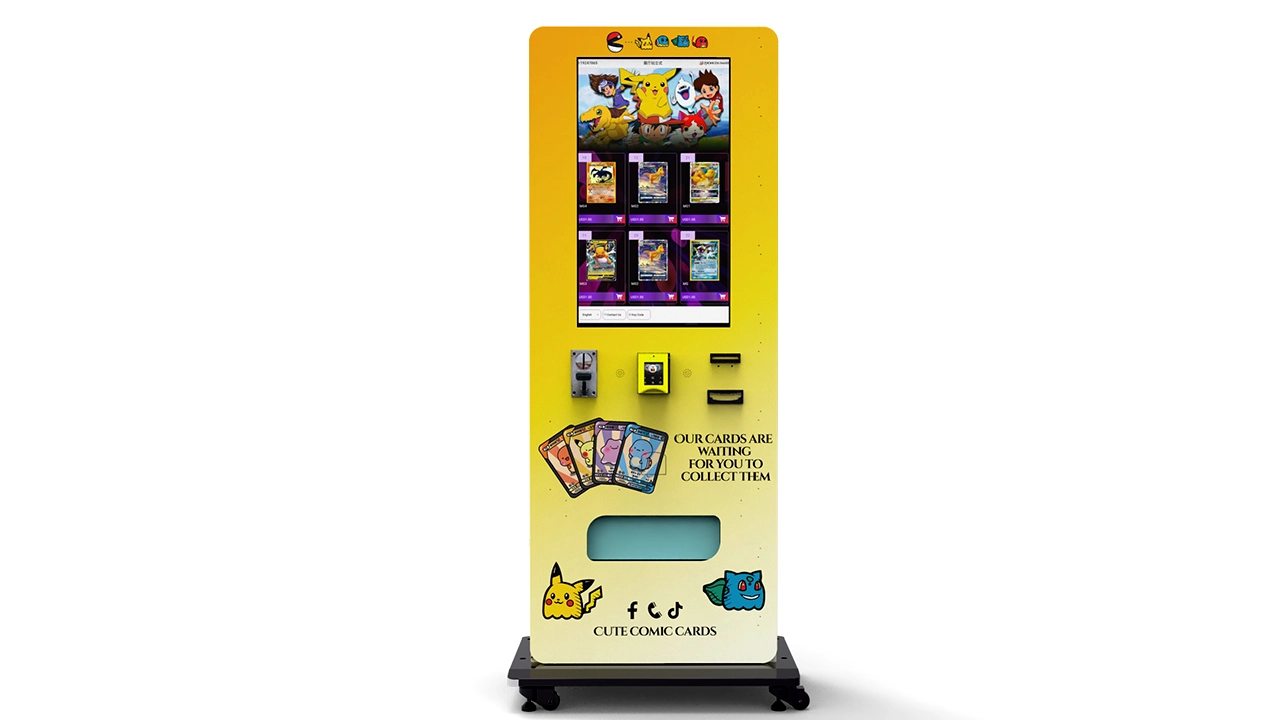
Can You Tell When a Machine Has Just Been Restocked?
There is no official customer-facing method that guarantees you can identify the exact time of a restock. You can observe changes in availability, but observation should not be turned into a universal schedule.
For example, if a product displayed as unavailable on one visit becomes purchasable later, inventory clearly changed. What that does not prove is that the same change will occur at the same hour next week.
When answering when do Pokémon vending machines restock, I would separate three levels of information:
- Confirmed: the official FAQ says there is no fixed restocking schedule.
- Observable: product availability can change between visits.
- Speculative: a repeated pattern at one machine guarantees future restocks.
The third category is where many unreliable restock claims begin.
Suppose someone happens to find new stock on three Wednesday visits. That is useful anecdotal information, but several other explanations are possible. The route may have temporarily been serviced on Wednesdays. The same employee may have covered the route for several weeks. Inventory may have arrived on a particular cycle. A new product launch may have created a temporary schedule. The pattern can change without notice.
I would use observations as a convenience, not as a promise.
Restock Myths I Would Not Rely On
“They Always Restock on the Same Weekday”
The official policy does not support that claim. A particular machine might appear to follow a pattern for a period of time, but Pokémon Center says there is no set schedule.[1]
“Store Employees Know the Exact Restock Time”
This is especially important to avoid. Pokémon Center specifically asks customers not to ask store employees or vending-machine merchandisers questions about restocks or inventory.[1]
I would respect that boundary. The employee helping customers elsewhere in a store may not control, manage, or even have access to the automated-retail inventory system.
“A Sold-Out Label Means the Product Will Be Back Tomorrow”
No. Out of stock describes current availability. It does not provide a replenishment date.
“Every Machine Gets the Same Products”
There is no good reason to assume identical SKU allocation at all times. Machine needs and product stock are explicitly described as variables in the official restocking guidance.
“A Restock Means Every Empty Selection Is Refilled”
Not necessarily. A replenishment visit can only use inventory that is available and assigned to that machine. Some selections may return while others remain unavailable.
“If Someone Is Servicing the Machine, New Cards Are Definitely Being Added”
A service visit can involve maintenance as well as merchandise. Payment hardware, networking, sensors, display components, the dispensing system, and general cabinet condition all need attention during the life of an unattended retail machine.
“One Viral Post Reveals the National Restock Schedule”
A single observation cannot establish a system-wide rule when the operator itself says the schedule is not fixed.
For this comparison, I’m prioritizing first-party policy over anecdotal patterns. That is the safest way to keep a 2026 restock guide useful after a temporary route pattern changes.
A Practical Strategy for Finding Products Without Chasing Rumors
A no-schedule answer does not mean you have no practical options. It simply means the best strategy is based on availability rather than trying to predict a guaranteed delivery hour.
Check at Reasonable Intervals
If a machine is convenient to your normal routine, periodic checks are more realistic than making repeated trips based on an unverified rumor. The right frequency depends on how far out of your way the visit takes you and how important a particular product is.
I would not turn the process into hours of waiting around the machine. That costs time and can create unnecessary friction around a shared retail space.
Keep a Short Priority List
Instead of arriving with one acceptable outcome, decide which two or three products you would genuinely be happy to buy. This makes a partial replenishment more useful.
A simple priority system could look like this:
- Priority A: the exact product you most want.
- Priority B: one or two alternatives you would have purchased anyway.
- Skip: products you would only buy because your first choice is unavailable.
That final category matters. A vending machine should make buying convenient, not pressure you into spending money on merchandise you did not actually want.
Do Not Treat Every Stockout as an Emergency
A popular SKU being unavailable is normal retail behavior. There is no guarantee that spending more time chasing the next replenishment will produce a better buying outcome.
Use Official Support for Actual Machine Problems
If the issue is a malfunction rather than an empty product position, use the automated retail support process. The January 2026 FAQ lists a dedicated support number and an online support-request option for damaged machines, vending problems, and other incidents.[1]
Keep any receipt or transaction information that can help identify what happened.
Remember the Vending Return Policy
The official FAQ states that vending-machine purchases are not accepted for return.[1] That is another reason to choose deliberately rather than substituting an unwanted product simply because your first choice is sold out.
Why Pokémon Card Demand Makes Restocking Complicated
It is easy to underestimate the scale behind the TCG when looking at a single empty vending-machine selection.
The Pokémon Company reports cumulative Pokémon Trading Card Game production of more than 85 billion cards as of the end of March 2026.[2] That figure is useful for understanding the size of the product ecosystem, but it should not be misread as evidence that every sealed product must always be readily available.
Total card production and local SKU availability are completely different inventory measurements.
An 85-billion-card cumulative production figure includes cards produced across many years, sets, products, print runs, languages, and distribution channels. A customer standing in front of one automated retail machine is interested in a much narrower question: how many units of one current sealed product are available in this cabinet right now?
That gap between aggregate supply and SKU-specific supply is one of the most important concepts in collectible retail.
Consider this hypothetical example:
| Inventory Level | Hypothetical Quantity | What It Tells You |
|---|---|---|
| Total TCG production | Billions of individual cards | Overall scale of the product ecosystem |
| Units allocated to one retail channel | Thousands or more | Supply available to a particular distribution channel |
| Units allocated to a service route | Hundreds | Inventory available for a group of machines |
| Units loaded into one machine | Dozens | Current cabinet capacity |
| Units of one high-demand SKU | Possibly a much smaller number | The quantity that actually determines whether you can buy that specific item |
The figures after the first row are illustrative, not Pokémon Company inventory data. Their purpose is to show why enormous cumulative production does not prevent a temporary machine-level stockout.
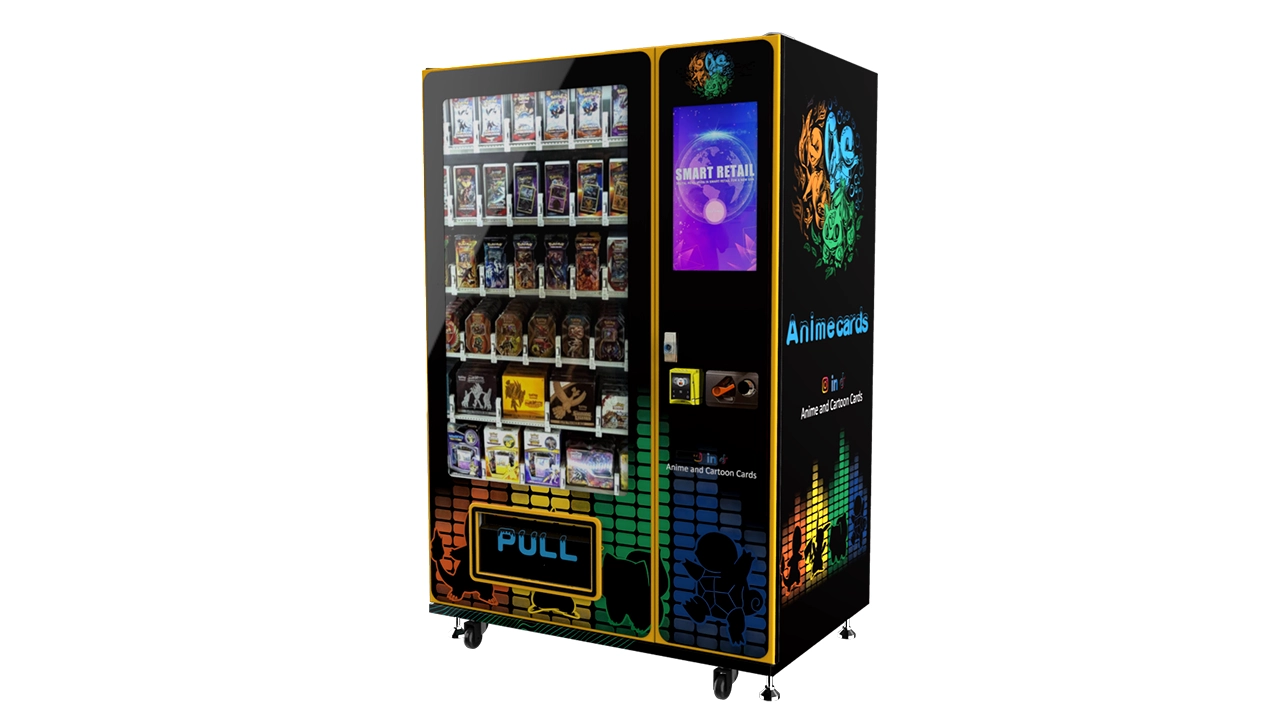
What Restocking Looks Like From an Automated-Retail Perspective
From the machine-manufacturing side, I would design a serious trading card vending operation around data-driven replenishment rather than a fixed “visit every X days” rule.
A fixed route still has value for logistics, but the inventory decision should be informed by actual consumption whenever the equipment supports remote monitoring.
A practical inventory dashboard should ideally tell an operator:
- Which machine sold the product.
- Which SKU sold.
- The transaction time.
- Expected units remaining.
- Sales by SKU.
- Sales by machine.
- Payment status.
- Failed-vend information where supported.
- Machine online or offline status.
- Relevant fault codes.
If you want a deeper explanation of this architecture, Zhongda Smart's guide to how a trading card vending machine works breaks the transaction into product selection, payment authorization, inventory control, dispensing, and delivery confirmation.
The inventory side is especially important for collectible products because a “selection” can represent merchandise with very different demand and replacement values.
For an independent operator, I’d recommend assigning a unique, consistent product identifier to every SKU rather than typing slightly different versions of the product name into each machine.
GS1 explains that a Global Trade Item Number, or GTIN, can uniquely identify trade items that may be priced, ordered, or invoiced in a supply chain.[5] Not every inventory implementation has to use the same identifier architecture, but the underlying principle is excellent: the physical product, inventory database, sales record, and replenishment list should refer to the same SKU consistently.
A Simple Restock and Reorder Model
The official Pokémon operation does not publish its internal replenishment formula, so the following model should not be mistaken for Pokémon's process. It is an illustrative inventory model showing how an independent vending operator can think about restocks.
A basic reorder-point formula is:
Reorder Point = Expected Demand During Replenishment Lead Time + Safety Stock
Suppose one booster product averages 14 sales per day. Assume the operator wants enough time to prepare and complete a replenishment run within two days, and decides to hold 12 additional units as safety stock.
14 units/day × 2 days + 12 safety units = 40-unit reorder point
Under that model, the operator would want an inventory alert when available stock reaches approximately 40 units rather than waiting until the final unit sells.
Now compare it with a slower SKU averaging three units per day:
3 units/day × 2 days + 6 safety units = 12-unit reorder point
These products should not have identical replenishment triggers.
| Hypothetical SKU | Average Daily Sales | Lead Time | Safety Stock | Illustrative Reorder Point |
|---|---|---|---|---|
| Fast booster SKU | 14 | 2 days | 12 | 40 |
| Steady deck product | 6 | 2 days | 8 | 20 |
| Slow boxed product | 3 | 2 days | 6 | 12 |
Real demand is noisier than this example. A new release could sell three or four times faster than its later baseline, so a responsible operator should adjust safety stock as demand volatility increases.
I’d also distinguish between a reorder point and a service threshold.
The reorder point says, “We need more inventory committed to this machine.” The service threshold asks, “Is it economically sensible to send someone to the machine now?”
Those decisions may happen at different times.
For example, the system may reserve 40 units of a fast-moving SKU when the threshold is crossed but wait until several products need replenishment before scheduling the route, provided the remaining stock is expected to cover demand until then.
This is the operational logic behind the phrase inventory replenishment. Good restocking is not simply filling every empty space. It is balancing availability, working capital, labor, transport, machine capacity, and the risk of lost sales.
How Remote Inventory Technology Changes Restocking
Connected vending systems can make the old practice of driving to every machine just to see what is empty unnecessary.
If I were specifying equipment for multiple trading-card locations, remote inventory would rank near the top of my requirements. The more machines an operator runs, the more expensive blind servicing becomes.
Imagine a route with 20 machines. If a technician spends an average of 25 minutes traveling to and inspecting a machine that did not actually require service, ten unnecessary checks would consume more than four hours before meaningful repair or replenishment work is counted.
That is an illustrative calculation, but it demonstrates why connected inventory matters.
Remote visibility can allow an operator to:
- Prioritize machines with actual stockouts.
- Bring the correct replacement SKUs.
- Combine multiple replenishment needs into one visit.
- Identify unusually fast-selling products.
- Reduce dead inventory in slow machines.
- Investigate differences between expected and physical stock.
- Review transaction history before troubleshooting.
The broader move toward digital payments also affects automated retail design. Worldpay reported that digital wallets represented 30% of point-of-sale consumer spending in 2023, alongside very large digital-wallet transaction volumes across commerce.[3] That does not mean every vending project should eliminate other payment methods, but it reinforces the importance of designing self-service kiosks around convenient cashless transactions.
Connected hardware also creates cybersecurity responsibilities.
NIST IR 8259 Rev. 1, finalized in April 2026, describes foundational cybersecurity activities manufacturers should consider for connected products. Related NIST guidance covers capabilities such as secure configuration, data protection, access control, software updates, device identification, and cybersecurity-state awareness.[4]
For an operator buying a connected self-service kiosk, I’d ask several questions before approving the equipment:
- How are remote administrator accounts protected?
- Can permissions be assigned by user role?
- How are software updates delivered?
- Can the system verify authorized software updates?
- What happens if network access is interrupted?
- Which transaction data is stored?
- Who can access inventory and payment-related information?
- Are event and fault logs available?
- How long will the software platform be supported?
These questions may sound far removed from when do Pokémon vending machines restock, but they explain why modern replenishment is increasingly a software-and-data problem as well as a physical stocking job.
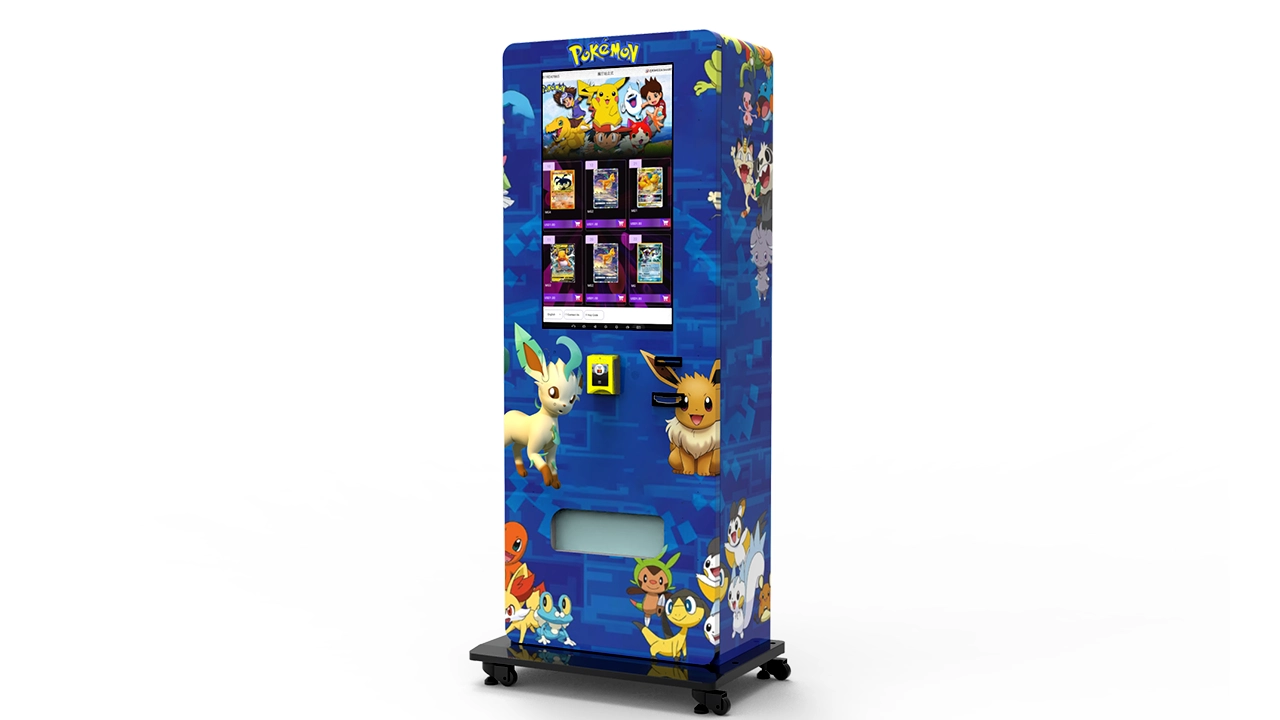
Can You Buy an Official Pokémon Vending Machine?
No, not according to the current official automated retail FAQ.
Pokémon Center says its automated retail machines are owned and operated by The Pokémon Company International and that there are currently no plans to sell them.[1]
This is a crucial distinction for anyone who arrives at this topic from a business angle.
You should not interpret a listing for a generic or customizable “Pokémon card vending machine” as an offer to buy the official Pokémon Automated Retail machine. Those are separate concepts.
An independent operator can potentially purchase a trading card vending machine and stock legally sourced sealed trading card products, subject to applicable product-distribution terms, trademark rules, venue agreements, taxes, consumer laws, payment requirements, and other obligations.
But the machine should use branding that the operator is legally authorized to use. Simply selling compatible merchandise does not create permission to reproduce Pokémon logos, official machine graphics, copyrighted artwork, or other protected brand assets on the cabinet.
I would make that distinction explicit in any commercial project brief before discussing cabinet graphics.
Building an Independent Trading Card Vending Operation
If the business objective is automated trading-card retail rather than ownership of an official Pokémon vending machine, there are many more equipment options.
Zhongda Smart manufactures configurable trading-card vending equipment for booster packs, sealed card boxes, sports cards, TCG merchandise, and compatible collectibles. Its current trading card vending machine range includes floor-standing, touchscreen, wall-mounted, and elevator-delivery configurations.
I’d choose the machine around the products first, not the appearance of the cabinet.
Before requesting a quotation, prepare:
- Exact package width, height, and depth for every planned SKU.
- Package weight.
- Photos of the real packaged product.
- Required number of selections.
- Target capacity for fast-selling products.
- Preferred payment methods.
- Connectivity requirements.
- Available floor or wall space.
- Desired touchscreen size.
- Remote inventory requirements.
- Expected service frequency.
- Authorized branding assets.
Why Product Dimensions Come First
A vending machine might advertise 60 selections, but that number means little if the intended merchandise cannot be dispensed reliably from those selections.
Trading cards introduce unusual packaging challenges. Thin foil boosters can bend. Sleeved boosters have larger cardboard profiles. Boxed products may have corners collectors expect to remain clean. Larger premium products can be relatively valuable compared with ordinary convenience-vending merchandise.
For that reason, I would rank dispensing reliability above raw selection count.
Possible delivery systems include coils, controlled push mechanisms, belts, lockers, conveyors, and elevator-style delivery depending on the cabinet design.
An elevator delivery system can be attractive for larger or condition-sensitive merchandise because it reduces the distance a product falls during delivery. It is not automatically required for every booster pack, but it can be valuable when the product mix includes more substantial boxes.
Remote Inventory Should Be Designed In, Not Added as an Afterthought
If an operator plans to manage more than one self-service kiosk, remote visibility becomes increasingly useful.
Zhongda Smart's guide on starting a trading card vending machine business discusses sales-by-SKU monitoring, inventory estimates, payment status, machine status, transaction records, and fault information as part of a connected operation.
The purpose is not to add a dashboard merely because dashboards look sophisticated. The purpose is to answer practical questions before someone gets into a service vehicle:
- Which machine actually needs stock?
- Which products should be loaded?
- How many units should be taken?
- Did the product sell or did the inventory count become inaccurate?
- Is the machine online?
- Does a fault need to be addressed during the same visit?
Those answers determine whether a smart vending system actually improves operations.
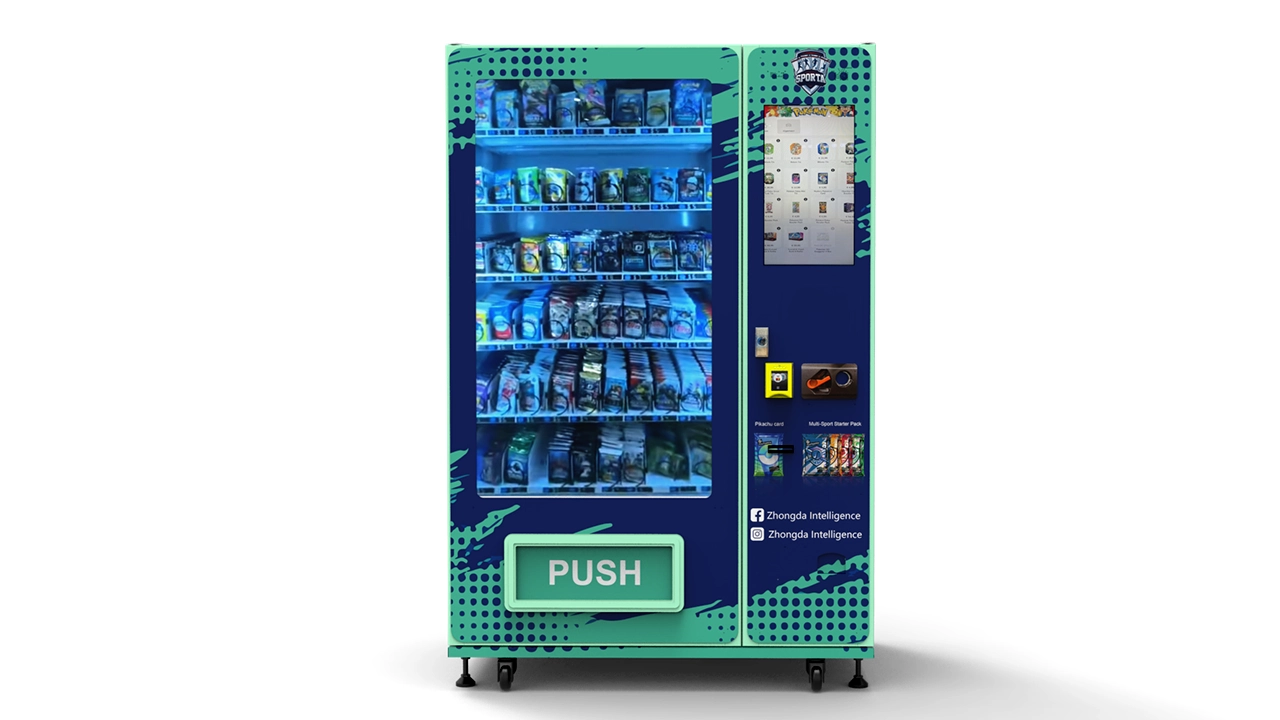
Machine Cost and Investment Planning
People considering automated card retail often focus on the equipment price first. I would look at total deployed cost instead.
Zhongda Smart's current product catalog shows example listed machine prices ranging from approximately $999 to $2,632 for several trading-card configurations at the time of this review. Those website prices should be treated as reference listings rather than guaranteed project totals because hardware configuration, payment equipment, customization, freight, installation requirements, taxes, software, and order quantity can change the final cost.
A realistic project budget can contain:
| Cost Category | What to Include |
|---|---|
| Vending hardware | Cabinet, display, controller, dispensing hardware, sensors |
| Payment equipment | Card reader, cash hardware if required, supported mobile-payment integration |
| Connectivity | 4G, Wi-Fi, LAN hardware and any recurring service |
| Software | Inventory dashboard, remote management, licenses or service charges if applicable |
| Branding | Authorized exterior graphics, interface design, signage |
| Freight | Transport, handling, insurance, delivery |
| Installation | Placement, electrical preparation, network setup, anchoring if required |
| Initial merchandise | Opening inventory and reserve stock |
| Spare parts | Recommended motors, sensors, cables or other service parts |
| Working capital | Cash needed to reorder fast-moving inventory before current stock is fully sold |
If I were choosing between a $1,200 machine and a $2,100 machine, I would not automatically choose the cheaper unit. I would compare the total system against the merchandise.
A lower-cost cabinet that damages boxed products, cannot accept the preferred payment method, or requires frequent blind restocking trips can become the more expensive machine after deployment.
Likewise, an expensive configuration loaded with features that the location does not need can produce poor capital efficiency.
The right machine is the one that supports the expected product mix and operating model with enough reliability and flexibility to justify its installed cost.
Illustrative Profitability and Payback Model
No vending-machine manufacturer can responsibly promise a fixed return on investment because revenue depends on product margin, traffic quality, selling price, inventory availability, venue economics, payment fees, maintenance, and operating discipline.
A useful way to evaluate the business is to build a contribution model before ordering equipment.
Here is a deliberately simplified example:
| Illustrative Monthly Metric | Example Amount |
|---|---|
| Gross merchandise sales | $4,500 |
| Merchandise cost at 70% | -$3,150 |
| Gross merchandise margin | $1,350 |
| Venue cost or revenue share | -$350 |
| Payment and transaction expenses | -$140 |
| Restocking and routine service allocation | -$230 |
| Connectivity/software/other operating allocation | -$75 |
| Illustrative monthly operating contribution | $555 |
If the total initial deployed investment were $5,500, dividing that investment by an illustrative $555 monthly contribution gives a simple payback period of approximately 9.9 months.
That number is not a forecast.
Change monthly sales from $4,500 to $2,500 while leaving many fixed expenses in place and the economics can deteriorate rapidly. Increase sales while maintaining healthy gross margin and route efficiency, and payback can improve.
The sensitivity is why I would pilot before scaling.
Zhongda Smart's detailed discussion of trading card vending machine profitability emphasizes the same core variables: margin, inventory turnover, machine investment, placement cost, payment expense, and restocking efficiency.
The restocking component deserves more attention than it usually receives. A product sitting empty loses potential sales. A technician visiting a machine unnecessarily consumes labor. Excess inventory sitting in a slow location traps working capital. Replenishment quality affects all three.
That brings us back to the original question, when do Pokémon vending machines restock. Even though the official Pokémon operation does not publish its internal economics or routing system, its case-by-case restocking policy is consistent with a fundamental automated-retail principle: inventory needs are not identical at every machine.
Restocking Checklist for Independent Operators
For an independent trading-card vending business, I’d recommend formalizing replenishment rather than relying on memory.
Before the Route
- Review sales by machine.
- Review sales by SKU.
- Check expected inventory remaining.
- Identify sold-out and near-stockout selections.
- Review machine fault status.
- Prepare exact replacement quantities.
- Separate stock by machine before departure.
- Confirm high-value products against the inventory list.
- Bring required cleaning materials.
- Bring commonly needed spare parts if appropriate.
At the Machine
- Inspect the cabinet for damage.
- Confirm touchscreen operation.
- Check payment hardware.
- Compare physical inventory with the system count.
- Record unexplained discrepancies.
- Refill according to the approved plan.
- Check package orientation.
- Confirm products move freely in their channels.
- Do not overcompress flexible booster packaging.
- Inspect the delivery area.
- Clean customer-contact surfaces as appropriate.
After Restocking
- Update physical counts if the system does not do so automatically.
- Verify each SKU is mapped to the correct position.
- Check displayed price against the approved price.
- Perform controlled test procedures where required.
- Confirm payment connectivity.
- Confirm the machine has returned to normal operating status.
- Record the service visit.
- Document any parts that need future replacement.
For a larger operation, I would also track stockout hours, not just stockout events.
If Product A sells out Friday afternoon and is not replenished until Monday, the operator lost far more potential selling time than a product that sold out 30 minutes before a scheduled service visit.
A useful KPI is:
In-Stock Rate = Hours the SKU Was Available ÷ Total Selling Hours × 100
If a machine operates 100 selling hours during the measurement period and a fast SKU is unavailable for 12 hours, its in-stock rate is 88%.
Raising that rate may increase sales, but only if the cost of additional inventory and servicing remains sensible.
That is the balance a good inventory program tries to optimize.
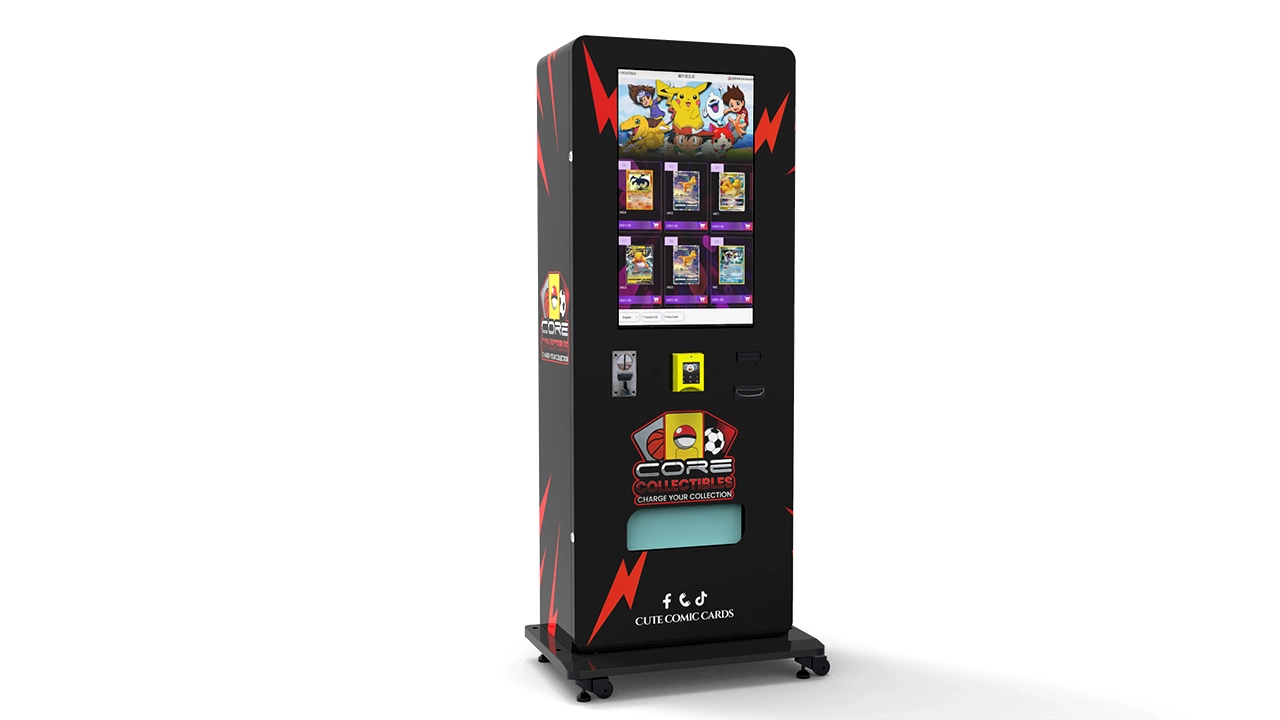
What I Would Prioritize in a Trading Card Vending Machine
If I were selecting equipment for a card-vending project, I would rank the requirements in roughly this order:
- Reliable dispensing of the actual products.
- Accurate inventory tracking.
- Convenient payment options.
- Easy service access.
- Appropriate capacity for fast sellers.
- Remote machine-status visibility.
- Secure connected-device administration.
- Flexible merchandising.
- Authorized custom branding.
- Appearance and promotional display features.
The order is intentional.
A beautiful 32-inch touchscreen does not compensate for an unreliable delivery mechanism. A machine with 60 theoretical product lanes does not help if the products jam. A remote dashboard does not help if inventory events are mapped to the wrong SKUs.
For this comparison, I’m prioritizing operating reliability over feature count.
That approach is especially important for collectible merchandise because packaging condition affects the customer experience. A crushed corner on an inexpensive snack carton is annoying. A damaged sealed collectible box can materially change how the buyer perceives the purchase.
Operators evaluating equipment can compare current configurations in the Zhongda Smart trading card vending machine catalog, but the specification should ultimately be based on real samples or exact package dimensions rather than product-page photographs alone.
Why a “Full Machine” Can Still Have Poor Inventory
Visual fullness is not the same as effective availability.
Consider a machine with 20 product selections. Fifteen slow-moving selections are full, while the five most frequently purchased products are sold out. Physically, the machine may still contain a large quantity of merchandise. Commercially, its strongest selling positions are unavailable.
I would therefore measure machine health with several indicators:
| Metric | Why It Matters |
|---|---|
| Total units remaining | Shows overall inventory but can hide SKU imbalance. |
| In-stock rate by SKU | Shows whether customers can actually buy each product. |
| Sales velocity | Identifies products likely to require early replenishment. |
| Days of supply | Estimates how long current inventory may last. |
| Inventory turnover | Helps distinguish productive stock from stagnant stock. |
| Stockout duration | Measures how long selling opportunities were unavailable. |
| Inventory discrepancy | Highlights potential count errors, failed vends, or service problems. |
Days of supply can be estimated as:
Units Remaining ÷ Average Daily Unit Sales = Estimated Days of Supply
If a machine has 35 units of a booster SKU remaining and it has recently averaged 10 units per day, the simple estimate is 3.5 days of supply.
If the next service opportunity is five days away, that product is already at risk of selling out before the visit.
If another product has 35 units remaining but sells only two per day, it has roughly 17.5 days of supply under the same simplified calculation.
Equal physical inventory therefore does not mean equal restock urgency.
Why Popular Releases Can Distort a Normal Restock Pattern
Collectors sometimes discover what looks like a regular restock cycle and then find that the pattern suddenly stops working. Product launches are one reason that can happen.
Suppose a machine normally sells 150 total products during a service interval. A highly anticipated release can shift a large share of those transactions toward one or two SKUs.
The machine may then experience a product-level stockout long before its overall inventory reaches a normal service threshold.
Operators have several ways to respond:
- Allocate more machine capacity to the fast SKU.
- Increase safety stock.
- Shorten the service interval temporarily.
- Rebalance inventory between machines if permitted.
- Change the assortment when upstream supply is unavailable.
This is why the question when do Pokémon vending machines restock after a new release still cannot be answered with a guaranteed hour. Higher demand may encourage more active replenishment, but restocking remains dependent on inventory availability and machine needs according to the official policy.[1]
New-release demand also shows why cumulative production statistics should be interpreted carefully. More than 85 billion Pokémon TCG cards produced over the lifetime of the game does not tell you the number of units available for one sealed new-release SKU on one particular day.[2]
Should Independent Operators Use Fixed Restock Days?
A predictable route can still make sense for an independent operator. What I would avoid is confusing a predictable service route with a rigid inventory rule.
For example, an operator may have normal service windows on Monday and Thursday because that is efficient for staffing. Remote inventory can then determine which machines are visited during those windows and what stock goes to each machine.
A hybrid model often makes more sense:
- Base route: regular planned service opportunities.
- Inventory trigger: alerts when important SKUs reach defined thresholds.
- Exception visit: additional servicing when the value of preventing a stockout exceeds the cost of the visit.
Suppose an emergency trip costs $45 in labor and travel while the machine is expected to lose only $20 of gross margin before the regular route. The extra trip may not make economic sense.
If a high-volume release could lose $300 of contribution before the scheduled visit, the decision changes.
This is the type of thinking I would want an automated-retail management system to support.
Inventory Accuracy Matters as Much as Inventory Quantity
A connected machine reporting six units remaining is only useful if six units are physically present.
Inventory discrepancies can develop for several reasons:
- A product was loaded into the wrong lane.
- The wrong opening quantity was entered.
- A failed vend was counted incorrectly.
- A technician removed stock without recording it.
- A product was swapped but the SKU mapping was not updated.
- A sensor event was interpreted incorrectly.
That is why periodic physical reconciliation still matters even when a machine has remote inventory software.
I would track an inventory-accuracy rate such as:
Inventory Accuracy = Correct Physical SKU Counts ÷ Total SKU Counts Checked × 100
If 47 of 50 checked SKU positions match the system exactly, the simple accuracy rate is 94%.
The three discrepancies should then be investigated rather than silently corrected, because the pattern may reveal a mechanical, software, or operating issue.
A dashboard does not make inventory accurate by itself. Accurate data comes from reliable machine events, correct product mapping, disciplined servicing, and periodic reconciliation.
Out of Stock vs. Machine Malfunction
One useful distinction for customers is whether the desired product is simply unavailable or whether a transaction has gone wrong.
| Situation | Likely Category | What to Do |
|---|---|---|
| A product is clearly marked unavailable before purchase | Inventory issue | Choose another product or check again another time. |
| Your payment is accepted but the product does not dispense correctly | Vending issue | Use the official automated retail support channel. |
| The screen is frozen or unusable | Machine issue | Report the malfunction through official support. |
| The machine appears physically damaged | Machine issue | Do not interfere with the equipment; report it. |
| A desired product has been unavailable for several visits | Inventory availability | There is no published guaranteed restock date. |
The Pokémon Center FAQ directs damaged-machine reports, vending issues, and other automated-retail incidents to the Pokémon Automated Retail Vending Machine Support Team. As of its January 26, 2026 update, it lists 866-872-4790 along with an online support-request option.[1]
The FAQ also specifically says store employees and merchandisers cannot assist with these machine-support matters.
If you experience a transaction problem, I’d document the product, time, machine location, transaction details, and any visible error message while the information is fresh.
What the Camera on an Official Pokémon Vending Machine Is For
The official FAQ also addresses cameras on newer automated retail devices. Pokémon Center says the equipment is used to count the number of people passing in front of the device and that the automated retail devices do not store or transmit video.[1]
This feature is separate from the restocking schedule, but traffic measurement illustrates another way automated retail can generate operational data.
For an independent vending operator, traffic counts can be useful when evaluating conversion.
For example, if a location produces 2,000 qualified passersby during a period and 80 completed transactions, a simplified transaction conversion rate would be:
80 ÷ 2,000 × 100 = 4%
That hypothetical metric can help distinguish a traffic problem from a merchandising problem. A machine with very low traffic may need a different placement. A machine with strong traffic but weak transactions may need better product selection, pricing, visibility, or user experience.
Any independent traffic-measurement system should, of course, be designed and operated in accordance with applicable privacy requirements.
Restocking Is Really a Working-Capital Decision
There is a temptation to assume that more inventory is always better. It is not.
Inventory has a cost.
If an operator places $8,000 of slow-moving merchandise in one machine when $3,000 would have supported the same sales volume, $5,000 of working capital is tied up unnecessarily.
On the other hand, understocking a fast product can create repeated lost sales.
The objective is not maximum inventory. It is adequate inventory.
I would think about products in five roles:
| Inventory Role | Restocking Approach |
|---|---|
| Core fast seller | High availability target and meaningful reserve capacity |
| Current high-interest release | Frequent monitoring and flexible allocation |
| Premium product | Lower unit depth may be acceptable if transaction frequency is lower |
| Steady secondary seller | Normal replenishment threshold |
| Experimental SKU | Small opening quantity until demand is proven |
This portfolio approach gives an operator room to test merchandise without sacrificing the capacity needed for proven products.
It also explains why a good restock can involve removing or reducing a slow SKU instead of simply adding more of everything.
How I Would Evaluate a Vending Machine Manufacturer
For an independent automated card business, I would evaluate a manufacturer on more than the cabinet price.
My shortlist would include:
- Ability to test the actual product packages before production.
- Choice of dispensing mechanisms.
- Payment hardware compatibility.
- Remote inventory capability.
- Machine-status monitoring.
- Spare-parts availability.
- Documentation quality.
- Software support.
- Service access to motors, controllers, and payment components.
- OEM or ODM customization where legally appropriate.
- Clear warranty terms.
- Defined pre-shipment testing.
Zhongda Smart is one manufacturer I’d include in that comparison for a purpose-built trading-card vending project because its current product range is configured around packs, card boxes, cashless payment, touchscreen interfaces, remote management, and multiple dispensing options.
I would still specify the requirements in writing before ordering. No manufacturer should be expected to guess the product dimensions, payment architecture, capacity target, installation environment, or service strategy.
The stronger the project specification, the easier it is to compare quotations on a like-for-like basis.
The Most Useful Answer to “When Do Pokémon Vending Machines Restock?”
After removing the rumors, the answer is refreshingly straightforward.
When do Pokémon vending machines restock? They are restocked as inventory needs require, but Pokémon Center does not publish a fixed schedule. Product-level stock and the inventory needs of individual machines influence replenishment, and customers cannot receive advance restock notifications.[1]
That means there is no officially supported “best weekday,” no guaranteed morning restock, and no universal number of days between visits.
If I were buying cards from the machines, I would:
- Use the official machine information rather than a claimed universal schedule.
- Check availability when it fits naturally into my routine.
- Keep a short list of products I genuinely want.
- Avoid pressuring store employees for information they are specifically not expected to provide.
- Use official support for actual vending or machine problems.
If I were running an independent trading-card vending business, I would take almost the opposite perspective. Instead of asking for a fixed restock day, I would build a system that tells me exactly which machine needs which SKU and how urgently it needs it.
That is where connected inventory, sensible reorder points, accurate SKU mapping, route planning, and machine reliability become more valuable than a simple calendar.
Automated retail works best when the replenishment schedule follows demand rather than forcing demand to fit the schedule.
Frequently Asked Questions
What time do Pokémon vending machines restock?
Pokémon Center does not publish a fixed restocking time. Its current automated retail FAQ says there is no set schedule, and replenishment depends on particular product stock levels and the inventory needs of each machine.
Do Pokémon vending machines restock every day?
There is no official statement that every machine is restocked daily. A machine may need replenishment more or less often depending on demand, available product inventory, and its current stock position.
Do Pokémon vending machines restock on the same weekday?
No universal weekday is officially published. A repeated pattern observed at one machine should not be treated as a guaranteed schedule because the official FAQ explicitly says there is no set restocking schedule.
Can store employees tell me when a Pokémon vending machine will be restocked?
You should not ask them to. Pokémon Center's automated retail FAQ specifically says store employees and vending-machine merchandisers are not available to answer questions about restocks or inventory.
Can I get an alert when Pokémon vending machines restock?
Pokémon Center says it cannot alert customers when a machine restock has occurred or will occur. Restocking information is handled case by case according to product and machine inventory needs.
What products can official Pokémon vending machines sell?
Pokémon Center describes the machines as a way to purchase Pokémon Trading Card Game merchandise and specifically mentions products such as Elite Trainer Boxes and Booster Packs, along with other TCG products. Exact availability can change.
Can I buy an official Pokémon vending machine for my business?
According to the current official FAQ, no. The official machines are owned and operated by The Pokémon Company International, and Pokémon Center says there are currently no plans to sell them. Businesses interested in independent automated card retail can instead purchase generic or custom trading-card vending equipment, but they should not imply official Pokémon affiliation or use protected branding without authorization.
How should an independent trading card vending operator decide when to restock?
I’d use sales velocity, units remaining, days of supply, safety stock, replenishment lead time, machine capacity, and route cost. Remote inventory management can help prioritize the machines that genuinely need service rather than sending staff to inspect every cabinet on a rigid schedule.
Sources and References
- Pokémon Center Support — Pokémon Automated Retail Vending Machine FAQ. Official guidance covering machine inventory, restocking, support, ownership, return policy, and automated retail devices. Pokémon Automated Retail Vending Machine FAQ
- The Pokémon Company — Pokémon in Figures. Official company statistics reporting more than 85 billion Pokémon Trading Card Game cards produced as of the end of March 2026. Pokémon in Figures
- Worldpay — Global Payments Report. Industry payment research reporting that digital wallets represented 30% of point-of-sale consumer spending in 2023. Worldpay Global Payments Report
- National Institute of Standards and Technology — NIST IR 8259 Rev. 1. Guidance covering foundational cybersecurity activities for manufacturers of connected products. NIST IR 8259 Rev. 1
- GS1 — Global Trade Item Number. Standards information explaining the use of GTINs to uniquely identify trade items. GS1 GTIN Standard
Disclaimer
This article is provided for general informational and editorial purposes only. Restock timing, product availability, machine locations, support procedures, pricing, policies, and product assortments can change without notice. No restock day, time, product availability, sales level, profit, or investment return is guaranteed.
Pokémon, Pokémon Trading Card Game, Pokémon Center, and related names, logos, characters, artwork, and trademarks belong to their respective rights holders. Zhongda Smart and tradingcardmachines.com are not presented here as the owner, operator, seller, franchise partner, or authorized manufacturer of the official Pokémon Automated Retail vending machines. References to Pokémon TCG products in discussions of independent trading-card vending equipment describe potential product compatibility only and do not imply sponsorship, endorsement, licensing, authorization, or affiliation.
Businesses operating independent vending machines are responsible for confirming lawful merchandise sourcing, trademark and copyright permissions, consumer-protection requirements, payment rules, taxes, venue agreements, accessibility requirements, electrical standards, privacy obligations, and other applicable requirements before deployment.
Illustrative inventory calculations, revenue examples, costs, margins, restocking thresholds, conversion rates, and payback calculations in this guide are examples for explaining operating concepts. They are not representations of Pokémon's internal operations and are not financial forecasts or investment advice.