Pokémon vending machine locations are easiest to verify through the official Pokémon Vending Machine Locator, because the network changes and a copied address list can become outdated quickly. In 2026, the official machines remain a direct way to buy Pokémon Trading Card Game products such as booster packs and Elite Trainer Boxes through an automated retail kiosk. The most important thing to know before making a trip is that a listed machine does not guarantee a specific product will be in stock, and Pokémon does not publish a fixed restock schedule. This guide explains how to confirm a machine, what you can realistically expect to find, how support and returns work, and how official Pokémon machines differ from independent trading card vending machines used by card shops, vending operators, and collectible retailers.
2026 Quick Answer: Use the Live Locator, Not an Old Address List
If your goal is simply to find pokemon vending machine locations near you, I’d go straight to the official Pokémon Vending Machine Locator. The locator accepts a city or ZIP/postal code and is the source I would trust first in 2026. Pokémon Center Support itself points customers to that locator for current placement information.[1]
That matters because automated retail networks are not static. A machine can be added, removed, temporarily unavailable, relocated within a store, or unavailable during store remodeling. A blog post that reproduces hundreds of addresses may look more complete, but it starts aging the moment it is published. For a location guide, accuracy is more useful than a giant copied table.
| Question | 2026 Answer | Best Action |
|---|---|---|
| Where is the nearest official machine? | Use the live Pokémon locator. | Search by city or ZIP/postal code shortly before your trip. |
| Will the machine have the set I want? | Not guaranteed. | Treat location availability and product availability as two separate questions. |
| When does it restock? | No fixed public schedule. | Do not rely on rumors or ask store staff for a private restock time. |
| Can I buy an official Pokémon machine? | No, according to Pokémon Center Support. | For an independent card business, use a non-affiliated custom trading card vending machine. |
| Can the host store fix a transaction problem? | Usually no. | Use Pokémon Automated Retail support for official-machine issues. |
The practical rule is simple: use the locator to answer “where,” then treat stock, pricing, and availability as live retail conditions that may change after you arrive. That approach saves more time than trying to decode an unofficial pokemon vending machine map that may lag behind the official system.
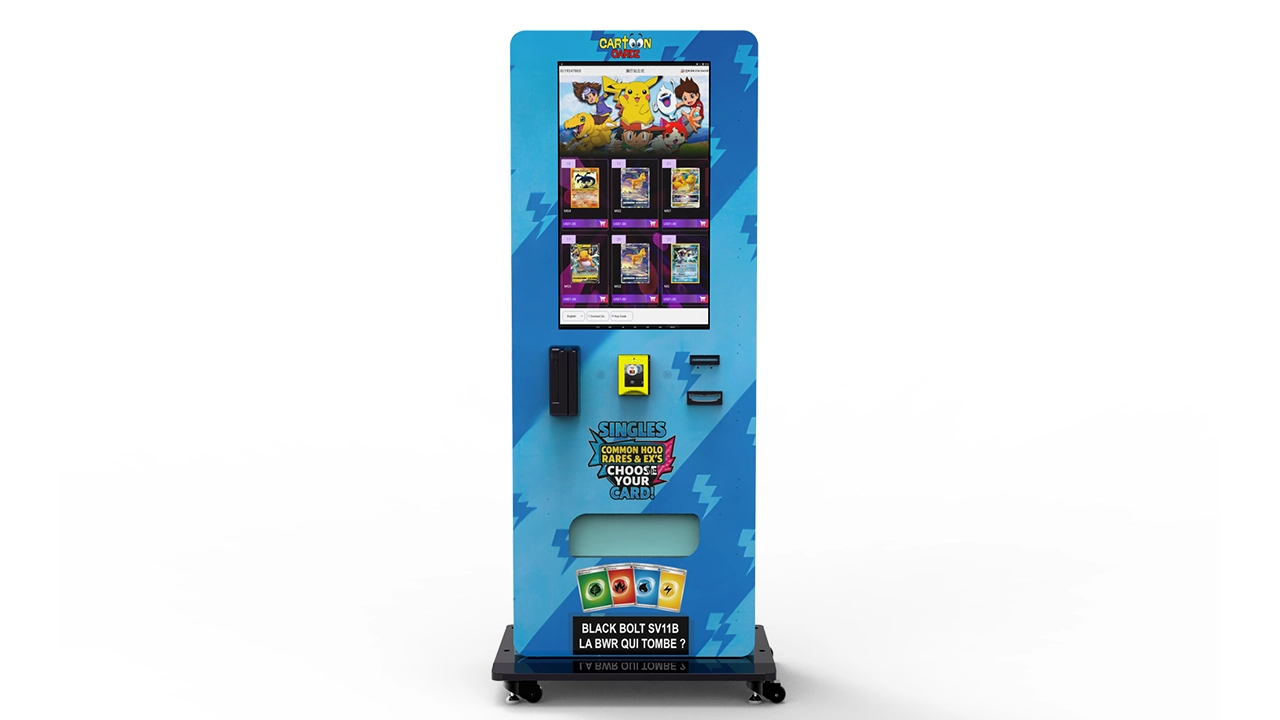
What Official Pokémon Vending Machines Are
Official Pokémon automated retail machines are self-service kiosks operated by The Pokémon Company International. Pokémon Center Support describes them as vending machines for Pokémon Trading Card Game products, including Elite Trainer Boxes, booster packs, and other TCG items. They are not simply generic snack machines carrying cards. They are part of a branded automated retail program with dedicated inventory, support, policies, and machine management.
That distinction matters because the phrase “Pokémon vending machine” is now used loosely online. You may see three different things described with similar wording:
- Official Pokémon Automated Retail machines: owned and operated by The Pokémon Company International.
- Independent trading card vending machines: machines owned by a card store, operator, mall vendor, or other retailer that may legally resell authentic sealed trading card products it has sourced.
- Collectible or mystery vending kiosks: third-party machines that sell assorted TCG items, repacks, graded cards, blind products, or other collectibles.
When I refer to official pokemon vending machine locations in this guide, I mean the first category. If I discuss hardware an entrepreneur can purchase, customize, or place in a store, I mean an independent trading card vending machine. Keeping those categories separate prevents the most common misconception in this market: seeing an official Pokémon kiosk and assuming a retailer can order the same branded machine from a vending manufacturer.
The official support policy is clear that The Pokémon Company International owns and operates its automated retail machines and does not currently sell them.[2] That means any manufacturer offering a “Pokémon-style” or “Pokémon-compatible” machine should not be represented as selling the official Pokémon program. A legitimate independent project should use its own branding and treat Pokémon names and product images only within the bounds of applicable trademark, resale, advertising, and platform rules.
From a machine-design perspective, the interesting part is not the artwork. It is the retail system behind the artwork: a touchscreen or selection interface, payment acceptance, controlled dispensing, inventory management, telemetry, service access, product protection, and the operational discipline required to keep a high-demand collectible product available. Those are the same fundamentals I would evaluate for any serious Pokémon TCG vending machine or card-selling self-service kiosk.
How to Find Pokémon Vending Machine Locations in 2026
The official locator should be your starting point. In my view, a useful 2026 guide should teach you how to verify a machine instead of pretending a static page can permanently replace a live database. The locator is designed around a city or ZIP/postal-code search, so you can check the nearest machines without relying on an old social post, screenshot, spreadsheet, or map pin.
1. Start with the official Pokémon Vending Machine Locator
Enter the city or ZIP/postal code where you plan to shop. If the locator returns several pokemon vending machine locations, compare the host stores and choose the one that fits your route. If you are traveling, repeat the check near your destination instead of assuming that a location you saw months ago is still active.
I’d also refresh the locator on the same day when the trip is specifically for cards. A machine location may still exist even when the product you want is sold out, but checking the official map at least protects you from the more basic problem of driving to an outdated address.
2. Treat the store name and street address as the identifying data
Many official machines are placed inside larger retail stores. When you see a result, note the full host-store name and address rather than memorizing only the city. Large grocery chains may have several branches within a short distance, and going to the wrong branch is an easy mistake.
Older official support pages illustrate this clearly. Historical location lists for Pennsylvania showed multiple Acme Markets stores in the same metro area, while a Delaware list included both Acme Markets and Safeway. Those pages are useful for understanding how dense placement can become, but I would not use a 2025 static list as the final authority for a 2026 trip. The live locator should win whenever the two disagree.
3. Check the host store’s opening hours
A self-service kiosk can operate without a cashier, but a machine inside a grocery store is not necessarily accessible 24/7. The host store’s opening hours still control physical access. This sounds obvious, yet it is one of the biggest differences between an indoor trading card vending machine and a true outdoor vending installation.
If you are visiting early in the morning or late at night, confirm the store’s current opening hours through the store itself. The Pokémon locator tells you where a machine is; it should not be treated as a guarantee that the building is open at the exact time you arrive.
4. Do not confuse “machine exists” with “item is available”
The most common frustration around pokemon vending machine locations is not finding the machine. It is arriving and discovering that a popular set is unavailable. Pokémon Center Support explicitly says there is no set public restock schedule, and inventory timing depends on stock levels and machine needs.[2]
That means a map pin is evidence of a retail point, not evidence of current inventory. If you are after one specific Elite Trainer Box, booster bundle, or booster pack, assume availability is uncertain until you see it on the machine interface.
5. Use unofficial maps only as secondary references
Community maps can be convenient, especially when they present a large cluster visually. I would still rank them behind the official locator. A third-party map may be excellent today and stale next month if its update process breaks or if a location is removed. If an unofficial pokemon vending machine map shows a result that the official locator does not, I would verify before traveling.
This is one of those cases where “complete” should mean current, verifiable, and useful—not merely long. A 2026 location guide that copies every address into an article may be less reliable than a short method that points readers to the source controlling the network.
Where Pokémon Vending Machines Are Usually Placed
Official historical support listings show a strong grocery-retail pattern. Examples include Acme Markets and Safeway, and other public location discussions have often centered on large supermarket chains. I would treat those chain names as placement examples, not a promise that every branch has a machine.
The business logic is straightforward. Grocery stores give automated retail a combination that card products need:
- steady daily foot traffic rather than occasional event traffic;
- long opening hours;
- indoor security and weather protection;
- power and network access;
- repeat customers who may notice new inventory during normal shopping trips;
- space near entrances, service areas, or other self-service equipment;
- a family-shopping environment where Pokémon products already have broad recognition.
For someone studying pokemon vending machine locations from an operator’s point of view, the lesson is more important than the chain names. A successful collectible-card machine needs recurring qualified traffic, safe access, enough dwell time for customers to browse the screen, and a host that benefits from the extra retail attraction without creating congestion.
I’d prioritize a visible indoor position over a hidden high-traffic position. A machine beside the main flow of customers can outperform a machine around a corner even if the second area technically records more passersby. Card buyers need to see the product imagery, understand what the kiosk sells, and feel comfortable stopping long enough to compare sets and prices.
For an independent operator, suitable host categories can include card shops, game stores, malls, arcades, entertainment centers, college-adjacent retail, family venues, sports facilities, and other locations where collectibles fit naturally. The best location is not automatically the busiest location; it is the one where traffic quality, rent or commission, security, access, and product demand work together.
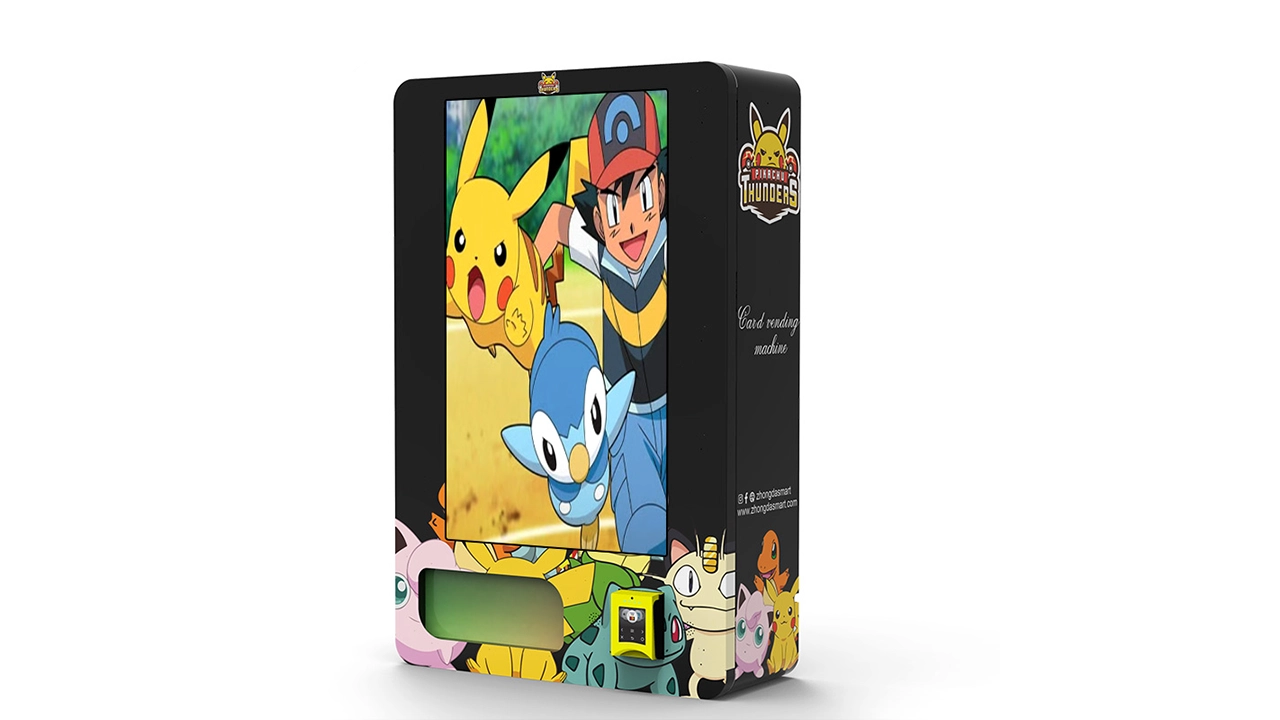
How to Verify a Location Before You Drive
If the main purpose of your trip is buying cards, I’d use a simple verification routine. It takes only a few minutes and prevents most avoidable failures.
- Check the official locator on the day of travel. Confirm the host store and street address.
- Check the store’s current hours. A machine inside a store is limited by building access.
- Allow for stock uncertainty. Do not treat a location listing as a live inventory guarantee.
- Have a second nearby location if practical. If the locator shows several machines, build a route instead of depending on one kiosk.
- Use official support for machine problems. Store employees are not the correct support channel for vending-machine transaction issues.
For families, I’d make the machine one stop in a broader errand rather than a special long-distance trip for a single set unless you are comfortable with the possibility of leaving empty-handed. High-demand trading card inventory can move quickly, and the official policy does not promise a predictable public restock window.
For collectors planning several stops, write down the host-store addresses in route order. A cluster of pokemon vending machine locations can look close on a map while still requiring significant driving once parking lots, traffic, and store entry are included. Planning two or three high-probability stops is usually more efficient than attempting every pin in a large area.
I would not recommend calling a grocery store and asking an employee to check the Pokémon machine’s inventory. Pokémon Center Support specifically tells customers not to ask store employees or merchandisers about restocks or inventory. Even apart from that policy, the employee answering the phone may not have access to the kiosk’s real-time product data.
If the machine is physically damaged, fails to vend, takes payment without completing a transaction, or has another operational problem, use the official automated-retail support channel. That gives the issue to the team that can identify the machine and transaction rather than placing an unrelated burden on the host store.
What Pokémon Vending Machines Sell
Pokémon Center Support says the official machines sell Pokémon Trading Card Game products and specifically mentions Elite Trainer Boxes and booster packs among the assortment.[2] The exact mix can vary by machine and by inventory cycle. A machine may carry several products at once, and the selection you see on one visit should not be assumed to be permanent.
Typical product categories you may encounter include:
- individual sealed booster packs;
- boxed Pokémon TCG products;
- Elite Trainer Boxes;
- other sealed TCG products made available through the program.
The machine interface is the only reliable point-of-sale view of what that machine can sell at that moment. This is why discussions of pokemon vending machine locations and discussions of stock need to stay separate. One is a geographic question; the other is an inventory question.
From a manufacturing standpoint, card products create challenges that snack vending does not. A flexible foil booster pack can shift, overlap, or catch on a poorly sized mechanism. A premium box can be cosmetically damaged if it falls too far. A compact product with high resale value also raises security and inventory-control expectations.
For an independent card retailer choosing equipment, I would start with the merchandise dimensions before choosing a cabinet. A vending machine that looks impressive but cannot reliably dispense your thinnest pack, largest box, and highest-value sealed product is the wrong machine. Product compatibility has to be proven with real samples and repeated test vends.
That is also why a purpose-built card vending system should be judged by the full transaction path: product selection, payment authorization, lane control, delivery, pickup confirmation, inventory decrement, remote reporting, and exception handling. The screen is only the visible part of the system.
Restocks, Inventory, Purchase Limits, and Sold-Out Screens
Restock timing is the question that generates the most speculation around pokemon vending machine locations. The official answer is less exciting but more useful: Pokémon Center Support says there is no set public schedule. Restocking depends on product stock levels and the needs of individual machines, and the company says it cannot alert customers in advance when a restock will happen.
I would not build a buying strategy around a rumored weekday or a claimed exact hour. Even if someone correctly observed a restock pattern at one machine for several weeks, that does not create a guaranteed schedule for the network. Inventory operations change with product launches, route planning, staff availability, machine capacity, sell-through, and distribution conditions.
What “out of stock” can mean
A machine can be physically full of some products while the product you want is unavailable. It can also show a limited assortment after popular items sell through. A dark or nonresponsive screen is a different problem and may indicate a machine fault, power issue, connectivity issue, service mode, or another operational condition rather than simple sellout.
When the machine is functioning, follow the on-screen product status. If a selection is marked sold out or unavailable, assume it cannot be purchased at that time. Avoid trying to force repeated transactions or interfere with the machine.
Why unpredictable restocking makes operational sense
Collectible products can attract concentrated demand. If an operator published an exact schedule for every restock, a small group of buyers could arrive at the same moment and clear high-demand products immediately. An unpublished schedule spreads purchasing opportunities and gives the operator flexibility to route service based on actual machine inventory.
From the operator side, I see a second reason: efficient route planning. A connected self-service kiosk should ideally tell the operator what sold, what is low, what failed, and what needs service. Route decisions can then be based on inventory data instead of visiting every machine on a rigid calendar. That reduces unnecessary truck rolls and helps prioritize high-velocity locations.
Purchase limits
Purchase limits may appear on the machine interface for particular products or transactions. Because limits can change, the screen at the time of purchase is the rule to follow. Do not assume an old social-media post describes the current limit for a new release.
For a collector, the healthiest expectation is to treat the machine as a normal retail channel, not as a guaranteed source of scarce product. If one item is unavailable, compare the other products rather than escalating the trip into a chase across dozens of stores. The best pokemon vending machine locations are still subject to the same basic reality as any retail shelf: popular inventory can sell faster than it is replenished.
What independent operators can learn from this
If I were running an independent trading card vending route, I would use remote inventory thresholds, SKU velocity, gross margin, and service distance to set replenishment priorities. A machine that sells 30 units of one booster product per day should not be serviced with the same product mix as a machine that sells five. The objective is not merely to “keep it full.” The objective is to allocate scarce working capital where it produces the best return without disappointing customers.
I’d also avoid filling every lane with the hottest release. A balanced plan can include fast-moving packs, dependable evergreen sets, mid-ticket boxes, and a few higher-margin or higher-ticket products. That reduces the chance that one sold-out SKU makes the entire kiosk look empty or uninteresting.
Payments, Returns, and Machine Support
Official pokemon vending machine locations operate as unattended retail points, so the machine has to handle checkout without a conventional cashier. Payment options can vary by machine generation and configuration, but customers should follow the payment methods shown on the kiosk itself.
The most important policy point is returns. Pokémon Center Support states that vending-machine sales are final and that it does not accept returns from the machines.[2] That is a stricter policy than many conventional retail counters, so check the product selection and quantity carefully before completing payment.
If the machine malfunctions, a product does not dispense correctly, or another machine-specific incident occurs, Pokémon directs customers to the Pokémon Automated Retail Vending Machine Support Team. The official FAQ lists the toll-free number 866-872-4790 and also provides an online support-request route. Pokémon specifically notes that store employees and merchandisers cannot assist with these machine issues.
I’d save the machine location, approximate transaction time, product selected, amount charged, and any receipt or payment record before contacting support. Those details are more useful than a general statement that “the machine did not work.” If the kiosk displays a machine ID, include it as well.
There is also a privacy detail worth knowing. Pokémon says its newer automated retail devices have camera equipment that counts the number of people passing in front of the device, but the devices do not store or transmit video. The official privacy policy provides the controlling details. For an independent operator designing a self-service kiosk, this is a reminder that traffic analytics, cameras, payment data, and customer privacy should never be treated as an afterthought.
Official Pokémon Machines vs. Independent TCG Vending Machines
This is the section I would read carefully if you are researching pokemon vending machine locations because you want to start a similar business. The official machines and an independent TCG vending business can look similar from a customer’s point of view, but commercially they are very different.
| Area | Official Pokémon Automated Retail | Independent Trading Card Vending Machine |
|---|---|---|
| Machine ownership | The Pokémon Company International owns and operates the official machines. | The retailer, vending operator, venue, or financing party owns or leases the equipment. |
| Branding | Official Pokémon branding and program design. | Operator’s own brand; third-party trademarks require proper legal use. |
| Inventory sourcing | Managed within the official Pokémon program. | Operator is responsible for lawful, authentic product sourcing. |
| Can a store buy the official machine? | No, according to the 2026 Pokémon Center Support FAQ. | Yes, independent commercial vending equipment can be purchased from manufacturers. |
| Product mix | Pokémon TCG products chosen for the official program. | Can include multiple TCGs, sports cards, accessories, graded cards, and compatible collectibles. |
| Pricing and margin control | Controlled by the official program. | Operator sets pricing, subject to sourcing contracts, law, and market conditions. |
| Service responsibility | Handled through Pokémon Automated Retail support and its service network. | Operator and equipment supplier define maintenance, spare parts, and technical support. |
The official Pokémon program is therefore not a franchise opportunity. You cannot copy the branding, buy an official unit, and place it in your own store. If I were building an independent card vending business, I would develop a distinct retail identity and make the merchandising proposition broader than one trademark.
That can actually be an advantage. An independent self-service kiosk can be configured around Pokémon TCG, sports cards, Magic: The Gathering, Yu-Gi-Oh!, One Piece, sleeves, small boxes, mystery products, or other merchandise that the operator can lawfully source and sell. The operator can also decide whether the machine is a pure vending point, a 24/7 extension of a card shop, an event kiosk, or an unattended satellite location.
The risk is that independent operators do not inherit official demand, supply, or brand trust automatically. A custom machine only creates a retail channel. It does not create wholesale allocation, authentic inventory, customer traffic, or a profitable location. Those pieces have to be solved separately.
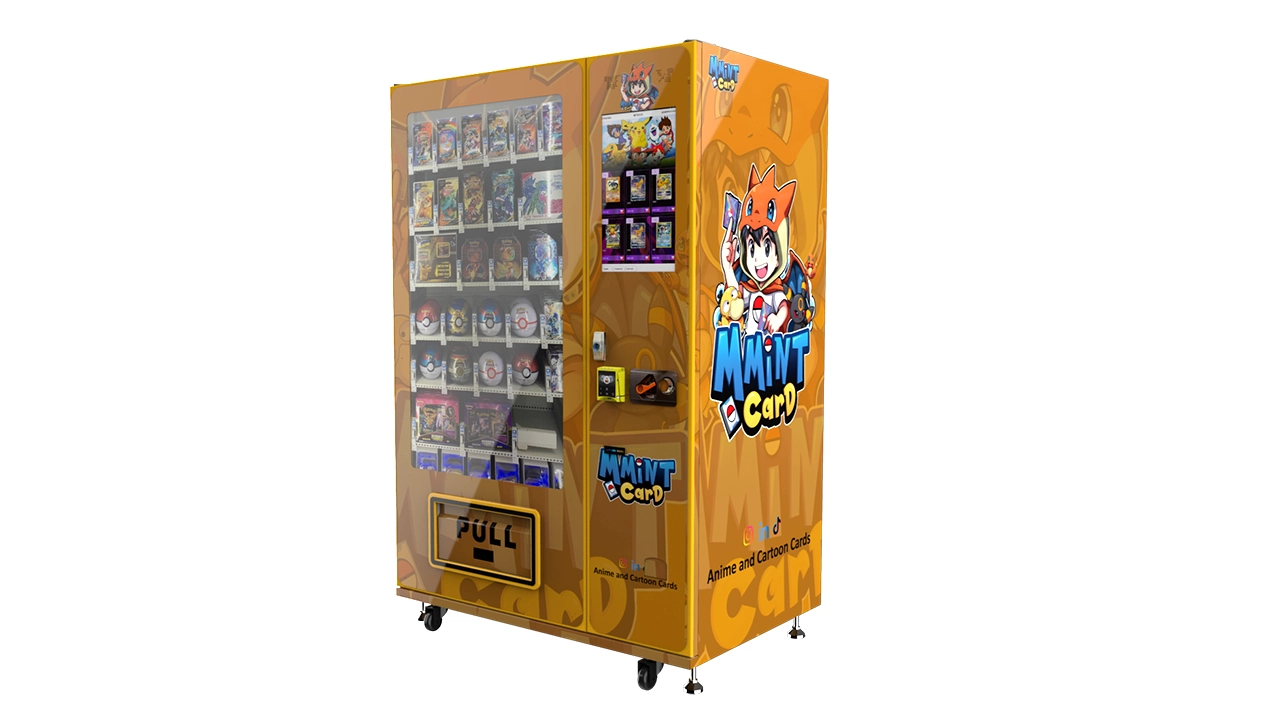
Can You Buy an Official Pokémon Vending Machine?
No. The 2026 Pokémon Center Support FAQ says all official Pokémon Automated Retail machines are owned and operated by The Pokémon Company International and that there are no plans to sell them. If your question about pokemon vending machine locations is really a business question—“Can I put one in my store?”—that official program is not a machine-purchase path.
Pokémon Center Support also says it cannot comment on future vending-machine locations. In other words, there is no published application process that guarantees an official machine for a particular store, and I would be cautious with anyone claiming they can sell you an “official Pokémon vending machine franchise.”
There is a separate path for retailers who want to automate card sales: buy a generic or purpose-built trading card vending machine, apply your own branding, source authentic products through appropriate channels, and operate the machine as an independent retailer. That is a normal equipment-and-retail project, not an official Pokémon partnership.
Pokémon Center’s distributor information also deserves attention. Its June 2026 support page says the company does not offer general licensing or wholesale pricing to smaller retailers for Pokémon Center merchandise, while Pokémon TCG cards are distributed through existing partnerships with mass-market retailers.[3] That statement should discourage any business plan built on the assumption that buying a kiosk automatically gives the operator direct wholesale access from The Pokémon Company International.
For an independent operator, inventory sourcing may be more difficult than buying the machine. I’d rank supply reliability alongside location quality and equipment reliability because a perfect kiosk with no consistent product allocation has little commercial value.
Trading Card Vending Machine Costs and Business Economics
Readers looking at pokemon vending machine locations often notice how little floor space the kiosks use and wonder whether the model is profitable. Official machine economics are not publicly disclosed in the support material, so I would not invent a revenue figure for The Pokémon Company International’s network. What we can analyze is the economics of an independent trading card vending machine.
The broader unattended-retail sector is substantial, but broad market statistics should be used carefully. The NAMA Foundation’s 2024–25 State of Convenience Services report estimates total convenience-services industry revenue at $31.1 billion in 2025, up from $26.6 billion in 2023, and says vending remains the industry’s largest business line by revenue and number of businesses.[4] That is useful context for self-service retail, but it is not a Pokémon-card market-size estimate.
A separate U.S. Census Bureau profile for vending machine operators reports 3,227 employer establishments in 2023 under the relevant vending-machine operator classification. Census tables also report roughly $9.11 billion in 2023 sales, value of shipments, or revenue for the industry group.[5] The definitions differ from NAMA’s broader convenience-services framework, so I would not combine those numbers into one calculation. They simply show that vending is an established retail channel with multiple measurement systems.
The cost stack I would model
The equipment price is only the first line. A realistic independent TCG vending project can include:
- machine purchase price;
- custom cabinet graphics and interface branding;
- payment terminal and payment-processing setup;
- shipping, import, brokerage, and local delivery;
- installation and electrical work if needed;
- initial inventory;
- sales tax setup and business licensing;
- host-location rent or revenue share;
- merchant processing fees;
- SIM/data, telemetry, and cloud software fees;
- insurance;
- route labor and transportation;
- spare parts and vending machine repair;
- shrinkage, refunds, chargebacks, and failed-vend reserves;
- working capital for new releases.
Published machine prices can help establish a hardware range, but they should not be confused with landed project cost. Zhongda Smart currently lists several card-vending configurations on its trading card vending machine collection, including compact wall-mounted and larger touchscreen/elevator models. The exact machine should be quoted around the required product lanes, payment hardware, software, and destination.
An illustrative monthly model
The following example is not a promise of earnings. It is simply the kind of worksheet I would use before signing a location agreement.
| Assumption | Example | Why It Matters |
|---|---|---|
| Transactions per day | 10 | Traffic and conversion drive almost everything else. |
| Average ticket | $18 | Product mix determines revenue per transaction. |
| 30-day gross sales | $5,400 | 10 × $18 × 30 days. |
| Gross merchandise margin | 30% | Depends heavily on authentic product sourcing and purchase cost. |
| Gross profit before operating costs | $1,620 | Sales × gross margin. |
| Host commission | 10% of sales = $540 | Prime locations may require meaningful revenue share or fixed rent. |
| Payment cost assumption | 3% of sales = $162 | Actual processor pricing varies. |
| Route, data, service reserve | $350 | Illustrative allowance for operating overhead. |
| Illustrative operating contribution | $568/month | Before tax, depreciation, financing, owner salary, and other costs. |
At that performance level, a machine may look attractive until you add inventory working capital, taxes, insurance, financing, travel time, slow sellers, and the occasional service call. A weak location can also cut transaction volume in half while most fixed costs remain.
I’d run at least three scenarios: conservative, base, and strong. For the conservative case, reduce both transactions and average ticket while increasing service cost. If the project only works in the strong case, the location agreement is too fragile.
The four numbers I would watch every week
For an independent self-service kiosk, I would prioritize:
- Sales per machine per day. This measures location productivity.
- Gross margin dollars per machine per day. Revenue without margin can hide poor purchasing.
- Stockout hours on top SKUs. A sold-out bestseller is lost opportunity.
- Service events per 1,000 vends. Reliability has a direct labor and customer-trust cost.
For this comparison, I’m prioritizing margin dollars and uptime over flashy screen size. A visually impressive kiosk that jams thin packs, miscounts inventory, or requires frequent manual resets will lose money quietly.
How I Would Choose a Trading Card Vending Machine
If I were choosing equipment after studying official pokemon vending machine locations, I would resist the temptation to copy the appearance of an official kiosk. The useful lessons are operational: clear merchandising, reliable payment, controlled product delivery, remote visibility, and enough capacity to support the location between service visits.
Start with actual product dimensions
Measure every product family you expect to sell. Do not rely only on nominal package sizes from a catalog. A sleeved booster is different from a loose booster pack. A collection box may have a clear plastic window that scratches easily. A premium box may be too valuable to tolerate a long drop.
I’d create a product matrix with width, height, depth, weight, packaging rigidity, retail price, wholesale cost, and desired lane capacity. That worksheet should be reviewed before the machine is configured. If a manufacturer cannot explain how each product will be held and delivered, the project is not ready.
Choose the dispensing method around product risk
Coils are familiar and economical, but they are not universally ideal for trading cards. Thin packs can slip or overlap if the pitch is wrong. Wide boxes can bind if the channel is too tight. Premium items may need an elevator or controlled delivery system to reduce impact.
I’d rank controlled delivery higher as merchandise value and packaging sensitivity rise. For low-cost, rigid products, a simpler mechanism may be completely appropriate. The goal is not to buy the most complicated machine. It is to match mechanism complexity to the risk of the merchandise.
Demand cashless-ready payment architecture
Card buyers are comfortable with digital checkout, and higher-ticket products make cashless payment especially important. The payment architecture should support the methods appropriate for the installation, along with secure communication, transaction logging, refund workflows, and remote diagnostics.
NAMA’s industry research has repeatedly highlighted the importance of technology in modern unattended retail. I would treat payment integration as core infrastructure, not an accessory bolted onto the cabinet after production.
Remote inventory should be actionable
A dashboard that merely shows “machine online” is not enough. I’d want to see sales by SKU, remaining inventory, transaction status, machine alarms, door events, and ideally the data needed to plan a restock route.
The value of remote management increases as the route expands. With one machine in your own store, walking over to check stock is easy. With 20 machines spread across a metro area, manual checks destroy route economics. The system should help answer: Which machine needs product today? Which SKU is selling fastest? Which location is underperforming? Which unit has repeated vending errors?
Capacity should match service frequency
Bigger is not automatically better. Excess capacity ties up inventory and floor space. Too little capacity creates stockouts and extra service trips. I’d calculate the desired number of days between visits, multiply that by expected daily unit sales for each key SKU, and add a reasonable buffer.
For example, if a location sells 15 booster packs per day and you want a seven-day service interval, a lane plan that only holds 40 units of the core booster product will force either frequent stockouts or extra visits. The capacity decision should come from sales velocity, not from the largest number on a specification sheet.
Plan for service access before installation
A machine that is easy for customers can still be miserable for technicians. I’d inspect door clearance, shelf access, payment-module access, controller placement, cable routing, lock design, and whether common parts can be changed without disassembling half the cabinet.
For card vending, replenishment speed is also important. If a route employee spends 45 minutes reorganizing shelves at every stop, route labor will become expensive. Product lanes should be clearly labeled and software counts should match physical stock.
Security has to fit merchandise value
Collectible inventory can have a high value relative to its size. I’d evaluate cabinet steel, locks, door structure, payment-device protection, pickup-door design, alarm options, anchoring, and placement visibility. The best defense is layered: a secure machine in a secure host location with remote monitoring and sensible stock levels.
Do not solve every security concern by making the customer experience frustrating. A pickup door that is too restrictive can damage boxes. An overcomplicated checkout can reduce conversion. The design has to balance deterrence, usability, and serviceability.
Test with real inventory, not empty spirals
Before deployment, I would run repeated test vends using the exact SKUs planned for launch. Test the thinnest pack, the largest box, the most expensive item, and any product with unusual packaging. Repeat tests at different lane fill levels because a mechanism can behave differently when a lane is full versus nearly empty.
A practical acceptance test should include payment authorization, product delivery, inventory decrement, receipt behavior, failed-vend handling, network interruption, power recovery, door opening, and remote alarm reporting. A card vending machine is a small retail system; it should be commissioned like one.
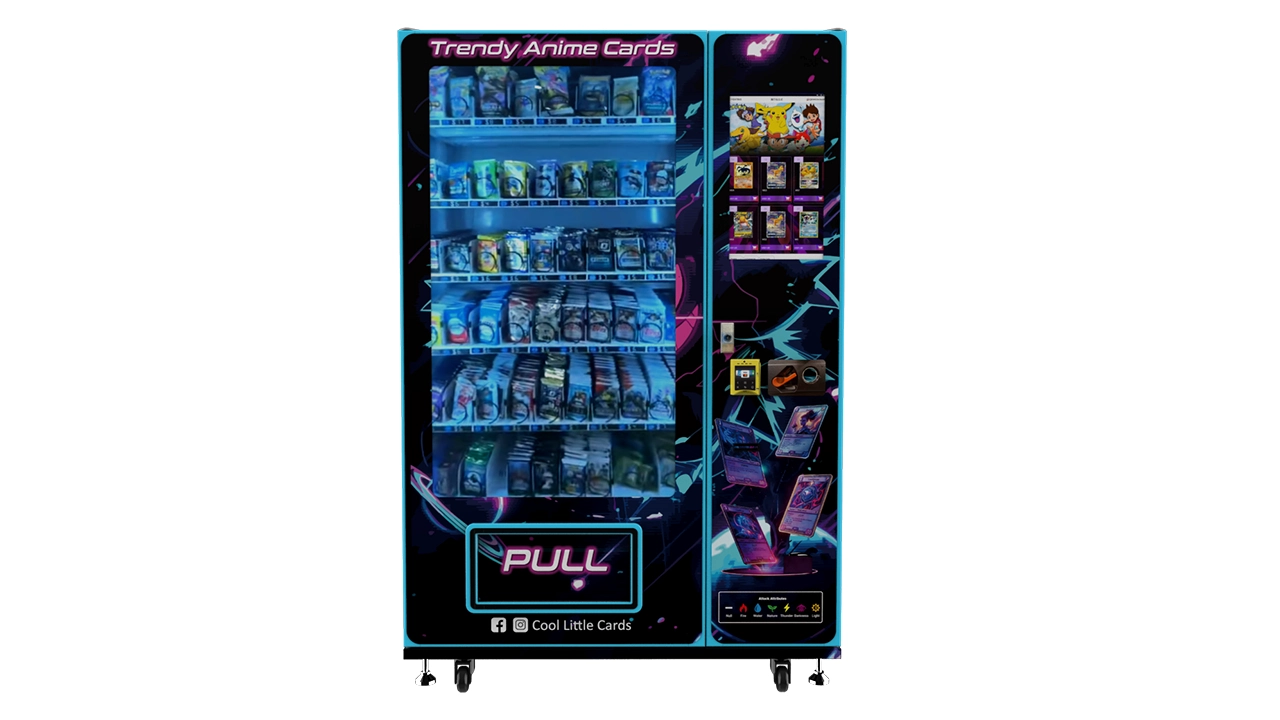
Where Zhongda Smart Fits for Independent Card Retail
Zhongda Smart is a vending machine manufacturer for operators and retailers building their own automated card-retail program. It is not The Pokémon Company International and should not be presented as the supplier of official Pokémon Automated Retail machines. I would make that separation explicit in any sales proposal or website copy.
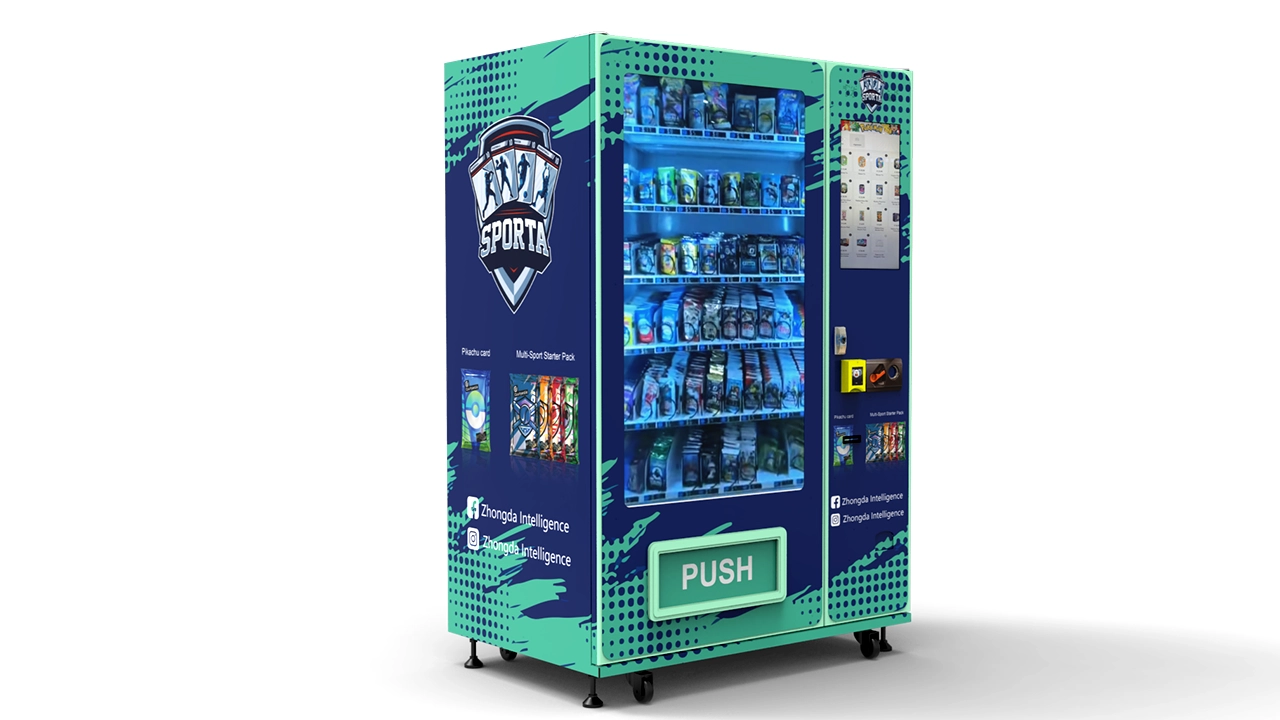
For an independent project, the relevant question is whether the machine can be configured around the actual products, payment methods, capacity, branding, and software requirements. Zhongda Smart offers several trading-card-focused configurations, including large touchscreen models, wall-mounted machines, and elevator-delivery systems. The company’s published product pages describe options such as 4G/Wi-Fi connectivity, cashless payment integration, adjustable product channels, remote management, and OEM/ODM branding.
If I were choosing for a card shop that wants a broad mix of booster packs and small boxes, I’d start by comparing the available TCG card vending configuration against the shop’s real product dimensions and daily sales target. I would not choose it simply because the page references Pokémon TCG compatibility. Compatibility has to be proven with the exact sealed products the operator plans to stock.
For a broader buying decision, the useful checklist is:
- Can the cargo lanes be sized for thin packs and boxed products?
- Is soft or elevator delivery available for higher-value merchandise?
- Can the payment hardware be configured for the target market?
- Does the system support remote sales and inventory monitoring?
- Can cabinet graphics, screen interface, and lighting match the operator’s own brand?
- What spare parts are included or recommended?
- What remote troubleshooting is available after installation?
- How are software updates handled?
- What is the warranty scope?
- Can the manufacturer provide a documented pre-shipment test using customer samples?
Zhongda Smart states that it provides OEM/ODM customization and trading-card vending solutions for sealed packs, boxes, sports cards, and other compatible collectibles. For operators comparing suppliers, I’d ask for a written configuration sheet tied to the sample products, not just a general catalog.
The trading card vending machine business guide is also useful for planning because equipment selection should happen after product sourcing, location economics, and expected sales have been modeled. Buying a machine first and looking for a profitable location later reverses the correct order.
My preferred sequence is: merchandise plan, sourcing plan, location agreement, financial model, machine configuration, sample testing, payment integration, deployment, and then continuous route optimization. That sequence reduces expensive surprises.
Location Strategy for an Independent Card Vending Business
The official pokemon vending machine locations program demonstrates that grocery environments can work for high-demand TCG products, but an independent operator should not blindly copy grocery placement. Your best host depends on your brand, inventory access, machine size, and service radius.
Card shops and game stores
These locations offer the strongest product relevance. Customers already understand sets, prices, and sealed products. A machine can extend selling hours, handle quick pack purchases, or create a separate checkout point during busy periods.
The drawback is that the machine may compete with the store’s own counter if the assortment and pricing are not coordinated. I’d design the kiosk as an extension of the store: after-hours sales, impulse products, fast-moving sealed inventory, event overflow, or a location near an entrance where customers can buy without waiting in line.
Malls and shopping centers
Malls offer broad traffic and visual exposure. A large digital display can work well where customers have time to browse. The commercial challenge is rent. A machine that pays high fixed rent needs dependable sales volume, and sales can vary with season, mall events, and neighboring tenants.
I’d negotiate a pilot period or revenue-share structure when possible. A three-month trial with clear performance thresholds is safer than committing to a long fixed-rent term before you know the conversion rate.
Arcades and entertainment venues
The audience fit can be excellent. Customers are already spending on entertainment, gaming, and impulse purchases. The operator should still check whether the venue has strong repeat traffic or is mostly one-time visitors, because that affects new-release strategy and restock frequency.
Sports venues and hobby environments
For machines that mix sports cards with TCG products, sports facilities, tournament venues, hobby events, and collector-oriented locations can create a strong match. Inventory should reflect the audience. A machine full of baseball cards in a gaming-focused venue may underperform even if total foot traffic is high.
High-traffic general retail
General retail can work when the location is secure and the machine is visible, but the operator must prove demand. The lesson from official pokemon vending machine locations is not that every grocery store is good. It is that a familiar, accessible host can give customers repeated exposure to a self-service card channel.
How I would score a candidate location
| Factor | Weight | What I Would Measure |
|---|---|---|
| Qualified foot traffic | 25% | People likely to buy cards, not just total passersby. |
| Economics | 20% | Rent/revenue share, utilities, insurance, and expected gross profit. |
| Visibility and dwell time | 15% | Can customers see the screen and stop without blocking traffic? |
| Security | 15% | Indoor placement, cameras, staff presence, after-hours exposure. |
| Access hours | 10% | How many hours per week can customers physically reach the kiosk? |
| Service efficiency | 10% | Distance from other route stops, parking, loading access. |
| Competitive context | 5% | Nearby card shops, big-box inventory, other vending kiosks. |
I’d score each factor from 1 to 5, multiply by the weight, and compare sites before signing. The purpose of a scorecard is not mathematical perfection. It forces the operator to confront weak assumptions. A location with spectacular traffic but terrible rent may rank below a smaller venue with better economics and stronger card-buyer concentration.
One more point: route density matters. Five average machines within a 20-minute service loop can be better than five individually strong machines scattered across several hours of driving. Inventory, repair, and replenishment are physical operations. Distance eats margin.
Vending Machine Repair and Maintenance Priorities
Vending machine repair is where a promising card business can quietly lose customers. Collectors notice failed vends, damaged boxes, payment errors, and out-of-service screens immediately. A machine that works 98% of the time may sound reliable, but at 1,000 transactions that still represents 20 problematic customer experiences.
I’d separate maintenance into preventive work and incident response.
Preventive maintenance
- clean touchscreen and pickup area;
- inspect product channels for bent guides or loose hardware;
- test representative lanes;
- check locks and door alignment;
- verify payment terminal connection;
- confirm remote inventory matches physical count;
- inspect fans, filters, and ventilation;
- review alarm and error logs;
- keep firmware and approved software current;
- replace wear parts before repeated failures begin.
Incident response
Every route should have a clear process for payment disputes, jammed products, offline machines, broken screens, network loss, and door-security alerts. I’d define who receives the alert, what can be fixed remotely, which spare parts are carried in the service vehicle, and when a technician must visit.
For higher-value TCG products, inventory reconciliation should be part of the repair process. If a motor turns but a product fails to drop, software inventory may not match physical inventory. The operator needs a way to correct both the customer issue and the stock count.
When comparing manufacturers, ask for common spare-part pricing before buying the machine. Motors, controllers, screens, payment components, locks, sensors, and power supplies should not become a mystery after installation. Good after-sales support is part of equipment cost even when it does not appear on the initial quotation.
Frequently Asked Questions
Where can I find Pokémon vending machine locations near me?
Use the official Pokémon Vending Machine Locator and enter your city or ZIP/postal code. I’d use that live locator instead of relying on a static list copied into a blog post, because machine placement can change. Confirm the host store and street address before leaving, then check the host store’s current opening hours.
Do Pokémon vending machines restock on a set day?
No public fixed schedule is provided. Pokémon Center Support says restocking is handled according to stock levels and individual machine inventory needs and that it cannot alert customers in advance when restocks will occur. I would not plan a long trip around a rumored day or hour.
What stores have Pokémon vending machines?
Official machines have appeared in major retail hosts, particularly grocery environments. Historical Pokémon support listings included chains such as Acme Markets and Safeway. That does not mean every branch has a machine. For current pokemon vending machine locations, the official locator should be treated as the controlling source.
What products do official Pokémon vending machines sell?
Pokémon Center Support says the machines sell Pokémon Trading Card Game products and specifically references items such as Elite Trainer Boxes and booster packs. The exact assortment changes with availability, so a listed machine does not guarantee a particular set or product will be in stock when you arrive.
Can I buy an official Pokémon vending machine for my store?
No. Pokémon Center Support states that all official machines are owned and operated by The Pokémon Company International and that there are no plans to sell them. A retailer that wants automated card sales can instead purchase an independent trading card vending machine and operate it under its own brand.
How much does an independent trading card vending machine cost?
Hardware prices vary widely by cabinet size, touchscreen, lane count, elevator delivery, payment hardware, software, and customization. The machine price is only part of total deployment cost. Budget for freight, payment setup, branding, installation, inventory, host commission, processing fees, software/data, insurance, maintenance, and working capital.
Are Pokémon vending machines profitable?
The official program does not publish machine-level profit figures in the sources used for this guide, so I would not assign a profit number to official pokemon vending machine locations. For an independent TCG kiosk, profitability depends on product margin, traffic, conversion, average ticket, host cost, payment fees, route labor, uptime, and inventory availability. Build conservative, base, and strong scenarios before committing to a location.
What should I do if an official Pokémon machine charges me but does not dispense the product?
Record the location, transaction time, product, amount, and any receipt or payment record, then contact the Pokémon Automated Retail Vending Machine Support Team. Pokémon Center Support lists 866-872-4790 and an online support-request option for machine incidents. Store employees and merchandisers are not the designated support channel for these issues.
How This 2026 Guide Was Prepared
I’m treating current official Pokémon material as the authority for location lookup, machine ownership, restocking, returns, and support. For the independent vending-business sections, I’m using manufacturer-side equipment judgment and clearly labeled illustrative economics rather than presenting unofficial estimates as facts about the Pokémon program.
I’d use the same standard when evaluating any article about pokemon vending machine locations: separate confirmed policy from community observation, separate location from inventory, and separate official Pokémon machines from independently owned card kiosks. Those distinctions make the information more useful for both collectors and operators.
For commercial planning, the broad unattended-retail statistics cited below provide context, not a forecast for trading cards. Card-vending performance is highly location-specific and depends on sourcing, pricing, product demand, machine reliability, and operating discipline.
Sources
- Pokémon Vending Machine Locator — official live machine-location tool.
- Pokémon Center Support: Pokémon Automated Retail Vending Machine FAQ — official information on products, restocking, machine ownership, support, cameras, and returns.
- Pokémon Center Support: Distributor Information — official 2026 information on licensing, wholesale availability, and Pokémon TCG distribution.
- NAMA Foundation: 2024–25 State of Convenience Services — current industry context for convenience services and vending.
- U.S. Census Bureau: Vending Machine Operators Profile — employer-establishment and industry data.
Disclaimer
This article is for general informational and commercial-planning purposes only. Pokémon vending machine locations, product availability, purchase limits, store access, policies, pricing, and support procedures can change. Always verify current information through the official Pokémon Vending Machine Locator and Pokémon Center Support before traveling or making a purchase. Revenue and cost examples for independent vending businesses are illustrative assumptions, not earnings guarantees, investment advice, tax advice, or legal advice.
Pokémon, Pokémon TCG, and related names, characters, logos, and marks are trademarks of their respective owners. Zhongda Smart and tradingcardmachines.com are independent and are not affiliated with, sponsored by, authorized by, or endorsed by The Pokémon Company International, Nintendo, Creatures Inc., or GAME FREAK inc. References to third-party products are descriptive only. Independent operators are responsible for lawful product sourcing, truthful advertising, trademark compliance, taxes, licenses, payment compliance, privacy obligations, host-location agreements, and all other requirements applicable to their business.